California Ballots: Who Gains From the DOJ Ultimatum?
By the Factrail desk · Method: how we source and score · Last reviewed
TL;DR
Federal prosecutors demand 48-hour citizenship checks for suspect California ballots. What is alleged, what is proven, and the risk to eligible voters.
Article
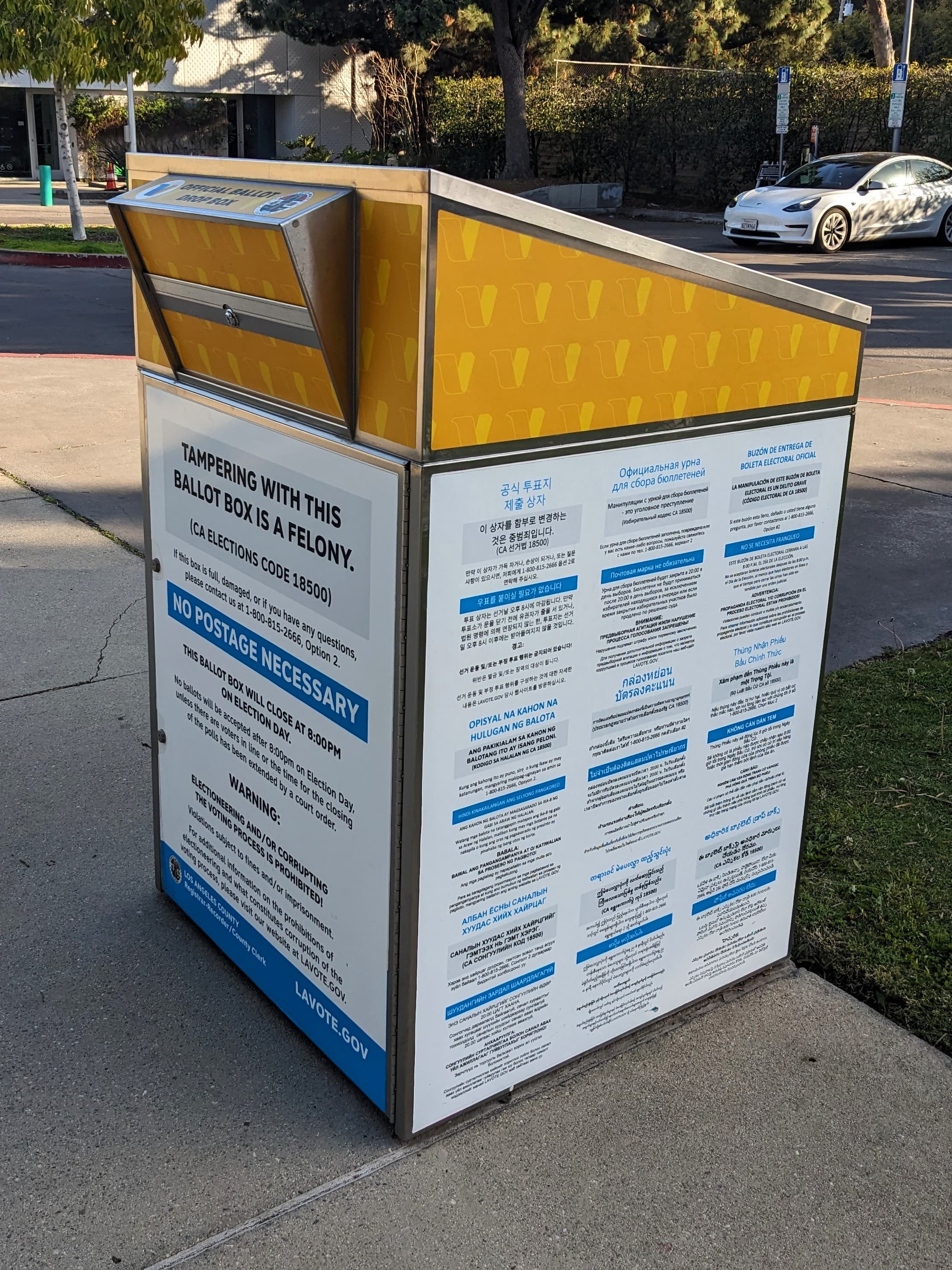
work_id: FR-NEWS-A-20261024-CALIFORNIA-BALLOTS-02 version: 1 type: news item_kind: NEWS_ANALYSIS status_cached: READY slug: california-doj-suspected-noncitizen-ballots-48-hours-2026 seo_title: California Ballots: Who Gains From the DOJ Ultimatum? meta_description: Federal prosecutors demand 48-hour citizenship checks for suspect California ballots. What is alleged, what is proven, and the risk to eligible voters. keywords_json: ["California Department of Justice election letters 2026","48 hour ballot segregation order","likely noncitizen voters California","Los Angeles county 20000 voter names","Bill Essayli prosecutors","2026 midterm election integrity","California Secretary of State Shirley Weber","voter roll data matching","US citizenship voting law","November 3 California mail ballots","federal state election authority","due process voting rights"] event_date: 2026-10-23 research_cutoff: 2026-10-24 word_count: 1276 source_count: 8 cover_image_url: cover_commons_file_page: cover_alt: Permanent locked ballot drop box outside a library in Los Angeles County, photographed in 2025 cover_author: Kelson Vibber cover_license: CC0 1.0 Universal public-domain dedication cover_context: Archival ballot box in Los Angeles County, not related to any ballot or voter in the federal allegation related_entities: People: Donald Trump; Bill Essayli; Shirley Weber; Rob Bonta. Organisations: US Department of Justice; California Secretary of State; Los Angeles County Registrar. Drivers: electoral integrity; voting rights; due process; federalism; data quality.
Full article
Cui bono verdict: a federal enforcement demand collides with voters' legal protections
PROVEN — cui bono: The Trump Justice Department gained a potent intervention point in California's election administration by sending October 23 letters demanding that counties identify potentially ineligible voters and set aside disputed mail ballots. State election administrators, meanwhile, now face an accelerated verification task and the prospect of litigation. STRONG INDICATION: the confrontation can benefit political actors who want the November election defined by fraud allegations, even though voting by noncitizens is illegal and documented cases are uncommon. HYPOTHESIS: the federal list identifies 20,000 unlawful voters or that the demands were designed solely to suppress legitimate ballots. Neither is proved. The public interest requires both accurate eligibility checks and timely counting of eligible citizens' votes. AP (opens in a new tab); CNN (opens in a new tab).
What happened on October 23
Associated Press (opens in a new tab) reports federal prosecutors sent letters to at least 18 California counties, requesting records and citizenship verification within 48 hours. The requests cover names the government believes may correspond to registered noncitizens, along with Social Security and identification information, registration records and instructions to isolate ballots whose eligibility cannot be established. The Los Angeles Times (opens in a new tab) independently reports county officials describing the instruction and associated criminal-liability warnings as intimidating or legally questionable.
First Assistant US Attorney Bill Essayli warned of potential criminal exposure for officials who knowingly process ineligible votes. That warning must be read precisely: knowledge and legal elements matter. A list generated by matching databases is an allegation-producing investigative tool, not a criminal verdict against every person named. The CNN account (opens in a new tab) says federal officials are seeking cooperation from county staff while a court case proceeds.
The underlying legal dispute over approximately 20,000 names
On October 15, the Department of Justice (opens in a new tab) sued California and cited records suggesting that more than 20,000 registrants might not be US citizens. The state's opposition disputes the reliability and context of that claim, according to AP (opens in a new tab) and the Guardian (opens in a new tab). Being flagged as likely ineligible is not the same as proving the individual is a noncitizen, registered unlawfully, received a ballot or voted.
The government separately announced criminal complaints against 28 lawful permanent residents (opens in a new tab) on October 19, alleging unlawful registrations or voting in particular cases. These are accusations to be tested in court, not final convictions. PROVEN: the complaints were filed. UNPROVEN: those complaints establish that the far larger flagged list contains the same offence rate. Extrapolating 28 cases to 20,000 people would be analytically unsound.
AP (opens in a new tab) says the government has sought urgent relief from a federal appeals court, while a district-court hearing is scheduled for Tuesday, October 27. No October 24 article should claim a final ruling or that all challenged ballots have already been excluded.
Federalism: who controls a US election?
Election laws set eligibility requirements, federal law prohibits voting in federal elections by noncitizens, and California administers registration, ballots and counting through state and county officials. The Secretary of State's election schedule (opens in a new tab) says mail ballots were issued starting October 5, early vote centres begin opening October 24 in specified counties, election day falls on November 3 and certification deadlines follow. The state's public voting guidance (opens in a new tab) emphasises county officials' role in determining valid ballots.
The Justice Department can investigate suspected federal crimes and litigate statutory questions. It does not automatically become the state’s election administrator merely by issuing an urgent prosecutorial letter. Conversely, states cannot disregard properly substantiated federal eligibility violations. Courts must resolve the actual conflict of powers and requested remedies.
The causal chain: algorithmic suspicion can become operational risk
The visible sequence is federal data matching → list of possibly ineligible names → legal complaint → prosecutor letters to counties → demands for verification and ballot segregation → emergency judicial and administrative decisions. Every step after the initial matching needs independently auditable safeguards. An eligibility flag may correctly detect a person without US citizenship; it may also capture naturalised citizens, outdated records or mismatched identities. Data quality is therefore a constitutional and practical issue, not merely a technical footnote.
If staff withhold a legitimate vote based solely on a flawed match, the cost is borne by that voter and potentially by public confidence in the result. If officials count a verified ineligible ballot, that also harms lawful participation. The defensible standard is individualized evidence, a lawful appeal or correction pathway, and public reporting of actual findings rather than assumptions about groups.
Beneficiary table: competing claims, asymmetric risks
| Actor | Possible advantage or burden | Evidence level |
|---|---|---|
| Federal prosecutors | Ability to press an immediate court and record-verification case | PROVEN |
| California county officials | Additional checks and exposure to conflicting legal demands | PROVEN |
| Political campaigns | Potential to shape public views of election fairness | HYPOTHESIS for electoral benefit |
| Ineligible registrants | Possible identification through accurate verification | STRONG INDICATION of investigatory purpose |
| Eligible voters incorrectly flagged | Delays or threatened loss of lawful ballot count | HYPOTHESIS for individual cases |
| US democratic institutions | Risk to confidence if facts or process are mishandled | STRONG INDICATION |
What it means to an ordinary voter
In California, election participation often starts with a ballot mailed to an existing voter. Official guidance (opens in a new tab) describes deadlines for voting, registration and returning ballots. A legitimate citizen wrongly matched to an out-of-date immigration record should have a realistic way to establish citizenship before the ballot is discarded. An immigrant lawfully resident but not naturalised cannot vote in federal elections. Those are individual legal statuses, not assumptions about ethnicity, origin, religion or language.
The cost of the confrontation falls on poll workers asked to act quickly, eligible voters worried their ballot may be sidelined, and taxpayers paying for litigation and extraordinary administration. County offices already have security and identity processes; the proper question is whether additional federal demands improve accuracy sufficiently to justify disruption this close to the election.
Strongest defence, strongest objection and future tests
The strongest federal argument is that even limited deliberate noncitizen voting violates law and undermines public trust, so authorities should seek evidence before certification. The strongest state argument is that unverified bulk matching and threats during active voting can delay or improperly exclude eligible ballots while courts have not approved the federal remedy. The Justice Department's complaint (opens in a new tab) and state-election guidance (opens in a new tab) establish the respective legal interests; neither substitutes for a case-specific judicial determination.
HYPOTHESIS: public concern about fraud may mobilise some voters or discourage others. HYPOTHESIS: an agreed verification protocol could improve both confidence and accuracy. Watch the October 27 hearing, county compliance decisions, error rates, actual proved ineligibility and remedies available to citizens. A healthy Western democracy must both prevent unlawful voting and resist treating accusations as the equivalent of proof.
FAQ and timeline
October 15: federal election-roll lawsuit. October 19: 28 people charged in separate cases. October 23: county letters sent. October 24: AP reports their scope (opens in a new tab); voting continues. November 3: election day.
FAQ — Are all 20,000 names confirmed unlawful voters? No. Did 28 prosecutions prove all remaining entries are invalid? No. Has a judge upheld a blanket ballot exclusion? Not established as of this reporting cutoff.
Sources
-
- Associated Press: DOJ demands 48-hour California ballot verification (opens in a new tab) — 2026-10-24; INDEPENDENT
-
- The Guardian: Federal prosecutors tell counties to set aside likely noncitizen ballots (opens in a new tab) — 2026-10-23; AP_SYNDICATION
-
- CNN via KESQ: Federal letter demands sequestering ballots (opens in a new tab) — 2026-10-24; INDEPENDENT
-
- Los Angeles Times: California counties challenge federal demands (opens in a new tab) — 2026-10-23; INDEPENDENT
-
- US Justice Department: October 15 federal lawsuit alleging likely noncitizen registrations (opens in a new tab) — 2026-10-15; PRIMARY_PROSECUTOR
-
- US Justice Department: October 19 charges against 28 permanent residents (opens in a new tab) — 2026-10-19; PRIMARY_PROSECUTOR
-
- California Secretary of State: Official election dates and voting procedures (opens in a new tab) — 2026-10-24; PRIMARY_ADMINISTRATION
-
- California Secretary of State: Mail voting, ballot tracking and state election authority (opens in a new tab) — 2026-10-24; PRIMARY_ADMINISTRATION
Rights and QA
Wikimedia Commons image and license details are stored above; covers are illustrative, not direct evidence of 2026 events. PROVEN means documented act, not guilt; STRONG INDICATION means evidence-based interpretation; HYPOTHESIS means unproven future or motive. Full legal and editorial review remains pending. No publication URL or internal entity ID is asserted.
Evidence
The sources this article cites, claim-bearing material first.
- justice.gov · justice.gov/usao-cdca/pr/united-states-sues-california-after-determining-more-20000-likely-noncitizens-are
- theguardian.com · theguardian.com/us-news/2026/oct/23/california-ballots-trump
- justice.gov · justice.gov/opa/pr/justice-department-charges-28-foreign-nationals-california-election-crimes
- sos.ca.gov · sos.ca.gov/elections/upcoming-elections/general-election-november-3-2026/key-dates-deadlines
- sos.ca.gov · sos.ca.gov/elections/voter-registration/vote-mail/usps-frequently-asked-questions-faqs