Poland's Rule-of-Law Veto: Who Gains From the Impasse?
By the Factrail desk · Method: how we source and score · Last reviewed
TL;DR
Nawrocki blocked Tusk's judicial-council reform and disputed tribunal oaths. Who controls Poland's courts, and what does the standoff cost citizens?
Article
VERDICT — PROVEN constitutional obstruction, contested legal legitimacy. President Karol Nawrocki vetoed Prime Minister Donald Tusk's judicial-council reform on 19 February 2026. On 15 October, he also refused to sign three other bills, including a measure concerning implementation of European Court of Human Rights judgments, while the sides clashed over oaths for judges of the Constitutional Tribunal. PROVEN: the vetoes and conflicting institutional acts. STRONG INDICATION: continued deadlock benefits political organizations that can mobilize around institutional conflict while prolonging uncertainty for citizens awaiting reliable court decisions. HYPOTHESIS: either camp can secure lasting control of judicial appointments merely through a disputed oath or executive statement. Poland's rule-of-law dispute matters to Europeans because courts must apply domestic and EU law impartially, including in disputes involving businesses, criminal defendants and EU citizens. President's office (opens in a new tab) | Prime Minister's office (opens in a new tab).
The February instrument: an actual veto, not a policy promise
Tusk's coalition sought to alter the selection of judicial members of the Krajowa Rada Sądownictwa (KRS), Poland's National Council of the Judiciary. Under the reforms introduced during the previous Law and Justice (PiS) era, parliament acquired a central role in choosing those members. Critics say the arrangement exposed appointments to party influence, weakening judicial independence. The government-backed bill passed parliament but Nawrocki refused his signature on 19 February, a formal presidential veto. The proposal therefore did not become law by ordinary promulgation. Veto notice (opens in a new tab) | Reuters (opens in a new tab).
Nawrocki argued that the proposed design would divide judges into favored and disfavored groups and risk institutional chaos. He simultaneously introduced his own draft law on restoring the right to a court and timely proceedings, emphasizing finality of judgments and legal protection for judges already appointed. This competing bill is a proposal, not an enacted settlement. A credible analysis must acknowledge the president's stated concern over legal certainty rather than assume disagreement proves bad faith. Presidential proposal (opens in a new tab).
The real veto arithmetic
Article 122(5) of the Polish Constitution permits the Sejm to override an ordinary presidential veto by a three-fifths majority with at least half the statutory membership present. That is a higher threshold than an ordinary government majority. When a divided parliament cannot muster the override, the president has an effective veto even though he does not draft cabinet policy. The president can also seek constitutional review before signature under distinct constitutional procedures. Neither route means Nawrocki can personally issue binding judicial decisions or replace parliamentary votes. Polish Constitution, Senate (opens in a new tab).
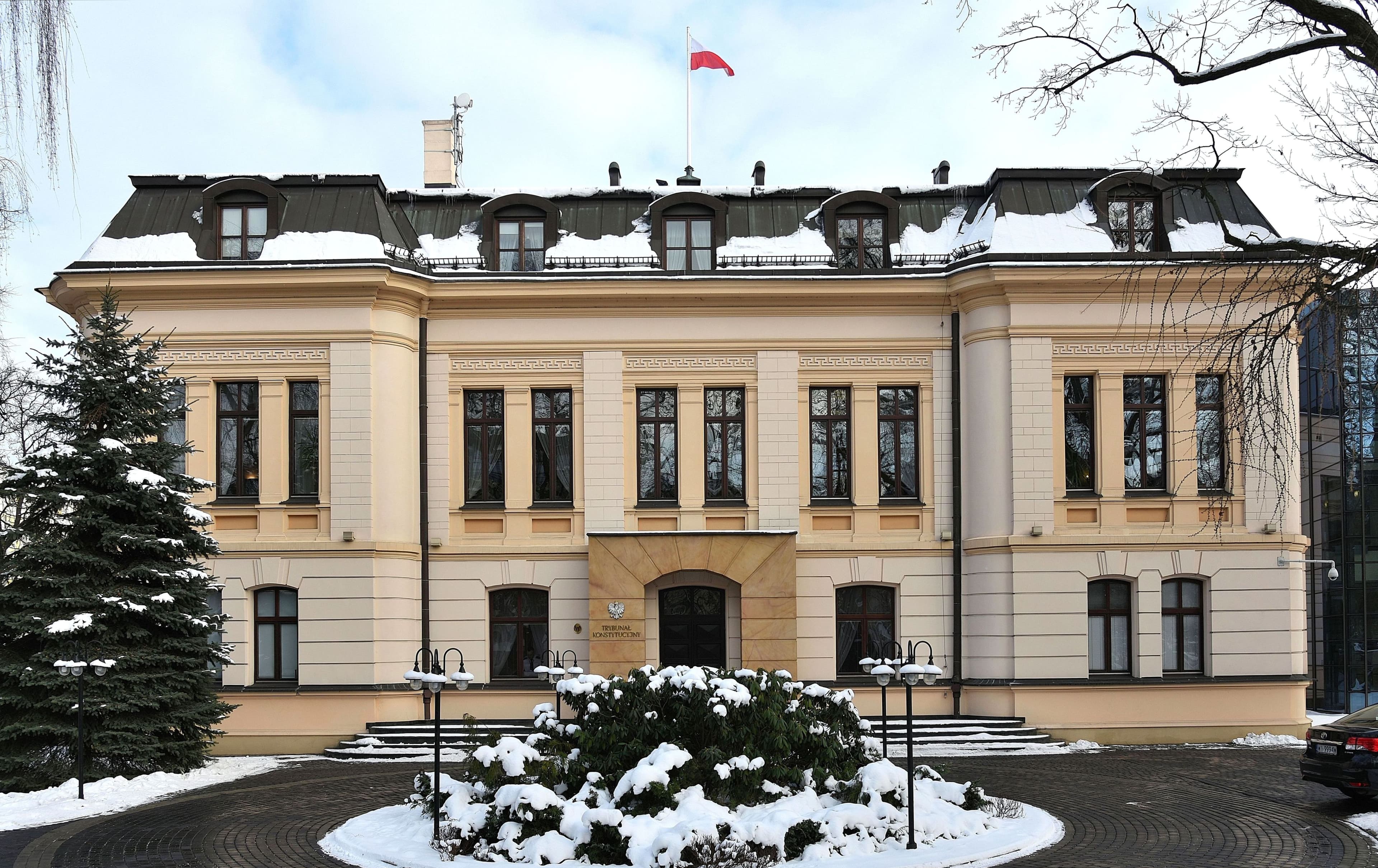
The standoff affects the KRS and the Constitutional Tribunal, but they are different institutions. The former helps shape judicial appointments; the latter reviews constitutional questions. Their disputes can interact because legislation, appointments and the validity of judicial decisions may be challenged, yet treating them as one body would obscure who holds which legal power.
The October turning point: oaths and rival legitimacy claims
On 14 October, Maciej Berek, elected by the Sejm to the Constitutional Tribunal, took an oath in parliament without Nawrocki attending. Supporters of this approach argue the president has failed to receive the oaths of properly elected judges; the presidential side contends constitutional procedures require the oath to be taken before the president, and disputes the attempted workaround. The tribunal's existing leadership did not automatically admit Berek to work simply because the parliamentary ceremony occurred. PROVEN: the oath was held and the institutional dispute continued. DISPUTED: whether that procedure lawfully completed the appointment. It would be inaccurate to describe either faction's interpretation as finally settled by a verified independent court judgment. Tusk statement (opens in a new tab) | Reporting (opens in a new tab).
Nawrocki's 15 October statement called for restoring depoliticized constitutional institutions and rejected suggestions that he would step aside. Tusk's 14 October statement insisted parliamentary selections were lawful and that his government would pursue available legal means to protect the court's work. Those are opposed political-legal positions, not two simultaneously verified final judgments. That differentiation protects readers against propaganda from either side. President | Government.
A further concrete action occurred on 15 October: the presidency listed three additional vetoes, covering amendments to the electoral code, political-advertising oversight, and implementation of European Court of Human Rights judgments. These are different bills with different rationales; the veto notice is evidence of decisions, not that the European Convention ceased applying in Poland. Presidential list (opens in a new tab).
What European courts established—and what they did not
The European Commission's 17 July 2026 Rule of Law Report describes steps made toward restoration as well as continuing problems: the KRS reform was vetoed and remedies for the status of judges appointed under contested arrangements remained under discussion. This is a documented assessment, not a statement that every Polish court has lost its legitimacy. Commission country chapter (opens in a new tab).
In a 24 March 2026 Grand Chamber judgment in C-521/21, the Court of Justice of the EU set out binding principles concerning independent tribunals, the KRS appointments process and scrutiny of judicial appointments where EU law applies. This establishes a meaningful legal standard beyond partisan slogans, but does not adjudicate whether Berek's particular October oath was valid. Inferences must respect the judgment's actual subject. CJEU judgment (opens in a new tab).
Money, access and public welfare
Poland's households need final, enforceable rulings on contracts, social security, family matters, property and criminal justice. Businesses financing Polish factories require predictable adjudication. HYPOTHESIS: unresolved appointments could increase litigation time, costs or legal risk in particular cases; that would require court-level case and duration data, not only political headlines. Access to EU programmes and cross-border recognition of decisions depend on institutional trust, but no specific funding suspension should be attributed to Nawrocki's October statements without a separate Commission decision.
The causal chain is government reform proposal → parliamentary passage → presidential veto → contested composition and continuity of judicial bodies → challenges to judgments or appointment legitimacy → possible delay, extra legal costs and weaker investor confidence. An alternative chain can operate where a rushed reform itself unsettles judgments previously treated as final. The policy problem is how to restore independence without arbitrary mass invalidation of lawful expectations.
Cui bono: beneficiary table
| Actor | Benefit or cost | Evidence level |
|---|---|---|
| Nawrocki and PiS-backed political camp | Retain a veto point and legitimacy argument | PROVEN |
| Tusk government | Can frame obstruction as reform's missing step; cannot unilaterally enact vetoed bills | STRONG INDICATION |
| Judicial associations | Gain influence in bargaining over selection rules | HYPOTHESIS |
| Citizens bringing court cases | Risk inconsistent procedures and longer disputes | HYPOTHESIS for measured impact |
| Polish businesses and EU partners | Need predictable cross-border judgments | STRONG INDICATION stake |
| European institutions | Retain EU-law review and monitoring authority | PROVEN |
| Any political force exploiting mistrust | May gain support from permanent confrontation | HYPOTHESIS |
Strongest counterargument and next tests
Nawrocki's most serious objection is that restoring independence must not delegitimize thousands of judges and past judgments without due process. Tusk's strongest case is that continuity cannot excuse a judicial appointment system that European institutions have found structurally deficient. Both concerns warrant a lawful solution. A government's electoral mandate does not exempt it from court scrutiny; a president's mandate does not confer authority to disregard binding EU rules.
Timeline: 19 February KRS veto and presidential alternative bill; 24 March EU court judgment; 17 July Commission report; 14 October Berek oath and government statement; 15 October presidential response and further vetoes. Watch the actual Sejm vote on any override, substantive amendments, independent court rulings on oaths, EU proceedings, court backlogs and published EU-funding decisions. HYPOTHESIS: one side will achieve a durable constitutional reset before the next election. On the record available, the proved outcome is unresolved institutional conflict; the defensible Western goal is judicial independence combined with predictable legal protection for every resident.
Sources
- Polish President's Office — Veto of KRS judicial council reform (2026-02-19) (opens in a new tab)
- Polish President's Office — President's alternative judiciary bill (2026-02-19) (opens in a new tab)
- European Commission — 2026 Rule of Law Report: Poland (2026-07-17) (opens in a new tab)
- CJEU — Case C-521/21 judgment, 24 March 2026 (2026-03-24) (opens in a new tab)
- Polish Prime Minister's Office — Tusk 14 October rule-of-law statement (2026-10-14) (opens in a new tab)
- Polish President's Office — Nawrocki's response on Constitutional Tribunal (2026-10-15) (opens in a new tab)
- Polish President's Office — Three October 15 vetoed bills including ECHR judgments (2026-10-15) (opens in a new tab)
- Polish Senate — Constitution Article 122 and three-fifths override (2026-10-24) (opens in a new tab)
- Notes from Poland — Constitutional Tribunal oath dispute (2026-10-14) (opens in a new tab)
- Reuters — Nawrocki vetoes judicial council reform (2026-02-19) (opens in a new tab)
Evidence
The sources this article cites, claim-bearing material first.