Who Controls TikTok US? Ownership Versus Real Power
By the Factrail desk · Method: how we source and score · Last reviewed
TL;DR
ByteDance's 19.9% stake is not the whole TikTok US story. Examine governance, algorithm access and the limits of what is publicly documented.
Article
Factrail investigation | United States, China, United Arab Emirates | Transaction completed 22 January 2026; company announcement dated 23 January | Research checked through 22 October 2026
SEO title: TikTok USDS Owners: Oracle, MGX, ByteDance and Control of the Algorithm
Meta description: TikTok's U.S. venture has Oracle, Silver Lake and Abu Dhabi's MGX at 15% each. The legal question is algorithm and data control—not just share ownership.
Verdict: the ownership cap was satisfied on paper; the operational boundary deserves a separate test
The U.S. TikTok deal did not simply move the platform from China to a group of American shareholders. The transaction completed in January 2026 created TikTok USDS Joint Venture LLC, with ByteDance retaining 19.9%, and Oracle, Silver Lake and Abu Dhabi-based MGX holding 15% each. The three managing investors therefore account for 45%, leaving 35.1 percentage points for the other announced investors. That ownership structure matters, but the governing U.S. statute reaches further: a “qualified divestiture” requires the president, through an interagency process, to determine that the U.S. operation is no longer foreign-adversary-controlled and that continuing operational relationships with its formerly affiliated foreign-adversary-controlled entities are precluded, including cooperation over a recommendation algorithm or data sharing. The president made the required determination in September 2025, ahead of the transaction's closing. The venture says it now secures and retrains the algorithm while retaining a globally interoperable platform, and contemporaneous reporting says it licenses the underlying algorithm from ByteDance. Those propositions create a precise compliance question, not proof of illegality or censorship: where does an arm's-length license end and an ongoing operational dependence begin? Public Law 118-50, Division H (opens in a new tab) · White House executive order (opens in a new tab) · Joint venture announcement (opens in a new tab).
First, reconstruct the timeline without rewriting the law as a presidential gift
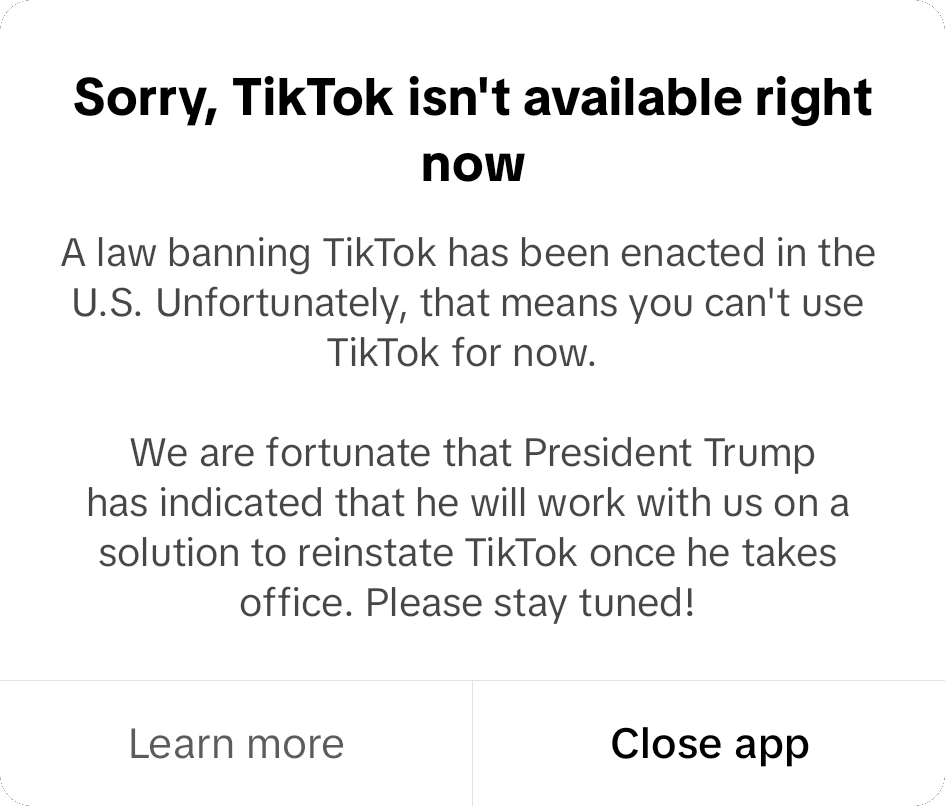
Congress enacted the Protecting Americans from Foreign Adversary Controlled Applications Act in April 2024, incorporated in Public Law 118-50, Division H (opens in a new tab). It threatened restrictions on distributing or maintaining TikTok in the U.S. unless a qualifying divestiture severed the legally defined foreign-adversary control. On 17 January 2025, the Supreme Court upheld the law against the TikTok challengers' First Amendment argument in TikTok Inc. v. Garland. The Court was testing a congressional law as applied to specific litigants. It did not examine, preapprove or independently audit the as-yet-uncompleted January 2026 ownership transaction. Supreme Court docket 24-656 (opens in a new tab) · Opinion (opens in a new tab).
On 25 September 2025, President Trump signed a determination (opens in a new tab) that the proposed framework qualified under the act. His order was a federal executive decision, not a judicial ruling on the final corporate documents. It set out goals for majority U.S. control, operation of the recommendation system and moderation by the new company, U.S. cloud storage and third-party monitoring. Its related White House fact sheet (opens in a new tab) asserted that ByteDance would remain below 20%, have only one seat of the seven-person board and be excluded from the security committee. The order also directed a 120-day non-enforcement interval so the divestiture could close. Such an enforcement delay should not be confused with changing the original text of the law.
The actual closing was reported on 22 January 2026; TikTok's formal public announcement appeared on 23 January (opens in a new tab), while MGX dated the announcement 22 January (opens in a new tab). That one-day date distinction is mundane but important to Factrail: announcement, corporate completion, executive determination, legal enactment and judicial constitutional review are different events. The narrative cannot present Trump's September approval as a post-closing audit or the Supreme Court's January 2025 decision as a judgment that the 2026 licensing terms were compliant.
The numbers: who owns what, and why the residual is not a rounding error
The official new-company announcement lists Silver Lake 15%, Oracle 15%, MGX 15% and ByteDance 19.9%. Subtracting those four stated stakes from 100% leaves 35.1% held by the additional investors named in the same release. The release names Dell Family Office, Vastmere Strategic Investments (associated with Susquehanna), Alpha Wave Partners, Revolution, Merritt Way (Dragoneer-related), Via Nova (General Atlantic-related), Virgo LI (a Milner family foundation investment arm) and NJJ Capital. It does not provide an audited cap table assigning exact percentages to each residual investor, nor does it value the total equity consideration. 15% ownership is not 15% of user data, and no investor's stake can be converted to a precise acquisition-price amount without a disclosed denominator. USDS company ownership statement (opens in a new tab).
The often repeated 80.1% non-ByteDance figure is simply 100% minus the retained ByteDance percentage; it does not mean that 80.1% of the venture is owned by U.S. citizens. MGX alone, at 15%, is headquartered in Abu Dhabi. Some other consortium members are international investors. “Majority American owned” is the firm's and White House's description; verifying the exact legal U.S.-person control numerator would require the definitive voting, equity and ultimate beneficial ownership schedules. On the public evidence, foreign versus Chinese control is not the same classification as American versus non-American capital.
The U.S. ownership narrative also obscures a second kind of power. Oracle supplies technology infrastructure, compliance monitoring and a board representative. It can be influential as a security contractor even if its voting stake is 15%, because operating the cloud environment and evaluating a proprietary system involve technical access unavailable to other investors. Silver Lake has financial and board influence as a managing investor. MGX brings capital and representation from a firm with unusually close ties to another state's leadership. But the identities alone do not show the three acted as a bloc, ordered changes in political recommendations or exercised unreported control over the platform. The claim must follow actual board resolutions, contractual vetoes, code access, operational policies and compliance audit records.
The MGX relationship: foreign capital does not end with ByteDance
There is a defensible political-power question within the investor list. MGX is an Abu Dhabi technology investment firm formed with Mubadala and G42 as founding partners, under the emirate's Artificial Intelligence and Advanced Technology Council. According to MGX's own formation account (opens in a new tab) and board disclosure (opens in a new tab), its chairman is Sheikh Tahnoon bin Zayed Al Nahyan, the UAE's national security adviser and deputy ruler of Abu Dhabi. The public firm biographies describe his positions and strategic ambitions; these are direct organizational statements, not a forensic finding about his involvement in individual TikTok decisions. Mubadala's original announcement (opens in a new tab) identifies its state-linked founding context.
MGX's TikTok statement (opens in a new tab) confirms the shared-company framework. The joint venture's seven-member board includes David Scott, described as MGX's chief strategy and safety officer. A non-American investor with a national-security-linked leadership structure having a seat in a U.S. social-network company is clearly a matter of public interest. It is not evidence that the UAE government is secretly receiving U.S. user data or commanding content moderation. The statutory divestiture measure principally addressed entities controlled by a specified foreign adversary, not a generalized rule disqualifying every foreign shareholder. Conflating these categories would misstate the law.
Why might MGX rationally participate? The platform is a major source of digital engagement, advertising and technology exposure, while MGX describes a global investment strategy in AI and related infrastructure. Those are publicly understandable financial motivations. The company could also benefit from access to an influential network of technology partners. But a board seat does not independently demonstrate that national security officials can send moderation instructions or collect data. That would require an attributable policy communication, operational instruction or access record. This investigation records the capacity for governance influence without manufacturing an instance of abuse.
The statutory stress test: a minority share is only the beginning
The text of the 2024 law defines a “qualified divestiture” in two parts. One is no foreign-adversary control as determined by the president through an interagency process. The other requires an absence of continuing operational relationships between the American operation and formerly affiliated foreign-adversary-controlled entities, with the statute expressly mentioning cooperation on content recommendation algorithms and data sharing. The distinction is not academic. A company can meet a share-ownership threshold yet depend materially on a former parent for a recommendation model, product engineering or international commercial interfaces. Conversely, a company can purchase or license an asset without ceding its day-to-day operation to the seller. The actual license and service schedules decide which description fits. Divestiture definition in Public Law 118-50 (opens in a new tab).
The USDS company says its U.S. entity will retrain, test and update the content recommendation algorithm on American user data and that the algorithm will be secured in Oracle's U.S. cloud. It also says the global user experience remains interoperable. Independent reporting (opens in a new tab), drawing from deal announcements and sources, reported that the venture licenses the algorithm from ByteDance. Reuters' account of the closing (opens in a new tab) stressed that the deal left business relationships between ByteDance and the new venture incompletely disclosed. These are not proofs that legal separation failed. They are an obvious legal-contract and technical-access question requiring the exact documents.
There are at least three different operational scenarios. In one, ByteDance permanently transfers or grants a static license to the code while the U.S. venture independently trains, hosts, modifies and audits it, without ongoing algorithm cooperation or sensitive-data transfers. In a second, ByteDance supplies continuing model changes or technical support but remains excluded from U.S. end-user data. In a third, a continuing dependency allows the former parent's staff or systems to influence recommendations or share protected information. The public texts distinguish those scenarios poorly. Some forms might be lawful and consistent with the presidential determination; others could raise the concern Congress sought to prevent. The reporter cannot label the actual system Scenario Two or Three without configuration records, interfaces, contracts or independent tests. The relevant journalistic advance is identifying exactly what must be proven, not claiming a violation on the basis of the word “license.”
The Supreme Court's judgment adds a vital boundary. In *TikTok Inc. v. Garland* (opens in a new tab), the Court upheld the law's application in a specific constitutional challenge and described national-security risk in the prior ownership structure. Its judgment did not settle the future commercial interpretation of every permitted software license or audit arrangement. Likewise, the president's formal determination does not establish that all expected controls will perform as designed in practice. Legal sufficiency, contractual performance and security efficacy are different claims, each requiring its own evidence.
Two businesses may operate inside a seemingly single app
A central disclosure in the joint venture's January statement (opens in a new tab) is that TikTok global's U.S. entities would continue to manage certain commercial activities, including e-commerce, advertising and marketing, while USDS controlled U.S. user data, algorithm security, platform security and trust-and-safety policy. Reuters' January report also described an apparent backend/front-office split: the new venture would provide technical and data services, while ByteDance-related commercial operations could continue to handle revenue-generating activity. Reporting itself cautioned that the complete business relationships had not been disclosed. Reuters closing report (opens in a new tab).
That separation creates more than an accounting curiosity. A commercial company may control advertiser relationships, pricing, user acquisition and campaign sales, while another entity controls moderation and ranking. Neither alone necessarily controls the whole user experience. The boundary matters most when commercial incentives intersect with political speech: advertisements, issue-based paid persuasion, creator monetization and the reach of controversial videos. The record does not show that ByteDance-directed commercial operations dictated any particular USDS moderation decision. It shows enough organizational separation to demand clarity about who has veto rights over ads, creator accounts, data flows, monetization rules and model configurations.
Imagine a legitimate advertising dispute. Who decides whether an advertiser's political message is accepted? Who holds the contract with the advertiser? Who can appeal a moderation restriction? Who controls the algorithmic reach of an otherwise permitted advertisement? These are four possibly different powers: commercial acceptance, payment and contracting, policy enforcement, and distribution/ranking. A majority-American board and a secure data center do not by themselves prove that the same party controls all four. Conversely, a residual ByteDance revenue relationship does not prove it can override U.S. trust-and-safety policy. The published agreements and real-world escalation process—not a single ownership pie chart—would settle the distinction.
Oracle: when the compliance monitor is also an owner
The USDS public announcement calls Oracle the venture's trusted security partner. Oracle provides the U.S. cloud environment for protected user data and is tasked with assisting ongoing source-code validation and security operations. Simultaneously, Oracle has a 15% equity stake and a board seat held by Kenneth Glueck, a senior corporate affairs and strategy executive. The board also includes Raul Fernandez, named as chairman of the security committee, and David Scott of MGX, identified as another security-committee member. USDS governance disclosure (opens in a new tab).
This dual role is neither inherently corrupt nor unusual in technology projects where a strategic investor supplies essential infrastructure. It does create a governance question: who independently verifies a security partner's own work? The company promises third-party auditing, certifications and recognized frameworks including NIST and ISO 27001. A promise to audit is not a released audit opinion, and a certification's meaning depends on its actual scope, date, exceptions and testing methodology. If Oracle is paid to operate security infrastructure, the report should differentiate revenue from service fees, ownership returns and regulatory responsibilities—no dollar values for those categories are provided in the announcement.
Conflating technological capability with editorial manipulation would also be an error. Oracle's cloud access could support legitimate and independently audited security functions. The 15% stake does not prove Oracle or its founders selected or demoted political content. But because news feeds help shape civic visibility, technical control over recommendation and moderation changes is consequential enough that transparent institutional safeguards are warranted. The Factrail Electoral Integrity and Competitiveness driver (opens in a new tab) provides the relevant public-welfare question: whether voters and political movements have fair, transparent access to political information. No actual effect on an election or quantified voter belief has been established by these deal documents.
The status of Larry Ellison, Oracle's co-founder and a prominent Trump ally, has prompted concern in coverage. ABC's deal analysis noted his political relationship and broader media interests. These facts help explain why the transaction attracts scrutiny; they do not demonstrate that the administration conveyed a specific improper benefit to Oracle or that Ellison has an exclusive content-veto power. Political proximity is weaker evidence than signed decision rights, contract awards, audit results and documented instructions. ABC News, 22 January 2026 (opens in a new tab).
The seven-member board is not a proxy for seven separate sovereignties
The new venture names Shou Chew, Timothy Dattels, Mark Dooley, Egon Durban, Raul Fernandez, Kenneth Glueck and David Scott as its initial board. The company identifies Adam Presser as the venture's new chief executive and Will Farrell as chief security officer. Management appointments provide executive authority; directors ordinarily provide oversight and company-level governance. They are related but not interchangeable. A person being on a board cannot by itself be treated as proof of what that person voted to do. TikTok USDS organizational declaration (opens in a new tab).
A useful influence map distinguishes equity investors from management, security operators, commercial counterparties and state regulatory authorities:
U.S. Congress → 2024 divestiture law → presidential interagency determination → January 2026 corporate restructuring.
Oracle / Silver Lake / MGX / other consortium investors + ByteDance minority equity → USDS governance and board representation → CEO and security committee.
Oracle security infrastructure → data hosting, software assurance and audit interfaces; USDS management → stated moderation and U.S. algorithm operation.
ByteDance and TikTok global entities → retained equity, algorithm intellectual-property relationship and disclosed cross-border interoperability/commercial services.
The first line represents public legal power, the middle two corporate governance and operating power, and the last an ongoing commercial and technical relationship whose exact contract is not publicly reconstructed here. None of these lines is a statement that the Chinese or Emirati government ordered a U.S. editorial outcome. The evidence establishes capacities and structural dependencies, while leaving specific abuses unproven.
The strongest justification for the deal must be considered
A TikTok ban or prolonged legal uncertainty would have imposed tangible costs on creators, advertisers, small businesses and audiences who rely on the service. TikTok says the venture supports more than 200 million Americans and 7.5 million businesses; those are company figures from January 2026, not independently audited current active-user or revenue counts. The presidential administration said its structure preserved a popular platform while placing data, moderation and algorithm security under U.S. control and subjected it to independent audit. Supporters could reasonably see a workable compromise between national-security risk and speech, continuity and economic opportunity. White House September 2025 fact sheet (opens in a new tab) · TikTok USDS January 2026 declaration (opens in a new tab).
This defense has substance. Multiple new investors can diversify ownership; a dedicated U.S. cloud environment can be audited; local executives can have clearer accountability; continuing international distribution protects creators against geographic fragmentation. Independent certification, if actually performed and disclosed, could be more meaningful than opaque political assertions about software security. Nothing in the record inspected here establishes that the newly structured venture has leaked data, manipulated an election, silenced a political group on government instructions or failed a third-party audit.
The strongest counterargument is narrower and better grounded than the conspiracy theory. The same arrangement can be commercially workable and still need closer scrutiny of its contractual boundaries. A foreign-adversary-control remedy rests on the president's statutory determination, and the law specifically demands separation of certain operational relationships. Assertions in press releases about independent control cannot substitute for independently inspectable information on intellectual-property licenses, model-update permissioning, access logs and group-level commercial governance. The existence of a contractual link is not automatically a prohibited operating link; without the underlying records, the line cannot be tested.
What the numbers cannot tell us about democracy, national security or profit
There is no published consideration amount in the joint venture's announcement from which to compute each investor's dollar investment. The 15% stakes are not revenue shares, the 19.9% ByteDance stake is not evidence of 19.9% control of the algorithm, and the more-than-200-million U.S.-user claim is not a measurement of political persuasion. Similarly, the board's seven names are not seven independently confirmed veto rights. The analyst should decline false precision. Market reactions to the announcement, even where separately recorded, would reflect investors' expectations rather than a demonstrated public-welfare improvement.
Potential measured outcomes require distinct datasets. Data protection needs tested exfiltration controls and incident counts. Algorithm independence needs model provenance, update logs and authorized personnel lists. Editorial autonomy needs governance rules, moderation escalation audits and systematic sampling of comparable content. Economic welfare needs verified employment, creator receipts and business continuity. Political fairness needs transparent platform reach statistics, methodologically controlled comparisons and independently established actor-to-decision links. The public deal summaries alone provide none of those causal outcome series. A public Factrail rating or influence weight cannot be responsibly derived from the ownership table.
Political regulation also has a distributional effect: companies allowed to build the substitute governance structure can acquire durable market access, while excluded bidders or alternative technical suppliers cannot. That is not proof the process was corrupt. To test the procurement and favoritism hypothesis one would need the bidding record, valuation, government screening criteria and conditions offered to other candidates. The law's security objectives may have favored an existing infrastructure provider such as Oracle for genuine technical reasons. The available record establishes an important market outcome and named beneficiaries; it does not establish that the choice breached a rule or damaged consumer choice.
Original finding: the law tests operational independence, not the nationality of an ownership pie
The most consequential documentary discrepancy in the public debate is between what can be counted and what must be established. The company can count equity stakes and directors. The law requires an interagency determination that foreign-adversary control and specified post-divestiture operational cooperation have been eliminated. The venture describes an algorithm re-trained inside Oracle's U.S. environment while remaining globally interoperable. Independent reporting describes a licensing relationship with ByteDance and ongoing commercial activities managed by TikTok global entities. These statements are not logically impossible together, but they demand specific separation and assurance arrangements.
This distinction also changes whom journalists should interview. Rather than merely asking whether the venture is “American,” ask the USDS security committee who can authorize model changes, ask Oracle's independent auditors what they actually tested, ask the corporate lawyers what the ByteDance license permits, ask the regulatory process what evidence supported the qualified-divestiture determination and ask the global company which cross-border services access information or moderation signals. Only then can the public compare the security promises with the limits Congress wrote. Accountability becomes a method of proof, not a rhetorical label.
The U.S. government's determination is a meaningful documented approval. The closing is a meaningful documented corporate event. But the available public transaction descriptions do not establish complete ex-post technical compliance for every recommendation update and data flow. Nor do they prove the opposite. The January 2026 TikTok settlement answered who was allowed to own the company. Its harder remaining question is who controls the system—and who independently checks the answer.
The next records Factrail would request
First, the operative algorithm licensing and support agreement between ByteDance or its affiliates and the U.S. venture, with redactions for trade secrets but disclosure of update control, access rights and termination clauses. Second, the independent security-assurance audit's scope, opinion date and unresolved exceptions, distinguishing whether Oracle audited itself or external assessors verified Oracle's performance. Third, the voting and governance agreement, including material vetoes, committee powers and related-party approval thresholds for Oracle, Silver Lake, MGX, other shareholders and ByteDance. Fourth, the actual intercompany services and data-flow inventory for advertising, marketing, e-commerce, recommendation metadata and international interoperability. Finally, the public interagency criteria and factual basis for the president's statutory determination, to the extent disclosure can be reconciled with genuine national-security requirements.
A verified record of self-contained algorithm retraining, no prohibited operational cooperation and independent audit would reinforce the government's case and undercut suspicions of hidden control. Evidence of unauthorized privileged access or politically directed recommendation changes would require a different and more serious investigation; this article reports no such discovery.
Claim ledger and primary-source map
| Proposition | Source | Evidence boundary |
|---|---|---|
| The 2024 law requires no foreign-adversary control and no specified continuing operational relationship | PL 118-50, Div H (opens in a new tab) | Does not independently adjudicate the 2026 licensing contract |
| Supreme Court upheld statute as applied, 17 Jan 2025 | Supreme Court docket and opinion (opens in a new tab) | Did not approve or test later January 2026 deal terms |
| President determined proposed divestiture qualified, 25 Sep 2025 | White House original executive order (opens in a new tab) | Executive determination, not an independent ongoing technical certification |
| Closing Jan 22, announcement Jan 23, ByteDance 19.9%, three 15% managing investors | TikTok USDS company announcement (opens in a new tab) and MGX account (opens in a new tab) | Not an audited voting-rights and price schedule |
| MGX's leadership includes UAE national-security adviser Sheikh Tahnoon; founding partners Mubadala/G42 | MGX board (opens in a new tab) and Mubadala origin declaration (opens in a new tab) | Does not prove foreign-state editorial instructions |
| Reuters and Axios describe algorithm licensing and continuing commercial arrangements with ByteDance entities | Reuters full closing report (opens in a new tab) and Axios (opens in a new tab) | Some transaction details undisclosed; no observed breach |
Editorial method: count separately equity, board membership, service-provider access, algorithm rights, commercial operations and state regulatory decisions; cite original law and governmental decision rather than partisan shorthand. Distinguish actual transaction closing from press release and earlier executive finding. Research compares company-controlled self-disclosure with U.S. statutory text and independent accounts. The link between any named shareholder and a named political content decision is unproven. No fabricated election outcomes, surveillance incidents, contract valuation, market profit or Factrail score have been assigned. Factrail Rule of Law (opens in a new tab) is a second relevant context driver, not an automatically approved graph relationship.
Independent publication requirements: inspect full signed license or at least redacted contractual summaries, actual audit findings, ownership and investor voting schedule, updated company governance in October 2026, all direct Factrail link targets and source access; complete independent editorial/legal review and importer dry-run before public publishing.
Sources
- www.govinfo.gov — source 1 (opens in a new tab)
- www.whitehouse.gov — source 2 (opens in a new tab)
- newsroom.tiktok.com — source 3 (opens in a new tab)
- www.supremecourt.gov — source 4 (opens in a new tab)
- supreme.justia.com — source 5 (opens in a new tab)
- www.whitehouse.gov — source 6 (opens in a new tab)
- www.mgx.ae — source 7 (opens in a new tab)
- www.mgx.ae — source 8 (opens in a new tab)
- www.mgx.ae — source 9 (opens in a new tab)
- www.mubadala.com — source 10 (opens in a new tab)
- www.axios.com — source 11 (opens in a new tab)
- www.investing.com — source 12 (opens in a new tab)
- abcnews.com — source 13 (opens in a new tab)
Evidence
The sources this article cites, claim-bearing material first.
- govinfo.gov · govinfo.gov/content/pkg/PLAW-118publ50/html/PLAW-118publ50.htm
- whitehouse.gov · whitehouse.gov/presidential-actions/2025/09/saving-tiktok-while-protecting-national-security
- Supreme Court of the United States · Docket 24-656 · 17 Jan 2025
- whitehouse.gov · whitehouse.gov/fact-sheets/2025/09/fact-sheet-president-donald-j-trump-saves-tiktok-while-protecting-national-security