Trump's Infrastructure Review Listed $17.8bn in Canceled Awards. The record Does Not Mean His Agencies Canceled It All.
By the Factrail desk · Method: how we source and score · Last reviewed
TL;DR
A July 22, 2026 federal audit found that four U.S. agencies reported canceling 796 infrastructure and climate awards worth $17.8 billion while leaving 2,528 awards worth $33.6 billion unresolved in snapshots taken on different dates. Those figures do not mean President Donald Trump personally canceled every award or that $33.6 billion remained frozen in November.
Key graph impact
The article explains graph entities; the causal edges belong to the facts and drivers it links to.
- ArticleTrump's Infrastructure Review Listed $17.8bn in Canceled Awards. The record Does Not Mean His Agencies Canceled It All.
- mentionsDriverEnergy Security
- strengthensIndicators (4)Poverty headcount ratio at $3.00 a day (2021 PPP) (% of population)
- ArticleTrump's Infrastructure Review Listed $17.8bn in Canceled Awards. The record Does Not Mean His Agencies Canceled It All.
- mentionsDriverFiscal-Policy Sustainability
Strengthens · 62% impact strength
Observed
10.4% · 10.2 above the normal line (2024)
Worse than normal7 readings, 2018–2024: fell from 11.1% to 10.4%.
Above normal = worse
Weakens · 60% impact strength
Observed
7.97% of population aged 16 years or over · 5.2 above the normal line (2025)
Worse than normal8 readings, 2018–2025: rose from 7.77% of population aged 16 years or over to 7.97% of population aged 16 years or over.
Above normal = worse · Lag ~3 mo
Strengthens · 50% impact strength
Observed
91.6% of population · 8.4 below the normal line (2023)
Worse than normal4 readings, 2020–2023: rose from 90.4% of population to 91.6% of population.
Above normal = better
Weakens · 48% impact strength
Observed
80 Years · 2.3 below the normal line (2023)
Worse than normal6 readings, 2018–2023: rose from 79.5 Years to 80 Years.
Above normal = better
Article
Factrail investigation | United States | Documentary event: July 22, 2026 | Research updated November 2, 2026
The finding: a cancellation total is not a presidential invoice
A July 22, 2026 federal audit found that four U.S. agencies reported canceling 796 infrastructure and climate awards worth $17.8 billion while leaving 2,528 awards worth $33.6 billion unresolved in snapshots taken on different dates. Those figures do not mean President Donald Trump personally canceled every award or that $33.6 billion remained frozen in November. Congress rescinded some funding; some recipients withdrew; other grants were halted by agency leaders. Nearly $20 billion of the unresolved total consisted of already-obligated EPA climate grants trapped in a separate legal dispute. The accountability question is not merely how much the administration announced it had reviewed, but which legal actor actually changed each award, what money could still move, and whether communities ever received the promised infrastructure.
The central evidence is the Government Accountability Office's July 22 funding-status audit (opens in a new tab), which follows the Infrastructure Investment and Jobs Act (IIJA) and Inflation Reduction Act (IRA) across the Environmental Protection Agency (EPA), Department of the Interior, National Telecommunications and Information Administration (NTIA), and Department of Transportation (DOT). It is not a government-wide tally. It does not include the separate Energy and Agriculture reviews, and it is not a real-time accounting of projects as of this article's date.
The audit's Table 2 is a useful test of political language because it contains four different outcomes: awards approved without changes, awards approved with modifications, awards canceled, and awards still awaiting a final decision. The figures are not interchangeable with appropriations, cash payments or permanent savings. They also do not identify the same person as decision-maker in every case. A presidential order established the policy direction; Congress retained its power to amend funding statutes; agency leadership made individual administrative choices; and recipients could abandon awards for their own reasons.
Our additional finding comes from reconstructing that decision path against the audit's footnotes, an earlier GAO review of transportation grant delays, the actual executive order, and later agency and court records. The widely repeated $17.8 billion figure includes actions that cannot responsibly be attributed to a single White House cancellation decision. Equally, describing all $33.6 billion as money that remained indefinitely blocked would erase documented later approvals and court interventions.
The order, the clarification, and the second review
On January 20, 2025, Trump signed Executive Order 14154, Unleashing American Energy (opens in a new tab). Section 7 instructed agencies to pause disbursement of funds appropriated under the IIJA and IRA and review relevant programs for alignment with the administration's energy policy. That created an executive gate on spending, but did not itself repeal the statutes enacted by Congress.
On January 21, acting Office of Management and Budget director Matthew Vaeth and National Economic Council director Kevin Hassett issued OMB memorandum M-25-11 (opens in a new tab). The memorandum narrowed the interpretation of the pause to projects implicated by the order's policy objectives, rather than a blanket halt to every bridge, road or water project. Reuters reported the clarification on January 22 (opens in a new tab). This matters because even within the administration's own instructions, an appropriation under one of the two laws was not by itself proof that a particular project should stop.
A second order, Executive Order 14222 of February 26, 2025 (opens in a new tab), told agency heads to review covered grants and contracts in consultation with agency DOGE teams and, where lawful and appropriate, modify or terminate them. It did not give a DOGE team member a universal personal veto over every grant. GAO found that agencies built different internal screening systems, sometimes using words associated with environmental justice or equity as initial flags, then sending recommendations to senior leaders.
The next decisive legal event was not an executive memorandum. Congress enacted Public Law 119-21 on July 4, 2025 (opens in a new tab), rescinding some unobligated IRA funds. Those statutory rescissions must be recorded as congressional action, even when the president signed the legislation and advocated the policy. A valid account of responsibility distinguishes the president's political initiative, the votes that made a statute, an agency's discretionary termination, and a recipient's decision to walk away.
Three money records—and the trap in adding them together
The first record is budget authority. GAO calculated about $628.4 billion made available to the four agencies under the IIJA and IRA for all or part of fiscal years 2022 through 2025. That is authority to incur obligations, not proof of a corresponding cash transfer. The IIJA portion was approximately $574.7 billion; agencies had obligated about 76% and disbursed about 54% of obligated funds. For roughly $53.7 billion in IRA funds, the three applicable agencies had obligated about 72% and disbursed about 60% of obligations. The audit also recorded $6.4 billion in IRA unobligated funds rescinded by Congress in July 2025. The periods and denominators matter.
The second record is the review queue. Table 2 counted 12,977 awards representing $182.1 billion under review across four different agency reporting dates. Of these, 8,739 awards worth $122.8 billion were approved unchanged, 845 worth $5.5 billion were approved with modifications, 796 worth $17.8 billion were canceled, and 2,528 worth $33.6 billion were pending. These numbers add to the reported dollar total after rounding, but the statuses do not all describe the same legal action. Interior's method counted approval of obligations and disbursements, not simply grants selected in a conventional competition. The apparent precision of a cross-agency ranking therefore exceeds the underlying comparability.
The third record is realized payment and performance. A grant announced to a city may not be legally obligated until a signed agreement; an obligated grant may not yet have paid for construction; and a program canceled by an agency may later be restored by a court. The GAO's separate July 2025 transportation review (opens in a new tab) explains the gap between grant selection, signed agreement, obligation and outlay. An award canceled before agreement cannot automatically be described as cash taken back from a town. Conversely, an existing legal obligation cannot be treated as unspent discretionary money that an administrator can simply erase.
For a simple original check on the pending headline, $20.0 billion of the $33.6 billion was eight EPA National Clean Investment Fund and Clean Communities Investment Accelerator grants. That is approximately 59.5% of the pending dollar amount, not 59.5% of the number of pending awards. It leaves about $13.6 billion in the other pending categories in those historical snapshots. GAO reported the EPA grants were fully obligated and their undisbursed funds remained frozen at the program's financial agent amid litigation. This is a different question from whether an unexecuted DOT grant agreement would be signed.
EPA: one agency, two legal battles, two kinds of missing money
EPA Administrator Lee Zeldin announced the termination of the approximately $20 billion National Clean Investment Fund and Clean Communities Investment Accelerator grants in March 2025. EPA's own announcement (opens in a new tab) cited program-integrity and fraud concerns. Those were agency allegations, not a finding that every recipient committed fraud. The July 2026 GAO report says the grants remained fully obligated in the agency's data while their funds were unavailable through the financial agent. The audit's $20 billion pending category thus records a contested legal and payment status, not a normal pipeline of yet-to-be-selected projects.
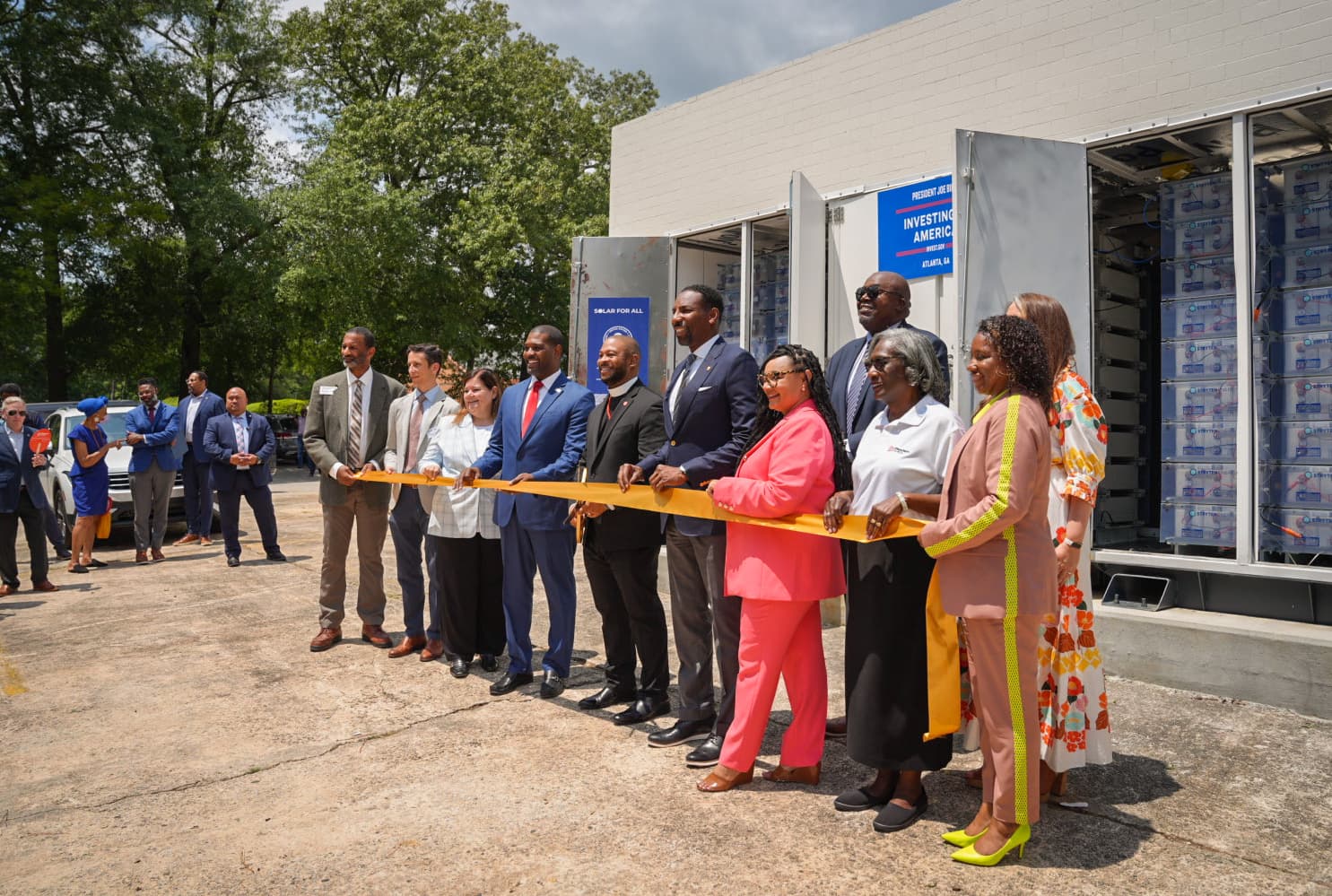
EPA separately canceled 372 IRA awards totaling about $9.2 billion in its review, of which $7 billion related to Solar for All. The intended recipients of Solar for All included state entities, tribes and nonprofit organizations serving lower-income households. Reuters' August 7, 2025 report (opens in a new tab) identified Groundswell, a nonprofit with a reported $156 million award intended to support solar access for more than 17,000 households across eight Southern states. That was a promised program allocation, not proof that Groundswell received or spent $156 million.
The legal stage subsequently changed. On September 18, 2026, a Rhode Island federal judge ruled that EPA's termination of Solar for All was unlawful and vacated it, according to the Associated Press' report on the ruling (opens in a new tab). EPA said it was reviewing the decision and considering an appeal. This article has not independently established the status of any later appeal, payment order or restored household installation. It would be false to present the 2025 cancellation as an uncontested final legal outcome in November 2026. The $20 billion financial-agent litigation and the $7 billion Solar for All case are related by the umbrella fund, but they are not the same court decision.
The potential beneficiary mechanism is concrete but conditional: if legally funded solar or efficiency programs proceed, named grantees and participating households may receive grants, services and lower energy bills; if canceled and upheld, that route disappears and the government may reallocate lawful remaining funds where authorized. No record examined here shows a political official personally receiving the money. Whether the alternative spending would create greater public value requires comparable project-level costs and measured results, not a partisan slogan.
Transportation: the most important cancellation footnote
DOT's table is the clearest reason not to equate the entire $17.8 billion with presidential agency cuts. The department reported $7.2 billion across 248 canceled awards in its September 30, 2025 snapshot. But GAO's footnote says 178 of those awards, totaling approximately $3.8 billion, were canceled by recipients or affected by statutory rescissions. DOT itself terminated or withdrew 70 awards totaling approximately $3.4 billion. The $3.8 billion category cannot be counted as 70 more discretionary terminations by Secretary Sean Duffy.
That split is not an exoneration of the administration's review policy. The review itself was real. GAO describes a DOT task force comprising operating-administration and secretary's-office leadership, including the deputy secretary, which made recommendations to the Secretary of Transportation for final decisions. DOT examined 3,879 mostly unobligated discretionary awards worth $60.5 billion across 94 programs. As of September 30, 2025, it had approved 3,111 awards, canceled 248 and left 520 undecided. The question is what the task force changed and whether its decisions complied with each program's statute.
Another DOT process reviewed already-obligated grants under Executive Order 14222. GAO says offices identified 2,231 awards for leadership review, but officials told auditors in April 2026 that all of these identified awards ultimately continued without changes. That is substantial counterevidence against an account in which every flagged grant was canceled. It also shows how searching for disfavored terminology could produce false alarms: DOT officials said some words were required by statutes or appeared in unrelated contexts. Screening a project is not the same as rejecting it.
The pending number also aged. DOT had reported $11.1 billion across 520 awards still awaiting decisions as of September 30, 2025. By April 24, 2026, officials told GAO that another 228 projects worth $139 million had been approved and three projects worth $31 million withdrawn, with 293 awards still under review. It would be an arithmetic error to subtract $139 million from $11.1 billion and call the remainder the April backlog: the updated 293-award dollar value was not provided in that passage, and status categories could have changed through other mechanisms.
DOT's strongest defense is also documented: its officials said the reviews had not delayed obligation or disbursement because grant agreements can take years even without a political review. The earlier GAO study (opens in a new tab) nevertheless found pre-existing problems with inflation, environmental review, project scope and agreements, and recommended a department-wide risk assessment. That earlier weakness means a late agreement alone cannot prove Trump caused the delay; it also means an added review could aggravate risks unless its incremental effect is measured. The right test compares comparable projects' agreement dates and milestones, not anecdotes selected for political convenience.
Commerce and Interior: the same headline conceals different authority
At Commerce, Secretary Howard Lutnick publicly defended changing the Broadband Equity, Access, and Deployment (BEAD) program to remove requirements he considered burdensome and prioritize lower-cost connectivity. His March 5, 2025 statement (opens in a new tab) is an explicit administration countercase: spending faster and at lower cost can itself be a public benefit if access and quality are maintained. GAO's July 2026 table found NTIA had approved $43.8 billion without modification in its June 30, 2025 snapshot. It did not establish that all of those dollars had already connected households.
NTIA's $1.4 billion canceled column included Digital Equity Act actions that officials said followed the Commerce Secretary's separate direction, not the IIJA review. The audit also distinguishes 58 previously obligated awards terminated from 62 recommended but unobligated applications withdrawn. A lost application and an ended signed grant are different legal and economic events. The department later told GAO that five of eight pending awards were withdrawn and three modified, but did not supply enough timing to retrofit the original snapshot. Any definitive legal claim about Digital Equity Act eligibility or subsequent litigation needs its own case-level record.
Interior used another definition: approvals of invoices and disbursements as well as obligations, rather than a single competition's awards. Its historical table listed about $2.3 billion in pending decisions as of September 30, 2025. Officials reported in April 2026 that reviews continued. An invoice awaiting approval is not necessarily a project that has been terminated. Mixing Interior's invoice workflow with DOT's unsigned award agreements in one undifferentiated backlog conceals the actual administrative veto.
Who gained, who lost an opportunity, and who could still stop the process
Trump set the policy direction through executive orders. The OMB and National Economic Council defined how to apply the first pause. Congress held the legislative veto and exercised it through Public Law 119-21. Agency heads and their review bodies controlled many individual administrative recommendations and decisions, subject to statutory constraints. Federal courts could review the legality of specific terminations, as the Solar for All judgment demonstrates. None of these powers is interchangeable with the power to appropriate money in the first place.
The named and traceable beneficiaries of continuing programs include public grant recipients, not an automatically identifiable group of politically connected companies. For a separate example of the administration choosing to spend, DOT's October 29, 2026 Safe Streets and Roads for All announcement (opens in a new tab) identified $1.01 billion for 297 projects, including $28.7 million for Lexington County, South Carolina, and $17.5 million for Williamson County, Texas. These are newly announced awards under a different dated funding round, not proof that the 2025 audit's pending awards were cleared. They establish that the administration's infrastructure policy includes active grantmaking as well as cancellations.
On the other side, a community with an announced but unsigned grant may have spent time on engineering, local matching funds and contractor preparation without ever receiving the federal share. A grantee whose signed award is disputed may have a stronger legal claim but still face cash-flow risk. Solar for All's intended low-income households could lose access to planned bill-reduction programs, but this investigation cannot calculate realized household losses from a canceled program forecast. For a contractor, an announced award is not equivalent to revenue, and a grant program's maximum is not a named firm's profit.
No inspected primary record establishes a personal financial tie between Trump, Duffy, Zeldin or Lutnick and the ultimate private suppliers for the 796 canceled awards. It would be irresponsible to invent a beneficiary list or treat an agency's policy preference as evidence of a kickback. The money trail that should be published next is project-level: original grantee, obligation date, cancellation authority, statutory basis, appeals, payments before and after, replacement awards and beneficial owners of any eventual contractors. Until then, political accountability is stronger at the level of documented decisions than speculative personal enrichment.
The strongest competing explanation
The administration argues that some prior awards embodied costly or ideological conditions and that reviewing them can redirect public money toward better-defined outcomes. The January 2025 OMB clarification explicitly protected spending outside the energy-policy conflict. Lutnick's BEAD statement emphasizes technology neutrality and lower costs. Duffy's later road-safety and freight awards demonstrate an affirmative spending agenda. GAO itself reported that the majority of reviewed award dollars were approved, and DOT officials rejected the premise that the reviews created unusual delays.
These facts deserve weight. An award that a recipient cannot match locally may fail even under an administration that enthusiastically supports its subject. A statutory rescission is a legislative act. A legal challenge may succeed or fail on jurisdiction and statutory authority rather than on whether a grant is economically desirable. A good audit should not manufacture a single causal explanation for all 796 canceled awards.
The countercase has limits too. Replacing one set of selection criteria with another does not establish lower delivered cost unless awards and projects can be compared after implementation. The $33.6 billion unresolved historical total demonstrates uncertainty, even if it is not a present-day backlog. And when courts reject a termination of already-obligated grants, the administration's claim of broad discretion has a concrete legal boundary. The burden is to show lawful project-level decisions and outcomes, not merely a press-release count of dollars reviewed.
What would change this finding
The decisive next evidence would be a refreshed, award-by-award reconciliation through late 2026 across all four agencies: unique award IDs, agency action versus congressional rescission versus recipient withdrawal, current obligation and disbursement balances, administrative appeal or court status, and actual construction or service delivery. A project-by-project comparison with similar awards outside the review could estimate delay attributable to the policy rather than to inflation, permits or normal grant negotiation. The final status of the September Solar for All judgment and the financial-agent litigation also matters.
For readers, the observable indicators are grant agreement execution time, dollars actually outlaid, canceled or reinstated awards, cost overruns, broadband connections delivered, road-safety outcomes and energy bills for participating households. Direction cannot be inferred from the July table alone. The most defensible conclusion is narrower but more consequential than a partisan total: the White House created a broad review apparatus, agencies exercised meaningful discretion, Congress and recipients caused part of the reported cancellations, and legal challenges put other terminations in doubt. The public still needs a consistent record showing whose decision removed each promised benefit and whether the substitute spending performed better.
Documentary sources and verification notes
The central quantitative evidence is GAO-26-108434, Funding Status: IIJA and IRA, July 22, 2026 (opens in a new tab), especially Table 2, the notes on DOT cancellations and EPA's $20 billion, and the agency-specific appendices. The earlier GAO-25-107166 DOT review, July 24, 2025 (opens in a new tab) establishes grant agreement and timing risks. The legal instruments are Executive Order 14154 (opens in a new tab), OMB M-25-11 (opens in a new tab), Executive Order 14222 (opens in a new tab), and Public Law 119-21 (opens in a new tab). The competing administration case is documented by Commerce's BEAD statement (opens in a new tab) and DOT's October 29 grant announcement (opens in a new tab). Independent reporting from Reuters on Solar for All (opens in a new tab) and AP on the September 2026 judgment (opens in a new tab) supplies additional reporting lineages. No direct right-of-reply was sought in this research run; no live Factrail internal link, private financial tie, or image license is claimed as verified.
Related Factrail context
The review took place under the administration of Donald Trump, but the GAO accounting separates agency cancellations, congressional decisions and recipient withdrawals rather than attributing every canceled grant to a single individual. The budget implications belong in Factrail's analysis of fiscal policy sustainability (opens in a new tab). The consequences of uncertain energy grants also intersect with energy security, especially when local projects depend on awarded rather than disbursed funds.
Evidence
The sources this article cites, claim-bearing material first.
- files.gao.gov · files.gao.gov/reports/GAO-26-108434/index.html
- whitehouse.gov · whitehouse.gov/presidential-actions/2025/01/unleashing-american-energy
- reuters.com · reuters.com/sustainability/sustainable-finance-reporting/white-house-says-order-pausing-ira-disbursements-only-applies-some-programs-2025-01-22
- govinfo.gov · govinfo.gov/content/pkg/DCPD-202500305/html/DCPD-202500305.htm
- govinfo.gov · govinfo.gov/app/details/PLAW-119publ21
- gao.gov · gao.gov/products/gao-25-107166
- epa.gov · epa.gov/newsreleases/administrator-zeldin-terminates-biden-harris-20b-gold-bar-grants
- reuters.com · reuters.com/legal/litigation/trump-administration-will-end-7-billion-solar-energy-grant-program-2025-08-07
More analysis
Ranked by shared facts, drivers and people — never by publication date alone.
Articles12
- Burgum's Interior Blocked 133 Park Agreements Worth $25.95m. Who Can Explain the Veto?Shares the driver: Fiscal-Policy Sustainability · 1 November 2026
- Wright Oversees a Nuclear Cleanup Estimated at Up to $840bn. Auditors Found “Effective” Safety Ratings Without a Test.Shares the driver: Fiscal-Policy Sustainability · 1 November 2026
- Trump Promised Faster Federal Building Sales. Auditors Found a $305m Funding Gap—and No Broker Scorecard.Shares the driver: Fiscal-Policy Sustainability · 1 November 2026
- Walsh Promises Faster Nuclear Cleanup. Auditors Found $500m in Contract Growth—and No Reliable End-State Scorecard.Shares the driver: Fiscal-Policy Sustainability · 31 October 2026