
Björn von Sydow
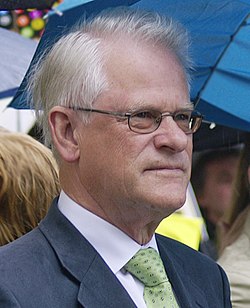
Björn von Sydow (born 26 November 1945) is a Swedish Social Democratic politician and political scientist.
- Facts0
- Drivers0
- Indicators0
Björn von Sydow (born 26 November 1945) is a Swedish Social Democratic politician and political scientist.
Björn von Sydow (born 26 November 1945) is a Swedish Social Democratic politician and political scientist. He was a member of the Riksdag for Stockholm County from 1994 to 2018. In Göran Persson's government he was minister for trade from 22 March 1996 to 31 January 1997 and Minister for Defence from 1 February 1997 to 30 September 2002. He then served as Speaker of the Riksdag from 30 September 2002 to 2 October 2006.
He received a filosofie kandidat degree from Stockholm University in 1969 and, in 1978, a doctorate and the title of docent in political science from Linköping University. The dissertation Kan vi lita på politikerna? (Can we trust the politicians?) studied public and internal politics in the Social Democratic leadership from 1955 to 1960. From 1970 to 1974 he was secretary to former prime minister Tage Erlander. He later lectured at Stockholm University, was head of its School of Social Work from 1982 to 1988, and edited the journal Tiden from 1983 to 1989. In Solna he sat on the municipal council and, from 1983 to 1991, chaired the environment and public-health committee.
On 30 September 2002, at the first sitting after that year's election, the chamber chose him as Speaker by acclamation, after thanks to the outgoing Speaker, Birgitta Dahl. The nomination cited his time as head of the Ministry of Defence, his municipal work in Solna, and his research on Swedish parliamentarism. After the 2006 election shifted the majority, Per Westerberg of the Moderate Party defeated him for the speakership by 177 votes to 169, with one member abstaining.
He returned to an ordinary seat and, from 2014 to 2018, was vice chair of the Committee on the Constitution. A curriculum vitae published by the Government Offices records that he chaired the Political Affairs Committee of the Parliamentary Assembly of the Council of Europe in 2010–2011 and in 2013, and the Riksdag delegation to the NATO Parliamentary Assembly from 2014. In January 2017 Defence Minister Peter Hultqvist appointed him chair of the cross-party Defence Commission, which was to prepare the basis for the following defence decision. On 26 September 2019 the government named him chair of the board of the Swedish Defence Research Agency (Totalförsvarets forskningsinstitut), from 1 October, in succession to Yvonne Gustafsson. The Royal Swedish Academy of Sciences elected him on 11 June 2008 to its class for the humanities and for outstanding services to science.
Björn G. von Sydow was born on 26 November 1945 in Stockholm, the birthplace given in the biographical handbook Vem är det. The political directory Altinget instead lists Solna, the municipality immediately north of the capital where the same handbook places him as a resident and where he later sat on the municipal council. He was the son of the editor Bengt Sköldenberg and the civil servant Tullia von Sydow.
Bengt Gustaf Sköldenberg was born in Karlshamn on 31 July 1918, took a filosofie kandidat in Gothenburg in 1941, and worked at Albert Bonniers förlag and as a reporter and programme host at Sveriges Radio before editing Sveriges statskalender from 1967 to 1983. He died in 2000. Tullia, born Alda Tullia Björnsdotter von Sydow in Stockholm on 20 November 1918, was a daughter of the naval commander and shipping-company director Björn Ryno von Sydow and the nurse Tullia Granström. She married Sköldenberg in 1945; they had four children, Björn, Tor, Dag and Ulrika, and divorced in 1958. From 1964 to 1983 she held posts at the National Board of Health and Welfare, work that centred on care for older people, and from 1998 to 2002 she sat in the Riksdag for the Social Democrats, at first as a substitute member. She died in 2019.
The name under which the son has been known is his mother's, not his father's. The Riksdag biography he supplied calls his parents the editor Bengt Sköldenberg and the bureau director (byrådirektör) Tullia von Sydow, while styling him Björn von Sydow, and Vem är det identifies Tullia as born von Sydow. The Svenskt kvinnobiografiskt lexikon records Sköldenberg as her married name, and the surname von Sydow is also that of her father, Björn Ryno von Sydow. A 2005 Svenska Dagbladet profile of another relative, the journalist Ebba von Sydow, placed both Björn von Sydow and the actor Max von Sydow in the family at a considerable distance ("på långt håll").
In a newspaper interview on his seventieth birthday he said he had been a difficult and self-centred child toward his parents and three siblings. He traced an early preference for informal conversation to a school at Tallkrogen, south of Stockholm, in the 1950s, and dated a lasting interest in democracy to about the age of fifteen, when he chaired a mock council—with its own currency and elections—at the summer home of the Stockholm grammar school Norra Latin.
He received a filosofie kandidat from Stockholm University in 1969. Neither the biography he gave the Riksdag for Fakta om folkvalda nor Vem är det names the subject of that degree. From 1969 to 1971 he was an acting university lecturer, and from 1970 to 1974 secretary to the former prime minister Tage Erlander, posts held while he was moving from the kandidat toward a doctorate. In 1978 Linköping University awarded him a filosofie doktor in political science and the title of docent. Those qualifications were the academic basis he later carried into a lectureship at Stockholm University and into national politics, as a Social Democratic member of the Riksdag from 1994, a minister, and Speaker from 30 September 2002 to 2 October 2006.
The posts are those von Sydow gave the Riksdag for Fakta om folkvalda. After a filosofie kandidat at Stockholm University in 1969 he was an acting university lecturer in 1969–1971; he later said he was then an assistant in its political-science department. From 1970 to 1974 he was secretary to Tage Erlander, who had left the premiership in 1969. In 2007 he said Erlander had asked the professors Olof Ruin and Hans Meijer for help with the diaries and that they named him. The same profile reports that Erlander then gave him the diaries and notes for research, and presents that access as the basis of the 1978 dissertation.
He took the doctorate and a docentship in political science at Linköping University in 1978, and lectured at Stockholm in 1978–1988 and 1992–2007. In 1982–1988 he headed the Department of Social Work at the Stockholm School of Social Work, incorporated in the university in 1977 as Institutionen för socionomutbildning – Socialhögskolan. Between the lectureships he was planning chief in the Prime Minister's Office in 1988–1991, under Ingvar Carlsson. The profile reported that he had gone on teaching except during his years as a minister.
Kan vi lita på politikerna? Offentlig och intern politik i socialdemokratins ledning 1955–60 (Tiden, Stockholm, 1978; ix + 490 pages, with an English summary) is catalogued as a Linköping dissertation: Can we rely on politicians? Public and private politics in the leadership of the Swedish Social Democratic Party 1955–1960. A 2007 profile calls it a comparison of what the Swedish Social Democratic Party said in public and internally. At a symposium on political language, reported in 2007, he distinguished for 1955–1960 a public role aimed at votes from an internal role aimed at power, and said the two sometimes diverged but that the party was usually frank about its intentions.
The Riksdag list also includes an afterword with Erlander to Socialismen inför verkligheten (1976), Pedagogiska nämnden i svenskt statsliv (1981), Parlamentarismens utveckling (1990) and Att vara med på riktigt (Tiden, 1993). Vägen till enkammarriksdagen: demokratisk författningspolitik i Sverige 1944–1968 (Tiden, 1989; 377 pages) is the study of the unicameral reform. In 2005 he cited it for the agreements of autumn 1966 and spring 1967 between the Social Democrats and the three non-socialist parties: one election day, three-year terms for 350 members, and exact proportionality above a 4 per cent threshold. He called an equal vote the shared principle, and the aim the blocking of an "artificial" majority for a bloc the voters had not produced.
Parlamentarismen i Sverige: utveckling och utformning till 1945 (Gidlunds with Riksbankens Jubileumsfond, 1997; 288 pages) was commissioned in 1991 after Gunnar Gerdner and Gunnar Heckscher had not completed the project. In Scandia, Sverker Oredsson noted that von Sydow's election to the Riksdag in 1994, and his becoming a minister in 1996, ended the account in 1945 rather than 1995, and called it a documented synthesis that remained a torso of the original plan. He reports eight criteria for parliamentarism, on government, the Riksdag and the head of state, rather than a requirement that the government hold parliament's confidence, which Herbert Tingsten had treated as too demanding where a minority cabinet need only be tolerated. On that reading the criteria were met unevenly from about 1860, with a Riksdag able after 1866 to force ministers out, governmental leadership of legislation in 1891–1900 and 1905–1918, and from 1919 a parliamentary system whose oppositions often would not govern; the 1939–1945 coalition lacked a normal opposition. The last chapter, he wrote, shows that parliamentarism is not introduced in one year. Maktdelning (1999) repeats the three criteria treated as central: dependence on the party balance, voters' indirect influence, and a head of state with no independent power.
Tiden: månadsskrift för socialistisk kritik och politik has been published by the Social Democratic Party since 1908. The national bibliography names Hjalmar Branting as first editor and as legally responsible publisher from 1908 to 1917; a later subtitle called the journal founded by him.
The Riksdag biography lists von Sydow as editor (redaktör) in 1983–1989. The bibliography records him as ansvarig utgivare only from 1986:4 to 1989:5, after Sverker Gustavsson (1983:3–1986:3); the editors named on the issues include Gerd Engman, Rolf Andersson and Gunnar Eriksson. "Tage Erlander och Tiden" (Tiden 1985:7, pp. 382–389) is catalogued as a survey of Erlander's contributions from 1940 to 1985.
Björn von Sydow's early political career was in Solna for the Swedish Social Democratic Party. The Nationalencyklopedin describes him as a docent in political science and a municipal politician in Solna from the 1970s, brought into the Prime Minister's Office during Ingvar Carlsson's first government.
The office-by-office list is information he supplied for the Riksdag publication Fakta om folkvalda. He records membership of Solna's municipal council from 1979 to 1996 and of the municipal executive board from 1983 to 1994; a seat on the social district committee from 1977 to 1982, as vice-chair from 1980 to 1982; the chair of the environment and public-health committee from 1983 to 1991; and second vice-chair of the social welfare committee from 1992 to 1994. The same account makes him chair of Solna arbetarekommun, the local party organisation, from 1983 to 2000, and a member of the executive committee of the Social Democrats in the Stockholm County district from 1987 to 1994.
When the new Riksdag met on 3 October 1994, von Sydow was not an ordinary member for Stockholm County. The roll placed him first among the Social Democratic substitutes. On 11 October the Speaker announced that, from 8 October, substitutes had been called to sit for members who were ministers, and that von Sydow had been called for Ingvar Carlsson. At that sitting the chamber also elected him to the Committee on the Constitution. The assignment register lists him as an ersättare from 8 October 1994 through 9 October 1995; in the biography he supplied, he called the interval service as a statsrådsersättare. He was re-elected to the constitutional committee on 10 October 1995, and the register keeps him there until 22 March 1996.
He joined the Election Review Board (Valprövningsnämnden), the Riksdag body through which an election or a referendum is appealed. On 16 November 1994 the Speaker declared him and Lena Sandlin elected as deputies after two resignations. On 21 December he was elected one of six full members, under the regeringsråd Lars Tottie. The register dates that membership from 21 December 1994 to 14 April 1996.
His place in the chamber changed after the 1995 European Parliament election. On 10 October 1995 members returning from the European Parliament, including Tommy Waidelich, resumed their seats from 9 October, and the chamber then released Waidelich from his mandate at his request. The next day the Speaker announced that, from 10 October, Riksskatteverket had appointed von Sydow the new member for Stockholm County, the only one named for that constituency. The register lists him from that date as a serving member rather than a substitute.
Two government tasks overlapped these years. In the Fakta om folkvalda biography he stated that he chaired Miljövårdsberedningen, an organ of the Government Offices, in 1994–1996. A government decision of 9 March 1995 set up a parliamentary committee to study issues for the European Union's 1996 intergovernmental conference and to encourage debate. Von Sydow was appointed chair on 10 April 1995; as EU 96-kommittén, it issued Sverige, EU och framtiden (SOU 1996:19), which he signed on 8 February 1996. The register names Berit Löfstedt as chair from 22 March 1996.
That date ended his daily work as a member. On 22 March 1996 the Speaker's announcement of the new government named him among the ministers, and the register records the appointment from 22 March and leave from the seat from 23 March.
On 22 March 1996, in Göran Persson's Social Democratic government, von Sydow became minister for trade (handelsminister). The Riksdag biography places him at the Ministry of Industry and Commerce (Närings- och handelsdepartementet); the assignment list records Näringsdepartementet for the same dates, through 31 January 1997.
Sweden had been in the European Union since 1995, so trade policy was mostly common policy. On 13 September 1996 he told Moderate member Sten Tolgfors that Sweden was pressing for freer EU textile rules on China, but that 2.3 million jobs in the sector, and Chinese over-use of quotas, left little chance of reopening the bilateral deal.
At the World Trade Organization's first ministerial conference, in Singapore on 9–13 December 1996, he argued for further liberalisation, for work on the environment, investment and competition, and for International Labour Organization standards without trade sanctions. He also urged zero tariffs on information-technology goods, a telecommunications-services deal, and better access for the least developed countries.
He was Minister for Defence, and head of the Ministry of Defence, from 1 February 1997 until 30 September 2002.
The bill Det nya försvaret (proposition 1999/2000:30), submitted on 18 November 1999 with von Sydow as the responsible minister, followed the spring 1999 checkpoint. It judged that an invasion to occupy Sweden was not feasible for about ten years if a basic defence remained, while uncertainty about Russia continued, and that the war in Kosovo required a faster international capacity. In place of a Cold War invasion defence it proposed a smaller, higher-quality operational defence (insatsförsvar), with later adaptation as a planning assumption.
On the prime minister's instructions von Sydow negotiated with the Centre Party, the Liberals, the Christian Democrats and the Moderate Party. Only the Social Democrats and the Centre Party agreed the policy and the economic frame for 2002–2004.
Expenditure area 6, Total Defence, was set 4 billion kronor a year lower for 2002–2004 than the 2001 frame approved in spring 1998, excluding a 1996 materiel deferral. Transition grants were 3 billion kronor in 2002 and 1 billion in 2003. The basic organisation was aimed at 16,350 conscripts a year. From a decision of 4 March 1999, the Swedish Armed Forces were to train about 15,000 in each of 2000 and 2001, while the bill said the intake should not fall below about 18,000—the 1999 level—until a final figure was set.
Proposed closures included seven brigades (Upplands-Bro, Kristinehamn, Eksjö, Halmstad, Falun, Sollefteå and Hässleholm), artillery and air-defence units, coastal artillery at Karlskrona and on Gotland, the Skåne air wing at Ängelholm and helicopter battalions at Boden and Ronneby, plus military-area staffs and the naval and air commands. An operational headquarters would sit at Upplands-Bro.
The Committee on Defence recommended approval; its majority said rejection would leave the 1996 decision in force. The Moderates, Christian Democrats and Liberals reserved against the whole bill. The Moderates called it the largest disarmament since 1925 and said it would more than halve the base for units abroad. The Christian Democrats objected to cuts they called too fast, and the Liberals said the forces would be narrower rather than sharper.
After debate on 29 March, the chamber voted on 30 March 2000. On a motion to reject the bill, 180 members backed the committee and 125 the reservation; eight abstained and 36 were absent. The majority was 120 Social Democrats, 37 from the Left Party, 17 Centre members and six Greens; the minority was 73 Moderates, 38 Christian Democrats and 14 Liberals.
The same bill treated Nordic defence cooperation, including closer work with Finland, as support for European crisis management. It called for an active part in the enhanced Partnership for Peace and described NATO's role in military crisis management as confirmed by Kosovo.
On 23 June 1999 the government ordered planning for a Kosovo force. Von Sydow said 1999 costs of 220 million kronor would fall on total defence and foreign affairs, and that the Kosovo Force and the Stabilisation Force in Bosnia and Herzegovina should cost at most 900 million kronor in 2000, about 500 million above the peacekeeping appropriation. Decisions later reviewed by the constitutional committee sent preparatory personnel on 15 July 1999, an armed force of at most 850 on 26 August, and 800 for April–September 2000.
On 13 September 2001 the government authorised 18 NH90 helicopters from NHIndustries, stated at about 6 billion kronor including equipment and training: 13 for land operations and five for maritime use. Von Sydow told the Riksdag that rules from March 1999 required 100 per cent industrial offset, that those terms could not yet be published, and that a contract with the Defence Materiel Administration was expected in December 2001. Sweden, Norway and Finland chose the type that month in a Nordic programme from which Denmark had withdrawn.
Svenska Dagbladet, citing Sveriges Radio, reported in 2011 that a classified materiel-administration paper had warned against the buy and leaned toward another type, but that von Sydow kept the Nordic order once the neighbours had chosen. He told TT that Nordic cooperation met an important security and military need and therefore came first, and denied steering the model in detail. Intelligence suspected an officer and a consultant had leaked material to NHIndustries; the inquiry was dropped and an American damages claim failed. He was heard by the Committee on the Constitution. A Chancellor of Justice review, the paper said, cleared the deal and criticised the intelligence service. By 2011 the helicopters were reported about 4.7 billion kronor over plan and eleven years late.
In October 2001 Green member Lars Ångström reported him to that committee, citing an assessment that the leak had added 0.5–2 billion kronor and arguing the government should have waited for the criminal inquiry. Aftonbladet reported that deliveries were then due from 2005, and that von Sydow would not discuss the investigation, pointing instead to findings that the competition had been sufficient.
At the first sitting of the Riksdag returned in the 2002 Swedish general election, on 30 September 2002, Britt Bohlin proposed for the Swedish Social Democratic Party that Björn von Sydow succeed Birgitta Dahl as Speaker (talman). The chamber elected him by acclamation, and at the same sitting elected three deputy speakers by acclamation as well. He held the post until the next Riksdag replaced him on 2 October 2006.
The Riksdag describes the speakership as the highest office to which a person in Sweden can be elected. Formally the Speaker ranks after the head of state, the King, and before the prime minister. The Speaker is impartial, stands aside from committee work and from debate and votes, and is replaced in those duties by a substitute; the Riksdag cannot remove the Speaker during an electoral period. No statute fixes the Speaker's party. Since 1982 the practice had been to take the Speaker from the largest party in the governing majority.
The Speaker chairs the Riksdag Board, and votes there, chairs the War Delegation, and sits on the Advisory Council on Foreign Affairs. Under the Instrument of Government, if the King or Queen regnant cannot perform the duties of head of state, a member of the royal house in the line of succession who is not prevented serves as temporary regent (tillfällig riksföreståndare). The Speaker, or a deputy speaker if the Speaker is prevented, does so only when no one else qualified can serve, and only after appointment by the Government. Travel abroad is not itself that case. While Carl XVI Gustaf was in San Francisco in September 2006, Crown Princess Victoria was deputizing as head of state, and von Sydow was to inform her of the government talks.
The Speaker and the deputy speakers alternate in the chair. The presiding officer settles the order of business, gives the floor, announces votes and keeps order, and may stop a member whose language or conduct breaks the Riksdag Act. The Speaker does not vote in the chamber.
When a prime minister is to be appointed, the Instrument of Government assigns the proposal to the Speaker, not the monarch. The Speaker consults each party group and the deputy speakers and may ask a party leader to explore a government. The proposal, which names the parties that are to govern, must be decided within four days and fails only if at least 175 of the 349 members vote against it. Up to four proposals may be made. The outgoing Speaker customarily opens the talks as soon as a government resigns and then hands the formation to any newly elected successor, who makes the formal proposal. A compulsory vote on a prime minister who stays on after an election was not part of this procedure in 2002–2006; the Riksdag dates that requirement from 2014.
Göran Persson did not resign after the 2002 election. On the day von Sydow took the chair, Moderate Party leader Bo Lundgren, backed by the 35 members then required, moved under chapter 12, article 4 of the Instrument that the Riksdag declare the prime minister lacked its confidence. Decided on 2 October, it needed support from more than half the members. It received 158 votes, from the Moderates, the Liberals, the Christian Democrats (Sweden) and the Centre Party (Sweden); 174 against, from the Social Democrats and the Left Party (Sweden); and 17 abstentions, all from the Green Party (Sweden). The motion failed, and Persson remained. No other prime minister was proposed during the rest of the term.
After the 2006 Swedish general election, Persson asked on 18 September to be discharged, and he and the other ministers were discharged the same day. On 19 September von Sydow said he had given Fredrik Reinfeldt the task of preparing a four-party government of the Moderates, the Centre Party, the Liberals and the Christian Democrats — a stronger formulation, he said, than a request merely to take soundings, because the majority was unusually clear — pending the final count. Per Westerberg, elected the following week, formally proposed Reinfeldt on 3 October after consulting the party groups and the deputy speakers. On 5 October the Riksdag approved him by 175 votes to 169, with five members absent: fewer than half voted no.
The newly elected Riksdag met on 2 October 2006 in a renovated chamber. Bohlin again proposed von Sydow. Mikael Odenberg, for the four parties of the Alliance (Sweden), proposed Westerberg, until then first deputy speaker, arguing that a clear majority grouping should supply the Speaker, and demanded a secret ballot. Westerberg received 177 votes, von Sydow 169, and one ballot paper was blank.
The day before, Reinfeldt had said the Alliance would nominate Westerberg, that a Social Democrat would be first deputy speaker, and that the Centre Party and the Liberals would fill the other deputy posts. Von Sydow headed his party's list for the speakership, but his spokeswoman, Anna Wieslander, said he would withdraw if he did not obtain that post, and he did not stand for a deputy speakership. The chamber then elected the deputies by acclamation: Jan Björkman of the Social Democrats as first deputy speaker, Birgitta Sellén of the Centre Party as second, and Liselott Hagberg of the Liberals as third.
After he left the office of Speaker of the Riksdag, Björn von Sydow remained an ordinary member of the Swedish Social Democratic Party for Stockholm County from 2 October 2006 until 24 September 2018. His main domestic committee in the later terms was the Committee on the Constitution: a member from 1 October 2012 to 29 September 2014 and vice chair from 7 October 2014 until his mandate ended. A government curriculum vitae from his time on the Defence Commission also lists him as the Social Democrats’ group leader on the committee from 2012.
Chapter 13 of the Instrument of Government, one of Sweden’s basic laws, charges the committee with examining ministers’ duties and the handling of government business. Each year it makes a special scrutiny, based on members’ complaints, of whether ministers followed the rules in particular cases, and a general scrutiny of how government business was administered; it may hold public hearings and see classified material.
The special report adopted on 7 June 2018 (2017/18:KU20), a decision von Sydow joined, examined the Swedish Transport Agency’s outsourcing of its IT operations. It found that from 2009 to 2014 the agency had lacked a required security analysis, that the previous government had not been shown to know of or share in the outsourcing, and that information-security work in that period had been neglected. A Centre Party reservation called the report’s treatment of former IT and energy minister Anna-Karin Hatt’s testimony misleading in important respects. On the government of Prime Minister Stefan Löfven, the Ministry of Justice and the Ministry of Enterprise were found to have acted too much apart: they had information by the end of 2015 showing how serious the case was, but the Prime Minister’s Office was told only in December 2016 and the prime minister some weeks later. The routines for passing information had failed, for which the prime minister bore the ultimate responsibility; the committee also criticised the then interior minister, called it remarkable that the then infrastructure minister learned so late of risks to national security in her portfolio, and judged that the minister for defence had acted reasonably. The chamber debated the report on 18 June 2018 and laid it to the record.
From 12 October 2010 to 30 September 2012 he was a substitute on the Committee on Education, and from 23 April 2010 to 18 February 2015 a member of the Election Review Board, as he had been from December 1994 to April 1996. The board hears appeals against elections to the Riksdag, regional and municipal councils, the Sami Parliament and the European Parliament, and against national referendums.
He sat again on the War Delegation from 1 October 2012 to 24 September 2018, after terms in 1998–2002 and 2002–2006. The delegation consists of the Speaker and 50 members elected for each term, with the Speaker as chair, and can take the Riksdag’s place in war or, if the prime minister and six members of the Advisory Council on Foreign Affairs so decide, in danger of war.
The biography he supplied for the Riksdag’s register records him as chair of the Riksdag’s foreign-policy club from 2011 to 2015 and, in 2014–2016, as a member of the Media Fundamental Laws Committee. That committee’s report, Ändrade mediegrundlagar (SOU 2016:58), set out proposed new texts of the Freedom of the Press Act and the Fundamental Law on Freedom of Expression and named him among the members.
On 14 November 2017 he told the Social Democrats’ nomination committee for the Stockholm region that he was placing his seat at the disposal of younger candidates for the 2018 election. He said that Sigtuna, where he lived, could place Marie Axelsson high on the party’s list, so he need not take an electable place—“sooner or later that is a reality”—while a lower place would show that he still wanted to work for Social Democratic ideas. That reversed what he had told Senioren earlier in the autumn: that he would stand because people of his generation, born in 1945, were still needed for equality, gender equality and the environmental commitment begun in the 1960s. The same Riksdag biography records him as chair of Sigtuna arbetarekommun in 2013–2015. His term as an ordinary member ended on 24 September 2018.
From 1 November 2006 to 1 November 2014 von Sydow was a member of the Riksdag delegation to the Parliamentary Assembly of the Council of Europe, and its deputy chair for nearly all of that time. He chaired the Assembly’s Political Affairs Committee in 2010–2011 and in 2013, and was rapporteur on Kosovo from 2009 to 2014.
On 22 June 2010 the Assembly adopted Resolution 1739 (2010) and Recommendation 1923 (2010), “The situation in Kosovo* and the role of the Council of Europe,” on his report. Kosovo was referred to under United Nations Security Council Resolution 1244, without prejudice to status. It put standards ahead of status, so that people in Kosovo could have democracy, the rule of law and human rights at a Council of Europe level. It cited a weak rule of law, separated communities, and discrimination against Kosovo Serbs and Roma, Ashkali and Egyptians, and urged the Kosovo institutions, EULEX and UNMIK to tackle corruption, procurement and judicial independence. The recommendation asked for wider status-neutral work, prioritising the rule of law, corruption, organised crime, the courts, education, cultural heritage and contact between communities.
On 22 January 2013 a follow-up, Doc. 13088, produced Resolution 1912 (2013) and Recommendation 2006 (2013). It recorded recognition by 34 of 47 member states against the organisation’s continued neutrality; slow progress on organised crime and corruption north and south of the Ibar; political interference and weak enforcement in the judiciary; and the European Union-mediated Pristina–Belgrade talks as an opening for reconciliation.
The Riksdag made him chair of its delegation to the NATO Parliamentary Assembly on 5 November 2014, and he remained chair until 24 September 2018. The Assembly, separate from NATO, is a forum for legislators from allied states and also meets partner parliaments; it is not itself the alliance. Sweden was not a NATO member during his term. The Riksdag had been an observer delegation from 1999 and an associate delegation from 2003, and a full Assembly member only from Sweden’s accession on 7 March 2024.
In March 2015 the government sent him to Saudi Arabia as a special envoy. On 11 February Foreign Minister Margot Wallström had told the Riksdag that women’s rights were being violated, called the flogging of the blogger Raif Badawi medieval, and described absolute royal power as a dictatorship, wording she later said she stood by. Saudi Arabia blocked a speech she had prepared for the Arab League; Sweden declined to renew a military-cooperation memorandum signed in 2005; and Ambassador Ibrahim bin Saad Al-Ibrahim was recalled over the criticism of human rights and democracy. Appointed on 24 March, he met King Salman bin Abdulaziz on 27 March at Al-Oja palace in Diriyah, with Deputy Crown Prince Muhammad bin Nayef and Defence Minister Mohammed bin Salman present, and handed over letters from King Carl XVI Gustaf and Prime Minister Stefan Löfven. The court said the king wrote at the government’s request and took no political position; the letters were not published. The Foreign Ministry’s stated aim was respectful relations. Von Sydow said he had regretted any feeling of misunderstanding and asked for dialogue, that the military memorandum was not discussed, and that trust between the royal houses had mattered. Löfven said Sweden had not meant to insult Islam or Saudi Arabia and regretted if that impression had arisen.
Al Arabiya reported an apology, and the Saudi press agency said the envoy had brought one from the prime minister. On 29 March Wallström said the government had not apologised for its position on democracy and human rights, had regretted the rupture, and had not attacked Islam. Devin Rexvid, a human-rights doctoral student at Umeå University, called it regrettable that Riyadh could set the terms and said the unpublished letters led him to credit the Saudi account. Expressen put the government flight, from a previously classified ministry document, at 144,900 kronor, excluding lodging and subsistence. On 28 March Wallström said the ambassador would return and relations could be normalised at once.
From 1988 to 1991, as planning chief in the Prime Minister's Office, von Sydow was executive member of the government's Research Advisory Board (Forskningsberedningen). From 1992/93, for about four years, he chaired the board of Fysikcentrum, a joint physics project of the KTH Royal Institute of Technology and Stockholm University that opened in 2001 as AlbaNova after a first favourable government decision in 1996. Electing him on 11 June 2008, the Royal Swedish Academy of Sciences described him as chair of the Swedish Research Council.
On 20 December 2006 Svenska Dagbladet reported that the government would the next day name the former Speaker chair of the council. His Riksdag biography gives the chairmanship as 2007–2009, and the council's report for 2009 still lists him as chair.
On 9 January 2017 Defence Minister Peter Hultqvist instructed the cross-party Defence Commission (Försvarsberedningen) to assess developments in Europe and Sweden's neighbourhood and to propose total defence, military and civil, for 2021–2025, reporting by 14 May 2019. Von Sydow, of the Swedish Social Democratic Party, chaired the round, including after he left the Riksdag on 24 September 2018.
Motståndskraft (Ds 2017:66), given to Hultqvist on 20 December 2017, held that an armed attack could not be excluded. For at least three months Sweden was to be able to handle a security crisis in Europe, including war on its territory for part of that time, and individuals were to manage for one week without public support; the civil measures were costed at about 4.2 billion kronor a year by the end of 2021–2025. Conscription had already been reactivated: on 2 March 2017 the government again required muster and basic military training.
Värnkraft (Ds 2019:8), dated 14 May 2019, was to be read with Motståndskraft as one whole. Security had worsened because of Russia's conduct, and the wartime organisation of the Swedish Armed Forces was not built for an armed attack on Swedish territory. A new organisation was to start on 1 January 2021 and grow from about 60,000 posts to about 90,000, with basic training rising from about 4,000 to 8,000 people a year from 2024. Military appropriations would reach 84 billion kronor a year from 2025, 1.5 per cent of GDP at 2019 prices, besides the civil sums.
The commission said it was agreed on the main lines. Members of the Sweden Democrats, the Left Party and the Green Party nevertheless filed reservations: the Left Party rejected the claim that an armed attack could not be excluded and called an increase on the scale of 84 billion kronor too large, and the Greens would not bind themselves to the figures. Members from the Moderate Party, the Centre Party, the Christian Democrats and the Liberals did not take part in the final adjustment. A Social Democratic annex, stated not to form part of the report, supported the direction but said the party was not then ready for a political deal on the economic frame. The bill Totalförsvaret 2021–2025 kept the three-month assumption, a wartime organisation from 1 January 2021 and design-to-cost, and added further funds in 2024 and 2025.
On 29 October 2015 the government appointed von Sydow special investigator, under directive 2015:103, on the direction, scale and organisation of defence research and development. Forskning och utveckling på försvarsområdet (SOU 2016:90), submitted in December 2016, recommended 200–300 million kronor more for the Armed Forces' research appropriation, a base grant of at least 60 million kronor to the Swedish Defence Research Agency (FOI), and about 45 million kronor, mainly at FOI and the Swedish Defence University, for civil-defence research. Combat aircraft and underwater systems were treated as essential security interests, and the inquiry proposed a joint research forum rather than a new performing organisation.
On 26 September 2019 the government named him chair of FOI's board, succeeding Yvonne Gustafsson, who moved to the same post at the Swedish Defence Materiel Administration; he took office on 1 October 2019. The board page, updated on 6 February 2026, still listed him as chair. A separate parliamentary committee, Förtjänstutredningen, was convened on 19 November 2019 with him as chair, to review public honours, the general flag days and the appropriation to the Royal Court. SOU 2021:74, signed in September 2021, proposed resuming state orders for Swedish citizens, open nominations and an independent non-party council at the Royal Orders. It also proposed a flag day for European Parliament elections, later removal of three royal name-day flag days and the spouse's flag day, and a clearer account of the court appropriation.
On 28 January 2007 the Swedish royal court announced that King Carl XVI Gustaf had conferred H.M. The King's Medal of the 12th size with chain on the former Speaker of the Riksdag, “för framstående insatser på skilda områden inom svenskt samhällsliv” (for distinguished services in several fields of Swedish public life). The court stated that the medals would be presented at Stockholm Palace on 30 January 2007.
On 14 April 2003, at Stenbock House in Tallinn, Estonian Prime Minister Juhan Parts met von Sydow, then Speaker, and congratulated him on the first class of the Order of the Cross of Terra Mariana, conferred by the President of Estonia.
On 11 June 2008 the Royal Swedish Academy of Sciences elected him to its class for the humanities and for outstanding services to science. The academy’s notice said that he was then chair of the Swedish Research Council, had taken an active part in preparing research-policy bills under several governments, and in the early 1990s had chaired the board of Fysikcentrum in Stockholm, contributing to the creation of the AlbaNova university centre. He remains listed in that class.
The Royal Swedish Academy of War Sciences records him as a member from 2009 and as its second styresman (deputy presiding officer) from 2020. On 18 May 2022 it appointed him styresman for 2022–2024, with Lieutenant General Dennis Gyllensporre as second styresman, in succession to General Sverker Göranson. He continued in the office after that initial term: a 2025 foreword to the academy’s journal is signed by him as styresman, and he opened the academy’s international conference of 20–21 November 2025 in the same capacity. The academy’s later presidium listing names Vice Admiral Jonas Haggren as styresman.
On 8 June 2012 the Letterstedtska föreningen announced that von Sydow had become its chair, succeeding former foreign minister Karin Söder, who had held the post for more than twenty years. Founded in 1875, the association promotes cooperation among the five Nordic countries in science, art and industry; it makes grants, awards a Nordic medal of merit and has published Nordisk Tidskrift since 1878. The 2023 roll of its Swedish section, which is also the main board, still names him as chair, and the journal’s account of the medal ceremony on 7 December 2023 refers to him in that office.
He has been married to Madeleine von Sydow since 1967. The biographical note issued with the 2012 Letterstedtska announcement described her as a former laboratory physician and said that the couple then had four children and eight grandchildren. An interview published on his 70th birthday, 26 November 2015, was held at a house in Sigtuna dating from the 1750s and reported four children and eleven grandchildren. One of the children is the political scientist Göran von Sydow, named as his son in a Svenska Dagbladet profile of 29 December 2014. The Riksdag biography drawn from information he supplied for Fakta om folkvalda also gives Sigtuna as his place of residence.
The 2015 interview listed horseback riding and the museum railway at Mariefred among his leisure interests. The same member-supplied Riksdag biography states that he chaired Museiföreningen Östra Södermanlands Järnväg from 1973 to 1976. The 2012 association note likewise mentioned railways, riding and reading.
Ranked by shared high-impact facts, then explicit ties, then shared drivers.
 Margot WallströmMargot Elisabeth Wallström (born 28 September 1954) is a…Affiliated
 Victoria, Crown Princess of SwedenVictoria Ingrid Alice DésiréeAffiliated
 Ingvar CarlssonGösta Ingvar Carlsson (born 9 November 1934) is a retired…Affiliated
 Fredrik ReinfeldtJohn Fredrik Reinfeldt is a Swedish economist and former…Affiliated
 Mohammed bin Salman Al SaudCrown Prince of Saudi Arabia since 2017 and prime minister…Affiliated
 Göran PerssonHans Göran Persson (born 1949) is a Swedish politician who…Affiliated
 Stefan LöfvenKjell Stefan Löfven is a Swedish politician who served as…Affiliated
 Carl XVI GustafCarl XVI Gustaf (Carl Gustaf Folke HubertusAffiliated
How the record is sourced and how the score is derived.
The score is formula-derived (Factrail formula v1, version 1.0.0), not an editorial verdict. Read the methodology.
By the Factrail desk · Method: how we source and score · Last reviewed
Dispute a fact on this pageNamed here, or represent someone who is? Request a right of reply.
Linked because the text names them, not because anything was measured.
Built from the indicator links of the drivers this text names. A profile of coverage, not a score.