
Christian Görke
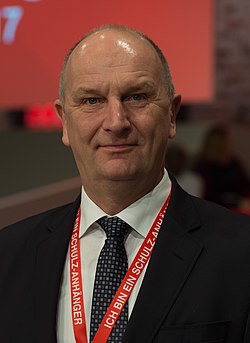
Christian Görke (born 17 March 1962 in Rathenow) is a German politician of Die Linke and a member of the Bundestag.
- Facts0
- Drivers0
- Indicators0
Christian Görke (born 17 March 1962 in Rathenow) is a German politician of Die Linke and a member of the Bundestag.
Christian Görke (born 17 March 1962 in Rathenow) is a German politician of Die Linke and a member of the Bundestag. A former history and sports teacher, he sat in the Landtag of Brandenburg and was Brandenburg's minister of finance from January 2014 to November 2019, and a member of the German Bundesrat over the same months. On 5 November 2014 he also became deputy minister-president in the second cabinet of Dietmar Woidke, while remaining finance minister. In the 21st Bundestag he is Die Linke's spokesperson for finance policy and for sport; since 25 June 2025 he has been deputy chair of the Finance Committee and, because the Alternative for Germany nominee for the chair did not obtain a majority, its acting chair.
The Bundestag biography, which rests on the member's own account, states that he has belonged since 1987 to the Socialist Unity Party of Germany and then to its successors, the Party of Democratic Socialism and Die Linke. He studied history, recorded by the Bundestag as Geschichte/FPL, at the Pädagogische Hochschule Dresden, qualified as a Diplomlehrer, and later took a sports-teaching qualification for lower secondary school at the University of Potsdam. He then taught for 15 years at the Bruno H. Bürgel comprehensive school in Rathenow. Before the Landtag he was a member of the Rathenow district council from 1990 to 1994, of the Havelland district council from 1994 to 2014, and of the Rathenow city council from 1998 to 2014. In the Landtag he was parliamentary managing director of the Left group from September 2007 to August 2012 and its chair from August 2012 to January 2014, and he chaired Die Linke in Brandenburg from 2014 to 2018.
He sat in the Landtag again from September 2019 until October 2021, when he entered the Bundestag. In both the 2021 and 2025 federal elections he was the Left candidate in constituency 64, Cottbus – Spree-Neiße, and reached the Bundestag on the Brandenburg state list rather than by winning that seat. In 2021 he received 11,156 first votes (8.8 percent); the Social Democratic Party of Germany won the constituency with 27.6 percent. In 2025 he received 12,818 first votes (9.8 percent), and Lars Schieske of the AfD won the seat with 42.0 percent.
In the 20th electoral term he was the Left's finance-policy spokesperson until December 2023. From December 2023 to March 2025, after the members no longer formed a Fraktion and sat as the Gruppe Die Linke, he was the group's first parliamentary managing director; since March 2025 he has again sat in the Fraktion Die Linke. The Finance Committee elected him deputy chair on 25 June 2025 by secret ballot, at the AfD group's request and with the consent of every faction except Die Linke, which withheld consent: 23 members voted yes, 15 no, and two abstained. Kay Gottschalk, the AfD candidate for the chair, had missed a majority when the committee was constituted in May 2025, so Görke has presided in an acting capacity; Olav Gutting of the CDU/CSU had led the committee until that vote as its longest-serving member. Görke is a full member and the Left's Obmann on the Committee on Sport and Volunteering, a deputy member of the Committee for the Scrutiny of Elections, Immunity and the Rules of Procedure, and a member of the Mediation Committee. In February 2026 he urged the reintroduction of the wealth tax, pointing to a German Institute for Economic Research study commissioned by Die Linke that put Brandenburg's annual yield at nearly €2.8 billion, of which about €535 million would reach municipalities.
Christian Görke was born on 17 March 1962 in Rathenow, then in the German Democratic Republic and now in the state of Brandenburg. A 2014 Tagesspiegel profile described him as the son of a teacher whose father was a politician of the Christian Democratic Union, and noted that a sister, also a teacher, was likewise a CDU member.
In a 2022 interview with Das Parlament he said that, in the GDR, he had lacked nothing “except freedom,” and that it was as well that state socialism had ended. In the same conversation he said that his father had been in the CDU and, after German reunification, became a deputy Landrat. Published biographies do not name the school. The handbook of the Landtag of Brandenburg and a Bundesrat curriculum vitae both record that he took the Abitur in 1980.
The Landtag handbook states that from 1980 to 1983 he performed Wehrdienst with the Bereitschaftspolizei. Those Volkspolizei readiness units were barracked formations; from 1962 their rank and file was drawn from conscripts, and in peacetime they reinforced other branches of the Volkspolizei. The Bundesrat résumé passes from the 1980 Abitur straight to university in 1983 and does not mention the service.
From 1983 to 1988 he studied at the Pädagogische Hochschule “Karl Friedrich Wilhelm Wander” in Dresden, the teacher-training college that had held that name since 1967. The Landtag handbook and the Bundestag biography, the latter drawn from the member’s own information, list the course as Geschichte/FPL and the qualification as Diplomlehrer. In the finding aid of the university archive at TU Dresden, FPL is the abbreviation for Freundschaftspionierleiter training. From 1969 the college trained Freundschaftspionierleiter, and from 1972 it had a section Freundschaftspionierleiter/Geschichte, combining a history teaching degree with preparation to lead groups of the Ernst Thälmann Pioneer Organisation in schools. The Bundesrat text describes the same years only as a history course at the Pädagogische Hochschule Dresden, ending as Diplomlehrer, and does not use the FPL label. Where the résumés give dates, they agree: Abitur in 1980 and the Dresden course from 1983 to 1988. They differ in whether the intervening service is listed and in how the subject is named. The Bundestag entry names both the Dresden combination and the later sport qualification but supplies no years.
The Landtag handbook dates the start of his teaching to 1988. From 1991 to 1993, while already a teacher, he took an external course in sport at the University of Potsdam, after which he was recognised as qualified to teach at Sekundarstufe I (lower secondary level). The Bundestag biography records the same Potsdam qualification and describes him as a certified teacher of history and sport.
The handbook of the Landtag of Brandenburg records that Görke has been a teacher since 1988, the year it lists him as having qualified as a Diplomlehrer. From 1991 to 1993 he took an external course in sport at the University of Potsdam, which awarded the teaching qualification for lower secondary level (Sekundarstufe I). The Bundestag biography, based on his own information, states that he taught for fifteen years at the Gesamtschule „Bruno H. Bürgel“ in Rathenow; he has described the subjects as sport and history.
The school is a municipal comprehensive school maintained by the town of Rathenow. The Brandenburg school directory gives its address as Bruno-Baum-Ring 26 and lists the present institution as a sport-profiled all-day Gesamtschule with a gymnasiale Oberstufe and as a UNESCO project school. The town chronicle places the Bruno-H.-Bürgel-Schule among the public buildings of the Rathenow-Ost housing estate, developed from 1968. Its short chronicle dates the foundation, and the naming after Bruno H. Bürgel, described there as an astronomer and author, to 1948, and records a polytechnic secondary school (Polytechnische Oberschule) in the GDR. After 1989–90, while Görke was on the staff, it operated as a Gesamtschule from grade 7. An upper secondary stage was planned from 1991, the first Abitur class left in 1995, and UNESCO project-school status is dated from 1995. Bound all-day schooling began in 2002/03, at the end of his classroom years.
The Landtag handbooks do not record an appointment as a Beamter, or any year for one. The December 2008 and 2018 editions both give the occupation as Diplomlehrer and the line “teacher since 1988”, marking the start of the profession rather than an end to classroom work. In the disclosures required of Bundestag members he has registered his occupation before entering the Bundestag as a teacher of the Land Brandenburg, with the seat given as Potsdam, together with a right of return (Rückkehrrecht). The Members of the Bundestag Act requires that last occupation, and any right of return, to be declared. For civil servants who draw service pay, the rights and duties of the service relationship are suspended for the duration of membership, and reinstatement into the former relationship is available on application after the mandate ends; corresponding rules apply to salaried employees of the public service. The published entry therefore records a continuing tie to the Land’s teaching service without stating whether that tie was a civil-service appointment or a public-service employment contract, and without dating either.
He became a member of the Landtag on 1 December 2003. He has written that he taught sport and history at the Rathenow school until he moved into politics; the fifteen years given in the Bundestag biography run from the 1988 start in the handbooks to that change.
The Socialist Unity Party of Germany (Sozialistische Einheitspartei Deutschlands, SED) was formed on 21 April 1946 in the Soviet occupation zone by the forced merger of the Communist and Social Democratic parties. It directed politics, the economy and society in the German Democratic Republic, founded in 1949, without a separation of powers or an independent judiciary. After the Berlin Wall fell, the SED leadership resigned on 3 December 1989. An extraordinary congress that month voted to continue the party; it was renamed the SED/PDS and, from February 1990, the Party of Democratic Socialism (PDS). Largely an eastern regional party, the PDS formally merged on 16 June 2007 with the Electoral Alternative for Labour and Social Justice (WASG), a western group formed in opposition to the Schröder government's social reforms, to create Die Linke.
Published accounts disagree on the year Görke joined the SED. A biography from the Brandenburg state centre for political education lists membership of the SED from 1985, of the PDS from 1990, of the Linkspartei.PDS from 2005 and of Die Linke from 2007. The same starting year appears in a curriculum vitae for the Conference of Interior Ministers—"Seit 1985 Mitglied der SED. Seit 1990 Mitglied der PDS, jetzt DIE LINKE"—and in a Tagesspiegel profile of 21 August 2012, which wrote that his career began in the SED in 1985 and continued in PDS and Die Linke. The current Bundestag biography, which the parliament says rests on members' own information, instead reads "Seit 1987 Mitglied der SED, PDS, Die Linke." A profile in Das Parlament on 22 August 2022 also dated the entry to 1987. Görke said joining so young was unusual, but that he had wanted to shape events and that the SED was a majority party; he added a degree of opposition to his parents, his father having been in the Christian Democratic Union. He said that in the GDR he had lacked nothing "except freedom," and that it was good that state socialism had ended.
His local mandates followed the 1990 municipal elections and the district reform in Brandenburg. A law of 24 December 1992 provided that the districts of Nauen and Rathenow would form one new district, coming into being—and dissolving the old districts—at the end of the day of the next statewide Kreistag election. A law of 22 April 1993 named it Landkreis Havelland and placed the seat of administration in Rathenow.
The state centre for political education lists him on the Kreistag of the district of Rathenow from May 1990 to December 1993, on the Kreistag of Havelland from January 1994 to January 2014, and on the Stadtverordnetenversammlung, the city council, of Rathenow from September 1998 to January 2014. The Bundestag biography gives the same offices in calendar years: 1990 to 1994, 1994 to 2014 and 1998 to 2014. The 2012 Tagesspiegel profile already recorded the Rathenow Kreistag term as 1990 to 1994, membership of the Havelland Kreistag from then on, and a seat on the Rathenow city council since 1998. In 2022 he recalled entering a Kreistag and said his election might have been chance, because he shares a surname with his father, who became a deputy Landrat after reunification.
He later chaired the district party. On 1 November 2019 the Märkische Oderzeitung reported that he had been elected chair of Die Linke in Havelland. The Bundestag biography dates that office, Kreisvorsitzender of Die Linke Havelland, from October 2019 to December 2024.
Görke entered the Landtag of Brandenburg in Potsdam on 1 December 2003, in its third legislative term. Hannelore Birkholz of the Party of Democratic Socialism had given up her seat at the end of 30 November 2003, and the Landtag’s record of the term lists Görke among the PDS members who moved up in place of deputies who had left.
On 19 September 2004 he won constituency 4, Ostprignitz-Ruppin III/Havelland III — Rathenow, Premnitz, Milower Land, Wusterhausen/Dosse and the offices of Rhinow and Neustadt (Dosse) — for the PDS with 10,745 first votes (38.75 percent). He held it for Die Linke on 27 September 2009 with 12,280 first votes (39.1 percent) and on 14 September 2014 with 6,607 (32.0 percent), ahead of Martin Gorholt of the SPD (5,364; 26.0 percent) and Dieter Dombrowski of the CDU (5,221; 25.3 percent). As lead candidate in 2014 he stood while the party’s second-vote share fell from 27.2 percent in 2009 (377,112 votes) to 18.6 percent (183,178). Seventeen Die Linke candidates were elected, four of them, including Görke, directly.
The mandate was interrupted once he became finance minister. On 19 January 2014 he said he would resign at the end of 31 January, applying early a party-statute rule, meant for the next legislative term, that ministerial office and a Landtag seat should be separated. Karin Weber, a Die Linke member from 2004 to 2009, was named to succeed him. On 10 February 2014 the Landtag president reported that the resignation had taken effect and that Weber had been a member since 1 February. Görke was returned at the September 2014 election and is recorded as the directly elected member for constituency 4 in the sixth term. He resigned that seat as well. At the sitting of 22 January 2015 the president stated that he had given it up at the end of 21 January and that the state returning officer had declared Anke Schwarzenberg a member from 22 January; the parliamentary group said the step followed a decision of the state party to separate office and mandate.
At the election of 1 September 2019 he was not re-elected directly: in constituency 4 he took 5,317 first votes (20.4 percent), behind Katja Poschmann (SPD; 6,490; 24.9 percent) and Kai Berger of the AfD (6,239; 24.0 percent). Die Linke won no constituency. With 10.7 percent of the second votes (135,558) it took ten list seats, and Görke entered from fourth place on the state list. He left on 31 October 2021; Schwarzenberg succeeded him on 1 November. A Bundestag biography based on members’ own information dates his memberships to December 2003–January 2014 and September 2019–October 2021, omitting the sixth-term seat he held until January 2015.
In September 2007 the Die Linke group elected Görke parliamentary managing director with 82.1 percent of the votes. He succeeded Heinz Vietze, who left the post after 17 years. He held it until August 2012. On 20 August 2012, at a meeting in Potsdam-Hermannswerder, the group elected him chair with 18 votes in favour, two against and four abstentions. Kerstin Kaiser did not stand. She wrote that on 13 August a majority of the group executive had advised her against running and criticised how the succession had been arranged; Görke said a large majority rejected that account. Thomas Domres became managing director with 20 votes. Görke stayed chair until he left the Landtag at the end of January 2014.
On 24 January 2014 a representatives’ meeting in Potsdam chose Görke as lead candidate for the September state election, with 91 of 105 votes (86.7 percent). The next day a state party congress elected him chair of Die Linke in Brandenburg, with 102 of 132 delegates (77.27 percent); 18 voted against and 12 abstained. He was re-elected in 2016 at a congress in Templin with 69.3 percent. He did not stand in 2018. On 17 March a congress elected the dual leadership he had proposed: Diana Golze, then minister for social affairs, with 78.5 percent, and Anja Mayer, the state manager, with 82.3 percent, the first time two women led the state party.
On 21 January 2014 Minister-President Dietmar Woidke of the Social Democratic Party of Germany (SPD) appointed Christian Görke of Die Linke finance minister of Brandenburg at the state chancellery in Potsdam; the Landtag of Brandenburg swore him in the next day. Justice minister Volkmar Schöneburg had left, so Helmuth Markov moved from finance to justice and stayed deputy minister-president, and Görke, chair of the Left Landtag group, entered the first Woidke cabinet of the red-red coalition.
After the election of 14 September 2014 the SPD and Die Linke renewed the coalition. On 5 November the new Landtag re-elected Woidke on the first ballot, and he appointed a second cabinet in which Görke was both deputy minister-president and finance minister. In the German Bundesrat he was a deputy member from 11 February 2014 to 10 May 2016 and a full member from 11 May 2016 to 20 November 2019. His Bundestag biography dates both the ministry and Bundesrat membership from January 2014 to November 2019.
On 1 September 2019 red-red lost its majority. Second votes gave the SPD 26.18 percent and 25 of 88 seats, Alternative for Germany 23.51 percent and 23, the Christian Democratic Union of Germany (CDU) 15.57 percent and 15, Alliance 90/The Greens 10.78 percent and 10, Die Linke 10.72 percent and 10, and BVB/Free Voters 5.05 percent and five. SPD, CDU and Greens formed a 50-seat "Kenya" coalition. On 20 November the Landtag re-elected Woidke by 47 votes to 37, with three abstentions, and constituted the third cabinet the same day, with Katrin Lange (SPD) as minister of finance and for European affairs. Die Linke went into opposition, and Görke left the Bundesrat that day.
Red-red budgets were planned without net new borrowing. In January 2019 SPD floor leader Mike Bischoff said the state had taken no new credit since 2011 and had repaid about 700 million euros since 2013. In March Görke reported a provisional 2018 surplus of 600.9 million euros, which he called the eighth consecutive red-red surplus. The cabinet assigned 150 million euros to debt repayment and about 450.9 million to the general reserve, which he expected to pass two billion euros, and projected debt of 17.81 billion euros, down from 18.66 billion at the end of 2012.
In September 2014, when federal finance minister Wolfgang Schäuble was reported to be offering the Länder room to borrow after 2020, Görke rejected any loosening of the debt brake. He called it a diversion from reforming federal-state finances and fiscal equalisation, and said Brandenburg wanted to stay inside that solidarity system. In January 2019 the SPD, CDU, Left and Green groups agreed to write that rule into the state constitution: a budget balanced in principle without credit, with narrow exceptions for a downturn and, by Landtag resolution with a repayment plan, for disasters and extraordinary emergencies. The Seventh Law Amending the State Constitution, of 16 May 2019, rewrote Article 103 in those terms and took effect on 1 January 2020.
After the Federal Constitutional Court struck down the federal Betreuungsgeld for parents who did not use daycare, Görke proposed in 2015 to use Brandenburg's share for a contribution-free last Kita year before school. The Tagesspiegel reported broad criticism in Potsdam: officials and providers said a fee waiver would do little for children and that staffing should come first, while education minister Günter Baaske (SPD) treated a general exemption as the wrong priority because, under local fee scales, it would mainly relieve middle-income parents. In September Baaske instead asked the Bundesrat, with three other states, to steer the money into Kitas and after-school care — 45 million euros for Brandenburg in 2016. The Landtag backed that course with SPD, Left and Green votes, though a Green deputy still called fee-free places the gap in otherwise free education.
The fee-free final year nevertheless began on 1 August 2018, under a law passed on 30 May. The finance ministry expected about 24,000 children to be covered, at 18.4 million euros in 2018 and about 44 million a year thereafter, and noted that spending on early-years care had risen from 150.9 million euros in 2009 to 418.3 million in 2018.
Berlin Brandenburg Airport is operated by Flughafen Berlin Brandenburg GmbH, owned 37 percent each by Berlin and Brandenburg and 26 percent by the federal government.
On 14 April 2015 the cabinet adopted Görke's bill for a special fund, the Finanzierungsfonds Flughafen BER. Rather than a grant from the annual budget, the fund would borrow and on-lend about 409 million euros — Brandenburg's 37 percent of a stated 1.1 billion euro completion need — as a repayable shareholder loan. Görke said this largely spared the taxpayer and relied on the airport's future ability to pay.
In 2016 the CDU said he had neglected the project. A reply to deputy floor leader Rainer Genilke showed that Görke, Brandenburg's representative in the shareholders' meeting since December 2014, attended none of the five meetings in 2015. The move from the supervisory board had followed audit-office criticism that finance state secretary Daniela Trochowski had not attended in person. Genilke said Görke should resign if he would not go. Görke answered that instructed representatives cast prepared votes, that he set Brandenburg's line, and that Berlin and the federation also sent officials.
In the 2014 campaign the CDU, the Greens and the FDP accused Görke, also Die Linke's lead candidate, of using an official "summer tour" as electioneering. The Tagesspiegel published the charge on 25 August as "Der doppelte Herr Görke." The ministry press office had given Sascha Krämer — Potsdam Left chair, a Landtag candidate and not a trained photographer — a fee contract until 6 September to photograph the tour, whose stops included police stations, schools and a dermatologist's practice in Zehdenick, for the ministry website. Görke refused to cancel, calling himself responsible for all state property, and Woidke declined to intervene. Görke then unwound the contract and paid Krämer himself. The ministry said party and ministry had not been mixed, and the tour continued.
At the Bundestag election of 26 September 2021, Görke was the constituency candidate of Die Linke in constituency 64, Cottbus – Spree-Neiße, and first on the party’s Brandenburg state list, with Anke Domscheit-Berg in second place. A delegates’ assembly in Schönwalde-Glien had drawn up that list on 24 April 2021.
He received 11,156 first votes, or 8.8 percent, and did not win the seat. Maja Scarlett Wallstein of the Social Democratic Party of Germany took it with 34,882 votes (27.6 percent); Daniel Münschke of the Alternative for Germany was second with 32,530 (25.7 percent). Die Linke’s second votes in the constituency were 9,670 (7.6 percent). Statewide the party polled 129,762 second votes (8.5 percent), 8.7 points below its 2017 share, and it won none of Brandenburg’s ten constituencies, all of which went to the SPD. The state returning officer’s final roll of those elected lists two Die Linke members from Brandenburg, on list places 1 and 2 rather than as constituency members. Turnout was 74.9 percent in the constituency and 75.6 percent in the state.
The following state list was decided on 19 December 2024 at a delegates’ assembly in Luckenwalde. The state executive had nominated Görke, then already a member of the Bundestag; Isabelle Vandre, a former member of the Landtag of Brandenburg, stood against him for first place. He received 62 of 108 votes cast, and Vandre 45. The party had failed to re-enter the Landtag on 22 September 2024, taking 3 percent, and Brandenburg then had two Linke members of the Bundestag; the new list contained six places, while national polls were reported at about 3 percent. The list admitted for the ballot placed Görke first, Vandre second and Christin Willnat third.
On 23 February 2025 he again contested constituency 64 and again missed the direct seat. Die Linke’s first votes there, cast for Görke, were 12,818 (9.8 percent). Lars Schieske of the AfD won the constituency with 42.0 percent, and Wallstein, again the SPD candidate, was second with 23.3 percent. The party’s second votes in the district were 12,144 (9.2 percent). Across Brandenburg, Die Linke received 176,224 second votes (10.7 percent), 2.2 points more than in 2021. In the federal returning officer’s final allocation the party was given three Brandenburg seats and no constituency won on the first vote, leaving three list seats. Görke was returned from first place on the state list.
Christian Görke entered the Bundestag when it constituted the 20th electoral term on 26 October 2021, sitting for Die Linke on a Brandenburg state-list mandate. The archived biography for that term lists him, from that date until 25 March 2025, as a full member and Obmann of the Finance Committee and as a substitute member of the Sports Committee and of the Committee for the Scrutiny of Elections, Immunity and the Rules of Procedure.
His Bundestag biography, drawn from members' own disclosures, records him as the Linke parliamentary party's spokesperson for finance policy from October 2021 until December 2023. He was the lead signatory of several finance motions. In May 2022 the Linke faction, with Görke named first, called for a bill, modelled on Italy's windfall levy, taxing at an additional 25 percent the portion of energy companies' 2022 profits that exceeded the previous year's profits by more than 10 million euros. In November 2022 a motion in his name asked for a one-off levy on multimillionaires and billionaires under Article 106(1) no. 5 of the Basic Law, oriented on the post-war Lastenausgleich.
After the faction had become a parliamentary group, he remained the first-named author of its finance initiatives. The group tabled, as printed paper 20/10462 of 22 February 2024, "Schuldenbremse in einem ersten Schritt reformieren – Zukunftsinvestitionen ermöglichen". The motion argued that the constitutional debt brake structurally limited the state's capacity to act and, citing the German Council of Economic Experts among others, asked for a bill that would as a first step add a transition after use of the emergency clause, raise the structural-deficit ceiling when the debt ratio is low, and reform the cyclical adjustment. Görke opened the first reading on 21 March 2024; the House referred the motion to the Budget Committee, in the lead, and to the Finance Committee. In June 2024 he led a group motion calling on the government to press, in international forums, for a global minimum tax on billionaires.
Under § 10(1) of the Bundestag's rules of procedure, a Fraktion must comprise at least five percent of members; in the 20th term that floor was 37. The Linke faction, previously 38 strong, dissolved with effect from 6 December 2023 after several departures left it short of that number, and its members became non-attached. Ten former members, who had left with Sahra Wagenknecht, sought recognition as the group of the Bündnis Sahra Wagenknecht. The other 28, including Görke, constituted themselves as a group on 29 November 2023 and applied for recognition on 1 December.
On 2 February 2024 the Bundestag, with the SPD, the Greens and the FDP voting against the CDU/CSU and the AfD, recognised both groups. A Gruppe is not a faction: members below the size threshold may be recognised as one, but the House decides their rights, and unlike factions they have no statutory claim to public funds. The resolution let the Linke group send members to committees, committees of inquiry and study commissions on the same terms as faction members; seat one member, with a vote on the House's internal affairs, on the Council of Elders; introduce bills and motions; table up to ten major or minor interpellations a month and demand up to two topical hours a year; and receive speaking time scaled to its size. Procedural demands reserved to a faction, or to five percent of members, required support from at least 37 members, and the group's basic funding, including the opposition supplement, was set at half the faction rate.
At a retreat in Berlin on 19 February 2024 the group elected Heidi Reichinnek and Sören Pellmann as chairs, in succession to Dietmar Bartsch, and elected Görke parliamentary secretary (Parlamentarischer Geschäftsführer). His biography lists him as first parliamentary secretary of the Linke group from December 2023 until March 2025.
In the 21st Bundestag, Christian Görke holds a seat from the Brandenburg state list of Die Linke, where he was placed first, and not a constituency mandate. The federal returning officer records constituency 64, Cottbus – Spree-Neiße, as the district in which he also stood. Since March 2025 he has been a member of the Die Linke parliamentary group and its spokesperson for finance policy and for sport policy.
The Finance Committee, with 42 full members, constituted itself on the afternoon of 21 May 2025 and elected no chair. The right to nominate the chair lay with the Alternative for Germany (AfD) group, which proposed Kay Gottschalk, who was not present. At the request of the CDU/CSU the ballot was secret: of 42 votes cast, 11 were in favour and 31 against. The AfD sought no further round, so the chair stayed vacant. Olav Gutting (CDU/CSU), a member of the Bundestag since 2002 and the longest-serving member of the committee, presided until a chair or a deputy chair was elected. Seats were divided 14 to the CDU/CSU, ten to the AfD, eight to the Social Democratic Party of Germany, six to Alliance 90/The Greens and four to Die Linke, Görke among them.
The Finance Committee at its constituent meeting on 21 May 2025.
On the morning of 25 June 2025 the committee elected Görke deputy chair by secret ballot, taken at the AfD group's request and with the consent of every parliamentary group except Die Linke, which withheld its consent. He received 23 yes votes, 15 no votes and two abstentions. Because Gottschalk had not obtained the votes required from the committee's members in May, Görke has led the committee from that morning; Gutting had done so until then. The ballot filled the deputy chair, not the chair. With no chair elected, the Bundestag lists him as acting chair (amtierender Vorsitzender), the capacity in which he conducts the committee's sittings.
Görke is a full member of the Committee on Sport and Volunteering and its Obmann for Die Linke, the group's coordinator on the committee. That committee, with 14 full members, constituted itself on 21 May 2025. Aydan Özoğuz (SPD) was elected chair, a deputy had not yet been chosen, and Görke was Die Linke's only full member.
He is a substitute member of the Committee for the Scrutiny of Elections, Immunity and the Rules of Procedure, and a full member of the Mediation Committee, the joint Bundestag–Bundesrat body under Article 77 of the Basic Law. Within three weeks of receiving a bill passed by the Bundestag, the Bundesrat may demand that the committee be convened for joint consideration; where Bundesrat consent is required, the Bundestag and the federal government may also demand that it meet. Bundesrat members on it are not bound by instructions.
On 24 September 2025 Die Linke tabled printed paper 21/1760, proposing under section 4 of the Entsorgungsfondsgesetz that Görke be elected to the board of trustees of the foundation Fonds zur Finanzierung der kerntechnischen Entsorgung (KENFO), with Jörg Cezanne as deputy. On 25 September 2025 the Bundestag made the elections without debate, and Görke and Cezanne were chosen unanimously.
The act of 27 January 2017, in force since 16 June 2017, establishes KENFO as a public-law foundation seated in Berlin. Its purpose is to secure financing for the safe disposal of radioactive waste already produced, and still to be produced, by the commercial use of nuclear energy to generate electricity in Germany. The board of trustees decides the fundamental questions tied to that purpose and to the fund's tasks, may consult the Deutsche Bundesbank, and supervises the executive board. It includes representatives of the federal finance, economic-affairs and environment ministries and members of the Bundestag — the smallest number that gives each parliamentary group at least one member, keeps majority ratios and reflects the plenary, and no more Bundestag members than government representatives. Members, each with a deputy, serve for one electoral term.
Since 1959 the Bundestag has, each electoral term, formed cross-party parliamentary friendship groups for its contacts with other parliaments. Görke chairs the German–Central Asian Parliamentary Group, whose partners the Bundestag data handbook lists as Kazakhstan, Kyrgyzstan, Mongolia, Tajikistan, Turkmenistan and Uzbekistan, and he is a deputy chair of the German–Portuguese Parliamentary Group, for Portugal.
The wealth tax has been suspended since 1997, after the Federal Constitutional Court held that real estate was valued unequally against other assets. Görke led Die Linke’s Bundestag motion 21/4029 (6 February 2026), which asked for a bill taxing personal net wealth from €1 million, plus a €5 million allowance for business assets. The rate would rise from 1 percent to 5 percent from €50 million and to 12 percent above €1 billion, and the government was to examine payment in asset shares and an income-tax credit along lines discussed by Gabriel Zucman. Using a 2026 study by the German Institute for Economic Research, the motion estimated about €100 billion a year after behavioural responses, accruing to the Länder and indirectly to municipalities, paid by the richest 2 percent.
The study was commissioned by Die Linke’s Bundestag group, its Landtag group chairs and the Rosa Luxemburg Foundation. On 9 February 2026 rbb24 reported Görke citing it for nearly €2.8 billion a year for Brandenburg, about €535 million for municipalities, against a gap Finance Minister Robert Crumbach had put at €7.7 billion for 2027–28. Görke called that a revenue problem and said cuts forced onto municipalities would not close it. rbb24 summarised the study, at 1 percent from €1 million and €5 million for companies, as €147 billion nationwide. The Confederation of German Employers’ Associations said the tax would cause capital flight, not more revenue.
On 7 October 2026 the Finance Committee recommended rejection, the CDU/CSU, AfD, SPD and Greens voting against Die Linke (Drucksache 21/8481). The CDU/CSU warned of weaker corporate equity, of the valuation problems that had stopped collection in 1997, and of knock-on effects in fiscal equalisation. The AfD said €100 billion was not assured revenue and that 12 percent was meant to cut into wealth itself; the Greens, citing emigration risk, preferred a levy from €500 million with a 4 percent top rate. Motion 20/4307 (November 2022) had already sought a one-off levy on the largest fortunes under Article 106 of the Basic Law, with no rates fixed in the text.
As finance minister he refused new borrowing while saying he had opposed the debt brake in the Basic Law. In September 2014 he called Wolfgang Schäuble’s proposed loosening for the Länder an Ablenkmanöver from the reform of federal–state finances, and said Brandenburg should remain in the solidarity system. In November 2015 he said refugee costs, expected to reach €700 million, should come from reserves of €715 million rather than new debt. In May 2019, backing a state rule so emergency credit would still be possible from 2020, he said he had rejected that constitutional form of the brake on principle, but noted that Brandenburg had taken on no new debt since 2010 and had repaid €890 million.
As a federal MP he first sought reform, then abolition. Motion 20/10462 (22 February 2024) asked, as a first step and following the German Council of Economic Experts, for a post-crisis transition, a higher structural-deficit limit at low debt ratios, and a changed cyclical adjustment, quoting International Monetary Fund chief economist Pierre-Olivier Gourinchas on the price of a very hard debt brake. Motion 21/2904 (24 November 2025) called for abolition, cited a KfW figure of more than €215 billion in municipal backlog, and described special funds for infrastructure and defence as a substitute for changing the rule.
Motion 21/3616 (13 January 2026) sought at least €1,800 gross a month for national-squad athletes after school, the sum it tied to a 32-hour week at the minimum wage, plus social insurance, citing Athleten Deutschland and representatives from 47 federations. Motion 21/5568 (21 April 2026) asked that funding follow sport’s social role rather than medals, link elite sport to club and school sport, and equalise disability sport. The floor would rise with the minimum wage, and PotAS, used to steer elite funding, would be kept only if validated. Funding would be a federal duty, up 10 percent a year for six years, with at least €1 billion a year for facilities to 2035. It set more than €110 million in the 2026 plans for Olympic federations against under €20 million for disability elite sport. The November 2025 budget resolution also proposed income tax only above €16,800, with rates of 53, 60 and 75 percent from €85,000, €250,000 and €1 million, and a sanction-free minimum income instead of Bürgergeld.
Official profiles describe Christian Görke as divorced and the father of two children. The German Bundesrat entry for the Brandenburg finance minister, who left that body on 20 November 2019, states “Geschieden, 2 Kinder.” The archived biography for the 20th Bundestag (2021–2025) opens “Geboren am 17. März 1962 in Rathenow; geschieden; zwei Kinder.” The 21st-Bundestag biography, revised in 2026, omits marital status and children; the parliament notes that such biographies rest on members’ own statements.
In the self-description carried by Abgeordnetenwatch, Görke writes that he was born in Rathenow in 1962, has two adult children and is now a grandfather (“stolzer Opa”). The children and grandchildren are not named. Abgeordnetenwatch lists his residence as Potsdam; the Bundestag biographies give no private address.
A Tagesspiegel profile of 17 November 2014, by Thorsten Metzner, calls him the son of a teacher whose father had been a politician of the Christian Democratic Union; a sister, also a teacher, was a CDU member. In Das Parlament on 22 August 2022, Jan Rübel quoted Görke as saying that joining the Socialist Unity Party of Germany in 1987 had included “ein bisschen Opposition zum Elternhaus”: his father had been in the CDU and, after German reunification, became a deputy Landrat, while the son entered the Kreistag. Görke added that his election might have been chance, “mein Vater und ich haben ja den gleichen Namen.” Neither profile gives the father’s or the sister’s first name, or the father’s departmental duties.
The current Bundestag biography lists membership of the Verwaltungsrat of SC Potsdam from 2019 to 2024. The Potsdam multi-sport club describes that board as local businesspeople plus representatives of municipal, state and federal politics. In June 2022 its then chair, Stephan Goericke, started a donation-funded social fund for talented young athletes from lower-income families; the club thanks the board as a group and does not give Görke a separate role. The seat is not among the outside posts for which income is published.
For the 2021–2025 and 2025–2029 terms, the only disclosure Abgeordnetenwatch records is his former job: teacher, with a civil-service right of return (Rückkehrrecht), at the state of Brandenburg in Potsdam. Entered on 18 July 2024 and last changed on 5 December 2025, it is classed as activity before Bundestag membership and carries no income figure. He writes on his own site that, diary permitting, he uses a gym, plays volleyball and attends sports and cultural events. The disclosures list no other clubs or paid outside work.
Ranked by shared high-impact facts, then explicit ties, then shared drivers.
 Sahra WagenknechtSahra Wagenknecht is a German politicianAffiliated
 Gabriel ZucmanGabriel Zucman (born 1986) is a French economist…Affiliated
 Dietmar BartschDietmar Gerhard Bartsch (born 31 March 1958) is a German…Affiliated
 Dietmar WoidkeDietmar Woidke (born 22 October 1961 in NaundorfAffiliated
 Wolfgang SchäubleWolfgang Schäuble was a German politician whose political…Affiliated
How the record is sourced and how the score is derived.
The score is formula-derived (Factrail formula v1, version 1.0.0), not an editorial verdict. Read the methodology.
By the Factrail desk · Method: how we source and score · Last reviewed
Dispute a fact on this pageNamed here, or represent someone who is? Request a right of reply.
People and organizations as listed in the Related section of this page; facts, drivers and the pages that name it as listed in the blocks here. Counts, not a rating.