
Christina-Johanne Schröder
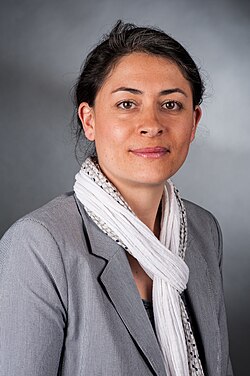
Christina-Johanne Schröder (born 6 December 1983 in Bremen) is a German politician of Alliance 90/The Greens.
- Facts0
- Drivers0
- Indicators0
Christina-Johanne Schröder (born 6 December 1983 in Bremen) is a German politician of Alliance 90/The Greens.
Christina-Johanne Schröder (born 6 December 1983 in Bremen) is a German politician of Alliance 90/The Greens. She lives in Berne, in the Wesermarsch district of Lower Saxony, where she grew up. She sat in the Bundestag throughout its 20th legislative period (2021–2025), elected on the Green state list for the constituency of Delmenhorst–Wesermarsch–Oldenburg-Land. In that parliament she was the Green group’s spokesperson for housing, urban development, building and municipalities, and a full member of the committee of that name and of the Committee on Food and Agriculture.
She passed the Abitur at the grammar school in Brake in 2003. From 2003 to 2008 she studied German and history towards a teaching qualification at the universities of Oldenburg, Wuppertal and Bremen, and from 2008 to 2013 she worked as a self-employed retail merchant. She then took a bachelor’s degree in social sciences at the University of Oldenburg (2013–2015) and a master’s programme in political management, public policy and public administration at the NRW School of Governance of the University of Duisburg-Essen (2015–2017). She has been married since 2009. From 2018 to 2021 she managed the office of Landtag member Christian Meyer, and from 2019 to 2021 she was a specialist adviser to the Green group in the Landtag of Lower Saxony.
Schröder has been a member of the Wesermarsch district council since 2011. She was the Green direct candidate in constituency 28 at the 2017, 2021 and 2025 federal elections. In 2017 the Greens received 12,933 first votes there (7.7 percent); placed seventh on the state list, she missed election to the Bundestag. In 2021 she stood third on the list adopted that May and took 21,202 first votes (13.1 percent). The constituency seat went to the Social Democratic Party of Germany with 36.7 percent of the first vote, and Schröder entered through the state list.
At the election of 23 February 2025 she was ninth on the state list chosen in December 2024 and received 18,021 first votes (9.8 percent). The direct mandate went to Bastian Alfons Ernst of the Christian Democratic Union of Germany, with 29.3 percent. The Greens’ Lower Saxony second-vote share was 11.5 percent, and the party’s state group in the 21st Bundestag comprised the eight candidates in list places one to eight. Schröder’s term therefore ended with the 20th Bundestag. In autumn 2026 the Nordwest-Zeitung named her among the members leaving the Wesermarsch district council.
Christina-Johanne Schröder was born on 6 December 1983 in Bremen. She states that she has lived since then in the Wesermarsch, the Lower Saxony district along the lower Weser. A March 2021 profile in the Weser-Kurier reported that she grew up in Berne, the municipality where she still lived. Berne is a dispersed municipality of 85.20 square kilometres in the south of the district, bordered by Lemwerder, Hude, Ganderkesee, Elsfleth and Bremen; the municipality counted 6,176 inhabitants on 1 January 1980 and 6,921 on 1 January 2000.
The same profile described her parents as self-employed and without university degrees, and reported that they had not wanted her to study politics. She told the paper that argument about public affairs began at home, in discussions of the newspaper at breakfast. In 2021 the Weser-Kurier wrote that she and her husband were living in her parents' old, listed house in Berne. On her own site she says that she has been married since 2009 and that the couple live in an old farmhouse in Berne which they renovated themselves. In her May 2021 application to the Lower Saxony Greens she wrote that she had long shared a multigenerational house with her husband, her father and her grandmother, whom she cared for. Periods of study took her away: the newspaper reported that she had been in Essen and Wuppertal for university and had always come back to Berne.
In 2003 she passed the Abitur at the Gymnasium Brake, the academic secondary school in the district town of Brake. She later told the Weser-Kurier that she had already been politically active at school, as a school spokesperson and on demonstrations against lorries in the locality and for a school library, and that she had always liked demonstrating. She also described later participation in anti-nuclear protests and said that she had always voted for Alliance 90/The Greens.
From 2003 to 2008 she studied German and history on a teacher-training course at the universities of Oldenburg, Wuppertal and Bremen. The archived Bundestag biography, which rests on members' own information, and the curriculum vitae in her 2021 Greens candidacy both list those years of study and do not name a state examination or any other completed teaching qualification. They do record a bachelor's degree for the social-sciences course she took later. She told the Weser-Kurier that she had begun with teacher training precisely because her parents had opposed a politics degree, then worked for a time in retail, and only afterwards completed social sciences.
From 2008 to 2013 she was a self-employed merchant in the retail trade. The candidacy curriculum vitae places that work in Brake. From March 2013 to October 2015 she studied social sciences at the University of Oldenburg; both the Bundestag biography and her candidacy CV record the result as a Bachelor of Arts. In the candidacy text she wrote that the social-sciences course was her first close encounter with agricultural policy in a European setting, and that she had researched how federal and Land governments differed in shaping the European Union's Common Agricultural Policy. The Weser-Kurier likewise traced her later interest in farm policy to a student research paper on European Union agricultural policy, which she connected both to the complexity of the rules and to living in Berne, where she saw cattle disappearing from the pastures and barns growing larger.
From October 2015 to September 2017 she followed the master's programme in political management, public policy and public administration at the NRW School of Governance of the University of Duisburg-Essen. The university describes that course as a four-semester, numerus-clausus Master of Arts taught at the Duisburg campus by the Institute of Political Science, combining policy analysis, public administration and political communication with a compulsory internship and preparation for work in ministries, parties, associations and administration. Inside that period, from February to May 2017, she held an administrative internship at Lower Saxony's representation to the European Union, focused on agriculture and the environment.
The Bundestag biography, again from her own information, gives her occupation as political scientist. Abgeordnetenwatch lists her professional qualification as social scientist and her place of residence as Berne. In March 2025, asked there which vocational qualification she held, she referred the questioner to the curriculum vitae on her website.
Schröder joined Alliance 90/The Greens in 2009. In the local branch for Berne and Lemwerder she served as board spokesperson, a role the Weser-Kurier recorded alongside her district-council work. In 2015 the Lower Saxony state association made her one of its delegates to the federal Länderrat.
On 14 October 2016 the Greens’ Weser-Ems regional conference (Bezirkskonferenz), meeting in Bad Bentheim with delegates from 18 district associations, elected a speaker team for two years. Schröder was chosen for Wesermarsch, with Vera Eirich (Leer), Bettina Pinzon-Assis (Delmenhorst), Sebastian Bracke (Osnabrück), Reinhard Prüllage (Grafschaft Bentheim) and Simon Schütte (Oldenburg-Land). The same meeting discussed climate protection, the regional energy transition and the recent local elections.
On 8 December 2020, because indoor meetings were hardly possible under coronavirus rules, the Wesermarsch district association elected a new executive outdoors on the Breithof in Berne. Schröder, Ahmet Akdogan and Ulrich van Triel, together with the re-elected treasurer Jürgen Janssen, were chosen to lead the association.
The district’s council information system lists Schröder as a Green member of the Kreistag from 1 November 2011 to 31 October 2016 and again from 1 November 2016 to 19 October 2026. In the first of those terms she was deputy chair of the Green group and sat on the district committee (Kreisausschuss) and on the committees for finance, personnel and equality and for the economy, tourism and digitalization; from March 2013 she chaired the working group on demographic change.
From 18 June 2018 the same register places her on the committee for planning, building and mobility, and from 1 November 2021 on the committee for the environment, nature conservation and agriculture and in the assembly of the Oldenburgisch-Ostfriesischer Wasserverband. She told the Weser-Kurier that her first Kreistag motion concerned the use of party buses, which she presented as typical of the everyday local subjects that had interested her.
She also held a seat on the municipal council of Berne. In October 2021, after she entered the Bundestag, she gave up that mandate. She said that pursuing building and agricultural policy in Berlin as well would be one parliament too many, and that she had decided “with a heavy heart” to leave the local council. Jürgen Graupner succeeded her. She kept the Kreistag seat, which by then she had held for ten years.
From 21 November 2016 she was a voting member of the supervisory board of Wirtschaftsförderung Wesermarsch GmbH, the district development company in Brake. At a closed meeting on 17 June 2020 she was the only woman on the board. After she asked whether the doors could be opened on a hot day, the chair, Hans-Dieter Beck of the Christian Democratic Union, a lawyer and notary from Brake, replied, “Sie können sich auch leichter anziehen” (“You could also dress more lightly”). She described the remark as sexist discrimination that denied women a professional setting in local politics and called for his resignation. Beck admitted the sentence, called it objectively out of line and said he had apologized to her and before the shareholders’ meeting. That meeting, chaired by deputy Landrat Marcel Schmikale, found that Beck had behaved wrongly, while rejecting the suggestion of structural sexism across the district’s bodies. In October 2020 Schröder gave up the seat. She said the board had criticized her for harming the company and had not criticized Beck.
From 2018 to 2021 Schröder was office manager in Hanover for Christian Meyer, a Green member of the Landtag of Lower Saxony. The Weser-Kurier described him in March 2021 as deputy chair of the Landtag group, and in July 2020 as the state’s former agriculture minister, and identified her as head of his office. The Bundestag biography separately records her as a specialist adviser (Fachreferentin) to the Green Landtag group from 2019 to 2021. In March 2021 she was reported to be the group’s adviser on housing and building. She has said that the post also included parental-leave cover in agriculture, food, animal protection and municipal policy. Discussing later cooperation with other members from the north-west, she said that Susanne Menge had previously been one of her superiors.
Christina-Johanne Schröder was the candidate of Alliance 90/The Greens in Lower Saxony constituency 28, Delmenhorst – Wesermarsch – Oldenburg-Land, at the federal elections of 2017, 2021 and 2025. The constituency covers the independent city of Delmenhorst and the districts of Oldenburg and Wesermarsch. The Bundestag is elected by personalised proportional representation: the first vote chooses a constituency candidate, and the second vote, cast for a party’s state list, decides how many seats that party receives. From the 2025 election, a party candidate who leads the constituency takes the seat only if it is also covered by the party’s second-vote allocation in that Land.
At a nomination meeting in Hude on 12 January 2017, Schröder was chosen as the Green direct candidate with 73 percent of the vote; Herbert Schuster, who lives in Hude, received 27 percent. She said she wanted a strong first-vote result, but that a high place on the Lower Saxony list was the more realistic route into parliament, and that she would seek at least seventh place. She was in fact placed seventh.
In the 2017 federal election the Christian Democratic Union won the constituency with 34.1 percent of the first votes (57,390), and the Social Democratic Party was second with 32.9 percent (55,326). Schröder received 12,933 first votes, 7.7 percent, 1.6 points more than in 2013, behind the CDU, the SPD, the Free Democratic Party (15,208 votes, 9.0 percent) and the Alternative for Germany (15,122 votes, also 9.0 percent). Green second votes in the constituency were 13,525, or 8.0 percent, 0.1 points below 2013. Turnout was 74.7 percent, with 170,194 voters out of 227,696 eligible. Across Lower Saxony the Greens took 8.7 percent of the second votes. The state association said that result would again return six Green members from Lower Saxony, so seventh place did not yield a seat. The Weser-Kurier later described the failure to enter as narrow.
On 5 December 2020 a Green meeting renominated Schröder for constituency 28. In a secret ballot she defeated Dr Thomas Wilde of Wardenburg by 56 votes to 17. Because indoor rooms were closed during the pandemic, the vote was held outdoors beside the town hall in Berne. At a state delegate conference in Oldenburg at the end of May 2021, about 270 delegates, some taking part online, placed her third on the Lower Saxony list, after Filiz Polat and Sven-Christian Kindler. The ballot was to be confirmed by post until 15 June.
At the 2021 federal election on 26 September, Susanne Mittag of the SPD won the constituency seat with 36.7 percent of the first votes (59,377). The CDU candidate, Philipp Albrecht, was second with 24.9 percent (40,410). Schröder finished third, with 21,202 first votes, 13.1 percent, a gain of 5.4 points. Green second votes in the constituency rose to 23,973, or 14.8 percent, up 6.8 points, also third behind the SPD (34.3 percent) and the CDU (22.6 percent). Turnout was 72.2 percent.
Statewide the Greens received 16.1 percent of the second votes, 7.4 points more than in 2017. The state party reported that 13 Green members from Lower Saxony would sit in the 20th Bundestag, more than double the previous six, and listed Schröder third among them, in the same order as the state list. She did not need the constituency seat: the Bundestag records her mandate as having come through the Lower Saxony state list for constituency 028, for the term 2021–2025.
On 24 October 2024, about 60 Green members from the district associations of Oldenburg-Land, Wesermarsch and Delmenhorst met at the Kulturmühle in Berne and renominated Schröder without an opposing candidate, with 94 percent approval. She aimed to be given fourth place on the state list at the conference then expected in February. The 20th Bundestag was dissolved early, and the federal president set the election for Sunday, 23 February 2025. The list was therefore adopted sooner, on 14 December 2024, when 228 delegates in Hanover nominated 31 candidates. Schröder, for the Wesermarsch district association, was placed ninth, immediately after Alaa Alhamwi.
In constituency 28, Bastian Ernst of the CDU won with 29.3 percent of the first votes (53,762). Hamza Atilgan of the SPD was second with 26.5 percent (48,627), and the AfD third with 19.2 percent (35,331). Schröder received 18,021 first votes, 9.8 percent, down 3.3 points, and was fourth. Green second votes were 18,435, or 10.0 percent, down 4.8 points, also fourth, behind the CDU (26.1 percent), the SPD (23.8 percent) and the AfD (19.5 percent). Turnout rose to 82.2 percent. In Lower Saxony as a whole the Greens fell to 11.5 percent of the second votes, 4.6 points less than in 2021.
The 2025 reform capped the Bundestag at 630 seats and abolished overhang and compensatory mandates, so a constituency winner is seated only when the party’s second votes cover the seat. Lower Saxony’s delegation shrank from 74 members to 65, of whom eight were Greens, all elected from the state list: places one to eight, ending with Alhamwi. Ninth place was outside that allocation. Schröder neither won the constituency nor returned through the list, and her membership ended with the 20th Bundestag.
Christina-Johanne Schröder sat in the Bundestag for the whole of its 20th legislative period (2021–2025) as a member of Alliance 90/The Greens, elected on the Lower Saxony state list for constituency 28, Delmenhorst–Wesermarsch–Oldenburg-Land. The archived biography records her as an ordinary member of two standing committees and of no others: the Committee on Housing, Urban Development, Building and Local Government (Ausschuss für Wohnen, Stadtentwicklung, Bauwesen und Kommunen) and the Committee on Food and Agriculture (Ausschuss für Ernährung und Landwirtschaft). On the housing committee, abgeordnetenwatch lists Sandra Weeser of the Free Democratic Party as chair and Kassem Taher Saleh as the Green whip (Obmann); Schröder appears there as a member, not as whip.
A separate office was the spokespersonship for housing, urban development, building and municipalities of the Green Bundestag group. The group’s own directory, in a brochure produced in May 2024, still gave her that title, marked both committee seats as ordinary memberships, placed her in its ecology subject area (Fachbereich 2), which included the working group on building and housing, and listed a Berlin Bundestag office and a constituency office at Bahnhofstraße 10 in Delmenhorst. She was not the group’s agriculture lead: the same directory names Renate Künast as spokesperson for food and agriculture, and abgeordnetenwatch lists Karl Bär as the Green whip on that committee, with Schröder again as an ordinary member.
In the chamber she took the floor for the group on business from those committees. On 10 November 2022, in the 66th sitting, she spoke for the Greens in the second and third reading of the bill to raise housing benefit (Wohngeld-Plus-Gesetz). On 15 June 2023, in the 109th sitting, she spoke for the group on the government’s bill to strengthen digitalization in land-use planning (Bauleitplanverfahren) and to amend related rules, after the housing committee had reported. The same protocols record shorter interventions by her during those debates. The archived biography links to the term’s collected speeches and recorded votes.
On 16 December 2021 the Nordwest-Zeitung reported that Schröder, who had entered parliament that autumn, was joining the extended executive of the Green Bundestag group (erweiterter Fraktionsvorstand) and becoming its spokesperson for housing, urban development, building and municipalities. In a Weser-Kurier interview published on 8 February 2022 she said she had been elected group spokesperson for that portfolio and that she also sat on the Committee on Food and Agriculture.
In the group’s account, that extended executive is the twelve-member faction executive plus the heads of its 25 working groups—elected with their deputies by the group assembly for the legislative period—and it discusses coalition bills before the full group, meeting on Mondays of sitting weeks and again on Tuesday if needed.
Members publish outside posts under the Bundestag’s rules of conduct. Where income is notifiable, the gross amount is published; costs are not deducted, and the figure is not taxable income. Schröder’s file for the 20th term lists posts and earlier jobs but no income brackets. Abgeordnetenwatch carries the same entries, likewise without amounts.
Before the mandate the disclosures name two posts in Hanover: office manager to Christian Meyer, then a member of the Landtag of Lower Saxony, and policy adviser (Referentin) to the Green group in that Landtag.
Offices dated to the parliamentary term are a seat on the supervisory board of FBS-Fähren Bremen-Stedingen GmbH in Bremen until 1 November 2021; an honorary seat on the supervisory board of Wirtschaftsförderung Wesermarsch GmbH in Brake; from 30 March 2023 an honorary seat on the advisory board of Verband Wohneigentum e.V. in Bonn, which the file enters both under companies and under associations; membership of the Wesermarsch district council (Kreistag); an honorary seat in the shareholders’ meeting of the Oldenburgisch-Ostfriesischer Wasserverband (OOWV) in Brake; and, until 28 September 2023, an honorary alternate seat on the foundation council of the Bundesstiftung Bauakademie in Berlin.
In the 20th Bundestag (2021–2025), Christina-Johanne Schröder was the Alliance 90/The Greens group's spokesperson for housing, urban development, building and municipalities. In the traffic-light coalition she treated faster building, sought by the Social Democratic Party and the Free Democratic Party, as acceptable only alongside the tenancy and land measures in the coalition agreement.
On 10 November 2022 she spoke for the Greens on the Wohngeld-Plus law, calling the higher Wohngeld one element of household security and saying more than two million households would benefit, especially single parents and pensioners. The federal government put €18.15 billion into social housing for the Länder through 2027 and said at least 100,000 new social homes a year were needed. In a December 2024 essay she wrote that the shortage had reached smaller towns, blamed privatisation and Union-led governments for halving a stock of about two million social homes between 2005 and 2021, and said about €20 billion a year went on housing costs and Wohngeld instead of easing the market. She said the coalition and the Länder were spending €47 billion on social housing, but that most cheap lets ended after ten to twenty years, and that Chancellor Olaf Scholz had not delivered the tenancy reform or the 400,000 new homes a year promised in 2021. Her stated alternative was conversion, added storeys and reuse, renovation to cut heating costs, closure of the furnished-let loophole, a rent freeze in the tightest markets, less land speculation, a stronger municipal pre-emption right, and harder action on excessive rents, plus a non-profit segment on the Vienna model for cooperatives, municipal providers and firms, including staff housing.
On 18 October 2024 the Bundestag wrote "promotion of non-profit housing purposes" into the Fiscal Code from 1 January 2025. Foundations, associations, municipal companies and social-economy firms qualify if the rent stays below the local market level and income, checked only at the start of the lease, is within five times the social-assistance rate, or six times for single people and single parents. The housing ministry estimated €1,000 to €2,000 of tax relief per dwelling a year and said the ceilings could cover about 60 percent of households; unlike social housing, the reduction would not expire. Investment allowances in the coalition agreement were left out. The FDP did not want the established industry disadvantaged; Green deputy Hanna Steinmüller called the act a cut-price version, Left deputy Caren Lay a labelling exercise, and Deutscher Mieterbund president Lukas Siebenkotten said it would mainly help bodies already non-profit.
In November 2024 she told abgeordnetenwatch that rent-brake rules in Berlin, North Rhine-Westphalia and Hesse would lapse in mid-2025 and in further Länder by year's end, blamed the FDP for blocking an agreed extension and Scholz for not leading, and listed a lower cap on increases in existing tenancies (Kappungsgrenze), a longer grace period for arrears, and limits on furnished lets and index-linked rents. Tagesschau reported the group's price for the building-code bill as extending the brake to 2029 and capping rises at 11 percent over three years.
Green ministers had joined the cabinet in approving a draft law on integrated urban development that amended the Baugesetzbuch. At first reading on 10 October 2024 the government said municipalities should be able to depart from binding plans, densify, add storeys, shorten plan-making and require infiltration or green roofs, and that the bar on converting rental flats into owner-occupied flats should last two more years. The centrepiece was a temporary § 246e, which Scholz had called a "Bau-Turbo": until the end of 2027, in markets designated as tight, a municipality could depart from the code for buildings of at least six dwellings, extensions that created homes, and changes of use to housing.
Schröder said faster planning, reuse and building were needed, including changes such as those in §§ 31 and 34, but that a pre-emption right in social-preservation areas (Milieuschutzgebiete) and an open-ended ban on conversions were missing despite the coalition agreement. Tax relief for the property industry, she said, had not helped municipal housing companies. The record has her accusing Scholz and housing minister Klara Geywitz of promoting "unsoziales Bauen" with a "Spekulationsturbo", numbered in the transcript § 264e—the draft's rule is § 246e—and refusing agreement until the tenancy reform came. She cited an appeal by the Mieterbund, NABU, Deutsche Umwelthilfe, the Federal Chamber of Architects and the DGB, and told ARD that profit-seeking firms, not people seeking affordable or social housing, would gain, with a risk of luxury building on the last parks and playgrounds. An alliance including the DGB, the Mieterbund and the architects' chamber called the turbo legally questionable because it would cut local participation. Green colleague Anja Liebert warned of large estates on open land without the planning and infrastructure to match.
The building ministry said departures were allowed only as far as required. FDP spokesman Daniel Föst pointed to a municipal veto and the 2027 end date and called Green distrust of local administration misplaced; Schröder interjected that municipalities lacked staff and that the German Association of Towns and Municipalities was opposed. CDU/CSU deputy Enak Ferlemann called the sunset self-defeating and offered support for a longer turbo; Jan-Marco Luczak wanted it nationwide, and Union deputies called her speech notice that the coalition was over.
On 3 March 2023, on an amendment to the Spatial Planning Act tied to an EU emergency regulation, she argued that faster permits for wind, grids, solar and storage still depended on more municipal staff. She said the bill put brownfield ahead of new land take, eased departures from spatial planning targets and marked areas for peatland and natural climate protection, while a resolution told the coalition to look harder at a limit of 30 hectares a day of new settlement and transport land; species protection, she said, was not being cut, and rewetting peatland should itself be accelerated. The CDU/CSU objected that the opposition saw the emergency text only hours before committee.
A 2021 judgment of the Federal Administrative Court had held the Milieuschutz practice unlawful. DEMO reported that Geywitz and the Association of German Cities wanted a new rule, that the FDP-led justice ministry blocked it, and that the draft therefore left unrestored the pre-emption right she had called a gap. On 6 June 2024 she said disaster protection sat with the municipalities and that honorary local office was the base of their self-government.
In the 20th Bundestag (2021–2025), Christina-Johanne Schröder of Alliance 90/The Greens, from Berne in the Wesermarsch in Lower Saxony, was a full member of the Committee on Food and Agriculture and of the housing committee; she was her group's spokesperson only for housing.
On 2 June 2022, in the second reading of the agriculture-ministry budget, she treated drought, lost soil water storage and flooding as climate damage already hitting farms, and blamed earlier CDU/CSU-led policy for farm closures. She presented the draft as a longer path: a mandatory state animal-husbandry label, changes to building and immission law, €1 billion she said was booked for higher-welfare barns but still lacked permanent financing, €10 million for coastal fisheries facing marine-diesel prices, and €1.6 million more for protein crops.
Peatland entered the same committee on 25 January 2023, during consideration of the federal National Peatland Protection Strategy. Schröder said her constituency, Delmenhorst–Wesermarsch–Oldenburg-Land, had districts with more peat than marsh, so rewetting would cover much highly productive dairy land, but that farmers had recognized the problem and were helping redesign a landscape drained for centuries. She described boards from sedges, reed canary grass and reed as low-embodied-energy insulation, citing her figure that more than 85 percent of buildings still needed it. Free Democratic member Gero Clemens Hocker, whose Osterholz–Verden seat includes the Teufelsmoor, backed moving forward but warned that compensation would not replace lost farmland or a new competitive disadvantage.
The dispute was sharper in the Wesermarsch, where drained peat grassland carries much of the dairy economy. On 22 July 2024 Schröder told the Nordwest-Zeitung that peat soils caused almost 18 percent of Lower Saxony's climate-damaging emissions and that rewetting was indispensable and also a chance for farming. The environment ministry, using the State Authority for Mining, Energy and Geology, had just put 2020 emissions from peat and other carbon-rich soils at 15.8 million tonnes of CO2-equivalent, about 18 percent of the state's greenhouse gases. State climate law requires a cut of 1.65 million tonnes a year by 2030; environment minister Christian Meyer presented the study Moore in Niedersachsen as a guide to voluntary cuts.
She conceded intensive dairying would probably not continue everywhere, and pointed to paludiculture—reed, cattail (Typha) or peat moss—as continued use. Typha for insulation, she said, would cut emissions, store carbon and replace higher-carbon materials; an "Allianz der Pioniere" including Toom, Procter & Gamble and Tengelmann wanted such products, grassland could be ploughed for them, and peatland photovoltaics belonged in what she called a "bouquet" of uses and subsidies.
Farm bodies had already quantified the risk. On 13 February 2023 the Nordwest-Zeitung reported figures Franz Jansen-Minßen of the Grünlandzentrum Niedersachsen/Bremen and the Kreislandvolk gave the district council: about 13,400 hectares, roughly 30 percent of district grassland, were peat under permanent grass for milk, and a full rise in water levels would, they said, end that milk production, costing 250 to 420 jobs directly and 2,100 to 3,350 with upstream and downstream work. Jansen-Minßen called a timetable he described as ending peat emissions by 2045 unrealistic for land drained over centuries.
The next day she called rewetting a "great opportunity," said dairy farming should remain because "a job is also a passion," and pointed to the "Zukunftsregion Moor" and Osterholz's model-region bid while inviting farmers to test wet use. In July 2024 she called warnings from dike and drainage associations—that rewetted peat could not take heavy rain—a "false narrative," saying intact peat stores more water and that the study was a planning tool, not an order to rewet every parcel. Pumps and sluices, she argued, still needed federal climate money, since drainage is otherwise local or state business and subsidies had to clear European Union rules.
On 19 November 2024 she named, on Abgeordnetenwatch, the InAWi guideline for organizing the transition and a machinery grant run for the environment ministry by Landwirtschaftliche Rentenbank: up to 65 percent of costs and up to €100 million for farms, contractors, machinery rings and recognized conservation groups. "We do not demand that dairy farmers have to retrain," she wrote, "but we want to support young farms that want to practise wet agriculture (paludi)."
On 16 June 2023 she spoke for the Greens on the Animal Husbandry Labelling Act and a law easing barn alterations, calling the Act, to agriculture minister Cem Özdemir, a "milestone" and describing herself as from "the region with the highest livestock density in Germany." The label would start with fresh pork and later cover catering, piglets, other species and processed goods; she tied it to building-code changes with Social Democratic and Free Democratic colleagues, and to immission law and subsidies, and said the package would secure German production. CDU/CSU member Artur Auernhammer called it a "botched law" that ignored the Borchert Commission's financing advice, because buyers wanted higher welfare but often would not, or could not, pay. Her June 2022 budget speech had defended the coastal-fisheries diesel aid as support for family cutter businesses.
On 26 November 2024 she wrote that agriculture was "largely on course," that a forest law had fallen with the coalition, and that the land-use (LULUCF) sector had become a source rather than a sink. Drained peat, she stated, caused about 7 percent of Germany's greenhouse gases on about 4.5 percent of the land and was agriculture's largest emissions driver; wet production and peatland photovoltaics, she wrote, could cut emissions and add farm income.
In the 20th Bundestag, Christina-Johanne Schröder’s roll-call votes on energy followed the Alliance 90/The Greens. On 7 July 2022 she voted for the onshore-wind law requiring about 2 percent of Germany’s land to be designated for wind power and for shorter planning. On 26 April 2024 she voted for the Solar Package I amendment to the Renewable Energy Sources Act, aimed at raising annual photovoltaic additions toward 22 gigawatts by 2026. In a February 2025 Nordwest-Zeitung questionnaire she said those federal area targets still left turbine siting to municipal councils.
On nuclear power she accepted a short extension and rejected a longer one. In August 2022 she called an “exit from the exit” a “red line,” saying reactors could replace less than 1 percent of gas, which was used mainly for heat and process energy, and that longer operation would hinder green hydrogen of interest to the Wesermarsch. On 11 November 2022 she voted for the government bill keeping the last three reactors in stretch operation until 15 April 2023; nine Green members voted against it. On 31 March 2023 she voted against a CDU/CSU motion to run Isar 2, Neckarwestheim 2 and Emsland until the end of 2024. After the shutdown she said Germany was not a European outlier among countries leaving nuclear power or never having used it; the paper noted that Belgium had postponed its phase-out. On 7 July 2023 she voted for the law expanding liquefied natural gas import infrastructure, including a terminal at Mukran on Rügen; seven Green members voted no.
In that February 2025 questionnaire for Delmenhorst–Wesermarsch–Oldenburg-Land she called for a single citizens’ health insurance, rural care including community nurses, and a statutory pension level of at least 48 percent. She said treating asylum, migration control and security as one issue was a mistake, and that further restrictions sought by the CDU, FDP and AfD strengthened the far right. She rejected another deepening of the Weser, saying supporters had falsely promised that damage to dikes, nature and agriculture would be compensated. She called the coastal Bundesautobahn 20 the most climate-damaging motorway because it would cross peat landscapes, and said it was technically barely feasible and too expensive. In November 2024 she wrote that it then had no financing.
On 31 January 2025 she voted against the CDU/CSU influx-limitation bill, which would have suspended family reunification for people with subsidiary protection; it failed, 349 to 338. The same day she voted for the SPD–Green bill giving people affected by gender-based and domestic violence a legal claim to protection and counselling; it passed with 390 votes in favour and none against. On 12 March 2025 she said she would not vote for the Union–SPD debt package as then drafted, calling the special fund a “treasure chest” for clientele politics and asking that new borrowing fund only additional investment in infrastructure, climate-friendly mobility and education. On 18 March she voted for the constitutional amendment that kept defence spending inside the debt brake only up to 1 percent of gross domestic product and authorised a credit-financed special fund of up to €500 billion for additional infrastructure and climate neutrality by 2045. On 16 December 2024 she abstained on Chancellor Olaf Scholz’s confidence motion, which failed 394–207 with 116 abstentions.
After Ricarda Lang and Omid Nouripour announced the party leadership’s resignation in September 2024, she said they had “taken responsibility” and urged the party to keep Lang’s “strong social agenda.” In August 2026 she announced a district-council motion on women’s health, citing long waits and the loss of maternity care in Nordenham and at St. Bernhard Hospital in Brake.
Accounts of Schröder’s record, and of her exit from the Bundestag, were carried by papers in the Wesermarsch and around Oldenburg. In constituency 28 (Delmenhorst–Wesermarsch–Oldenburg-Land) she received 18,021 first votes on 23 February 2025, 9.8 percent and 3.3 points below 2021; Alliance 90/The Greens took 10.0 percent of second votes, down 4.8 points, and the direct mandate went to Bastian Ernst of the Christian Democratic Union with 29.3 percent. The Nordwest-Zeitung wrote that the constituency was losing two advocates in Berlin, Schröder and Christian Dürr of the Free Democratic Party, and would have one member rather than three, and that she had missed another term “ganz knapp” from ninth place on the Lower Saxony list. She called the result a disappointment after an intense campaign, said losses of progressive voters to Die Linke should give the party pause, and added that she would remain “ein politischer Mensch” and loyal to local politics. The Kreiszeitung Wesermarsch quoted her that failing to return “gehört zum Business,” and reported that she would have to look for a new job.
A Kreiszeitung portrait just before the vote presented her as wanting a loophole-free rent brake and as standing fully behind the Building Energy Act; she said most of what people had read about the “heating law” was untrue. On peatland, a July 2024 Nordwest-Zeitung interview set her against dairy farmers who saw rewetting as a threat to Wesermarsch grassland: she called that account exaggerated, pointed to paludiculture and peatland solar, and described flood warnings from dike and drainage associations as a “Falscherzählung.” In early October 2026 the paper still listed “Ex-Bundestagsabgeordnete Christina-Johanne Schröder” from Berne among the “politische Schwergewichte” leaving the Kreistag, with former Landtag member Horst Kortlang and the Green Ina Korter.
She stood again for the district council. At a Green meeting in Rodenkirchen on 21 June 2026 she was placed second on the list for Berne, Elsfleth and Lemwerder, behind Brigitta Rosenow. On 13 September, 44,987 of 71,322 people entitled to vote cast ballots, a turnout of 63.1 percent. The state statistical office recorded 18,287 votes and six of 42 seats for the Greens; the Social Democratic Party won 11 seats, the CDU 10, the Alternative for Germany 8, the Unabhängige Wählergemeinschaft 3, and Die Linke and the Free Democrats 2 each. The Braker Zeitung reported that the district election committee confirmed that result on 17 September, putting the Greens at 14.22 percent, and noted that these elections have no five-percent hurdle.
Schröder was not returned. The Nordwest-Zeitung stated that she, like Kortlang, had not gathered enough votes, and that only 14 of 42 members of the 2021–2026 council continued. Ahead of the constitutive sitting on 2 November 2026 in Brake, it reported that the SPD, CDU and FDP would form a majority group. At the old council’s last sitting, Landrat Stephan Siefken called trust “nur geliehen,” and he was due to host the farewell, including Schröder, on 16 November 2026 at Wiechmanns Hotel in Brake.
The 21st Bundestag convened on 25 March 2025. The next day the Weser-Kurier profiled what it called the “Neustart der Bernerin”: she described herself as out of work but unhurried after about three and a half years of days of at least 14 hours, with job offers, an April holiday, and work on her garden and house in Berne. She had skipped the official farewell and was going back to Berlin to take leave of staff. Citing Renate Künast’s advice to give up the habit of appointments, she said she would decide in about two years whether to run for the Bundestag again. She told the paper that departing members receive less than is often assumed—three months of transition pay and a pension claim of 2.5 percent of the last parliamentary salary—and criticised Friedrich Merz over what she called the Union’s change of course on the debt brake, while welcoming late concessions on Ukraine and on climate and infrastructure spending.
The same interview reported her election to the Lower Saxony Greens’ Parteirat, already looking toward the 2026 local elections, and her decision to remain on the Kreistag. The state party still listed her as a Parteirat member in November 2026. The district seat she had held since 2011 ended with the September 2026 election.
Ranked by shared high-impact facts, then explicit ties, then shared drivers.
 Omid NouripourOmid Nouripour (born 18 June 1975) is a German politician…Affiliated
 Friedrich MerzFriedrich Merz has been Chancellor of Germany since May…Affiliated
 Bastian ErnstBastian Alfons Ernst (born 30 January 1987 in Delmenhorst)…Affiliated
 Filiz PolatFiliz Polat (born 11 July 1978 in Bramsche) is a…Affiliated
 Olaf ScholzOlaf Scholz was Chancellor of Germany from December 2021…Affiliated
 Renate KünastRenate Künast (born 15 December 1955 in RecklinghausenAffiliated
How the record is sourced and how the score is derived.
The score is formula-derived (Factrail formula v1, version 1.0.0), not an editorial verdict. Read the methodology.
By the Factrail desk · Method: how we source and score · Last reviewed
Dispute a fact on this pageNamed here, or represent someone who is? Request a right of reply.
People and organizations as listed in the Related section of this page; facts, drivers and the pages that name it as listed in the blocks here. Counts, not a rating.