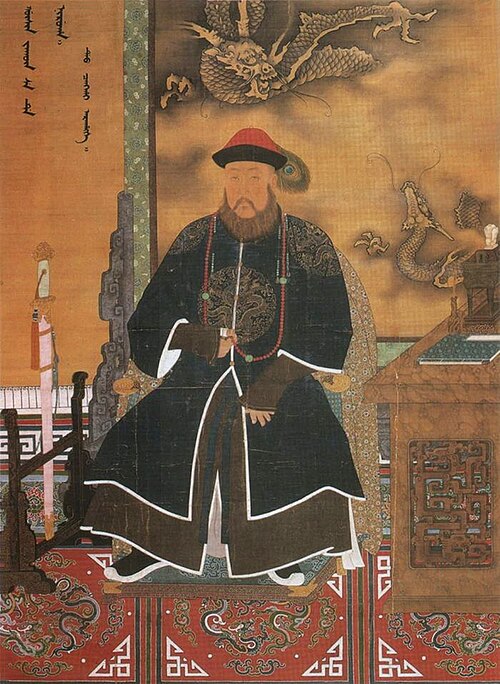
Dorgon
Dorgon (November 17, 1612 – December 31, 1650), formally Prince Rui of the First Rank, was a Manchu prince, statesman…
- Facts0
- Drivers0
- Indicators0
Dorgon (November 17, 1612 – December 31, 1650), formally Prince Rui of the First Rank, was a Manchu prince, statesman…
, formally Prince Rui of the First Rank, was a Manchu prince, statesman, and military commander who served as regent for the infant Shunzhi Emperor from 1644 until his death, effectively directing the Qing dynasty's conquest and early consolidation of rule over China. As the fourteenth son of Nurhaci, founder of the Later Jin state, and half-brother to Hong Taiji, Dorgon rose to prominence through military campaigns and administrative acumen, culminating in his leadership of the allied Manchu-Han forces under Wu Sangui that captured Beijing from rebel leader Li Zicheng on June 6, 1644, thereby ending Ming control of the capital and enthroning his six-year-old nephew Fulin as emperor.
Under Dorgon's regency, the Qing expanded southward, implementing policies to integrate Manchu rule with Chinese imperial traditions while enforcing symbols of submission, such as the 1645 edict mandating Han Chinese men to adopt the Manchu queue hairstyle—shaving the forehead and braiding the remaining hair—on pain of death, which symbolized loyalty but provoked widespread resistance and massacres in non-compliant regions. His administration focused on stabilizing governance by managing gentry-bureaucratic networks, claiming dynastic legitimacy through Ming precedents, and facilitating defections from Ming forces to minimize bloodshed during the transition, thereby laying the foundations for Qing imperial order.
Dorgon's death during a hunting excursion near Chengde—possibly from natural causes or murder—led to posthumous accusations of treason and usurpation, including rumored improper relations with the Shunzhi Emperor's mother, resulting in the stripping of his titles and the flogging of his corpse in 1651 amid factional rivalries at court. These charges were reversed in 1671 and his honors fully restored by the Qianlong Emperor in 1774, reflecting a later recognition of his instrumental role in the dynasty's survival and expansion, though his childless status and authoritarian style had alienated key Manchu nobles like his brother Jirgalang.
Dorgon was born on 17 November 1612 as the fourteenth son of Nurhaci, the Jurchen chieftain who unified various tribes into the Later Jin state in 1616, laying the foundation for what became the Qing dynasty. His birthplace was in the region of Mukden (modern Shenyang), the emerging Manchu capital in southern Manchuria. Nurhaci, born in 1559, rose from tribal conflicts to challenge Ming authority through military organization, banner systems, and alliances, fathering at least sixteen sons from multiple consorts, which positioned Dorgon within a competitive noble lineage of the Aisin Gioro clan.
Dorgon's mother was Lady Abahai (1590–1626) of the Ula Nara clan, captured by Nurhaci in 1613 during campaigns against the Ula tribe and elevated to primary consort; she bore him three sons—Ajige (1605–1651), Dorgon himself, and Dodo (1614–1649)—and was posthumously honored as Empress Xiaoliewu after Nurhaci's death. Abahai's influence grew amid Nurhaci's succession struggles, as she advocated for her sons' interests following his demise in 1626, though her forced suicide shortly thereafter—allegedly ordered by rival princes including Hong Taiji—highlighted the factional tensions within the Manchu elite. Dorgon's full brothers shared his banner affiliations under the elite Plain Yellow Banner, while half-brothers like Hong Taiji (1592–1643), from an earlier consort, dominated early leadership, shaping Dorgon's path amid intra-family rivalries.
Dorgon's military career began in his adolescence following the death of his father, Nurhaci, in 1626, as he accompanied Manchu forces under his half-brother Hong Taiji in expeditions against rival tribes and Ming border defenses. In 1628, at age 16, Dorgon demonstrated notable bravery during the campaign against the Chahar Mongols led by Hong Taiji, earning him the title Mergen daicing, or "Wise Warrior," for his contributions to the Manchu victory that subdued Chahar resistance and incorporated Mongol allies. This engagement marked his initial prominence in Manchu warfare, aligning with broader efforts to consolidate control over Inner Mongolian tribes during the early Tiancong era (1627–1636).
By the mid-1630s, Dorgon had risen to command the Plain White Banner and held the rank of Hošoi Beile, participating in nearly every major Manchu campaign of the period. In 1635, he collaborated with princes Yoto and Haoge to subdue remaining Chahar Mongol forces, further weakening their khan Ejei and facilitating Manchu dominance over the region through submission and tribute arrangements. These victories expanded Manchu influence into Mongolia, providing strategic depth against Ming threats and resources for future offensives.
Dorgon's engagements shifted toward direct confrontations with Ming forces in the late 1630s, as Hong Taiji escalated raids on northern China. Appointed Fêng-ming Ta Chiang-chün (Pacifying the East Grand General) in 1638, he led one of two army groups that breached the Great Wall, sacking over 40 cities in Hebei (Chihli) and Shandong provinces, including key targets like Jinan and Tianjin, before withdrawing to Mukden (Shenyang) with substantial booty and captives. This campaign demonstrated Manchu mobility and firepower, yielding economic gains and intelligence on Ming defenses while avoiding prolonged sieges. In 1642, Dorgon oversaw the extended siege of Songshan and Jinzhou fortresses in Liaodong, which resulted in the surrender of Ming commander Zu Dashou and extended Manchu control up to the Great Wall, setting the stage for deeper incursions. These operations honed Dorgon's tactical acumen in combined banner forces, emphasizing rapid strikes and exploitation of Ming internal weaknesses.
Dorgon distinguished himself in campaigns against Mongol tribes, such as the 1635 pursuit of Chahar leader Ejei under Hong Taiji's orders, alongside other princes, which weakened Mongol resistance and facilitated later submissions. He also took part in the 1636–1637 invasion of Korea, enforcing Qing suzerainty over Joseon after its refusal to recognize Hong Taiji's imperial claims. These operations demonstrated Dorgon's tactical acumen in coordinating bannermen forces against fortified positions and mobile foes.
In 1636, following Hong Taiji's proclamation of the Qing dynasty and adoption of the imperial title, Dorgon was granted the title of Prince Rui of the First Rank, signifying his elite status among the Manchu nobility and command over the Plain Blue Banner. He led subsequent offensives against Ming border defenses, including the 1638 encirclement of Shanhaiguan and the 1641 siege of Jinzhou, where his forces captured 36 castles, secured six surrenders, and took 120,000 prisoners, pressuring key garrisons in Liaodong. By the early 1640s, Dorgon's repeated successes had positioned him as one of Hong Taiji's most trusted commanders, though internal princely rivalries persisted.
Upon the sudden death of Hong Taiji on 21 September 1643 without a designated heir, a succession crisis erupted among Manchu elites, pitting factions loyal to his eldest son Hooge against those supporting his half-brother Dorgon, who commanded significant military loyalty through control of the Plain White Banner and alliances with his full brothers Dodo and Ajige.
Dorgon, despite his strong candidacy for the throne bolstered by battlefield successes and banner influence, refrained from claiming imperial title to avert internal civil war that could undermine Manchu conquest efforts against the Ming, instead maneuvering to install Hong Taiji's six-year-old ninth son, Fulin (later Shunzhi Emperor), as a neutral compromise figurehead. This strategic choice aligned with Dorgon's prioritization of dynastic stability and personal ascendancy, as enthroning a child allowed him to assume regency without direct usurpation.
In late September 1643, Dorgon forged a key alliance with his cousin Jirgalang, another influential prince, convening a council of nobles and banner leaders to endorse Fulin's accession on 10 October 1643, while securing joint regency appointments—Dorgon as senior regent (Prince Rui) and Jirgalang as junior—to legitimize his dominance over court decisions. This arrangement marginalized Hooge's supporters, who held the Two Yellow Banners but lacked unified backing, effectively sidelining Hooge from immediate power.
Dorgon's consolidation extended to suppressing rivals; by March 1648, he orchestrated Hooge's arrest on charges of plotting against Fulin, resulting in Hooge's death in prison that same month, which eliminated a primary threat but sowed seeds of factional resentment among displaced elites. These maneuvers, rooted in banner politics and pragmatic avoidance of fragmentation, positioned Dorgon as the de facto ruler until his own death in December 1650, though they later fueled posthumous accusations of overreach by Jirgalang in 1651.
Following the sudden death of Hong Taiji on 21 September 1643, the Deliberative Council of Princes and Ministers faced a succession crisis amid rival claims, including from Hong Taiji's eldest son Hooge. To avert further instability, the council enthroned Hong Taiji's six-year-old son Fulin as the Shunzhi Emperor on 7 October 1643, appointing Dorgon—Nurhaci's 14th son and commander of two elite White Banners—and Jirgalang, Nurhaci's nephew, as co-regents to govern during the emperor's minority.
Dorgon rapidly consolidated authority by neutralizing potential rivals. In May 1644, leveraging his military influence, he secured Hooge's impeachment on sedition charges, demoting the prince to commoner status and eliminating a direct threat to the regency. Concurrently, tensions with Jirgalang escalated; late in 1644, Jirgalang was downgraded to "Assistant Uncle Regent" with his stipend halved, curtailing his influence while preserving nominal co-regency.
By 1645, Dorgon's dominance was formalized when the Shunzhi Emperor bestowed upon him the title "Uncle Prince Regent" (皇叔父攝政王) in June, granting ceremonial precedence equivalent to an imperial consort and affirming his role as the paramount decision-maker in Qing affairs. This elevation, amid ongoing conquests, underscored Dorgon's transformation from co-regent to de facto sovereign, steering the dynasty through its critical expansion into Ming territories.
Following the victory at the Battle of Shanhai Pass on May 27, 1644, Qing forces under Dorgon's command pursued the retreating army of Li Zicheng and entered Beijing on June 6, 1644, through the Chaoyang Gate. Dorgon immediately moved to stabilize the city by suppressing looting, executing corrupt officials who had collaborated with the rebels, and restoring basic order among the population, which had suffered under Li's brief occupation. This initial occupation allowed the Qing to secure the former Ming capital without significant resistance, leveraging alliances with defected Ming generals like Wu Sangui to legitimize their presence as restorers of stability rather than conquerors.
To formalize Qing rule and relocate the dynastic center from Shengjing (Mukden), Dorgon arranged for the six-year-old Fulin, already designated as emperor in May 1644, to be transported southward in a royal procession. The young monarch arrived in Beijing during the tenth lunar month (October) 1644, with Dorgon personally greeting him at the city gates on October 19. This event signified the official shift of the capital to Beijing, demoting Shengjing to a secondary status while integrating the city's infrastructure, including the Forbidden City, into Qing administration. On October 30, 1644, Shunzhi performed inaugural sacrifices to Heaven and Earth at the Ming Altar of Heaven (Tiantan), a ritual adapted from imperial precedent to affirm dynastic continuity and heavenly mandate.
Under Dorgon's regency, imperial protocols were rapidly established by blending Manchu military hierarchy with selected Ming bureaucratic and ceremonial elements. The court adopted the Forbidden City's layout for audiences and residences, with Dorgon assuming the title of Uncle Prince Regent (Yishu beile) and directing edicts from provisional headquarters. Key measures included retaining Ming civil officials under Manchu oversight, initiating the compilation of legal codes based on prior dynastic statutes, and enforcing attendance at court rituals to symbolize submission. These protocols prioritized administrative continuity to prevent collapse, though tensions arose from Manchu privileges, such as segregated seating in audiences, reflecting the regent's emphasis on banner loyalty over full Sinicization at this stage.
Dorgon's military strategies for conquering the Ming emphasized opportunistic alliances with defecting Han Chinese forces to bypass fortified defenses and exploit the dynasty's internal collapse. In April 1644, following Li Zicheng's capture of Beijing, Dorgon formed an alliance with Ming general Wu Sangui, who commanded 40,000 troops at Shanhai Pass, the critical eastern gateway through the Great Wall. This pact enabled the Qing to combine their 60,000 bannermen with Wu's forces against Li Zicheng's approximately 60,000 rebels, turning a potential siege into a decisive field battle.
The Battle of Shanhai Pass on May 28, 1644, showcased Dorgon's tactical acumen, as a sandstorm concealed Qing deployments, allowing forces to maneuver onto high ground and launch flanking attacks. Wu Sangui's veterans struck the rebel left flank, while Manchu cavalry archers and heavy units disrupted Li's formations, leading to a rout despite numerical parity. Dorgon reserved elite units for pursuit, preventing rebel reorganization and facilitating the Qing entry into Beijing on June 6, 1644, where Shunzhi was enthroned.
Post-Beijing, Dorgon coordinated multi-pronged campaigns to pacify northern China, dispatching bannermen to pursue Li Zicheng's remnants and quell local warlords, incorporating surrendered Ming troops into auxiliary roles to augment Manchu numbers. By 1645, Qing armies advanced southward, suppressing resistances in Shandong and Henan through rapid cavalry strikes and sieges, though southern Ming holdouts required prolonged efforts. These strategies leveraged Manchu mobility and archery superiority against disorganized foes, prioritizing swift consolidation over total annihilation to minimize attrition.
To consolidate Manchu rule over conquered Han territories, Dorgon enforced the adoption of distinctive Manchu cultural markers on the Han Chinese population during his regency. The central policy was the Queue Order, promulgated on July 21, 1645, which required all adult Han men to shave the forehead and temples while braiding the remaining hair into a long queue, emulating the traditional Manchu hairstyle. This decree aimed to symbolize loyalty and submission to the Qing dynasty, serving as a perpetual visible sign distinguishing adherents from Ming loyalists who retained traditional Han topknots.
Enforcement of the queue mandate was immediate and severe, with local officials ordered to compel compliance within ten days, under threat of execution for resisters—the policy encapsulated in the ultimatum to "keep the hair and lose the head, or lose the hair and keep the head." Non-adherence sparked widespread resistance, prompting brutal reprisals such as the 1645 Yangzhou massacre, where tens of thousands perished for defying the order. Dorgon prioritized this tonsure over other customs, viewing it as a durable test of allegiance since hair regrowth demanded ongoing commitment, unlike temporary clothing changes.
Complementing the hairstyle edict, Dorgon mandated the wearing of Manchu-style attire, including riding jackets, boots, and robes, on Han officials and subjects to promote uniformity and erode Ming-era distinctions. These impositions represented coercive assimilation tactics, imposing Manchu practices to foster obedience rather than reciprocal cultural blending, though full enforcement varied regionally due to logistical challenges and ongoing rebellions. By 1649, Dorgon intensified scrutiny, directing the Board of War to root out long-haired elites among the gentry.
Dorgon centralized bureaucratic authority early in his regency by abolishing the practice of assigning Manchu princes to oversee the Six Boards—responsible for civil appointments, revenue, rites, war, justice, and works—thus reducing princely interference and aligning the administration more closely with imperial control. This reform, enacted shortly after his appointment in late 1643, addressed factional rivalries within the Manchu elite and facilitated smoother integration of the inherited Ming administrative framework. He further strengthened the bureaucracy by recruiting defected Ming officials, such as Hong Chengchou, to senior roles, pairing Manchu and Han appointees in a dyadic system to ensure oversight while harnessing Chinese administrative expertise for governance amid conquest. These measures preserved operational continuity but prioritized loyalty, with edicts punishing corruption and mandating surrender of Ming registers to verify official pedigrees.
Economically, Dorgon's policies emphasized stabilization to support military campaigns and post-conquest recovery, largely retaining the Ming land tax system while granting temporary exemptions in newly subdued regions to encourage agricultural resumption and population retention. Following the 1644 entry into Beijing, he fielded numerous petitions for tax relief amid war-induced devastation, approving reductions to mitigate famine and rebellion risks, though enforcement relied on local collaboration with gentry elites. Land redistribution favored bannermen with allocations from confiscated estates, but Han cultivators received protections against excessive seizure to sustain revenue, as seen in 1646 directives halting arbitrary bannermen claims on farmland. These fiscal concessions, coupled with anti-corruption drives targeting extortionate officials, aimed to restore productivity without overhauling the hereditary tax quotas, reflecting pragmatic adaptation to inherited fiscal strains rather than wholesale innovation.
Dorgon was born on November 17, 1612, as the fourteenth son of Nurhaci, founder of the Later Jin (precursor to the Qing dynasty), and his consort Abahai (also known as Ulanara). Abahai, one of Nurhaci's secondary consorts elevated to primary status after his death in 1626, bore three sons: the twelfth son Ajige, Dorgon, and the fifteenth son Dodo. These full brothers formed a close political bloc within the Manchu nobility, with Ajige and Dodo supporting Dorgon's regency after Hong Taiji's death in 1643. Dorgon also had numerous half-siblings from Nurhaci's other consorts, including the prominent half-brother Hong Taiji (eighth son), who ascended as emperor in 1626 and granted Dorgon the title of Prince Rui in 1637 for military service.
Historical records indicate Dorgon had no children, leaving no direct heirs upon his death in 1650; official Qing genealogies explicitly note the absence of sons, leading him to designate his nephew Dorbo (son of Dodo) as successor to his princely titles. This lack of progeny contributed to instability in the Plain White Banner, Dorgon's affiliated Manchu military unit, as succession defaulted to collateral kin.
Details on Dorgon's marriages remain sparse in primary sources, with no verified records of principal wives or consorts producing offspring, likely reflecting his prioritization of regency duties over family establishment amid the conquest of Ming territories. Posthumous political attacks under the Shunzhi Emperor in 1651 ordered the execution or demotion of Dorgon's associates and suppressed aspects of his personal history, potentially obscuring marital alliances. Manchu nobles typically maintained multiple consorts for alliance-building, but Dorgon's case shows no documented unions yielding heirs or notable diplomatic ties beyond familial bonds within the Aisin Gioro clan.
Historical rumors have persisted regarding a possible romantic or sexual relationship between Dorgon, the Qing regent, and Bumbutai (Empress Dowager Xiaozhuangwen, 1613–1688), the mother of the Shunzhi Emperor and consort of Dorgon's elder brother Hong Taiji (1592–1643). These speculations often cite their collaborative role in early Qing governance, where Xiaozhuang provided counsel on state affairs during Dorgon's regency from 1643 to 1650, as well as their proximate ages—Dorgon was born in 1612—contrasting with Hong Taiji's elder status.
Claims of an affair or even a secret marriage lack support from contemporary Qing records or primary sources, such as edicts issued by the Shunzhi Emperor in 1651 denouncing Dorgon for usurpation, ritual violations, and power abuses, which omit any reference to impropriety with Xiaozhuang. Such allegations appear instead in later literary traditions and fictional narratives, fitting tropes of polyandrous or wanton empresses in late-imperial Chinese storytelling, where figures like Xiaozhuang are retroactively dramatized for dramatic effect rather than evidentiary basis.
Modern historiographical assessments treat the relationship as unsubstantiated rumor, potentially amplified by political motivations post-Dorgon's death to justify his posthumous disgrace, though no direct evidence links it to Shunzhi's purges of Dorgon's allies. While their alliance strengthened Qing consolidation—exemplified by Xiaozhuang's influence in balancing Manchu factions—attributing romance to it relies on inference absent archival corroboration, highlighting how Qing official histories, shaped by imperial oversight, prioritized dynastic legitimacy over personal scandals.
Dorgon succumbed to death on December 31, 1650, at age 38, while returning from a hunting expedition near present-day Chengde in Hebei province. Official Qing court accounts attributed his demise to a sudden illness that struck approximately 30 hours after he fell from his horse during the hunt, with no male heirs left to inherit his influence. This narrative emphasized natural causes, aligning with the physical demands of the expedition and Dorgon's active military lifestyle, though primary records from the period, such as Manchu chronicles, provide limited forensic detail on the precise ailment—possibly exhaustion, injury, or infection exacerbated by the winter conditions.
The timing of Dorgon's passing fueled immediate suspicions of foul play among contemporaries, given the escalating frictions between the regent and factions loyal to the 13-year-old Shunzhi Emperor, who had recently begun asserting independence from Dorgon's dominance. Historians note that Dorgon's unchecked power, including his favoritism toward the White Banner and perceived overreach in imperial protocols, had alienated key Manchu nobles and Han collaborators, creating motives for intrigue; yet, no direct evidence of poisoning or ambush has surfaced in verifiable archival materials, leaving assassination as a speculative interpretation rather than a substantiated claim. The absence of an autopsy or independent inquiry, standard for the era's elite deaths, further obscures causality, with causal realism pointing to a plausible accident amid the risks of mounted pursuits in rugged terrain as the baseline explanation absent contradictory empirical data.
Dorgon's abrupt death on 31 December 1650, during a hunting expedition near Chengde in Hebei province, left the Qing court without a clear regent successor, as he had no male heirs and had centralized authority in his own hands. This vacuum intensified latent rivalries among the Manchu Eight Banners, the core military and administrative units whose leaders had chafed under Dorgon's authoritarian control and favoritism toward his Plain White Banner. Disturbances erupted, particularly within the White Banner forces loyal to Dorgon, as other banner elites maneuvered to fill the void and curb the influence of his faction.
Prince Jirgalang, Dorgon's half-brother from the Bordered Yellow Banner who had been demoted from assistant regent in 1649, emerged as a key figure in the ensuing power realignment. Allied with other sidelined princes, Jirgalang orchestrated a purge of Dorgon's inner circle, including officials and military commanders tied to the White and Plain Blue Banners, to prevent any continuation of Dorgon's dominance and to facilitate direct rule by the 12-year-old Shunzhi Emperor.
By March 1651, these banner-based conflicts culminated in an imperial edict branding Dorgon a usurper, stripping him and his brothers—like Dodo of the Plain Blue Banner—of titles and honors, and redistributing commands among rival princes to balance factional power. This episode highlighted the precariousness of early Qing stability, where banner loyalties served as proxies for princely ambitions, nearly derailing the dynasty's consolidation amid ongoing conquests.
Following Dorgon's death on December 31, 1650, during a hunting excursion near the Great Wall, the Shunzhi Emperor, then aged 12, transitioned to personal rule and swiftly moved to dismantle his regent's legacy. Initially, Dorgon had received extraordinary posthumous honors, including emperor-level canonization as Yi Huang-di (Righteous Emperor), but these were reversed amid accusations of overreach during his regency.
The campaign escalated in early 1651, beginning with purges of Dorgon's supporters among Manchu nobles and officials, such as the execution of key allies like Ubai and Ganglin, to eliminate potential opposition before targeting Dorgon himself. On March 12, 1651, a court decree formally denounced Dorgon, charging him with usurping imperial authority, behaving as emperor in all but name, humiliating fellow princes, and falsifying official records and ancestral tablets. These allegations portrayed Dorgon as having compelled the young emperor to perform subservient acts, such as menial services, thereby eroding Shunzhi's dignity and consolidating unchecked power.
Consequences were severe and symbolic: Dorgon's princely titles and honors were abolished, his adopted heir and nephew Dorbo was disinherited, and his remains were exhumed for posthumous flogging before reburial as a commoner, with his tomb left neglected. His mother lost her empress dowager status, his brother Ajige perished in prison that year amid related investigations, and the Plain White Banner—Dorgon's primary affiliation—was reassigned directly to Shunzhi to sever institutional ties. This demotion reflected Shunzhi's drive to reassert Aisin Gioro clan hierarchies and centralize authority, though it also sowed divisions among Manchu banners that lingered into subsequent reigns.
In 1778, during the forty-third year of his reign, the Qianlong Emperor formally rehabilitated Dorgon posthumously, acknowledging his critical contributions to the founding and consolidation of the Qing dynasty. This restoration included reinstating Dorgon's name in the imperial lineage, granting him the posthumous title Yi (義, meaning "righteous"), and repairing his long-neglected grave, which had been desecrated following Shunzhi's earlier condemnations.
Qianlong's edict eulogized Dorgon as instrumental in the Manchu conquest of China, emphasizing his strategic leadership in key campaigns such as the entry into Beijing in 1644 and the suppression of Ming remnants, thereby crediting him with enabling the dynasty's early stability despite prior accusations of overreach. This act marked the end of over a century of disgrace, as intermediate emperors like Kangxi and Yongzheng had refrained from full reversal, possibly to avoid reopening factional wounds from the regency era. The rehabilitation also involved refurbishing associated structures, such as temples linked to Dorgon's legacy, signaling a broader imperial effort to honor foundational figures while mitigating lingering Plain Yellow Banner resentments.
Dorgon, as regent from 1644 to 1650, orchestrated the Qing military entry into China proper by commanding forces at the Battle of Shanhaiguan on May 27, 1644, where he allied with Ming general Wu Sangui to decisively defeat Li Zicheng's rebel army of approximately 100,000, preventing further anarchy in northern China following the Ming collapse. This victory enabled Qing troops to advance unopposed to Beijing, which they occupied by late May 1644, allowing Dorgon to proclaim the six-year-old Shunzhi Emperor as ruler and relocate the capital there in October 1644, thereby centralizing authority and restoring order in the power vacuum left by the Shun dynasty's brief interregnum. His adoption of a relatively lenient approach toward surrendered Ming officials—retaining many in their posts to ensure bureaucratic continuity—minimized administrative disruption and facilitated the transition of governance structures, stabilizing tax collection and local control in Hebei and Shandong provinces by mid-1645.
To enforce loyalty and cultural submission among Han Chinese, Dorgon issued edicts mandating the adoption of the Manchu queue hairstyle—shaving the forehead and braiding the remaining hair into a single tail—initially for officials in June 1644 and extended to all adult males by July 1645, with non-compliance punishable by death, which symbolized acceptance of Qing sovereignty and quelled potential organized resistance by breaking traditional Ming-era customs. This policy, while sparking revolts such as in Jiading in 1645, ultimately contributed to long-term stability by integrating Manchu identity into the empire's social fabric, as evidenced by widespread compliance in urban centers by 1646 despite initial bloodshed. Administratively, Dorgon directed the prompt revival of the imperial examination system, holding the first Qing metropolitan exams in August 1646, which incorporated Han scholars into the bureaucracy and provided merit-based avenues for loyalty, thereby co-opting the literati class and reducing elite opposition to Manchu rule.
Under Dorgon's oversight, Qing armies conducted systematic campaigns against southern Ming holdouts, capturing key cities like Yangzhou in 1645 and Nanjing in 1645, which suppressed fragmented loyalties and unified fiscal resources under central control, with northern China's grain tribute stabilizing by 1647 to support imperial needs. These measures collectively transformed the fragile post-conquest regime into a functioning empire, averting collapse amid ethnic tensions and warlord threats, though full pacification of the south extended beyond his death in December 1650.
Historians remain divided on Dorgon's personal ambitions during his regency (1644–1650), particularly whether he sought to supplant the six-year-old Shunzhi Emperor (r. 1643–1661) rather than merely consolidate Qing authority. Proponents of usurpation intent point to Dorgon's accumulation of quasi-imperial honors, including the title "Uncle Prince Regent Supreme of the Right" in 1649 and acceptance of prostrations from officials as if he were sovereign, alongside alterations to court rituals that elevated his status above other princes. These actions, coupled with his refusal to delegate power to co-regent Jirgalang, suggest to some a drive for dynastic self-aggrandizement within the Aisin Gioro clan, potentially positioning his own line for succession. Counterarguments emphasize Dorgon's decision in 1643, after Hong Taiji's death, to reject the throne outright and instead enthrone Shunzhi (then Fulin), Hong Taiji's son, as a means to preserve clan unity amid Manchu factionalism; his posthumous demotion in 1651 via Shunzhi's edicts accusing him of "monopolizing authority" is often attributed to the emperor's personal resentment and banner rivalries rather than irrefutable evidence of treasonous plotting, especially given Dorgon's later rehabilitation under the Kangxi Emperor (r. 1661–1722).
Dorgon's methods for securing Qing dominance have sparked debate over their necessity versus excessiveness in a conquest state facing existential threats from Ming loyalists and internal divisions. His military strategy prioritized swift, opportunistic alliances, such as partnering with Ming general Wu Sangui at the Battle of Shanhai Pass on May 27, 1644, to crush Li Zicheng's rebel forces, enabling the Qing entry into Beijing by June 1644 and subsequent campaigns that subdued southern resistance by 1662 under his successors. Domestically, policies like the June 1645 edict mandating Han Chinese men to adopt the Manchu queue hairstyle—shaving the forehead and braiding the remaining hair as a loyalty test—enforced cultural distinction to prevent Manchu dilution in a vast Han population, with non-compliance punishable by death; this, alongside banner segregation and suppression of Ming gentry influence, arguably forged the administrative cohesion required for dynastic survival. Critics, however, highlight the causal backlash, including mass resistance and atrocities like the reported 800,000 deaths in Yangzhou during the 1645 siege under Dorgon's orders, arguing such brutality entrenched ethnic animosities and reliance on terror rather than conciliatory integration, as evidenced by prolonged uprisings in Fujian and Guangdong. Defenders counter that softer approaches risked Manchu collapse, given the Ming's prior collapse amid similar hesitations, rendering Dorgon's realism a pragmatic bulwark for long-term stability.
Dorgon's regency (1644–1650) fundamentally shaped the Qing dynasty's institutional framework, enabling its consolidation over China and subsequent expansion into a multi-ethnic empire lasting until 1912. By allying with Ming general Wu Sangui and securing victory at the Battle of Shanhai Pass on May 27, 1644, Dorgon facilitated the Manchu forces' rapid advance, capturing Beijing on June 6, 1644, and proclaiming the Shunzhi Emperor, which transitioned nominal Ming legitimacy to Qing rule. This military foundation suppressed southern Ming remnants and rebel factions, allowing the dynasty to prioritize administrative integration over prolonged chaos, with policies like retaining Ming bureaucrats fostering short-term stability that evolved into long-term bureaucratic continuity under later emperors.
A hallmark policy was the 1645 edict mandating the queue hairstyle for Han Chinese males as a loyalty test, enforced ruthlessly amid resistance that provoked massacres such as the Yangzhou slaughter in May–June 1645, where tens of thousands perished. This cultural imposition, blending Manchu tradition with coercive assimilation, symbolized submission to Qing sovereignty and persisted as a visible marker of dynastic authority for over 260 years, reinforcing ethnic hierarchy and Manchu dominance even as Han elites adapted Confucian governance. Resistance to the queue fueled underground loyalism but ultimately embedded Qing identity in everyday life, contributing to the regime's resilience against internal revolts.
Dorgon's centralization of authority, vesting executive power in the regent while elevating the banner system as the core military and administrative apparatus, curbed princely factionalism inherited from Nurhaci's era and set precedents for imperial oversight of Manchu elites. Posthumous purges under Shunzhi in 1651 dismantled Dorgon's network, yet the regency's suppression of gentry-led opposition during conquest—through land reallocations and banner garrisons in key cities—laid groundwork for the dynasty's fiscal and territorial stability, evident in the Kangxi era's (1661–1722) territorial expansions and economic recovery. This early coercion yielded a hybrid state blending Manchu martial ethos with Chinese bureaucracy, sustaining Qing rule through adaptive authoritarianism amid demographic growth from 150 million in 1650 to over 400 million by 1850.
The depiction emphasizes his dignified posture amid regalia including a sheathed sword, Manchu script, dragon imagery, and scholarly items like an incense burner and book, reflecting Manchu noble aesthetics of the early Qing era..jpg) As a Manchu prince, his appearance aligns with ethnic traditions of facial hair and elaborate court dress, though contemporary textual eyewitness accounts of his features remain scarce and unverified in primary sources.
Ranked by shared high-impact facts, then explicit ties, then shared drivers.
 Qianlong EmperorThe Qianlong Emperor (Chinese: 乾隆帝Affiliated
 NurhaciNurhaci (1559–1626) was a Jianzhou Jurchen chieftain of…Affiliated
 Kangxi EmperorThe Kangxi Emperor (4 May 1654Affiliated
 Hong TaijiHong Taiji (1592–1643) was a Manchu chieftain and the…Affiliated
 Li ZichengLi Zicheng (1606–1645)Affiliated
How the record is sourced and how the score is derived.
The score is formula-derived (Factrail formula v1, version 1.0.0), not an editorial verdict. Read the methodology.
By the Factrail desk · Method: how we source and score · Last reviewed
Dispute a fact on this pageNamed here, or represent someone who is? Request a right of reply.
People and organizations as listed in the Related section of this page; facts, drivers and the pages that name it as listed in the blocks here. Counts, not a rating.