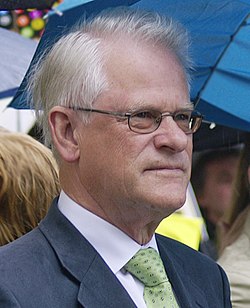
Gudrun Schyman
Gudrun Schyman was born on 9 June 1948 in Täby, Sweden.
- Facts0
- Drivers0
- Indicators0
Gudrun Schyman was born on 9 June 1948 in Täby, Sweden.
Gudrun Schyman was born on 9 June 1948 in Täby, Sweden. She qualified as a socionom, the Swedish professional degree in social work, and represented Stockholm County in the Riksdag from 2 October 1988 to 2 October 2006, with a leave of absence from 6 September to 7 October 1997.
In 1993 she succeeded Lars Werner as leader of the Left Party (Vänsterpartiet) and held the post until 2003. In the 1998 general election the party took 12 percent of the vote, which the Nationalencyklopedin records as its highest share. On the morning of 26 January 2003 she resigned with immediate effect at a press conference in the Riksdag, saying that a tax affair had blocked the party's work and that she had not kept the control over her own routines that she should have had.
On 30 October 2003 she accepted a prosecutor's penalty order of 50 day-fines of 435 kronor each for vårdslös skatteuppgift (careless provision of tax information) and was not brought to trial; she told Svenska Dagbladet that she accepted the finding that she had committed an offence. On 7 December 2004 she left the Left Party at a specially called meeting of the party board, saying she wanted feminist issues higher on the agenda, and she refused demands from party colleagues that she give up her Riksdag seat.
In April 2005 she led the founding of Feminist Initiative (Feministiskt initiativ), formed by feminists who argued that established parties still treated women as a minority concern. The Nationalencyklopedin lists her as the party's leader from 2005 to 2011 and again from 2013 to 2019. In the 2014 European Parliament election the party received 204,005 votes, 5.49 percent, up from 2.22 percent in 2009; in the Riksdag election that September it received 194,719 votes, 3.12 percent, up from 0.40 percent in 2010. On 29 March 2022 she left Feminist Initiative, the party she had helped to found.
She entered the municipal council of Simrishamn Municipality in 2010 for Feminist Initiative and, after the 2026 election, kept that council's single seat for Klimatinitiativ Simrishamn, the third party label under which she has sat there. On 6 July 2010, during the political week at Almedalen on Gotland, she burned 100,000 kronor in banknotes that an advertising agency had donated. Feminist Initiative said the sum was what Swedish women lost every minute relative to men; Statistics Sweden had reported in 2008 that women working full time earned 19 percent less than men on average, and Schyman said that burning the money might look desperate because the pay gap was desperate as well.
Gudrun Schyman was born on 9 June 1948 and grew up in Näsbypark in Täby, north of Stockholm. Her parents moved there that year, when the district was still countryside, and the family lived in a small house. In the biography she supplied to the Riksdag, her father is the merchant Stig Bernhard Schyman and her mother the shop assistant Gerd Ingrid Maria Karlsson. She has described him as a travelling salesman for the handicrafts organisation Hemslöjden who developed severe alcoholism and drank away jobs, and her mother as a woman who had wanted to train as a seamstress, instead kept house and worked to hold the household together. Money ran short enough that her mother at times asked the social welfare office for help to put food on the table. Schyman has said that as a child she thought her father was choosing drink over her, and that only after her own treatment did she see the drinking as an illness rather than a choice.
She has also called the childhood happy: outdoor play with a few neighbouring children, and, in her words, a time when "it was easier to be poor." For six years she went to a small school, where she has credited a storytelling teacher with her top marks; in lower secondary school she has called herself obstinate and cheeky. There was, she has said, no question of her or her brother staying on. She took the lower-secondary examination (realexamen) in 1963 and was a clerk from 1964 to 1969, starting at 15 at Postgirot sorting postal money orders and later at a pipe wholesale firm. She planned to become a company director's secretary and in the evenings studied business correspondence, shorthand and English; from 1967 to 1969 she also attended evening upper-secondary school. She has said she was not politically active then and that in her first parliamentary election she voted for the Liberals, then Folkpartiet, impressed by its youth league's hunger demonstrations for more foreign aid.
After several years at work she entered Socialhögskolan, the school of social work in Stockholm, on a quota for applicants without a studentexamen, part of an experiment in widened admission. She took the socionom examination in 1972. She has said she arrived full of an "educational complex" and then found her own background useful in social work. At the school she learned that Folket i Bild/Kulturfront was being launched, went to a meeting and helped start a local branch that met in her flat, which she has called her first political commitment.
She worked as a social worker in Stockholm from 1971 to 1976, overlapping the end of her training. She has tied the profession to her childhood: help from the social services had mattered to her mother, she has said, but the interventions seemed dramatic, and she thought there must be another way. With colleagues, she has said, she started a project in which workers entered the whole family and took over its contacts with the authorities, an approach she described as new and later called family therapy or family treatment. She has spoken of about twenty years in the profession; the posts she reported to the Riksdag are dated more narrowly, with film work in between.
Through Folket i Bild/Kulturfront she met the documentary filmmaker Lars Westman, who became her partner. From 1976 to 1980 she listed freelance documentary filmmaking as her occupation, and in 1977 the couple moved to Gladsax, in Simrishamn municipality on Österlen in Skåne County. In 1978 she gave birth to their son Dan at the maternity ward in Ystad, assisted by the midwife Signe Jansson, while Westman—laid up with a bad back—filmed the labour. In 1979 they released Födelsen (The Birth), a real-time record of the delivery, later shown on television and used for decades in parent education. She has said she feared the first audience would only gawp, that the film's force took over, and that she remains proud of it.
From 1981 to 1987 she was again a social worker, now in Ystad. In 1987 the relationship with Westman ended and she returned to the Stockholm area with the children, living at first in a collective house on Värmdö. The following year she took her seat in the Riksdag.
The Riksdag biography, drawn from information Schyman supplied, places her in Vänsterpartiet Kommunisterna (VPK) in Simrishamn Municipality by the late 1970s. She sat on the local branch board from 1978 to 1987, on the national party board from 1981 and on its executive committee from 1984, and she was a municipal councillor from 1980 to 1987 and a member of the municipal social-welfare board from 1982 to 1987.
She took her seat for Stockholm County on 2 October 1988, in an election in which VPK won 314,031 votes, 5.8 percent and 21 seats. Statistics Sweden lists the party as the Left Party from the 1991 election, when the result was 246,905 votes, 4.5 percent and 16 seats, and notes that Vänsterpartiet Kommunisterna is recorded under that name from then. She was vice-chair from 1988 to 1993. She was a full member of the Social Affairs Committee from 10 October 1988 to 29 September 1991 and a substitute until 10 February 1993, and a substitute on the Committee on the Constitution from November 1988 to September 1991. From 1989 to 1991 she also sat on the social-welfare board in Värmdö Municipality. The register shows a leave from 6 September to 7 October 1997 and ordinary membership again from 8 October 1997 until 2 October 2006.
A party congress on 7 January 1993 elected her unanimously to succeed Lars Werner, who left the leadership the same day. In 1994, the first election she led, the Left Party received 342,988 votes, 6.2 percent and 22 seats.
The 1996 programme För en solidarisk värld defined the party as socialist, committed to abolishing capitalism, and in the same section as feminist: besides class society, it said, a patriarchy consistently subordinated women, and male patterns of power had to be broken down. It treated feminist theory, with Marxism, as part of the party's analysis, and the statutes named both as subjects of local education. The programme also opposed Swedish membership of the European Union and called for withdrawal.
The 1998 Riksdag election was the peak. The Election Authority's final table gave the Left Party 631,011 votes, 11.99 percent of 5,261,122 valid votes, and 43 seats, 21 more than in 1994; turnout was 81.39 percent. Statistics Sweden's published series rounds that share to 12.0 percent. The Swedish Social Democratic Party fell to 36.4 percent and 131 seats. In 2002 the Left Party received 444,854 votes and 30 seats, recorded by Statistics Sweden as 8.4 percent. She left the leadership on 26 January 2003, announcing an immediate resignation at a press conference in the Riksdag.
During the leadership years she was a member of the Advisory Council on Foreign Affairs from 17 October 1994 to 19 February 2003 and of the War Delegation from 1991 through December 2004, and a substitute on the foreign-affairs and cultural-affairs committees for much of 1994–2002.
After the 1994 election the Left Party voted for Ingvar Carlsson as prime minister of a Social Democratic minority government. That autumn the government carried economic measures, chiefly reversals of tax changes made by the previous non-socialist government, mainly with Left Party support. From the spring of 1995 the Social Democrats' principal partner on economic policy was the Centre Party. An official inquiry into government formation from 1994 to 2006 states that leading Social Democrats judged further savings difficult to negotiate with the Left Party, and that the Centre cooperation, focused on acute economic problems and without a coalition, lasted through most of the rest of the term. When the Riksdag voted on Göran Persson as prime minister in March 1996, Schyman again backed a Social Democratic prime minister, citing the left majority, while criticizing decisions taken with the Centre Party as increasing inequality for little budgetary saving.
The 1998 result left the Social Democrats and the Left Party with 174 of 349 seats, one short of a majority, while the Green Party held 16. Persson said neither cooperating party would enter the cabinet. On 5 October 1998 a communiqué signed by Persson, Schyman and Green spokesperson Birger Schlaug committed the three parties to the coming term in five fields: the economy, employment, fair distribution, gender equality and the environment. The government declaration the next day stated that the budget bill to be presented the following week had been prepared with the Greens and the Left Party. A December 1998 agreement scheduled monthly meetings of the party leaders and economic spokespersons, with the finance minister leading the government's side, and regular meetings in the Riksdag of group leaders, committee members and chiefs of staff. The cooperation continued for the rest of the electoral period.
After the 2002 election the three parties again negotiated support for a Social Democratic single-party government rather than cabinet seats for the Left Party or the Greens. The agreement was a 121-point programme on economic policy, the budget and specific measures; foreign, defence and security policy, and EU questions, lay outside it unless a proposal affected the budget. Each support party was to place eight officials in the Government Offices. Aftonbladet reported that the talks lasted 19 days and that the Left Party's final point was higher housing supplements for pensioners on low incomes. Schyman remained the member for Stockholm County after she ceased to be party leader, until the term ended on 2 October 2006.
In January 2003 the tax authority in Malmö, which handled returns for Simrishamn, where Schyman was registered, rejected deductions of 120,371 kronor claimed as employment income in her return for the previous year. A department head said that some costs had been paid by the Riksdag administration or the Left Party, not by Schyman, and that she could not document others. Reported items included domestic flights and rental cars already paid by the Riksdag, a Brussels–Paris flight already paid by the party, and a long-haul ticket largely paid with bonus points. The authority also questioned representation costs, including a large glögg party, and the reporting of a property sale in Simrishamn, and it imposed a tax surcharge of 40 percent.
Schyman said she had not meant to cheat. At her resignation press conference she said her routines were inadequate, that she had lacked the control a return requires, and that the responsibility was hers to sort out with the tax authority. She later said she had had help with the returns but had not supervised them as she should have.
The Swedish Economic Crime Authority in Malmö investigated. Chief prosecutor Gertrud Holm opened the inquiry and, according to later reports, wanted to close it in the summer of 2003; deputy chief prosecutor Gösta Ivarsson took it over, citing its importance in principle. On 30 October 2003 Schyman, through her lawyer Tomas Nilsson, accepted a summary penalty order (strafföreläggande) of 50 day-fines of 435 kronor each, 21,750 kronor in all, for careless tax information (vårdslös skatteuppgift). The order covered the 2002 assessment year: deductions of 70,787 kronor for travel already paid by the Riksdag administration or the party, which had cut her tax by 38,760 kronor. Ivarsson said he could not prove intent, but that she had at least by gross carelessness given incorrect information, and that the sum made it a fine offence. Because an accepted order has the same effect as a judgment, there was no indictment or trial. Schyman said that matched her account and that she signed to end the case rather than face possibly several courts. The same day the tax board in Simrishamn disallowed similar travel claims for the income years 1998–2000, raised her taxable income by 106,749 kronor, and with the surcharge assessed her roughly 80,000 to 90,000 kronor more, due by 12 December 2003. She accepted most of the adjustments but contested tax on 20,000 kronor contributed toward a fiftieth-birthday party in June 1998; the board treated a personal celebration as private. Those years were not referred for prosecution, the amounts being below the authority's threshold for a criminal complaint. The Prosecutor-General's office then requested the file. Chief prosecutor Lars Persson said the request was informational, amid debate about the line between carelessness and intent, and that an approved penalty order stood as a final judgment.
Schyman resigned as party leader on 26 January 2003, at 09:15, at a press conference in the Riksdag's Andrakammarsalen in Stockholm. She said she had planned to leave at the February 2004 congress, but that debate over her returns and over whether she could remain leader had blocked the party's work, and that she lacked the full support she would have needed to stay.
Party secretary Pernilla Zethraeus said an extra board meeting on 7 February would elect a first and a second vice chair, the first to serve as acting leader until the congress. The board named Ulla Hoffmann first vice chair and acting leader and Ingrid Burman second vice chair, to lead the party until the congress of 19–22 February 2004. After the penalty order, Hoffmann said the matter was closed, that Schyman had been careless, and that there was no reason for her to give up her seat. Zethraeus called the outcome mild and quick and said it showed carelessness rather than intent.
Schyman stayed in the Left Party's parliamentary group until December 2004. On 7 December she told an extra board meeting that she was leaving the party to work more freely on feminist politics, and that she would keep her seat. Party leader Lars Ohly and Zethraeus said a member elected for a party should place the mandate at the party's disposal; the MP Peter Pedersen called the refusal pitiful. In a letter dated 8 December 2004 she notified the Riksdag that she no longer belonged to the Left Party or its group. The chamber recorded the change of party designation on 10 December. She then sat without affiliation, listed as "(-)", for Stockholm County until the term ended on 2 October 2006.
Feminist Initiative (Swedish: Feministiskt initiativ, Fi) was presented on 4 April 2005 outside the Riksdag in Stockholm. Gudrun Schyman, leader of the Left Party until 2003, said the association would test support for a feminist alternative at the 2006 election and treat unequal power, not a formal sharing of posts, as the issue. With her were Sofia Karlsson, Monica Amante, Susanne Linde and the gender scholar Tiina Rosenberg; Ebba Witt-Brattström sat on the 15-member board formed the day before. No leader was named. Karlsson spoke of an anti-patriarchal organization, and Amante said it should not be a project for a white middle class.
The April platform was a brochure, not a finished programme. It took up rape legislation, the finances of women living alone, discrimination in working life, the wage gap between women and men, and international trafficking in women, and it did not set out a tax policy or a place on the left–right scale. Later that summer Svenska Dagbladet reported that the prospective party meant to campaign on a six-hour working day and a fully individualized parental-insurance system, demands closely associated with the Left Party.
At its first annual meeting in Örebro, from 9 to 11 September 2005, Fi decided to become a party and to stand in the next Riksdag election. The meeting largely adopted the board's guidelines: full-time employment as the norm, a national job evaluation aimed at equal pay for work of equal value, a six-hour day with no cut in pay, and parental insurance split equally between women and men. Board member Maria Jansson argued that an equal split would reinforce the couple norm and disadvantage single women; the meeting followed Schyman, who called the rule a signal that children were not only women's responsibility. She conceded that some demands would have economic consequences, but the meeting left taxes and a wider economic policy unsettled. Schyman became one of three spokespersons.
The founding circle split before a programme existed. Weeks before Örebro, Witt-Brattström left the board; Schyman called that a serious loss, while board member Cecilia Chrapkowska had already spoken of divisions involving Rosenberg. On 12 October 2005 Rosenberg wrote in Dagens Nyheter that she was leaving politics because academic work and party activity could not be combined, and because "feminist" had become a term of abuse amid what she called an anti-feminist backlash.
The first national results were well short of the 4 percent threshold for Riksdag seats. In 2006 Fi received 37,954 votes (0.68 percent), and in 2010 it received 24,139 (0.40 percent). In the 2009 election to the European Parliament it took 2.22 percent and no seat.
Gudrun Schyman with supporters during Feminist Initiative's 2014 campaign.
The 2014 elections were the high point. In the European vote Fi won 204,005 votes, 5.49 percent, and one of Sweden's seats; its leading candidate, Soraya Post, said on election night that the party had drawn support from several parties and that many young voters wanted change. In the Riksdag election the same year it won 194,719 votes, 3.12 percent — its best parliamentary result — and still no seats.
The 2.5 percent line still brought public money. Under the 1972 Act on state support to political parties, the annual grant uses the two latest ordinary Riksdag elections, and a party with no seats is credited with each whole tenth of a percentage point above 2.5 percent. Fi's 3.12 percent in 2014 therefore qualified; the 2010 result did not. Because the grant looks back over two elections, the 2014 result still counted after 2018 and ceased to count after 2022.
The vote then fell away. In 2018 Fi received 29,665 Riksdag votes (0.46 percent). In the 2019 European election it fell to 32,143 votes (0.77 percent) and lost its seat. In the 2022 Riksdag election it received 3,157 votes (0.05 percent). Schyman's account in October 2018 was that many sympathizers had backed larger parties in order to stop what she called an advance of conservatism, nationalism and militarism, rather than risk a vote for a party that might miss the Riksdag threshold.
Schyman was a spokesperson from 2005 until 2011, when she left the post for municipal politics in Simrishamn, and again from 2013, sharing it by 2018 with Gita Nabavi. On 28 October 2018 she said she would not stand again: after first thinking the election made resignation impossible, she argued that the party was better organized than ever, with lists in more than 60 municipalities, and that she would stay a member, run a course called Fi Akademi, and continue in Simrishamn. At the Sundsvall congress, Farida al-Abani was elected to succeed her alongside Nabavi; Dagens Nyheter reported that choice on 10 February 2019. Fi's communications officer, Karin Tennemar, later dated Schyman's leadership to 2005–2011 and 2013–2019, so the second term ended at the congress, not on the October announcement.
On 8 February 2022 the board opened an exclusion case. Tennemar said the statutes covered a member who damaged the party by holding office for another party or standing as its candidate, and that Schyman wanted Klimatalliansen made into a party for the Riksdag election and was willing to stand on its list while keeping her Fi seat in Simrishamn. Schyman said she had already explained the project, that Klimatalliansen was not an ordinary party but a group of people seeking to shift climate policy, and that she still wanted a place on its list and expected agreement.
She resigned before any exclusion vote. On 29 March 2022 Dagens Samhälle reported that she had left Feminist Initiative, was not leaving municipal politics, and called the party's course a "tråkig utveckling": Fi, in her words, was now like a traditional party. Dagens Nyheter reported the departure the same day.
On 12 February 2022 Klimatalliansen decided at a members' meeting to form a party and contest that autumn's election to the Riksdag. Anders Wijkman, a representative of the group, said it had gained nearly 1,000 members in a few months. Gudrun Schyman, then a Feminist Initiative councillor in Simrishamn, told Dagens Nyheter that joining the campaign could make the group effective as a "blåslampa" on established politics.
The plan conflicted with her membership. On 8 February Feminist Initiative opened an exclusion case: she wanted Klimatalliansen turned into a Riksdag party and was prepared to stand on its list while holding the party's Simrishamn seat. On 29 March she left rather than face expulsion, after an inquiry recommended that the board expel her. The Riksdag list was headed by Schyman, with the former archbishop of the Church of Sweden, K. G. Hammar, second. The Election Authority register gives the same national ballot, marked "Hela landet", with the folk high-school teacher William Grönlund third, and records the party as cleared for every Riksdag constituency on 22 April 2022.
In the general election on 11 September 2022 the list received 1,702 of 6,477,970 valid votes, about 0.03 percent, and no seats. Seats go only to parties with at least 4 percent nationally or 12 percent in one constituency; Klimatalliansen's ballots were part of the authority's total for other registered parties, 100,252 votes, or 1.55 percent.
Schyman returned to Simrishamn's municipal council in 2010 as Feminist Initiative's lead candidate. The party received 1,137 votes, 8.93 percent, and four of 49 seats, its first council representation in Sweden. It kept four seats in 2014 and three in 2018. In April 2022 she was still a councillor but without a party label; two of the three Feminist Initiative members had become independents and moved to a new local list.
Klimatinitiativ Simrishamn was registered for the municipal election on 18 April 2022, with Schyman first, Sigrid Widalen second and Max Jamieson third. She told SVT that it had been founded a few months earlier, was not tied to a left–right ideology, and wanted a municipal climate committee and a carbon budget, demands she said the local Feminist Initiative had already made. On 11 September the list received 314 votes, 2.38 percent, and one of 41 seats, above the 2 percent threshold for a single-constituency municipality. Schyman took the seat with 108 personal votes; Widalen and Jamieson were substitutes.
She kept the single seat in 2026. SVT's final count gave the list 2.59 percent and one mandate, from 12,940 valid votes and turnout of 82.97 percent. Dagens Samhälle reported on 15 September that Schyman, then 78, would serve another four years, having represented three parties on the council, and did not rule out starting another. She told the magazine she had hoped for more seats, and that in the Riksdag election she voted for the Green Party because she considered climate the most important issue, while missing an antimilitarist party.
The count omitted a sealed box of 121 advance votes, 117 of them valid, missed in the Wednesday collection count and found too late for the County Administrative Board of Skåne. Jesper Jacobsson, the board's head of legal affairs, said the ballots were unlikely to matter nationally or regionally but could change the 41 council seats. The board confirmed the result on 25 September without them, and Ystads Allehanda reported on 8 October that the appeal deadline had passed with no local party known to have appealed.
Schyman described women's subordination as a power order older than class society, expressed in pay, unpaid care and violence, and argued that women had to act together while men gave up privileges. At the Left Party congress in January 2002 she said women still earned 82 percent of men's wages, a gap she said had widened since the early 1990s. Equality law, she said, missed the cause: care of people was valued less than care of machines, goods, information and money. About 80 percent of staff in schools, health care and social care were women, she said, and a decade of tax cuts and service reductions had brought dismissals, frozen wages and long-term sick leave.
In the Riksdag she co-signed a 1993 Left Party motion asking for a plan to cut the normal working day to seven hours by 1997 and to six hours later, with limits on overtime, and for a study of how a shorter day would affect pay differences between women and men. In 2005, sitting without a party label, she moved that parental insurance be individualized so leave could not be transferred inside the family. She called the existing "freedom of choice" an illusion set by women's lower pay, and wrote that extra reserved months for fathers would not break the segregated labour market.
On 5 October 2004 she and other Left Party members tabled motion 2004/05:So616, asking for a national calculation of the cost of men's violence against women and for state funding of women's shelters. Citing the 2001 study Slagen dam, it said 46 percent of women had experienced violence from a man after the age of 15, and treated that violence as structural. Once the cost was known, it said, one should ask how men collectively should pay, by analogy with the polluter-pays principle; it set no tax. In Expressen she said one form could be a "mansskatt," a higher tax on men, because women already paid through fear and shelters relied on unpaid work. Berit Lindwall, chair of shelters in Solna, Sundbyberg and Ekerö, backed a cost inquiry but called a tax on all men collective punishment.
Opening the congress in Västerås, she said discrimination looked different from place to place, "but it is the same norm, the same structure, the same pattern, that is repeated both in the Taliban's Afghanistan and here in Sweden." She pictured an Afghan woman as a light-blue tent whose eyes could not be met, and said that image had been used as a reason to bomb the country where she lived. It was good that the Taliban had lost power, she said, but U.S. bombing could no longer be called self-defence and belonged with the UN Security Council. Most violence against women and children, she added, happened in the family; reviving the phrase "death to the family," she said the words caused more anger than the deaths. Asked about a common European defence, she said Sweden should not help build one and should stay non-aligned, while still joining UN-mandated peacekeeping.
Svenska Dagbladet reported that many people heard the speech as equating Swedish men with the Taliban, and that "death to the family" also offended women who wanted to be valued in family life. MP Eva Zetterberg said she had told Schyman to think again, and that the party risked looking extreme. Former party secretary Kenneth Kvist called the speech theoretically weak, with rhetoric replacing analysis. His successor, Lars Ohly, praised it for forcing a public debate on feminism, and deputy leader Johan Lönnroth said the row was heated but not a crisis and that her standing was stronger than ever. Schyman said she regretted nothing. She told Aftonbladet she had not compared Swedish men with the Taliban, but had meant the same norm — the subordination of women — in Afghanistan and in Sweden, taking different forms.
On 6 July 2010, during the political week centred on Almedalen in Visby, on Gotland, Schyman burned 100,000 kronor (about $13,000 or £8,500) in 100-krona notes on a barbecue. She acted for Feminist Initiative, which hoped for its first Riksdag seat on 19 September.
The notes, the BBC reported, came from an advertising agency, and the party presented 100,000 kronor as what women missed each minute compared with men. The Local named the donors as Per Eriksson and Tomas Mazetti of Studio Total in Malmö, who had saved the sum for a boat, and quoted Schyman calling gender discrimination one of the greatest scandals in Swedish democracy. At Hamnplan she tipped 100-krona notes from a plastic bag onto the grill beneath a banner saying Fi was burning for democracy. The party's own figure, reported by The Local, was 4,700 kronor a month less for a woman in a comparable full-time job, about 70 billion kronor a year. The BBC reported that Sweden's statistics agency had found that, in 2008, women working full time earned on average 19 percent less than men. Schyman said the burning might look desperate, but so was the situation, and she tied the protest to a proposed 70-billion-krona equality fund.
The Local reported that Sveriges Riksbank confirmed destroying currency was not illegal, and that a ban on destroying coins had lapsed in 1980. Dagens Nyheter reported criticism from politicians and from Stadsmissionen, whose vice-chair Elisabeth Fredell said the cash would have paid for many meals. Schyman said she understood the anger, including the view that the notes could have gone to a women's shelter, but that the party sought political change rather than charity.
In May 1998, the year she turned 50, Fischer & Co published Schyman's memoir Gudrun Schyman: människa, kvinna, mamma, älskarinna, partiledare, a 208-page hardcover. The Riksdag biography she supplied lists it only as "Memoarer 1998". It opens on 2 September 1996, when, as leader of the Left Party, she told breakfast television about her alcohol problems, and sets that account against the press version. Dagens Nyheter called it an open book about that alcoholism under the headline "Att slippa ljuga ger ny styrka". Aftonbladet later called the memoir very revealing on that struggle.
Later books were shorter and more directly political. In December 2005 Svenska Dagbladet reported that she had printed 18 monthly "feminist letters" as Till alla feminister, Från Gudrun Schyman, sold for 20 kronor plus postage, with half going to Feminist Initiative. A 2016 TMG hardcover, 100 brev som inte?!? förändrade världen (264 pages), collected further letters; antiquarian listings note a foreword by Carl Bildt and photographs by Elisabeth Ohlson Wallin. In May 2017 Leopard förlag issued Homeparty med Gudrun, 100 pages drawn by Ellen Ekman from the informal meetings she had held since spring 2014. On 17 April 2018 the same house released Johanna Palmström's Det gäller livet – en biografi om Gudrun Schyman, which it presented as the first full biography. Per Andersson wrote in Kulturnyheterna that Palmström stayed on the surface and, as a sympathizer, waved opponents aside.
On 21 July 1996 she hosted Sommar i P1 on Sveriges Radio, on becoming politically active, social work, and the filming of her first childbirth.
In early 2010 she competed on TV4's Let's Dance with Björn Törnblom. She objected to an opening in which women were to kneel before the men; TV4 then split professionals from amateurs instead. For "Don't Cry for Me Argentina" she and Törnblom wanted a banner on Eva Perón's campaigns for women's suffrage and abortion; TV4 blocked it as a distraction from the dancing. Dagens Nyheter reported that she hoped the show would also draw voters to Feminist Initiative, under a headline quoting her wish to show a feminist was not a "bitterfitta". The Evita number scored 18 jury points and the fewest viewer votes, eliminating the pair; Schyman said her contest ran on until the September election.
In the 2014–15 season of På spåret she was paired with former archbishop K. G. Hammar. Recorded early that autumn, the episodes were due to air inside the three months before an extra election on 22 March 2015, when Sveriges Television normally keeps politicians out of entertainment. Acting channel chief Thomas Nilsson let them run because the election had not been foreseeable; adviser Paul Ronge called the slot an enormous advantage.
In September 2007, about to host a conversation programme on TV8, she answered the label "mediekåt agitator" in Aftonbladet by calling the work popular education rather than self-promotion. When she again claimed a "medieskugga", Isobel Hadley-Kamptz wrote in Dagens Media in October 2018 that the complaint could be traced in media archives to December 2001, and that results were not simply a function of access.
Hampus Linder's documentary Gudrun – konsten att vara människa (Nordic Factory Film & TV Sweden) opened on 10 August 2018. The Swedish Film Institute described a 2014–2018 portrait, including talks with her daughter, and an average score of 3.15 where numbers were given (Dagens Nyheter 2, MovieZine 4). Mats Johnson in Göteborgs-Posten found those talks, about motherhood and drinking, the film's strength, and the absence of opponents a failure of scrutiny. Johan Croneman wrote that Linder never dared to talk politics with her. Jonna Vanhatalo in MovieZine called the portrait informative and "fairly objective", if likely to reach mainly the already convinced.
Schyman has said that she has “made a point of never marrying.” With the documentary filmmaker Lasse Westman (born Lars Gerhard Vestman) she had two children, a son, Dan, born in 1978, and a daughter, Anna. Westman’s film Födelsen (1979) records Dan’s birth at the hospital in Ystad. She and Westman lived at Klockaregården, a farmhouse in Gladsax, in Simrishamn Municipality, and separated in 1987. She then moved with the children to Ängsviksgården, a collective in a former old-age home in Värmdö, the residence given in the biography she supplied to the Riksdag. She has described a shared kitchen and dining room where residents cooked and looked after one another’s children.
In 1999, after what she counted as twelve years in the Stockholm area, she bought the Gladsax house back. In the summer of 2001 she began a relationship with the architect Jacques Öhlund, whom she had met when he interpreted at meetings between the Left Party and its French counterpart. Öhlund, who had grown up in Sweden and was living in Paris, moved in within a few months. She said in 2023 that they had been a couple since 2001, and in 2026 that they had been together for 25 years and were not married. She has remained at Klockaregården and has described contact with Dan, a musician, Anna, a forest scientist, two grandchildren, and Westman after his return to Simrishamn from Brazil. Westman died on the morning of 16 September 2025.
Schyman has described alcoholism as an illness that ran in the family. She has said that her father developed severe alcoholism, that it marked her childhood in Täby, and that both he and his father died of it, and that her own dependence meant she “was not really there” as a parent as she should have been. It became public on 28 August 1996, when she was heavily intoxicated at a film premiere in Stockholm. On 2 September she spoke about her drinking on Sveriges Television’s Rapport morgon, took about two weeks off, including a little more than a week at the Ewa clinic of the Karolinska Institute in Solna, and returned as party leader on 16 September, saying she would not drink again.
Further relapses followed in the summer of 1997. On 4 September she was again intoxicated, at the Stockholm premiere of Fever Pitch, and acknowledged the relapse on television; two days later the party board decided that she needed another break from politics. The Riksdag register lists her as on leave from 6 September to 7 October 1997 and as an ordinary member again from 8 October. Expressen reported that she entered Nämndemansgården in Blentarp on 8 September for four weeks, was discharged in early October, returned to the chamber on 10 October, and resumed the leadership ten days later, saying she would stand for re-election. In November 1997 a 1994 radio interview became public in which she said she had driven while intoxicated, and the same account reported a further relapse in April 1999 on a flight home from Rhodes. By 2001 she described herself as a sober alcoholic and a regular participant in Alcoholics Anonymous. She has said that the hardest part, before treatment, was her children’s disappointment when promises to stop were not kept.
Inside the Left Party, assessments of Schyman turned on votes and on whether feminism was crowding out class politics. Nationalencyklopedin credits her leadership with gains in the 1994 and 1998 elections to the Riksdag and in the 1995 and 1999 elections to the European Parliament, and calls the 1998 share — 12 per cent in its account — the party's highest to that point. The election authority's final figure was 11.99 per cent and 43 seats. Aftonbladet reported in 2003 that predecessor Lars Werner remained a critic, but that a leader who had raised the party that far was hard to remove.
The January 2002 congress speech, likening the structure of women's subordination under the Taliban in Afghanistan to that in Sweden, brought a sharper internal attack. MPs Eva Zetterberg, Kenneth Kvist and Per Rosengren told Sveriges Radio the comparison had damaged the party; Zetterberg called for a retraction, and party secretary Pernilla Zethraeus feared a single-issue image in which feminism eclipsed socialism. Schyman refused to withdraw it. Columnist Zendry Svärdkrona wrote that the comparison erased the difference between Swedish equality gains and Taliban rule.
When she co-founded Feminist Initiative, critics inside feminism made a related charge. In November 2005 Alex Duval Smith reported that early polls of nearly a quarter had fallen to about 1.2 per cent after a factional congress, and that commentators and defectors said the party had set the cause back. Björn Elmbrant of Sveriges Radio called it suddenly very narrow. Left Party secretary Ingrid Burman said marriage-law grievances and a refusal to face economics could not sustain a party. Ebba Witt-Brattström resigned warning that a monopoly on women's issues would be a "catastrophe" for feminism; Tiina Rosenberg also left. Schyman denied building a personal vehicle and said other parties funded women only with leftover money. The 2010 burning of 100,000 kronor at Almedalen split sympathisers the same way: Centre Party women's chair Annika Qarlsson called it a mockery of the low-paid, while shelter-association chair Angela Beausang said the symbolism of women's weaker pay was clear.
Sören Holmberg told Svenska Dagbladet on 9 January 2002 that there was no measurable "Schyman effect". The rise, he argued, followed the end of the Moscow association and the Swedish Social Democratic Party moving toward the centre, which let dissatisfied left-leaning Social Democratic voters cross over as the Left Party itself moderated. She was not a drag, but more popular than the party among right-wing voters who would not vote for it, and less popular than the party on parts of the left. Pollster Toivo Sjörén replied that her plain speaking helped, and that personal difficulties were tolerated by Left voters who wanted politicians like themselves.
In 2014 Feminist Initiative took 5.49 per cent and a European Parliament seat, then 3.12 per cent in the Riksdag election, short of 4 per cent, after 0.68 per cent in 2006 and 0.40 per cent in 2010. Kirill Filimonov and Jakob Svensson argued in Nordicom Review that the campaign sat at the front of a broader feminist turn among other party leaders, and that defining feminism through any experience of oppression risked emptying it into anti-discrimination in general. Sofie Blombäck and Jenny de Fine Licht classed it as left-libertarian: neither a pure niche party nor just another left party. Its European vote was not explained by left–right position alone, yet it took votes from the Left Party and the Green Party, whose similar policies left them little room to answer, in a system that has often given new parties only one European term.
Ranked by shared high-impact facts, then explicit ties, then shared drivers.
How the record is sourced and how the score is derived.
The score is formula-derived (Factrail formula v1, version 1.0.0), not an editorial verdict. Read the methodology.
By the Factrail desk · Method: how we source and score · Last reviewed
Dispute a fact on this pageNamed here, or represent someone who is? Request a right of reply.