
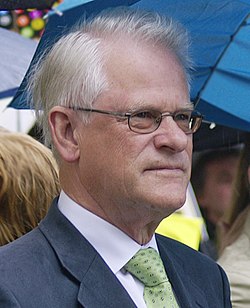
Ines Uusmann
Ines Junéa Uusmann (née Johansson; born 30 October 1948) is a Swedish politician of the Swedish Social Democratic Party and a former senior civil servant.
- Facts0
- Drivers0
- Indicators0
Ines Junéa Uusmann (née Johansson; born 30 October 1948) is a Swedish politician of the Swedish Social Democratic Party and a former senior civil servant.
Ines Junéa Uusmann (née Johansson; born 30 October 1948) is a Swedish politician of the Swedish Social Democratic Party and a former senior civil servant. She was Sweden's Minister for Communications, and head of the Ministry of Communications, from 7 October 1994 to 6 October 1998. The Nationalencyklopedin records that she was appointed to that post in Ingvar Carlsson's third government after the 1994 election and remained until 1998, by which time Göran Persson had been prime minister since 1996. She was a member of the Riksdag from 1990 to 1998 and, from 1999, director-general of Boverket, the National Board of Housing, Building and Planning.
After the studentexamen in 1967 she worked in the state postal service, as a post assistant from 1969 and a post over-controller from 1974, then as an ombudsman for the state employees' union Statsanställdas förbund from 1979 and as its press ombudsman from 1982. In Täby she sat on the municipal council from 1977 to 1994, the school board from 1974 to 1979 and the municipal executive board from 1980 to 1994. The biography she supplied to the Riksdag dates her appointment as opposition municipal commissioner to 1986, while the Nationalencyklopedin places her full-time commissionership from 1985 to 1990. She was a substitute member of the Riksdag in 1989 and from 14 June 1990 to 29 September 1991, an ordinary member from that date until 6 October 1994, and on leave from 7 October 1994 to 5 October 1998 while she was a minister.
On the night of 28 September 1994, nine days before she took office, the passenger ferry M/S Estonia was lost on the passage from Tallinn to Stockholm. At an extraordinary cabinet meeting on 10 October, Carlsson's incoming government gave her principal responsibility for the Estonia question, including information to the media and contact with relatives and survivors. The Riksdag's Constitutional Committee included her handling of the City Tunnel in Malmö and of the railway tunnel through Hallandsås in its 1997/98 scrutiny of ministers. From 1996 to 1998 she chaired the IT Commission. With the unions TCO and LO she promoted the home-PC reform, under which employees could borrow or rent a personal computer for home use without the benefit being taxed; the Swedish Internet Museum, citing a 2002 analysis, reports that 850,000 computers were delivered between January 1998 and the end of 2001.
A May 1996 article in Svenska Dagbladet attached her name to the phrase that the internet was a passing fad. The museum's account of the interview quotes her as saying she did not think people would go on devoting so much time to aimless surfing, and that the habit might pass as use became more specific. In a later interview she told the same newspaper that colleagues had been upset because they thought she had been misquoted, "but that was not so." A profile of her successor, Janna Valik, describes Boverket as the agency for planning, building and housing, formed in 1988, then answering to the Ministry of the Environment, with about 190 employees. Uusmann joined the board of the consumer cooperative OK ekonomisk förening in 1999, chaired it from 2003, and left the chair at the meeting of 2 June 2017. The population register lists her as married to Jan Torsten Andersson and living in Helsingborg.
Ines Junéa Uusmann was born Ines Junéa Johansson on 30 October 1948. The Nationalencyklopedin gives the form “Uusmann, Ines, född Johansson 1948,” and the biography she supplied to the Riksdag for Fakta om folkvalda records the birth year as 1948. Merinfo’s public extract of the population register lists the name Ines Junéa Uusmann and a personal identity number beginning 19481030, the register’s encoding of that date.
She grew up in Halland. On 29 October 2003, as she was about to turn 55, Helsingborgs Dagblad wrote that the celebration would be held that weekend at a holiday place she loved in the Varberg district, and reported her description of herself as a Hallander, born and raised in Varberg. The article named no parish. What later local reporting attached to the family was Rolfstorp, inland from the town: when Hallands Nyheter interviewed her on 10 June 2008, the questions it printed asked whether she was often in Rolfstorp and stated that her father, Thure G. Johansson, was the boy who had found the Bocksten Man. The Riksdag biography records a studentexamen in 1967, then the examination completing upper-secondary schooling in Sweden, but names no school. Published accounts otherwise say little about her childhood beyond that date, the birth record and the Halland upbringing she described in 2003.
The same biography names her parents as the postal officials Thure Gilbert Johansson and Hillevi Linnéa Ingegärd Johansson. Hallands Nyheter treated that Thure — “Thure G. Johansson” — as the child who, with his family, came upon the medieval body in a Rolfstorp peat bog.
Halland Museum of Cultural History dates the discovery to 22 June 1936, the day before Midsummer Eve. Eleven-year-old Thure was harrowing peat behind a horse on Bocksten bog, with five-year-old Gulli, his sister, behind him and their father Albert in a peat barn nearby, when the harrow tore up cloth and bone. Digging by hand, they uncovered more of a body, covered it because it was too late to call the police, and went home. Early on Midsummer Eve, Thure’s older brother Harry cycled to the district constable, Axel Johansson, in Rolfstorp. County police officer Viktor Olsson and the Varberg physician Lars Söhrman found the man face down, staked into the bog with clothing around him; judging the death ancient, they dropped any criminal inquiry, and that evening Söhrman told Albert Sandklef, director of the Varberg museum, who examined the find the next morning.
The museum states that the skeleton and clothing had lain there nearly 600 years, the acid peat preserving hair, textiles, wood and leather. It dates the costume to about 1350–1370 and calls it Europe’s only medieval man’s outfit of its kind to survive so completely: pointed hood, cloak, hose, tunic, a belt with two knives, and shoes, in home-woven wadmal rather than imported cloth, and hardly worn. From that it concludes he was probably neither a nobleman nor an ordinary farmer, but someone close to a wealthier household, perhaps a servant, scribe or craftsman. An oak stake through the heart, still intact, and two birch stakes through the torso held him down. The museum reads the staking and the face-down position as meant to stop him from “walking again” and as a humiliation; its English account calls him a man who had probably been murdered. The remains are shown at the museum in Varberg Fortress, in a larger exhibition opened in the summer of 2021.
The biography Ines Uusmann supplied to the Riksdag for Fakta om folkvalda lists a studentexamen in 1967 and, under the same education heading, the grades postassistent in 1969 and postöverkontrollör in 1974. The member register gives her occupational title as posttjänsteman. Studentexamen was the leaving examination of the Swedish gymnasium: written papers and an oral test before a censor, usually a professor or another representative of higher education appointed by the government. The Riksdag decided in 1964 to abolish it, and 1968 was the last year pupils sat the examination in that form, so the class of 1967 was among the last to qualify under the old system.
She then worked in Postverket, the state postal administration of Sweden. The service was founded in 1636 and, well into the late twentieth century, remained a public body carrying letters and parcels and handling payments through a national network of offices—4,383 at the peak in 1949. The National Archives’ administrative history describes it as a commercial state enterprise (affärsdrivande statligt verk), with regional districts set in the 1960s and a split in 1983–84 into business areas for letters and parcels and for giro and cash services. In Sveriges statskalender for 1970 an överkontrollör is listed under the postmaster at major offices; a technical dictionary glosses the postal sense of the title as chief superintendent or assistant postmaster. Uusmann later described the work itself more narrowly. In 2003 she told Helsingborgs Dagblad that during the 1970s she had been a personnel administrator at the post, and that her working life as a whole had been that of “a bureaucrat in the service of the state.”
The administration was reorganized after she had left it. The monopoly on letter delivery ended on 1 January 1993, and on 1 March 1994 Postverket was converted into the wholly state-owned company Posten AB. Regulatory tasks passed to the authority that became the Swedish Post and Telecom Authority, and a new postal act took effect the same day.
The Riksdag biography records her next employment as ombudsman in Statsanställdas förbund from 1979 and as pressombudsman from 1982. Nationalencyklopedin states that she was employed at Postverket and at the union before becoming a full-time politician in 1985. In the 2003 interview she said the personnel job had been followed by some years as a union ombudsman in the first half of the 1980s, and that this led her into politics and a Social Democratic seat in the Riksdag.
Statsanställdas förbund was the affiliate of the Swedish Trade Union Confederation (Landsorganisationen i Sverige, LO) formed in 1970 by a merger of unions for state-sector employees that had cooperated since 1937 in the Statstjänarkartellen. The successor union, Seko, describes that body as gathering railway workers, postal staff and power-plant workers, and notes that Svenska Postförbundet—renamed in 1962 from Svenska Postmannaförbundet, itself descended from a national postal association founded in 1886—joined in 1970. In Swedish usage an ombudsman is an official whose main task is to act for a principal. Uusmann’s titles appear in the Riksdag biography as posts at the union, and Nationalencyklopedin describes her as employed there, rather than setting out any further duties of the 1982 press post. During the 1990s, sales and corporatization of state activities left many members privately employed, and in 1995 the union took the name Seko, Service- och kommunikationsfacket.
Ines Uusmann’s Social Democratic municipal career was based in Täby, in Stockholm County. The biography she submitted for the Riksdag publication Fakta om folkvalda records her as a member of the municipal school board (skolstyrelsen) from 1974 to 1979, of the municipal council (kommunfullmäktige) from 1977 to 1994, and of the municipal executive board (kommunstyrelsen) from 1980 to 1994.
The Swedish Social Democratic Party did not hold a majority of the seats. In Statistics Sweden’s series of council mandates, the party won 15 seats in 1976, 13 in 1979, 13 in 1982, 15 in 1985, 14 in 1988, 11 in 1991 and 13 in 1994. The council had 51 members at the elections of 1976, 1979 and 1982 and 61 from 1985. The Moderate Party was the largest party each time, with 16 seats in 1976, 20 in 1979, 24 in 1982, 27 in both 1985 and 1988, 31 in 1991 and 28 in 1994. Together with the Centre Party and the Liberals (then Folkpartiet; Statistics Sweden’s series uses the later name Liberalerna), the Moderates held a majority of the seats throughout.
Under the Municipal Act (1977:179), as consolidated, councillors served three years counted from 1 November of the election year, Stockholm city excepted. Offices vacant at the end of the year were filled at a council meeting before the end of December; in a nationwide election year, the newly elected council made those choices.
Nationalencyklopedin states that, after employment at the Post Office and Statsanställdas förbund, Uusmann became a full-time politician in 1985, first as kommunalråd in Täby until 1990 and then as a member of the Riksdag. The parliamentary biography instead records “oppositionskommunalråd i Täby 86”, one year in the same shorthand it uses for the starting years of her earlier jobs, and it gives no end date. The sources thus differ in both title and opening year. The municipal election of 15 September 1985 falls between those years. Nationalencyklopedin’s closing year, 1990, is when she began a longer period as a substitute Riksdag member, from 14 June 1990; council and executive-board membership is still listed through 1994.
Oppositionskommunalråd was the customary name for a full-time elected post on the opposition side, not a separate statutory office. A 1983 government bill noted that full-time and substantial part-time municipal posts, including kommunalråd, had grown quickly in the 1970s—nearly 500 kommunalråd by 1980—while most councillors remained fritidspolitiker who spent limited time on their duties. How many such posts to create was left to each municipality under the Municipal Act’s freedom of organization.
The same biography lists her party posts. She sat on the board of Täby arbetarekommun, the local party organization, from 1976 to 1980 and again from 1986, with no closing year given. From 1979 she chaired Täby’s Social Democratic women’s club. From 1980 she was on the executive of the Stockholm County district of the women’s organization, chairing it from 1988, and from 1987 she is listed in the national organization, again without end years. The biography styles the county body “Sveriges socialdemokratiska kvinnoklubb (SSKF)”. The federation, Sveriges socialdemokratiska kvinnoförbund (later S-kvinnor), dates its foundation to 1920, when 120 local women’s clubs formed a national body.
Ines Uusmann, a Social Democrat from Täby, entered the Riksdag as a substitute. The biography she supplied for Fakta om folkvalda records a substitute period in 1989 and again in 1990–91. On 17 January 1989, while Mona Sahlin was on leave, the Social Democratic group reported Uusmann, Sahlin’s ersättare, as a substitute on the Constitutional Committee and the Labour Market Committee. From 14 June 1990 to 29 September 1991 she sat for Stockholm County in place of Prime Minister Ingvar Carlsson. The roll of 2 October 1990 lists her on the county’s benches as “ersättare för statsminister Ingvar Carlsson”, a substitute the National Tax Board had named on 14 June 1990.
After the 1991 election the register lists her as an ordinary member for Stockholm County from 29 September 1991 to 6 October 1994, and on leave from 7 October 1994 to 5 October 1998 while she was a minister; Åsa Stenberg and Björn Ericson alternated in the seat. The document register links her to 222 motions from 1988/89 through 1993/94, many of them party texts she co-signed.
In 1991 she was first signatory of a motion on the two-year rule, under which a foreign spouse received a permanent residence permit only after two years of marriage; it argued that women who left earlier because of abuse risked deportation. With Björn Ericson she returned to the rule in motion 1993/94:Sf609, which said women from Thailand, Malaysia, the Philippines and the former Eastern Europe had been isolated and assaulted, and asked for a change in the law on what the text called the “import of foreign women”. With Hans Stenberg she answered the bill on a trial of citizen-service offices (medborgarkontor), arguing that post offices should take part and that privacy still needed study. A 1992 motion in her name called traffic the main environmental threat in the Stockholm region and asked for more public transport, selected bypasses and economic instruments. In January 1993, with Sören Lekberg, she used the wreck of the tanker Braer off Shetland to argue for tighter control of ships under flags of convenience. In 1993/94 she also signed the Social Democrats’ main transport motion, proposing a national communications plan and an extra 4,600 million kronor for maintenance of state roads and railways.
The Riksdag lists her mostly as a substitute: on the Constitutional Committee from 17 January to 15 June 1989; on the Labour Market Committee for that span, again from 3 October 1990 to 29 September 1991, and from 29 September 1991 to 1 October 1994; and on the Finance Committee from 25 April to 13 June 1990. On the Committee on Transport and Communications she was a substitute from 7 October 1991 to 17 February 1993 and a full member from 18 February 1993 to 1 October 1994.
She was a substitute on the temporary EEA Committee (EES-utskottet) from 26 May 1992 to 4 June 1993, the body set up to prepare the bill on the European Economic Area agreement and related business due before 1 January 1993. From 8 November 1993 to 2 October 1994 she was a substitute in the Swedish delegation to the Parliamentary Assembly of the Council of Europe. While still on leave she sat on the War Delegation from 31 October 1996 to 5 October 1998. That delegation, the Speaker and 50 members and open to ministers on leave from their seats, can assume the Riksdag’s powers in war or danger of war.
In the biography she gave the Riksdag she is listed from 1993 as a member of the party board and as chair of Socialdemokrater för EG. At the party’s Europe congress in 1994, Allan Larsson later wrote, a yes committee under Uusmann and a no committee under Sten Johansson put both cases in one report. Her argument, as he records it, was that Sweden needed a Social Democratic government and membership of the European Union, because “participation and co-determination give more real democracy than remaining outside”. The congress recommended a yes by 232 votes to 103.
Ines Uusmann of the Swedish Social Democratic Party became Sweden’s minister for communications, and head of the Ministry of Communications (Kommunikationsdepartementet), on 7 October 1994. That day Prime Minister Ingvar Carlsson told the Riksdag that she would hold the post in his third government, formed after the 1994 election. She succeeded Mats Odell of the Christian Democrats, minister and head of the same department from 4 October 1991 to 7 October 1994 in the non-socialist government of Carl Bildt. The biography she supplied for the Riksdag publication Fakta om folkvalda gives her tenure as 7 October 1994 to 6 October 1998, during which she was on leave from her seat.
She kept the portfolio when Göran Persson succeeded Carlsson. On 22 March 1996 Persson announced to the Riksdag that Uusmann would again be minister and head of the Ministry of Communications in his government. The Riksdag dates Carlsson’s third cabinet to 1994–1996 and Persson’s to 1996–2006. She was not included in the cabinet formed after the general election of 20 September 1998. The Government Offices yearbook for 1998 lists her as communications minister through 7 October, a day later than the end date in the Riksdag biography.
The ministry had existed since 1920, when matters of transport and communications were transferred from the abolished Ministry of Civil Affairs (Civildepartementet). Nationalencyklopedin describes its later field as land communications, shipping, aviation, postal, telecommunications and radio services, vehicle equipment and condition, measures against pollution from ships, sea rescue, transport and traffic research, and meteorological, hydrological, oceanographic and geotechnical surveys. For 1998 the Government Offices stated the responsibility as road and rail infrastructure, road traffic, rail traffic, shipping, aviation, postal conveyance, telecommunications and overarching information-technology questions, together with sectoral research and the environmental effects of transport. Twelve government agencies and boards, three commercial public utilities and four state-owned companies belonged to the ministry that year.
The routine business of 1998 was transport policy, traffic safety and posts. On 5 March the government submitted Transportpolitik för en hållbar utveckling (Prop. 1997/98:56), signed in Stockholm by Persson and Uusmann, with the starting point that transport policy should contribute to socially, culturally, economically and ecologically sustainable development. The yearbook described the overall aim as a long-term sustainable supply of transport for citizens and business throughout the country, and recorded continued work on Vision Zero: no one killed or seriously injured in road traffic, an objective that was also to cover other modes. Bills were presented on a new driving-licence act and reformed legislation on professional traffic, and in the spring of 1998 the government adopted Vägverket’s national road-maintenance plan and Banverket’s trunk-network plan for 1998–2007. A bill amending the Postal Services Act was meant to clarify the state’s responsibility for universal postal services and for cash services. In the ministry’s field that year the government decided 11 bills, two written communications to the Riksdag and ten sets of committee directives, and nine reports in the series Statens offentliga utredningar were delivered. Government business in 1998 also included the wreck of the ferry Estonia, the Hallandsås tunnel and the information society; those subjects are treated separately.
At the opening of the Riksdag on 6 October 1998 Persson announced a reorganization of the Government Offices, reducing the number of ministries from thirteen to ten. The ministries of Communications, Labour Market, the Interior, and Industry and Trade were to cease, and a new, enlarged Ministry of Enterprise (Näringsdepartementet) was created in order to pursue the government’s aims for growth, welfare and employment. The organization took formal effect on 1 January 1999; until then the ministers concerned acted under special appointments. Björn Rosengren became minister for enterprise on 7 October 1998 and was, through 31 December, also head of the Communications, Labour Market, and Industry and Trade ministries. The Ministry of Communications itself ceased on 31 December 1998. Rosengren’s title was minister for enterprise, so Uusmann was the last minister designated communications minister.
In the early hours of 28 September 1994 the Estonian-flagged ro-ro ferry MS Estonia, bound from Tallinn to Stockholm, lost its bow visor in a south-westerly storm in the northern Baltic Sea. The visor pulled the bow ramp open, the car deck flooded, and the ship sank at about 01:50. Of 989 people on board, 137 survived and 852 died, from 17 countries; 757 were still missing.
The sinking fell during a change of government in Sweden. Outgoing prime minister Carl Bildt and incoming prime minister Ingvar Carlsson both spoke of large efforts to recover the dead, words a later review found many relatives treated as promises.
Uusmann became minister for communications on 7 October. On 10 October Carlsson’s government gave her principal responsibility for the Estonia question, including public information and contact with relatives and survivors. Officials assumed that recovering everyone inside the wreck required raising the ship. On 11 October the Swedish Maritime Administration reported that salvage was technically possible and legally unobstructed. The same day Uusmann said on television that “what the sea takes, the sea should also keep.” The 1998 review found that relatives heard this, and other vague remarks, as hesitation, and that at least one of her comments on diving to the wreck was wrong in substance.
An ethical council advised against raising the ship or recovering the dead, and recommended sealing the wreck. December dive reports, briefed especially by the administration’s Johan Franson, led Uusmann to treat full salvage as impracticable; she and the other deciding ministers did not watch the dive films. On 15 December 1994 the government decided not to raise Estonia, not to recover the dead, and to treat, cover and legally protect the site as a grave. Carlsson announced the decision in the Riksdag and regretted the expectations his earlier words had created; Bildt endorsed it. Uusmann’s letter reached relatives the same day, but many first heard the news in the media because police notice arrived late.
SOU 1998:132, in November 1998, ruled out general blame of government and authorities, but criticised the missing information plan and unstructured contact with relatives. It found that the state had in an essential respect taken the next of kin’s place, and recommended that diving still be tried to recover and identify the dead.
On 23 February 1995 Finland, Estonia and Sweden signed an agreement in Tallinn treating the wreck and a defined area around it as a final resting place, agreeing that Estonia shall not be raised, and undertaking to criminalise disturbance, including diving for victims or property. A party could still cover the wreck or prevent pollution from it. The agreement entered into force on 26 August 1995. The Riksdag adopted a grave-peace act on 1 June 1995, in force a month later, with a maximum penalty of two years’ imprisonment.
In March 1995 Sweden commissioned a concrete shell over the wreck. On 19 June 1996, under prime minister Göran Persson, the government stopped the work once pressure banks around the hull were finished, because a cover would block any further search for evidence; it said the work could resume later. Uusmann told relatives the next day that the government wanted a broader dialogue. The analysis group found that many relatives read the halt as reopening recovery.
The Joint Accident Investigation Commission of Estonia, Finland and Sweden, formed on 29 September 1994, reported unanimously in December 1997. It found that the visor attachments were not designed for realistic loads on the route, that the crew did not slow down after metallic sounds from the bow, and that the lifeboat alarm came only after the list had made escape very difficult.
In November 1995 a conference of the International Maritime Organization amended the SOLAS Convention for ro-ro passenger ships, in force on 1 July 1997, with stronger bow-door rules, bridge indicators, a collision bulkhead meant to survive a detached bow door, and phased damage-stability and life-saving requirements. It did not adopt a global rule that ships survive half a metre of water across the car deck. States wanting that stricter standard met in Stockholm in January and February 1996. Their Stockholm Agreement, in force on 1 April 1997, sets water-on-deck criteria for ro-ro passenger ships on regular voyages between designated ports in north-west Europe and the Baltic Sea, regardless of flag.
The Hallandsås tunnels were to carry the West Coast Line between Gothenburg and Malmö through a fractured, water-bearing ridge on the border of Halland and Skåne. In the summer of 1991 the government assigned Banverket two single-track bores, 8.6 kilometres of a 14.5-kilometre scheme. Driving began in October 1992, for completion in December 1996 at 1,250 million kronor. The boring machine stuck after 13 metres, and blasting followed. Skanska replaced Kraftbyggarna in 1995–96. In October 1997, with about a third of the main tunnels out and a little over 1,000 million kronor spent, work stopped.
Cement would not seal the rock. Inflow sometimes reached about 70 litres a second, against a permit of 33. Skanska injected Rhoca-Gil, a Rhône-Poulenc grout containing acrylamide and N-methylolacrylamide—about 1,400 tonnes of mix, some 140 tonnes of those substances, over about two months. Banverket skipped its routine for new chemicals. The county administrative board and Båstad municipality were told on 14 August 1997, after large trials had begun.
Workers fell ill, cattle that drank the leakage were paralysed, and fish died at a farm on a receiving stream. Twenty-nine wells were contaminated. Of 223 workers examined, about 20 had peripheral nerve effects; nine still did in the spring of 1998. About 370 animals and 330,000 kilograms of milk were destroyed. The Institute of Environmental Medicine called the use unacceptable medically, but any added cancer risk to the workers very small because exposure was short. Local restrictions on water and food lasted until March 1998.
On 20 October 1997 the government appointed the Tunnel Commission under Axel Edling to explain the damage, not to assign liability. Its reports, SOU 1998:60 and SOU 1998:137, called Rhoca-Gil a chain of mistakes by client, contractor and supplier, and blamed above all Banverket’s leadership and its breach of the water permits. In January 2002 Helsingborg District Court fined Skanska 3 million kronor, the maximum corporate fine, and sentenced two managers for an occupational-safety offence and for causing environmental disturbance. The supplier’s information had been poor, but the court held that it was not an excuse.
A Dagens Nyheter headline of 23 November 1997 said that if one could travel to the moon, one ought to be able to build a tunnel. Ramboll, engaged by Banverket for the environmental review, attributes to Uusmann this line on SVT’s Rapport on 13 October 1997: “Om man kan åka till månen fram och tillbaka, så kan man också tycka att det är rimligt att tycka att man ska kunna bygga den här tunneln och andra stora tunnlar miljösäkert” (if one can go to the moon and back, it is reasonable to think that this tunnel, and other large tunnels, can be built in an environmentally safe way). Driving resumed in 2003. The 8.7-kilometre tunnels opened on 8 December 2015. Trafikverket, Banverket’s successor, put the cost at 10.8 billion kronor in 2008 prices.
In 1997/98:KU25 the Riksdag’s Committee on the Constitution also reviewed the City Tunnel under Malmö, toward the Öresund Bridge. On 20 February 1997 the government told Swedish State Railways and Banverket to sign a preliminary financing agreement. Director-general Monica Andersson dissented over the risk and resigned when, on 26 February, the board ordered her to sign. The majority found no ministerial rule: the decision was the government’s, not Uusmann’s alone, and signing was not an exercise of authority against a person or a municipality.
Heard on 15 April 1998, she said she learned of Rhoca-Gil only on 1 October 1997, from director-general Bo Bylund, and denied that the ministry should have been told in February. Earlier reports had flagged excess water and up to 800 million kronor in extra cost, not the chemical. The April 1997 dialogue had not covered the tunnel, a point she first misstated and then corrected. She said daily technical supervision was not a ministerial task. Acting directors-general had covered vacancies of about half a year in 1995 and 1997.
The majority found the vacancies acceptable and no ground for criticism. No minister was a criminal suspect, and the committee could return after the trials. Moderate Party members said the vacancies were too long and that she could not escape criticism for failing to inform herself about the new method and Rhoca-Gil, for not consulting the environment minister, and for denying governmental responsibility for such a disaster. Liberal People’s Party members accepted the vacancies’ length but not that hands-off view, and added the groundwater. The Green Party member criticised the vacancies and the corrected testimony, but not the handling of the grout if she had not known of it.
On 9 April 1996 Ines Uusmann, minister for communications in the Social Democratic government, succeeded Jan Nygren as chair of the IT Commission (SB 1995:01), which sat under the Ministry of Communications; she held the chair until 30 June 1998. Supplementary directives of 6 June 1996 kept the commission as an adviser to the government, tied it to the information-technology bill the Riksdag had approved, and told it to concentrate on growth and employment, wider access, and consequences and future scenarios, with a partial report by 31 March 1997 and a final report by 31 May 1998. The directives said as many people as possible should be able to use the technology regardless of age or sex — use was then greatest among younger men and least among women and older people — and that electronic networks should offer enough capacity throughout Sweden on reasonably equal terms, including in sparsely populated areas. In a 1996 interview with Dagens Nyheter, Uusmann called the technology a means of growth that could affect unemployment.
On 19 June 1997 the government of Göran Persson, through Finance Minister Erik Åsbrink, proposed that private use of employer-supplied computer equipment be exempt from benefit tax if the offer went essentially to the whole permanent staff of a workplace. The bill, which was to take effect on 1 January 1998, presented the exemption as a way to keep tax uncertainty from blocking IT training at home, and the staff-wide rule as a limit on replacing taxable wages with a tax-free benefit. In the consultation, the Swedish Confederation of Professional Employees (TCO) opposed that staff-wide condition. Uusmann has said the scheme was worked out in the IT Commission with TCO and the Swedish Trade Union Confederation (LO), and that she had to persuade the Ministry of Finance.
Roland Steen’s 2002 study for the commission judged that about 850,000 packages were delivered from 1998 through 2001, adopting IDC figures; IT Research estimated about 1,037,000. Internetmuseum’s summary of the study says 71 percent of participants reported greater digital competence. The Swedish Agency for Public Management found in 2005 that the skills effect was hard to isolate: about half of Steen’s recipients already had a computer, he estimated that roughly 112,500 to 187,000 households gained one they would not otherwise have had, and the agency judged the scheme a general staff benefit weighted toward higher earners, with lost revenue for the state, municipalities and county councils over seven years of 8 to 12 billion kronor, against the original view that the fiscal cost would be marginal. The 2007 budget of Fredrik Reinfeldt’s government abolished the exemption from 1 January 2007 and set a standard value of 2,400 kronor a year.
Uusmann later likened rural broadband to the railway building of the late nineteenth century: an outlay she did not think the market would make, and which she said the government of the 1990s could not carry further. In the same interview she described a meeting in Stockholm at which Bill Gates, co-founder of Microsoft, asked her and the Social Democratic minister Leif Pagrotsky why the city had no internet cafés; her reply was that families had a personal computer at home. Internetmuseum’s account of the.se domain, which Björn Eriksen had run largely alone, says neither the Post and Telecom Authority nor the ministries would take the registry, so the Swedish chapter of the Internet Society formed a foundation on 26 August 1997 and Eriksen signed over.se on 8 October. Uusmann has said she took part in moving the domain out of Eriksen’s private control, that she recalled no discussion of a state agency, and that she still thought the foundation had served the internet well.
In spring 1996 Svenska Dagbladet ran an interview with Uusmann headed “Med begränsad tid för informationstekniken” (“With limited time for information technology”). Internetmuseum, quoting the article, says a reporter opened it in May 1996 with “Internet är en fluga som kanske blåser förbi” (“The internet is a fad that may blow over”). What it quotes her as saying is narrower: she would not be definite, but she did not think people would go on spending as much time as surfing then took — “an awful lot of time” — and that the talk of the moment might pass, after which use would become more specific.
In 2016 she told the same paper that colleagues had been upset because she had been misquoted, “but it wasn’t so.” In 2020 she told Internetmuseum she had not put it that way, and that an editor had placed the words in the headline. Asked whether it might only be a fad, she recalled answering that it might pass and become more orderly, and would not remain “toys for boys”; she had expected the headline to fade, and it did not.
Uusmann, a Social Democrat who left the cabinet on 6 October 1998, became director-general of Boverket, the Swedish National Board of Housing, Building and Planning, in 1999. The Riksdag register reproduces a biography she submitted to the publication Fakta om folkvalda, in which she entered the director-generalship as “99–” and the chair of the agency’s board from 1999, both without an end date.
Boverket is a central government authority with its main office in Karlskrona, and it describes its work as housing, building and planning. The instruction issued on 22 November 2007 made it the administrative authority for the built environment and the management of land and water, for physical planning, for building and the management of buildings, and for housing, and charged it with the central administration of state support in that field. The same ordinance required the agency to promote sustainable development, gave it sector responsibility for environmental questions in its field—including the environmental-quality objective “A Good Built Environment”—and a sector responsibility for disability questions connected with its work. In February 2008 Sydöstran described an agency formed in 1988, with about 190 employees, answering to the Ministry of the Environment and dealing with community planning, building and urban development, housing, construction and management, and certain subsidies.
In the same biography, submitted while those appointments were still open, she also listed the chair of Stadsmiljörådet from 1999; membership of Byggforskningsrådet in 1999–2001; membership from 2001 of Formas, Forskningsrådet för miljö, areella näringar och samhällsbyggande; membership of Statstjänstenämnden from 1999 and of Miljömålsrådet from 2002; a seat on the Rikstrafiken board from 1999; and membership and the vice chair of the Arbetsgivarverket board from 2000. She recorded the chair of the 2000 delegation from 1998. Formas’s instruction, SFS 2000:1210, tasked that council with promoting and supporting basic and needs-driven research in the environment, land-based industries and community building.
In a Sydöstran interview as the fixed term was ending, Uusmann said she would step down on 11 January 2008 and did not intend to retire; the paper’s fact line dated the director-generalship to that day. The vacancy was filled by advertisement, with 22 applicants. On 31 January 2008 Environment Minister Andreas Carlgren presented Janna Valik, director-general of the Swedish Migration Agency from 2004 to 2007, as successor, citing her experience of leading an agency both in ordinary administration and in reorganization. Fastighetssverige noted that Valik followed Uusmann, who had held the post since 1999, and Sydöstran reported that Valik would take office on 1 March 2008. Ulf Troedsson, acting director-general in the interval, told Sydöstran that the agency was glad she was coming.
Uusmann was a board member of the cooperative association OK ekonomisk förening from 1999 and its chair from 2003. On 8 November 2016 she told the association that she would not stand again; she remained chair until the general meeting on 2 June 2017 and said she intended to continue in the disability movement.
From April 2014 she chaired Vi-skogen, succeeding Nina Jarlbäck, a former chair of Kooperativa Förbundet. The organization, started in 1983, stated that its method was agroforestry—planting trees together with crops—and that its work around Lake Victoria had by then contributed to the planting of 100 million trees and to support for more than one million families. Land and Aktuell Hållbarhet reported the change of chair and the tree-planting work around the lake; the organization’s notice also recorded that she was still chair of OK ekonomisk förening. She said she wanted the role to bear on climate-adapted farming and production, on women’s economic and democratic position, and on knowledge in Sweden of Vi-skogen’s work.
At Handikappförbunden’s congress in Haninge on 15–16 May 2013 she was elected to the board of that cooperation body, which then comprised 38 Swedish disability federations representing about 400,000 people. By December 2017 the organization, formerly Handikappförbunden, was called Funktionsrätt Sverige and brought together 41 federations, and Uusmann was a vice chair. On 12 December 2017 she and the other vice chair, Pelle Kölhed, resigned at once after chair Lars Ohly, a former leader of the Left Party, refused to leave amid #MeToo allegations of sexual harassment. She told SVT that she was not judging guilt, but that Ohly’s place in that controversy harmed the organization, and that she would not attend an extraordinary congress called for January 2018 to discuss confidence in him. A third board member, Bengt-Erik Johansson of Dyslexiförbundet, also resigned; a prosecutor had discontinued a preliminary investigation the day after a woman reported Ohly for offensive physical contact.
Ines Junéa Uusmann was born on 30 October 1948. Merinfo, using the population register, gives that full name and lists her as married. Before the surname Uusmann she was Ines Johansson, from Halland. A postal placement in Täby that was meant to be short did not stay that way: in 2007 she told Sydöstran that she got married, became Mrs Uusmann, had a child and a job, and remained for 30 years. The profile described her as remarried. Of her thirties and forties she said she had just divorced, with her daughter still at school; the later wedding, she said, came only after she had cut her hair and then dyed it — “After that I got married” — and she spoke of marrying Jan Andersson “på gamla dar,” late in life. Sydöstran identified him as a member of the European Parliament and said she shared the Helsingborg home with him insofar as he was there.
The population register lists Jan Torsten Andersson, born on 17 March 1947, as married and domiciled in the same Helsingborg apartment as Uusmann. A profile on 29 October 2003, the day before she turned 55, named the family as husband Jan Andersson, daughter Marie and grandson Johan, then three and a half. She said the best present would come in January, when she was to become a grandmother again. By November 2007 Sydöstran listed one daughter and two grandchildren, plus one stepdaughter and two step-grandchildren.
The Riksdag biography, taken from what she supplied to Fakta om folkvalda, gives Täby as her place of residence. New housing was going up there, she later recalled, and as a postal employee she could borrow from Postbanken: the three-room flat cost 15,700 kronor.
The 2003 profile said she lived in Karlskrona, where Boverket had posted her, and that she liked what she called “the enormously fine Karlskrona.” Helsingborgs Dagblad carried the same account of the birthday: the gathering that weekend would be at a loved leisure place in the Varberg area; she was a Hallander born and raised in Varberg; and she called herself “a bureaucrat in the service of the state.”
In November 2007, after more than eight years in Blekinge and with the appointment ending on 11 January 2008, she had given three months’ notice on a flat on Östra Köpmansgatan in Karlskrona. She said she had never been registered as living there, and that travel meant she spent the least of those years at the Helsingborg home, an apartment with Andersson in Norra hamnen. Merinfo records both as registered at Stuvaregatan 11, apartment 1601, 252 67 Helsingborg, a bostadsrätt of 94 square metres in Helsingborg Municipality, Skåne County.
Ranked by shared high-impact facts, then explicit ties, then shared drivers.
 Ingvar CarlssonGösta Ingvar Carlsson (born 9 November 1934) is a retired…Affiliated
 Carl BildtNils Daniel Carl Bildt (born 15 July 1949) is a Swedish…Affiliated
 Mats OdellMats Christer Johannes Odell (born 30 April 1947 in…Affiliated
 Fredrik ReinfeldtJohn Fredrik Reinfeldt is a Swedish economist and former…Affiliated
 Göran PerssonHans Göran Persson (born 1949) is a Swedish politician who…Affiliated
 Bill GatesBill Gates is the co-founder of Microsoft and co-chair of…Affiliated
How the record is sourced and how the score is derived.
The score is formula-derived (Factrail formula v1, version 1.0.0), not an editorial verdict. Read the methodology.
By the Factrail desk · Method: how we source and score · Last reviewed
Dispute a fact on this pageNamed here, or represent someone who is? Request a right of reply.
People and organizations as listed in the Related section of this page; facts, drivers and the pages that name it as listed in the blocks here. Counts, not a rating.