
Irene Mihalic
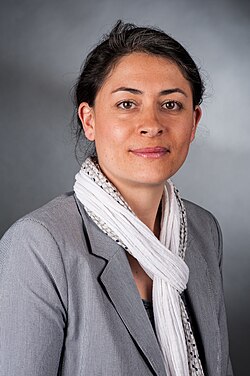
Irene Mihalic (born 17 November 1976 in Waldbröl, North Rhine-Westphalia) is a German politician of Alliance 90/The Greens and a member of the Bundestag.
- Facts0
- Drivers0
- Indicators0
Irene Mihalic (born 17 November 1976 in Waldbröl, North Rhine-Westphalia) is a German politician of Alliance 90/The Greens and a member of the Bundestag.
Irene Mihalic (born 17 November 1976 in Waldbröl, North Rhine-Westphalia) is a German politician of Alliance 90/The Greens and a member of the Bundestag. She served in the 18th, 19th and 20th legislative periods—the 18th Bundestag was constituted on 22 October 2013—and took her seat in the 21st Bundestag on 25 March 2025. A police officer by training, she joined the North Rhine-Westphalia police in 1993 and has been assigned since 2007 to the police headquarters in Cologne, on leave for the length of her parliamentary mandate.
The Bundestag biography, based on her own disclosures, records a Fachoberschulreife, police training, a diploma in public administration (Diplom-Verwaltungswirtin (FH)) from the University of Applied Sciences for Public Administration, a 2016 master's degree in criminology and police science at Ruhr University Bochum, and a 2018 doctorate from that university's law faculty. The same account lists her as non-denominational, married and the mother of two children; the Green parliamentary group's profile gives Gelsenkirchen as her place of residence.
Mihalic joined the Greens in 2006. From 2009 to 2013 she sat on the Gelsenkirchen city council as deputy chair of the Green group, after serving on the city's district executive from 2007 to 2009. She was a member of the party's state executive in North Rhine-Westphalia from 2010 to 2018 and of its Ruhr district executive from 2015 to 2023, chairing the latter from 2019. In the Bundestag she was the group's spokesperson on interior policy and its lead member on the 18th term's inquiries into the Edathy affair and the National Socialist Underground, and on the 19th term's inquiry into the 2016 attack at Berlin's Breitscheidplatz.
On 7 December 2021 the Green parliamentary group elected her first parliamentary managing director (Erste Parlamentarische Geschäftsführerin) with 99 percent of the vote, succeeding Britta Haßelmann. Der Spiegel described that post as the job of organising the group's daily work, settling the Bundestag agenda with the other groups, and linking the group to the parliamentary administration. For the election of 23 February 2025 she stood third on the Greens' North Rhine-Westphalia state list and as the party's candidate in constituency 122, Gelsenkirchen. Markus Töns of the SPD won the constituency with 31.4 percent of the first votes; the Greens, with Mihalic as their constituency candidate, took 6.1 percent of first votes (7,379) and 6.5 percent of second votes there. In the 21st Bundestag she is a full member of the Committee for the Scrutiny of Elections, Immunity and Rules of Procedure and of the Council of Elders, and a deputy member of the Interior Committee. She said the group had again entrusted her with the managing director's post for the new term, and Der Spiegel later quoted her in that office criticising Interior Minister Alexander Dobrindt's plan for broader turnbacks of asylum seekers at the border as contrary to European law and a strain on the Federal Police.
Irene Mihalic was born on 17 November 1976 in Waldbröl, a town in the Oberbergischer Kreis in the Bergisches Land of North Rhine-Westphalia, and grew up there as the youngest of three siblings. She attended the Realschule in Waldbröl and left with the Fachoberschulreife. She later said she had wanted to go to the school her friends attended, and that as a pupil she was both class and school spokesperson. In 2021 her mother still lived in Waldbröl, her brother in nearby Nümbrecht and her sister in Cologne.
Her parents came to Germany in the 1960s from the former Yugoslavia. A 2013 Deutsche Welle profile identified her father as a locksmith from Zagreb and her mother as a seamstress of Hungarian origin from Novi Sad, and placed them in the Yugoslav guest-worker generation. In a Bundestag debate on 1 December 2022, Mihalic said she was naturalized on 3 October 1983. She added that her father, a Rohrschlosser (pipe fitter), was not on a classic Gastarbeiter contract, but that he knew pub signs declaring guest workers unwelcome. Deutsche Welle reported the same incident and wrote that her parents, coming from a country without free elections, took German citizenship in order to take part in political life and urged their children to follow the news. The family watched the evening Tagesschau together, and she has said her father, who favoured the Social Democratic Party, was her first source of political information.
German and Croatian were both spoken at home. As a child she spent summers with her grandparents on the Croatian island of Brač, where she and her siblings were among eleven grandchildren. By 2013 she said she understood Croatian but had rarely spoken it for years, and had not visited Croatia for about two decades, although relatives in Zagreb followed her career through her father.
The early-1990s wave of far-right violence coincided with the end of her schooling. Racist riots in Hoyerswerda in September 1991, and in Rostock-Lichtenhagen in August 1992, targeted housing for contract workers, refugees and asylum seekers. On 23 November 1992 neo-Nazis firebombed two houses of Turkish-origin families in Mölln, killing three people, and on the night of 28–29 May 1993 the Solingen arson attack killed five girls and women of the Genç family. Mihalic was sixteen. A 2014 Bundestag profile places the start of her course at the police school in Linnich at the time of Solingen and reports that this racism preoccupied her: she found it inconceivable that anyone should face such hostility because of their origin. Recruits heard, in the school canteen, from a riot unit stationed there that had been sent to Hoyerswerda and Rostock-Lichtenhagen, including how powerless officers could feel when a far-right mob set upon residents. She said that showed her the police must represent the rule of law for everyone, not for one group, and later told a Croatian interviewer that seeing the consequences of the attacks had already politicized her. Her parents, she said, remembered her as a small girl with a strong sense of justice. A classmate who applied to the police and reported favourably on it led her to join the North Rhine-Westphalia Police in 1993, against her mother's fear that the work would put her in danger.
Irene Mihalic joined the North Rhine-Westphalia Police in 1993, straight after the Fachoberschulreife, and at 17 began recruit training at the police school in Linnich. An operational company on the same grounds had been deployed when hostels were attacked in Hoyerswerda and during the Rostock-Lichtenhagen riots. In a 2014 Bundestag profile she said those officers' accounts to new recruits fixed for her the idea that police represent the Rechtsstaat for everyone rather than for one group.
After training she served from 1996 to 2001 with the highway police (Autobahnpolizei) of the Cologne district government, in 2001–2002 at the district police authority in Gummersbach, seat of the Oberbergischer Kreis, and from 2004 again with the Cologne highway police, gaining practical experience in the investigative service during her studies in between. In 2007 that highway unit was attached to the Polizeipräsidium Köln, the headquarters named in her official biographies from then on; a Bundestag profile described the post-training work as chiefly that of a highway officer in Cologne.
From 2002 to 2004 she studied at the Fachhochschule für öffentliche Verwaltung in Cologne, part of the college for public administration of North Rhine-Westphalia, and graduated as a Diplom-Verwaltungswirtin (FH). The mandate took her off day-to-day duty rather than out of the service. Its biography, based on members' disclosures, says she has been at the Polizeipräsidium Köln since 2007 and is on leave for the mandate; the register of reportable interests lists her as a Polizeibeamtin of the Land Nordrhein-Westfalen there, with a right to return. Munzinger dates active service from 1993 to 2013. She told the 2014 profile that supervisors had supported her party work until the two roles could no longer be combined and she stood for parliament.
While still a police officer she took a master's in criminology and police science (Kriminologie und Polizeiwissenschaft) at the law faculty of Ruhr University Bochum, completing the M.A. in 2016. In the summer semester of 2018 the faculty accepted her doctorate. The preface names Professor Thomas Feltes as Doktorvater and Professor Gereon Wolters as the second examiner, and thanks the chair of criminology, criminal policy and police science, the Gelsenkirchen police under its then president Anne Heselhaus-Schröer, and the city administration for the data.
Felix-Verlag in Holzkirchen published the thesis the same year as volume 45 of Bochumer Schriften zur Rechtsdogmatik und Kriminalpolitik, edited by Feltes, Rolf Dietrich Herzberg and Holm Putzke. The title is Polizeiliche Einsätze, Kriminalität und Raum. Eine kriminalgeografische Analyse auf Basis polizeilicher Einsatzdaten und Sozialstrukturdaten der Stadt Gelsenkirchen (ISBN 978-3-86293-545-1; xiv and 280 pages). The University of Tübingen holds an open copy in its criminological repository.
The book is a descriptive study of Gelsenkirchen in 2015, for the northern and southern police areas and then the 18 districts, after chapters on the Chicago school, German criminal geography and social disorganization theory. The state interior ministry refused IGVP case-system extracts, arguing that the system was not a statistical source and that classifications change during investigations, so Mihalic used eCEBIUS deployment records, 2015 police crime statistics and the city's social-structure figures. A working group including a Gelsenkirchen command-centre officer reduced 245 incident codes to eleven super-categories and dropped waterway-police calls. The rest covered 79,812 deployments. Crimes were the largest group (22,639; 28.4 percent), ahead of traffic (15,400) and danger prevention (15,125).
The south had fewer residents but a higher share with a migration background, more transfer-benefit receipt, less stable housing and a higher crime frequency (Häufigkeitszahl). Deployments followed: 47,309 in the south and 32,506 in the north, and 6,678 against 4,242 for assault, domestic violence, theft, burglary and drug offences. The Altstadt took 21.6 percent of all deployments and Buer 14 percent. Theft and assault clustered in the Altstadt, burglary in Bulmke-Hüllen, and drug offences and domestic violence in Schalke. She called the Altstadt, Bulmke-Hüllen and Schalke hot spots and suggested community policing there.
Targeted crime-control operations did not match that burden: 1,169 in Buer and 129 in the Altstadt, with thin coverage too in Schalke, Ückendorf and Rotthausen. The force, as set out in the thesis, said it went where residents reported feeling unsafe, because that feeling often diverged from the recorded workload, and because it believed poorer districts with many migrants settled problems among themselves. Emergency calls pointed the other way: they opened 48 percent of deployments in Buer, against 56 to 69 percent in Neustadt, the Altstadt, Schalke and Bulmke-Hüllen, which Mihalic read as no measurable reluctance to call the police. She treated social-disorganization models as plausible for the south but not as proof of a direct cause, warned that mapping social conditions onto places can stigmatize them, and limited the thesis to description. Crime statistics were too coarse, deployment data only a partial substitute, and a stronger test would need suspect and victim addresses, smaller areas and repeats over time. Astrid Klukkert's January 2019 review in the Polizeiwissenschaft newsletter, a venue associated with Feltes, restated the north–south and emergency-call results and treated the reduced incident codes as reusable.
Irene Mihalic, who had lived in Gelsenkirchen since 2004, joined Alliance 90/The Greens in 2006. A 2014 profile in the Bundestag series Wege in die Politik reported that she did so in reaction to what she saw as the failed climate policy of the then grand coalition, and quoted her as concluding: “Now you have to get active. Just sitting on the sofa and sounding off cleverly will not do.” The same account says that a year later she took responsibility in the Gelsenkirchen district executive and that, from 2010, she combined police work and a council mandate with a seat on the state executive in North Rhine-Westphalia.
At the municipal election of 30 August 2009 she was the Green candidate for mayor and received 2,083 of 89,691 valid votes (2.3 percent). Incumbent Frank Baranowski of the Social Democratic Party was re-elected with 63.9 percent; turnout was 45.8 percent. In the council election the same day the Greens won 5,688 votes (6.4 percent) and four of 66 seats. The SPD took 50.4 percent and 34 seats, an absolute majority, so the Green group sat in opposition. The biography published by the Bundestag, drawn from members’ own disclosures, dates her council membership from 2009 to 2013.
The city chronicle for 2010 records her arguing from that minority seat. In late January the main committee, with the SPD majority following the administration, set up a three-member steering group on the future of Gelsenkirchen’s energy supply. Consultants were to spend nine months on models as the ELE concession neared its end in 2013 or 2014, including a possible municipal utility. Mihalic lost the vote for a place to Markus Karl of the CDU because the Greens would not accept support from Pro NRW. Green spokesman Peter Tertocha criticised the SPD for rejecting a larger body that would have included every faction. On 9 December 2010 she accused the administration of ending too lightly a contract with an animal-welfare association to take in stray animals, and of announcing that the draft zoning plan for a northern extension at Scholven was on display before the council had adopted it. The 2014 Bundestag profile later named, as the council issue she pressed hardest, plans by BP to extend the Scholven refinery into a landscape-protection area. In April 2011, as neighbours contested plans to locate Haus Vogelsang GmbH on the former Bergmannsglück colliery in Hassel, she told the Westdeutsche Allgemeine Zeitung that facts should not be created prematurely.
The Bundestag biography lists the party offices that ran with, and beyond, the council mandate: the Gelsenkirchen Kreisvorstand from 2007 to 2009; the state executive of the Greens in North Rhine-Westphalia from 2010 to 2018; and the Ruhr district executive (Bezirksvorstand) from 2015 to 2023, as its chair from 2019 to 2023. An internal list of state-board duties for 2012–2014, dated August 2012, assigned her interior affairs, democracy and law, transport and urban development, with energy as a further theme. She was the board’s contact for the district associations in Hagen, Münster, Oberberg and Steinfurt and, with Raoul Roßbach, for the Ruhr regional association.
In the Ruhr Greens that chair is exercised as a speakership. In August 2019 she and Daniela Schneckenburger invited members, as speakers of the Bezirksverband Ruhr, to a municipal convention on 8 September at the Jahrhunderthaus in Bochum, on the transport transition, open land, living conditions and a programme for the first direct election of the Regionalverband Ruhr assembly. They still signed as the speaker team on the call to the district assembly of 2 May 2023 at the Gelsenkirchen office on Ebertstraße, where a new executive was to be elected. Schneckenburger and Felix Banaszak filed for the two chair posts. The Bundestag biography closes her Ruhr office, chair included, in 2023. Looking back in 2014, she said police duty, the council mandate and the state executive had become hard to reconcile, and that in 2013 she had to choose between the police and politics.
Irene Mihalic has been the Alliance 90/The Greens candidate in Gelsenkirchen at every federal election from 2013 to 2025, and on each occasion she entered the Bundestag through the party's state list in North Rhine-Westphalia rather than by winning the constituency. The constituency is the city of Gelsenkirchen. It was numbered 123 at the elections of 2013, 2017 and 2021, and 122 at the election of 23 February 2025.
At the 2013 German federal election on 22 September 2013, the state returning officer's record of members elected from the state lists names Mihalic at place 7 on the Green list, with her residence in Gelsenkirchen. For the 18th electoral term the Bundestag recorded that mandate as a state-list seat for constituency 123. In the constituency the Greens polled 4,270 first votes, 3.7 percent and 3.9 points below 2009, and 6,413 second votes, 5.5 percent and 1.4 points below 2009. The direct mandate went to Joachim Poß of the Social Democratic Party of Germany, with 58,967 votes (50.5 percent). The 18th Bundestag was constituted on 22 October 2013.
On 24 September 2017 the Gelsenkirchen constituency returning officer admitted Mihalic as the Green candidate in constituency 123, where she was described as a police officer living in the city. She received 5,444 first votes (4.6 percent, up 1.0 point on 2013), and the Greens 5,489 second votes (4.6 percent, down 0.8 points). Markus Töns (SPD) won the constituency with 45,017 votes (38.3 percent). The official list of those elected from the North Rhine-Westphalia state lists places Mihalic fifth among the Greens, and the Bundestag again recorded a list seat for constituency 123. The 19th Bundestag met for its constituent sitting on 24 October 2017.
At the 2021 German federal election on 26 September 2021 she was again admitted as the Green candidate in constituency 123, by then listed as Dr Irene Mihalic. Her first-vote result was 11,286 (10.2 percent, up 5.5 points), and the Green second-vote result was 11,170 (10.0 percent, up 5.4 points), in a constituency where turnout was 66.7 percent. Töns held the direct mandate with 44,965 votes (40.5 percent). The final list of members elected from state lists names her at Green list place 3. The 20th Bundestag was constituted on 26 October 2021.
For the 2025 German federal election on 23 February 2025, the state returning officer's directory of candidates lists Mihalic both as the Green candidate in constituency 122 and as number 3 on the North Rhine-Westphalia Green list. She received 7,379 first votes (6.1 percent, down 4.1 points from 2021), and the Greens 7,944 second votes (6.5 percent, down 3.5 points). Turnout in the constituency was 74.5 percent of 164,673 eligible voters. Töns won the constituency again, with 38,118 votes (31.4 percent); the runner-up was Friedhelm Rikowski of the Alternative for Germany, on 25.8 percent. The federal returning officer records Mihalic as elected for the Greens from North Rhine-Westphalia at list place 3, associated with constituency 122, and the state's final list of members returned from party lists likewise gives her place 3. The 21st Bundestag was constituted on 25 March 2025.
In the 18th Bundestag, Irene Mihalic's committee base was internal affairs. The Interior Committee's membership list of 24 September 2014 named her a full member for Alliance 90/The Greens and marked her, with an asterisk the list defined as Obleute, as the group's spokesperson. In the 19th Bundestag the chamber's archived biography lists her as a full member of the Committee on Internal Affairs and Homeland, as the Greens' Obfrau on the first committee of inquiry, as a deputy member of the Committee on Legal Affairs and Consumer Protection, as a deputy member of the Joint Committee, and as a full member of the Bundestag body under Article 13(6) of the Basic Law.
After she became the Greens' First Parliamentary Managing Director, the archived biography for the 20th Bundestag lists her as a deputy, not a full, member of the Committee on Internal Affairs and Homeland, and as a full member of the Committee for the Scrutiny of Elections, Immunity and Rules of Procedure, of the Joint Committee, and of the Mediation Committee. On 24 March 2022 the Bundestag elected her, with 520 votes, to the Parliamentary Oversight Panel, which supervises the federal intelligence services.
In the 21st Bundestag she is a full member of the Committee for the Scrutiny of Elections, Immunity and Rules of Procedure and of the Council of Elders, a deputy member of the Interior Committee, a full member of the Joint Committee under Article 53a, and a deputy rather than a full member of the Mediation Committee.
In the 18th Bundestag she was the Greens' Obfrau on the second committee of inquiry, chaired by Eva Högl of the Social Democratic Party of Germany, into the case of the former SPD deputy Sebastian Edathy. The committee was to establish why the Federal Criminal Police Office took so long to connect Edathy with a Canadian child-pornography investigation, how information moved inside the authorities, and whether he had been warned. At its constitution in July 2014 she said the Interior Committee had already heard "four different versions" and that the inquiry had to learn "the truth about the procedures." On 1 July 2015 she said she was "absolutely sure" that the SPD deputy Michael Hartmann had warned Edathy. The Frankfurter Allgemeine Zeitung reported her charge, in January 2015, that the SPD was trying to "construct contradictions." The majority report, printed paper 18/6700, found that before the searches of 10 February 2014 Edathy knew or strongly suspected measures were coming, but that suspicion against Hartmann, though "nourished," lacked sufficient proof. The dissenting opinion she filed with Frank Tempel of Die Linke stated there was "no plausible doubt" that Hartmann had informed Edathy.
She was again the Greens' Obfrau on the third committee of inquiry of that term, the second inquiry into the National Socialist Underground. Its remit was to clarify how security and investigative authorities had used confidential informants and comparable sources.
In September 2016 she told Die Welt that the Federal Office for the Protection of the Constitution was still withholding central files — "Half of them are not there, and what arrives is pure chaos" — and that requested material, readable only in the agency's Treptow branch, remained "lost in the realm of the safes." The committee's 1,798-page report, adopted unanimously, found far-reaching defects in the criminal investigation and established that a staff member had deliberately shredded files to conceal how many informants had been active around the group. In the plenary debate she said there was "no Verfassungsschutz post-NSU," only "the old spirit of blocking, covering up and obfuscating," and accused the then president, Hans-Georg Maaßen, of declining a fresh internal inquiry into the shredding. In a minority vote the Green group argued for replacing the agency with a new federal office separated more clearly from police work.
In the 19th Bundestag she was Obfrau on the first committee of inquiry into the 2016 Berlin truck attack, in which Anis Amri drove a lorry into a Christmas market at Breitscheidplatz on 19 December 2016, killing twelve people, including the driver he had shot. Set up unanimously on 1 March 2018, it was to reconstruct why Amri was not stopped and to recommend changes for the authorities and for victims; it compared files from the federation and all sixteen states and heard about 180 witnesses and experts. In December 2020 she told Deutschlandfunk that files sometimes arrived only on the day of a hearing and were blacked out "beyond recognition," and that the attack might have been prevented if indications of Amri's dangerousness had been taken seriously earlier. She contrasted admissions of error by the heads of the criminal police and the foreign intelligence service with what she called their absence under Maaßen. On 16 December 2020 the Federal Constitutional Court rejected an organ-dispute by the Free Democratic Party, the Left, the Greens and those groups' inquiry spokespersons over the refusal to name an informant handler. The Second Senate held that, in that case, the right to take evidence yielded to the interest of the state in the service's functioning. Debating the report on 24 June 2021, Mihalic said the federal security authorities bore a large share of the responsibility, that the Joint Counter-Terrorism Centre had misjudged Amri, and that he had belonged to a jihadist network rather than acted alone. The Federal Criminal Police Office, she said, had worked "very much on the principle that the perpetrator is dead, so the case is solved." Der Spiegel reported that the Greens, the Free Democrats and the Left dissented from the majority report: indications had "at least negligently" been ignored or misread, and Amri "was to be portrayed from the outset as a lone perpetrator."
From December 2013 Mihalic was spokesperson for internal security of the Bundestag group of Alliance 90/The Greens. In April 2016 she succeeded Volker Beck as the group's spokesperson for interior policy; she had been its security-policy spokesperson. She held that brief for the rest of the 18th electoral term and through the 19th. After she became First Parliamentary Managing Director in December 2021 she continued to speak on security, and in March 2022 joined the Parliamentary Oversight Panel.
The office she pressed for longest was an independent federal police commissioner, modelled on the armed forces commissioner. On 19 February 2016 the Green group, with Mihalic among the sponsors, introduced Drucksache 18/7616: a commissioner elected by the Bundestag, responsible for the Federal Police, the Federal Criminal Police Office and customs, whom citizens and staff could approach about misconduct and structural failings outside the chain of command.
Police unions opposed the bill at an interior-committee hearing on 29 May 2017. Jörg Radek of the Gewerkschaft der Polizei said it placed the Federal Police under a general suspicion; Rainer Wendt of the Deutsche Polizeigewerkschaft called a parliamentary commissioner "political parallel justice" and said internal controls were enough. Lawyers invited as experts were more favourable, pointing to comparable bodies abroad and to European Court of Human Rights case law on investigators independent of the police. The Greens called the office quality assurance, not distrust. On 29 June 2017 the Bundestag rejected the bill, and two related motions, with the votes of the governing CDU/CSU and SPD against the opposition.
A revised bill of 20 February 2019, Drucksache 19/7928, added the Bundestag police and was not adopted. The 2021 coalition agreement of the SPD, the Greens and the FDP then promised an independent commissioner for the federal police forces, based at the Bundestag, with access to files and to premises. The coalition bill, reported from committee on 17 January 2024, became the Polizeibeauftragtengesetz. It limited the office to the Federal Police, the BKA and the Bundestag police—customs was omitted—and left criminal, disciplinary and judicial remedies unchanged. On 14 March 2024 parliament elected the SPD member and former Bavarian officer Uli Grötsch by 416 votes to 215, with 38 abstentions; 368 were required. President Bärbel Bas appointed him the next day; he resigned his seat and was sworn in on 20 March for five years. Mihalic rejected the view that this kind of scrutiny was hostility to the police. In June 2020 she called "polizeifeindlich" an improper label: police conduct had to be open to question, and answering criticism with the charge of a general suspicion ended the argument.
The National Socialist Underground shaped her case on domestic intelligence. The Green motion of 12 March 2014, Drucksache 18/776, which she introduced, treated the first NSU inquiry's cross-party recommendations as a minimum. It called for the Federal Office for the Protection of the Constitution to be dissolved and rebuilt with narrower tasks, confined to efforts linked to violence, and for open-source analysis to pass to an independent institute without intelligence powers. It also demanded an end to informants in the right-wing scene—described as disastrous, useless and counterproductive—and a statutory police-complaints office.
After the 2016 Berlin truck attack at Breitscheidplatz she argued that the failure was operational. In an interview published on 23 January 2017 she said that, despite wide powers, "many things were not done that could have been done" in the case of Anis Amri. She backed round-the-clock surveillance only of a few priority Gefährder: covering roughly 550 Islamist, 130 right-wing and 136 left-wing Gefährder, at about 30 officers each, was impossible. Residence law was not, she said, counter-terrorism law—more than half the Islamist Gefährder held German passports—and preventive detention broke the presumption of innocence: "We are not in Guantánamo here." She put the shortages of staff and equipment down to the Union's nearly twelve years at the interior ministry.
When, after the 2018 Chemnitz protests, Hans-Georg Maaßen suggested that a video of attacks might be deliberate disinformation, she told the Rheinische Post that anything not grounded in the agency's own reliable findings was "pure political agitation." With Konstantin von Notz she called the downplaying of Chemnitz by Maaßen, Saxony's minister-president and Interior Minister Horst Seehofer irresponsible. In a taz interview after the decision to remove Maaßen, she said replacing him was not a new start: the office should become a scientific institute using open sources, plus a smaller service for threat detection and counter-espionage that would give way to the police once a concrete danger appeared. The same failure of analysis, she said, had marked the Amri case, and informants could be only a last resort after their role around the NSU. A March 2019 motion, Drucksache 19/8700, put that division before the Bundestag. The Süddeutsche Zeitung reported that the draft reversed Seehofer's plan to give the domestic service further surveillance powers so that it could work alongside the police. The majority did not adopt it.
On 24 March 2022 the Bundestag elected Mihalic to the Parliamentary Oversight Panel, which supervises the foreign intelligence service, military counter-intelligence and the domestic intelligence office, with 520 votes; 369 were required. Von Notz was elected with her. The candidates of the Alternative for Germany and the Left were not.
After raids on 7 December 2022 against a Reichsbürger movement network accused of planning a coup, she said that known right-wing extremists and Reichsbürger had to be removed from the public service, that the legal means were still too limited, and that armed staff of security authorities inside such networks were a particular danger to democracy. On 19 December she urged the FDP not to block tighter weapons law: nearly 100 legally held weapons had been found with more than 50 people, including a gun dealer. Interior Minister Nancy Faeser (SPD) was seeking a reform, including a ban on war-like semi-automatic weapons in private hands; Justice Minister Marco Buschmann (FDP) replied that Germany's gun laws were already strict.
In a Bundestag parliamentary group the Erste Parlamentarische Geschäftsführerin — the first parliamentary managing director, a post comparable to a chief whip — runs day-to-day business with the chairs. Managing directors prepare plenary sittings, settle agendas with the other groups and in the Council of Elders, hold members together for important votes, help fill committee places, and mediate with the government, the Bundesrat, their party and outside organisations. In the group of Alliance 90/The Greens, Der Spiegel called the first managing director the organiser of everyday group work, of the Bundestag's order of business with the other groups, and of the link to the Bundestag administration.
On 4 December 2021 Spiegel reported that Mihalic had told colleagues, in a letter the magazine had seen, that she was standing. She wrote that the group's task was to carry its projects through parliament and that she wanted to contribute "in a responsible position", and that people expected it to take procedure seriously, "above all the mandate to scrutinise the government". The magazine placed her on the party's left: then 45, a police officer and a criminologist with a doctorate, and for several years the group's interior-policy spokesperson. Britta Haßelmann, the incumbent and a figure of the Realo wing, was standing for the chair, as was the left-leaning economics politician Katharina Dröge. With Mihalic, Spiegel wrote, the three leading posts would be held by women, all from North Rhine-Westphalia; no serious rivals had been announced or were thought likely.
The group elected her on 7 December 2021. The Westdeutsche Allgemeine Zeitung reported that she received 99 percent of the votes. She succeeded Haßelmann, whom the group that day chose, with Dröge, as co-chair in place of Anton Hofreiter and Katrin Göring-Eckardt, who had led it for eight years. Filiz Polat, Anja Reinalter and Till Steffen were elected as the other parliamentary managing directors.
From December 2021 the Greens governed in the traffic-light coalition with the Social Democratic Party and the Free Democratic Party. As whip, Mihalic repeatedly argued for a common line. In August 2022, after partners criticised economics minister Robert Habeck over the gas levy, she told newspapers of the RedaktionsNetzwerk Deutschland that SPD and FDP politicians were attacking the Green partner in search of better polls instead of a jointly agreed profile. "Some people must finally grasp that the success and failure of the traffic light fall directly on the parties and groups that carry it," she said.
On 14 March 2024, before another CDU/CSU motion demanding Taurus cruise missiles for Ukraine, she said there was no reason to break group or coalition discipline and that she expected no dissenters. Everyone in the group, she said, understood that the Union motion was motivated purely by domestic politics.
The budget fight at the coalition's end was sharper. On 6 November 2024 she said in Berlin that the government again stood "Spitz auf Knopf" — on a knife-edge — and that it was unacceptable for the FDP to withhold itself from joint crisis management. She accused finance minister Christian Lindner of having "completely miscalculated", of overestimating tax revenue and of not commanding "the basics of mathematics", and called the shortfall a "Lindner gap". She credited Habeck with offering billions originally planned for Intel, and said one party had to stop making its interests "the navel of government policy". The finance ministry answered that she was unfamiliar with the procedure: estimates rest on the economics ministry's forecast and are applied technically, so the gap would be a "Habeck gap" if the charge held.
After the coalition collapsed, the dispute moved to the calendar. On 15 November 2024 she defended dropping the Bundestag's budget week: it could go because there was visibly no majority, "but that does not mean a standstill". The Union, SPD, Greens and FDP carried the cancellation; the AfD, the Left and the BSW opposed it as a cut in opposition rights.
The Greens were in opposition after the election of 23 February 2025. On 26 February the group left its executive in office on an acting basis. On 24 March it re-elected Haßelmann and Dröge as co-chairs, each with 90.4 percent, and Mihalic as first parliamentary managing director with 93.9 percent. Tagesschau reported that the chairs had drawn internal praise for negotiations with the Union and the SPD on a financial package for defence and infrastructure. On 29 April the group re-elected Filiz Polat and Anja Reinalter as parliamentary managing directors and added Claudia Müller. Till Steffen, a managing director in the previous term, lost a contest for a deputy chair to Konstantin von Notz.
The Bundestag biography lists Irene Mihalic as a member of LEAP Deutschland (Law Enforcement Against Prohibition). LEAP, founded in Berlin in 2015, lists her among its speakers rather than on its five-member executive, and describes her as a police officer, a member of parliament and a member of Alliance 90/The Greens.
During the 19th Bundestag she told Abgeordnetenwatch that a controlled supply of cannabis mattered to her personally and that she worked with LEAP on a voluntary basis for what she called a progressive drug policy. She argued that prohibition had failed in practice: the illegal market had no age or health controls, supplies were sometimes cut with dangerous adulterants and synthetic cannabinoids, and the trade supported organised crime, while users could still obtain the drug. Decriminalising adult possession for personal use would, she wrote, free investigators for prevention, harm reduction and treatment. She also repeated a Green estimate of more than two billion euros a year in revenue.
On 21 February 2024, as first parliamentary managing director of the Green Bundestag group, she said she was not counting on dissenters and that the group was “very satisfied” with the Cannabis Act. “We are taking the first step toward decriminalising cannabis,” she said, with stronger protection of children and young people. She voted yes on 23 February. The bill passed by 404 votes to 226, with four abstentions. From 1 April 2024 adults may possess up to 25 grams in public and 50 grams at home and grow up to three plants; non-commercial cultivation associations may distribute cannabis from 1 July. The stated aims were health protection, prevention, a smaller illegal market and stronger youth protection.
The CDU/CSU opposed the law. Health spokesman Tino Sorge called it, in a circular to the group, “fatal and irresponsible in the highest degree.” A letter from Sorge, Silvia Breher and Günter Krings said a future Union-led government would repeal “this irresponsible law.”
After the December 2022 raids in the suspected Reichsbürger coup plot, Mihalic urged tighter firearms rules. She told the Redaktionsnetzwerk Deutschland that nearly 100 legally held weapons had been found and that a gun dealer was among those searched, and that right-wing extremists, including adherents of the Reichsbürger movement, had to be disarmed more effectively. She said the Free Democratic Party should not block the coalition’s promised review of weapons law, because legal guns must not reach terrorists. Plans by Interior Minister Nancy Faeser for better exchange of information between police and weapons authorities, and for banning private possession of semi-automatic firearms resembling weapons of war, drew criticism from the FDP.
On asylum, she opposed summary refusal at the frontier. On 8 May 2025, after Interior Minister Alexander Dobrindt said asylum seekers could be turned back at land borders—except pregnant women, children and other vulnerable people—and that more Federal Police would be sent there, Mihalic called blanket rejection of asylum applications “simply contrary to European law” and said it called cooperation with neighbouring countries into question. Shifting officers to the border would, she said, impose an “unprecedented overload” on the Federal Police and open gaps at railway stations and airports.
She has opposed suspicionless data retention. In January 2015, after an attack in France, she told the Mitteldeutsche Zeitung that France had stored such data “for years” without preventing the killings, and that a CSU demand to introduce retention instrumentalised the events. In April 2026 she criticised a cabinet plan to keep IP addresses for three months, citing gaps that would remain, earlier governments’ failure to produce a constitutional statute, and her doubt that the draft would survive judicial review.
The Bundestag biography also lists membership of PolizeiGrün, Greenpeace, the International Police Association and the Gewerkschaft der Polizei.
Bundestag biographies, compiled from members' own statements, record Mihalic as married and the mother of two children. The entries for the 19th and 20th electoral terms also list her as konfessionslos; the biography for the 21st term repeats the marriage and the two children and gives Gelsenkirchen as her place of residence, but does not restate a denomination. A July 2014 portrait in the Bundestag series "Wege in die Politik" said she had lived in the city with her husband since 2004.
Contemporary reports identify that husband as Dennis Melerski, her colleague on the Cologne motorway police. Hans Otto Film, which from May 2008 produced segments of the kabel eins series Achtung Kontrolle, listed "the Cologne motorway officers Irene Mihalic and Dennis Melerski" among the people it had filmed. In July 2014 Die Tageszeitung wrote that the officer at the wheel was her husband Dennis, himself a motorway policeman; the Bundestag portrait called him her then partner on the programme. In March 2014 the Westdeutsche Allgemeine Zeitung presented Melerski and Mihalic together as active in the Gelsenkirchen Greens, and in 2018 described her as a mother of two whose centre of life was still the city.
Writers who visited her Bundestag office found a mannequin in her old green police uniform, which she called a reminder of where she had come from. It dated from her appearances on Achtung Kontrolle! – Einsatz für die Ordnungshüter (2008–2017), a daily kabel eins reportage on police, customs officers, bailiffs and food inspectors. Die Tageszeitung wrote that, outside North Rhine-Westphalia, she had until her election been known mainly to fans of reality documentaries, riding in an unmarked BMW around Cologne as one of two "Vorzeige-Cops" against speeding and tailgating.
The portrait, "Polizistin aus dem Pott" — a name for the Ruhr — called her a genuine exception in Alliance 90/The Greens, a party "traditionally said to have a tense relationship with the police and the military", and the group's first and only police officer. She spoke of "defensive reflexes on both sides", from officers who still saw the Greens as stone-throwers and from members who remembered anti-nuclear demonstrations. An October profile in politik&kommunikation, headed "Die Ausgleichende", reported that heated debates did bring attacks, more often from younger members, including the Grüne Jugend, than from the founding generation. It quoted Rainer Wendt of the Deutsche Polizeigewerkschaft calling her "knowledgeable, open and refreshingly pragmatic", and reported Cem Özdemir's remark in Der Spiegel that Green officers such as Mihalic could be "door openers in both directions".
Die Tageszeitung called her a lateral entrant for "a new, undogmatic generation" and wrote that she and Frank Tempel, another former officer, were on "a narrow ridge". In 2016 it said the Greens' turn toward the police could be read in her. Der Spiegel in 2020 still opened on her twenty years in uniform and on whether the Greens could do "law and order". The Munzinger-Archiv heads its entry "German police officer and politician", with service from 1993 to 2013 before the Bundestag.
Ranked by shared high-impact facts, then explicit ties, then shared drivers.
 Horst SeehoferHorst Lorenz Seehofer is a German politician who served as…Affiliated
 Christian LindnerChristian Wolfgang Lindner is a German retired politician…Affiliated
 Felix BanaszakFelix Banaszak (born 24 October 1989 in Duisburg) is a…Affiliated
 Katrin Göring-EckardtKatrin Dagmar Göring-Eckardt is a German politician of the…Affiliated
 Filiz PolatFiliz Polat (born 11 July 1978 in Bramsche) is a…Affiliated
 Katharina DrögeKatharina Dröge (born 16 September 1984 in Münster) is a…Affiliated
How the record is sourced and how the score is derived.
The score is formula-derived (Factrail formula v1, version 1.0.0), not an editorial verdict. Read the methodology.
By the Factrail desk · Method: how we source and score · Last reviewed
Dispute a fact on this pageNamed here, or represent someone who is? Request a right of reply.
People and organizations as listed in the Related section of this page; facts, drivers and the pages that name it as listed in the blocks here. Counts, not a rating.