
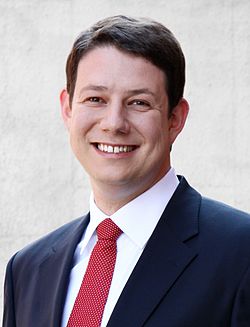
Kerstin Radomski
Kerstin Christiane Radomski (born 1 November 1974 in Krefeld-Hüls) is a German schoolteacher and a politician of the Christian Democratic Union (CDU).
- Facts0
- Drivers0
- Indicators0
Kerstin Christiane Radomski (born 1 November 1974 in Krefeld-Hüls) is a German schoolteacher and a politician of the Christian Democratic Union (CDU).
Kerstin Christiane Radomski (born 1 November 1974 in Krefeld-Hüls) is a German schoolteacher and a politician of the Christian Democratic Union (CDU). She has been a member of the Bundestag since 22 October 2013 (18th to 21st electoral terms) and, in the 21st electoral term, holds the direct mandate for constituency 113, Krefeld II – Wesel II, in North Rhine-Westphalia. The constituency takes in the Krefeld boroughs of Nord, Hüls, Mitte and Ost and, from the district of Wesel, the municipalities of Moers and Neukirchen-Vluyn.
The Bundestag biography, which rests on her own disclosure, records that she is Protestant and has two children. She passed the Abitur at the Fichte-Gymnasium in Krefeld and studied to teach biology and geography at Ruhr University Bochum. She worked from 2004 at the Waldschule in Eschweiler, moved in 2008 to the Gesamtschule in Mönchengladbach-Hardt, and from 2013 was a Studienrätin at the Maria-Sibylla-Merian-Gymnasium in Krefeld. She joined the Young Union in 1997 and chaired its Niederrhein district association from 2003 to 2008, became a CDU member in 1998, and has sat on the state executive of the CDU in North Rhine-Westphalia since 2005. Since 2012 she has been deputy district chair of the CDU in Krefeld, and since 2019 deputy chair of the CDU in the Niederrhein region.
At the 2017 federal election she won the then constituency 114, Krefeld II – Wesel II; the Rheinische Post recorded her first-vote share as 37 percent, and the official CDU total in the constituency was 48,817 votes (37.0 percent). In 2021 she was again the CDU direct candidate there, against Jan Dieren of the Social Democratic Party of Germany. The SPD won the seat with 45,852 first votes (35.2 percent) to the CDU's 37,033 (28.4 percent). She remained a member of the Bundestag. At the 2025 German federal election the same area, renumbered as constituency 113, returned her with 44,412 first votes (32.0 percent), ahead of Jan Ulrich Dieren of the SPD on 41,999 votes (30.2 percent), with turnout at 80.9 percent. She was also 15th on the CDU state list for North Rhine-Westphalia, adopted at a party assembly in Essen on 14 December 2024.
In the 21st Bundestag she chairs the Audit Committee (Rechnungsprüfungsausschuss), sits as an ordinary member of the Budget Committee, and is a deputy member of the committees on research, technology, space and technology assessment and on culture and media. She is deputy chair of the parliamentary group for relations with Canada, and from 2015 to 2018 she was a member of the Parliamentary Assembly of the Council of Europe. In March 2016 she apologised to voters after Bild reported that she had charged a work bag costing 532 euros to the Bundestag office-materials account, then capped at 12,000 euros a year; she said the administration had checked the purchase and found it in order, and that she had nonetheless shown no sense of proportion.
Kerstin Radomski was born on 1 November 1974 in Hüls, the place her Bundestag biography gives as Krefeld-Hüls. Hüls had belonged to the district (Landkreis) of Kempen; in 1975 it was incorporated into the city of Krefeld and is now that city’s northern district. She has written that she grew up there with a younger brother and still lives in the north of Krefeld. The Bundestag, which states that members’ biographies rest on their own information, lists her as Protestant and as the mother of two children. A September 2017 profile in the Westdeutsche Zeitung described her as a single mother of two daughters and as the elder sister in the family.
In that interview she connected her childhood above all with the racecourse at Hüls, where her mother worked for fifty years in the ticket booth. On race days, when the grounds filled with people placing bets, she earned pocket money — “a few marks” — as a Läuferin, a runner on the course, and she remembered the atmosphere as familial. Being outdoors, and an interest in nature and animals, ran through the same account: she said she had wanted to become a farmer, but that farming was economically too difficult.
Radomski took her Abitur at the Fichte-Gymnasium in Krefeld. That Gymnasium was later merged with the Arndt-Gymnasium. In February 2019 the school conference of the combined inner-city school chose to name it after the political theorist Hannah Arendt, subject to approval by the Krefeld city council. The successor, the Hannah-Arendt-Gymnasium, still uses the former Fichte buildings on Lindenstraße for its upper years.
She then studied for a teaching degree (Lehramt) in biology and geography at Ruhr University Bochum. A 2021 Rheinische Post portrait records the same outline: born in Hüls in 1974, the Abitur at the Fichte, and a teaching degree in biology and geography at Bochum. During her studies, she later said, she spent a great deal of time at a centre of the Naturschutzbund Deutschland (NABU), identifying groups of insects. The Westdeutsche Zeitung presented biology and Erdkunde — the school subject corresponding to geography — as the classroom career that followed once farming had dropped away.
In North Rhine-Westphalia, teacher education is divided into a university phase and a practical phase, the Vorbereitungsdienst (Referendariat). Trainees hold a revocable civil-service appointment; the preparatory service ends when the result of the state examination is issued, and for candidates who hold a first state examination that examination has, since 1 August 2011, been designated the second state examination. Published biographies do not name the training centre or the date of Radomski’s examination. They record that she was employed as a teacher from 2004, the start of her school career, and list her rank as Studienrätin in the service of the Land North Rhine-Westphalia.
Radomski qualified to teach biology and geography at the Ruhr University Bochum. The biography published by the Bundestag, which the parliament states is based on members’ own information, records that she worked from 2004 at the Waldschule – Städtische Gesamtschule Eschweiler, a municipal comprehensive school, moved in 2008 to the Gesamtschule in Mönchengladbach-Hardt, and from 2013 was a Studienrätin at the Maria-Sibylla-Merian-Gymnasium in Krefeld. The CDU in North Rhine-Westphalia describes the years from 2004 as teaching at several types of school.
The civil-service title predates the 2013 gymnasium post. On 18 September 2008 the Westdeutsche Zeitung called the then 33-year-old a Studienrätin. A Rheinische Post profile of 17 September 2009 placed her as a teacher then working in Mönchengladbach-Hardt, which she called “eine tolle Schule”. In August 2021 the same paper described her most recent school post as that of a Gymnasiallehrerin in Krefeld.
In North Rhine-Westphalia the education ministry uses Studienrat and Studienrätin for a civil-servant teacher qualified for Gymnasien and Gesamtschulen or for a Berufskolleg: the entry office in pay group A 13, plus a pensionable structural allowance under section 47 of the Land pay statute. Studienreferendarinnen normally serve only the preparatory period, as civil servants on revocation, until the state-examination result is announced. Radomski is recorded as a Studienrätin, not in that trainee grade.
She has been a member of the Bundestag since 2013, including the 20th electoral term (2021–2025), so the school post has not been resumed between terms. Under section 5 of the Members of the Bundestag Act, the rights and duties of a salaried civil servant’s public-law service relationship are suspended from the day the Federal Electoral Committee establishes the result, or from acceptance of the mandate, for the duration of membership. Official secrecy and the ban on accepting rewards and gifts continue. The official title may be used with the addition “außer Dienst”, and the suspension lasts at most until retirement. Section 73 of the North Rhine-Westphalia Civil Service Act does not create a separate leave arrangement for a Bundestag mandate. It provides that the civil-service consequences are set out in special statutes, without prejudice to certain other rules of the Land act.
The “Rückkehrrecht” in her disclosures is the reinstatement rule in section 6 of the federal act. After membership ends, the rights and duties remain suspended for at most six further months. An application within three months must be followed, within three months, by return to the former service relationship in an office of the same or an equivalent career and with at least the same final basic salary; pay for the last office is due from the date of the application. The statute does not guarantee the previous school. If no application is made, suspension continues until retirement. The supreme service authority may order a return, with dismissal if it is refused, only where the civil servant has neither belonged to the Bundestag for at least two electoral terms nor reached 55 when membership ended, and not where the member served in the federal government during the mandate. The register of notifiable interests names the Land Nordrhein-Westfalen, Düsseldorf, as the employer before she entered parliament: “Studienrätin” in the biography for the 18th electoral term, and “Studienrätin, Rückkehrrecht” in the current biography, a wording also carried by Abgeordnetenwatch.
Kerstin Radomski joined the Junge Union in 1997 and the Christian Democratic Union (CDU) in 1998, according to the biography published by the German Bundestag from the member's own information. It dates her chairmanship of the Junge Union Niederrhein, the Lower Rhine branch of the youth organisation of the CDU and the Christian Social Union, from 2003 to 2008.
She left the chair at the branch assembly, the Niederrheintag, in Dinslaken in February 2008. The Westdeutsche Zeitung reported on 25 February that she had led the association for six years and had decided not to stand again, leaving Thomas Selders of the Kleve branch, then 25, as the only candidate. Of 66 delegates entitled to vote, 44 supported him, 20 voted no and two abstained. Radomski said, "Es ist eine junge Riege, und ich will sie nicht am Fortkommen hindern" ("It is a young cohort, and I do not want to hold it back"), and called the step her move into the CDU. As an assessor (Beisitzerin) on the state executive in North Rhine-Westphalia, she said she wanted to work particularly for Krefeld.
On 22 November 2012 an extraordinary Krefeld district congress in the König-Palast replaced a board that Winfried Schittges had led for 27 years. Marc Blondin was elected district chairman with 113 of 122 votes, and Radomski, then 38, became a deputy chair (stellvertretende Kreisvorsitzende) with 96 of 119 votes. She was returned at the congress reported on 30 April 2017, with 81 votes, Stefan Galke replacing Daniel Wingender as the other deputy, and again at those covered on 28 June 2021 and 5 May 2023, when she received 71 yes votes from 80 delegates. A new executive elected on 22 March 2025, chaired by Christopher Schiffer with Maximilian Pasch and Christina Ehlen as deputies, does not include her.
The CDU Bezirksverband Niederrhein comprises the district associations of Wesel, Kleve, Viersen, Krefeld, Neuss and Mönchengladbach. At the Niederrheintag reported on 23 January 2019, at Haus Kleinlosen in Verberg, delegates confirmed Günter Krings of Mönchengladbach as regional chairman with no votes against and elected Radomski one of his deputies. She was re-elected on 30 August 2022 at the Bürgerhaus in Dülken with 74.68 percent, together with Marcus Optendrenk, Stefan Rouenhoff and Hermann Gröhe; Charlotte Quik of Wesel joined the deputy chairs. At the congress in Mönchengladbach's Kaiser-Friedrich-Halle, reported by the Rheinische Post on 1 October 2024, Krings was confirmed with 97.7 percent and Radomski was again a deputy, with Heike Troles of Neuss replacing Gröhe. The regional association's account of that congress gave Radomski 84.6 percent and also described her as its membership officer (Mitgliederbeauftragte). At the Niederrheintag of 2026, again in the Kaiser-Friedrich-Halle and reported on 6 September, the Rheinischer Spiegel listed the same deputy team: Optendrenk, Quik, Radomski, Rouenhoff and Troles.
On the CDU state executive, the Bundestag biography dates her membership from 2005; by February 2008 the Westdeutsche Zeitung already identified her as an assessor. State-party result sheets record 288 votes (49.4 percent) for her among the 31 assessors in Bonn on 6 November 2010 and 68.4 percent at the 41st congress on 9 June 2018. She was among the 31 elected on 23 October 2021, received 300 votes (48.9 percent) at the 45th congress in Hürth on 28 October 2023, and was elected again at the 47th congress in Bonn, reported on 30 August 2025. The state association's board page continues to list her. Since 2015 the biography has also named her liaison (Verbindungsmitglied) between the CDU's North Rhine-Westphalian Landesgruppe in the Bundestag and the CDU group in the state parliament.
On 12 December 2016 the Krefeld branch of the Mittelstands- und Wirtschaftsunion (MIT) — the CDU's organisation for small and medium-sized business, also called the Mittelstands- und Wirtschaftsvereinigung — elected Peter Vermeulen chairman and Radomski first deputy chair. The Rheinische Post reported on 4 July 2023 that Vermeulen, in office since December 2016, had been confirmed and that Radomski remained first deputy. At the members' meeting of 29 April 2025, at the Schlüffken brewery in Krefeld's Nordbahnhof, Maximilian Becker succeeded Vermeulen, who did not stand after nearly nine years. The Rheinische Post named Andreas Stattrop as first deputy and Mehmet Demir, Tanja Riesner, Alexandra Chatzivassiliadis and Michael Neppeßen as the further deputies; Radomski was not among them. The Bundestag biography of 29 October 2026 nevertheless still recorded both the Krefeld CDU deputy chair and the Krefeld MIT deputy chair as held since 2012 and 2016 respectively, without end dates.
Kerstin Radomski has stood in the Bundestag constituency Krefeld II – Wesel II, in North Rhine-Westphalia, at each federal election from 2013 to 2025. The seat comprises four boroughs of the independent city of Krefeld—2 Nord, 3 Hüls, 4 Mitte and 8 Ost—and, within Kreis Wesel, the municipalities of Moers and Neukirchen-Vluyn in full. The rest of Krefeld, and the other municipalities of the district, including the city of Wesel, lie in neighbouring constituencies.
The Federal Returning Officer used the same municipal description for the constituency in 2013, 2017 and 2021, when it was numbered 114, and again in 2025, when the federal redistribution renumbered it 113 without altering its area. The electorate fell from 182,593 in 2013 to 179,118 in 2017, 175,852 in 2021 and 173,314 in 2025. Voters cast a first vote for a constituency candidate and a second vote for a party’s state list. Through 2021 the first-vote plurality won the constituency seat outright; list seats then filled out each party’s proportional share.
On 22 September 2013 Radomski was the Christian Democratic Union candidate against the sitting Social Democratic Party member Siegmund Ehrmann. Ehrmann kept the seat with 53,578 first votes (41.5 percent). The CDU took 51,835 (40.1 percent), a margin of 1,743 votes. Die Linke received 6,994 (5.4 percent), Alliance 90/The Greens 6,888 (5.3 percent), the Free Democratic Party 3,245 (2.5 percent) and the Pirate Party 3,040 (2.4 percent). Turnout was 71.8 percent, with 129,237 valid first votes. On the CDU second vote the constituency gave the party 36.9 percent and the SPD 34.6 percent.
Radomski was also place 40 on the CDU state list, adopted at the party’s Landesvertreterversammlung in Münster on 16 March 2013. She did not win the constituency, but the list place was reached and she entered the 18th Bundestag as a list member on 22 October 2013, when that parliament constituted itself.
At the election of 24 September 2017 Radomski won the constituency. The CDU received 48,817 first votes (37.0 percent). The SPD candidate Elke Buttkereit was second with 42,219 (32.0 percent), 6,598 votes behind. The Alternative for Germany took 11,294 (8.5 percent), the FDP 10,769 (8.2 percent), the Greens 8,063 (6.1 percent) and Die Linke 7,418 (5.6 percent). Turnout was 74.6 percent. The Rheinische Post described the result as the first time a CDU candidate had carried the constituency. Second votes there were 30.9 percent for the CDU and 27.7 percent for the SPD. Radomski sat for the 19th Bundestag as the directly elected member.
On 26 September 2021 she lost the seat to Jan Dieren of the SPD, a candidate from Moers. The SPD won 45,852 first votes (35.2 percent) to the CDU’s 37,033 (28.4 percent), a gap of 8,819 votes. The Greens rose to 17,398 (13.4 percent), ahead of the FDP on 10,954 (8.4 percent), the AfD on 9,077 (7.0 percent) and Die Linke on 4,100 (3.1 percent). Turnout was 74.9 percent. Second votes went 31.8 percent to the SPD and 24.7 percent to the CDU. Radomski was place 20 on the CDU state list, as well as the constituency candidate, and returned to the 20th Bundestag from that list rather than from the constituency. She told the Rheinische Post that place 20 was the penultimate CDU list place in North Rhine-Westphalia to be reached.
The 2025 federal election, held on 23 February 2025, was the first under the 2023 reform of the federal electoral law. The Bundestag is fixed at 630 members. Second votes alone set each party’s seat total. A party’s constituency winners in a Land are ranked by their share of valid first votes, and only as many of them receive a seat as the party’s second votes in that Land cover. A plurality therefore no longer seats a candidate by itself. Candidates elected that way are left off the list allocation; any seats still due go down the state list. In July 2024 the Federal Constitutional Court held the coverage rule compatible with the Basic Law.
In constituency 113 Radomski received 44,412 first votes (32.0 percent) and Dieren 41,999 (30.2 percent), a margin of 2,413 votes. The AfD candidate Hauke Finger took the party’s 23,421 votes (16.9 percent), and the Green candidate Ursula Schauws its 12,133 (8.7 percent). Die Linke received 8,552 (6.2 percent) and the FDP 4,841 (3.5 percent). Of 173,314 eligible voters, 140,222 cast ballots, a turnout of 80.9 percent, and 138,969 first votes were valid. On the second vote in the constituency the CDU led with 40,194 (28.8 percent), followed by the SPD with 31,212 (22.4 percent) and the AfD with 23,203 (16.6 percent).
The CDU state list, adopted in Essen on 14 December 2024, placed Radomski at number 15, and she also stood in the constituency. The Federal Returning Officer recorded her as elected in Wahlkreis 113 with 32.0 percent, not as a list member: the covered constituency seat was the mandate she took, and a candidate elected that way is not given a further seat from the list. Dieren, the runner-up, entered from SPD list place 17. Finger entered from AfD list place 18 and Schauws from Green list place 5; both had also been constituency candidates in Wahlkreis 113. The Bundestag’s biography lists Radomski’s seat in the 21st Bundestag as the constituency mandate for Krefeld II – Wesel II.
Kerstin Radomski has been an ordinary member of the Budget Committee (Haushaltsausschuss) of the Bundestag in each electoral term since she entered parliament in 2013. Archived biographies record that membership for the 18th term (2013–2017), the 19th (2017–2021) and the 20th (2021–2025), and the biography for the 21st term again lists her as an ordinary member. When the committee constituted itself on 21 May 2025, the Bundestag named her among the 14 members from the CDU/CSU.
The committee leads on the federal budget. Under § 95 of the Bundestag’s rules of procedure it considers budget bills, above all the annual draft the federal government must introduce. The budget is divided into Einzelpläne, the chapters for constitutional organs and ministries. For each chapter the committee appoints one rapporteur from each parliamentary group; before the committee debates a chapter, those rapporteurs hold talks with the ministers and senior officials responsible. It also checks whether other bills with financial effects fit current and future budgets (§ 96 of the rules) and may impose qualified blocks, so that appropriated funds can be spent only with its consent. The chair is customarily held by a member of the largest opposition group. In the 21st Bundestag the committee has 42 members: 14 from the CDU/CSU, ten from Alternative for Germany, eight from the SPD, six from Alliance 90/The Greens and four from the Left. It constituted itself on 21 May 2025 under Bundestag President Julia Klöckner. No chair was elected: the AfD, which held the right to nominate, saw its candidate Ulrike Schielke-Ziesing receive 12 votes to 29.
At second reading of the 2021 budget on 8 December 2020, the plenary named Radomski among the rapporteurs for Einzelplan 30, the chapter of the Federal Ministry of Education and Research. The Budget Committee’s recommendation of 11 October 2023 on the same chapter for the 2024 budget again listed her as rapporteur.
In the 21st term those chapters changed. A CDU/CSU budget working-group list dated 14 June 2025 names her for Einzelplan 01, the Federal President and the Office of the Federal President, and for Einzelplan 04, the Federal Chancellor and the Federal Chancellery. The second reading of the 2026 budget recorded the same roles: on 25 November 2025 she was among the rapporteurs for Einzelplan 01, and on 26 November 2025 among those for Einzelplan 04. The government’s 2026 draft put Einzelplan 04 at 4.9 billion euro. The Bundestag’s press service attributed the rise partly to higher spending on the Federal Intelligence Service and on culture, and to the placing of sport and volunteering inside the Chancellery chapter after ministerial responsibilities were redrawn; the draft set aside 359.5 million euro for a minister of state for sport and volunteering within that plan.
The Audit Committee (Rechnungsprüfungsausschuss) is a subcommittee of the Budget Committee with the organisational form of a standing committee. Its members are also members or deputy members of the Budget Committee. In the current term it has 18 members, and every ordinary member of the Budget Committee is also a deputy member of the subcommittee. Where the Budget Committee decides appropriations, the subcommittee follows how money was spent, examines the federation’s budgetary and economic management, and prepares the plenary’s discharge of the federal government from the remarks of the Bundesrechnungshof.
Radomski was an ordinary member of the subcommittee in the 18th and 19th terms. The archived biography for the 20th term does not list it. In the 21st term the Bundestag lists her as chair and as an ordinary member. The agenda for the subcommittee’s third sitting, on 11 July 2025, was issued over her signature as chair and named her rapporteur for the findings on the federal accounts for 2023. A Budget Committee report of 10 July 2026, recommending discharge of the federal government for the 2024 fiscal year under Article 114 of the Basic Law and § 114 of the Federal Budget Code, and covering the Bundesrechnungshof’s remarks for 2025, names her as rapporteur.
In the 20th term she was an ordinary member of the Vertrauensgremium under § 10a (2) of the Federal Budget Code. The Bundestag may give that body, drawn from the Budget Committee, power to approve expenditure that must stay secret. During the annual budget procedure it decides the economic plans of the Federal Intelligence Service, the Federal Office for the Protection of the Constitution and the Military Counterintelligence Service (MAD), and it monitors their use of funds during the year; only the closing totals appear in the public budget. Its oversight stands beside that of the Parliamentary Control Panel, with mutual rights of consultation, and its members are bound to secrecy. On 17 February 2022 the Bundestag elected her, by secret ballot on a joint group proposal (Drucksache 20/708), as one of the CDU/CSU members. The biography for the 21st term does not list the body.
The biographies for the 19th and 20th terms, which the Bundestag says rest on members’ own information, state that since 2018 she was rapporteur for international exchange programmes in the Commission of the Council of Elders for the Bundestag’s internal affairs. The Council of Elders supports the President in the conduct of parliamentary business and appoints commissions to prepare its work; the Bundestag’s internal affairs, where not reserved to the President or the Presidium, are among its tasks. The 21st-term biography does not list that commission or the rapporteurship, nor the Budget Committee’s subcommittee on questions of the European Union.
As a full member of the Budget Committee, Kerstin Radomski was named in the plenary record as a rapporteur for Einzelplan 30, the chapter of the Federal Ministry of Education and Research, in the 19th and 20th Bundestag. On 28 November 2019 the protocol listed her with Christoph Meyer, Swen Schulz, Marcus Bühl, Gesine Lötzsch and Ekin Deligöz. She said the government draft had stood 69 million euros below the 2019 plan, that the committee had added 82 million euros, and that the chapter then reached what she called a high of 18.3 billion euros. She also said a second tranche of about 500 million euros for artificial intelligence, spread across ministries, included 150 million euros in this chapter; that 44 million euros had been set aside for infection research in Greifswald toward a Helmholtz institute; and that 10 million euros had been added for research at universities of applied sciences.
On 8 December 2020, again listed as a rapporteur, she said the 2021 plan put 20.8 billion euros into the chapter, which she called the highest sum ever provided for the field. She argued that about three quarters was for the science system and research and only a quarter for education, because schooling is a task of the Länder, and she identified the federal assumption of BAföG costs as the largest education item, beside vocational training, the Aufstiegs-BAföG and adult literacy.
On 24 November 2022 she opened the second reading for the CDU/CSU, again as a named rapporteur. She said the coalition had raised the chapter by nearly 1 billion euros against the September draft, then cited more than 200,000 unfilled training places, a fifth more than the year before, and an Institute for Employment Research survey putting the unfilled share, including unregistered places, at up to 40 percent. She sought more weight for vocational education, including rejected CDU/CSU proposals on young women in technical subjects and the crafts, criticised a block on funds for the planned German Agency for Transfer and Innovation and cuts at universities of applied sciences, and called the overall increase welcome. The FDP rapporteur Christoph Meyer put the chapter, after those changes, at 21.5 billion euros.
On 30 January 2024 the chair again named her a rapporteur, with Wiebke Esdar, Bruno Hönel, Christoph Meyer, Marcus Bühl and Gesine Lötzsch. She said about 22 billion euros were available for 2024, but that a globale Minderausgabe required the ministry to withhold 845 million euros, about 4 percent of its budget, a share she called the highest of any department. She described that as not real saving but “real opacity,” said she had for two years sought revision of the 2015 guideline on inter-company training centres, and noted that CDU/CSU bids for more funding of long-Covid research and fusion technology, with offsetting savings, had been rejected.
In early August 2020 she visited the Max Delbrück Center for Molecular Medicine in the Helmholtz Association in Berlin, which the centre said is financed 90 percent federally and 10 percent by Berlin. Briefed on cardiovascular, cancer and SARS-CoV-2 research, she said linking basic research with clinical problems was of vital importance.
From her entry in 2013 she was a deputy, not a full, member of the Committee on Education, Research and Technology Assessment in the 18th, 19th and 20th electoral periods, with an ordinary seat on the Budget Committee. The archived biography for the 20th term records those seats and does not list a culture committee. In the 21st Bundestag the research body was renamed the Committee on Research, Technology, Space and Technology Assessment. The current biography lists her as a deputy member of that committee and, for the first time in these records, as a deputy member of the Committee on Culture and Media, with the ordinary seat still on the Budget Committee. Abgeordnetenwatch records the same deputy seats for 2025–2029.
The Parlamentskreis Mittelstand is a sociological group inside the CDU/CSU Bundestag group and, on the group’s account, its voice on the Mittelstand, business, the crafts and the liberal professions. Its 2025 flyer calls it the largest of six such groups, with 166 of 208 members, meeting before group sittings on the Mittelstand relevance of bills, with commissions on the crafts, labour and social law, and the defence industry, and with Christian von Stetten as chair. The Rheinische Post reported on 10 June 2025 that Radomski had been elected a deputy chair. The flyer lists her in that role, with Florian Oßner as first deputy chair and Caroline Bosbach and Tilman Kuban among the other deputies. From 3 June 2025 her Bundestag disclosure also records a board seat on the Verein zur Förderung der Arbeit des Parlamentskreises Mittelstand.
On 24 September 2015 the Bundestag elected Kerstin Radomski, on a CDU/CSU proposal, as an ordinary member of Germany's delegation to the Parliamentary Assembly of the Council of Europe, replacing Philipp Mißfelder, who had died earlier that year. The House agreed without objection. The delegation has 18 members and as many substitutes. She attended the part-session in Strasbourg from 28 September to 2 October 2015. The Assembly lists her as a representative for Germany from 28 September 2015 to 21 January 2018, in the Group of the European People's Party. Her Bundestag biography, based on members' own information, gives the same years.
No report or committee opinion is listed under her name. On 27 January 2016 she was a full member of the Committee on Political Affairs and Democracy and alternate to Thomas Feist on the Committee on Culture, Science, Education and Media. By 16 March 2016 the political-affairs place was an alternate to Jürgen Hardt. That role was still listed on 7 September 2017 and had gone by 19 October 2017; the alternate seat to Feist remained through December 2017.
From 2 October 2015 to 18 October 2016 her name is on six motions for resolutions, covering education and social competences, editorial integrity, demographic change in Africa, the rule of law, social media and freedom of expression, and OECD recommendations. A signature is not authorship of a report. The file also records electronic votes, among them the June 2016 votes on culture and democracy and, on 12 October 2016, Resolution 2131 (2016), "Sport for all: a bridge to equality, integration and social inclusion". A local report four days later said she spoke in that Strasbourg debate, calling sport a way of passing on the values of a free society and citing the Bundesjugendspiele and the programme "Integration durch Sport". On 18 January 2018 the Bundestag elected the delegation for the 19th electoral term from Drucksache 19/443; she was not a candidate. The Assembly dates the end of the mandate to 21 January 2018.
Bundestag parliamentary groups (Parlamentariergruppen) are cross-party associations, separate from the standing committees. They keep a dialogue with parliaments in partner countries, meet government, opposition and civil-society figures, and explain German positions. The work is not aimed at bills or treaties. Each term the Council of Elders sets their number and structure. Chairs follow the strength of the parliamentary groups, and a group without the chair may name a deputy. A member may join at most three. A bilateral group may send one delegation to the partner country per term and invite one return visit, and the groups have no budget of their own. In the 21st Bundestag, 47 groups cover relations with about 180 countries.
The German–Canadian group is one of them. Board lists for the 19th and 20th terms name Bernd Rützel (SPD) as chair and do not include Radomski. In the 21st term her biography lists a deputy chair (Stellvertretender Vorsitz). The Bundestag overview shows her with Rützel, still chair, and with Bastian Treuheit (AfD), Stefan Schmidt (Bündnis 90/Die Grünen) and Maik Brückner (Die Linke). It is a board seat in a contact group for Canada, not a government office.
Published delegation lists do not include her. The notice for Ottawa, Halifax and St. John's, 28 April to 5 May 2024, names Rützel, Stefan Schmidt, Manuel Höferlin and Alexander Ulrich. The notice for the trip announced for 18–23 October 2026, to Ottawa, Saskatchewan and British Columbia, names Rützel with Markus Koob, Lars Rohwer, Treuheit, Schmidt and Brückner.
The Bundestag publishes Radomski's notifiable outside activities with her biography. The association entries list her as deputy chair of Schutzgemeinschaft Deutscher Wald Bundesverband e.V. in Bonn from 26 September 2025; chair of the Krefeld district association, with no end date; board member of the state association in Oberhausen until 18 April 2026; and chair of the North Rhine-Westphalia state association from that date. Abgeordnetenwatch dates the district chairmanship from 28 November 2022, continued into the 2025–2029 mandate, and the state chairmanship from 5 May 2026. No income sum is given for these lines.
Section 45 of the Members of the Bundestag Act requires notice, within three months, of board or other leading or advisory roles in an association, federation or foundation that is not exclusively local. Income is reportable only above 1,000 euros in a month or 3,000 euros in a calendar year; reimbursed expenses are not income, and notifiable particulars are published, so no higher sum appears for these posts. The same list records a council seat at Stiftung Kinder forschen in Berlin, formerly Stiftung Haus der kleinen Forscher, until 18 March 2026, also without a published income.
On 18 April 2026 the state delegates, meeting at Gut Leidenhausen in Cologne, elected her unanimously as state chair, the association reported that day. The release calls the office honorary, says she succeeded Marie-Luise Fasse after more than 20 years, with Fasse named honorary chair, and notes that Radomski was already federal vice-president, Krefeld district chair and an ordinary member of the state board.
The federal association has been in the Bundestag lobby register since 8 March 2022 as R003103, an NGO, last updated on 30 June 2026. That version names her as an authorised representative, function vice-president and member of the Bundestag, and among those entrusted with interest representation. Section 3 of the Lobby Register Act requires the interest representative to name its authorised representatives and anyone entrusted with interest representation more than occasionally who exercises it directly, and to note a current or recent Bundestag membership. The entry says the association acts only for itself, through papers, statements and occasional contact with members and staff, and reports 2025 interest-representation spending of 70,001 to 80,000 euros (0.5 full-time equivalents).
The biography, based on members' own statements, lists membership of the Naturwissenschaftlicher Verein zu Krefeld and the Verein für Heimatkunde e.V. Krefeld, membership since 2003 of the Arbeitskreis Krefelder Frauenverbände at the summer playground "Spiel ohne Ranzen", and service as a playground sponsor (Spielplatzpatin). These do not appear as published side activities: the rule covers leading or advisory posts outside purely local bodies, not ordinary local membership.
The natural-science society says it was founded in 1858 to spread natural-history knowledge on the Lower Rhine, including through Natur am Niederrhein. The Heimatkunde society says it was founded on 22 February 1918 and publishes the yearbook Die Heimat; its chair list names Jörg Enger from 2025 and does not include Radomski, whom the biography records only as a member of both.
The city describes "Spiel ohne Ranzen" as a free, unregistered playground in the first week of the summer holidays on the Stadtwaldwiese, led by the Arbeitskreis Krefelder Frauenverbände. Sponsors, in a scheme begun in 1991, report damage, organise events and link families with the administration; on 7 May 2024 the city counted 463 sponsors for 125 of 168 playgrounds. The biography does not name her playground or when the sponsorship started.
On 17 November 2015, the Krefeld member of the Bundestag Kerstin Radomski (CDU) bought a calfskin briefcase by the Italian firm Piquadro, the Blue Square 16 with a laptop compartment, for 532 euros. She submitted the invoice to the Bundestag administration, which reimbursed it from the annual account for benefits in kind (Sachleistungskonto), the part of members' official equipment used for office materials.
The Bundestag states that each member may use at most 12,000 euros a year from the materials account—a sum not paid out in cash—for office and business supplies and communications equipment, including stationery, mandate-related books, writing instruments, constituency-office information technology, telephones and related contracts, and that each member decides the purchases. That description does not list briefcases or a per-item price cap. Reporting on this invoice said there was no upper limit on the price of a bag if the annual amount was not exceeded, and Radomski said the administration had checked the bill, found it in order and paid it. She added that the unused remainder returns to the federal treasury, as had again happened with her budget at the end of 2015.
The materials account is separate from outside-earnings disclosures. Abgeordnetenwatch, using the side activities Radomski has notified to the Bundestag, lists association and foundation offices and a short term, marked honorary, on the board of the Institute for Federal Real Estate; none of those entries carries a reportable income band. Her pre-parliamentary post as a Studienrätin, with a right to return to North Rhine-Westphalia, is listed apart from those offices.
Bild reported the purchase on the night of 15 March 2016, citing Bundestag administration documents, and quoted Radomski as saying she had charged a work bag with a laptop compartment, used daily to carry files, to the Sachleistungskonto. The same article recalled an earlier use of the 12,000-euro allowance: in 2009 Bild had reported that 115 members bought 396 Montblanc fountain pens and pens, worth 68,800 euros, before the end of that electoral term. The 2016 reports did not name other members who had claimed a comparable briefcase; the precedent they cited was those pens.
On 16 March the Krefeld paper Extra Tipp wrote that Bild and Focus Online had both described the 532-euro calfskin bag and the reimbursement, and that Radomski had given Focus Online the same explanation. On 18 March the Westdeutsche Zeitung said she had done nothing illegal but had not yet dealt with the reported price or apologised, that local CDU office-holders were not commenting, and that parts of the reaction were excessive. Its commentator assumed, without naming anyone, that other members in Berlin might stop charging bags to the account.
On 21 March 2016 Radomski set out the episode in the Westdeutsche Zeitung. She wrote that bags used to carry files to meetings had repeatedly worn out, and that in autumn 2015 she had bought a sturdy one with a laptop compartment for 532 euros and had since taken it to nearly all her appointments. She said the pace of work in Berlin had led her to rely on the legal view alone: "Auch wenn ich rechtlich nichts falsch gemacht habe, so habe ich kein Fingerspitzengefühl bewiesen … Das tut mir leid und dafür möchte ich mich entschuldigen." She said the criticism had shaken her ("durchgerüttelt") and that she had learned her lesson.
Ranked by shared high-impact facts, then explicit ties, then shared drivers.
 Gesine LötzschGesine Lötzsch was born on 7 August 1961 in Berlin-KaulsdorfAffiliated
 Julia KlöcknerJulia Klöckner (born 16 December 1972 in Bad Kreuznach) is…Affiliated
 Christian von StettenChristian Alexander Freiherr von Stetten (born 24 July…Affiliated
 Günter KringsGünter Krings (born 7 August 1969 in RheydtAffiliated
 Philipp MißfelderPhilipp Mißfelder (25 August 1979Affiliated
How the record is sourced and how the score is derived.
The score is formula-derived (Factrail formula v1, version 1.0.0), not an editorial verdict. Read the methodology.
By the Factrail desk · Method: how we source and score · Last reviewed
Dispute a fact on this pageNamed here, or represent someone who is? Request a right of reply.
People and organizations as listed in the Related section of this page; facts, drivers and the pages that name it as listed in the blocks here. Counts, not a rating.