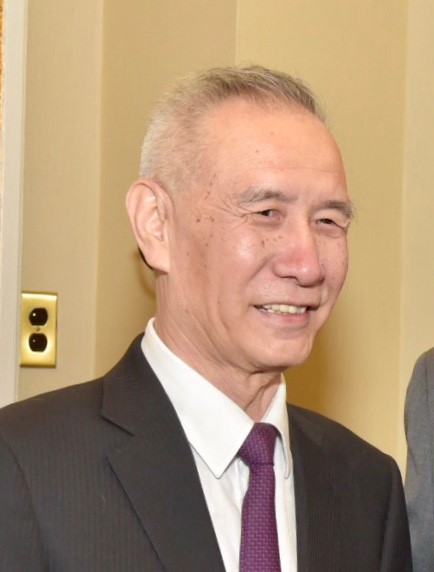
Liu He
- Facts2
- Drivers0
- Indicators0
Claims against the record, the type of responsibility, and what is disputed.
Responsibility
Shared with 1 other named actor: Robert Lighthizer
What could change this assessment
The most relevant dated facts, newest first.
17 January 2023
Liu He tells Davos China is open again after zero-COVID1 January 2020
US and China sign Phase One trade dealHow the record is sourced and how the score is derived.
2 of 2 linked facts verified, drawing on 1 distinct source (2020–2023).
Sources include checked 2026-10-15 GET 200, final URL = original (no non-trivial redirect), claim in text: liu he+davos.
Sources
The score is formula-derived (Factrail formula v1, version 1.0.0), not an editorial verdict. Read the methodology.
By the Factrail desk · Method: how we source and score · Last reviewed · Sources: 1
An excerpt; the full analysis opens on request.
Liu He is a Chinese economist and former vice premier who served as one of Beijing's most prominent economic-policy negotiators during the U.S.-China trade conflict. His clearest externally documented role was as China's principal signatory to the Phase One trade agreement with the United States on 15 January 2020. U.S. Trade Representative materials identify the agreement as covering intellectual property, technology transfer, agriculture, financial services, trade expansion and an enforcement mechanism. Liu's relevance is therefore as a senior negotiator inside China's party-state economic system, not as the sole author of Chinese trade policy. Source: USTR, 15 January 2020 (opens in a new tab).
Liu negotiated through a period of escalating U.S. tariffs and Chinese retaliation. On 15 January 2020 he signed the Phase One agreement on behalf of China alongside U.S. President Donald Trump. USTR later created a bilateral evaluation and dispute-resolution office to monitor implementation, and U.S. officials held implementation calls with Liu. The agreement reduced uncertainty in some areas but did not end the structural U.S.-China trade conflict; major tariffs remained. Liu's role as vice premier ended in 2023, after which He Lifeng became the senior Chinese economic official most visible in later trade negotiations. Sources: USTR Phase One page (opens in a new tab), USTR, 14 February 2020 (opens in a new tab), and USTR country background (opens in a new tab).