
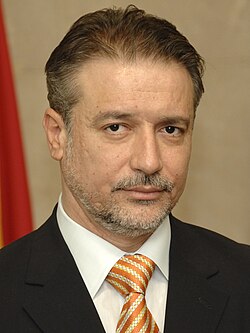
Ljube Boškoski
Ljube Boškoski is a politician from North Macedonia who served as minister of the interior from May 2001 until November 2002…
- Facts0
- Drivers0
- Indicators0
Ljube Boškoski is a politician from North Macedonia who served as minister of the interior from May 2001 until November 2002…
Ljube Boškoski is a politician from North Macedonia who served as minister of the interior from May 2001 until November 2002, during the armed conflict between state security forces and the ethnic Albanian National Liberation Army. He was born on 24 October 1960 in Tetovo and is a citizen of North Macedonia and of Croatia. He studied law in Skopje, worked in the courts and in the health-insurance administration, and later did business in Rovinj and in Skopje. Between December 2000 and January 2001 he was director of the Directorate for Security and Counter-Intelligence, and from the end of January 2001 he was state secretary in the Interior Ministry. On 13 May 2001 he entered the government of national unity formed under Prime Minister Ljubčo Georgievski of VMRO-DPMNE.
In June 2001, with fighting still under way, he resigned from the cross-party body set up to oversee President Boris Trajkovski's peace plan, while remaining interior minister. He accused that body of capitulating to Albanian political demands and said the crisis should be resolved by Macedonian security forces without international interference. The International Criminal Tribunal for the former Yugoslavia later found that an internal armed conflict existed by August 2001.
That conflict produced one ICTY case, against Boškoski and the police officer Johan Tarčulovski, over a 12 August 2001 police operation in the village of Ljuboten, near Skopje. Boškoski was charged only as a superior, under Article 7(3) of the Tribunal's statute, with murder, wanton destruction and cruel treatment, on the allegation that he failed to take necessary and reasonable measures to punish police who committed crimes. Croatian authorities arrested him on 31 August 2004 on unrelated charges; he was transferred to The Hague on 24 March 2005 and pleaded not guilty at his initial appearance on 1 April 2005. On 10 July 2008 a trial chamber acquitted him. It found that he had authority over the police and was on notice of serious allegations, but that reports which ministry police made to the investigating judge and the public prosecutor were likely to trigger an investigation and therefore met his duty to punish, even though those authorities brought no case against any officer. Tarčulovski, who had led the police into the village, was convicted of ordering, planning and instigating murder, wanton destruction and cruel treatment and was sentenced to 12 years. The appeals chamber dismissed both his appeal and the prosecution's appeal against Boškoski's acquittal on 19 May 2010.
In 2009 Boškoski founded the party United for Macedonia (Обединети за Македонија), which contested the 2011 parliamentary election and won no seats. On 6 June 2011, the day after the vote, he was arrested in an investigation into abuse of office and breaches of the rules on financing an electoral campaign, and he remained in custody throughout the proceedings. On 29 November 2011 the Skopje Court of First Instance convicted him and sentenced him to seven years' imprisonment. On 23 April 2012 the Skopje Court of Appeal reduced the sentence to five years while upholding the conviction, and on 30 January 2013 the Supreme Court dismissed his further challenge; that judgment was served on 8 May 2013. On 4 June 2020 the European Court of Human Rights held that the proceedings had violated Article 6 §§ 1 and 3 of the European Convention because of the courts' reliance on a protected witness and the exclusion of the public from several hearings, and it awarded him €4,500 for non-pecuniary damage and €1,220 for costs and expenses. After a retrial, the Basic Criminal Court in Skopje acquitted him on 22 February 2023. The U.S. Treasury's Office of Foreign Assets Control lists Ljube Boskovski, born 24 October 1960, as a specially designated national under its Balkans sanctions program.
Ljube Boškoski was born on 24 October 1960 in Tetovo, then in the Socialist Republic of Macedonia within the Socialist Federal Republic of Yugoslavia, now North Macedonia. The case information sheet of the International Criminal Tribunal for the former Yugoslavia gives Tetovo as the birthplace. At his later trial, defence counsel put it to a police witness, who agreed, that he had been born in the village of Čelopek, where Macedonians and Albanians lived together, and the witness called Čelopek his native village. The Macedonian Encyclopedia records primary and secondary school in Tetovo and a law degree from the Faculty of Law in Skopje in 1986.
He then moved to the Croatian coast. On 14 September 1987 he notified the authorities that he was no longer resident in Skopje and registered in Rovinj, in Istria, remaining registered there until 25 January 1999, when he re-registered in Skopje. The State Electoral Commission relied on those dates in March 2004 when it refused his independent presidential candidacy: residence in Croatia after the Macedonian constitution of 17 November 1991 did not count toward ten years' domestic residence in the previous fifteen. The European Court of Human Rights, declaring the challenge inadmissible, recorded that he held both Macedonian and Croatian nationality, and noted his argument that he had left for Croatia for economic reasons. The encyclopedia likewise places the Rovinj residence in 1987–1999 and the return after the 1998 parliamentary elections.
How he made a living there is less firmly documented than the residence record. In October 2001 the Institute for War and Peace Reporting described him as having worked in Croatia in the late 1980s and early 1990s and as owning several sweet shops, a detail political opponents used when they called him the "candy man." The same report said that in the Istrian village of Bale his parents ran a small hotel and restaurant called Lion, kept goats, and that he produced a red wine sold under the same Lion name. In a 2019 interview with Glas Istre he dated the family's connection with Bale to 1974, when his father, who ran a construction firm employing about fifty people in Macedonia, worked on a local water-supply project and bought a stone house; he said the household later kept about 300 sheep and sold cheese to tourists until his father's death in 2002. Neither the Strasbourg decision nor the encyclopedia names a court, firm, or public office in which he practised law in Rovinj.
IWPR's reporting on the Croatian War of Independence does not identify a unit, rank, decoration, or operation. It stated in October 2001 that he had fought on the Croatian side while working in Croatia, and in November 2005 that he had lived and worked there for more than a decade and had fought in the war in the early 1990s. He told the Skopje magazine Forum, as quoted by IWPR, that "Fighting against the Serb aggression in Croatia was a fight for the independence of Macedonia."
The same 2001 article reported a further set of claims drawn from a file compiled by the Macedonian security service: that he had been trained as a "Zenga," which the report glossed as a member of Croatian paramilitary forces; that he had harassed and intimidated ethnic Serbs and Albanians along the Dalmatian coast; and that he had first been engaged by the Croatian secret service in that period. IWPR stated that there was no independent confirmation of those file claims.
IWPR described him in those years as a close associate of politicians of the Franjo Tuđman era, naming Gojko Šušak, Šime Đodan, Marko Veselica, and Dalibor Brozović. In the 2019 interview he said he had valued Tuđman highly and recalled 1989 cooperation with Tuđman, Veselica, and others, plus an early role as an international representative of the newly formed VMRO-DPMNE. That political account is his later recollection; the court record establishes the Rovinj registration, the dual nationality, and the January 1999 return to Skopje.
After more than a decade in Croatia, Ljube Boškoski — Љубе Бошковски in Macedonian official usage, and Boskoski or Boskovski in much English-language reporting — entered politics in the Republic of Macedonia, now North Macedonia, with the 1998 parliamentary success of the Internal Macedonian Revolutionary Organization–Democratic Party for Macedonian National Unity (VMRO-DPMNE), of which he was a member. A profile published in June 2002, while he was still interior minister, said that his first two years in office were spent first in public security, the uniformed police, and then in the counter-intelligence agency, under Interior Minister Dosta Dimovska, whom the profile quoted him calling a mentor. The ministry later recorded Dimovska’s term as 27 December 1999 to 13 May 2001.
Accounts of the counter-intelligence rank differ. A note in the Skopje daily Nova Makedonija on 15 May 2001, reprinted by Radio Free Europe/Radio Liberty, said that between December 2000 and January 2001 he was director of the Directorate for Security and Counter-Intelligence, and that from the end of January 2001 he was state secretary in the Ministry of Internal Affairs. The Institute for War and Peace Reporting, writing in 2005, described him instead as deputy head of that agency before the state secretaryship. In both accounts the service was the ministry’s security and counter-intelligence arm — the directorate of the 2001 biography, and the division later identified as the UBK — not a body outside the ministry.
In the ministry’s organisation the state secretary and the deputy minister stood immediately beneath the minister. The public-security bureau and the security and counter-intelligence division each had a director appointed and dismissed by the government on the minister’s proposal. Those directors sat with the state secretary, the deputy minister and senior police managers in a collegium which the ministry’s rule book defined as advisory to the minister, not as a decision-making body.
On 13 May 2001 the Assembly of the Republic of Macedonia elected a new government and chose Ljube Boškovski to head the Ministry of Internal Affairs. The decision, taken under the constitution and the law on the government, took effect that day and appeared on 14 May in the Official Gazette (No. 37). The same act re-elected Ljubčo Georgievski as prime minister, named Vlado Bučkovski minister of defence, and appointed Refet Elmazi, of the Democratic Party of Albanians, deputy interior minister. The ministry’s list of former ministers gives Boškoski’s term as 13 May 2001 to 1 November 2002, directly after Dimovska.
The cabinet was a government of national unity, formed after weeks of bargaining and after outside pressure on the governing parties and the opposition had increased. Its stated tasks were to address the crisis in inter-ethnic relations and to prepare elections. Of 18 ministers, VMRO-DPMNE took six, the largest share, and kept the interior portfolio; the opposition Social Democratic Union of Macedonia received three ministers, as did each of the ethnic Albanian parties in the cabinet, the Democratic Party of Albanians and the Party for Democratic Prosperity.
At the beginning of January 2001 the president was Boris Trajkovski and the prime minister was Georgievski, both of VMRO-DPMNE. In the May reshuffle Boškoski was promoted from state secretary to minister of the interior and, under the constitution, joined the Security Council, which considered security and defence. The law on government bodies charged a minister with managing the ministry, representing it, securing the lawful and efficient completion of its work, and deciding employees’ rights and duties except where another statute provided otherwise. In its judgment of 10 July 2008 the International Criminal Tribunal for the former Yugoslavia found that this gave Boškoski de jure authority to control and direct ministry personnel, including regular, reserve and special police, and that he could enforce it, but no authority over the army, which remained with defence, or over the judiciary, the public prosecutor, or hospital and prison staff, which fell to justice.
He left office when the Assembly voted in a new government on 1 November 2002, with Branko Crvenkovski as prime minister. At the 15 September 2002 parliamentary elections the opposition coalition Together for Macedonia, formed around the Social Democratic Union, won 60 of 120 seats; the outgoing VMRO-DPMNE–Liberal Party coalition won 33 and could not continue. Hari Kostov succeeded Boškoski; the ministry dates Kostov’s term from 1 November 2002 to 2 June 2004.
Armed conflict in the Republic of Macedonia opened on 22 January 2001, when grenades hit a police station near the Kosovo border, killing one officer and wounding at least two. Four days later the National Liberation Army (NLA) claimed the attack and said the uniform of the "Macedonian occupier" would be targeted until Albanians were "freed." The BBC described its members as former fighters from the Kosovo conflict who sought greater Albanian rights—Albanians then made up as much as a third of about two million people—and said only a small minority favoured arms. Human Rights Watch noted the dispute over aims: the NLA spoke of ending discrimination, while the government said the goal was territory and blamed radicalism from Kosovo.
Ljube Boškoski, of the governing VMRO-DPMNE, became interior minister about two months into the fighting and repeatedly called for an all-out offensive. In June, after the NLA took Aračinovo, about seven kilometres from Skopje, he called the situation "dramatic," spoke of an estimated 1,000 rebels at strategic points, and said the army was preparing an attack that would "destroy the rebels." The same week President Boris Trajkovski proposed disarmament incentives and faster reform, and told parliament that the army and police would share a single command while he talked with Albanian leaders. European Union envoy Javier Solana said the main party leaders backed that plan; Arben Xhaferi, of the Democratic Party of Albanians, called it "shapeless" and demanded a ceasefire. In March Xhaferi was reported criticising colleagues for favouring security measures over politics, and former Gostivar mayor Rufi Osmani warned that a military victory risked conflict between ethnic groups.
Human Rights Watch found serious violations by both sides: police, whose conduct toward Albanians it called a long-standing grievance, shelled villages, looted property—monitors of the Organization for Security and Co-operation in Europe found widespread destruction in Selce after an April offensive near Tetovo—and tortured detainees, while the NLA killed, abducted and tortured civilians, including eight elderly Serbs. By mid-October about 25,000 refugees remained in Kosovo and about 53,000 people were still displaced inside the country.
The agreement concluded at Ohrid and signed in Skopje on 13 August 2001, the Ohrid Framework Agreement, rejected violence for political ends, preserved a unitary state, and required the ethnic Albanian armed groups to disarm and disband voluntarily. Signatories were Trajkovski, Prime Minister Ljubčo Georgievski, Xhaferi, Branko Crvenkovski of the Social Democratic Union of Macedonia, and Imer Imeri of the Party for Democratic Prosperity, with EU and United States envoys as witnesses; the NLA did not sign. The parties promised a police service that would by 2004 generally match the population, starting with 500 officers from non-majority communities by July 2002 and 500 more by July 2003. NATO then collected about 4,000 weapons the NLA handed over. During the talks Boškoski attacked the foreign diplomats involved and accused them of protecting Albanians too readily, the Institute for War and Peace Reporting wrote. In September U.S. Secretary of State Colin Powell urged Georgievski and the party leaders to withdraw special reservist units from the crisis areas; NATO Secretary General George Robertson had raised the same issue.
Those appeals concerned the Lions (Лавови). In September 2001 Boškoski told the magazine Forum that they were policemen who had done especially well against the NLA: an elite rapid-reaction force still "under construction," and so not yet formally constituted, under the Interior Ministry. He denied that they were paramilitaries. On a name that matched the VMRO-DPMNE emblem, a golden lion on red, he said a unit called "monkeys" or "crocodiles" would have been accepted, and that "the problem is that we called them 'lions.'" The Institute for War and Peace Reporting later offered another account: a force of about 1,400, named after a hotel he owned in Croatia and a red wine he bottled under a Lion label.
Human Rights Watch, drawing on press reports, grouped the Lions with the Tigers and the Red Berets as ethnic Macedonian paramilitary-style units recruited largely from police reserves and described as run by radicals in the police. It reported that such groups appeared to lead a 6 June riot in Bitola that burned dozens of Albanian homes and shops, with some officers taking part, and that intimidation of Albanians continued after the agreement. In November Boškoski sent an elite unit into the Tetovo area to secure an alleged mass grave and arrest former guerrillas despite an amnesty. Three officers were killed in an ambush; the Guardian, citing police, identified them as Lions who died near Semševo, with two others badly hurt near Trebos. A group calling itself the Albanian National Army claimed the attack, called the dead "paramilitaries," and told Albanian politicians to leave state institutions. Officials later said the hostages had been freed, and a former NLA commander said the disbanded army was not responsible. Boškoski called the peace process a "farce" and urged a "definite strike against the bandits." Western diplomats called the deployment of about 200 police a unilateral provocation, and parliament delayed ratification of the August deal.
The unit survived the war. In January 2003, after VMRO-DPMNE left office, about 700 armed Lions blockaded for two days the road north of Skopje toward Kosovo, opposite about 200 regular police, opposing the inclusion of former Albanian fighters in the new coalition. After talks with Trajkovski and Prime Minister Crvenkovski, spokesman Toni Mihajlovski said leaders of a force he put at 1,200 had agreed to disband, most joining the police or the army and the rest demobilised. Crvenkovski said the country did not need the unit; the Associated Press reported that he also promised an inquiry and possible charges. Human-rights groups and foreign observers blamed the Lions for worsening inter-ethnic tension despite a relatively successful peace process.
On 10 August 2001, during the 2001 insurgency in Macedonia, a landmine killed eight soldiers near Ljuboten, a predominantly ethnic Albanian village about 12 kilometres from Skopje. Trial Chamber II of the International Criminal Tribunal for the former Yugoslavia later found that by August an internal armed conflict existed between the security forces and the National Liberation Army.
On the morning of 12 August at least 60 to 70 armed reserve police, possibly more than 100, entered with incendiary material. Johan Tarčulovski, an escort inspector in the presidential security unit, led them without a formal appointment. Army units in the hills gave mortar and other fire support; no soldiers were charged.
The chamber found that the police blew open a gate and fatally shot the unarmed Rami Jusufi as he tried to close his door, then burned property in the yard and about a dozen houses along the main road without searching them. At the compound of Adem Ametovski, 13 unarmed men were forced to the ground and severely beaten. Sulejman Bajrami was shot dead there, and Muharem Ramadani, an elderly man kept behind, was also shot dead. Ten others were beaten again at a house known as Braca’s, at the village entrance, and at Mirkovci police station. One died in hospital the next day; because intent to kill was not proved against Tarčulovski’s unit, and the station police were a different group, that death was not part of the murder conviction.
Three further men, running from houses at the edge of the village, were killed under fire from police and army positions. Later autopsies could not show which force caused the deaths, and the men may still have been taking part in hostilities, so murder by the police was not proved. Other police cruelly treated men at a checkpoint on the Skopje road and at city stations; assaults at the court and hospital were not shown to have been the work of people under the interior minister.
The judges held that this was a deliberate, indiscriminate attack on ethnic Albanian residents, not a search for NLA members. Its predominant object was retaliation for the landmine and other NLA attacks, and a warning against support for the NLA, on the day before the Ohrid Agreement ended the fighting.
Contrary to accounts current at the time, Boškoski was not directing the police throughout the day. The president asked him to go once news spread; he arrived as the operation was ending, watched for more than an hour from Braca’s house, and was told of arrests, not shootings. From the smoke and the distant detainees he could see, and from what police told him, the chamber found he then had no reason to suspect murder, cruel treatment or wanton destruction.
Prosecutor v. Boškoski and Tarčulovski (IT-04-82) was the only case in which the tribunal indicted anyone from the former Yugoslav Republic of Macedonia, now North Macedonia, for crimes in the 2001 conflict.
An indictment confirmed on 9 March 2005 by Judge Robinson, and made public on 15 March, charged three counts of violations of the laws or customs of war under Article 3 of the tribunal’s United Nations statute: murder, wanton destruction of cities, towns or villages, and cruel treatment. It did not charge crimes against humanity or genocide. Boškoski, interior minister from May 2001 to November 2002 and a prominent member of VMRO-DPMNE, was charged only as a superior under Article 7(3), for knowing or having reason to know of the crimes and failing to punish the perpetrators. He was not charged with planning, ordering, or directing the operation in person. The alleged failure ran until May 2002. The counts alleged seven murders, the burning of at least 14 houses, and cruel treatment of more than 100 men between 12 and 15 August in the village, at checkpoints and police stations, and at a Skopje court and hospital. Tarčulovski was charged under Article 7(1) with ordering, planning, instigating and aiding and abetting the crimes in the village, and with a joint criminal enterprise to attack civilians and civilian objects without military necessity; mistreatment outside Ljuboten was not alleged against him. Authorities in Croatia had arrested Boškoski on 31 August 2004 on unrelated charges. He was transferred to the detention unit in The Hague on 24 March 2005 and, on 1 April, pleaded not guilty before Judge Kevin Parker. Tarčulovski, arrested on 14 March and transferred on 16 March, pleaded not guilty on 18 April. Trial Chamber II — Parker presiding, with Judges Christine Van Den Wyngaert and Krister Thelin — sat from 16 April 2007, heard closing arguments on 6–8 May 2008, and gave judgment on 10 July 2008.
The chamber held that Boškoski had authority over the police, including reservists and Tarčulovski. Within about two days he was on notice, through police reports that “terrorists” had been killed and through diplomats, human-rights groups and the press. Under Article 7(3), the judges held, the duty to punish could be met by a report likely to trigger an investigation. Ministry police made two such reports, to the investigating judge and the public prosecutor: one on the evening of 12 August about the dead in the village, and another after the hospital death. Boškoski was told that the judicial authorities had been notified. The reports were incomplete and inaccurate, but the chamber found them still likely to start an investigation and, under the law then in force, to bring cruel treatment and destruction to light as well.
No investigation followed and no officer was prosecuted, chiefly because of failures at Čair police station and inattention by authorities over whom Boškoski had no power. It was not shown that those failures were his orders, that he knew of them in the period charged, or that he should have foreseen them. The judges called this a serious failure of the police and the Macedonian authorities, but not a proved breach of his duty to take necessary and reasonable measures. He was acquitted on every count and ordered released; supporters in the gallery applauded.
Tarčulovski was convicted of ordering, planning and instigating the murders of Jusufi, Bajrami and Ramadani, wanton destruction of property belonging to twelve ethnic Albanian residents, and cruel treatment of the thirteen men at Ametovski’s house and the ten at Braca’s. He had prepared the operation on 10 and 11 August and led the police through the village. A joint criminal enterprise was not proved: the reservists acted on his orders, while he acted on orders from superiors the evidence did not identify. As a relatively junior officer under orders, a matter going to gravity rather than excuse, he received 12 years, with credit for time served, and was not convicted for the other four deaths in the indictment.
Boškoski returned to Skopje on 11 July 2008. Prime Minister Nikola Gruevski met him at the airport, where he kissed the ground, and several thousand supporters later rallied with VMRO-DPMNE politicians. He said his “biggest allies were the Macedonian people who believed in me,” and that Macedonians “must forgive but must not forget” the police and soldiers killed in 2001.
Both sides appealed. On 19 May 2010 the Appeals Chamber, Judge Patrick Robinson presiding, dismissed Tarčulovski’s seven grounds and the prosecution’s single ground against the acquittal. Resort to force in self-defence in an internal conflict, it held, does not by itself prevent crimes committed there from being serious violations of international humanitarian law, and Macedonia’s amnesty excluded acts within the tribunal’s jurisdiction. A superior may meet the duty to punish by reporting to the competent authorities when that report is likely to trigger an investigation, and the trial chamber had not erred in finding that these reports should ordinarily have done so. The acquittal and the 12-year sentence were affirmed. Tarčulovski was transferred to Germany on 7 July 2011 and granted early release on 8 April 2013.
The government did not publish what it spent on the two men. A 2013 investigation by the Balkan Investigative Reporting Network, unable to obtain official accounts, put lawyers, lobbying, court costs, family support and homecomings at almost 9.5 million euro.
In the early hours of 2 March 2002, police in the Republic of Macedonia (now North Macedonia) shot dead seven men at Rastanski Lozja—also spelled Rashtanski Lozja or Raštanski Lozja—about five kilometres north of Skopje, near the village of Ljuboten. Interior Minister Ljube Boškoski said the dead were "probably Pakistanis" who had planned attacks on vital installations, Macedonian officials, and the embassies of Germany, Great Britain and the United States, and that they had been killed after firing on a police patrol; no officer was reported hurt. Police said they had found AK-47 rifles, grenade launchers, grenades and uniforms of the ethnic Albanian National Liberation Army, and showed journalists identity cards in the names Omer Farooq and Bilal Hussain.
Amnesty International named the six Pakistani citizens as Bilal Hussain Shah, Khalid Mahmood, Muhamad Asif Javed, Omer Farooq, Riaz Ahmed and Ijaz Ahmed, and the seventh man as Sam Singh, an Indian Sikh also reported as Sathnam Singh. From relatives' accounts, it described them as economic migrants travelling from South Asia through Turkey, Bulgaria and Serbia toward Greece. Papers the police presented as evidence of Islamist ties were, Amnesty wrote, an invitation to a Shia gathering and a standard Shiite text; the six Pakistanis were reported to be Shia. On 20 March 2002 the US embassy in Skopje said it knew of no specific threat to American interests and that no credible evidence linked the men to any international terrorist group. Amnesty treated the deaths as possible extrajudicial executions and criticised the lack of an independent inquiry under United Nations standards on unlawful killings. On 4 March Boškoski said, without proof, that there were "hints" two of the men had fought in Afghanistan.
On 30 April 2004, after a change of government, Interior Ministry spokeswoman Mirjana Kontevska said the seven were illegal immigrants, lured by a promise of passage to western Europe, taken to Rastanski Lozja, surrounded and shot. She called the operation a "staged murder" and "a monstrous fabrication to get the attention of the international community," meant to present Macedonia as taking part in the US-led campaign that followed the September 11 attacks. The Guardian reported that the men were shot in cold blood and that bags of guns and uniforms were then placed beside the bodies. On 21 May 2004 Deputy Interior Minister Hasbi Lika apologised to the Pakistani government and the victims' families; Macedonian officials said any compensation would have to wait until a court confirmed the charges.
The public prosecutor asked parliament to lift Boškoski's immunity so that he could be charged, and on 4 May 2004 authorities issued a warrant accusing him of complicity in the deaths. On 5 May the Assembly confirmed a decision of its mandate-and-immunity commission withdrawing that immunity, without the votes of the opposition VMRO-DPMNE, whose deputies called the procedure defective and the case politically constructed. Four members of the Lions special police unit and their commander were already in custody. Boškoski, a Croatian as well as a Macedonian citizen who had lived for years in Croatia, had left the country; Croatian law did not allow his extradition, and he could be tried only if Croatia took the case. He denied ordering a staged killing, called the allegations a "dirty ploy" to remove him from politics, and said a recording showed the men planning an attack on the US embassy with Albanian fighters he linked to al-Qaeda.
Croatian police arrested him on 31 August 2004. In February 2005 a prosecutor in north-western Croatia charged him with orchestrating the murders "in order to prove to the US that Macedonia was participating in the international war on terrorism"; he denied the charge and said the men were al-Qaeda operatives acting with Albanian militants. In March 2005, rather than try him then, Croatia sent him from custody to the International Criminal Tribunal for the former Yugoslavia in The Hague on a separate indictment over events at Ljuboten in 2001, and the murder file in Pula was set aside while that case had priority.
In Skopje, Goran Stojkov, Aleksandar Cvetkov, Boban Utkovski and Mitko Kikerekov, arrested on 28 April 2004, were tried for the premeditated killing. Stojkov, a special-police commander, was accused of leading the group that carried out the shooting; Cvetkov, an intelligence official, was accused of planning it with Boškoski. On 22 April 2005 the Basic Court Skopje 2 acquitted all four. The BBC reported that the presiding judge cited insufficient evidence; the prosecution said the court had treated the conduct as committed in error, called that reasoning incomprehensible, and announced an appeal.
After Boškoski's acquittal in The Hague on 10 July 2008, Macedonia asked Croatia to return the file; a deputy public prosecutor in Pula said the Croatian prosecution would not continue the investigation. The case stayed in Pula and was left inactive for years while Boškoski was imprisoned on other matters. On 8 June 2022 his Croatian lawyer, Rajko Branković, said that after witnesses were questioned the prosecution had found no evidence he committed the offence, and that the County Court in Pula had issued a judgment rejecting the charges. Boškoski called that the end of what he described as two decades of political persecution.
Parliamentary elections on 15 September 2002 ended VMRO-DPMNE’s time in government in the Republic of Macedonia (now North Macedonia). The Social Democratic Union of Macedonia (SDSM) coalition “Together for Macedonia” won 60 of 120 seats in the Assembly, and the VMRO-DPMNE coalition 33; OSCE/ODIHR recorded the transfer of power to the opposition. Boškoski, still interior minister immediately afterwards, was described by that mission as pressing the State Election Commission over the count. He then sat for VMRO-DPMNE in the 2002–2006 Assembly, which lists him as a former interior minister living in Skopje.
The death of President Boris Trajkovski brought an early presidential election on 14 and 28 April 2004. On 24 March Boškoski, still a VMRO-DPMNE legislator, applied as an independent with 10,000 signatures. The State Election Commission rejected him the next day under Article 80 § 5 of the Constitution, which required continuous residence for at least ten of the previous fifteen years. He had left the Skopje register on 14 September 1987, registered in Rovinj in Croatia, and returned only on 25 January 1999. Under transitional Article 132 the commission counted residence in other republics of Yugoslavia as domestic only from 14 April 1989 to the Constitution of 17 November 1991, and treated later years in Croatia as foreign: seven years, nine months and twenty-two days.
The Supreme Court dismissed the appeal on 27 March, confining Article 132 to the period before independence. Boškoski, who said the move had been economic and that Kiro Gligorov and Vasil Tupurkovski had been treated more generously, called the ruling a conspiracy between the SDSM and VMRO-DPMNE and a “blow to democracy.” OSCE/ODIHR noted that the commission had required the same residence documents as of other nominees, and that the judgment fitted international practice on state succession.
On 29 March he petitioned the Constitutional Court and lodged application no. 11676/04 with the European Court of Human Rights. On 31 March that court rejected the petition (U.br.55/2004) without a hearing, for lack of jurisdiction over the right to stand. On 2 September 2004 the Court’s Third Section unanimously declared the application inadmissible. Article 3 of Protocol No. 1 covers the choice of the legislature; this president, the Court held, was not part of it, with no power to initiate or adopt laws, only a provisional veto, and no power to appoint or dismiss the government. Article 6 did not apply either: a dispute over candidacy concerns political rights, not civil rights and obligations. Both complaints were incompatible ratione materiae.
Branko Crvenkovski of the SDSM won the 28 April runoff, 550,317 votes (60.5 per cent) to Saško Kedev of VMRO-DPMNE (329,179; 36.2 per cent). Boškoski urged voters to abstain. In the Rastanski Lozja prosecution a parliamentary committee voted on 30 April to lift his immunity; a warrant was issued on 4 May, and on 5 May the Assembly confirmed that step without VMRO-DPMNE’s votes. Its deputies called the procedure unauthorized and the timing a diversion from alleged flaws in the presidential election. By 8 May Interior Minister Hari Kostov said Boškoski had gone to Croatia; Boškoski called the case a “dirty ploy” to remove him from politics.
By 2009 VMRO-DPMNE again held office under Prime Minister Nikola Gruevski. After acquittal at the International Criminal Tribunal for the former Yugoslavia in 2008, Boškoski sought the presidential nomination; the party chose Gjorge Ivanov, and he stood as an independent. For the presidential election of 22 March, held together with municipal polls, the State Election Commission registered all seven candidates and refused none.
Spokeswoman Vesna Tasevska said public employees who backed him were threatened with dismissal and violence, and that evidence had been sent to the police. He called himself the legitimate VMRO-DPMNE candidate, supported in private by members who were afraid to say so. The party denied defections and did not answer the allegation.
Turnout on 22 March was 56.88 per cent, with 986,882 valid votes. Ivanov received 345,850 (35.04 per cent) and Ljubomir Frčkoski of the SDSM 202,691 (20.54 per cent). Imer Selmani of New Democracy took 147,547 (14.95 per cent), and Boškoski 146,878 (14.88 per cent), in fourth place. The Democratic Union for Integration, the Liberal Democratic Party and the Democratic Party of Albanians took 7.46, 4.06 and 3.06 per cent. No candidate won a majority of registered voters. On 5 April Ivanov beat Frčkoski, 453,616 votes (63.14 per cent) to 264,828 (36.86 per cent).
Boškoski then left VMRO-DPMNE, accusing Gruevski of stalling the path to the European Union and NATO and favouring a pragmatic settlement of the name dispute with Greece. In late May 2009 he announced his own conservative party, United for Macedonia.
In 2009, after leaving VMRO-DPMNE, Ljube Boškoski announced United for Macedonia (Macedonian: Обединети за Македонија), which he described as conservative, with a launch planned in Skopje on 28 May. He was its chairman. The party contested the early parliamentary elections of 5 June 2011 in the Republic of Macedonia, now North Macedonia. In final results published by an election-observation mission of the Organization for Security and Co-operation in Europe, it received 17,081 votes, 1.52 per cent, and no seats.
On 6 June 2011, the day after the election, police arrested him in Skopje in an operation filmed by television crews outside the Vodenica restaurant. Officers said they had followed him for two months under a court order on suspicion of illegal party financing and abuse of office, and that a bag containing €100,000 and a gun had been found in his car.
An investigating judge remanded him in custody for the rest of the proceedings. The same day a witness said he had given Boškoski €10,000, €20,000 and €100,000 in April, May and June 2011 for the campaign, and that he would cooperate only if examined as a protected witness. The judge ordered that he be heard under the pseudonym “3-1”, with face and voice concealed. By video link the witness described himself as a friend who had agreed to help finance the campaign.
On 25 July 2011 Boškoski was indicted, as party chairman and campaign organiser, for abuse of official authority and power and for breach of the rules on funding electoral campaigns, under Articles 353 and 165-a of the Criminal Code. The charge was that he had taken the three sums, €130,000 in all, from the protected witness, a foreign national, on 12 April, 28 May and 6 June 2011. The indictment cited the witness’s statement, court-ordered recordings of the meetings, search records and fingerprint reports. He pleaded not guilty. Before the appeal court he said Prime Minister Nikola Gruevski’s government had orchestrated the case, and asked the judges to annul the verdict against what he called a political prisoner. The defence said the money had been planted and that the witness might have been instructed; lawyer Dančo Nakov told the trial court he suspected the witness was a police agent and that the €100,000 given on the day of the arrest had come from the state budget.
In March 2016 the Special Prosecution said it suspected then secret-police chief Sašo Mijalkov and six officers of torture and inhuman treatment during the arrest, alleging that they had been told to use excessive force although Boškoski did not resist, and that he was filmed handcuffed on the ground and made to stand facing an outdoor toilet. On 23 July 2021 a panel of the Basic Criminal Court in Skopje presided over by Judge Aleksandra Ristovska acquitted Mijalkov and the six Alfa officers, finding the charges unproved beyond reasonable doubt. The Skopje Court of Appeal rejected the prosecutor’s appeal and, in a decision announced on 23 March 2023, confirmed that acquittal in the case known as “Torture”.
A five-judge panel of the Skopje Court of First Instance heard the case. Over defence objections it sat in private on 20 and 25 October 2011 to play recordings of three meetings at which money changed hands and to read the witness’s earlier statement, and again on 15 November 2011, when witness 3-1 was questioned from another room through a link that distorted his face and voice.
On 29 November 2011 the court convicted him as charged and sentenced him to seven years’ imprisonment. It relied on the recordings, on fingerprint evidence linking him to the confiscated money, and on witness 3-1, whose statement it said put the purpose of the money beyond doubt.
On appeal he argued that a friend whose identity he knew should not have been protected, that the dark screen hid whether anyone else was directing the witness, and that the closed hearings had not been justified. On 23 April 2012 the Skopje Court of Appeal partly allowed the appeal, cut the sentence to five years and upheld the conviction, treating the witness’s fear as “a personal feeling” given the gravity of his statement. On 30 January 2013 the Supreme Court dismissed an extraordinary review and upheld the lower courts; its judgment was served on 8 May 2013.
He served the sentence at Idrizovo. The five-year term was due to end in June 2016, with release up to 90 days early if the prison governor approved. Director Živko Pejkovski told Nova TV that Boškoski left on 3 June 2016, three days before the formal expiry on 6 June.
Boškoski lodged application no. 71034/13 with the European Court of Human Rights on 8 November 2013. In Boshkoski v. North Macedonia, a Chamber judgment of 4 June 2020, final on 4 September 2020, the Court held unanimously that the proceedings, taken as a whole, violated Article 6 §§ 1 and 3 of the European Convention on Human Rights. The domestic courts had not examined whether objective reasons supported anonymity, although the witness knew the applicant, and his testimony carried significant weight even if it was not the sole or decisive evidence. The distorted link left the bench and the defence unable to observe his demeanour, and the courts did not treat the statement with particular caution. Closing the hearings of 20 and 25 October and 15 November 2011 was not objectively justified, because his face and voice were already distorted and nothing offset the effect of a closed hearing on public confidence. The Court awarded €4,500 for non-pecuniary damage and €1,220 for costs and expenses, plus any tax, payable within three months of the judgment becoming final. Complaints that the witness had been an agent provocateur, that the conviction was a political vendetta, and that two prosecution submissions had not been served were declared inadmissible as raised more than six months after the Supreme Court judgment was served. A separate application, no. 73778/13, raising similar complaints about the same prosecution, was declared inadmissible on 20 October 2020 as out of time.
The judgment was followed by a retrial. On 22 February 2023 the Basic Criminal Court in Skopje, presided over by Judge Elena Ilievska-Josipović, acquitted him in the case known as “Campaign”. In its closing address the prosecution dropped the charge of abuse of official position because it was time-barred. The protected witness did not appear; the judge said two attempts to call him failed after the competent unit reported that it had no data from which his identity could be established. The court found it unproved that Boškoski had received the money from a foreign person. He described the acquittal as a victory of justice and said he would withdraw from politics for private reasons.
On 28 May 2003, President George W. Bush signed Executive Order 13304, effective at 12:01 a.m. eastern daylight time on 29 May 2003. It terminated earlier Yugoslavia emergencies and replaced the annex to Executive Order 13219 of 26 June 2001. The new annex includes “Boskovski, Ljube [born 24 Oct 1960].” The order says it was issued “to take additional steps with respect to continuing, widespread, and illicit actions that obstruct implementation of the Ohrid Framework Agreement of 2001, relating to Macedonia,” United Nations Security Council Resolution 1244 on Kosovo, or the Dayton Accords and related Peace Implementation Council decisions on Bosnia and Herzegovina, “including the harboring of individuals indicted by” the International Criminal Tribunal for the former Yugoslavia. The annex line for Boškoski gives only the name and date of birth, not a separate finding about him.
Under the revised section 1, property and interests in property of people named in the annex are blocked if they are in the United States or come within the possession or control of United States persons, and “may not be transferred, paid, exported, withdrawn, or otherwise dealt in,” aside from stated statutory exceptions and any later license. The Secretary of the Treasury, consulting the Secretary of State, may later decide that a name no longer belongs in the annex; that decision takes effect on publication in the Federal Register. Criteria for later designations—open tribunal indictment, specified violence or obstruction, material support, or acting for a listed person—are not printed as a finding next to the annex names.
A 23 June 2009 Federal Register rule that updated the Treasury’s alphabetical appendix of blocked persons repeated “BOSKOVSKI, Ljube; DOB 24 Oct 1960 (individual) [BALKANS].” That compilation was not the original listing. The Office of Foreign Assets Control Specially Designated Nationals list still carried Ljube Boskovski, born 24 October 1960, under the BALKANS program as identifier 7664, on the list current on 8 October 2026.
In 2004 Boškoski published Мојата борба за Македонија: Прилог кон расветлувањето на воениот конфликт во Македонија 2001–2002 (My Struggle for Macedonia: A Contribution to Clarifying the Military Conflict in Macedonia, 2001–2002), a 221-page book issued under his own name.
He left Idrizovo prison on 3 June 2016. Director Živko Pejkovski told Nova TV that relatives had collected him and that he was going to his native village of Čelopek; the five-year sentence was formally due to end on 6 June.
On 23 June 2023, Prime Minister Dimitar Kovačevski, asked about Boškoski working in government while on the U.S. blacklist, said he was not a foreign-investment adviser. Kovačevski said a contract made before his premiership had engaged Boškoski as a collaborator on attracting foreign investment, including promotion of the country in Croatia. On 25 March 2024 Boškoski told Fokus, as reported by Netpress, that he had left that post about six months earlier. He said a coalition with VMRO-DPMNE was not yet final and would be ideological, and that leader Hristijan Mickoski had assured him of no cooperation with former prime minister Nikola Gruevski.
That week Deutsche Welle reported VMRO-DPMNE legislator Antonio Milošoski as saying the coalition would add seven parties previously aligned with the Social Democratic Union of Macedonia, including United for Macedonia (Обединети за Македонија). The State Election Commission later confirmed, in all six districts for the 8 May 2024 parliamentary election, the lists of “Your Macedonia” (Твоја Македонија), headed by VMRO-DPMNE and including United for Macedonia. Preliminary commission figures reported by MIA, with over 99 percent counted, gave the coalition 431,251 votes (43.23 percent) and 58 of 120 seats. United for Macedonia did not file its own list.
Ranked by shared high-impact facts, then explicit ties, then shared drivers.
 Hristijan MickoskiHristijan Mickoski has led VMRO-DPMNE and been Prime…Affiliated
 George W. BushGeorge Walker Bush is an American politicianAffiliated
 Branko CrvenkovskiBranko Crvenkovski (born 12 October 1962) is a Macedonian…Affiliated
 Boris TrajkovskiBoris Trajkovski (25 June 1956Affiliated
 Ljubčo GeorgievskiLjubčo Georgievski (born 17 January 1966) is a Macedonian…Affiliated
How the record is sourced and how the score is derived.
The score is formula-derived (Factrail formula v1, version 1.0.0), not an editorial verdict. Read the methodology.
By the Factrail desk · Method: how we source and score · Last reviewed
Dispute a fact on this pageNamed here, or represent someone who is? Request a right of reply.
People and organizations as listed in the Related section of this page; facts, drivers and the pages that name it as listed in the blocks here. Counts, not a rating.