
Michèle Alliot-Marie
Michèle Alliot-Marie, born on 10 September 1946 in Villeneuve-le-Roi, in Val-de-Marne, is a French academic and politician.
- Facts0
- Drivers0
- Indicators0
Michèle Alliot-Marie, born on 10 September 1946 in Villeneuve-le-Roi, in Val-de-Marne, is a French academic and politician.
Michèle Alliot-Marie, born on 10 September 1946 in Villeneuve-le-Roi, in Val-de-Marne, is a French academic and politician. She represented the sixth constituency of Pyrénées-Atlantiques in the National Assembly for the Union for a Popular Movement, and that mandate ended with the thirteenth legislature on 19 June 2012. French newspapers refer to her by the initials MAM.
She entered national government as secretary of state for education, attached to the minister of national education, from 20 March 1986 to 10 May 1988 in Jacques Chirac's second government, and served as minister of youth and sports from 30 March 1993 to 11 May 1995 under Prime Minister Édouard Balladur. In the membership ballot reported on 6 December 1999 she was elected president of the Rally for the Republic, taking 62.71 percent of the vote (35,573 ballots) against 37.29 percent (21,154) for Jean-Paul Delevoye, after François Fillon and Patrick Devedjian had been eliminated and had transferred their support to her. From 7 May 2002 to 15 May 2007 she was minister of defence, holding the veterans' portfolio as well until 16 June 2002, beginning in Jean-Pierre Raffarin's government.
She was then minister of the interior, overseas territories and local authorities from 18 May 2007 to 23 June 2009; minister of state and keeper of the seals, minister of justice and liberties, from 23 June 2009 to 13 November 2010; and minister of state for foreign and European affairs from 14 November 2010 to 27 February 2011, the last of those posts held under President Nicolas Sarkozy. She was a municipal councillor in Ciboure from 1983 to 1989 and in Biarritz from 1989 to 1995, mayor of Saint-Jean-de-Luz from 25 June 1995 to 3 July 2002, and a vice-president of the general council of Pyrénées-Atlantiques from 28 March 1994 to 18 March 2001. She was also a member of the European Parliament from 25 July 1989 to 30 March 1993, and again from 1 July 2014 to 1 July 2019.
Her three months at the foreign ministry ended in resignation on 27 February 2011, after weeks of criticism of her contacts with the government of Zine El Abidine Ben Ali during the uprising in Tunisia that opened the Arab Spring. In January she had offered the help of French security forces as the protests spread, three days before Ben Ali fled; she had spent the Christmas holiday in Tunisia, was reported to have flown on a private jet belonging to a businessman described as close to the regime, and had spoken to Ben Ali by telephone, while her parents, who were with her, were reported to have bought shares in a property company owned by the same businessman. In her resignation letter she wrote that she did not believe she had committed any wrongdoing, and Sarkozy replaced her with the defence minister, Alain Juppé.
On 6 September 2024 the criminal court in Nanterre sentenced her to six months' imprisonment, fully suspended, for illegal taking of interests (prise illégale d'intérêts) between 2010 and 2012, when she was deputy mayor of Saint-Jean-de-Luz. An investigation opened in 2013 had examined payments involving local associations that organised a festival chaired by her father, and she had been placed under formal investigation in February 2019. The prosecution had sought two years' suspended imprisonment, a fine of 50,000 euros and three years' ineligibility; the court imposed neither a fine nor ineligibility, referring to the age of the facts and to her withdrawal from political life, and her lawyers announced an appeal.
Michèle Marie, who later took the name Alliot-Marie, was born on 10 September 1946 in Villeneuve-le-Roi, in the present-day Val-de-Marne. Her father, Bernard Marie (17 June 1918 – 10 February 2015), was born in Toulouse and died in Neuilly-sur-Seine. He joined the Banque de France in 1942 and headed its litigation department from 1961. A former player for Biarritz Olympique, he refereed international rugby union from 1955 to 1968, chaired the technical commission of the international rugby federation from 1963, and in March 1965 became the first Frenchman to officiate a match in the Five Nations.
A Gaullist since his service in the French Resistance, he was recruited for the 1967 legislative elections by two ministers of Charles de Gaulle, Christian Fouchet and Roger Frey. He then sat until 1981 for the constituency of Bayonne, Biarritz and Saint-Jean-de-Luz, in the Basses-Pyrénées and, after the department was renamed, the Pyrénées-Atlantiques. He was mayor of Biarritz from 1977 to 1991. Her mother, Renée Leyko, has been described, in accounts drawn from family recollection, as a résistant who carried messages to British airmen in the folds of her blouses, and later as the manager of the family’s thermal-insulation business. She told Michèle and her younger sister, Yannick, that what a man could do a woman could do, and that they should work for at least a year before marrying.
The household lived in Paris. Michèle attended the communal school on boulevard Pereire, in the 17th arrondissement, where she later said she fought in the playground, including with her fists, and then the lycée de la Folie Saint-James in Neuilly-sur-Seine. Summers in the early 1950s were spent at Saint-Jean-de-Luz; she took that Basque interest in rugby back to the lycée and tried, without success, to convert the girls’ handball team, an idea the school treated as too rough.
She read law in Paris and, at about twenty-one, did not picture herself in politics. Jacques Chirac, elected in the same intake as her father and immediately made a junior minister, had already asked about her future over lunch at the family home. During May 1968 she later recalled speaking in a packed lecture hall “wholly against the current of what was being said,” and being listened to; she was then drawn into a small group, drawn from different backgrounds, asked to reflect on reform of the university. One of her law professors, Michel Alliot, who later became her husband, was after the revolt appointed directeur de cabinet to Edgar Faure, the education minister charged with that reform. As a student she also considered archaeology, until a professor told her the field offered no career.
From the late 1960s she set out to collect a law doctorate, a doctorate in political science, a certificate in the law and economics of African countries, and a master’s degree in ethnology. In 1973 she defended, at Paris-Panthéon-Assas University, a law thesis entitled Le Salarié actionnaire. In 1982, under the supervision of Georges Dupuis, she defended at Paris 1 Panthéon-Sorbonne University a political-science thesis, Décisions politiques et structures administratives.
Michèle Alliot-Marie studied at the faculty of law and economics of Paris and at the faculty of letters of the Sorbonne. She held a diplôme d'études supérieures spécialisées in private law, political science and the history of law, and in 1973 became a doctor of law with a thesis on the employee as shareholder (le salarié actionnaire). A second thesis, the 1982 state doctorate Décisions politiques et structures administratives, was defended at Paris 1 Panthéon-Sorbonne University under Georges Dupuis. A biographical note attached to a 2005 interview also records that she held the certificat d'aptitude à la profession d'avocat, the qualification for practice at the French bar.
From 1970 to 1984 she was an assistante, first at the Paris faculty of law and economics and then at Paris I; the same note describes her as a maître de conférences from 1984. In a 1984 issue of the Revue française d'administration publique she was still identified as maître-assistante at Paris I, and with Gérard Timsit published an article on whether the administration of the overseas departments was an administration of development, work in public law. In 1983 the Presses Universitaires de France issued La décision politique: attention! une république peut en cacher une autre, on how political decisions are made. She later said that, without politics, she would have gone on teaching law, for the contact with students and the pleasure of speaking in a lecture hall.
Her first access to a ministerial office came through Edgar Faure. When Charles de Gaulle named Faure minister of national education on 12 July 1968, Faure took the law professor Michel Alliot as directeur de cabinet; Alliot helped draft the orientation law on higher education promulgated that November. In 1971 Alliot married a former student, Michèle Marie, who kept the name Alliot-Marie after their divorce in 1984. In 1972–73 she was herself a chargée de mission in Faure's cabinet, during his term as minister of state for social affairs under Pierre Messmer; in 1973 Faure left that post to become president of the National Assembly.
The same note places her as chargée de mission to Bernard Stasi in 1973–74, when Stasi was minister for the overseas departments and territories (5 April 1973 – 27 February 1974), and then in the same role with Jean-Pierre Soisson, secretary of state for the universities in the first government of Jacques Chirac (27 May 1974 – 12 January 1976). From 1976 to 1978 she was chef de cabinet to Alice Saunier-Seïté, whom the note describes as minister for the universities. Her election to the National Assembly on 16 March 1986, and her appointment on 20 March as secretary of state for education, ended the years in which she was an academic and a ministerial adviser rather than a member of the government; she resigned the deputy's seat on the day the mandate opened.
Alliot-Marie's first elected office was on the council of Ciboure, beside Saint-Jean-de-Luz, on the coast of the French Basque Country in the Pyrénées-Atlantiques. The National Assembly dates that seat from 14 March 1983 to 12 March 1989, and a seat at Biarritz from 20 March 1989. She sat there on the majority list of her father, Bernard Marie, Gaullist mayor of the resort since 1977.
In the autumn of 1990 his plan to replace the art deco casino on the Grande Plage split that majority. Sud Ouest later wrote that a vehement remark by Alliot-Marie, then only a councillor, "set fire to the powder." Didier Borotra, the first deputy and a figure of the Union for French Democracy, joined Socialists and Basque nationalists against the mayor, and a partial municipal election followed in March 1991. On 8 March Antenne 2 filmed her campaigning beside her father, the Rally for the Republic candidate; Borotra won, and Marie kept an opposition seat only briefly before turning toward Saint-Jean-de-Luz. The Assembly carries her Biarritz membership to 18 June 1995, while an Interior Ministry note ends it in 1992.
At the cantonal election of 20 March 1994 in the canton of Saint-Jean-de-Luz, standing for the RPR while minister of youth and sports, she won in the first round with 4,688 votes, 50.92 percent of ballots cast. The Assembly lists her as vice-president of the departmental council from 28 March 1994 to 18 March 2001; the ministry's note calls her first vice-president from 1994 to 2000. François Bayrou was re-elected president of that council on 3 April 1994.
On 18 June 1995 she won the mayoralty in a four-list second round. Le Monde reported that she took the town from the outgoing UDF mayor, Paul Badiola, who might have held it had the left-wing and Basque autonomist lists withdrawn; critics later put the margin at 342 votes. The Assembly dates her installation to 25 June 1995. Asked in 2001 why she had not stood in Biarritz, she told Le Parisien that she was "from Saint-Jean" and had spent her childhood there.
On 11 March 2001 the right-wing list was returned in the first round with 3,652 votes, 51.86 percent of 7,042 valid ballots, on a turnout of 71.31 percent of 10,272 registered voters. She remained mayor until 3 July 2002. Appointed defence minister on 7 May, she then gave up the office to her deputy, Peyuco Duhart, and became first deputy mayor, a post still on her Assembly file for 2007–2012 and in the ministry's 2012 note.
In February 2008, as interior minister, she headed a third ticket, "Saint-Jean-de-Luz pour tous," for the Union for a Popular Movement, on the understanding that Duhart, the incumbent and her first running mate, would keep the mayoralty. On 9 March the list took 3,836 votes, 55.56 percent, and 26 of 33 seats, against Georgette Jariod's Socialist list (1,736 votes, 25.14 percent, four seats) and Pascal Lafitte's regionalist list Herri Berri (1,332 votes, 19.29 percent, three seats). She did not lead in 2014: the departmental UMP invested Duhart in October 2013. The council installed on 29 March 2014 re-elected him with 27 votes and six abstentions, and Alliot-Marie was not among its 33 members.
Michèle Alliot-Marie sat in the National Assembly for Pyrénées-Atlantiques from the eighth legislature through the thirteenth, leaving the chamber each time she joined a government. The election of 16 March 1986 used proportional representation by department. The Assembly records her, for the Rally for the Republic, as a deputy for Pyrénées-Atlantiques only on 2 April 1986: the mandate opened and closed that day by resignation. From the ninth legislature she represented the department’s sixth constituency. Re-elected on 12 June 1988, she held that seat for the full term, 13 June 1988 to 1 April 1993.
She was returned at the 1993 general election, but the mandate ran only from 2 April to 1 May 1993, when she entered the government. A by-election on 17 September 1995, to replace a deputy who had resigned, restored her until 21 April 1997. In the eleventh legislature she sat from 1 June 1997 to 7 June 2002. The twelfth legislature gave her 19 June to 18 July 2002, in the Union pour la majorité présidentielle group, and the thirteenth 20 June to 19 July 2007, in the Union for a Popular Movement. Her substitute, Daniel Poulou, held the constituency during those absences. After her ministerial functions ended by decree of 27 February 2011, article L.O. 176 of the electoral code closed his mandate at midnight on 27 March; the Assembly dates her return from 28 March 2011 to the end of the legislature on 19 June 2012.
On the benches she served mainly on foreign affairs and defence. She was a member of the Foreign Affairs Committee from June 1988 to April 1993, from March 1996 to April 1997, and throughout the eleventh legislature, and of the National Defence and Armed Forces Committee from October 1995 to March 1996, during the short 2002 sitting, and from 29 March 2011 to 19 June 2012. From 1997 to 2002 she was vice-president of the parliamentary office for the evaluation of legislation and a member of the Assembly’s delegation for the European Union. She also sat on the 1991 control commission on the first cycles of universities and on information missions on national service and the written press.
On 10 June 2012 she led the first round in the sixth constituency with 35.37 per cent, ahead of Sylviane Alaux of the Socialist Party on 31.55 per cent. In the runoff on 17 June, Alaux won 27,648 votes (51.62 per cent) to Alliot-Marie’s 25,908 (48.38 per cent), her first defeat after successive wins since 1986.
Alliot-Marie was a member of the European Parliament in Strasbourg twice. On 18 June 1989 she was elected sixth on the UDF–RPR list headed by Valéry Giscard d'Estaing, and sat from 25 July 1989 to 30 March 1993 for the RPR in the Group of the European Democratic Alliance, alongside her National Assembly seat. She served on the Political Affairs Committee and then the Committee on Foreign Affairs and Security, and on the delegation for relations with Central America and Mexico, and as a substitute on external economic relations, the human-rights subcommittee and the delegation for relations with the United States.
In 2014 she headed the UMP list in the South-West constituency. “Pour la France, agir en Europe avec Michèle Alliot-Marie” took 544,551 votes (18.52 per cent) and two of ten seats. She sat from 1 July 2014 to 1 July 2019 in the European People's Party Group, for the UMP until 29 May 2015 and then for The Republicans. She was a member of the Committee on Foreign Affairs for the whole term. She joined the delegation for relations with the Arab Peninsula on 14 July 2014 and chaired it from 13 October 2014 to 1 July 2019, which also seated her on the Conference of Delegation Chairs; the delegation handles relations with Bahrain, Kuwait, Oman, Qatar, Saudi Arabia, the United Arab Emirates and Yemen. She was a substitute on the delegation for relations with China, on Employment and Social Affairs until July 2017, and thereafter on Industry, Research and Energy.
On 4 December 1999 the adherents of the Rally for the Republic (Rassemblement pour la République), the Gaullist party Jacques Chirac had founded in 1976, elected Michèle Alliot-Marie president in the movement's first leadership vote by the membership. She took 62.71 percent in the runoff against 37.29 percent for Jean-Paul Delevoye, a senator whose candidacy the president's entourage had promoted. In the first round she had finished second, with 31.19 percent to his 35.26 percent. Contemporary papers treated the result as a break in a male-dominated system. L'Orient-Le Jour wrote that she had become "la première femme chef d'un grand parti en France," and the Irish Times reported that, for the first time, a woman had been elected leader of a major French party. El País was narrower: the first woman to preside over the RPR.
She was 53, deputy-mayor of Saint-Jean-de-Luz, and a former youth and sports minister under Édouard Balladur. She had entered as an outsider in a party the press called "macho," and being a woman was presented as proof of modernity. She promised to be "une présidente pour tous" and to prepare the next elections "avec et pour Jacques Chirac." El País still read the ballot as a protest against his "constructive cohabitation" with Lionel Jospin, and against Delevoye's label as the official Élysée candidate. Reported membership had nearly halved since 1996, from about 130,000 to 70,000, after the losses that followed the 1997 dissolution. She was the fourth president, after Chirac, Alain Juppé and Philippe Séguin.
On 17 December she presented a team and set the RPR "résolument dans l'opposition" to the Socialist, Communist and Green government. She also said she would not be bullied, a line the Irish Times took as a message to the Élysée alongside her pledge to work with the president.
After Chirac's re-election the RPR was folded into a broader party of the right. Alliot-Marie had resisted letting the Gaullist organization simply vanish. At an extraordinary congress in Villepinte she told delegates, "Je veux entrer dans la nouvelle union et je veux rester gaulliste!" About 3,000 representatives of some 88,000 declared members voted 86.51 percent to dissolve it; Démocratie libérale voted the same way the same day. Names were to transfer from 15 October unless a member objected, before formal dissolution at the founding congress of 17 November. Chirac's message to that congress saluted the Union for a Popular Movement (Union pour un mouvement populaire) as an end to the dispersal of the republican right, and Juppé was elected president.
On 31 October 2006, as defence minister, she opened a small office near the old RPR seat for Le Chêne, a club inside the UMP. She said it was not a campaign headquarters. Le Figaro described it as the opening of a presidential bid, drawing former RPR parliamentarians around her "vision d'une France volontariste." The club was read both as a Chiracian alternative to Dominique de Villepin and as leverage with Nicolas Sarkozy. Patrick Ollier, her companion, said she would not split her political family.
She did not seek the 2007 nomination. On the evening of 12 January, after seeing Sarkozy at UMP headquarters, she told France 2 she would not run. Having already refused the party's funds and apparatus, she also gave up a free-standing candidacy, citing the risk of splitting the right before a left "avide de revanche" and a strong Front national.
The UMP became The Republicans (Les Républicains) at the end of May 2015, after a vote of members. On 13 February 2016 she lost the presidency of its national council, vacated by Jean-Pierre Raffarin, to Luc Chatel, whom Sarkozy backed: 532 votes (55.3 percent) to 430, of 962 cast. She skipped the party's primary. On 8 December 2016 she told 20 Minutes she would run alone, with about half the 500 sponsorships required, and regretted that since 2002 the right's currents had rallied behind one man and one language. The Constitutional Council validated 74 sponsorships for her. She missed the threshold and was not a candidate.
On 20 March 1986, during the first cohabitation between President François Mitterrand and Prime Minister Jacques Chirac, Alliot-Marie became secrétaire d’État auprès du ministre de l’Éducation nationale, chargé de l’enseignement. She served under René Monory until 10 May 1988, beside Nicole Catala, secrétaire d’État for vocational training.
Speaking in the Senate on 2 December 1986, she made déconcentration her main brief: decisions were to move down so that local authorities, newly responsible for parts of education, would face accountable state officials. Twenty-eight of about a hundred planned measures were already in force. Recteurs received global allocations and responsibility for académie policy, including the brevet de technicien supérieur; inspecteurs d’académie took the organisation and financial control of collèges; head teachers gained day-to-day powers.
She also set prevention, not punishment, as the school response to drugs, alcohol and violence. She put drug-related credits at 25 million francs, announced 12,000 extra staff-training days and a forthcoming information campaign, and told senators that medical staffing was rising slightly rather than being cut.
From 30 March 1993 to 11 May 1995 she was ministre de la Jeunesse et des Sports in Édouard Balladur’s government, the second cohabitation under Mitterrand.
The Senate cultural-affairs committee’s opinion of 22 November 1993 put the 1994 draft at 2,724 million francs, 11.8 per cent under the 3,089 million initially voted for 1993 and 0.19 per cent of the state budget. The Fonds national pour le développement du sport was again shown at 850 million francs although 1993 receipts were heading for 650 to 680 million; she said the budget minister would fill the gap. New local youth conventions, worth 63.6 million francs, were to fund initiatives, leisure and help for young people in difficulty, but youth intervention credits fell by 168.8 million francs and no new FONJEP association posts were planned. Sports medicine and the prevention of doping were to continue without extra money; the committee cited 10,000 controls and limited interest from federations. Twenty million francs of new measures covered the 1994 Lillehammer Olympics and the Jeux de la Francophonie.
Law no. 93-1282 of 6 December 1993, on the security of sporting events, followed violence at the Stade Malherbe Caen–Paris Saint-Germain match of 28 August 1993. A National Assembly report of 5 April 2006, which called it the “loi Alliot-Marie”, recorded heavier penalties for drunken entry, alcohol and incitement to hatred, and new offences covering racist symbols, flares and pitch invasions. Courts could ban offenders from stadiums for up to five years and require them to report during matches. The report still described the 1993 law as the main legal basis for tackling football hooliganism.
On 7 May 2002 a decree named Michèle Alliot-Marie minister of defence and veterans in the first government of Jean-Pierre Raffarin, formed after the re-election of Jacques Chirac. Published in the Journal officiel the next day, the appointment made her the first woman to hold the portfolio, at the Hôtel de Brienne in Paris. Le Monde later noted that the portraits of earlier defence ministers were all of men, and that hers was added only after she left. She kept the post through Raffarin's later governments and that of Dominique de Villepin. From 17 June 2002 veterans affairs were delegated to secretary of state Hamlaoui Mékachera, and her title became minister of defence. She left on 18 May 2007, when François Fillon's government under Nicolas Sarkozy named Hervé Morin to defence and moved her to the interior.
On 8 May 2002 a suicide bomb in Karachi, Pakistan, destroyed a bus carrying French naval-shipyard workers and killed 11 French nationals and three Pakistanis. Alliot-Marie visited the site the next day and said France had been "shattered by this odious attack."
French forces were deployed abroad throughout the five years, and she visited them repeatedly, including in Afghanistan. France contributed to the NATO-led International Security Assistance Force around Kabul and sent special forces, under United States command, to the east under Operation Enduring Freedom. On 17 December 2006 she announced that about 200 of those special forces, based at Jalalabad, would leave at the start of 2007, as the NATO force spread nationwide. About 1,100 French troops were to remain around Kabul, with more weight on training Afghan units; seven special-forces soldiers had been killed.
The planning act of the tenure was the military programming law of 27 January 2003 (law no. 2003-73) for 2003–2008, not a new white paper. The ministry lists white papers for 1972, 1994, 2008 and 2013; the 2008 paper, which added national security to defence, was commissioned after she left. The 2003 law was to carry out the "2015 armed forces" model of the 1994 white paper: a smaller professional force, able to project power. Conscription in France had already been suspended by the law of 28 October 1997 for men born after 31 December 1978. Article 6 of the 2003 law only authorised ordinances to clear the remaining legal effects of that suspension from 1 January 2003. Equipment-payment credits were set at an average of €14.64 billion a year in 2003 prices. Major items included deliveries of the Dassault Rafale and, in the 2002 draft, a second aircraft carrier from 2005 beside Charles de Gaulle.
She argued that European defence could advance without breaking with NATO. In June 2003 France was the framework nation for Operation Artemis in the Democratic Republic of the Congo, the European Union's first autonomous military operation outside Europe and its first without NATO planning support, under a United Nations mandate to stabilise Bunia. About 1,500 troops took part, most of them French, and France and Britain pressed the EU battlegroup idea, small units meant to deploy within days. On the Iraq War, France, Germany and Belgium blocked in February 2003 the opening of NATO planning to protect Turkey, arguing that it would treat invasion as inevitable. The alliance broke the deadlock on 16–17 February in the Defence Planning Committee, where France, outside the integrated military structure, did not sit. In January 2004 Alliot-Marie said that no French soldiers would be sent to Iraq.
In Ivory Coast, Operation Licorne had held a buffer since the war began in September 2002. On 6 November 2004 government aircraft bombed the French camp at Bouaké, killing nine French soldiers and a United States citizen. Chirac ordered an immediate reply: French forces destroyed Ivorian combat aircraft on the ground, and reinforcements went out as crowds attacked French sites in Abidjan. Alliot-Marie called the raid deliberate and held President Laurent Gbagbo responsible for order. Belarusian suspects were detained, then released. A 2016 request to try Alliot-Marie, Villepin and foreign minister Michel Barnier in the Cour de justice de la République, over that release, was refused in May 2019: the court's commission des requêtes found no criminal offence. Lawyers for the families called the ruling a denial of justice.
After the 2006 Lebanon War between Israel and Hezbollah, resolution 1701 enlarged the United Nations Interim Force in Lebanon. France, which already led the force, first offered only about 200 extra troops, a figure widely called too small for a mission meant to grow toward 15,000. On 24 August 2006 Chirac raised the French contingent to about 2,000, saying assurances on the mandate had been obtained. Alliot-Marie had wanted the task, including the right to use force, fixed before the numbers. On 9 November she told parliament that French soldiers had been two seconds from firing on Israeli jets that dived toward UN positions in October, and that a catastrophe had been avoided only by their judgement.
The ministry was also drawn into the Clearstream affair. General Philippe Rondot, her adviser on intelligence and special operations, told judges he had informed her in May 2004 that lists of alleged hidden accounts were forgeries; she said an internal inquiry had been closed and that she learned the political names from the press. Offices at the ministry were searched in 2006. She was heard as a witness and was not charged.
On 18 May 2007 President Nicolas Sarkozy appointed Alliot-Marie minister of the Interior, Overseas and Local Authorities in the first government of Prime Minister François Fillon, succeeding interim minister François Baroin. She was the first woman at the Interior. Immigration, previously joined to the portfolio, went to a separate ministry under Brice Hortefeux. Reappointed after the June 2007 elections, she stayed until 23 June 2009, when Hortefeux replaced her and she moved to Justice.
She introduced the bill transferring the National Gendarmerie from Defence to the Interior while keeping its military status. Law No. 2009-971 of 3 August 2009, promulgated after she had left, gave the interior minister the force's organization and its use in internal security, and left military missions and discipline with Defence. In September 2007 she announced the merger of the Direction de la surveillance du territoire and the Renseignements généraux into the Direction centrale du renseignement intérieur, created by decree of 27 June 2008 with effect from 1 July.
A decree of the same day, taken on her report, authorized the police file EDVIGE. It could hold data, including some sensitive categories, on people aged 13 and over judged liable to threaten public order, and on people with significant political, trade-union or religious roles. The CNIL had raised reservations. After protests from unions, rights groups and some on the right, Decree No. 2008-1199 of 19 November 2008 withdrew the file. On 27 May 2009 she presented a draft programming law of about €2.5 billion over five years for the National Police, the gendarmerie and civil security. It was unfinished when she left.
A general strike over prices and wages began in Guadeloupe on 20 January 2009 and spread to Martinique. Secretary of State Yves Jégo negotiated on the islands until Fillon recalled him; Alliot-Marie stayed out of the wage talks and sent extra gendarmes. Law No. 2009-594 of 27 May 2009, which she had introduced in July 2008, created overseas activity free zones and tax and social-charge relief. On 11 November 2008, with searches still under way after sabotage of SNCF overhead lines, she said those arrested around the Corrèze village of Tarnac belonged to the "ultra-left, anarcho-autonomous movement" and had struck the railway as a symbol of the state. The terrorist label was later dropped. In April 2018 a Paris court acquitted the main defendants of criminal damage and criminal association, and the prosecution did not appeal.
The decree of 23 June 2009 made her minister of state, keeper of the seals, and minister of Justice and Liberties, in succession to Rachida Dati. She left the Ministry of Justice in the November 2010 reshuffle: the decree of 14 November 2010 moved her to Foreign and European Affairs and named Michel Mercier keeper of the seals.
The prison bill, prepared under Dati, was promulgated on 24 November 2009 as Law No. 2009-1436 after Parliament adopted it in October. It defined the prison service's tasks, prisoners' rights and wider sentence adjustment. On single cells, a rule of 1875 widely ignored because of overcrowding, she wanted a prisoner to be able to choose a shared cell. The National Assembly backed the government; a joint committee restored individual cells, with a five-year moratorium, against the Chancellery.
A committee under Philippe Léger, set up by Dati, reported on 1 September 2009. It proposed abolishing the investigating judge, giving investigations to prosecutors, and creating a "judge of the investigation and of liberties" to authorize coercive acts. She consulted for several months and in early 2010 circulated a draft of several hundred articles. Magistrates and lawyers opposed handing investigations to prosecutors, who answer to the justice minister, and the abolition was not voted before she left.
Police custody was split off after the courts intervened. On 30 July 2010 the Constitutional Council, citing nearly 800,000 custodies in 2009, struck down the ordinary regime for failing to protect the rights of the defence, including a lawyer during questioning and notice of the right to silence, and delayed the effect until 1 July 2011. She brought a custody bill to the Council of Ministers on 13 October 2010; the law that took effect in 2011 was passed under Mercier. On 28 July 2010 she sat in an Élysée meeting, chaired by Sarkozy, on illegal camps of Travellers and Roma, where the government decided to clear camps and speed removals of people in an irregular situation. The circulars that named Roma camps specifically came from Hortefeux's Interior ministry and were criticized as ethnic targeting.
On 14 November 2010, after François Fillon had resigned the previous evening and been reappointed prime minister, Nicolas Sarkozy moved Michèle Alliot-Marie from justice to the Quai d'Orsay as minister of state for foreign and European affairs, in place of Bernard Kouchner. The same decree named Alain Juppé minister of state for defence and veterans; he returned to the cabinet as she took the foreign portfolio.
Alongside Tunisia, the disputed election in Ivory Coast occupied the weeks. France, with the United Nations and African organisations, treated Alassane Ouattara as the winner of the 28 November runoff. On 19 December, after Laurent Gbagbo demanded that the UN mission and France's Licorne force leave, Alliot-Marie said he no longer had the standing to make that demand, that French troops would not place themselves between Ivorians, and that he should hold his forces back if he did not want deaths on his conscience. Unrest that had begun in Tunisia later spread to Egypt; the controversy that ended her tenure was the Tunisian one.
The protests that became the Tunisian Revolution followed the self-immolation of Mohamed Bouazizi at Sidi Bouzid on 17 December 2010. Alliot-Marie later told deputies that she had reached Tunis after Christmas with Patrick Ollier, the minister for relations with Parliament, and relatives, and continued to Tabarka. She said a friend, the businessman Aziz Miled, who was flying there himself, had offered spare seats for about twenty minutes instead of a two-hour drive, and had not put the aircraft at her disposal.
Le Canard enchaîné, in its 3 February edition, reported the flights, taken after unrest had begun. Mediapart reported that the aircraft was a Bombardier Challenger 604, registration TS-IBT, held through Karthago Private Jet, a company tied to Belhassen Trabelsi, brother-in-law of President Zine El Abidine Ben Ali. It also reported that the same jet left Tunis on the evening of 14 January, when Ben Ali fled, and was met at Cagliari by Italian police with only the crew aboard; which aircraft carried him was not established. Her office said Miled had hosted them, was not of the Ben Ali clan, and had lost 20 per cent of his airline and its chairmanship to the Trabelsis, so the flight was "in no way" a favour from the clan. She called him a despoiled friend. Mediapart reported that he sat on the ruling party's central committee, had backed another Ben Ali candidacy, had been decorated by him in 2009, and had Swiss assets frozen and later released. She confirmed a second flight, on 29 December to Tozeur.
On 7 February she told Europe 1 that the free flights had been "an error" and that she would not accept one again. Mediapart recorded her telling Le Parisien that there had been "no repression" during the stay and that she had left before Bouazizi's self-immolation — although that act was on 17 December, protesters had been shot by 25 December, and Tunis saw a large demonstration on 27 December.
On 11 January, three days before Ben Ali left, she answered questions in the National Assembly on violence in Tunisia and Algeria. To Jean-Paul Lecoq she said that violence against "friendly peoples" could only be deplored, but that it showed the point of proposing that "the savoir-faire of our security forces, which is recognised throughout the world", make it possible "to settle security situations of this type", so that "the right to demonstrate is assured as well as security". To Axel Poniatowski she added that calming, after clashes that had caused deaths, could rest on "techniques of maintaining order". The remarks were reported as an offer of help in restoring order to a government whose police had fired on protesters.
Le Canard enchaîné then reported that her parents, both in their nineties, already held part of a property company, SCI Ikram, and bought the remaining shares from Miled while in Tunisia with her. Le Monde reported the signing on 30 December at the Tabarka hotel and a nominal value of 755,000 dinars, about 325,000 euros. She said their private life was "their own affair". Her father, Bernard Marie, told Europe 1 that Miled was a long-standing friend and that only he and his wife were party to the deal. An aide said she had had "a brief telephone conversation" with Ben Ali during the holiday.
Opposition parties called for her resignation. Fillon said she had the confidence of the prime minister and the president; Union for a Popular Movement senator Alain Fouché wrote that the conduct had "gravely offended" political morals and the appearance of an independent foreign policy. On 16 February the government restated its "total support", and Sarkozy told ministers to take future holidays in France.
On 27 February 2011 she resigned. In a letter to Sarkozy seen by AFP, she wrote that she did not feel she had "committed any wrongdoing" — the Guardian rendered it "committed no fault" — but had decided to leave, citing attacks built on "counter-truths", "harassment" of her family, and any implication of a weakened French policy. That evening Sarkozy, on television, named Juppé in her place without mentioning her; Gérard Longuet took defence and Claude Guéant the interior, replacing Brice Hortefeux. She had held the post for three months.
After leaving the government in February 2011, Alliot-Marie resumed the seat for the sixth constituency of Pyrénées-Atlantiques in the National Assembly. The mandate ran from 28 March 2011 to 19 June 2012; she was back in the chamber on 29 March, in the place held by her substitute Daniel Poulou, and sat with the Union for a Popular Movement. On 17 June 2012 she lost the runoff to Sylviane Alaux of the Socialist Party, 48.38 percent (25,908 votes) to 51.62 percent (27,648). A deputy for the department since 1986, she was not returned for what would have been an eighth term; coverage already called her "MAM".
In March 2013 she published the memoir Au cœur de l'État (Plon). She sat again in the European Parliament from 1 July 2014 to 1 July 2019, in the European People's Party Group, for the UMP until 29 May 2015 and then for The Republicans. The assistants inquiry below concerns that term.
On 6 September 2024 the criminal court at Nanterre convicted her of prise illégale d'intérêts (illegal taking of interests) for acts in 2010–2012, when she was a deputy mayor of Saint-Jean-de-Luz, and sentenced her to six months' imprisonment, wholly suspended. It called the offence indirect and limited, and the sentence a warning, and it imposed no fine or ineligibility, citing the age of the facts, her withdrawal from politics, and the fact that ineligibility was not then mandatory. On 2 July the prosecution had sought two years suspended, a €50,000 fine and three years' ineligibility.
The charge was that she could vote municipal subsidies some of which could reach the Association pour l'organisation des festivals, chaired by her father, Bernard Marie. The sums at issue went to the tourism office, which under a renewed convention paid the association to organise a film festival; between January 2010 and October 2012 the association received more than €260,000, notably from that office. She denied any offence, saying the budget went to the office, which chose its contractors. Absent when judgment was given, she was represented by lawyers who announced an immediate appeal and said they wholly disagreed; Christophe Ingrain said the court had found no personal enrichment and had entered a conviction of principle for very old facts. The appeal left the judgment non-final, and reports of the verdict did not record a ruling by the court of appeal.
A separate matter, not a criminal conviction, concerns the European term. In September 2023 Libération reported that the Parliament was seeking about €600,000 paid from 2014 to 2019 to her nephew Florimond Olive as an accredited assistant; Le Monde said it was preparing that claim over suspected fictitious employment. Olive said the European Anti-Fraud Office had referred the file to the Parquet national financier, which on 18 March 2022 found an "absence of indications that the parliamentary assistant's employment was fictitious" and closed it without prosecution. He said an administrative review had treated the work as closer to that of a local assistant or chief of staff, and the reports noted that she could challenge a recovery before the Court of Justice of the European Union. The French closure and any recovery are different procedures; those accounts recorded neither a completed repayment nor a judgment on a challenge.
Born Michèle Marie, she married the jurist Michel Alliot, one of her teachers, in 1971; after their divorce in 1984 she kept the name Alliot-Marie. Her partner is the politician Patrick Ollier. In November 2010, under the headline nicknames "MAM" and "POM", Le Monde called him her companion and reported that he entered the government with her move to the foreign ministry.
Ranked by shared high-impact facts, then explicit ties, then shared drivers.
 François FillonFrançois Fillon (born 4 March 1954) is a retired French…Affiliated
 Édouard BalladurÉdouard Balladur (2 May 1929Affiliated
 Jacques ChiracJacques Chirac was mayor of Paris and then president of…Affiliated
 Zine El Abidine Ben AliZine El Abidine Ben AliAffiliated
 Nicolas SarkozyNicolas Sarkozy was president of France from 2007 to 2012…Affiliated
 Jean-Pierre RaffarinJean-Pierre Raffarin (born 3 August 1948) is a French…Affiliated
 François BayrouFrançois René Jean Bayrou is a French politician who…Affiliated
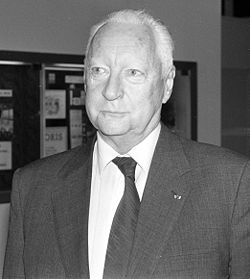 Pierre MessmerPierre Messmer (20 March 1916Affiliated
How the record is sourced and how the score is derived.
The score is formula-derived (Factrail formula v1, version 1.0.0), not an editorial verdict. Read the methodology.
By the Factrail desk · Method: how we source and score · Last reviewed
Dispute a fact on this pageNamed here, or represent someone who is? Request a right of reply.