
Neil Andrew
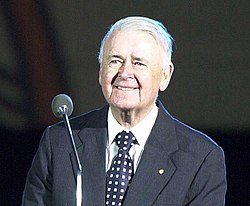
John Neil Andrew AO (7 June 1944 – October 2026), who was known by his second given name, was an Australian horticulturalist…
- Facts0
- Drivers0
- Indicators0
John Neil Andrew AO (7 June 1944 – October 2026), who was known by his second given name, was an Australian horticulturalist…
John Neil Andrew AO (7 June 1944 – October 2026), who was known by his second given name, was an Australian horticulturalist and Liberal Party of Australia politician from South Australia. He represented the Division of Wakefield in the Australian House of Representatives from the 1983 federal election until he retired at the 2004 election, and he was the twenty-fourth Speaker of the House from 10 November 1998. His family announced on 6 October 2026 that he had died after an illness.
Andrew was born in Waikerie, in the Riverland, the son of the farmer John (Jack) Clover Andrew and his wife Elsie. He attended Waikerie High School and completed the year-eleven Leaving Certificate at Urrbrae Agricultural High School in Adelaide, then returned home to grow peaches, citrus and grapes. He joined the Liberal Party in 1967, married the mathematics and science teacher Carolyn Ayles in 1971, and served as a councillor on the District Council of Waikerie from 1976 to 1983. In 1975 a Nuffield travelling scholarship took him to study the British fruit industry, and from 1980 to 1982 he chaired the South Australian Advisory Board of Agriculture.
At the March 1983 election he won Wakefield, then a rural seat stretching from the Yorke Peninsula through the Riverland, which had once been held by the first Speaker of the House, Sir Frederick Holder. The coalition's national defeat that year meant he entered parliament in opposition, where he was deputy opposition whip in 1985–89 and 1990–93, Deputy Chair of Committees on three occasions, and a member of the Speaker's panel. After John Howard's government took office in 1996 he became Government Chief Whip in July 1997. He had come third in a 1996 party-room ballot for the Speakership; after the 1998 election he defeated David Hawker for the party's nomination and the House elected him on 10 November 1998, the first South Australian Speaker since Sir John McLeay in 1966.
He told the House he would apply the standing orders equally, and he continued to attend Liberal party meetings on the ground that his constituents' interests required it. His speakership covered the introduction of the goods and services tax, heated question times in which he suspended members including the minister Tony Abbott, and a 30 November 2000 motion, moved by Opposition Leader Kim Beazley after a tied division on defective bells, that the Speaker no longer possessed the confidence of the House; the motion was defeated 60 votes to 78. He presided at the House's centenary sitting in Melbourne in May 2001 and was re-elected Speaker in February 2002. He retired at the October 2004 election after a redistribution made Wakefield a largely suburban and notionally Labor seat, telling the ABC that he was not leaving in order to "go fishing".
After parliament he qualified as a mediator, worked largely in rural disputes, and chaired the Crawford Fund, which supports international agricultural research. In January 2015 he succeeded Craig Knowles as chair of the authority responsible for the Murray–Darling Basin. He was elected an honorary fellow of the Australian Academy of Technological Sciences and Engineering in 2006 and appointed an Officer of the Order of Australia in 2008, for service to the Parliament of Australia through parliamentary administration and reform and to agricultural research, development and education.
John Neil Andrew, who used his second given name, was born on 7 June 1944 in Waikerie, South Australia, the son of the farmer John (Jack) Clover Andrew and his wife, Elsie. Waikerie stands in the Riverland on the Murray River. It was one of at least thirteen labour, or village, settlements that the government of Charles Cameron Kingston placed along the river in the 1890s, schemes meant to test cooperative landholding, apply irrigation, and employ people from the city. A royal commission led to the abandonment of the village system; more conventional tenure on those sites was followed by the fruit and vine growing that became the economic base of this part of the state.
Jack Andrew later chaired the Waikerie District Council and the Waikerie Producers Co-operative, and was national president of the Australian Council of Local Government Associations. His son recalled that Jack had stood unsuccessfully for the state seat of Ridley in the mid-1960s, against the independent member Tom Stott, and that Jack "never saw one side of the Parliament as having all wisdom vested in it."
Most of Neil Andrew's secondary schooling was at Waikerie High School. He then attended Urrbrae Agricultural High School in Adelaide, where he completed the Year 11 Leaving certificate. Urrbrae opened in 1932 on about 46 hectares that the pastoralist Peter Waite had left to the state for an agricultural high school, with the aim of giving students, including those from the city, a practical and scientific introduction to primary industry. Its motto is "Science with Practice." Andrew did not take a university degree at the time. He later said that his only tertiary qualification came after he had left politics, when he completed arbitration and mediation courses at the University of Adelaide.
In 1971 he married Carolyn Ayles, a mathematics and science teacher at Waikerie High School. They had three children, Matthew, Kate and John.
Andrew grew up among the fruit-growers of the Riverland. A 2020 profile described him as a third-generation horticulturist, and he spoke of himself as "a fruit grower from Waikerie." An account published by the Crawford Fund, which he later chaired, records that he was born in the South Australian Riverland, "where his family and later Neil had interests in horticulture," and that he was an active participant in the South Australian Agricultural Bureau movement.
After Urrbrae he returned to Waikerie, where he grew crops that included peaches, citrus and grapes, and joined the local gliding club. The Parliamentary Handbook gives his occupation before federal politics as horticulturist and notes that he belonged to various horticultural commodity groups. Looking back on how advice to growers had changed, he said in 2020: "In my day, the Agricultural Bureau served growers well, but today most of the leading horticulturists access and evaluate much more professional advice." He added that they were "computer savvy" and used the latest technology to decide irrigation applications.
He was working as that Waikerie horticulturist when he was elected to the House of Representatives in 1983. He kept a hand in the industry afterwards. In retirement, while he and Carolyn lived in Adelaide, he still grew Valencia oranges on a small riverfront property at Taylorville, near Waikerie, managed by the horticulturist Greg Twigden, and used a modest cabin and camping area on the block.
Before he stood for the federal parliament, John Neil Andrew’s organisational work was in Waikerie, in South Australia’s Riverland, and in the state machinery of the Liberal Party of Australia. He joined the party in 1967 and chaired its Waikerie branch from 1971 to 1974. In 1972 he joined the Liberal State Council and, from 1972 to 1975, chaired the electorate conference for Chaffey, the House of Assembly district covering the Riverland. From 1980 to 1982 he chaired the federal electorate conference for the Division of Wakefield, then a rural seat that included his home district.
His first elected public office was as a councillor of the District Council of Waikerie, from 1976 to 1983. The council was the local authority for the irrigated settlements around Waikerie. Andrew’s father, the farmer John (Jack) Clover Andrew, had earlier been its chairman, and had also chaired the Waikerie Producers Co-operative and been national president of the Australian Council of Local Government Associations. The son’s council service ran through the years in which he also chaired the Wakefield electorate conference, and it ended in 1983.
The Parliamentary Handbook lists Andrew as a horticulturist and as a member of various horticultural commodity groups, without naming those organisations. The description matches the mixed plantings recorded for his Waikerie property: peaches, citrus and grapes. No contemporary public list identifies which commodity boards or grower associations he sat on, so the handbook entry is the extent of the published record on that point.
The agricultural office that is dated in detail is the South Australian Advisory Board of Agriculture. Andrew was a member from 1973 and its chair from 1980 to 1982. The Advisory Board was the governing body of the Agricultural Bureau of South Australia, a non-profit and non-political organisation of farmers formed in 1888 to exchange practical knowledge and improve production, including horticulture. Governments appointed leading agriculturalists to a central body that advised ministers and provided a secretariat for local branches; that body became the Advisory Board, with representatives of the bureau movement, government and the university, and it continued to consult on rural landholder and community questions. Andrew later said that in his time the Agricultural Bureau “served growers well,” contrasting that network with the more specialised technical advice later used by horticulturists.
Two overseas programs came before his move from local to federal politics. In the Rotary year 1969–70, the Rotary Club of Waikerie recorded that Andrew had been selected for a Group Study Exchange team visiting the United States. The Parliamentary Handbook lists the 1970 exchange as a team to Utah. Andrew later said that he was 26 at the time and that the visit also took in Idaho.
In 1975 the Nuffield Foundation awarded him a travelling scholarship to study the British fruit industry. The Parliamentary Handbook records the award as that of an Australian Nuffield Scholar in Agriculture, and he later described it as six months in the United Kingdom. Nuffield Australia’s 2025 yearbook identifies him as a 1975 scholar. Under the Foundation’s overseas scheme, begun in 1950, farmers from Australia and other Commonwealth countries went to Britain for six months of study, hosted at first through the National Farmers’ Union and later with programs arranged around British Nuffield scholars. In 1976, the year after Andrew’s award, the Foundation required the remaining Commonwealth participants—Australia, Canada and New Zealand—to fund their own scholarships from their own resources.
Andrew had chaired the Liberal Party of Australia federal electorate council for the Division of Wakefield from 1980 to 1982, and at the election of 5 March 1983 he was the party's candidate. The sitting Liberal, Geoffrey O'Halloran Giles, who had represented Wakefield since a redistribution in 1977, retired before the poll. The election was a double dissolution. Nationally the Coalition lost office and Bob Hawke's Australian Labor Party formed government, so Andrew entered the House of Representatives in opposition, but Wakefield itself stayed Liberal. He polled 43,380 first-preference votes (59.51 per cent) and 46,588 votes after preferences (63.91 per cent), a majority of 20,285 over Labor's Suzanne Owens, from an enrolment of 78,243 and a turnout of 95.48 per cent.
He held the seat at every general election from 1984 to 2001. Against Labor, his two-candidate-preferred vote was 62.93 per cent on 1 December 1984 (Suzanne Owens), 63.69 per cent on 11 July 1987 (Susan Stephens), 62.93 per cent on 24 March 1990 (George Karzis), 66.98 per cent on 13 March 1993 and a peak of 69.96 per cent on 2 March 1996 (Mike Stevens), and 66.29 per cent on 3 October 1998 (Carla Leversedge). The Australian Democrats stood throughout, and the National Party of Australia at several earlier elections. In 1998 One Nation took 16.67 per cent of first preferences and Andrew's share fell to 50.07 per cent, but the Australian Electoral Commission still classed the seat as safe Liberal. On 10 November 2001 he received 44,216 first preferences (56.24 per cent). After preferences the tally was 50,765 (64.57 per cent) to 27,861 (35.43 per cent) for Labor's Tim Rowbottom, a swing of 2.07 percentage points to Labor, and the seat was again classed as safe Liberal. His recorded service for Wakefield runs from 5 March 1983 to 31 August 2004.
When Andrew was elected, Wakefield was a rural South Australian electorate stretching east from the Yorke Peninsula through the Riverland, where he lived, toward the borders with Victoria and New South Wales. The division, named for the colonisation theorist Edward Gibbon Wakefield, was first proclaimed in 1903. Its first member was Sir Frederick Holder, elected that year, who died in office on 23 July 1909; he had been the first Speaker of the House, and the seat Andrew won was one Holder had held.
By 2001 the Commission put the division at about 31,841 square kilometres, from Stenhouse Bay on the Yorke Peninsula to Renmark near the New South Wales border. Towns inside it included Gawler, Kadina, Moonta, Wallaroo, Angaston, Tanunda, Nuriootpa, Kapunda, Balaklava, Waikerie, Morgan, Loxton, Berri, Barmera and Renmark. The profile rated the electorate rural. Its main industries were mixed cereal-growing and sheep, viticulture in the Barossa Valley and the Riverland, and irrigated orchards along the Murray River. Andrew argued agricultural, regional and small-business questions from his horticultural background, and a biographical study records him as the first rural South Australian federal member to keep an electorate office in the division rather than in Adelaide.
That shape did not last. South Australia's entitlement fell from 12 divisions to 11, and no existing division was inside the projected enrolment tolerance. The 2003 Redistribution Committee proposed moving the Yorke Peninsula councils to Grey, placing the River Murray communities, including the Riverland, in Barker, and shifting Wakefield south to take the City of Playford and part of Salisbury from Bonython, plus the Clare and Gilbert Valleys, including the Clare Valley, from Grey, while keeping Gawler, Light, Mallala and part of the old rural seat. Most of the land would still be the former Wakefield, but most electors would come from Bonython, which the committee proposed to abolish; it kept the name because of the preference for Federation-era divisions. The ABC later reported that the redrawn electorate was notionally Labor.
In opposition Andrew was Deputy Chairman of Committees from 26 February to 9 September 1985, from 23 May 1989 to 19 February 1990, and from 4 May 1993 to 21 February 1994, and Opposition Deputy Whip from 9 September 1985 to 12 May 1989 and again from 11 April 1990 to 7 April 1993. From 21 February 1994 until 27 August 1997 he was a member of the Speaker's panel. A study of the Speakership treats the deputy whip's work as early training in the administration and discipline of the House, and time on the panel as experience of presiding.
His committee service while the Coalition was in opposition included the House standing committees on Aboriginal Affairs, Publications and the Parliamentary Library in 1983–84; the Joint Statutory Committee on Public Works from February 1985 to June 1987; Aboriginal Affairs again from October 1987 to September 1988; the Selection Committee from May 1990 to February 1993; and Finance and Public Administration, continued as Banking, Finance and Public Administration, from May 1990 to February 1993. He returned to the Public Works Committee in May 1993, a membership that ran on into the next parliament. After John Howard's government was elected on 2 March 1996, Andrew remained on the Speaker's panel and, from 11 July 1997, was Government Chief Whip until 18 October 1998.
On 11 July 1997, during a rearrangement of offices in the first John Howard ministry, Neil Andrew, the Liberal Party member for Wakefield, became Chief Government Whip in the House of Representatives. He succeeded Alan Cadman, who left the office to become a parliamentary secretary; on the same day Peter Slipper was appointed a government whip and Peter Reith became Leader of the House. He had already been opposition deputy whip in 1985–89 and again in 1990–93, a Deputy Chairman of Committees, and a member of the Speaker’s panel. After the 1996 election he stood for the Speakership in the party room and finished third, behind Kathy Sullivan and the winner, Bob Halverson.
Whips are party officers, not ministers: the Chief Government Whip is not a minister, as the equivalent officer is in the British House of Commons. House of Representatives Practice describes them as administrative officers of their parliamentary parties. Outside the chamber they support party meetings, nominations to committees and internal ballots. In the chamber they arrange speaking lists, secure attendance for divisions and quorum calls—a heavier task for government whips, because the government is expected to keep a quorum—arrange “pairs” so that absences do not change the parties’ relative numbers, and by convention act as tellers. The titles Chief Government Whip and Chief Opposition Whip date from 1994, when the Main Committee, a parallel debating chamber, increased the workload. The Chief Government Whip helps the Leader of the House keep the legislative timetable, may move certain procedural motions without a seconder, and, after consulting ministers, opposition whips and independents, settles the government business sent to the Main Committee. The office carries an additional salary. Andrew held it through the dissolution of the 38th Parliament on 31 August 1998.
Halverson resigned as Speaker on 3 March 1998, and Ian Sinclair, a former leader of the National Party of Australia, was elected the next day. Sinclair retired at the federal election of 3 October 1998, and Howard endorsed Andrew to follow him. The nomination was still put to a party-room ballot, whose discussions are treated as confidential and are not normally published. Andrew’s opponent was David Hawker, the Liberal member for Wannon. Hawker had been opposition chief whip from 1994 to 1996 and, overlooked for the ministry, had turned his attention to the Speakership. Andrew argued that his time on the Speaker’s panel showed he was “someone who’s able to make bipartisan and fair judgments,” and he won the ballot.
The House, not the party room, elects the Speaker. On 10 November 1998, the first sitting of the 39th Parliament, Stewart McArthur nominated Andrew and John Forrest seconded the motion. Nobody else was proposed. Kim Beazley, Leader of the Opposition, said the Australian Labor Party had decided not to oppose him, citing in particular his record in offices such as Chief Government Whip. The Clerk declared Andrew elected, and McArthur and Forrest conducted him to the chair. Howard’s congratulations recalled the whip’s office. Hawker, who had lost the party-room vote, congratulated him on an unopposed election in the chamber. The same day Howard told the House that Michael Ronaldson had been appointed Chief Government Whip.
John Neil Andrew, the Liberal Party member for Wakefield, became the 24th Speaker of the House of Representatives on 10 November 1998, the opening day of the 39th Parliament. Ian Sinclair had left the House at the October election. Prime Minister John Howard endorsed Andrew, who beat the Victorian Liberal David Hawker in the party room after arguing that his time on the Speaker’s panel showed he could judge fairly. In the chamber Stewart McArthur proposed him and John Forrest seconded the motion. With no other candidate he was conducted to the Chair, the Mace was laid on the Table, and he was congratulated by Howard, Opposition Leader Kim Beazley and the Leader of the National Party. He was presented that afternoon to Governor-General Sir William Deane.
He was the first South Australian Speaker since Sir John McLeay, whose term ended in 1966. He told the House that members had more in common than divided them, and he vowed to apply the standing orders equally. He kept attending Liberal Party meetings, which he said served his constituents. The first term ended when the House was dissolved on 8 October 2001. After the government was returned he was re-elected Speaker on 12 February 2002, again after defeating Hawker and others in the party room, and he remained Speaker until the dissolution of 31 August 2004. The new Opposition Leader, Simon Crean, proposed that the Speakership alternate between the sides. Andrew said that whoever held the Chair still needed a floor majority, and that stressing reform too heavily implied the chamber had failed as a legislature.
At his second Question Time, on 12 November 1998, Andrew called the disorder “quite absurd.” He required answers to be relevant and, in September 2000, ruled the acting Prime Minister, John Anderson, out of order on that ground. Debate on the goods and services tax was especially sharp. On 21 June 2000, at a sitting that included criticism of continual changes to the new tax system, he ordered six members out for an hour under standing order 304A for persisting after warnings: opposition members Cheryl Kernot, Christian Zahra and Bob Horne, government members Christopher Pyne and Trish Draper, and, at 3.23 p.m., the Minister for Employment Services, Tony Abbott, for continuing to argue. Accounts of the speakership treat that order against Abbott as the first removal of a minister since McLeay named Minister Hugh Roberton in 1961.
The Opposition accused Andrew of bias and often moved dissent from his rulings. By late 2000 his own side was also restless: Howard was reported to have sought clarification of rulings, and there was published talk of Liberal discontent. Andrew said he was “delighted if some of my own crew are unhappy,” because “I’m the umpire and there is always going to be distress on both sides.” On 28 May 2002 Wayne Swan moved dissent from a ruling that an opposition question was out of order, and a second dissent over the expunging of words from Hansard. Both failed. A motion to suspend standing orders so Swan could move against the Speaker—citing that expunging, alleged favour to ministers, and the use of procedure to shield the Chair—was negatived.
The most direct challenge was on 30 November 2000. Abbott moved to suspend standing orders so Kernot, the member for Dickson, could explain her part in a 1996 preference arrangement between the Australian Labor Party and the Australian Democrats. The dispute followed Andrew’s refusal to make Abbott withdraw a remark Labor read as an imputation that Kernot had improperly received money while Democrats leader. Bob McMullan objected that Beazley already had a motion before the Chair. Andrew ruled that he did not, and Beazley moved dissent. After several closure divisions the dissent tied, 57 votes to 57.
Andrew declared that the question lacked a majority and that he would not give a casting vote, though he believed the ruling correct. He said he should not vote merely to keep himself in office. Opposition members complained that the bells had rung for one minute, not the usual four. Citing possible confusion, and standing order 208, he put the question again. Labor left the chamber; with no tellers for the ayes he declared the dissent lost, and Abbott’s suspension motion lapsed when its time expired. Beazley then moved that the Speaker no longer possessed the confidence of the House, blaming faults in the rulings and alleging that two coalition members had entered after the doors were locked and that a second division was unjustified. The motion failed on party lines, 60 votes to 78. Andrew soon called the one-minute bells a “wrong decision.” He said he had considered voting himself out of the Chair, but thought the issue too slight a reason to go.
On 9 May 2001 the House met with the Senate in Melbourne’s Royal Exhibition Building to mark the centenary of the first Commonwealth parliamentary meetings in 1901. Senate President Margaret Reid invited Deane to speak. He read a message from Queen Elizabeth II, who was not present, congratulating the parliament on the hundred years since her grandfather had opened the first parliament in the same hall. Andrew invited Howard and Beazley to address the meeting, spoke himself, and at 2.39 p.m. adjourned the House until the next morning in the Legislative Assembly chamber at Melbourne’s Parliament House. He later said the House of 2001 was more open to change and diversity, and less rigid in its rules, than its predecessors.
On 23 October 2003 George W. Bush addressed both Houses in the House chamber at Parliament House, after welcomes from Howard and Crean. During the speech Andrew ordered Australian Greens senator Bob Brown, at 11.38 a.m., and senator Kerry Nettle, at 11.48 a.m., to withdraw for an hour under standing order 304A for continuing to interject. Both were senators, not members of the House, and both refused to leave when the Serjeant-at-Arms was sent to them. After Bush had left, Andrew named them for defying the Chair. Abbott moved that they be suspended from the service of the House; members and senators present agreed, and the pair were suspended for 24 hours. The senators questioned a House Speaker’s power to exclude them. Andrew answered that the Senate had agreed to follow House procedure and that Senate President Paul Calvert supported him. The parliamentary chronology calls the suspension “purported.” Senate committees later recommended that future addresses be to the House, with senators present as guests, and that practice was adopted.
The 24-hour suspension kept Brown and Nettle from the address next day by Hu Jintao, President of China, again to a meeting of both Houses. Democrats senator Lyn Allison had earlier moved that Bush and Hu be received in the Great Hall, objecting to an address in the House by a head of state who was not democratically elected.
Security at Parliament House tightened in stages. On 11 July 1999 a man threw two fire bombs at the front doors, and on 3 September 2001 staff intercepted packages containing bullets and detonators addressed to Beazley, senator Natasha Stott Despoja and senator Brown. After the 11 September 2001 attacks the threat level rose from low to medium. People entering were screened, except senators and members, and unaccompanied passes into private areas were limited. A find of white powder in November 2002 was handled as an anthrax scare; Andrew wanted further changes kept unobtrusive, and from February 2003 members passed through metal detectors. On 24 March 2003 guards removed anti-war protesters from the chamber during questions to Howard about Iraq, while a crowd outside tried to force the main doors. With Senate President Paul Calvert, Andrew then limited the grassy roof to visitors already screened on entry, saying he was distressed that some people came only to disrupt proceedings.
He argued that a public which saw only extracts of Question Time would misread the House, and he backed the Parliamentary Education Office, the magazine About the House, lectures by members and officials, and the 2004 merger of the Parliamentary Library, the Parliamentary Reporting Staff and the Joint House Department into one Department of Parliamentary Services. On 16 September 2003 he told the ABC he would leave at the next election. A redistribution had made Wakefield more urban and notionally Labor—in his words, largely a rebadged Bonython, with about four of some thirty Liberal branches left. He had told Howard in May. The decision, he said, was mainly one he and his wife had made after twenty years; he was not going fishing, and he expected to be the longest-serving Speaker since Billy Snedden. He thought debate less venomous, crediting Howard, Beazley and Crean, but still short of the standard he wanted. He stayed in the Chair until the dissolution on 31 August 2004.
On 22 January 2015 the Minister for the Environment, Greg Hunt, and his parliamentary secretary, Bob Baldwin, announced that Neil Andrew would chair the Murray–Darling Basin Authority. His four-year term began on 1 February 2015, succeeding Craig Knowles, who had said in October 2014 that he would leave at the end of January.
Under the Water Act 2007 the Authority oversees the Basin Plan, operates the River Murray for the basin governments, and runs basin-wide natural-resource programs. The announcement described him as a South Australian horticulturalist and a former Liberal member for Wakefield and Speaker of the House of Representatives. Andrew said too much water was already committed, so "somebody, somewhere right across the Basin" would have to give up part of an entitlement.
Farm groups split. Les Gordon, chair of the National Farmers' Federation water taskforce, cited Andrew's policy and irrigation background and urged him to visit both ends of the basin. Richard Anderson, of the Victorian Farmers Federation, said an irrigator in the chair supplied a missing perspective, and that his home state mattered less than balance. Mark McKenzie, of the New South Wales Irrigators' Council, wanted a chair from outside South Australia: many New South Wales irrigators, he said, thought the Authority too focused on end-of-system flows, while the South Australian government and its environmental lobby were "fixated" on the Lower Lakes, the Coorong and an open Murray mouth. Knowles called the choice excellent.
The 2012 Basin Plan, which the new chair was to help implement, rested on an Authority judgement that 10,873 gigalitres a year was an environmentally sustainable surface-water take: 2,750 gigalitres less than was diverted in 2009. In September 2015 the Senate passed, with Labor's support, a government bill capping Commonwealth buybacks at 1,500 gigalitres and favouring recovery through infrastructure.
Two days into the job he inspected the southern Riverina around Deniliquin with Baldwin and the local member, Sussan Ley. Murray Irrigation's Bruce Simpson said the district stood to lose 40 per cent of its productive water, not one third, and wanted the limit adjusted. Andrew said locals were more receptive than he had expected, but worried about overflows from environmental watering. Changes to the limits were for the ministerial council; his task was to have state recommendations by mid-2016, and not to push more water through the Barmah Choke than the river could carry.
In November 2016 the Authority recommended cutting the northern-basin recovery target from 390 gigalitres to 320. Irrigation groups in southern Queensland and northern New South Wales, under the #MoreThanFlow banner, said that still took too much and should not exceed the 278 gigalitres already recovered. Environment Victoria said the plan was "unravelling", and that less water in the Darling and its tributaries would hurt the river and downstream communities. Water minister Barnaby Joyce welcomed the reduction and spoke of a "moral responsibility" not to add to the strain on basin towns.
Compliance overtook that argument after the ABC's Four Corners, in July 2017, reported alleged theft and meter tampering on the Barwon–Darling, and Prime Minister Malcolm Turnbull asked the Authority to review state enforcement. The Guardian reported that from July 2016 the Authority's Data Cube satellite work had indicated that billions of litres bought for the environment were being taken from the Barwon, including during low flows and pumping bans. The Authority had sent the material to the states, then removed the starkest figures from a public report, and said the data were flawed and did not prove illegality. A panel inside its November 2017 review found the Authority "unable to assert its authority" and too passive on compliance, and said the plan was in "real jeopardy". The Authority admitted it had "not dealt adequately with allegations of compliance breaches". Enforcement was described as far tighter in South Australia and Victoria than in New South Wales and Queensland, where the Australian Conservation Foundation called it "basically non-existent". Turnbull said water theft was a crime and that the states had to apply their laws.
Drought closed the term. Fish kills, two of unprecedented scale at Menindee Lakes on the lower Darling, left hundreds of thousands of fish dead in late 2018 and January 2019. On 31 January 2019 South Australia released the report of a royal commission by Bret Walker SC. He found that the original plan had ignored potentially "catastrophic" climate risks, and that Commonwealth officials had committed gross maladministration, negligence and unlawful acts in drawing it up. He recommended more water for the environment, repeal of the northern-basin cut, and abandonment of projects such as the Menindee Lakes scheme.
The Authority's meeting on 4 and 5 February 2019 marked the end of the term. Andrew attended as an observer, and member Joanna Hewitt became acting chair pending a permanent appointment by the Minister for Agriculture and Water Resources. Members rejected the findings of negligence, impropriety or unlawfulness, backed chief executive Phillip Glyde, and noted the fish deaths. On 21 February, after Andrew had left, the Authority called restarting the plan "a reckless act" and said a different legal opinion was not evidence of maladministration.
The Authority credited him with work on salinity and water quality, the Northern Basin Review, the sustainable-diversion-limit adjustment and the compliance review, and with engagement across the basin that it called exceptional. He thanked the staff and urged the remaining members to keep consulting communities and to stay transparent. No permanent chair was named then. In August 2020 water minister Keith Pitt appointed the former defence chief Sir Angus Houston for four years, replacing acting chair Stuart Bunn.
After leaving the Australian House of Representatives in November 2004, Andrew became chairman of the Crawford Fund in June 2005, on the retirement of Tim Fischer, and he retired as chair in late 2010. The Fund was established in 1987 by the Australian Academy of Technological Sciences and Engineering and named for the agricultural economist Sir John Crawford. It publicises the benefits, in Australia and overseas, of international agricultural research, and it runs an annual conference and short training for people working in developing countries. By December 2013 John Kerin, a former minister for primary industries, was chair of the board.
In March 2013 the Fund set up a task force, which Andrew chaired, to examine a National Farmers’ Federation argument that aid-funded international agricultural research should give more weight to benefits for Australian farmers and for domestic research capacity. With him were Terry Enright, a Western Australian producer and former chair of the Grains Research and Development Corporation; Tony Gregson, a Victorian grower and research manager; Cathy McGowan, then the independent member for Indi; and the agricultural economist John Mullen. Denis Blight and Eric Craswell prepared the published report with Mullen. Doing Well by Doing Good (December 2013) treated help for developing countries as the primary purpose of the aid, and argued that the same work could also benefit Australia. From a sample of projects of the Australian Centre for International Agricultural Research (ACIAR), the task force reported benefit–cost ratios between 50:1 and 70:1, mostly as higher farm incomes in developing countries, and estimated Australian benefits of about $100 million a year from the germplasm of three international centres, set against an annual contribution of about $10 million to the international research network. It suggested that ACIAR remain a separate body, within both the aid program and Australia’s agricultural innovation system, and that this funding grow at least with inflation.
Andrew also served as a commissioner on ACIAR’s Commission for International Agricultural Research. The centre’s Partners magazine for March–June 2008 said the commission advised the minister on ACIAR’s programs, and listed the members as Andrew, Barry Buffier, Peter Core, David Crombie, Bruce Davis and John Williams. In its report for 2015–16 the Fund recorded a new category of patron for people who had continued to support the organisation and international agricultural research for development. The first three, all recent chairs, were James Ingram, Fischer and Andrew; Kerin, then still chair, presented the awards and was himself named a patron after he retired from the chair.
Andrew completed arbitration and mediation courses at the University of Adelaide after leaving parliament. The Biographical Dictionary of the House of Representatives records that he qualified as a mediator in 2008 and then worked at the same Adelaide law firm as his daughter. A statement from his family after his death said that he had qualified as an arbitrator and mediator and worked mainly in the rural sector.
The same statement recorded his appointment to the National Capital Authority, the statutory authority that plans and manages Canberra as the national capital. Minutes of a special meeting on 2 April 2007 list a member, “N Andrew,” among those present when the Authority agreed not to proceed with a 25-metre landmark building north of Albert Hall and beside Lake Burley Griffin, and to reconsider the rest of that land as a public lakeside park, subject to the agreement of the ACT government. In the mid-2000s, when orange growers were receiving poor returns, he chaired a South Australian citrus-industry marketing review. He later served on the board of Citrus Australia in 2014.
Andrew was elected an honorary fellow of the Australian Academy of Technological Sciences and Engineering in 2006. The academy’s directory styles him Neil Andrew AO FTSE, places him in the South Australia and Northern Territory division, and lists an affiliation with the Crawford Fund.
In the Australia Day honours announced on 26 January 2008 he was appointed an Officer of the Order of Australia.%20-%20Gazette%20S01.pdf) The Commonwealth of Australia Gazette (Special Gazette No. S 1) listed “The Honourable John Neil ANDREW” of Gilberton, South Australia, with the citation: “For service to the Parliament of Australia through the advancement of parliamentary administration and reform, and to the community in the areas of agricultural research, development and education.”%20-%20Gazette%20S01.pdf)
In 1971 Andrew married Carolyn Ayles, a mathematics and science teacher at Waikerie High School in Waikerie. While he held the Division of Wakefield—then a rural seat of more than 30,000 square kilometres taking in towns in the Riverland, the Mid North, the Barossa Valley and Yorke Peninsula—he and Carolyn moved with the children from the Riverland to Gawler, which sat more centrally in the electorate. The family became well known in Gawler, and he was an honorary member of the Gawler Rotary Club, but they kept a Riverland tie: a small riverfront property at Taylorville, near Waikerie, where he still grew Valencia oranges in 2020 and where the family used a modest cabin and camping area.
By July 2020 Andrew and Carolyn were living in Adelaide, volunteering for Meals on Wheels and grandparents to six grandchildren. In that interview he credited Carolyn with their stable family life, saying she had kept him and the children with their “feet firmly on the ground.” After leaving parliament he qualified as a mediator in 2008 and later worked at the same Adelaide law firm as his daughter.
His niece Nicola Centofanti, a Liberal Party member of the South Australian Legislative Council, was born and raised in Berri, the daughter of Stuart and Suzanne Andrew. In her maiden speech she said her introduction to Liberal campaigning was handing out how-to-vote cards for “my Uncle, former Member for Wakefield, the Hon Neil Andrew AO,” at the Croatian Association Hall in Winkie, and that at 16 she attended his swearing-in as Speaker of the House of Representatives on 10 November 1998. She said her father flew a small group, including Andrew’s daughter and her cousin Kate, from the Riverland for that trip, and that people who spoke to her about her uncle used words such as “committed, unwavering, true to his word and a gentleman.”
Andrew died in early October 2026 after an illness, aged 82. He had been born on 7 June 1944. InDaily reported the death on 6 October and did not give a calendar date distinct from that report, or a diagnosis beyond illness. The previous day, Opposition Leader Angus Taylor had already written that Andrew had spent his final days at the Mary Potter Hospice in Adelaide, surrounded by his family.
The family statement, shared by Centofanti, said it was “with great sadness that we share the passing of our much-loved husband, father, grandfather, brother and uncle, John Neil Andrew AO.” It said that to many he would be remembered for his service as the member for Wakefield and as Speaker, and for contributions to agriculture, regional Australia and the Murray–Darling Basin, and as “a proud Riverlander whose connection to the region remained an important part of who he was throughout his life.” “Despite the responsibilities and achievements of his public career, family was always incredibly important to Neil,” the statement continued; relatives would remember “his warmth, his wisdom, his sense of humour and the genuine interest he took in the lives of those around him.” The family said they were proud of his contribution “to his community, South Australia and our nation,” but that “today, we remember and mourn the man we loved. Neil will be greatly missed and forever loved.”
Taylor, writing on behalf of the Liberal Party, described Andrew as still remembered “as one of the best Speakers – fair and firm, with an outstanding depth of knowledge of the Standing Orders,” and said that in “intense debates, especially on the GST,” he was “admired for his calm authority.” Taylor also credited him, as Speaker, with changes to security at Parliament and with programs meant to help the public understand the House of Representatives, and noted his later work as a mediator and on agricultural boards, closing with “His was a life well lived.” The same day, former foreign minister Alexander Downer called Andrew “my old friend and colleague,” “in every way a good person; honest, dependable and hugely committed to Australia,” “a lovely man” and “a very good Speaker,” and offered condolences to Carolyn and the family. Those judgements were the authors’ own.
Ranked by shared high-impact facts, then explicit ties, then shared drivers.
 Simon CreanSimon Findlay Crean AC (26 February 1949Affiliated
 John KerinJohn Charles Kerin AOAffiliated
 William DeaneSir William Patrick Deane AC KBE KC (born 4 January 1931)…Affiliated
 George W. BushGeorge Walker Bush is an American politicianAffiliated
 John HowardJohn Winston Howard OM AC (born 26 July 1939) is an…Affiliated
 Bob BrownRobert James Brown (born 27 December 1944) is an…Affiliated
How the record is sourced and how the score is derived.
The score is formula-derived (Factrail formula v1, version 1.0.0), not an editorial verdict. Read the methodology.
By the Factrail desk · Method: how we source and score · Last reviewed
Dispute a fact on this pageNamed here, or represent someone who is? Request a right of reply.
People and organizations as listed in the Related section of this page; facts, drivers and the pages that name it as listed in the blocks here. Counts, not a rating.