
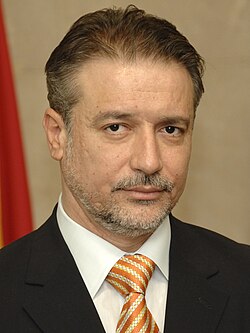
Nikola Kljusev
Nikola Kljusev (Macedonian: Никола Кљусев) was a Macedonian economist, university professor and politician…
- Facts0
- Drivers0
- Indicators0
Nikola Kljusev (Macedonian: Никола Кљусев) was a Macedonian economist, university professor and politician…
Nikola Kljusev (Macedonian: Никола Кљусев) was a Macedonian economist, university professor and politician, and the first prime minister of independent Macedonia, now North Macedonia. He was born in Štip on 2 October 1927 and completed his schooling there. The Macedonian Academy of Sciences and Arts, of which he was a member, announced that he had died late on Wednesday, 16 January 2008, at the age of 80. On 18 January 2008, which Deutsche Welle reported as a day of national mourning, commemorations were held in the Assembly and at the Academy, and he was to be buried in the Alley of the Great.
Between 1942 and 1945 he took part in partisan units of the anti-fascist movement. In 1947 he began studies at the Faculty of Economics of the University of Belgrade. Detention on Goli Otok brought a two-year exclusion from the university, and he graduated on 10 July 1953. He took a doctorate at Belgrade in 1964. From 1953 he worked at the Institute for Scientific Research in the Industry of Macedonia, and from 1961 to 1968 at the Institute of Economics in Skopje, where he was a researcher and director. He became an associate professor in 1968 and a full professor in 1972 at the Faculty of Economics of Ss. Cyril and Methodius University of Skopje, and he was dean of the faculty from 1985 to 1987. His study stays included the Ford Foundation at Columbia University and the University of California, Berkeley, the University of Sussex, the London School of Economics, the academies of sciences in Moscow and Warsaw, and the World Bank in Washington. He was elected a member of the Macedonian Academy in 1988.
After Macedonia’s first multi-party elections at the end of 1990, Kljusev led a government composed of experts from January 1991 until August 1992. On 8 September 1991, during that term, the republic declared independence from federal Yugoslavia, which was breaking up after Slovenia and Croatia had opted for independence. The Balkan Investigative Reporting Network wrote that his relatively brief leadership played an important role in the peaceful establishment of Macedonian statehood during a dissolution that produced wars in Slovenia, Croatia and Bosnia-Herzegovina, and later in Serbia’s Kosovo province. Deutsche Welle reported that the expert government introduced the Macedonian denar and laid the foundations of the Macedonian army.
He was a member of the council of the centre-right party VMRO-DPMNE from 1997, and from 1998 to 2000 he was minister of defence in the coalition government of Ljubčo Georgievski. That defence portfolio coincided with the Kosovo refugee crisis and the start of the war. He published numerous studies on economics and several books of poetry and essays. On 21 March 2011 President Gjorge Ivanov posthumously granted him the Order of 8 September for his contribution to independence, sovereignty and the country’s international position; his son, Ljudmil Kljusev, received the decoration.
Nikola Kljusev (Macedonian: Никола Кљусев) was born on 2 October 1927 in Štip, a Macedonian town then in the Kingdom of Serbs, Croats and Slovenes. In 1929 that kingdom took the name Kingdom of Yugoslavia; Štip is now in North Macedonia. He completed primary school and gymnasium in Štip.
The Axis invasion of Yugoslavia in April 1941 broke the country into occupation zones. The United States Holocaust Memorial Museum records that Bulgaria annexed Yugoslav Macedonia. In Štip, German aircraft bombed the town on 6 April 1941, killing soldiers and civilians, and Bulgarian forces then occupied it; Bulgaria administered the eastern part of Vardar Macedonia for most of the war. From the autumn of 1941 the Communist Party of Yugoslavia attempted to organize armed resistance in the town, as part of the wider movement of the Yugoslav Partisans, while Bulgarian control lasted until 1944. Macedonia's state news agency, MIA, states that Kljusev, still short of the age of majority and then a pupil, took part from 1942 to 1945 in the anti-fascist resistance in partisan units in Macedonia. That account does not name a unit, a rank, or a particular action.
In 1947 he began a degree at the Faculty of Economics of the University of Belgrade, in Belgrade. MIA reports that he was arrested and sent to Goli Otok, an island off the coast of Croatia, and that the university then excluded him for two years. MIA does not say how long he was held, what he was accused of, or whether a court imposed a sentence.
The island camp belonged to the split of 1948 between Josip Broz Tito and Joseph Stalin. The Cominform, set up in 1947 under Soviet influence, condemned the Communist Party of Yugoslavia and the Yugoslav leadership that year. From 1949 to 1956 Goli Otok, together with the nearby island of Sveti Grgur, held people labelled as supporters of that resolution. The Ante Zemljar memorial association, which documents the camp, states that a person could be sent there for open support of Stalin, but also on suspicion, after a denunciation, for a joke or a criticism, or for association with someone already treated as unreliable, and that many were committed by the secret police, UDBA, without a public trial. It puts at about 13,000 the number who passed through in those years and were subjected to forced labour, political "re-education", humiliation, and physical and psychological violence. In 1956 the site ceased to be a Cominform, or Informbiro, camp and became a penitentiary, which closed in 1988. A National Geographic account, citing documents the U.S. Central Intelligence Agency released in 1970, estimated that more than 15,000 people were sent to the island while the political prison was most active and that as many as 600 may have died.
Kljusev resumed the degree and graduated from the Faculty of Economics on 10 July 1953.
In 1964 he defended a doctorate in the economic sciences at the University of Belgrade, the university that had awarded his diploma. The Yugoslav agency Tanjug, reporting an announcement by the Macedonian Academy of Sciences and Arts, gave the subject as Kriterijumi i metodi za ocenjivanje ekonomske efikasnosti investicija ("Criteria and methods for assessing the economic efficiency of investments"). The Macedonian Encyclopedia, which records the 1964 degree without printing that title, lists among his early books a 1963 Skopje study, Aktivizacionen period na investiciite (Activation Period of Investments, 389 pages), and a 1965 Skopje monograph of 298 pages on criteria and methods and the economic effectiveness of investment. Judging whether an investment was economically effective, and how long capital stayed tied up before it began to yield a return, remained the centre of the research he published and taught after leaving Belgrade.
After graduating from the Faculty of Economics in Belgrade on 10 July 1953, Kljusev took a research post in Skopje at the Institute for Scientific Research in the Industry of the People's Republic of Macedonia. He started as an expert associate and was promoted to senior expert associate in 1960. The work was on investment and development, the subjects that later accounts treat as the centre of his scholarly career.
In 1961 he moved to the Institute of Economics in Skopje, founded in 1952 as an independent research body under the economic council of the republican government and later a unit of Ss. Cyril and Methodius University of Skopje. He was a research associate there and, after his 1964 doctorate at Belgrade, a senior research associate. The foundation chronology places him at the institute through 1968. In that period he published five books and worked on several research projects.
A January 2008 Balkan Insight obituary called him a researcher and director of the Economics Institute. The Macedonian Encyclopedia, drawing on university and academy bulletins, does not record a directorship. It does list other coordinating posts: member of the Economic Council of the Socialist Federal Republic of Yugoslavia and of the Economic Council of the Socialist Republic of Macedonia; member of the central board and of the scientific section of the Union of Economists of Yugoslavia; president of the consortium of the economic institutes; member of the editorial board of the journal Ekonomist; and editor-in-chief of Stopanski pregled (Economic Review).
The Faculty of Economics in Skopje, created by a regulation of the government of the People's Republic of Macedonia on 14 November 1950 as the fifth faculty of Ss. Cyril and Methodius University, elected him associate professor in 1968 and full professor in 1972.
He introduced two subjects there: the theory and policy of economic development, and investments—theory, policy and the economics of appraisal and choice. Textbooks he published for both were used at universities across Yugoslavia. He headed postgraduate study in economic development and economic analysis and supervised dozens of master's and doctoral dissertations. The foundation chronology adds that, from 1965, he also taught investment courses on postgraduate programmes in monetary and credit problems and in the economics of the enterprise, and that he organized and led the development programme until he retired in 1988. He was dean of the faculty from 1985 to 1987.
The encyclopedia and the foundation chronology list study visits under the Ford Foundation at Columbia University in New York and at the University of California, Berkeley; stays at the University of Sussex in Brighton and at the London School of Economics; visits to the Academy of Sciences of the Soviet Union in Moscow and the Polish Academy of Sciences in Warsaw; and time at the International Bank for Reconstruction and Development in Washington. He took part in international congresses of economists in Montreal, Madrid and Budapest. Within a project on instruments of scientific and technological policy he also worked in Barbados, Brazil, Venezuela, Mexico, Egypt, India, Korea, Japan and England. The encyclopedia counts more than 300 items in his scholarly output—books, articles, studies, analyses, reports and projects—running from microeconomic assessments to longer-term strategic studies.
The Macedonian Encyclopedia, the foundation chronology and Balkan Insight's obituary all date his election to the Macedonian Academy of Sciences and Arts (MANU; Македонска академија на науките и уметностите) to 1988, the year after his deanship. The academy announced his death in January 2008. A later commemoration by the Media Information Agency instead gives 1989 and states that he presided over MANU's Council for Demographic Research.
In 2002 he was elected head of the academy's Center for Strategic Research. MANU had set up the centre on 28 September 2000 as a scientific unit to initiate and carry out research, lectures and public discussions on strategic questions of national and international importance. Its brief covered historical, geopolitical, economic, social, cultural and security problems insofar as they bore on the medium- and long-term development of the Republic of Macedonia as an independent state. The centre was to draw on scholars from inside and outside the academy, hold round tables, and cooperate with comparable institutions in the country and abroad, especially in neighbouring states.
Reporting his funeral, Deutsche Welle noted that a commemoration was held at the academy as well, and described him as a member of nearly two decades' standing, consistent with an election in the late 1980s. His field inside the academy remained the theoretical and methodological side of investment and development, the same preoccupations as his faculty teaching.
Kljusev’s research concentrated on the theoretical and methodological problems of investment and of economic development, the field in which he defended a doctorate in economics at the Faculty of Economics in Belgrade in 1964.
The first extended monograph was Активизационен период на инвестициите во индустријата на СР Македонија во период 1957–1961 година (The Activation Period of Investments in the Industry of SR Macedonia, 1957–1961). Issued in Skopje in 1963, in 389 pages with a bibliography on pages 367–389, it is associated in library notes with the Economics Institute of SR Macedonia and examines the lag between investment outlays and the entry of new industrial capacity into use. The Macedonian Encyclopedia records the same book under the shortened title Активизационен период на инвестициите.
In 1965 the Economics Institute in Skopje published O kriterijumima i metodama ocenjivanja ekonomske efektivnosti investicija (On the Criteria and Methods of Assessing the Economic Effectiveness of Investments), 298 pages, with a bibliography on pages 275–291. The Macedonian Encyclopedia lists a 1965 Skopje book of the same length under a slightly different Serbian wording, referring to the “functioning” of economic effectiveness rather than its assessment. Later Yugoslav writing cited the 1965 title in comparative discussions of quantitative appraisal, including beside cost–benefit analysis and the federal common methodology for judging the social and economic justification of investments.
Two institute monographs then applied those questions to industry in the Socialist Republic of Macedonia. Користење на производните капацитети во индустријата на СР Македонија (Utilization of Productive Capacity in the Industry of SR Macedonia; Economics Institute of the University in Skopje, 1967) runs to 217 pages. Ефективност на инвестициите во индустријата на СР Македонија (The Effectiveness of Investments in the Industry of SR Macedonia; Economics Institute of the University, 1969) runs to 345 pages and includes graphic presentations. The institute library also holds his 1971 university study of indicators of the effectiveness of fixed assets in Yugoslavia, comparing developed and less-developed areas, and a related 1970 study with the same regional contrast. The encyclopedia lists, in addition, a 1968 Skopje book of 300 pages, Теорија и економска инвестиција у предузећу, on investment in the enterprise, a title not separately confirmed in the catalogues consulted here.
At the Faculty of Economics in Skopje, part of Ss. Cyril and Methodius University, he introduced the courses “Theory and policy of economic development” and “Investments—theory, policy, economics—assessment and selection.” The Macedonian Encyclopedia states that the textbooks for those courses were used at universities throughout the former Yugoslavia. The investment textbook identifiable in library records is Investicije (Belgrade: Književne novine, 1980), 506 pages, with a bibliography on pages 491–501; the Economics Institute copy is catalogued as covering theory, economics and policy, and a later article cites a 1984 issue from the same house. He headed postgraduate study in economic development and methods of economic analysis and supervised numerous master’s and doctoral theses, among them Siniša Milić’s 1985 dissertation on research and the development of the SFR Yugoslavia. The encyclopedia puts the corpus at more than 300 items—books, articles, studies, analyses, elaborates and projects—from microeconomic appraisal to macroeconomic and empirical work, a count that is not a separately audited list of monographs.
The same entry records study stays through the Ford Foundation at Columbia University and the University of California, Berkeley, and at the University of Sussex, the London School of Economics, the academies of sciences in Moscow and Warsaw, and the International Bank for Reconstruction and Development, as well as work on the project “Instruments of science and technology policy.” With Ksente Bogoev and Nikola Uzunov he sat on the editorial board of Долгорочниот економски развој на СР Македонија до 2000 година (The Long-term Economic Development of SR Macedonia to the Year 2000; Macedonian Academy of Sciences and Arts, Skopje, 1986), a 369-page conference volume with English summaries. In 1987 he was among the authors of Меѓународниот трансфер на технологијата и земјите во развој (The International Transfer of Technology and the Developing Countries; Skopje: Komunist).
In 2001 Matica makedonska in Skopje published Избрани дела (Selected Works) in six volumes. As listed in the Macedonian Encyclopedia, they are Теорија и политика на економскиот развој (Theory and Policy of Economic Development); Инвестиции: теорија – политика – економика (Investments: Theory–Policy–Economics); Проблеми на стопанскиот развој (Problems of Economic Development); Инвестиционо-развојни проблеми (Investment-Development Problems); Патот на македонската независност (The Path of Macedonian Independence); and Златно зрно (Golden Grain), the last a literary collection rather than an economic treatise. A separate academy volume, Економијата на Македонија во транзиција (проблеми, дилеми, цели) (The Economy of Macedonia in Transition: Problems, Dilemmas, Goals; MANU, 2002), 340 pages, has an added English title page and names Kljusev among the authors.
The first multi-party elections for the 120-seat Assembly of the Socialist Republic of Macedonia, now North Macedonia, ran from 11 November to 9 December 1990. No party had a majority: VMRO-DPMNE won 38 seats, the League of Communists–Party for Democratic Transformation 31, and the Party for Democratic Prosperity 22. The Assembly met on 8 January 1991. On 27 January it elected Kiro Gligorov president, after a vote on 19 January had missed the required two-thirds, and on 1 February it elected VMRO-DPMNE leader Ljubčo Georgievski as vice-president, under a bargain in which the former communists named the president and VMRO-DPMNE the vice-president and the prime-minister designate.
Gligorov rejected four VMRO-DPMNE nominees for head of government. Early in March the academic Nikola Kljusev was proposed instead. At the tenth sitting, on 20 March 1991, the Assembly elected his list by 83 votes to 17, with three abstentions, out of 115 deputies present. Kljusev became president of the government, with Blaže Ristovski, Jovan Andonov and Bekir Zhuta as vice-presidents. The ministers included Risto Damjanovski at defence, Jordan Mijalkov at interior, Denko Maleski at foreign affairs and Metodija Toshevski at finance. Kljusev presented them as specialists who would not take a party line. A Friedrich-Ebert-Stiftung history by Mišo Dokmanović notes that only Andonov and Aleksandar Lepavcev declared a party membership, and that the cabinet was still known as the “expert government”. Their oath still pledged them to defend both the republic and the Socialist Federal Republic of Yugoslavia. In April the former communists became the Social Democratic Union of Macedonia, under Branko Crvenkovski.
On 25 January 1991 all 120 deputies adopted a declaration of sovereignty, including a right of secession, and on 7 June “Socialist” was removed from the republic’s name. VMRO-DPMNE wanted an independence declaration before any referendum; the government argued for a prior popular vote. On 6 August the Assembly set the referendum for 8 September. The question, worded so that a future Yugoslav link was optional, asked whether voters were “for a sovereign and independent state of Macedonia, with a right to enter into a future alliance of the sovereign states of Yugoslavia”.
The Party for Democratic Prosperity and the People’s Democratic Party, the main parties of the republic’s Albanians, had favoured an independent Macedonia but tied participation to demands on status, language and local government. On 1 September they decided not to call their members out. Turnout was 25.72 percent in Tetovo and 36.37 percent in Gostivar. Of 1,495,807 registered voters, 1,132,981 voted (75.74 percent). The “yes” vote was 1,079,308, or 95.26 percent of ballots cast; 39,639 voted “no”. On 17 September the Assembly confirmed the result and again stated that the republic claimed no neighbours’ territory.
The constitution was adopted on 17 November 1991 by 92 of 120 deputies. Deputies of the two Albanian parties did not vote for it. Sovereignty was vested in the citizens, but the preamble, after VMRO-DPMNE had pressed for a “national constitution”, called Macedonia the national state of the Macedonian people, with civic equality and coexistence for Albanians, Turks, Vlachs, Roma and others. Albanian amendments on constitutive status and a veto over questions of vital interest failed, and those deputies stayed away from the promulgation on 20 November.
International recognition lagged. On 19 December 1991 the Assembly requested it under the European Community’s criteria, and amendments of 6 January 1992 disclaimed territorial claims and interference in other states’ affairs. On 11 January the Arbitration Commission chaired by Robert Badinter found that Macedonia met the Community guidelines of 16 December 1991, and that the name “Macedonia” implied no territorial claim. On 15 January the Community recognized only Slovenia and Croatia. That day Bulgaria became the first state to recognize the republic under its constitutional name; Turkey followed on 6 February. Greece blocked Community recognition over the name. At Lisbon on 27 June 1992 the European Council offered recognition inside the existing borders only under a name without “Macedonia”. Maleski resigned the next day, and the government rejected the condition. The United Nations admitted the state in April 1993, after this cabinet had gone, as “the former Yugoslav Republic of Macedonia”.
The Yugoslav People’s Army was still in the republic after the constitution. On 14 February 1992 the Assembly passed a defence law creating an Army of the Republic of Macedonia. The same day the Presidency of the Yugoslav federation ordered the federal army out, citing the independence measures, the end of conscription into that army, and the republic’s exit from federal financing. Gligorov had asked Colonel-General Blagoje Adžić, the acting federal defence secretary, for a negotiated withdrawal.
On 21 February in Skopje, Gligorov and Adžić agreed that personnel, weapons, ammunition and other movable property would leave by 15 April 1992, that immovable property would stay, and that the new army would take over the territory. The departure finished early: on 27 March the last federal soldier left. Dokmanović writes that this was done without armed incidents and without a shot on Macedonian territory, and that Macedonia was the only republic to become independent on those terms. He also notes that more than 40 Macedonian soldiers died on fronts elsewhere, and that the opposition attacked the agreement for allowing the army to remove its weapons. Balkan Insight later said Kljusev’s brief leadership played an important role in the peaceful establishment of statehood during the federation’s breakup.
Complaints about legislative delay, economic policy and ministers speaking for themselves came to a head over Lisbon. Twenty-three deputies from across the parties put down a question of confidence. Zoran Krstevski, of the Liberal group, said a non-political government had no political or constitutional basis and had been slow and ineffective. Kljusev answered that fifteen months of abnormal conditions, and decisions taken with the president and the Assembly, were also parliament’s responsibility. On 7 July 1992 two deputies voted confidence, 91 voted to withhold it, and seven abstained. The Assembly recorded a no-confidence majority of the whole house and left the cabinet in place until a successor was chosen.
Dokmanović dates a formal resignation to 16 July. Gligorov first offered the next government to VMRO-DPMNE, which could not find a majority. On 17 July he mandated Petar Goshev of the Social Democratic Union; Goshev returned the mandate on 6 August, saying the parties had left him too little say over appointments. Crvenkovski was proposed on 12 August. The election sitting began on 2 September, and on 4 September the Assembly chose his coalition — the Social Democratic Union, the Liberal Party, the Party for Democratic Prosperity and the Socialist Party — by 72 votes of 78 deputies present. On these records the expert government was elected on 20 March 1991, lost confidence on 7 July 1992, and remained only as a caretaker until 4 September, rather than from January 1991 to August 1992.
Leaving the Yugoslav dinar was treated as a precondition for stabilization after the Socialist Federal Republic of Yugoslavia broke up. In January–April 1992 more than 10 billion dinars entered the republic as the federal deficit was monetized; prices rose about 380 percent, and the black-market premium on foreign exchange was nearly 300 percent over an official rate of about 200 dinars per Deutsche Mark. On 26 April 1992 the government of Nikola Kljusev asked the Assembly to legislate at an Easter sitting. Deputies passed laws on the National Bank of Macedonia (85 votes), on the monetary unit (77 to 12) and on the use of that unit (77 to 1). Kljusev said the unit would be the denar, showed the notes, and proposed that, because a normal currency was not ready, the National Bank issue temporary value coupons for up to a year. Governor Borko Stanoevski later wrote that the name was settled only days earlier, when the finance minister conveyed a proposal from the classical philologist Petar Hr. Ilievski, of the Macedonian Academy of Sciences and Arts, linking it to the Roman denarius; Stanoevski informed President Kiro Gligorov and the prime minister, and both agreed.
Coupons were printed at the 11 Oktomvri works in Prilep. Stanoevski recorded a stock above 18 billion dinars by the exchange. Yugoslav notes were exchanged from 27 April at par and, he wrote, the operation finished within three days. A World Bank mission reported that only up to 50,000 dinars in cash could be converted, the rest becoming deposits frozen for a month, and that on 30 April about 17 billion denars were in circulation and about 5 billion frozen. Metodija Toshevski spoke for the government in the debate, so the separation was a cabinet, bank and parliamentary act, not Kljusev’s alone.
The bank’s task was stability of the denar, with money and credit meant to grow more slowly than prices. The official rate was fixed at 360 denars per Deutsche Mark, near the parallel market. Reserves were only about US$18 million, federal assets having stayed in Belgrade, so the rate was expected to be eased toward about 480 per mark by the end of 1992, and a partial surrender rule already produced multiple rates.
The Assembly endorsed the committees’ conclusion on an anti-inflation program by 75 votes to 1. Kljusev called the design heterodox: tight money and a smaller budget, plus the peg, a wage freeze and selected price controls, a scheme the World Bank traced to a government team working with economists at the Ss. Wages were tied to 31 March 1992, with a one-time adjustment and a ban on in-kind pay, and pensions were frozen. Ceilings, after a corrective rise, covered fuel, electricity and a short list of basic foods. Public spending was to fall from about 38 percent of gross social product to 35 percent, central-bank financing of the budget was capped at 5 percent, and May–December inflation was meant to be held to about 92 percent.
The external shock was larger than the anchor. About 70 percent of external transactions had been inside Yugoslavia, and foreign-exchange earnings equal to roughly a quarter of national income were expected to disappear in 1992. Full United Nations Security Council sanctions on the new Yugoslav state ran from May 1992 to November 1995, and Greece had already applied partial embargoes in 1991 and 1992; its closure of the common border from February 1994 to September 1995 came after Kljusev left office. The dispute over the state’s name delayed recognition, and the April program started almost without reserves and without International Monetary Fund or World Bank financing. Household foreign-currency deposits above US$1 billion, whose assets had been in Belgrade, were frozen.
The first results did not last. The parallel premium on foreign exchange vanished within days, and monthly inflation eased from 86 percent in April to 70 percent in May and 17 percent in June, still above target. Stanoevski later described the May–December average as 12.7 percent. Wage restraint held for about two months; real wages then rose and by the end of 1993 had nearly regained their pre-reform level. Rediscount limits were relaxed in late June 1992 as firms and banks lost liquidity, and in May 1993 the National Bank let the denar float. On the authorities’ figures used by the World Bank, retail prices rose 1,925 percent from December 1991 to December 1992 and 233 percent in 1993, while real gross social product fell about 13 percent and then 15 percent.
The coupons were retired by the next government. On 7 May 1993, with Branko Crvenkovski prime minister, the Assembly passed by 70 votes to none a change in the denar’s value: 100 coupon denars equalled one new denar, and ordinary notes replaced the coupons. Dževdet Hajredini, for the government, called it a redenomination of the April 1992 unit, not a new currency. On 4 January 1994 Governor Stanoevski and Finance Minister Hajredini sought a World Bank recovery loan built on wage ceilings, a smaller deficit and an end to selective credit, alongside an IMF Systemic Transformation Facility purchase.
Kljusev left the premiership in 1992 and did not return to a ministry for several years. Biographical notices state that in 1994 he was elected president of the National Convention of Macedonia. The post is listed in the English text of his Macedonian Encyclopedia entry and in the chronology of the memorial foundation established in his name. Neither account identifies the convention’s membership, decisions or lifespan, and contemporary international reporting does not supply that detail.
In 1997 he entered the leadership of the centre-right Internal Macedonian Revolutionary Organization – Democratic Party for Macedonian National Unity (VMRO-DPMNE). The Balkan Investigative Reporting Network recorded that he had been a member of the party’s council since 1997. The encyclopedia entry describes the 1997 step as election to the presidency of that council.
VMRO-DPMNE was then in opposition. After the parliamentary elections of October and November 1998, the first change of government since the early post-independence years, President Kiro Gligorov on 19 November asked the party to name a prime minister-designate, and on 23 November Ljubčo Georgievski received the mandate. The list of ministers was announced on 27 November, and the Assembly approved the government on 30 November by 76 votes to 31, with one abstention. The coalition joined VMRO-DPMNE, the Democratic Alternative and the Democratic Party of Albanians. The International Crisis Group counted 14 ministers for VMRO-DPMNE, including the prime minister, eight for the Democratic Alternative and five for the Democratic Party of Albanians.
Kljusev took the defence portfolio in that cabinet as the VMRO-DPMNE nominee, with Refet Elzami of the Democratic Party of Albanians named as his deputy. BIRN’s obituary places the appointment in 1998–2000, in the centre-right coalition led by Georgievski. Some later chronologies compress the office to the single year 2000, the dating used by the memorial foundation and by the encyclopedia entry’s English text. That wording does not match the November 1998 investiture or the 1999 record of him still in the post. On the dating given by BIRN, the ministry ended in 2000.
The portfolio coincided with the Kosovo War and with a NATO military presence on Macedonian territory. The state was already inside the Alliance’s Partnership for Peace. When the North Atlantic Council received the Macedonian ministers in April 1999, it pointed to a revised Individual Partnership Programme for 1998–2000 and treated the Partnership for Peace Status of Forces Agreement as the framework for the deployed troops, including an exceptional waiver of the host country’s usual 25 per cent share of damages.
On 7 January 1999 NATO Secretary General Javier Solana visited Skopje. The published programme was a meeting at the airport with Foreign Minister Aleksandar Dimitrov and Defence Minister Kljusev, then a visit to the Kosovo Verification Coordination Cell in the military compound at Kumanovo and to the NATO Extraction Force at Petrovec, and a press conference by Solana.
On 18–19 February Solana returned with General Wesley Clark, Supreme Allied Commander Europe. NATO’s summary of the trip says they discussed the Kosovo crisis with Gligorov and Georgievski and then visited the Extraction Force at Kumanovo. A Slovenian news report filed as the delegation arrived said Solana was also to meet Kljusev, chiefly about a possible peacekeeping deployment in Kosovo. Speaking in Macedonia, Solana warned that if the Rambouillet talks failed, NATO would know what to do and that this would come “very soon.”
After the air campaign began, the Council met Dimitrov and Kljusev in Brussels on 9 April 1999. Allies thanked the Republic of Macedonia for its part in the effort to end the fighting in Kosovo and in the humanitarian emergency, while noting the strain of the refugee influx. The Council said NATO forces were moving supplies, providing logistics and helping to set up refugee centres with the UN refugee agency, and that on 3 April it had authorised General Sir Michael Jackson, commander of the NATO forces in the country, to coordinate that relief. It described the troops as enabling forces for a hoped-for NATO-led peace-implementation contingent, not as an offensive force, and said an attack on them, or a threat from the Federal Republic of Yugoslavia to Macedonia’s integrity arising from their presence, would draw an Alliance response. Macedonia’s security was called a direct concern of the Allies, and Partnership for Peace work was presented as preparation for possible membership.
Kljusev stated the same limit in public. He said Macedonian territory could not be used for “any kind of military aggressive action against neighbouring territories,” but that NATO troops could enter Kosovo if the Yugoslav government agreed to their entry. He said the Brussels meeting had produced “words of gratitude, unlike some of the criticism” in the media, and he attacked the BBC and CNN. The Independent, reporting those remarks on 10 April, also noted that thousands of refugees had been deported from a border camp to Albania even as official statements praised the authorities in Skopje, and that European Union foreign ministers had just offered financial aid and a closer political association.
The political handling of the crisis was shared. Gligorov received Solana and Clark in February; Georgievski, as prime minister, took part in those talks and headed the government that had accepted the NATO deployment; Dimitrov sat with Kljusev at the January airport meeting and at the April session of the Council.
Alongside his economics, Nikola Kljusev published poetry, essays and prose. An obituary by the Balkan Investigative Reporting Network noted that, besides numerous economic studies, he published several books of his own poetry and essays. The Macedonian Encyclopedia says that these books also set down the record of an engaged intellectual and public figure; its sources include bulletins of the Macedonian Academy of Sciences and Arts. He is listed among former members of the Writers’ Association of Macedonia (Društvo na pisatelite na Makedonija); a 2011 biographical article dates the membership to 2001. One journal review treats his novel, and a later essay places a single long poem in the literature of Goli Otok without examining the verse.
The encyclopedia’s bibliography begins with a Romanian selection, almost a decade before the Skopje books. Grăuntele de aur (The Golden Grain) appeared in Bucharest in 1985 from Orient-Occident, selected and given a postface by Dumitru M. Ion and translated by Ion and Carolina Ilica.
Four titles are dated 1994, all in Skopje: Antiteza (Antithesis), Kamen ostrov (Stone Island), Silata na zborot (The Power of the Word) and Oda na zborot (Ode to the Word). In Stožer (2019), the writers’ association journal, Jasmina Mojsieva-Gusheva cites Kamen ostrov as a poem (поема) of 64 pages from Matica makedonska. She places it among the books—prisoners’ testimonies and several novels—with which the prison island Goli Otok, a subject left in silence until the last years of the Socialist Federal Republic of Yugoslavia, was opened in Macedonia. She names the poem and does not interpret it.
A chronology on the Nikola Kljusev Foundation site adds imprints: Makedonska kniga for Antiteza and Silata na zborot; Matica makedonska for Oda na zborot, Neizrteno seme and volume 6 of the 2001 selected works, Zlatno zrno (Golden Grain); NAM and Feniks for Rečnik na srceto; NAM for La semence d’or and Ispraḱam sončev zrak; and Hayat Cesilemeleri (Ocak, Ankara, 2005). Of the six selected volumes, Zlatno zrno is the one not given to development, investment or the path of Macedonian independence.
The essay books begin with Pogledi i promeni (Views and Changes), Skopje, 1994. Matica makedonska still offers the volume; the cover carries Kljusev’s name, the title and the house imprint.
Cover of Nikola Kljusev's 1994 essay volume Pogledi i promeni (Views and Changes), issued by Matica makedonska.
The encyclopedia then lists a series marked Predizvici (Challenges): Verba i izmama (Faith and Deception), book 1 (1997); Bessoni noḱi (Sleepless Nights), book 2 (1998); and Viduvanje (A Vision), book 3 (2000). The foundation chronology names Matica makedonska for those three books and for Pogledi i promeni, and records a second edition of Verba i izmama from NAM in Skopje in 2005.
The prose work is the novel Lenman: hronika na edna mladost (Lenman: Chronicle of a Youth). Ranko Mladenoski’s review in Portal (2004) gives the imprint as NAM, Skopje, 2003; the foundation chronology notes a second edition in 2005. He reads it as a reminiscence, entered from the present, of many youths and totalitarian orders, set in Tuzlin, which can stand for any Macedonian town. Through Lenman he finds wartime zeal, postwar disappointment, torture of former fighters on Goli Otok, and a system that advances the servile. He quotes Paskal Gilevski on pages steeped in patriotism and in hope for the homeland, and he closes on Kljusev’s contrast between “small people with a big heart” and those who, from indolence and faintheartedness, “sank into their own nothingness.” The review does not place him in a poetic canon, and the 2008 obituary registers the poems and essays without a critical ranking.
Nikola Kljusev died suddenly at the age of 80 at his home in Skopje late on 16 January 2008; no medical cause was stated. The Macedonian Academy of Sciences and Arts, of which he was a member, announced the death.
The government declared 18 January a day of mourning and the day before named him posthumously a meritorious citizen of Macedonia. That morning his body was to lie in the Assembly’s ceremonial hall, with a book of condolences, an honour guard and commemorations at the Assembly and the Academy. He was buried that afternoon, the service having been set for 1 p.m., with state honours in the Alley of the Great at Butel cemetery. At the cathedral of St Clement of Ohrid the rite was led by Archbishop Stefan of Ohrid and Macedonia, head of the Macedonian Orthodox Church, with Metropolitans Petar and Agatangel and Bishop Kliment. Deutsche Welle reported honour guards at the coffin, citizens, ambassadors and the government passing it, and a commemoration at the Academy beforehand.
Prime Minister Nikola Gruevski, in the address carried by the Information Agency, called him one of the most marked figures of independent Macedonia and credited the expert government with the denar, the army, the constitution and stabilising hyperinflation. He died while chairing the board of the agency for foreign direct investment.
For his scientific work, the biography issued by his family foundation lists the Order with the Golden Wreath, the “13 November” award and, for lifetime achievement, the “11 October” award, which it calls the highest republican prize, along with other commendations from Macedonia and abroad. The same materials date a family memorial centre in his name to 2008.
On 21 March 2011, the twentieth anniversary of the first expert government, President Gjorge Ivanov posthumously conferred the Order of 8 September and presented it to Kljusev’s son, Ljudmil. The presidency said the order recognised a contribution to an independent and sovereign republic, its territorial integrity and its international standing. Ivanov credited that leadership with the currency, the police and the army, and with a peaceful withdrawal of the Yugoslav People's Army.
On 18 December 2019, the patronal feast of Štip, Mayor Blagoj Bochvarski presented the municipality’s Order of St Nicholas posthumously at the cathedral of St Nicholas. Kljusev’s daughter, Margarita Nenovska, received it. Bochvarski paired him with Kiro Gligorov, also from Štip, as a figure in the making of the independent state.
Soon after the death, Nenovska and her daughter Angela Nenovska founded the Foundation “Memorial Centre Nikola Kljusev” to promote his life and work. In 2009 the Gruevski government gave it rent-free use of 216 square metres beside the Army House in central Skopje; in 2015 the grant became permanent. A 2019 investigation reported that the foundation, still headed by Nenovska, had let part of the space for training and meditation sessions and had funded scholarships at a family-owned private school, and had not answered questions about gaps between its published mission and its statute.
Judgements of the 1991–92 premiership are attributed rather than unanimous. The Balkan Investigative Reporting Network wrote that, although relatively brief, his leadership played an important role in the peaceful establishment of Macedonian statehood during Yugoslavia’s violent dissolution. Kljusev himself, interviewed by Radio Free Europe/Radio Liberty in 2003, called the loss of confidence a great omission, “not to say a sin”, arguing that party manoeuvring had removed the expert government before it finished the legal and economic shaping of independence and that privatisation had been degraded. In a 2021 history published by the Friedrich Ebert Foundation, Mišo Dokmanović noted a common domestic view that this “expert” government was among the best after independence, then argued for reassessment. He described much of the cabinet as partisan rather than expert, and listed as shortfalls the failure to win international recognition, passage of only the defence law among systemic laws due within six months of the constitution, no start on transforming social capital, and clashes among ministers. He counted as successes the seizure of Yugoslav conscript records and monetary independence, and he treated President Gligorov’s agreement with the Yugoslav army, rather than the cabinet alone, as decisive in the non-violent separation. Unresolved questions, he wrote, fell largely on the government of Branko Crvenkovski, elected in September 1992.
Ranked by shared high-impact facts, then explicit ties, then shared drivers.
 Branko CrvenkovskiBranko Crvenkovski (born 12 October 1962) is a Macedonian…Affiliated
 Joseph StalinGeneral Secretary of the Soviet Communist Party from 1922…Affiliated
 Javier SolanaFrancisco Javier Solana Madariaga (born 14 July 1942) is a…Affiliated
 Ljubčo GeorgievskiLjubčo Georgievski (born 17 January 1966) is a Macedonian…Affiliated
 Kiro GligorovKiro Gligorov (Macedonian: Киро ГлигоровAffiliated
 Gjorge IvanovGjorge Ivanov (Macedonian: Ѓорге ИвановAffiliated
How the record is sourced and how the score is derived.
The score is formula-derived (Factrail formula v1, version 1.0.0), not an editorial verdict. Read the methodology.
By the Factrail desk · Method: how we source and score · Last reviewed
Dispute a fact on this pageNamed here, or represent someone who is? Request a right of reply.
People and organizations as listed in the Related section of this page; facts, drivers and the pages that name it as listed in the blocks here. Counts, not a rating.
Named by 1 page on Factrail.