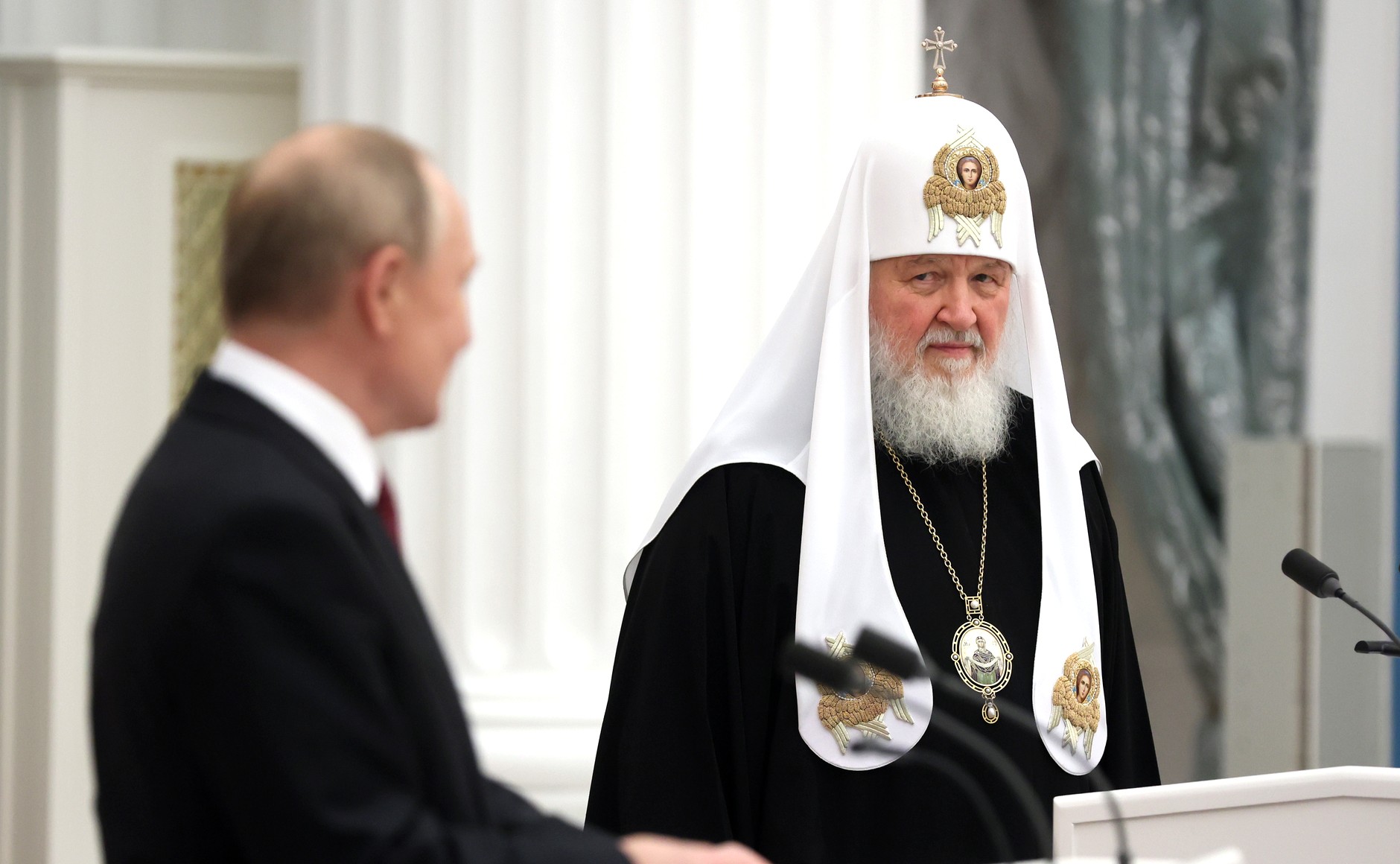
Patriarch Kirill
Kirill or Cyril is a Russian Orthodox bishop. He became Patriarch of Moscow and all Rus' and Primate of the Russian Orthodox Church on 1 February 2009.
- Facts2
- Drivers0
- Indicators0
Kirill or Cyril is a Russian Orthodox bishop. He became Patriarch of Moscow and all Rus' and Primate of the Russian Orthodox Church on 1 February 2009.
Claims against the record, the type of responsibility, and what is disputed.
Responsibility
What could change this assessment
The most relevant dated facts, newest first.
16 June 2022
UK sanctions Patriarch KirillHow the record is sourced and how the score is derived.
2 of 2 linked facts verified, drawing on 2 distinct sources (2022).
Sources include checked 2026-10-15 GET 200, keywords: kirill+sanction+uk, checked 2026-10-15 GET 200, keywords: kirill+sermon+gay.
Sources
The score is formula-derived (Factrail formula v1, version 1.0.0), not an editorial verdict. Read the methodology.
By the Factrail desk · Method: how we source and score · Last reviewed · Sources: 2
An excerpt; the full analysis opens on request.
Patriarch Kirill, head of the Russian Orthodox Church, is a religious leader whose political significance increased sharply after Russia’s full-scale invasion of Ukraine in 2022. He did not command armed forces or write military orders, but he repeatedly gave moral and religious legitimacy to the Kremlin’s framing of the conflict. Reuters via Euronews (opens in a new tab) reported that the United Kingdom sanctioned Kirill for what it called his prominent support of Russian military aggression. His role is therefore best analyzed as ideological and institutional support for state violence, not as direct operational command.
Kirill’s public record during the war includes sermons and statements that connected military service with spiritual meaning. In September 2022, Reuters via Investing.com (opens in a new tab) reported a sermon in which he said sacrifice in the course of military duty could wash away sins. Such language was especially consequential because it came from the highest office of Russia’s largest religious institution during mobilization and heavy battlefield losses. The church’s public messaging also repeatedly echoed Kremlin narratives about Russian civilization, moral conflict and threats from the West, reinforcing a close church-state alignment.
The consequence of Kirill’s stance has been a deeper fusion between the Russian Orthodox hierarchy and the state’s wartime narrative, alongside sharper divisions within global Orthodoxy and criticism from other Christian institutions. The Reuters Institute (opens in a new tab) examined how church communication became part of the broader information environment supporting the war. Sanctions also turned Kirill’s rhetoric into an international policy issue. His influence should not be overstated as if religious messaging determined Russian war policy, but it contributed to legitimizing sacrifice and obedience in a conflict whose initiation and conduct remained decisions of the Russian state.