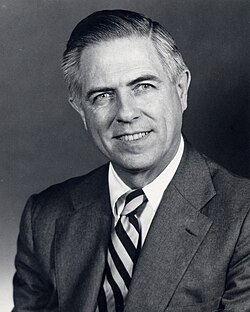
Richard Ottinger
Richard Lawrence Ottinger (January 27, 1929 – February 16, 2026) was an American Democratic politician, lawyer…
- Facts0
- Drivers0
- Indicators0
Richard Lawrence Ottinger (January 27, 1929 – February 16, 2026) was an American Democratic politician, lawyer…
Richard Lawrence Ottinger (January 27, 1929 – February 16, 2026) was an American Democratic politician, lawyer, and environmental advocate from New York who served 16 non-consecutive years in the U.S. House of Representatives, championing causes like Hudson River protection and renewable energy. Representing New York's 25th congressional district from 1965 to 1971, he returned to Congress in 1975 for the 24th district until 1983 and then the 20th district until 1985, often focusing on energy conservation and environmental legislation. After leaving office, Ottinger joined Pace University's law school as a professor of environmental law, where he helped establish programs in the field, served as dean from 1994 to 1999, and later became dean emeritus.
Ottinger's congressional tenure highlighted his commitment to environmental issues, including advocacy for solar power and other renewables, as well as leading efforts on energy policy in the House. He unsuccessfully ran for the U.S. Senate in 1970 but remained influential in bipartisan environmental initiatives during his time in Washington. Post-Congress, his academic career at Pace emphasized global environmental legal studies and the transition to sustainable energy, founding centers dedicated to these topics. Ottinger, who died in Mamaroneck, New York, at age 97, left a legacy bridging politics, law, and environmental stewardship.
Richard Lawrence Ottinger was born on January 27, 1929, in New York City to Lawrence Ottinger, a businessman and founder of U.S. Plywood, and Louise Loewenstein. He was the younger of two children in the family. The Ottingers later resided in Scarsdale, New York.
Ottinger, born in New York City, attended Cornell University, where he earned a Bachelor of Arts degree in 1950. He then pursued legal studies at Harvard Law School, graduating with an LLB in 1953. These credentials provided a foundation in government and law that aligned with his later interests in public policy.
Following his graduation from Harvard Law School, Richard Ottinger served in the United States Air Force from 1955 to 1957. During this period, he advanced to the rank of captain. Ottinger served as a pilot, contributing to his early professional experiences before transitioning to civilian roles.
Ottinger joined the newly established Peace Corps in 1961 as its second staff member, playing a key role in its formative years by directing programs for the west coast of South America until 1964. In this capacity, he oversaw the development and implementation of volunteer initiatives across countries including Peru, Ecuador, Colombia, and Chile, helping to expand the agency's operations in the region amid the organization's rapid growth under President John F. Kennedy. His efforts contributed to the Peace Corps' early focus on community development, education, and technical assistance projects tailored to local needs in Latin America. This experience in international public service built on his prior U.S. Air Force background and preceded his entry into elective politics.
Richard Ottinger, a Democrat, was first elected to the U.S. House of Representatives in 1964, defeating incumbent Republican Robert R. Barry to represent New York's 25th congressional district, which encompassed Westchester and Putnam counties. He took office in 1965 and secured re-election in 1966 and 1968, serving three terms through 1971. His initial campaign drew attention for debates over spending, with Ottinger criticizing Barry's record amid broader fiscal concerns in the district race.
Ottinger declined re-election in 1970 to pursue a Senate bid, but after that loss, he returned to the House in 1974 and won subsequent elections, serving continuously from 1975 until his retirement in 1985 across New York's 24th and 20th districts. This span covered five additional terms, marking a total of eight non-consecutive terms focused on legislative service from the New York suburbs.
In 1970, Richard Ottinger, leveraging his experience from three terms in the U.S. House, sought the Democratic nomination and won it to challenge incumbent U.S. Senator Charles Goodell, who held both Republican and Liberal Party lines. Ottinger's campaign emphasized organized, methodical outreach, but faced a crowded field including Conservative Party candidate James L. Buckley.
The election dynamics were shaped by a conservative surge in New York, particularly in suburban areas, which boosted Buckley while splitting the more liberal vote between Ottinger and the increasingly unpopular Goodell. This fragmentation prevented either Ottinger or Goodell from consolidating sufficient support, allowing Buckley to secure victory with a plurality of approximately 39% of the vote. Ottinger finished second, with Goodell placing a distant third.
During his tenure in the U.S. House of Representatives, Ottinger emerged as one of the earliest and most prominent advocates for environmental protection, focusing on pollution control, energy conservation, and sustainable resources. He sponsored legislation to establish an interstate commission addressing pollution in the Hudson River and worked to curb shoreline development and pollutants there.
In 1975, Ottinger founded the bipartisan Environmental Study Conference in the House, which rapidly expanded to include more than 150 members from both parties and served as a key forum for environmental policy discussion. As chairman of the House Energy Conservation and Power Subcommittee, he championed initiatives for renewable energy sources, including solar power, and introduced bills such as the Residential Energy Conservation Tax Credit Act of 1984 to incentivize energy efficiency.
In 1984, toward the end of his congressional service which concluded in 1985, Ottinger joined the faculty of Pace University School of Law in White Plains, New York, where he began teaching environmental law. His congressional experience in environmental policy motivated this shift to legal education, allowing him to focus on classroom instruction in environmental legal issues.
Ottinger founded the school's environmental law program, establishing it as a key component of the curriculum and later contributing to the creation of the Pace Energy and Climate Center to advocate for renewable energy and climate solutions. From 1984 to 1994, he taught courses that drew on his legislative expertise, imparting practical knowledge of environmental policy and law to students and emphasizing real-world applications from his time in Congress. His instruction fostered a generation of lawyers equipped to address pressing ecological challenges, enhancing the program's reputation for integrating advocacy with legal training.
Ottinger served as dean of Pace University School of Law from 1994 to 1999, having previously taught there as a professor from 1984 to 1994. His leadership proved transformative, emphasizing administrative growth and student focus; he personally greeted incoming students and fostered an inclusive environment that supported their professional development.
Key accomplishments included establishing the Law School's Board of Visitors (also referred to as Board of Advisors) to enhance governance and advisory input, launching the annual fundraising dinner to bolster financial resources, and securing funds for a new modern classroom building, which opened during his tenure and was later dedicated as Richard Ottinger Hall in 2013. He also facilitated the relocation of the New York State Judicial Institute to the campus, strengthening ties with judicial training, expanded the LLM program, and advanced international initiatives to broaden the school's global reach. Following his deanship, Ottinger was appointed Dean Emeritus, a title reflecting his enduring contributions to the institution.
Ranked by shared high-impact facts, then explicit ties, then shared drivers.
How the record is sourced and how the score is derived.
The score is formula-derived (Factrail formula v1, version 1.0.0), not an editorial verdict. Read the methodology.
By the Factrail desk · Method: how we source and score · Last reviewed
Dispute a fact on this pageNamed here, or represent someone who is? Request a right of reply.
People and organizations as listed in the Related section of this page; facts, drivers and the pages that name it as listed in the blocks here. Counts, not a rating.