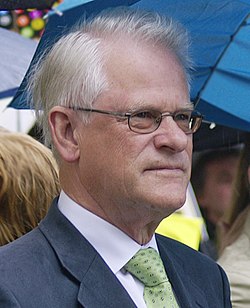
Ulf Adelsohn
Ulf Adelsohn (born 1941) is a Swedish politician and jurist who led the Moderate Party from 1981 to 1986…
- Facts0
- Drivers0
- Indicators0
Ulf Adelsohn (born 1941) is a Swedish politician and jurist who led the Moderate Party from 1981 to 1986…
Ulf Adelsohn (born 1941) is a Swedish politician and jurist who led the Moderate Party from 1981 to 1986, serving as the primary opposition figure against the Social Democratic governments headed by Olof Palme and Ingvar Carlsson. He previously acted as Minister of Communications in Thorbjörn Fälldin's coalition cabinet from 1979 to 1981 and later held the governorship of Stockholm County from 1992 to 2001. Adelsohn earned a Candidate of Law degree from Stockholm University in 1968, establishing his legal background before entering politics.
During his tenure as Moderate Party leader, succeeding Gösta Bohman, Adelsohn focused on challenging socialist policies amid Sweden's economic debates, though the party faced electoral setbacks in 1985 leading to his resignation and replacement by Carl Bildt. He represented the Moderate Party as a member of the Riksdag intermittently from 1982 to 1988, including roles on the Committee on Foreign Affairs and as chair of the Swedish Delegation to the Nordic Council. Earlier, Adelsohn served in Stockholm's city council from 1966 to 1979, rising to positions such as chair of the finance committee. Post-governorship, he took on board leadership in state enterprises, reflecting his continued influence in public administration and infrastructure.
Ulf Adelsohn was born on 4 October 1941 in Stockholm, Sweden, to parents Oskar Adelsohn, who served as kansliråd in Sweden's Ministry of Justice (Justitiedepartementet), and Margareta (née Halling). His father's civil service role in the justice sector provided a backdrop of public administration that influenced Adelsohn's early exposure to governance structures.
Adelsohn's paternal grandparents were Polish Jews, imbuing him with a Jewish ethnic heritage amid Sweden's predominantly Lutheran society, while his mother's Swedish lineage connected him to longstanding national traditions. This dual ancestry shaped his identity, blending immigrant roots with indigenous Swedish history. Through his maternal line, he descends as a great-great-great-great-grandson from Jacob Johan Anckarström, the historical figure convicted and executed for the regicide of King Gustav III in 1792, highlighting a provocative thread in his familial legacy.
Adelsohn studied law at Stockholm University, earning a Candidate of Law degree (juris kandidat) in 1968. This qualification established the legal foundation for his career as a jurist, enabling his transition into public service.
Adelsohn's entry into national politics followed a foundation in Stockholm's municipal governance, where he cultivated a reputation for effective leadership prior to 1979. Appointed Minister of Communications in Thorbjörn Fälldin's second center-right cabinet, he served from 1979 to 1981, overseeing policies related to transport infrastructure, postal services, and telecommunications. This cabinet position highlighted his administrative capabilities, bolstered by his legal training, and positioned him prominently within Moderate Party circles as a capable figure for broader responsibilities.
Ulf Adelsohn succeeded Gösta Bohman as leader of the Moderate Party in 1981. His prior ministerial experience as Minister of Communications positioned him as a capable figure to guide the party in opposition.
From 1981 to 1986, Adelsohn led the Moderate Party as the primary opposition force against Prime Minister Olof Palme's Social Democratic government, and briefly against Ingvar Carlsson following Palme's assassination in 1986. Under his leadership, the party emphasized conservative policies amid Sweden's polarized political climate, though voter support fluctuated significantly, dropping to as low as 18 percent in polls.
The 1985 general election proved pivotal, as the Social Democrats retained power and the Moderate Party incurred notable losses, marking a disappointing outcome for Adelsohn's campaign efforts. This electoral setback prompted his resignation as party leader in 1986, after which Carl Bildt assumed the role.
Adelsohn served as a member of the Swedish Riksdag for the Moderate Party from 1982 to 1988, representing Stockholm County.
During his tenure, he acted as a substitute member of the Foreign Affairs Committee from 1982 to 1985 and chaired the Swedish Delegation to the Nordic Council from 1982 to 1984. He also participated in the Foreign Affairs Council and the War Delegation from the 1982/83 to 1985/86 parliamentary terms, focusing on matters of national security and international relations. Additionally, as chairman and group leader of the Moderate Party's trust council in the Riksdag during the same period, he helped coordinate party positions on legislative priorities. After the 1985 election, he remained an active member until 1988, with intermittent leaves, contributing to opposition efforts in a non-leadership capacity.
Following his parliamentary service, Ulf Adelsohn was appointed Governor (Landshövding) of Stockholm County, serving from 1992 to 2001 in a role that shifted his focus from national politics to regional administration.
During his nearly decade-long tenure, Adelsohn oversaw the county's administrative functions amid Sweden's evolving regional governance. He notably endorsed the Lugna Gatan initiative, a youth employment and crime-reduction program in Stockholm's suburbs launched in 1995 by Fryshuset, describing it as "the most important occupational, social and youth work that he had ever" encountered, highlighting his emphasis on integrating disadvantaged young people through community patrols, school interventions, and social services.
Ulf Adelsohn was appointed Chairman of the Board of SJ AB, Sweden's state-owned passenger railway company, in 2001 and held the position for nine years.
Throughout his tenure, Adelsohn focused on navigating the challenges of operating within a partially deregulated rail market, where competition from new entrants strained SJ's monopoly on high-speed and long-distance services.
In early 2011, escalating public disagreements with the Reinfeldt government's railway policies prompted his resignation; Adelsohn criticized the deregulation framework for failing to allocate adequate funding to infrastructure maintenance and capacity expansion, arguing it undermined the system's reliability and competitiveness.
He described the government's investment plans as "not good enough," highlighting a perceived mismatch between liberalization goals and practical support for state-owned operations, which he believed exacerbated operational bottlenecks and safety risks.
The clash culminated in Adelsohn's forced departure on April 7, 2011, after a press conference where he directed sharp rebukes at both the government and parliament for insufficient oversight of the sector's transformation.
This episode underscored tensions between corporate autonomy in state enterprises and national policy directives, positioning Adelsohn's exit as a notable critique of Sweden's evolving transport liberalization amid his prior administrative experience.
Ulf Adelsohn has been married to Lena Adelsohn Liljeroth since 1981. She later served as Sweden's Minister for Culture.
Ranked by shared high-impact facts, then explicit ties, then shared drivers.
How the record is sourced and how the score is derived.
The score is formula-derived (Factrail formula v1, version 1.0.0), not an editorial verdict. Read the methodology.
By the Factrail desk · Method: how we source and score · Last reviewed
Dispute a fact on this pageNamed here, or represent someone who is? Request a right of reply.
People and organizations as listed in the Related section of this page; facts, drivers and the pages that name it as listed in the blocks here. Counts, not a rating.