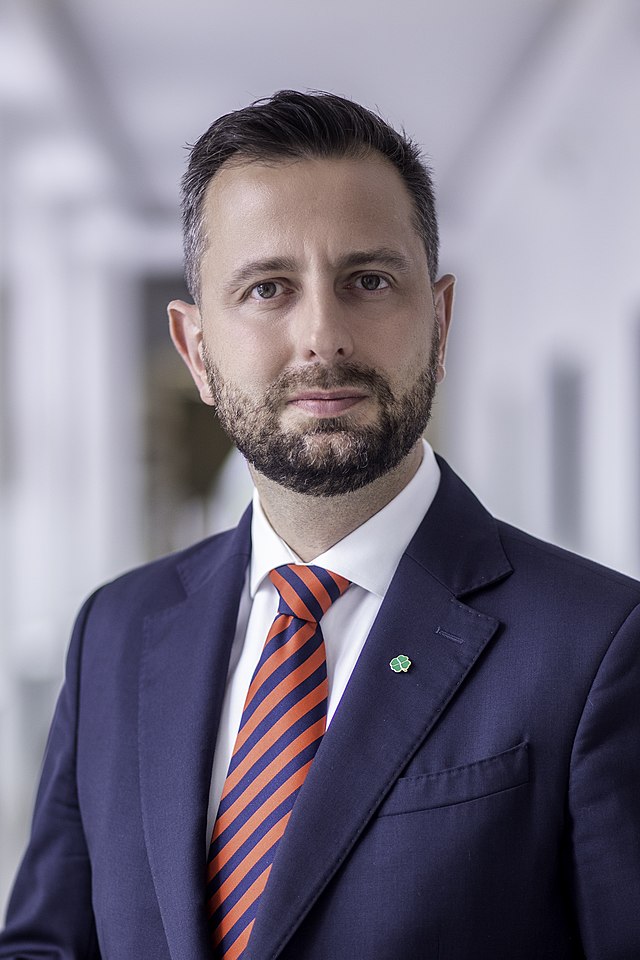
Defence minister in a period of strategic rearmament
Władysław Kosiniak-Kamysz was sworn in as Poland’s deputy prime minister and national defence minister on 13 December 2023 as part of the change in national government. The Ministry of National Defence’s announcement (opens in a new tab) records both his appointment and his first public message to service personnel. He entered office as Poland was expanding its defence effort amid Russia’s continuing invasion of Ukraine, and the ministry was responsible for translating large political commitments into procurement, deployments, training and military readiness.
That institutional responsibility should not be confused with personally controlling every decision of the armed forces, NATO or the European Union. Polish defence appropriations depend on Parliament and government-wide choices; alliance decisions require consultation among states. Kosiniak-Kamysz can nevertheless be assessed for prioritizing projects, representing Poland in multilateral negotiations and explaining military commitments to the public. The challenge is to distinguish concrete actions—such as signing a cooperation document or announcing a support package—from aspirational language about preparedness. Treating aggregate national defence spending as his individual achievement would disregard decisions that preceded his tenure.
Ukraine assistance and cooperation with European allies
Support for Ukraine has been a central strand of Kosiniak-Kamysz’s defence diplomacy. Following talks with Germany’s defence minister Boris Pistorius in March 2024, the two governments announced collaboration on an armored-capability coalition for Ukraine. The Polish ministry’s report (opens in a new tab) also describes planned joint activity and the broader objective of strengthening European defence cooperation. The identifiable role of Kosiniak-Kamysz was to take part in negotiations and present the bilateral arrangements; the transfer and use of particular equipment require additional evidence before any specific battlefield outcome can be attributed to him.
At a January 2025 Ukraine Defence Contact Group meeting (opens in a new tab), the minister described a plan for continued assistance and development of Ukrainian armored capabilities, while noting that Polish support was subject to national security requirements. That qualification matters for accountability. Promising solidarity and reserving capabilities for Poland’s own defence are not inherently inconsistent, but each choice can affect when aid arrives and what equipment is available. The public record supports an account of sustained ministry-level engagement; it does not establish that every planned donation was delivered on the day it was discussed.
NATO readiness, air defence and eastern-flank policy
Kosiniak-Kamysz has also participated in NATO planning on deterrence, interoperability and command infrastructure. In October 2024, the Polish defence ministry (opens in a new tab) reported that he signed two letters of intent related to allied training and integration, including an initiative for air and missile defence networks. Letters of intent indicate a commitment to pursue cooperation; they are not evidence that the associated systems had already entered service. NATO’s future effectiveness depends on subsequent spending, technical implementation and collective political decisions.
By October 2025, Polish officials were emphasizing the response to airspace violations and support for NATO’s eastern flank. A ministry statement from Brussels (opens in a new tab) sets out Kosiniak-Kamysz’s arguments for a lasting defensive posture and continued logistical support for Ukraine. These decisions engage real trade-offs: higher spending can strengthen deterrence but also competes with civilian priorities, while deeper cross-border coordination may increase security without eliminating risk. A balanced assessment tracks concrete training commitments, infrastructure and alliance agreements rather than awarding personal credit for all military effects. It also keeps the underlying driver of Russia’s war against Ukraine separate from an individual Polish minister’s response to that war.