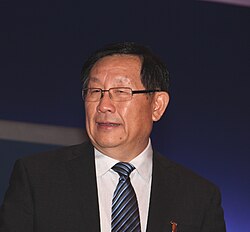
Wan Exiang
Wan Exiang (Chinese: 万鄂湘; pinyin: Wàn Èxiāng; born May 1956) is a Chinese politician and jurist from Gong'an County, Hubei…
- Facts0
- Drivers0
- Indicators0
Wan Exiang (Chinese: 万鄂湘; pinyin: Wàn Èxiāng; born May 1956) is a Chinese politician and jurist from Gong'an County, Hubei…
Wan Exiang (Chinese: 万鄂湘; pinyin: Wàn Èxiāng; born May 1956) is a Chinese politician and jurist from Gong'an County, Hubei, who has held prominent roles in the judiciary and politics, including as vice president of the Supreme People's Court and chairman of the Revolutionary Committee of the Chinese Kuomintang (RCCK). He served as vice president of the Supreme People's Court, overseeing key aspects of China's judicial system during his tenure. Politically, Wan led the RCCK, one of China's eight minor political parties, and was elected vice chairperson of the Standing Committee of the National People's Congress in 2018, contributing to legislative oversight.
Prior to his high-level positions, Wan pursued an academic career as a professor of international law at Wuhan University, where he also earned a doctorate in law, building expertise in legal matters before ascending through provincial courts in Hubei to the national level. His judicial roles emphasized advancements in commercial and international law applications within China, reflecting his background in legal scholarship.
Wan Exiang was born in May 1956 in Gong'an County, Hubei Province.
Wan Exiang graduated from the Department of Law at Wuhan University, specializing in international law, and holds a graduate degree along with a doctorate in law from the institution. He later pursued advanced studies abroad, earning an LL.M. from Yale Law School in 1987 through a Ford Foundation exchange program.
Following his education, Wan served as a professor of international law at Wuhan University School of Law, where he contributed to legal academia before transitioning to judicial roles.
Wan Exiang was appointed vice president of the Intermediate People's Court of Wuhan in September 1996, serving until September 1999. In this role, he contributed to the court's judicial operations in the provincial capital, drawing on his prior academic experience in law.
In March 1999, Wan advanced to vice president of the High People's Court of Hubei, holding the position until May 2000. This promotion marked his progression to overseeing appellate matters across the province, while he concurrently maintained affiliations with Wuhan University.
Wan Exiang served as vice president of the Supreme People's Court from April 2000 to March 2013, holding the rank of second-level grand justice and membership in the court's adjudication committee. In this capacity, he contributed to national judicial oversight, including efforts to advance reforms aimed at enhancing fairness and efficiency in the Chinese judiciary. His work involved guiding policy implementation and addressing systemic challenges, such as through speeches on judicial modernization delivered during his tenure.
During his time at the apex court, Wan engaged in on-site evaluations of lower-level courts to assess reform progress and operational effectiveness, exemplified by his 2010 survey in Hubei Province where he met with judges and emphasized strengthening grassroots judicial work. These activities underscored his role in bridging national policies with local implementation, focusing on areas like trial quality and public trust in the legal system. Wan concluded his judicial career in 2013, marking the end of over two decades in progressively senior court positions.
Wan Exiang was elected chairman of the Central Committee of the Revolutionary Committee of the Chinese Kuomintang (RCCK) in December 2012, assuming leadership of the party shortly before his retirement from the Supreme People's Court in 2013. He served in this role through two terms, guiding the RCCK as one of China's eight minor democratic parties aligned with the Chinese Communist Party's united front framework.
As chairman, Wan emphasized the RCCK's commitment to national unity and policy support, including advocacy for innovation-driven development during inspections of high-tech sectors in provinces like Jiangsu. His legal expertise from prior judicial service informed the party's focus on rule-of-law initiatives within its contributions to multiparty cooperation. In public addresses, such as commemorations of the 1911 Revolution, he highlighted the RCCK's historical legacy in promoting democratic progress under socialist conditions.
Wan stepped down as chairman in 2022, having led the RCCK in issuing statements reaffirming loyalty to the People's Republic of China on key anniversaries, including the 70th founding of the PRC.
Wan Exiang served as vice chairperson of the Standing Committee of the 13th National People's Congress from March 2018 to March 2023. In this capacity, he participated in the committee's core functions, including legislative deliberation, enforcement supervision, and major national policy oversight between plenary sessions. His appointment built on prior political leadership, enabling contributions to parliamentary processes distinct from organizational party duties. During the tenure, Wan engaged in inspection activities, such as reviewing high-tech industries in Jiangsu Province to assess implementation of national development strategies.
As vice chairperson of the Standing Committee of the National People's Congress, Wan Exiang represented China at the Group of 20 parliament speakers' meeting held in Tokyo, Japan, from November 3 to 7, 2019. The forum brought together legislative leaders from G20 nations and invited guests to discuss parliamentary cooperation amid global challenges, including economic governance and multilateral dialogue.
During the event, Wan emphasized China's commitment to enhancing parliamentary exchanges with Japan to foster bilateral relations and mutual understanding. He advocated for deeper legislative collaboration to support broader diplomatic ties, aligning with China's positions on promoting inclusive global governance through inter-parliamentary mechanisms. This participation underscored Wan's role in advancing China's diplomatic outreach via legislative channels.
In December 2020, the United States imposed sanctions on Wan Exiang under Executive Order 13936, targeting individuals responsible for undermining Hong Kong's autonomy. As vice chairperson of the [Standing Committee of the National People's Congress](/page/Standing_Committee_of_the_National_People's_Congress), Wan was designated for his involvement in actions that eroded obligations under the [Sino-British Joint Declaration](/page/Sino-British_Joint_Declaration) and Hong Kong Basic Law, including the NPC's passage of the Hong Kong National Security Law and resolutions disqualifying pro-democracy legislators. ``
The sanctions, announced by the U.S. Department of the Treasury's Office of Foreign Assets Control on December 7, 2020, added Wan to the Specially Designated Nationals list alongside 13 other Chinese officials, primarily NPC vice chairpersons. These measures prohibit U.S. persons from engaging in transactions with him, freeze any assets under U.S. jurisdiction, and bar his entry into the United States, pursuant to the Hong Kong Autonomy Act. Chinese officials condemned the actions as interference in internal affairs, but no specific response from Wan was publicly reported.
Ranked by shared high-impact facts, then explicit ties, then shared drivers.
How the record is sourced and how the score is derived.
The score is formula-derived (Factrail formula v1, version 1.0.0), not an editorial verdict. Read the methodology.
By the Factrail desk · Method: how we source and score · Last reviewed
Dispute a fact on this pageNamed here, or represent someone who is? Request a right of reply.
People and organizations as listed in the Related section of this page; facts, drivers and the pages that name it as listed in the blocks here. Counts, not a rating.