Karol Nawrocki's accountability ledger: veto, referral and the fuel-price fight
TL;DR
Poland's president used veto and constitutional-referral powers over energy legislation, then signed a windfall-tax bill. The accountability record is a sequence of legal instruments, not a claim that he alone set household fuel prices.
By the Factrail desk · Method: how we source and score · Last reviewed
Key graph impact
The article explains graph entities; the causal edges belong to the facts and drivers it links to.
- ArticleKarol Nawrocki's accountability ledger: veto, referral and the fuel-price fight
- mentionsDriverDemocratic Resilience
- strengthensIndicators (3)Having a say in government
Strengthens · 70% impact strength
Observed
29.8% of population aged 16-65 years · 8.13 below the normal line (2023)
Worse than normalTwo readings: 30.2% of population aged 16-65 years (2021) and 29.8% of population aged 16-65 years (2023).
20212023 Above normal = better · Lag ~6 mo
Strengthens · 45% impact strength
Observed
0.53 score from 0 to 1 · 0.34 below the normal line (2024)
Worse than normal125 readings, 1900–2024: rose from 0.17 score from 0 to 1 to 0.53 score from 0 to 1.
Above normal = better · Lag ~6 mo
Strengthens · 45% impact strength
Observed
0.55 index score (0-1) · 0.26 below the normal line (2024)
Worse than normalAbove normal = better · Lag ~12 mo
Article
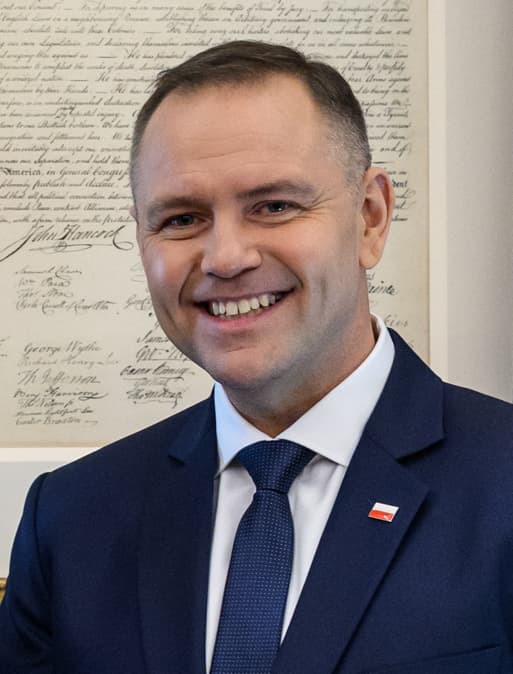
Karol Nawrocki's presidency is an unusually clean test of institutional accountability because the key actions are documented legal instruments rather than rhetorical associations.
His June 2025 victory mattered because Poland's governing coalition did not possess a routine supermajority capable of neutralising a presidential veto. A narrow presidential election therefore translated into leverage over a government with a different political programme.
Energy policy made that leverage visible almost immediately. On 21 August 2025 Nawrocki vetoed legislation easing rules for onshore wind construction. The package also extended household electricity-price protections. Nawrocki argued that allowing turbines closer to homes was unacceptable and that price relief should be separated from the wind-planning changes. Donald Tusk's government argued that the veto delayed cheaper energy and weakened energy security.
Factrail should preserve both sides of that institutional dispute without pretending they are equivalent factual claims. The completed fact is the veto. Whether the veto ultimately raised electricity costs is a downstream causal question requiring evidence through the Driver → Indicator chain.
The 2026 fuel crisis produced an even sharper sequence. Nawrocki signed emergency fuel-price legislation in March. In July he sent a separate windfall-tax law to the Constitutional Tribunal before signature, citing doubts over retroactive taxation. The government said the referral blocked around 4 billion zlotys of expected proceeds that were intended to help finance its fuel-price relief architecture.
The design of the proposed levy matters. According to Poland's Energy Ministry, it targeted extraordinary fuel margins rather than total company profit: a company's 2025 average margin, increased by 20%, formed the reference level, with a 60% levy applying only above that threshold. The ministry estimated around 3.8 billion zlotys of receipts in 2026 and another 0.2 billion in 2027.
On 1 October, Nawrocki announced that he had signed a windfall-tax bill. Reuters reported a day later that the combination of the tax and a fuel-price cap could reduce inflation pressure after fuel prices had risen sharply.
These events should not be collapsed into a partisan label such as "pro-company" or "anti-consumer." The accountability record is more useful when represented as a sequence of powers exercised: sign, veto, refer for constitutional review, then later sign a tax measure. The government, parliament, Constitutional Tribunal, energy companies and external oil-price shock remain distinct actors.
The resulting Factrail chain should therefore stay disciplined: presidential legal action → discrete policy fact → Polish fuel/energy-policy driver → measurable price or energy-system indicator → welfare effect.
No direct Nawrocki → household-price edge should be stored. No manual score should be supplied.
Institutional record on the person dossier
Karol Nawrocki became president of Poland after narrowly winning the June 2025 presidential election with 50.89% of the vote. Although the Polish presidency does not run the government, its veto and constitutional-review powers can materially constrain a cabinet that lacks enough parliamentary votes to override the head of state. That institutional leverage quickly became visible in energy policy.
In August 2025 Nawrocki vetoed legislation that would have eased restrictions on new onshore wind farms. The bill also carried an extension of household electricity-price protections. Nawrocki argued that reducing the minimum distance between turbines and homes was unacceptable and objected to combining that change with the price-freeze provisions. The Tusk government argued that the veto obstructed cheaper and more secure electricity supply. The episode is relevant to democratic accountability because the causal chain is not "president controls energy prices"; it is narrower: a constitutionally empowered president can block or delay legislation that changes the energy system.
During the 2026 fuel-price shock, Nawrocki also became part of a more direct distributional dispute. In March he signed emergency legislation designed to reduce fuel-price pressure, including changes concerning strategic petroleum stocks and excise tax. In July, however, he sent a separate windfall-tax law on extraordinary fuel-company profits to the Constitutional Tribunal before signing it. His office said the concern was retroactivity: the measure would have taxed extraordinary margins for a period beginning before the law entered into force.
The government argued that the July referral delayed roughly 4 billion zlotys of expected revenue intended to help fund consumer and business relief. The proposed tax targeted only extraordinary margin above a reference based on 2025 profitability plus a buffer, rather than all fuel-sector profit. That makes the accountability issue concrete: Nawrocki invoked a rule-of-law objection while the cabinet framed the same act as blocking financing for relief during a fuel-price crisis.
By 1 October 2026 Nawrocki announced that he had signed a windfall-tax bill targeting energy companies. The following day Reuters reported that Poland's fuel-price cap, combined with the newly approved tax, was expected to reduce near-term inflation pressure. This later signature does not erase the earlier July referral; the two decisions belong on separate dated facts because they capture different legal instruments and different stages of the policy fight.
Factrail should therefore treat Nawrocki neither as the sole author of Polish fuel prices nor as a ceremonial bystander. His responsibility is strongest where a documented presidential signature, veto or Constitutional Tribunal referral changed the legal path of a policy. Market oil prices, refinery margins, Middle East supply shocks, government programme design and central-bank policy remain separate causal actors.
Impact boundaries
The clearest accountability record is institutional rather than personal-price attribution. Nawrocki used presidential powers to stop or delay government energy legislation and later approved a windfall-tax measure. The welfare consequences depend on downstream policy implementation, market conditions and judicial outcomes, so no manual score or unsupported causal weight should be assigned. The strongest negative accountability question concerns whether presidential intervention delayed lower-cost or compensatory energy policy; the strongest countervailing argument is that constitutional review of retroactive taxation is itself a rule-of-law function.
Open these pages
- Karol Nawrocki — person dossier
- Donald Tusk — person dossier
- Democratic Resilience — driver (opens in a new tab)
- Mid article: Nawrocki and Poland's fuel windfall tax (opens in a new tab)
- Mid article: Dodik proxy victory in Bosnia (opens in a new tab)
- Mid article: Imran Khan long march on Islamabad (opens in a new tab)
Evidence
The sources this article cites, claim-bearing material first.
More analysis
Ranked by shared facts, drivers and people — never by publication date alone.
Articles3
- Taiwan after the Election of Lai Ching-te: Democracy under External PressureShares the driver: Democratic Resilience · 3 August 2026
- How to Measure Democratic Resilience without Reducing It to a Single ScoreShares the driver: Democratic Resilience · 3 August 2026
- The January 6 Capitol Attack: A Test of American DemocracyShares the driver: Democratic Resilience · 3 August 2026