Macron and Meloni turn political rapprochement into migration enforcement and strategic-industry machinery
TL;DR
The Antibes meeting between Emmanuel Macron and Giorgia Meloni is easy to describe as a thaw between two leaders whose politics and personalities have often diverged. That framing is too shallow.
By the Factrail desk · Method: how we source and score · Last reviewed
Article
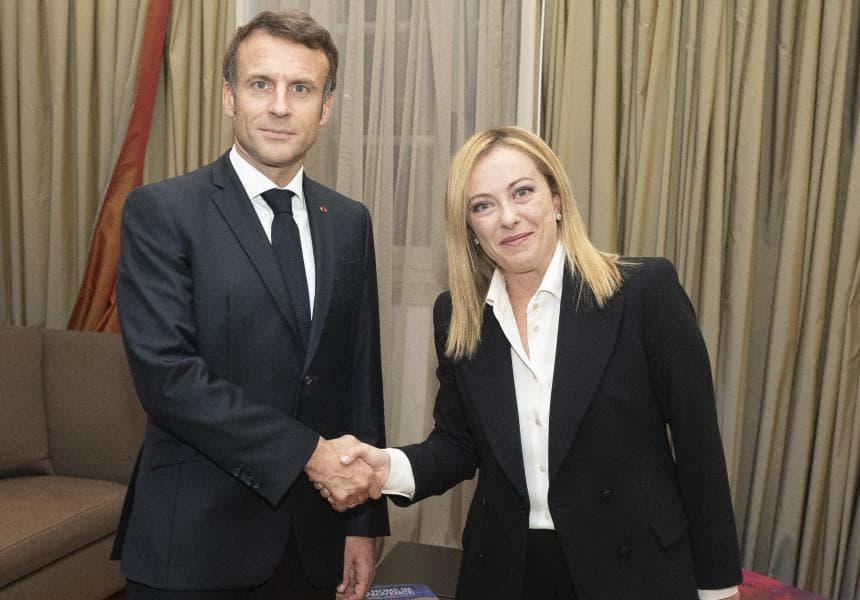
The Antibes meeting between [Emmanuel Macron (opens in a new tab)](/people/emmanuel-macron) and [Giorgia Meloni (opens in a new tab)](/people/mig-giorgia-meloni) is easy to describe as a thaw between two leaders whose politics and personalities have often diverged. That framing is too shallow. What matters is the machinery their governments are building underneath the rapprochement — particularly where state cooperation expands enforcement power over migrants, defense procurement and strategic industries.
The Franco-Italian summit brought migration management, industrial competitiveness and European security into the same bilateral framework. The significance is not simply that Paris and Rome agreed more often than they disagreed. It is that political coordination is being converted into administrative structures capable of acting after the summit photographs disappear.
Migration provides the clearest example.
France and Italy agreed to deepen cooperation against irregular migration and human-smuggling networks, including a joint mechanism involving their security authorities. Governments have a legitimate interest in policing borders and prosecuting trafficking organizations. But the accountability question begins where the diplomatic communiqué often ends: what happens to the people subjected to that enforcement?
A joint security mechanism concentrates practical power in agencies that can share information, coordinate operations and affect whether migrants cross borders, are intercepted, detained or returned. Evaluating that policy therefore requires more than counting reduced crossings.
The relevant chain is:
executive agreement → stronger bilateral enforcement capacity → more interceptions and movement controls → consequences for migrants and asylum seekers
A fall in irregular crossings can represent reduced trafficking, successful deterrence, displacement to another route, reduced access to asylum, or several of those things simultaneously. Governments should not be permitted to treat the first number as proof of all the others.
That is where criticism-first analysis differs from either pro-migration or anti-migration rhetoric. The question is not whether states may control borders. It is whether the instruments they create are transparent, reviewable and consistent with legal protections for people seeking asylum.
The industrial side of Antibes involves a different concentration of power.
France and Italy are among the European Union’s largest economies and possess substantial defense, aerospace, energy and manufacturing capacity. Their governments used the summit to coordinate strategic sectors, including defense-industrial cooperation, space, energy and cross-border investment. Those arrangements can create genuine public benefits: resilient supply chains, shared research costs, infrastructure and stronger European production capacity.
They can also channel public resources toward a limited group of politically significant firms.
That creates a second accountability chain:
political coordination → industrial agreements and procurement priorities → public money and regulatory advantages → private-sector winners and long-term strategic dependencies
The proper test is therefore not whether Macron and Meloni describe cooperation as good for European competitiveness. It is which projects receive state backing, how contracts are awarded, how risks are divided between taxpayers and companies, and whether promised public benefits can later be measured.
Security cooperation adds a third layer. France and Italy have overlapping interests in European defense, Ukraine, Mediterranean stability and the future security architecture around Lebanon. Strategic alignment between major EU governments can reduce fragmentation. It can also move consequential choices — defense spending, weapons development and external security commitments — into executive negotiations that receive less public scrutiny than their fiscal and military consequences warrant.
Antibes matters because it converts a political relationship into infrastructure.
Macron and Meloni do not need ideological agreement on every question to exercise power together. They need compatible interests and institutions able to implement them. That is exactly what the summit sought to strengthen.
The accountability benchmark should therefore be concrete: publish the operating rules of joint migration enforcement; track whether asylum safeguards survive implementation; disclose how strategic-industry support is allocated; and subject defense commitments to normal democratic oversight.
A warmer Franco-Italian relationship is not itself a public good. Its value depends on what the two governments use it to do — and who bears the costs when cooperation becomes coercive.
Evidence
The sources this article cites, claim-bearing material first.
The one cited source is a general profile page; it identifies the subject but does not document the specific claims in this article.
- www.elysee.fr · official profile
More analysis
Ranked by shared facts, drivers and people — never by publication date alone.
Articles12
- Military Aid to Ukraine: How the Support Coalition Took ShapeAlso covers Emmanuel Macron · 3 August 2026
- Sanctions against Russia: What They Changed and Where Their Limits Became ClearAlso covers Emmanuel Macron · 3 August 2026
- Russia's Full-Scale War against Ukraine: How It Changed the European Security OrderAlso covers Emmanuel Macron · 3 August 2026
- Emmanuel Macron’s School Crisis Is Now 400–500 Closed Lycées DeepAlso covers Emmanuel Macron · 5 October 2026