Trump's Federal Building Sales Have a Data Blind Spot: 20.2 Million Vacant Square Feet Missing From Congress's Occupancy Picture
By the Factrail desk · Method: how we source and score · Last reviewed
TL;DR
SEO title: Trump, GSA and the 20.2 Million Square Feet Missing From Federal Office Data. A new congressional audit finds that Washington's first national office-use report omitted GSA-controlled vacancy.
Key graph impact
The article explains graph entities; the causal edges belong to the facts and drivers it links to.
- ArticleTrump's Federal Building Sales Have a Data Blind Spot: 20.2 Million Vacant Square Feet Missing From Congress's Occupancy Picture
- mentionsDriverFiscal-Policy Sustainability
Article
Factrail investigation | United States | Documentary trigger: 16 October 2026 | Researched: 2 November 2026
SEO title: Trump, GSA and the 20.2 Million Square Feet Missing From Federal Office Data
Dek: A new congressional audit finds that Washington's first national office-use report omitted GSA-controlled vacancy. A $24.3 million sale shows who can acquire federal assets—but does not prove a rigged price or that the missing figures caused the transaction.
The finding: a measurable blind spot, not a proven illicit sale
President Donald Trump's administration is selling and consolidating federal office property on the premise that taxpayers should not maintain buildings the government does not need. That is a defensible objective. But the first congressionally mandated national occupancy picture, published in March 2026, left out 20,243,856 usable square feet of GSA-controlled vacant space identified in July data later obtained by the Government Accountability Office (GAO). The omitted inventory includes 155 fully vacant buildings or leased locations and vacant areas within another 724 partly occupied locations. A building can therefore look more efficiently used in the published measure than it would if the unassigned space were counted. GAO's October 16 audit (opens in a new tab) does not say the administration hid assets illegally, nor does it say a particular sale was undervalued. It establishes that Congress and the public lacked a complete comparative picture while officials were making consequential property decisions. Separately, a March sale transferred a 940,000-square-foot Washington property to a named private developer. The test is whether disposal decisions can be checked against complete, building-level data and actual net savings, not whether a sale headline sounds efficient.
What is new in the document comparison
Factrail compared three different records that are too easily treated as one: the GSA's March 31 national occupancy release (opens in a new tab), the October GAO review (opens in a new tab) of what that release excluded, and the March 25 GSA announcement (opens in a new tab) of an actual federal property sale. The first is an administrative scorecard, the second is an audit of its boundaries and methods, and the third is an executed asset decision. Their coexistence exposes a governance problem: policymakers can be right that empty buildings are costly while still lacking an adequately disclosed inventory for comparing which buildings to keep, consolidate, lease, renovate or sell.
The distinction matters for both critics and supporters of Trump. The audit did not conclude that GSA's omission caused the sale to Dalian Development or that Dalian received preferential treatment. The property had been vacant since March 2025, and GSA says the sale was competitive. Nor is the 20.2 million figure a count of secretly occupied buildings. It is vacant usable floor area, including empty portions of otherwise occupied properties, recorded in a later July 2026 GSA dataset. A national total of square footage is not itself a list of assets that should be sold.
The documentary timeline: law, data, transaction, audit
The legal framework predates the current administration. Congress enacted the Utilizing Space Efficiently and Improving Technologies (USE IT) Act in January 2025 as part of the 2024 water-resources legislation. It established a 60% utilization benchmark and directed 24 Chief Financial Officers Act agencies to measure use of specified owned and leased office spaces. GSA was assigned a coordinating and reporting role, in consultation with the Office of Management and Budget (OMB). Under the statutory sequence described by GAO, after the 2027 report, GSA and OMB must address spaces below the threshold for two consecutive years. A single low first-year number is not an automatic statutory command to sell an entire building. GAO, October 2026 (opens in a new tab).
In 2025, Trump publicly made reducing the federal footprint and requiring in-person federal work part of his governing program. The White House's March 4 statement (opens in a new tab) framed shrinking bureaucracy and returning staff to offices as fiscal and managerial priorities. The two objectives are not mathematically equivalent: bringing more employees to a workplace may increase attendance, while staff reductions, agency consolidation or a change in mission can decrease the space needed. The operative question is what a building costs relative to actual work performed and credible alternatives.
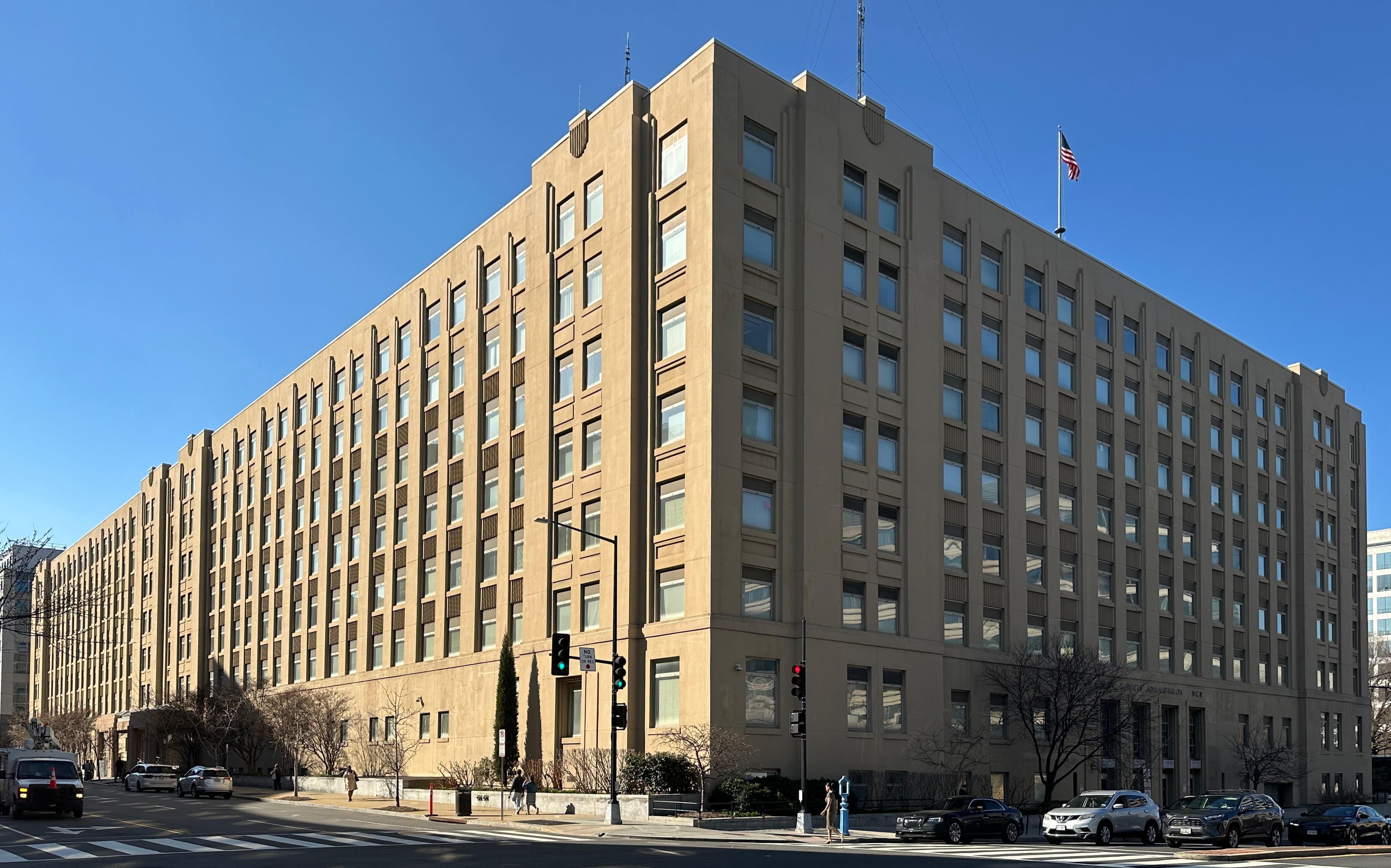
On March 25, 2026, GSA announced completion of a competitive public sale of its Regional Office Building at 301 Seventh Street SW, Washington, D.C. It described a 940,000-square-foot facility on more than 3.4 acres, vacant since March 2025, and named Dalian Development as the private buyer. GSA Administrator Edward C. Forst expressly tied the transaction to Trump's smaller-property-portfolio agenda. The agency projected avoidance of more than $200 million in delinquent maintenance and $5.5 million in annual operations and maintenance. These are GSA's estimates of avoided future liabilities and running costs, not evidence that $205.5 million was deposited into the Treasury. GSA sale announcement (opens in a new tab).
Independent property reporting supplies a missing price denominator. Bisnow's March 27 report (opens in a new tab), citing D.C. deed records, states a $24.3 million purchase price. Wall Street Journal's local reporting (opens in a new tab) identifies a Delaware affiliate, Lakeville Ventures LLC, as the reported contractual buyer associated with Dalian. The public GSA release emphasizes the buyer's development plans and cost avoidance but does not itself give the sale price. That difference in disclosure is a reason to reconcile the deed, bid history, valuation and federal asset book value before reaching a verdict on taxpayer value.
On March 26, GSA announced a separate headquarters reshuffle: Energy would move out of the Forrestal building into the Lyndon B. Johnson building, while Education would move headquarters functions to 500 D Street SW. The administration said Energy's move could avoid more than $350 million in deferred maintenance and Education's could save more than $4.8 million per year in rent. The Education move was targeted for August 2026, a plan rather than proof of completed occupancy at the time of the announcement. GSA relocation release (opens in a new tab).
On March 31, GSA published the first USE IT Act office-utilization results. Its official release (opens in a new tab) recognized that the snapshot was imperfect and said it would support co-location, consolidation and disposal. Then, on October 16, GAO released its audit of how agencies collected and GSA presented the data. That report is the new documentary trigger: it identifies what the first snapshot did not reveal and what a more complete congressional comparison requires. GAO-27-108503 (opens in a new tab).
The 20.2 million-square-foot denominator
The most consequential GAO table is not a political quote but Table 2. GSA's July 2026 inventory showed 15,045,226 usable square feet of vacant space in federally owned buildings and 5,198,630 in leased spaces, a combined 20,243,856. Of that, 4,627,682 square feet were in 155 fully vacant locations—78 owned and 77 leased. Another 15,616,173 square feet were vacant portions of 724 partially occupied locations—500 owned and 224 leased. These figures are space areas, not prices, rents or necessarily immediately marketable assets. GAO Table 2 (opens in a new tab).
The audit also describes a more subtle distortion. In March's reported universe, 72 partially vacant GSA-controlled spaces met or exceeded the 60% threshold but could fall below it when vacant areas were incorporated. In a California federal building, GAO illustrates a possible drop from 68% to 57% after counting 33,482 vacant square feet. A Michigan lease could fall from 78% to 58% after including 5,737 vacant square feet. These are GAO's building-level illustrations using July vacancy data, not a recalculated national occupancy rate. They show why a denominator can change a policy decision even when the headcount numerator is unchanged.
There is an important boundary to the criticism. GSA told auditors the law and OMB guidance centered on occupied spaces with active occupancy agreements, and not all vacant floor area necessarily meets the definition of typical office space. GAO agreed that different classifications matter. Its objection was that the act and guidance did not prevent GSA from presenting vacancy as additional context, clearly separated from tenant-occupied utilization. The audit also noted that a separate GSA vacancy dataset existed. The strongest criticism is therefore not that every omitted square foot legally had to appear inside the same percentage; it is that the public-facing report did not clearly connect the two inventories.
Who can decide, who can stop, who must account
The decision map has several layers. Congress created the reporting rule and the two-year trigger; it can demand disclosure, change the statutory standard or investigate a transaction. Trump set the administration's general downsizing and in-person-work priorities; his public directive does not establish that he personally selected Dalian or appraised the Seventh Street building. GSA, led by Forst, manages the federal property portfolio, coordinates USE IT Act reporting and implements disposals subject to applicable federal requirements. OMB shares responsibility for reporting guidance and subsequent utilization responses. Tenant agencies control mission-specific staffing and space requirements and supply much of the attendance information. A purchaser such as Dalian Development, led by CEO Hossein Fateh, can negotiate and bid for a property but does not determine statutory reporting requirements.
The veto points are consequently distinct. A property can be administratively proposed for accelerated disposal, yet face legal, historic-preservation, tenant, procurement, valuation or financing constraints before transfer. A relocation announcement is not a deed. A low occupancy rate is not itself a competitive bid. Congress can assess the portfolio and appropriations but the audit does not identify a vote authorizing this specific purchaser. In the Washington Post's March 27 reporting (opens in a new tab), the administration's initial 2025 list of 443 potential disposals was rapidly narrowed and withdrawn after objections about consultation; subsequent plans were described as more measured. That history undermines any claim that presidential preference alone settles which assets can be disposed of.
The law also gives GSA no simple excuse to wait. GAO made four concrete recommendations: show GSA-controlled vacancy and building-wide utilization alongside tenant occupancy; disclose that the public dataset excludes spaces at or above 60% or publish them too; evaluate how definitions of office space and non-working days affect rates; and coordinate with agencies to correct inconsistent and incomplete submissions. GSA did not agree or disagree with the recommendations but said it would consider them with OMB. That is neither acceptance of all proposed changes nor proof of defiance. GAO recommendations and agency response (opens in a new tab).
Who benefits financially: one actual buyer and several different mechanisms
The Seventh Street sale has a specific private beneficiary: Dalian Development and its acquisition affiliate, which obtained control of a large former federal office asset. The reported deed price is approximately $24.3 million, or about $25.85 per 940,000 gross square feet if those two figures are divided. That simple quotient is not a defensible fair-market valuation: it ignores condition, land value, conversion costs, zoning, financing, environmental liabilities and the difference between gross and usable area. Bisnow's deed-based report (opens in a new tab) and GSA's property description (opens in a new tab) provide the inputs; the arithmetic is Factrail's. The transaction transfers redevelopment opportunity and risk to a private owner, not an automatic profit of the difference between some speculative valuation and the price.
Fateh's statement published by GSA (opens in a new tab) presented a mixed-use redevelopment vision and recognized substantial time and capital would be required. WTOP (opens in a new tab) reported the proposed residential and other uses. Potential beneficiaries beyond the buyer include future tenants, construction firms and Washington's tax base if redevelopment succeeds; none is a verified realized benefit as of this research. The public may benefit from lower federal maintenance obligations and a sale receipt. It may also lose the option to reuse a centrally located federal asset later. Quantifying that option cost requires an appraisal and credible alternatives, not merely invoking the property's size.
The financial claims must remain separate. $24.3 million is the reported transaction price. More than $200 million is GSA's estimate of avoided deferred maintenance, not a contractor payment, realized saving or asset market price. $5.5 million per year is GSA's stated avoided annual operating cost, conditional on the relevant counterfactual. None should be added into a single realized 'profit' without a timeline, cost baseline, net proceeds, sale expenses, lease-back obligations and avoided work that government would actually have funded. GSA's broader $5 billion portfolio saving estimate is also prospective, not a verified cash receipt. GSA announcement (opens in a new tab).
A real savings case exists, but the numbers need different labels
The October audit contains positive evidence for consolidation. Of 23 surveyed agencies, 13 expected millions in property-management savings. The Small Business Administration said data helped it reduce 25 spaces and expected roughly $885,000 annual savings. GSA reported surrendering 40,000 square feet in one Kansas City lease and anticipated $3.7 million annually from seven further consolidation or disposal opportunities. Energy described seven terminated leases totaling 37,000 square feet and estimated $1.6 million annually. Veterans Affairs reported a lease reduction of almost 150,000 square feet expected to save $9.7 million annually. These are agency-reported actual actions mixed with expected future savings, not a GAO-certified aggregate realized cash total. GAO agency examples (opens in a new tab).
DHS reported at least 15 space-reduction projects that could remove 95,000 square feet, with $350 million of estimated savings over 20 years. That 20-year figure cannot be compared as if it were a one-year saving against GSA's annual $5.5 million projection. A 20-year estimate also depends on lease terms, discount rates and whether the planned projects finish. These distinctions are precisely why an independently reviewable building-level record matters.
Another GAO report released July 15 (opens in a new tab) found 168 of 189 Transportation Department office buildings under the 60% utilization benchmark in a 2025 sample, with $370 million in annual rental, operations and maintenance costs associated with the underutilized locations. It warned that a planned FAA headquarters consolidation lacked definitive arrangements for 950 personnel and detailed savings estimates. The conclusion is not that all $370 million is recoverable. It is that a genuine excess-space problem can coexist with a serious execution and accounting problem.
The strongest counter-case: incomplete metrics do not make a bad sale
The administration's best argument is substantial. An empty federal office building can impose operating costs while delivering no current agency service. Leaving it idle may consume appropriations and defer redevelopment. A competitive public sale transfers renovation risks to a private investor, and a conversion may add housing and tax revenue. The Seventh Street property had no tenant after March 2025; GSA's published sale process and Dalian's redevelopment proposal are real documentary facts. The first national USE IT Act reporting was new and GSA recognized imperfections rather than asserting the figures were flawless. GSA March data release (opens in a new tab); GSA sale release (opens in a new tab).
GSA's technical defence also has merit: occupancy agreements are an administratively identifiable reporting universe, and treating a closed, unused or unconfigured floor as equivalent to a normal staffed office can mislead. GAO did not demand that every space automatically be forced into the same rate. It recommended additional presentation and disclosure. Some agencies told auditors the standard includes cafeterias or non-working days in ways that can depress apparent utilization; GSA proposed methodological adjustments to OMB in July 2026. The audit said GSA had not documented an evaluation of how those proposed changes would affect reported rates as of October. A sound comparison needs consistent definitions rather than whichever formula supports a preferred sale.
The rival explanation for the $24.3 million price is market economics, not a favour. A large, obsolete building may require expensive reconstruction before residential conversion; a depressed office market can produce low price-per-square-foot figures. The available sources do not supply the independent appraisal, number and value of qualifying bids, renovation budget or developer's financing structure necessary to test whether the government sold below defensible market value. There is no evidence here that Trump, Forst, Ernst or any other official received a payment or secretly steered this property to Dalian.
The incomplete reporting problem goes beyond one landlord
GAO's evidence points to uneven collection within agencies, not only presentation by GSA. The Department of the Interior recognized that as of April 2026 it was reporting employees assigned to spaces rather than employees actually present, because of limitations in badge and timecard data. By July, it had begun collecting headquarters badge swipes, while broader coverage remained in progress. DHS said it was not collecting and reporting occupancy for nearly 700 spaces subject to the law because many lacked sufficient badging technology; it was exploring Wi-Fi and interim methods. These are not estimates of 700 empty offices. They are identified gaps in measuring attendance. GAO's agency interviews (opens in a new tab).
The audit surveyed 23 of the 24 CFO Act agencies; USAID did not complete the survey, citing work on reducing its footprint and terminating awards. The agencies collectively reported approximately $16 million in 2025 data-collection and reporting costs. That expenditure cannot be equated with the cost of the entire federal portfolio, nor does it prove that the data were worthless. It establishes a measurable administrative investment whose value depends on whether the resulting information is sufficiently comparable for decisions.
The public dataset also omitted individual locations meeting or exceeding 60%, even though GSA said about 22% of spaces with active occupancy agreements were at or above the benchmark. A list showing only the failing properties is useful for identifying candidates but not for independently testing how the whole portfolio performs. GSA argued it had clarified the reporting universe elsewhere; GAO maintained the actual dataset page needed clearer language. This disagreement is not semantic when politicians cite a national 'snapshot' as proof of efficiency.
What it moves: fiscal claims, asset prices, public-service capacity
The first measurable indicator is federal usable square footage, separated into occupied tenant space, GSA-controlled vacant owned space and vacant leased space, by building and reporting date. The second is average daily utilization under a consistent capacity definition, including a disclosed sensitivity test with and without vacant areas. The third is net property cost: annual rent, operations, maintenance, sale proceeds, transaction expenses, relocation costs and any continuing lease obligations. The fourth is service capacity, including whether a consolidated agency can house staff and provide accessible public services after a move. The fifth is private transaction outcomes: appraised values, bid competition, completed redevelopment, and changes in local tax receipts.
Directionally, adding previously omitted vacant floor area would reduce the calculated utilization of some partially occupied properties; GAO demonstrated cases crossing the 60% line. Better disclosure could increase the number of assets considered for consolidation, but cannot establish that every such building should be sold. A successful disposition can lower future maintenance outlays, while an imprudent one can impose relocation or repurchase costs. None of those outcomes can be scored from a single portfolio percentage.
What would change the conclusion
A defensible follow-up would obtain the complete March 2026 and July 2026 building-level occupancy and vacancy inventories, including occupancy-agreement IDs and a reproducible mapping between the two. It would obtain the Seventh Street appraisal, solicitation, bid tabulation, executed deed and closing statement, with any legally required redactions. It would reconcile GSA's $200 million maintenance and $5.5 million annual operating estimates to project-specific budgets and actual expenditures, and track Dalian's permits and conversion spending. It would check the 2027 USE IT Act report for the two-consecutive-year trigger, GSA/OMB responses to GAO's four recommendations, and whether Interior and DHS fixed their data gaps.
Until those records are available, the evidence supports a narrower but important finding: the administration is transferring and consolidating public assets while Congress's first national utilization report lacked more than 20 million square feet of contextual vacancy and some agency attendance data were incomplete. The omission makes oversight weaker. It does not, without further evidence, establish corruption, an unlawful sale, an undervalued asset or a private political kickback.
Source trail and verification limits
Primary sources: GAO-27-108503, October 15/16, 2026 (opens in a new tab); GSA USE IT release, March 31, 2026 (opens in a new tab); GSA sale release, March 25, 2026 (opens in a new tab); GSA relocation announcement, March 26, 2026 (opens in a new tab); GAO-26-108089 on DOT, July 15, 2026 (opens in a new tab); White House's March 2025 policy statement (opens in a new tab). Independent reporting: Bisnow's deed-based transaction report, March 27 (opens in a new tab); Wall Street Journal's federal-property sale report, March 2026 (opens in a new tab); Washington Post's federal-sale process reporting, March 27 (opens in a new tab); Traded's transaction summary, March 31 (opens in a new tab). Independent reporting and government releases sometimes repeat the same GSA claims; these are not ten independent confirmations of the savings estimates. No direct right-of-reply request, independent appraisal inspection, deed-file download, internal Factrail canonical-link verification, image licence clearance or legal approval has been performed. This is an original documentary comparison prepared for independent editorial QA, not a finding of individual wrongdoing.
Related Factrail context
The federal property disposal strategy also belongs in the broader fiscal sustainability discussion (opens in a new tab). Readers can compare the executive decision-making responsibilities of President Donald Trump with the fiscal policy oversight responsibilities of Treasury Secretary Scott Bessent (opens in a new tab). These links provide analytical context; they do not establish direct involvement by either official in an individual property sale.
Sources retained from the live page
Evidence
The sources this article cites, claim-bearing material first.
- files.gao.gov · files.gao.gov/reports/GAO-27-108503/index.html
- gsa.gov · gsa.gov/about-gsa/newsroom/news-releases/gsa-releases-use-it-act-data-03312026
- gsa.gov · gsa.gov/about-gsa/newsroom/news-releases/gsa-sells-its-underutilized-federal-property-in-washington-dc-03252026
- whitehouse.gov · whitehouse.gov/releases/2025/03/president-trump-is-making-government-work-for-you-again
- gsa.gov · gsa.gov/about-gsa/newsroom/news-releases/gsa-doe-ed-unveil-major-federal-headquarters-relocations-03262026
- files.gao.gov · files.gao.gov/reports/GAO-26-108089/index.html
More analysis
Ranked by shared facts, drivers and people — never by publication date alone.
Articles12
- GSA Claims $1.68bn in OneGov Savings. It Rejected Auditors' Call for Cloud-Cost Reporting.Shares the driver: Fiscal-Policy Sustainability · 1 November 2026
- Trump Made Opportunity Zones Permanent. Governors Pick the Winners Before Washington Can Measure the Results.Shares the driver: Fiscal-Policy Sustainability · 1 November 2026
- Congress Funded $1.625bn to Counter China's Influence. Washington Still Cannot Show What Worked.Shares the driver: Fiscal-Policy Sustainability · 1 November 2026
- Treasury Protected $289 Million for Community Lenders. Court Records Show the Money Still Had to Move.Shares the driver: Fiscal-Policy Sustainability · 1 November 2026