
Fatmir Besimi
Fatmir Besimi is an ethnic Albanian economist and politician in North Macedonia and a member of the Democratic Union for Integration.
- Facts0
- Drivers0
- Indicators0
Fatmir Besimi is an ethnic Albanian economist and politician in North Macedonia and a member of the Democratic Union for Integration.
Fatmir Besimi is an ethnic Albanian economist and politician in North Macedonia and a member of the Democratic Union for Integration. He served as minister of economy in 2004–2006 and again in 2008–2011, as minister of defence from 2011 to 2013, sitting on the National Security Council, and as deputy prime minister for European affairs from 2013 to 2016. The Ministry of Finance records that he held the finance portfolio from September 2020 until 24 June 2024, when Gordana Dimitrieska-Kochoska succeeded him after parliament voted in the government of Hristijan Mickoski.
He studied at the Faculty of Economics of Ss. Cyril and Methodius University of Skopje from September 1994 to November 1998, specializing in banking and finance, and undertook doctoral study at Staffordshire University in Stoke-on-Trent from 2001 to 2007. The British Library’s EThOS catalogue records that Staffordshire awarded him a PhD in 2009 for the thesis “Monetary and exchange rate policy in the Republic of Macedonia during the process of accession to the European Union.” South East European University in Tetovo lists him as a full professor of economics. In 2010 the World Economic Forum included him among its Young Global Leaders.
His university curriculum vitae places him as a researcher at the National Bank of the Republic of Macedonia from 2001 to 2002, as the bank’s vice-governor from 2003 to 2004, and as an economist at the World Bank office in Pristina from November 2007 to July 2008. As deputy prime minister he met Enlargement Commissioner Štefan Füle in Brussels on 22 January 2014, with Foreign Minister Nikola Poposki, to discuss the High Level Accession Dialogue, media freedom, judicial independence, electoral legislation and relations with neighbouring states. Parliament had approved a Social Democratic–Democratic Union for Integration cabinet under Zoran Zaev on 30 August 2020, by 62 votes to 51, with recovery from the coronavirus pandemic among the priorities Zaev set out; the finance ministry dates Besimi’s tenure from the following month.
In August 2012, while defence minister, Besimi laid flowers and bowed at a monument in Slupčane, near Kumanovo, to members of the National Liberation Army killed in the 2001 conflict, during events marking eleven years since the Ohrid Framework Agreement. President Gjorge Ivanov said institutional procedures had not been followed and warned institutions not to misuse the army for party purposes; the government and the ruling VMRO-DPMNE said Besimi had acted alone, while he called the gesture an act of reconciliation implied by the agreement. After the 2024 handover he has remained on the South East European University faculty and is presented as president of Strategers, a Skopje firm occupied with consulting, policy research and executive education.
Fatmir Besimi was born in 1975 in Tetovo, in the Socialist Republic of Macedonia, now North Macedonia. On 16 December 2004, during the Assembly of North Macedonia’s debate on a new government, the member Žarko Karadžoski read from a biography of Besimi, then nominated as minister of economy. He described him as relatively young, born in 1975 in Tetovo, a graduate of the Faculty of Economics in Skopje, and a speaker of English, German, Serbian and some Croatian, and said that he was not reading the biography to the end. A biographical directory gives the date as 18 November 1975. That day is not in the parliamentary reading or on his university curriculum vitae.
He is an ethnic Albanian. In August 2020 the Albanian-language outlet Portalb described him as the second ethnic Albanian proposed to lead the finance ministry. His profile at South East European University in Tetovo lists Albanian as his native language and, by self-evaluation, Macedonian at C2, English at C1, Croatian at B2 and German at A1. The Ilindenska address on that profile is a contact address in Tetovo. Neither the CV nor the biography read in parliament names a primary or secondary school.
From September 1994 to November 1998 Besimi studied at the Faculty of Economics of Ss. Cyril and Methodius University of Skopje. The university CV records the qualification as “Economist,” with the specialty Economics, Banking and Finance. The December 2004 parliamentary reading likewise said that he had graduated from the Faculty of Economics in Skopje. The CV does not record a scholarship, or any other funding, for that degree.
The CV dates a PhD in economics at the Faculty of Business and Law of Staffordshire University in Stoke-on-Trent from January 2001 to September 2007. The thesis title it gives is “Monetary and Exchange Rate Policy in the Republic of Macedonia during the Process of Accession to the European Union.” The British Library EThOS catalogue records the same work, under the author name Fatmir I. Besimi, as a PhD awarded in 2009 by Staffordshire University, with the keyword “economic policy” and Dewey class 337. The catalogue does not say when the thesis was submitted or examined, so the 2009 award stands two years after the end of the study period on the CV without a recorded reason.
The doctorate overlapped work at the National Bank of the Republic of Macedonia. The CV lists him as a researcher from May 2001 to October 2002 and as vice-governor from August 2003 to November 2004. In February 2005 the Hungarian site Origo, citing Staffordshire University, reported that the 29-year-old Besimi was writing the dissertation in England and that, still a student, he had been deputy governor of the central bank for a year and a half. The report called the office parliament had approved the finance ministry; the December 2004 debate was on the economy ministry.
In 2006 Besimi, Geoff T. Pugh and Nick J. Adnett issued a Staffordshire working paper on Macedonia’s monetary transmission, covering the denar–euro exchange rate, interest rates, the money supply and currency substitution. Its abstract reports stronger effects on domestic prices from the exchange rate and the money supply than from interest rates, and a damping role for currency substitution after a devaluation. In 2009 he published Monetary and Exchange Rate Policy of Macedonia: Accession to the European Union; a London School of Economics profile lists that book among his works. Neither the university CV nor the EThOS record names a scholarship or other external funder for the doctorate.
Besimi’s teaching record is set out on the staff pages of South East European University (SEEU) in Tetovo. The profile heading lists him as a full professor, full time, in the Faculty of Business and Economics. The work history on the same page has not been revised to that rank: it still records an associate professorship from September 2019, an adjunct associate professorship from September 2016 to June 2019, and an assistant professorship from November 2009 to September 2012. For those SEEU posts the profile says he taught bachelor’s, MBA and doctoral courses in advanced economics, money and banking, monetary economics, finance, international finance and economics.
The same chronology lists a lectureship at the University of Tetovo from September 1998 to September 2006, and an assistant professorship from November 2010 to September 2012 at the State University of Tetova, which the profile names as the State University of Tetovo. From December 2007 to June 2008 it lists him as a lecturer at Riinvest University in Pristina, Kosovo. The Tetovo and SEEU dates overlap years in which the same curriculum vitae records him as a government minister.
His doctoral thesis, Monetary and exchange rate policy in the Republic of Macedonia during the process of accession to the European Union, was awarded by Staffordshire University in 2009 and is catalogued by the British Library’s EThOS service. A trade edition, Monetary and Exchange Rate Policy in Macedonia: Accession to the European Union, was published in 2009 by LAP Lambert Academic Publishing (ISBN 978-3-8383-1614-7). With Geoff Pugh and Nick Adnett he wrote “The Monetary Transmission Mechanism in Macedonia: Implications for Monetary Policy,” a 2006 working paper later posted on SSRN, on how monetary policy is transmitted in Macedonia.
On enlargement, “European enlargement challenges, Western Balkans and the way forward” appeared in 2016 in the Journal of Contemporary Economic and Business Issues, issued by the Faculty of Economics at Ss. The article discusses security, political and economic pressures on the pace of enlargement and compares convergence of Western Balkan economies with the European Union. His LSE visiting-fellow biography also lists a 2015 book, My Notes: Integration beyond Rhetoric. A profile on his consulting site adds a 2024 book, Economy and Integration in Times of Polycrisis; that title is not in the publications section of the SEEU profile.
Later work, much of it co-authored with SEEU colleagues, returned to growth, public spending and accession. With Arlinda Idrizi and Blerta Abazi Çaushi, “The Impact of Political Instability on North Macedonia’s Growth” (SEEU Review, 2025) uses a vector autoregression for 2003–2023 and reports that instability redirects public expenditure from infrastructure and education toward crisis management and defence. With Ardiana Aliti and Abazi Caushi he contributed “Education Expenditure and Economic Growth—A Data-Driven Analysis” to the 2025 Springer volume Economic Resilience and Sustainability. A sole-authored chapter the same year, “The Path of North Macedonia to the European Union Is the Only Way Forward,” appeared in Western Balkans and the Future of Europe. A 2025 ERAZ conference paper with Idrizi and Abazi Chaushi reviews stock-market reactions to corporate climate-strategy disclosures.
LSEE—Research on South Eastern Europe, at the London School of Economics, lists Besimi as a visiting senior fellow from September 2016 to September 2017. Its biography says the research concerned the political economy of European integration in the Western Balkans. Some later profiles date the stay to 2017–2018. The LSE people page, the SEEU curriculum vitae, and the acknowledgements of the discussion paper that came out of the visit all give 2016–2017.
On 24 January 2017 he gave an LSEE research seminar, listed as “The Role of EU Integration in Accelerating Credible Structural Reforms in the Western Balkans”; the slides are titled with “Enhancing” rather than “Accelerating.” A July 2017 post on LSE’s EUROPP blog argued that convergence of the six Western Balkan states with the EU was a long-term process, that structural reforms supported it, and that EU membership strengthened it. With Vassilis Monastiriotis he developed that work into LSE “Europe in Question” Discussion Paper No. 140 (January 2019). The paper reports a positive association between EU-related structural reforms and growth, models governments as weighing accession against domestic policy stability, and describes an EU choice between pushing reform effort and limiting non-compliance. The acknowledgements state that the project began during the 2016–2017 fellowship.
Fatmir Besimi's curriculum vitae at South East European University dates a research post at the National Bank of the Republic of Macedonia—the country's central bank, since renamed for North Macedonia—from May 2001 to October 2002. Through those years the bank's strategy, in place since 1995, was exchange-rate targeting, with the denar anchored first to the German mark and then to the euro.
A biography on the site of Strategers, the firm he heads, instead describes commercial and central banking in 1999–2001 and a vice-governorship in 2002–2004. The bank's Economic Research series lists him as author of a 2003 paper on exchange-rate variability and trade and as co-author of a 2003 paper on the exchange-rate transmission channel.
On 25 July 2003 the Assembly appointed him a vice-governor, on a nomination deputies said had come from the head of state, in the same sitting as Vancho Kargov and Emilija Nacevska. Of 70 deputies voting, 66 were in favour, two against and two abstained. The university CV dates the post August 2003–November 2004, which fits that vote and not the 2002 start on the Strategers page. He was still deputy governor in February 2004, when the Bank of Albania reported a meeting with Governor Shkëlqim Cani on cross-border supervision, statistics and capital-account liberalisation. On 17 December 2004 the Assembly confirmed Vlado Bučkovski's government, and Deutsche Welle listed Besimi, then 29, as minister of economy.
Between those bank posts, the university CV lists him as chief executive director of the Public Enterprise for Airport Services in Skopje from November 2002 to August 2003. The enterprise, JPAU, then ran the international airports at Skopje and Ohrid. An Institute for War and Peace Reporting article dated 6 September 2005 quotes him as the new director, and as a member of the Democratic Union for Integration, blaming the previous management's "irresponsible policies" for losses an audit put at about €2 million, with debts of about €6 million and staff up from 470 in 1997 to 873. It says Ernad Fejzulahu ran JPAU until November 2002; he denied misconduct and tied the losses and hiring to the 2001 conflict and the Ohrid Framework Agreement. The 2005 dateline sits awkwardly against the July 2003 appointment and the CV's August 2003 end date, because the article treats Besimi as the director then in office.
The CV next places him at the World Bank office in Pristina, Kosovo, as an economist from November 2007 to July 2008, and runs a term as minister of economy from December 2004 to July 2008 that would overlap that job and a second economy term dated from August 2008. A World Bank quarterly for April–June 2007 already lists him, at fbesimi@worldbank.org, as a contact at the Kosovo office for a poverty briefing the Bank planned to publish in October 2007; it reported that 45 percent of the population was below the poverty line in 2005/06. The European Leadership Network biography and the Strategers profile instead give economy mandates of 2004–2006 and 2008–2011, with the World Bank job in 2007–2008 between them. Reporting fits a break rather than one continuous term: Deutsche Welle records the December 2004 appointment, and on 14 January 2008 Balkan Insight identified Vera Rafajlovska, not Besimi, as the economy minister who resigned.
Parliament in Skopje confirmed Vlado Bučkovski’s coalition government on 17 December 2004. Besimi, then 29, became minister of economy of the Republic of Macedonia (now North Macedonia), the youngest member of a cabinet whose average age was 44. The government paired the Social Democratic Union of Macedonia with the Democratic Union for Integration. It left office when parliament confirmed Nikola Gruevski’s VMRO-DPMNE-led cabinet on 26 August 2006, by 68 votes to 22. Gruevski’s party bodies had already accepted a list nominating Vera Rafajlovska of the New Social Democratic Party, not Besimi, for economy. A curriculum vitae running one economy term from December 2004 to July 2008 therefore includes time when he was out of the cabinet.
On 16 March 2006 Bučkovski announced that Austria’s EVN had won the tender for the state electricity company ESM, offering €225 million for 90 percent plus €96 million of investment over three years. ESM then had about 721,000 customers, annual sales of 4.4 terawatt-hours and 11 small hydropower plants; ČEZ and Enel had also bid. Transmission and a market operator were already separate, while splitting generation from distribution was still planned. On 27 February 2006 Radio Free Europe reported that Macedonia had become a full member of the Central European Free Trade Agreement, nearly two years after applying, with Romania, Bulgaria and Croatia the other participants then in view. Ministry official Krum Efremov called it further liberalization and a step toward the European Union; the economic chamber was divided over the effect on exporters.
The World Bank approved the Business Environment Reform and Institutional Strengthening loan, €8.8 million later cut to €6.4 million, on 21 June 2005. It took effect on 22 November 2005, with the Ministry of Economy as implementing agency, to support regulatory-impact assessment, a “regulatory guillotine” review of rules, metrology and standards, and competition policy. The 2011 completion report rated the outcome moderately satisfactory and noted a Doing Business rise from 96th in 2007 to 38th in 2010, but also found that changes of government and agency leadership made the first three years uneven: under 13 percent of the loan was disbursed at the start of 2010. Besimi was minister at approval and again near the 31 December 2010 closing, not through the middle of the project.
After the 1 June 2008 election, parliament backed a new Gruevski government, now with DUI, by the 78 deputies present on 26 July. Reporting at the time listed Besimi as economy minister among DUI’s portfolios; 28 July was the first working day for more than half the cabinet. On 13 July 2011 Deutsche Welle, citing DUI sources, reported that he would leave economy for defence after the 5 June 2011 election, and parliament approved that government later in July.
On 26 January 2009 he headed Macedonia’s delegation to the founding conference of the International Renewable Energy Agency in Bonn. The conference report names him minister of economy and head of delegation, and lists the country among the states whose full powers to sign the statute were accepted and among the 75 signatories. From 1 January 2010 Macedonia held the Energy Community presidency, which Besimi assumed after the ministerial council in Zagreb. At the council in Skopje on 24 September 2010 he, as president in office, and Ukraine’s fuel and energy minister Yuriy Boyko signed Ukraine’s accession protocol; a European Commission deputy director-general represented the vice-presidency. The council had cleared the accession in December 2009 subject to an EU-aligned gas law, enacted in Ukraine by July 2010. Besimi called the signature a milestone beyond a purely Western Balkans focus.
On 31 March 2009 Besimi met World Trade Organization director-general Pascal Lamy in Geneva. The WTO recorded that they discussed the economic situation and agreed that, in the financial crisis, open markets and a concluded Doha Development Round were the way to resist protectionism.
On 17 December 2009 in Skopje he and Kosovo’s economy minister Ahmet Shala signed a cooperation agreement covering energy, infrastructure, transport, agriculture, construction, tourism and the environment. Besimi called Kosovo a significant partner alongside an existing free-trade arrangement. Balkan Insight cited estimates, not official totals, of about €200 million a year in exports to Kosovo against about €80 million in imports, an unusual surplus led by petroleum products, food and cigarettes.
The business-environment loan was still open. In a letter of 17 May 2011 Besimi, as minister, thanked the World Bank, agreed to publication of the completion report, and enclosed the project unit’s account of regulatory-impact assessment, the regulatory guillotine and company-law changes. The Bank still judged that disbursement picked up only after the 2010 restructuring and rated borrower performance moderately satisfactory.
After early elections on 5 June 2011, the Assembly of the Republic of Macedonia (now North Macedonia) approved, late on 28 July and by 70 votes to 47, a government led by Nikola Gruevski of VMRO-DPMNE in coalition with the Democratic Union for Integration (DUI). Deutsche Welle had reported on 13 July, citing DUI sources, that Fatmir Besimi would leave the economy portfolio for defence. The Ministry of Defence lists him as minister from 29 July 2011 to 18 February 2013, after Zoran Konjanovski (26 July 2008–28 July 2011) and before Talat Xhaferi (18 February 2013–18 June 2014). A December 2023 fact-check by SMK, republished by Racin, said that list shows Besimi, an ethnic Albanian DUI politician, was the first member of the Albanian community to hold the post, and that Xhaferi was not.
As defence minister, Besimi sat by office on the Security Council. Article 86 of the constitution makes the president its head and includes the ministers for security, defence and foreign affairs; the council considers security and defence questions and proposes policy to the Assembly and the government. In September 2012 the ministry, naming Besimi as publisher, issued a White Paper on Defence that tied a new transformation cycle to future membership of NATO and the European Union. It said that by 2015 the army should be more mobile, with 50 percent of its capabilities deployable and interoperable and manning kept near 90 percent, and that shared capabilities would use NATO’s Smart Defence concept “to the maximum extent.” A 2012 programme for equitable ethnic representation recorded military personnel listed as Albanian rising from 12.20 percent in 2005 to 18.72 percent in 2012, and those listed as Macedonian falling from 81.37 percent to 73.67 percent; the paper said the targets were not yet met, especially among officers from non-majority communities.
Besimi left defence in a DUI reshuffle before the March 2013 local elections. He was to become deputy prime minister for European affairs, replacing Teuta Arifi, while DUI legislator Talat Xhaferi took defence. Xhaferi, a former commander in the ethnic Albanian National Liberation Army (NLA) in 2001, took office on 19 February; the veterans’ party Dignity called the appointment humiliating, and Balkan Insight noted that Besimi had been more acceptable to those veterans because he had not fought in the conflict.
The 2001 fighting between government forces and the NLA ended with the Ohrid Framework Agreement, signed in Skopje on 13 August 2001, which rejected violence, affirmed the unitary state, and provided for equitable representation of communities. Around its eleventh anniversary, Besimi, other ethnic Albanian ministers and people in uniform laid flowers and bowed at a monument to NLA fighters in Slupčane, near Kumanovo, a former NLA stronghold. Balkan Insight called this the country’s first institutional expression of respect for NLA fighters killed in the conflict, and noted that such memorials remained highly controversial among the ethnic Macedonian majority.
A ministry spokesperson, Selvet Baruti, called the visit a DUI decision for reconciliation and said Besimi had also honoured defenders killed on the Macedonian side. President Gjorge Ivanov said institutional rules and procedures had not been followed. His office said the people in uniform were members of the minister’s cabinet, not of the army’s formation, and that he had asked the competent authorities to clarify the case and determine whether office had been abused. He urged institutions not to misuse the army or its uniform for political or party purposes. The government, the Army General Staff and VMRO-DPMNE said the visit had surprised them and that Besimi had acted alone; the army said the uniformed men were ministry employees, not soldiers, and the General Staff said he had not coordinated the event with the army leadership.
Besimi said he regretted that the gesture had not been taken as reconciliation in the spirit of the Ohrid agreement, which he called part of the constitution, and argued that the accord implied equal respect for all victims and that he did not need the president’s consent. The U.S. Embassy in Skopje, in a reply reported by Alfa TV, welcomed his “brave leadership” in serving all citizens. The opposition Social Democratic Union of Macedonia called the act unprecedented. On 22 August Gruevski said Besimi had neither sought nor would have received government approval, that the uniformed escort had hurt Macedonians’ feelings, and that the act worsened relations, while calling Besimi’s regret a possible step toward calm. DUI spokesperson Bujar Osmani said leader Ali Ahmeti had described the commemoration to Gruevski as reconciliation in the spirit of the agreement, not as a provocation. Reports record Ivanov’s request that any abuse of office be established, but not a later prosecutorial finding or Besimi’s removal; he stayed in post until the February 2013 reshuffle.
On 18 February 2013 the Assembly of North Macedonia elected Fatmir Besimi minister without portfolio for European integration, with 64 votes. Prime Minister Nikola Gruevski proposed him to replace Teuta Arifi, who resigned as deputy prime minister for European affairs to run for mayor of Tetovo. Besimi and Arifi were from the Democratic Union for Integration (DUI), junior partner in Gruevski’s VMRO-DPMNE coalition in the Republic of Macedonia (now North Macedonia).
His university curriculum vitae dates the post from March 2013 to March 2016. A Skopje Economic Forum biography splits it into March 2013–May 2014 and June 2014–March 2016, around that year’s election. On 19 June 2014 parliament endorsed Gruevski’s new government by 77 votes to six, and Besimi stayed as deputy prime minister for European affairs, beside Vladimir Peshevski (economy) and Musa Xhaferi (Ohrid Framework Agreement).
On 8 April 2016 Arbër Ademi, also of DUI, formally took over and was briefed on the Secretariat for European Affairs’ projects. Ademi still held the office in January 2017, when he attended an informal meeting of European-affairs ministers in Valletta. In the 2017 cabinet of Zoran Zaev—the Social Democratic Union of Macedonia, DUI and the Alliance for Albanians—the portfolio passed to Bujar Osmani.
In the post Besimi coordinated accession work and was national coordinator for the European Union’s Instrument for Pre-Accession Assistance (IPA) and other donor funds.
In a December 2013 Euractiv interview he asked the EU, member states, NATO or the United States to help end the name dispute with Greece, while saying UN-mediated talks with Athens would continue. He said expectations already differed among ethnic groups, and that ethnic Albanians linked EU progress with jobs and rights while unemployment stayed high; he pointed to EU roles in other Balkan disputes without prescribing a format.
On 22 January 2014 Enlargement Commissioner Štefan Füle met Besimi and Foreign Minister Nikola Poposki. The Commission said they discussed reforms and the High Level Accession Dialogue, the political agreement of 1 March 2013, media freedom, judicial independence, electoral legislation and good-neighbourly relations. The October 2014 progress report said no High Level Accession Dialogue meeting had been held over the past year, that the unresolved name dispute was directly harming European aspirations, and that the recommendation to open talks stood despite backsliding on the judiciary and freedom of expression.
The IPA II Indicative Strategy Paper, adopted on 19 August 2014, set an indicative €664.2 million for 2014–2020: €205.9 million for reforms preparing for membership, €298.8 million for socio-economic and regional development, €53.2 million for employment, social policies and education, and €106.3 million for agriculture and rural development. On 30 October 2014 Besimi and EU ambassador Aivo Orav presented that total in Skopje and said further money would be available for cross-border cooperation, including €1.6 million with Greece for municipalities, professional associations and non-governmental organisations.
In February 2015, after the opposition released alleged illegal wiretaps, Besimi told an LSE European Politics interview that the affair would damage Euro-Atlantic integration, that intercepting private conversations was not right, and that privacy was a fundamental right requiring independent institutions and courts. After agreements in Skopje on 2 June and 15 July 2015, Commissioner Johannes Hahn and three members of the European Parliament said a High Level Accession Dialogue in September would review implementation with the signatory parties and civil society. In October 2015 Besimi said that if the 2 June agreement and the urgent reform priorities were not carried out, the country could lose the recommendation to open talks.
In February 2016 in Pristina he and Kosovo’s European-integration minister, Bekim Çollaku, signed an agreement on legislative alignment, administrative capacity, translation of EU law, assistance and public communication; Besimi called the exchange important for citizens who backed integration.
Besimi did not return to the European-affairs portfolio under Zaev. Nezavisen vesnik reported on 27 November 2017 that he had become an economic adviser in the prime minister’s cabinet and would join the delegation to the Budapest summit of heads of government in China’s cooperation process with Central and Eastern Europe. His curriculum vitae lists both the special advisership for economy and finance and the co-chairmanship of the Council for Economic Growth and Sustainable Development from August 2017 to May 2019; a conference biography ends the advisory post in April 2019. Radio Free Europe reported on 4 June 2019 that he was paid 50,000 denars a month for economic issues and coordination with the economic portfolios. He left in 2019 and returned as minister of finance in September 2020.
On 30 August 2020 the Assembly of North Macedonia confirmed a government under Zoran Zaev by 62 votes to 51, closing a caretaker period that had stretched through a delayed election and the first months of the COVID-19 pandemic. The 19-member cabinet, supported by Zaev’s Social Democratic Union of Macedonia, the Democratic Union for Integration and one further deputy, included Fatmir Besimi as minister of finance. The next day he took over the ministry from Nina Angelovska. Zaev told the Assembly that continued anti-crisis measures and a return to earlier rates of growth would be central tasks.
The International Monetary Fund, concluding the 2021 Article IV consultation in February 2022, said fiscal support had limited job losses. On the figures then available it recorded a 6 percent fall in real GDP in 2020 and a general-government deficit of 8.2 percent of GDP, narrowing to an estimated 5.5 percent in 2021 as lifelines were withdrawn and revenue recovered, with 2021 growth put at about 4 percent. Later national accounts used by the World Bank Group and Eurostat revised the 2020 contraction to 4.7 percent and 2021 growth to 3.9 percent, while the 2020 deficit remained 8.2 percent of GDP and the 2021 deficit about 5.4 percent. On the World Bank’s measure, public and publicly guaranteed debt rose from 59.8 percent of GDP in 2020 to 61.0 percent in 2021. Besimi was still finance minister when the Assembly, on 16 January 2022, elected Dimitar Kovačevski to succeed Zaev, 62 votes to 46, at the head of a Social Democrat-led coalition facing an energy-price shock.
In November 2021 the Ministry of Finance projected 4.6 percent growth for 2022, which Besimi tied to an 8.5 percent increase in gross investment and higher capital spending. The energy and food-price shock that followed Russia’s invasion of Ukraine overtook that outlook. The European Commission reported average inflation of 14.2 percent in 2022, with the annual rate peaking at 19.8 percent in October—higher than in several regional peers—before easing to 8.3 percent by August 2023. The World Bank attributed more than three-quarters of the 2022 increase to food and energy, and noted that double-digit nominal wage growth still left real net wages lower. The central bank, not the finance ministry, raised its policy rate by 495 basis points between April 2022 and August 2023, to 6.15 percent.
The government responded with large energy subsidies, tax reductions and targeted income support. A supplementary budget adopted in July 2022 lifted the deficit target to 5.3 percent of GDP. The outturn was 4.5 percent, down from 5.4 percent in 2021, because inflation boosted value-added-tax receipts and several spending lines, including transfers to the state electricity producer, were undershot. The same inflation reduced the public-debt ratio by about 1.2 percentage points, to 59.8 percent of GDP, and general-government debt to 50.9 percent, although both stayed well above pre-pandemic levels and the nominal debt stock continued to rise. Growth did not reach the 4.6 percent projection: the Commission later put 2022 growth at 2.2 percent.
In November 2022 the IMF approved a Precautionary and Liquidity Line, described by the World Bank as about €530 million with half of it disbursing; the Commission said the first installment helped reserves recover after the energy-import shock, alongside market borrowing. An Organic Budget Law adopted in September 2022 provided for fiscal rules and a fiscal council. The Commission said broader reform of public-investment management remained slow, and it flagged the Bechtel-Enka contract for parts of road Corridors 8 and 10d, expenditure arrears above 3 percent of GDP, and wage and pension indexation as risks to consolidation. In 2023, growth slowed further to an estimated 1 percent on weak domestic demand, average inflation was 9.6 percent, and the deficit widened to 4.9 percent of GDP, slightly above a 4.8 percent target. Public debt rose by 3 percentage points from the end of 2022, to 62.1 percent of GDP, with part of the increase in public-enterprise borrowing for energy and transport projects.
In a February 2023 statement the Federation of Trade Unions of Macedonia accused Besimi of being the main reason some 138,000 public-sector workers had started a strike, saying they had not received a wage adjustment required by law. The union said that deleting a salary-increase provision he had himself defended was a crime under Article 166 of the Criminal Code, and that a hearing the next morning at the Basic Civil Court in Skopje would open its lawsuit against the government for discrimination and for not aligning public-sector pay with the statute. That criminal characterization was the union’s; the statement did not cite a decision by a prosecutor or a court.
In July 2023 the government raised public-sector wages by 10 percent from September and reallocated the budget so the extra cost would fit inside the year’s then deficit target of 4.6 percent of GDP. The Commission also recorded a July decision to link later public-sector increases to average-wage growth as well as prices. A further reallocation in September covered higher wages, pensions and social transfers; the 2023 deficit still finished at 4.9 percent of GDP. The 2024 parliamentary election replaced the coalition in which he served. On 23 June 2024 the Assembly elected a government led by Hristijan Mickoski of VMRO-DPMNE, with 77 votes in favor and 22 against. The next morning Gordana Dimitrieska-Kočoska assumed the finance ministry; the ministry said Besimi briefed her on work in progress.
Fatmir Besimi's cabinets have come through the Democratic Union for Integration (DUI; Albanian: Bashkimi Demokratik për Integrim), the main party of Albanians in North Macedonia, led by Ali Ahmeti. In North Macedonia it has joined cabinets led by either of the larger Macedonian parties.
After the 1 June 2008 early election, VMRO-DPMNE under Nikola Gruevski dropped the Democratic Party of Albanians and agreed a coalition with DUI, which had 18 seats to VMRO-DPMNE's 63. The slate sent to parliament named Besimi economy minister in the DUI group. DUI later changed partners. In May 2017 prime minister-designate Zoran Zaev, of the Social Democratic Union of Macedonia, offered a cabinet in which DUI named six ministers; Besimi was not among them.
He returned after the July 2020 election. On the night of 30 August parliament confirmed Zaev's SDSM–DUI cabinet by 62 votes to 51, with Besimi as finance minister. He kept the post under Dimitar Kovačevski, whose cabinet was approved in January 2022; the conditional resignation Besimi filed in 2023 was addressed to him.
The arrangement ended at the 8 May 2024 elections. VMRO-DPMNE, led by Hristijan Mickoski, finished well ahead of SDSM. DUI was third, ahead of the Albanian opposition list VLEN ("it's worth it," also styled Vredi). Mickoski's party said it would not bring DUI back in and looked to VLEN instead. Parliament approved his cabinet on 23 June. The next morning Gordana Dimitrieska-Kočoska took the finance ministry from Besimi.
While that 2020 cabinet was being formed, Besimi's brother Florin Besimi gave up a seat he had just won. Second on the DUI list in the sixth district after Ahmeti, and then director of the clinical hospital in Tetovo, he said on 23 August that he was returning the mandate, after consulting Ahmeti, so his Assembly vote would not conflict with his brother's nomination as finance minister. Biljana Ivanovska, president of the State Commission for Prevention of Corruption, said the new deputy should not take part in selecting his brother and that the commission would follow the brothers' actions. Assembly speaker Talat Xhaferi replied that the Law on Prevention of Corruption and Conflict of Interest already let an MP ask to be left out of debate and voting, and that resignation was not required in every case. The warning concerned one parliamentary vote. It was not a finding that Fatmir Besimi had committed an offence.
In the summer of 2023 DUI used resignations as leverage over constitutional amendments linked to European Union accession and to relations with Bulgaria. Bulgaria had required the Bulgarian community to be named in the constitution, and the government lacked the two-thirds majority that change needed. Ahmeti told Kovačevski that every DUI member of the government was depositing a resignation that would take effect only if the opposition voted the amendments through, which he presented as VMRO-DPMNE's condition for supporting them. Besimi, Artan Grubi, Bujar Osmani, Bekteshi and Jeton Shaqiri posted letters to that effect. SDSM said the step met Mickoski's conditions, including a cabinet without DUI. VMRO-DPMNE demanded irrevocable resignations and early elections, and said there would be no amendments on those terms. The Assembly opened debate in August 2023 and then postponed the vote; the issue was still pending at year's end, so the ministers stayed. Besimi handed over the finance ministry only in June 2024.
Presenting the July 2024 revision, Dimitrieska-Kočoska described "a state in chaos," a budget that was "a list of wishes" rather than a development plan, and an economy "in clinical death." She cut the 2024 growth assumption from 3.4 percent to 2.1 percent, citing a weak 2023, a weak first quarter and a reported 21.6 percent fall in goods exports. The revision added about 4.1 billion denars for wages and about 5 billion for pensions; she said some institutions had wage lines only through June. Shifting about 20 billion denars from weakly used items and adding about 11 billion for matured and other legal obligations, she said, raised the deficit by 11.156 billion denars. She put interest due from 2024 to 2028 at 1.8 billion euros.
VLEN said afterwards that the previous government, with Besimi as finance minister, had left the budget in a "catastrophic state." The statement accused DUI of having "mercilessly stolen the state budget," of nepotism and of a lack of transparency, and it tied that record to the emigration of young Albanians. The statement was not a judgment, a prosecutor's charge, or a sanctions listing against Besimi.
In an interview that autumn he said he had waited so the new government could examine the figures. He cited a State Statistical Office release of 14 October putting 2023 GDP growth at 2.1 percent, against an April figure he recalled as 1 percent. On the claim that 71 percent of the year's planned deficit was spent in six months, he said that reflected ordinary treasury timing around taxes, wages and pensions. The 2024 deficit, he said, had been set at 33 billion denars and was only slightly higher, though anti-crisis payments to pensioners, students and other social categories had weighed on the first half.
In 2010, while minister of economy, Besimi was included among the World Economic Forum's Young Global Leaders. A list of that year's honourees, embargoed until the Forum's announcement in Geneva on 3 March 2010, names him as minister of economy of the former Yugoslav Republic of Macedonia, as does the Forum's roster of active Young Global Leaders as of 24 June 2010. The European Leadership Network likewise records the 2010 selection.
A decree of 20 January 2015 conferred on "Dott. Fatmir Besimi" the rank of Grand Officer of the Order of the Star of Italy. Published in the Gazzetta Ufficiale on 6 March 2015, it was signed by Senate president Pietro Grasso, then exercising the powers of head of state, on the proposal of foreign minister Paolo Gentiloni Silveri; the names appear in a graphic annex. On the evening of 3 June 2015, at a reception for Italy's national day in the National Theatre in Skopje, ambassador Ernesto Massimo Beleli presented the decoration to Besimi, then deputy prime minister for European affairs. Portalb reported that it was linked to cooperation on European integration during Italy's 2014 presidency of the Council of the European Union, and quoted Besimi as treating it as recognition for the state rather than a personal one.
After the finance ministry passed to Gordana Dimitrieska-Kochoska on 24 June 2024, Besimi's public appearances were those of a former minister and of the head of a small Skopje firm. At the Belgrade Security Conference, held on 17–19 November 2025 at the Sava Center in Belgrade, the organizers listed him as founder and chief executive of Strategers on the panel "Resetting Enlargement: A New Approach towards the Western Balkans," with Agon Maliqi and Tanja Miščević.
The fifth Tirana Economic Forum, on 10 December 2025 at the Rogner Hotel in Tirana, listed him as president of the board of Strategers Institute for a session on human capital and education. Earlier, still finance minister, he spoke at the Skopje Economic Forum on 1 March 2023 in a session on maintaining economic growth in uncertain conditions.
Strategers' site gives his title as president and an office at Str. 1647, No. 20, in Skopje, and describes an independent platform for policy, strategy and leadership work spanning advice, research, discussion and executive education. Comparing consulting firms linked to former finance ministers, the Skopje business site Faktor reported that Strategers DOOEL Skopje was founded in 2020, that Besimi had become its sole owner before 2025, and that its 2025 accounts showed four employees, revenue of 6,432,153 denars (about €104,600) and a net profit of 50,960 denars (about €830). That was a larger turnover than the firms Faktor associated with Zoran Stavreski and Dragan Tevdovski, and a much thinner margin.
The curriculum vitae of South East European University identifies him as a full professor in the Faculty of Business and Economics, while the experience section records an associate professorship from September 2019 in economics and finance. A 2025 article in SEEU Review, with Arlinda Idrizi and Blerta Abazi Chaushi, examined political instability and growth in North Macedonia.
On 19 December 2025, the day before a Democratic Union for Integration congress, Gazeta Express, citing TetovaSot, reported that Besimi was among figures expected to leave the leadership in a renewal associated with Ali Ahmeti after local-election losses. Albeu's account of the 20 December congress named veterans dropped from the central presidency, including Talat Xhaferi and Fatmir Dehari, and listed the new officers; Besimi was in neither group.
Ranked by shared high-impact facts, then explicit ties, then shared drivers.
 Zoran ZaevZoran Zaev was Prime Minister of North Macedonia from 31…Affiliated
 Hristijan MickoskiHristijan Mickoski has led VMRO-DPMNE and been Prime…Affiliated
 Ali AhmetiAli AhmetiAffiliated
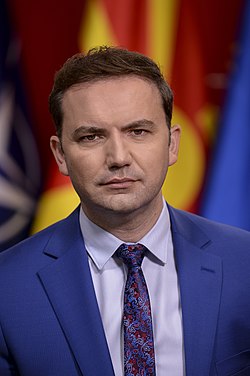 Bujar OsmaniBujar Osmani (born 11 September 1979) is a North…Affiliated
 Nina AngelovskaNina Angelovska (born 13 July 1988) is an entrepreneurAffiliated
 Gjorge IvanovGjorge Ivanov is a Macedonian juristAffiliated
How the record is sourced and how the score is derived.
The score is formula-derived (Factrail formula v1, version 1.0.0), not an editorial verdict. Read the methodology.
By the Factrail desk · Method: how we source and score · Last reviewed
Dispute a fact on this pageNamed here, or represent someone who is? Request a right of reply.
Linked because the text names them, not because anything was measured.
Built from the indicator links of the drivers this text names. A profile of coverage, not a score.