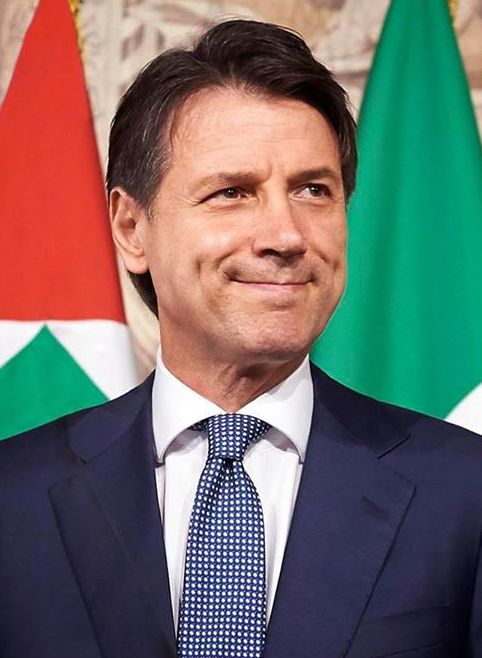
Identity and office
Giuseppe Conte has been president of the Five Star Movement since 6 August 2021. He was president of the Council from 1 June 2018 to 13 February 2021. He remains M5S president on 4 September 2026. The office can bind a group. It does not give him the Senate’s vote counter or a unique Superbonus coefficient.
He is not a Ukraine co-belligerent on this catalog. ukraine-war is not minted and is not attached. 2014+/Karabakh/Kosovo/Taiwan events are not hung on territorial-revisionism. Soviet-scope rows are not used as primary homes.
The League coalition is dated. On 1 June 2018 he swore as prime minister. Matteo Salvini was interior minister and deputy prime minister. That cabinet produced decreto-legge 4 October 2018 n. 113, proposed by Conte as president of the Council and Salvini as interior minister, converted as legge 1 December 2018 n. 132 (Gazzetta (opens in a new tab); Reuters (opens in a new tab)). Humanitarian protection as a general ground was abolished. Sharing the proposal with Salvini is not a reason to drop 4 October 2018.
The M5S presidency is dated. On 6 August 2021 he became party president after leaving Palazzo Chigi. That is the opposition-broker office used on 30 October 2025.
The Nordio file is gazette and Senate. M5S voted against. Conte said the reform was a design to clip the judiciary and take full powers (Repubblica (opens in a new tab)). Giorgia Meloni is live. Carlo Nordio is named. He is not minted. Because two-thirds was not reached, a confirmatory referendum followed; Politico later recorded a March 2026 rejection neighbourhood.
Documented benefits
The offsets that a commissioned-positive portrait would lead with are real only where dated. Recovery-fund negotiation in 2020 is neighbouring EU and is not stored as a rebate of d.l. 113/2018. Superbonus cost tallies are contested and are not invented here as Contribution.size.
Contributions and limits of responsibility
He swore the 2018 cabinet. He co-proposed d.l. 113/2018 as CdM president. He accepted the 2021 M5S presidency. He bound M5S against the 30 October 2025 fourth reading. He does not sit as Nordio. He does not sit as the Senate’s president. Sharing 2018 with Salvini is not a reason to drop the gazette.
Causal chain through facts
1 June 2018 opens the League-coalition file. 4 October 2018 writes the security decree into the gazette under his CdM title. 6 August 2021 makes him M5S president. 30 October 2025 records the Nordio fourth reading with M5S against. None of those dates hangs on ukraine-war, territorial-revisionism, or Glavlit. He connects to the mechanism only through dated facts.
What the score does not say
This page does not promise an exact number. Direction on this chain is negative on the 2018 gazette and mixed on the 2025 opposition no: a completed League-coalition security decree, then a completed opposition fight over judicial careers. It does not invent a unique Superbonus integer or a unique referendum turnout. A later genuine contest would be a different fact with a different date. Nordio remains a name on this file, not an invented biography.
What did Giuseppe Conte own as prime minister, and what belongs to his coalitions?
Giuseppe Conte’s record is unusually easy to distort because he led two governments built from different coalitions. From 2018 to 2019 he governed with the Five Star Movement and Matteo Salvini’s League; from 2019 to 2021 he led a Five Star–Democratic Party coalition. The prime minister was responsible for cabinet direction and decrees his government adopted, but he was not the sole author of every migration action, pandemic rule or parliamentary vote taken by coalition partners.
The first government’s hardest rights question was migration. Salvini, as interior minister, drove the closed-ports strategy and security decrees aimed at rescue vessels and asylum policy. Conte defended and administered a government that adopted those measures, so he cannot be treated as an uninvolved observer. At the same time, direct responsibility for a specific port refusal or ministerial order should follow the signature and legal authority attached to the act. Shared cabinet responsibility is real; fictional sole authorship is not.
The COVID-19 emergency created a more direct prime-ministerial record. In early 2020 Conte’s government imposed some of Europe’s first nationwide restrictions as hospitals in northern Italy came under extraordinary pressure. The restrictions carried immense costs: movement was curtailed, schools and businesses closed, and output collapsed. The public-health rationale was equally concrete: authorities were trying to slow transmission and prevent intensive-care capacity from being overwhelmed before vaccines were available. Evaluating the policy requires both sides. A lockdown is a restriction and an economic shock; it can also reduce transmission when alternatives are scarce. The relevant evidence is timing, hospital pressure, mortality, mobility and the design of support measures rather than hindsight slogans.
Conte’s second government also helped negotiate the European recovery response that became NextGenerationEU, with Italy one of its largest beneficiaries. That policy shifted the record from emergency restriction toward fiscal support and investment. It was a European bargain involving the Commission, European Council and other governments, not a Conte-only program. His responsibility lies in Italy’s negotiating position, national planning and the commitments his cabinet accepted.
Since leaving office, Conte has led the Five Star Movement and has taken a more skeptical line on military support for Ukraine than the Italian center-left’s most Atlanticist factions. Reuters reported in October 2026 that those differences complicate opposition unity ahead of the next election. That is a legitimate democratic disagreement, but it is also consequential because coalition arithmetic can affect Italy’s foreign-policy continuity.
Conte’s strongest defense is adaptability: he moved from a populist coalition with the League to a pro-European coalition during an unprecedented health crisis. His critics see the same sequence as opportunism and excessive use of executive decrees. Both interpretations should be tested against acts rather than personality. The clean record separates migration, pandemic emergency powers and European recovery into distinct decisions with distinct co-authors and consequences.