
Ida Gabrielsson
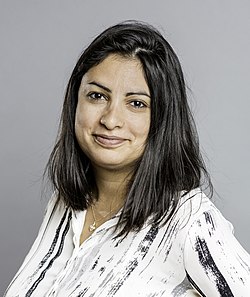
Ida Gabrielsson (born 19 November 1981 in Sandviken, Gävleborg County) is a politician in Sweden for the Left Party (Vänsterpartiet).
- Facts0
- Drivers0
- Indicators0
Ida Gabrielsson (born 19 November 1981 in Sandviken, Gävleborg County) is a politician in Sweden for the Left Party (Vänsterpartiet). She has been an ordinary member of the Riksdag since 24 September 2018. Parliament's open data, current as of 5 October 2026, lists her as a serving member for a term running from 28 September 2026 to 23 September 2030. She entered the Riksdag for the Stockholm County constituency and, in the parliament that convened on 26 September 2022, took a seat for Stockholm Municipality, which remains her constituency.
The Left Party's board elected her deputy chair on 21 November 2020, after Nooshi Dadgostar had become party leader. On 29 November 2023 the party named her its economic-policy spokesperson in place of Ali Esbati. She was vice chair of the parliamentary committee on social insurance from 4 October 2022 until 7 January 2024, and a member of the committee on finance from 8 January 2024 until that term ended on 28 September 2026.
Her political path began in Sandviken and in the Left Party's youth league, Ung Vänster. In 2005, when she was 23, Aftonbladet reported that the league's nomination committee had unanimously proposed her as chair. Asked whether she was a communist, she said that she was, "because I think we have a proud history." She held the chair until Stefan Lindborg was elected at the league's congress in Sandviken on 5 June 2011. The party has also described her as the person who led its future commission and as having a background in municipal politics in Sandviken.
In the Riksdag she was the party's spokesperson on social insurance, and the party has said she took part in negotiations that raised the guarantee pension. Before the 2026 election she said a rebuilding of sickness insurance would be a priority if the Left Party's seats were required to form a government, arguing that an earlier agreement had been undercut by the government's instructions to the Social Insurance Agency. After the vote, with government formation still open, she wrote that other parties could not choose Magdalena Andersson while withholding government influence from the Left Party. SVT, reporting on 25 September 2026, described her as a central figure in those talks and noted that she had been called both "the brain behind Nooshi" and the party's "attack dog" in the media.
Ida Anna Carolina Gabrielsson was born in 1981. The Riksdag's member register records only the year. The directory Ratsit, which states that its personal data come from public authorities, private actors and its own collection, gives the registered name Ida Anna Carolina Gabrielsson and the date 19 November 1981. She grew up in Sandviken, the seat of Sandviken Municipality in Gävleborg County. A 2026 column in Realtid, summarizing a Svenska Dagbladet interview, described her as coming from that mill town (bruksort). In December 2008 she told the socialist weekly Flamman that she had lived there until the age of 25, and that a job at the engineering group Sandvik—which she called the town's heart—had long been treated locally as a piece of good fortune and as something secure. That autumn Sandvik had given notice of about 900 job cuts.
In an October 2005 interview with Gefle Dagblad she said her family had always been on the left and that she had walked in May Day marches since she was a child. She said she had felt a need to organize with others in order to change her own situation, having noticed that someone with little money, or a girl, did not have the same prospects or influence. The newspaper recorded that she was already a member of Sandviken's municipal council at 19. The Realtid account of the later Svenska Dagbladet interview reported that she had joined the Left Party because she found the Social Democrats dull (töntar), and that she moved out of the family home at 16.
In September 2010 Arbetarbladet described a stop at Sandvikens gymnasieskola as a return to her old school. She hesitated at the cafeteria and said it felt a little nerve-wracking, "like when you were in school." The Realtid rendering of the 2026 interview has her saying that, after leaving home at 16, she drank tea, smoked and "fikade bort" upper secondary school—spent it in cafés—with marks she summarized as "några MVG, många streck, lite varierat": a few top grades on the scale then in use, many subjects left without a grade, and the rest mixed. When Ung Vänster's nomination committee proposed her as national chair on 12 October 2005, it stated that she was 23, lived in Sandviken, and had studied at Komvux, municipal adult education, in order to obtain gymnasiekompetens, the upper-secondary qualification. The same note said her capacity for work was at times reduced by a muscle disease. She told Aftonbladet that the condition was muscle pain and that she believed she could manage it in the youth organization.
A March 2022 profile in the Left Party paper Vänstern på Tjörn listed her background as a trained treatment assistant (behandlingsassistent) and as having grown up in Sandviken. Published accounts of her family are brief and come from different years. In October 2005 Gefle Dagblad reported that she had been married for four years, having wed a man named Tommy in church at 19. She said she had found the ceremony cozy, that she was a member of the Church of Sweden, and that she did not believe in God. In a December 2017 essay in Flamman she wrote of making breakfast for her nearly three-year-old daughter before preschool drop-off. The 2022 party profile gave her household as a husband and a six-year-old daughter, and her home as Jarlaberg in Nacka. In September 2026 TV4 reported that she was married to Kalle Larsson, the Left Party's chief of staff.
Her move from Sandviken toward Stockholm was gradual. At the end of October 2005 she told Gefle Dagblad that she had, for the past week, been staying with friends in Alby in order to lead the youth league, and she was interviewed at the party's rooms on Hyttgatan in Sandviken. By September 2010 she was living in Stockholm and said she often went back to Sandviken to see family.
Ung Vänster (Young Left) is the youth league of the Left Party (Vänsterpartiet). Before the 2005 contest, Ida Gabrielsson, then 23 and from Sandviken, had been district chair in Gävleborg County, national vice-chair, chair of the league's feminist committee, and a member of the national board. She was also standing in as the Left Party's opposition councillor in Sandviken, a post she said she would leave, moving to Stockholm, if elected.
The league was coming out of open conflict. Ali Esbati resigned as chair in January 2004, and Tove Fraurud, elected at an extraordinary congress that April to heal the split, told Flamman on 7 September 2005 that she would not stand again. She cited personal reasons and said she had not repaired the wounds; the conflicts and a harsh climate remained, though she denied that benefit-fraud allegations were why she was leaving.
The allegations were the public backdrop. In late May 2005 the National Board for Youth Affairs reported the Jämtland district to the police over suspected inflated membership figures for state grants and withheld the rest of that year's grant. The leadership said a review found carelessness — more than 300 members reported against 250–275 on its count — while former auditor Cecilia Edström said a register held 85 names, not all paid up. Young Left then missed the next application deadline and, refused an extension, stood to lose millions of kronor.
No rival candidate had been presented when Gefle Dagblad interviewed her on 14 October. She said the league should leave its downturn by taking a clearer place in debate, and called it a revolutionary youth organization seeking fundamental social change. On 20 October Aftonbladet interviewed her as the nomination committee's unanimous choice. She called the recent years a decline and said the task was organizational rebuilding and a return to public debate, so as to stop what she called a systemic shift sought by the centre-right Alliance. Asked whether she, like party leader Lars Ohly, called herself a communist, she said she usually called herself Ida, and then: "Om jag är kommunist... ja, då skulle jag svara ja. Jag är kommunist för jag tycker att vi har en stolt historia." Ohly had used the label since February 2004. On 30 October 2005 he told SVT's Agenda he would stop, because it had been tied to Soviet dictatorship and blocked discussion, while saying his ideals were unchanged.
The 43rd congress, in Lidköping on 20–23 October 2005, elected her on the Saturday evening to succeed Fraurud; the league reported the vote as unanimous. She told TT the league should rebuild its organization, speak for ordinary young people, demand feminist self-defence, and oppose privatization. Flamman described a calmer congress and a more united board. Delegates rewrote the feminism section of the programme of principles and adopted a platform centred on a six-hour day, public-sector jobs and reversing privatizations.
She remained chair until June 2011.
A unanimous nomination committee proposed her again before the 44th congress in Arboga, 20–23 March 2008. Convener Björn Öberg said the league was growing stronger across the country, and Gabrielsson, then 26, called removing Fredrik Reinfeldt's government the immediate task. On 21 March the congress re-elected her, with what the league described as a standing ovation.
SVT, using figures the youth leagues themselves supplied, reported 4,000 members in 2009 and 5,000 in 2010. Gabrielsson later said there were more local clubs than when she took over, and that stability had improved after years when, she said, many members had ignored congress decisions.
On 27 December 2010, at her parents' home in Sandviken, she said she would not stand again. She was 29, would turn 30 the next year, and said she was satisfied but tired of the travel; a muscle illness had often meant hostels while others slept in dormitories. Leaving the chair, she said, would not stop her demanding change. Nomination-committee convener Tora Breitholtz said the search for a successor was starting, ahead of a congress set for the Ascension weekend of 2011.
On 19 May 2011 the committee unanimously proposed Stefan Lindborg, 26. He had grown up outside Borås, lived in Nacka, and was national secretary after chairing the Älvsborg district and the trade-union committee. The Sandviken congress elected him on Sunday 5 June, succeeding Gabrielsson, who had been chair since 2005. In his speech of thanks he said "Vi ska utförsäkra överklassen" — that the upper class should be pushed off its security — and that the right had gained ground.
Gabrielsson's first elected posts were in Sandviken Municipality for the Left Party. In October 2005, when she was 23, Gefle Dagblad reported that she had sat on the municipal council (kommunfullmäktige) from the age of 19. She was then the party's acting opposition councillor (vikarierande oppositionsråd), covering for Karin Nilsson during parental leave, a member of the municipal education committee (kunskapsnämnden), and a member of the party's district executive.
Nominated that autumn to chair the youth league, she told the paper that the post required her to work in Stockholm and that the council group would need a handover. Nilsson's leave was not expected to last much longer, so she thought the change could be managed. She moved to Stockholm within days of the election and left the Sandviken assignment.
The next roles were national, and they were not the same body. At the Left Party congress in Gävle on 7–9 May 2010, delegates elected a programme commission that included Gabrielsson, listed from Stockholm with eight others, in a vote the party presented as continuity ahead of a hoped-for red-green government. That commission is a standing organ chosen by congress. Party rules charge it with stimulating debate on theoretical, ideological and strategic questions, developing programmatic positions, and proposing changes to the party programme.
In the 2010 Riksdag election the Left Party received 5.60 percent and 19 seats, about 0.2 points less than at the previous election. Lars Ohly called the result an enormous disappointment. He said the right had won a clear majority of the votes, and he described the entry of the Sweden Democrats as a systemic shift. The next weekend the party board rejected an extra congress and instead appointed a future commission to look for a new strategy. Ohly said Sweden no longer resembled the 1980s or 1990s. Flamman reported the board united on that choice. Jens Holm, who had wanted a congress because only a congress can change policy, called it the fifth election in a row of decline.
The future commission was a temporary group of six, separate from the programme commission, with six months to collect members' ideas and to set goals for the party's role, direction and organization over ten years. Gabrielsson was convenor. With her were Vasiliki Tsouplaki of Västerås, Maria Chergui, Mattias Håkansson, Thaher Pelaseyed and Björn Öberg. On 15 October 2010 the group opened a website for comments on both organization and policy. She told Flamman that the point was how to reach people after several weak elections, and that a young commission fitted a society changed since the 1970s and 1990s.
In March 2011 she told Svenska Dagbladet the party should "do politics" rather than only demand it: homework help, legal advice for people cut off from sickness insurance, and projects such as a girls' night taxi, instead of leaflets and demonstrations alone. She also proposed a women-only network, arguing that economic arguments were wasted if they could not be explained without jargon. In Aftonbladet that January she had called for a generational change, writing that the party should stop defining itself against the Social Democratic Party and take more responsibility for full employment.
The report went to the party board on 8 December 2011. Gabrielsson said the party needed its own identity and should be the obvious voice of the Swedish Trade Union Confederation (LO) collective, though Statistics Sweden's figures had not shown it gaining LO members as Social Democratic sympathy fell. Feministiskt perspektiv reported that the commission found the party's feminism too narrow and internally resisted, with men over-represented in parliament and on boards, and recommended a women's network, an internal feminist plan, and more stress on care, sexualized violence and women's work. The same account said the report set aside intersectionality and treated class and gender as the categories that showed how power is reproduced.
Ida Gabrielsson has been an ordinary member of the Riksdag for the Left Party (Vänsterpartiet) since 24 September 2018. The Riksdag registers that seat as one ordinary mandate through 23 September 2030; its open data split it into 24 September 2018–26 September 2022, 26 September 2022–28 September 2026 and 28 September 2026–23 September 2030. The constituency changed. She entered for Stockholm County and from 2022 has represented Stockholm Municipality, listed for the term that opened in September 2026 as place 81.
On 9 September 2018 the Left Party won 56,466 votes in Stockholm County, 6.93 percent, and three seats. A Stockholm ballot adopted in December 2017 placed Jonas Sjöstedt, Nooshi Dadgostar, Karin Rågsjö, Ali Esbati and Jens Holm first through fifth, and Gabrielsson sixth. In the county the Election Authority first assigned the three seats to Sjöstedt, who had 12,333 personal votes (21.84 percent of the party's vote there), then to Dadgostar and Rågsjö on comparison numbers. A candidate elected in more than one constituency keeps the seat where that candidate's personal-vote share, or comparison number, is highest, and is replaced elsewhere by the next candidate in turn. Sjöstedt kept Västerbotten County, and the protocol names Gabrielsson as his replacement in Stockholm County. Dadgostar and Rågsjö kept Stockholm Municipality and were replaced in the county by Lorena Delgado Varas and Amineh Kakabaveh; the municipality's four Left seats went to Holm, in Sjöstedt's place, with Dadgostar, Rågsjö and Esbati. Personal election requires at least five percent of the party's votes in the constituency; Gabrielsson did not reach it, and the redacted 2018 tables no longer show her preference total.
At the 2022 election, on 11 September, she stood in Stockholm Municipality, where the Left Party took 71,171 votes (11.73 percent) and four seats. She was fourth on the candidate list, with 142 personal votes, far below the five-percent line. Dadgostar, first on the list, had 17,277 personal votes (24.28 percent) but was returned from Stockholm County; Delgado Varas filled that municipality place as list successor. Gabrielsson, Rågsjö and Esbati were elected on comparison numbers.
She was re-elected on 13 September 2026. The final count, updated on 19 September, gave the party 85,059 votes in Stockholm Municipality, 13.04 percent, and four seats. Gabrielsson was second on the named list and received 747 personal votes, under one percent of the party's constituency vote, and was again elected on her comparison number. The four members were Malin Björk, as list successor after a double election; Ilyas Hassan, personally elected with 5,981 votes (7.03 percent); and Gabrielsson and Andreas Lennkvist Manriquez on comparison numbers. She was also second on the party's named list in Stockholm County, with 644 personal votes, but took the municipality seat; Dadgostar, personally elected in both constituencies, kept the county mandate. Nationally the party won 30 seats, up from 24.
Her standing committee posts were on social insurance and, from 2024, finance. She was a finance-committee deputy from 2 October 2018 and a tax-committee deputy from 16 October 2018 until 26 September 2022. On the Committee on Social Insurance she was a deputy from 19 June 2019, a member from 27 November 2020, and, from 4 October 2022 to 7 January 2024, vice chair. From 8 January 2024 she was a full member of the Committee on Finance and again a social-insurance deputy; both posts ended on 28 September 2026. She was also a deputy on the Committee on European Union Affairs (13 March 2019–4 October 2022 and 18 October 2022–24 May 2024), a member of the War Delegation (11 October 2022–19 February 2025), a deputy on the nominating committee (26 September 2022–28 September 2026) and a deputy on the parliamentary council for the Swedish National Audit Office (1 April 2019–5 March 2021).
On 18 March 2020 she was appointed deputy in the labour-market, civil affairs, justice, culture, environment and agriculture, enterprise, health and welfare, transport and education committees until 26 September 2022, and in the defence, constitution and foreign affairs committees until 3 September 2020. As of 5 October 2026, a week after the new term opened, her page listed no new committee post, only the ordinary seat.
The Riksdag's register of what she has said and done records 319 motions, 47 speeches in debates on committee reports, six interpellation debates, eight written questions, three question-time appearances, one prime minister's question time, one budget debate, three debates on the spring fiscal bill and one special debate. Most are party texts she co-signed. Motions in her name as first signatory include a 2019 text on the pension system and 2021 texts on sickness insurance and occupational-injury insurance, in line with the committee she then sat on. In March 2026 she led the party's responses to bills on supplier checks in procurement and on cash payments. The cash motion asked that a statutory cash requirement also cover cafés, restaurants, fuel and clothes shops; the Riksdag rejected five of its six points and approved one. In the chamber she spoke in the special debate on grocery prices on 6 May 2025 and took part in the debate on the spring fiscal bill on 13 April 2026.
On 31 October 2020 a digital congress of the Left Party unanimously elected Nooshi Dadgostar party leader, succeeding Jonas Sjöstedt, who had led the party since 2012. Until that day Dadgostar had been deputy party chair. The congress ran from 30 October to 1 November and also elected a new party board.
On 21 November 2020 that board elected Ida Gabrielsson deputy party chair (vice ordförande), the post Dadgostar had left, and at the same meeting chose the party secretary and the executive committee (verkställande utskott). The party leader, by contrast, is elected by the congress. Gabrielsson was already a member of the Riksdag, elected in 2018, and the party's spokesperson on social insurance, and she had chaired Ung Vänster, the youth league, and headed the party's future commission. In the announcement she said it felt important to work in a growing party that could reach more widely than it then did. She also said that repairing sickness insurance was, for her, the immediate task.
The executive kept Dadgostar as chair, added Gabrielsson as deputy, and reappointed Aron Etzler as party secretary and Hanna Gedin as deputy secretary. The new members were Ulla Andersson, then the economic-policy spokesperson, together with Ali Esbati and Maria Forsberg.
The new party office did not move her onto the economic brief. On 27 November 2020 the parliamentary group nominated her as an ordinary member of the Committee on Social Insurance in Dadgostar's place, and she gave up the substitute seat she had held on that committee since 19 June 2019. She remained a substitute on the Committee on Finance, an assignment dating from 2 October 2018, while Andersson stayed economic-policy spokesperson.
On 29 November 2023 Dadgostar presented Gabrielsson, still deputy party chair, as the new economic-policy spokesperson at a press conference in the Riksdag. The economic-policy spokesperson is a separate assignment from the deputy chair, which the party board elects. Reports of Esbati's succession in February 2022 and of Gabrielsson's in November 2023 described both as decisions the party made public. She succeeded Esbati, who had said he would leave both the role and his seat at the turn of the year, and she said it felt very good to be given the trust.
Esbati had written on 20 November that he was leaving the Riksdag for family reasons. His daughter had lived in Oslo with her mother since the summer of 2022, and he described himself as caught for some time in what he called a Scandinavian spagat. He wrote that the decision was not a career move and that he did not yet know what he would do instead, and he planned to move to Oslo to be closer to his family.
He had held the economic brief only since 1 February 2022, when he succeeded Andersson. Andersson had said she would not stand for re-election and was to leave the Riksdag at the 2022 election; Ciczie Weidby took the labour-market spokesperson role Esbati had held.
In the party's account of the press conference, Dadgostar described Gabrielsson as someone who knew both how to get a change through the political system and how the guarantee pension worked in daily life, pointing to negotiations she had already taken part in. A party post on X called her a "sharp negotiator" firmly anchored in ordinary people's everyday lives; that was the party's wording, not an outside assessment.
The announcement did not by itself change her committee seats. From 4 October 2022 she was vice chair of the Committee on Social Insurance, and from 12 October 2022 she was again a substitute on the Committee on Finance. On 8 January 2024, after Esbati's departure, she became an ordinary member of the finance committee and a substitute on the social insurance committee; the vice-chairmanship had ended the day before. The economic-policy assignment and the committee that handles the budget thereby coincided.
Ida Gabrielsson was the Left Party's social-insurance spokesperson when its executive elected her deputy chair on 21 November 2020. In the Riksdag she sat on the social-insurance committee from 2019 and was its vice chair from 4 October 2022 to 7 January 2024.
On 13 June 2022 the Social Democrats, the Left Party, the Green Party and the Centre Party agreed a permanent rise in the guarantee pension (garantipension) of 1,000 kronor a month before tax from August 2022, to 9,779 kronor for a single person at 2022 prices, with housing-supplement changes so the gain would not be clawed back. The Riksdag passed it on 22 June in the spring amending budget: 173 members voted for the finance committee's text, the bid from the Moderates, Christian Democrats, Sweden Democrats and Liberals, and 174 against, so the government-side reservation won. Two members were absent, and the independent Amineh Kakabaveh cast the deciding vote. Pensionsmyndigheten put the maximum rise at 1,002 kronor. Between July and August, 1,025,300 pensioners got a higher guarantee pension or housing supplement — averages of 900 kronor for 655,800 existing recipients, 500 for 341,800 new ones, and 400 for 289,200 with a housing supplement. About three quarters of those with a higher or new guarantee pension were women. The cost was put at 3.9 billion kronor in 2022 and 10.5 billion in 2023.
The supplement the Left Party had required before tolerating Magdalena Andersson was different. On 23 November 2021 the Social Democrats, the Greens and the Left Party agreed a tax-free guarantee supplement (garantitillägg) of up to 1,000 kronor a month through the housing supplement, for about 700,000 people, with a permanent law from 1 September 2022 and a temporary payment by the end of August 2022. Nooshi Dadgostar called pensions the core issue: the party would abstain in the prime-ministerial vote and then back the government's budget. She had wanted the guarantee pension itself; Andersson said the housing-supplement design was meant to leave the Pensions Group alone. PRO and SPF Seniorerna called a higher guarantee pension unfair because it narrowed the gap with the income pension of low-paid workers, which they wanted raised instead. Gabrielsson said a wider reform was needed, but the party would demand only what the government could do without the other parties in the group.
Those talks broke down in June 2022. Minister Ardalan Shekarabi then offered at least 10,000 kronor a month in guarantee pension instead of the tax-free supplement. Gabrielsson said the net effect for the lowest pensions was about the same, roughly 1,000 kronor after tax, and that the level mattered if the 2021 deal was kept. The supplement had been criticised by the right-wing parties, economists and Pensionsmyndigheten as distorting the system; their alternative paired a smaller rise with housing supplement and tax cuts. The 13 June text, which they rejected the same day, was costed at just over 4 billion kronor in 2022. Elisabeth Svantesson said the opposition package was better because it reached every pensioner. After the vote Ulf Kristersson said it would have given more to the worst off and kept the principle that work should pay, while Dadgostar called the result the largest ever rise in the guarantee pension. Aftonbladet reported that the higher floor narrowed the "respect distance" between full basic protection and the lowest income-related pensions.
On 9 December 2015 the Riksdag abolished, from 1 February 2016, the outer time limit in sickness insurance (the bortre parentes), which normally ended benefit after about two and a half years. Minister Annika Strandhäll said it had not helped people return to work. In September 2026 Gabrielsson called this the Left Party's 2016 deal with Stefan Löfven's government, under which the limit would go and sickness benefit and sickness compensation would be restored. She said the Social Democrats and the Greens then got round it in the annual instruction to the Swedish Social Insurance Agency (Försäkringskassan), so the pressure on sick-listed people continued.
On 10 September 2026 she made rebuilding sickness insurance a demand if the party's seats were needed to form a government, including a higher benefit and ceiling and an end to the waiting-period deduction (karensavdrag). With former LO and TCO investigator Kjell Rautio, the party also proposed reviewing the rehabilitation chain toward a step-by-step model and setting rates so 80 percent of employees could receive 80 percent of pay. In the same campaign the Social Democrats, the Left Party and the Greens wanted the deduction gone. The Moderates, Liberals and Centre Party opposed abolition, citing absence and employer cost; the Sweden Democrats and Christian Democrats had signalled openness for some jobs.
The Left Party was outside the Pensions Group during the 2022 deal. On 30 August 2023 the government invited it, with the Sweden Democrats and the Greens. Minister Anna Tenje said joining required accepting the system's principles, ending separate campaigns, and carrying out what the original five parties had already agreed. Gabrielsson said the party would join, to press for higher pensions.
On 29 November 2023 the Left Party named deputy party chair Ida Gabrielsson its economic-policy spokesperson, succeeding Ali Esbati, who was leaving the Riksdag. She was a full member of the Committee on Finance from 8 January 2024 until 28 September 2026. With party leader Nooshi Dadgostar she presented the alternative budgets and the motions on the spring fiscal-policy bill. On 27 November 2024 the Riksdag adopted the government's framework for 2025 and rejected the Left Party motion. Pensions and sickness insurance in those documents are treated separately.
Presenting the motion for 2025 on 3 October 2024, Gabrielsson said it would raise taxes by 60 billion kronor and that nobody earning under 45,000 kronor a month would pay more income tax. SVT reported an alternative 130 billion kronor larger than the government's, a rejection of about 30 billion kronor of government tax cuts, abolition of the RUT household-services deduction and the newest earned-income tax credit, and child benefit up 400 kronor a month.
The motion, from Dadgostar and others including Gabrielsson, also set a temporary 50 percent tax on bank profits above the 2018–2022 average for 2025–2027, which the party put at 15 billion kronor in the first year. With other Left Party members she moved rejection of the 2025 petrol and diesel tax cut, which the government itself expected to raise fossil-fuel use, and proposed benefits, cheaper public transport and a lower rural road tax instead.
For 2026, Dagens industri reported about 80 billion kronor in reforms, child benefit up 400 kronor a month (9 billion), income tax higher from 50,000 kronor a month, a bank tax and an end to RUT. Gabrielsson said the party would "take back the Moderate subsidies". In the September 2025 budget debate she cited 12,000 kronor a month as the extra cost for an ordinary family with children. SVT Verifierar found the spreadsheet ran from 2020, not 2021, including almost two years before that government took office; the party corrected the dates.
The spring motion of 28 April 2026 proposed 500 kronor more a month in child benefit from June to December (7.3 billion kronor), 2.4 billion for housing benefits, and 2.5 billion in May–July compensation for lower-income car owners instead of a fuel-tax cut. Gabrielsson told TT that government tax cuts put "very little money in many people's hands" and should go to those hit hardest, including low-income rural households. She said the package, just over 15 billion kronor, could be covered by a 50 percent tax in 2026–2028 on bank profits above the 2018–2022 average, because the banks "make large excess profits", with a smaller RUT deduction as backup. A Dagens industri editorial called that populist: the profits were undefined, bank margins were not exceptional, and borrowers would likely pay. In a TT interview cited there, Finance Minister Elisabeth Svantesson of the Moderate Party called a bank tax a "mortgage tax" passed on to customers, criticizing a parallel proposal from the Social Democrats.
On the April 2024 spring amending budget, Gabrielsson told SVT the government was making "a historically large cut in health care but calling it a historically large investment". The 2025 motion proposed 20 billion kronor more in general grants to municipalities and regions, split evenly, and a 5 billion kronor health-care sector grant, which SVT described as 5 billion more than the government's, while rejecting the queue billions. It cited a projected 20 billion kronor regional deficit in 2024, a need to cut about 5,000 posts, and shortages of midwives, specialist doctors and nurses in every region. For 2026, 10 billion kronor went to health care; Gabrielsson said the government's "queue billion" did not cover Västra Götaland's deficit.
The 2025 motion proposed 700 billion kronor in climate-related investment over ten years, including 490 billion for rail-focused transport, 130 billion for renovation and building, and 100 billion for the grid and renewable generation. The shadow budget for 2026 put 4 billion kronor into transport infrastructure and 3 billion into rail maintenance. The spring 2026 motion added a national public-transport pass, the Sverigebiljett, at 450 kronor a month for adults, 1.25 billion kronor more for charging points and 1.15 billion for an electric-car premium. It also proposed "Sweden prices", separating electricity used in Sweden from the export price, and a tax on grid companies' excess profits.
As deputy chair of the Left Party, Ida Gabrielsson spoke for the party in its conflict with Social Democratic-led governments. On 15 June 2021 party leader Nooshi Dadgostar gave Prime Minister Stefan Löfven 48 hours to drop freer rent-setting in new rental housing, point 44 of the January Agreement, or negotiate with the tenants' union. The Left Party could not table no confidence alone, so the Sweden Democrats requested the vote. On 19 June Gabrielsson said those points still had to go, that talks conditioned on market rents would make the tenants' union a "hostage," and that the Left Party's seats were worth as much as the Centre Party's.
On 21 June the Riksdag passed what SVT called a historic no-confidence vote: 181 in favour, 109 against and 51 abstentions, with eight members absent. The Left Party voted with the Moderate Party, the Christian Democrats and the Sweden Democrats. The Centre Party and the Liberals abstained; the Social Democrats and the Green Party voted no. Dadgostar, not Gabrielsson, gave the floor explanation. Löfven resigned on 28 June and on 7 July was tolerated again as prime minister.
In November the Left Party's condition for tolerating Magdalena Andersson was a pension settlement. On 23 November the sides agreed a guarantee supplement for low-income pensioners, which Dadgostar called the core of the talks. Andersson left open cooperation with the Left Party after the next election. On 24 November she was elected Sweden's first woman prime minister, 117 to 174 with 57 abstentions—fewer than 175 votes against were required—after the Left Party and the Centre Party let her through. Centre leader Annie Lööf said her party would vote for its own budget. The opposition budget passed, the Greens left the coalition the same day, and Andersson resigned within hours.
On 17 June 2022, during further budget and pension disputes, Gabrielsson told SVT's Aktuellt that separate Social Democratic meetings with her party and the Centre Party were a "visklek," and that agreement could have come earlier in one room. If all four were needed for a majority, she said, the Left Party, the Social Democrats, the Centre Party and the Greens should govern together. If the Centre Party refused, those two parties would have to win a great many votes. The Centre Party had declined the broadcast.
Three days before the election of 13 September 2026, Gabrielsson told Expressen that outside budget deals were not enough. A 2016 agreement with the Social Democratic–Green government was to remove the outer time limit in sickness insurance; she said the two parties had gone around it in the appropriation directions to the Swedish Social Insurance Agency. Cabinet participation was, she said, "not about ministerial posts" but about agreements being carried out. She warned that red-green voters would be disappointed if Ebba Busch remained deputy prime minister. In an SVT debate that week Andersson said she found it hard to see the Left Party in government, citing Expressen reports on candidates who had praised terrorism and spread antisemitism.
The Election Authority fixed the result on 19 September. The Left Party received 8.40 percent and 30 of 349 seats. The Social Democrats took 99, the Moderates 70, the Sweden Democrats 62, the Centre Party 25, the Christian Democrats 22, the Greens 22 and the Liberals 19. Social Democrats, Left, Centre and Greens therefore held 176 seats, against 173 for the other four parliamentary parties. Turnout was 84.9 percent.
Ulf Kristersson asked to be dismissed, and on 18 September Speaker Andreas Norlén gave Andersson the first exploratory mandate. On 15 September Gabrielsson wrote that one could not choose Andersson while excluding the Left Party from government and still use its voters' seats: the four parties should first have an equal chance of influence, and only then negotiate policy. Centre leader Elisabeth Thand Ringqvist said the Left Party should have as little influence as possible. On 20 September Gabrielsson told Agenda that all four had to have influence, and that a snap election would be the Centre Party's fault if it did not "choose a side."
On 28 September Andersson returned the mandate after the Left Party voted for Norlén rather than the Social Democrats' candidate. She spoke of a new constellation with the Moderates. Gabrielsson called that an "overhasty comment" and said the party would never vote for Kristersson. Dadgostar, after Norlén's re-election, said the party's 30 seats could not be counted unless it sat in government. Thand Ringqvist said respect for seats did not mean cabinet places. No new mandate followed on 30 September.
On 2 October Norlén returned the mandate, with talks to begin on 5 October and a report due on 12 October. The same day Thand Ringqvist invited the four parties to a situation review rather than a negotiation over posts. All four accepted, while she said the Centre Party's lines against the Left Party stood. On 4 October she repeated that refusal. Gabrielsson said the public expected a government, so the parties had to cooperate whether or not they agreed. As of those reports, in early October 2026, no new government had been formed.
In the government talks after the 2026 election, reporters treated Gabrielsson, not party leader Nooshi Dadgostar, as the Left Party's public negotiator. Malin Lernfelt of Liberala Nyhetsbyrån told TV4 that she was both "Dadgostars attackhund" and "städgubbe": she pushed the Social Democrats and the Centre Party with hard demands so Dadgostar could retreat. A party source said that when someone is to be expelled or pushed aside, it is often Gabrielsson who "håller i yxan". The two, close since Ung Vänster, were sometimes called "Nooshida" in the party. Marie Grusell of the University of Gothenburg told Aftonbladet that Gabrielsson was there to take "den första matchen". Gabrielsson has called herself a "mespropp".
On 20 October 2005, proposed as chair of Ung Vänster, she was asked by Aftonbladet whether she called herself a communist as party leader Lars Ohly did. "Vanligtvis brukar jag kalla mig Ida. Men om du vill skriva att jag kallar mig kommunist så får du göra det. Jag bryr mig inte." If asked whether she was a Left Party member or a communist, she said: "Om jag är kommunist...ja, då skulle jag svara ja. Jag är kommunist för jag tycker att vi har en stolt historia." Gefle Dagblad reported opinion pages calling her "kommunistpucko". She said she usually called herself Ida and saw no conflict in being both a democrat and a communist. In an Aftonbladet chat on 26 January 2006 she again preferred "Ida" and described the youth league as socialist and feminist, without taking back the October answer.
The sentence was revived when she became deputy chair in November 2020. Catarina Kärkkäinen, in Timbro's Smedjan, wrote that December that it had drawn notice the week before and was "särskilt anmärkningsvärt", because communists usually avoid a history of mass death. Grouping her with earlier remarks by Ali Esbati and others, Kärkkäinen argued that the party had cut some Soviet ties without settling with communist ideas. The essay, republished on 2 March 2021, quoted no retraction. In February 2022 Sveriges Television's 30 minuter showed the line to Esbati, who said he no longer used the word. On 29 November 2023, when she became economic-policy spokesperson, Moderate MP Lars Beckman wrote that she "kallar sig stolt kommunist". In June 2026 she wrote that "V är riksdagens minst kommunistiska parti".
In SVT's 2022 documentary Maktspelet, unaware the camera was running, she said "vilka jävla fittor alltså" about Social Democrats after the Riksdag's third deputy speakership went to the Centre Party. She called it "dumt sagt". Magdalena Andersson said that language would be unacceptable in her own party.
In September 2026 she answered Expressen's reports that candidates had shared antisemitic conspiracy theories and praised Hamas and Vladimir Putin. After 25 were removed, eight more were struck off. She said the party took this "på stort allvar", that unelectable places far down the lists were very hard to police, and that people on the left more readily adopt conspiracy theories than the political centre, while the cases did not involve the same number of people with real power. She added that the left is not immune to prejudice. She accused Andersson of "fulspel" for praising the spring removals and then changing tone. Andersson called the claim that the Social Democrats would rather cooperate rightwards than abolish the sickness-insurance waiting day "en av de märkligare konspirationsteorier jag har hört". Andersson also said the Left Party "har en lång resa att göra, och just nu går de åt fel håll".
Ranked by shared high-impact facts, then explicit ties, then shared drivers.
 Anna TenjeAnna Tenje is a Swedish politician affiliated with the…Affiliated
 Jonas SjöstedtJonas Sjöstedt (born 25 December 1964 in Gothenburg) is a…Affiliated
 Nooshi DadgostarMehrnoosh "Nooshi" Dadgostar (born 20 June 1985) is a…Affiliated
 Ebba BuschEbba Busch became the Christian Democrats' first female…Affiliated
 Amineh KakabavehAmineh Kakabaveh (born 1970) is a Swedish independent…Affiliated
 Magdalena AnderssonEva Magdalena Andersson (born 1967) is a Swedish economist…Affiliated
How the record is sourced and how the score is derived.
The score is formula-derived (Factrail formula v1, version 1.0.0), not an editorial verdict. Read the methodology.
By the Factrail desk · Method: how we source and score · Last reviewed
Dispute a fact on this pageNamed here, or represent someone who is? Request a right of reply.
People and organizations as listed in the Related section of this page; facts, drivers and the pages that name it as listed in the blocks here. Counts, not a rating.