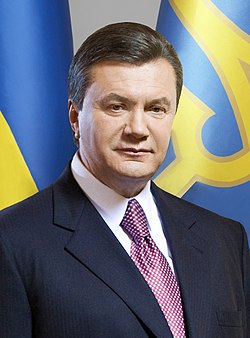
Ihor Ihorovych Kostenko (Ukrainian: Ігор Ігорович Костенко; 31 December 1991 – 20 February 2014) was a Ukrainian geography student, sports journalist, and volunteer editor of the Ukrainian Wikipedia who was killed during the Euromaidan protests in Kyiv. He was born in the village of Zubrets, in Buchach Raion (now Chortkiv Raion), Ternopil Oblast, and was buried there on 23 February 2014.
After finishing the Buchach Collegium of St. Josaphat, he entered Ivan Franko National University of Lviv in 2009 and studied organizational management in the faculty of geography. Alongside his studies he wrote for the sports publication Sportanalitika. On the Ukrainian Wikipedia, using the name Ig2000 from 23 July 2011, he created more than 280 articles and made more than 1,600 edits in about two and a half years, on sport, geography, economics, and the history of the Ukrainian military; the community marked his article on the destroyer Nezamozhnyk as a good article. He administered a Facebook page for Ukrainian Wikipedians and in August 2013 proposed a one-day writing event, a "wiki flashmob," timed to the tenth anniversary of the Ukrainian Wikipedia in January 2014.
The protests had begun in November 2013 after President Viktor Yanukovych suspended preparations to sign an association agreement with the European Union. Kostenko joined student actions in Lviv whose demand was that the agreement be signed, traveled to Kyiv more than once, and on 18 February 2014 went to the capital again with other students from Lviv. On 20 February he was killed by gunfire on Instytutska Street near the October Palace. The same day, Sportanalitika told Interfax-Ukraine that a body outside the palace had been identified as the 22-year-old student from Ternopil region. A Wikimedia Ukraine account published four days later said he had gone forward with a shield and was hit by two bullets, one of them in the head. He is counted among the protesters killed in the February clashes, commemorated in Ukraine as the Heavenly Hundred.
On 21 November 2014, Decree No. 890/2014 of President Petro Poroshenko awarded him, posthumously and together with other people killed during the Revolution of Dignity, the title Hero of Ukraine with the Order of the Golden Star. In August 2014 he was named Wikipedian of the Year; the weekly Ukrainskyi Tyzhden reported that he was the first Ukrainian to receive it. Jimmy Wales presented the award to Kostenko's sister, Inna, on 13 September 2014 at the Yalta European Strategy meeting in Kyiv.
Ihor Ihorovych Kostenko was born on 31 December 1991 in Zubrets, then in Buchach Raion of Ternopil Oblast and now in Chortkiv Raion. He spent his childhood and youth in the village.
His parents were Ihor and Oksana Kostenko. They worked for long periods in Saint Petersburg, and he and his sister, Inna, were brought up in Zubrets by their grandparents. Inna studied in Dnipropetrovsk, now Dnipro. His father later said they kept working in Russia because the household had two students to support, and that Ihor did not want them there and would not eat sweets brought back from Russia. He often returned to his grandparents in the village.
Oksana Kostenko remembered a careful reader whose shelves held Harry Potter, encyclopedias, and histories of Galicia, the Ukrainian Insurgent Army, and Europe. She said he kept a traditional Christmas Eve, with twelve lenten dishes and hay under the tablecloth, and checked the dishes against a list. Mariia Tkachivska, head of the Zubrets school, described him as cheerful, strong-willed and persistent, widely read, and well informed about history.
As a boy he wanted to be a footballer, then followed FC Karpaty Lviv as a supporter; his mother also said he loved boxing. He next thought of mechanical engineering and of designing bridges, and of how the Zaporozhets car might be updated. Architecture and aircraft construction followed, and he read aviation history, until poor eyesight made drafting impractical. His mother said a career in tourism then seemed the practical choice, because he liked to travel and agreed when she suggested it.
Kostenko completed nine grades at the Zubrets general secondary school and then spent two years at the Buchach Collegium of St. Josaphat Kuntsevych, which he finished in 2009.
The school had opened in September 1995 as a historical-philosophical lyceum of the Buchach Monastery of the Exaltation of the Holy Cross, of the Order of Saint Basil the Great, and was reorganized as a collegium in 2001. The Buchach raion administration, the raion council and the monastery were co-founders. Pupils came from more than one oblast, took a course in the basics of Christian ethics, and received state-standard leaving certificates. His mother described it as a school with an advanced emphasis on history and Christianity. At the village school he had already been interested in history and geography.
In the collegium graduation album he wrote, "I believe that … collegians with a patriotic spirit will build Ukraine," and added, "Let us be Ukrainians in soul and with God in our hearts."
In 2009 he entered the Faculty of Geography at Ivan Franko National University of Lviv. Biographical notices give the specialty as the management of organizations; his mother described the course as preparation for work as a manager in the tourism industry. He lived in a university dormitory in Lviv. Volodymyr Bilaniuk, dean of the faculty, called him one of its best students, and classmates described him as intelligent, cheerful and purposeful, with a thorough knowledge of history. Bilaniuk later said he had done well in history, the fundamentals of Ukrainian law, and informatics.
The same year he joined the All-Ukrainian Brotherhood of Soldiers of the Organisation of Ukrainian Nationalists–Ukrainian Insurgent Army, named for Roman Shukhevych; his parents said they learned of that membership only after his death. While a student he also worked as a journalist, telling his mother that some classmates were already employed from the second year and that he could manage a job he liked.
In 2013 he gained a bachelor's degree and began a master's course; at the time of the 2013–14 academic year he was a fifth-year student. A classmate, Iryna Balyas, said he was due to defend a master's thesis in June 2014 titled "The tourism industry in Lviv Oblast." Bilaniuk described the subject differently, as the development of the tourism industry of Kostenko's native town.
While studying organizational management in the geography faculty of Ivan Franko National University of Lviv, Ihor Kostenko worked as a journalist for Sportanalitika, a sports outlet at sportanalytic.com. Interfax-Ukraine described it as a sports newspaper. Ukrainian reports used the names «Спортаналітика» and «Спортаналітик» and called it an internet publication. Wikimedia Ukraine wrote on 23 February 2014 that the job ran in parallel with his fifth-year studies. The Museum of the Revolution of Dignity, within the National Memorial Complex of the Heavenly Hundred Heroes, records that he began there as a student, played football, and supported the Lviv club FC Karpaty Lviv.
On 20 February 2014 Interfax carried the newsroom's notice, in Russian at 18:14 and in English at 19:35. It said that one of the bodies outside Zhovtnevy Palace in Kyiv had been identified as Kostenko, a 22-year-old geography student from Ternopil Oblast, and that the Sportanalytic journalist had "died a hero's death for freedom and justice." The editors offered condolences to his family and friends. Detector Media quoted the Ukrainian wording—that the journalist of «Спортаналітика» had "heroically died for freedom and justice"—and said the site was citing a Facebook post by the Euromaidan SOS community. The Institute of Mass Information reported the same identification and said it was trying to establish the circumstances.
The fullest description of the job was issued in the name of the editorial office. On 26 February 2014 the editors appealed for help for the family. In wording the Institute of Mass Information relayed from sportanalytic.com, they called him "a young and talented journalist of our publication «Спортаналітик»" and an "angel" of the Heavenly Hundred. They wrote that in a little more than a year of active work he had become the author of nearly 6,000 notes and news items on sports subjects. In the same passage they described him as an active fan of Karpaty and of the Ukraine national football team, and wrote that he also loved biathlon and Formula One. That total is the newsroom's own figure. Those February reports do not reproduce individual stories or bylines.
His mother, Oksana Kostenko, told the Ternopil paper 20 khvylyn in November 2014 that he "lived for sport" and loved boxing and football, and that she could no longer bear to hear about those sports, or about Lviv. An earlier article in the same paper, after the funeral in Zubrets, identified him as a Sportanalitika journalist from the accounts of the village school director, Mariia Tkachivska, and a classmate, without describing particular pieces.
The museum states that he was also one of the initiators of a Ukrainian-language sports site, allsport24.com. It says the launch had to be postponed because Kostenko and his friends were taking part in the Euromaidan protests, and that the project was carried out only after he was killed. Interfax, Detector Media, and the Institute of Mass Information did not mention allsport24 in their reports of 20–26 February 2014. Those accounts stay with his employment at Sportanalitika and with the editors' description of his sports notes and of the teams and sports he followed.
Ihor Kostenko contributed to the Ukrainian Wikipedia under the username Ig2000. He registered the account on 23 July 2011 and began writing articles in that same month. In about two and a half years he created more than 280 articles and made more than 1,600 edits. A memorial issued for Wikimedia Ukraine, and published in English on the Wikimedia blog, listed the subjects as sports—association football and Formula One among them—together with geography, economics, and the history of the Ukrainian military. The Kyiv Post, summarizing the same span, wrote that he "wrote some 280 and edited more than 1,600 articles" on sports, geography, economics, and Ukrainian military history.
The community gave Good Article status to his article on the destroyer Nezamozhnyk (Ukrainian: «Незаможник»), a ship of the Ukrainian and Soviet navies in the first half of the twentieth century. The Ukrainian text of the memorial said the community had recognized that article as one of the most complete on its subject. He also wrote a number of reports on sporting events for Wikinews. From 21 February 2014, the day after he was killed in the Euromaidan protests, editors placed a black mourning ribbon on the Ukrainian Wikipedia logo.
Kostenko used social media to recruit editors. He administered a Facebook group of Ukrainian Wikipedia contributors and regularly posted short items taken from the encyclopedia. The Kyiv Post described the effort as an attempt to draw more people into writing for the project. When he was later named Wikipedian of the Year, Wikimedia Ukraine's account of the distinction presented it as recognition of his large contribution to Wikipedia, of his promotion of the project on social networks, and of a civic position pursued by nonviolent means.
In August 2013 he proposed a "wiki flashmob," a single day on which as many people as possible would be invited to write new articles. He wanted it held on 30 January 2014, the tenth anniversary of Ukrainian Wikipedia—the first article in the edition had appeared on 30 January 2004—and he argued that the day could add thousands of articles if organizers followed a strategy he sketched. The plan was cancelled because of events in the country, and he did not live to see a flashmob held. An April 2014 announcement said that in 2013 he had put forward the proposal and had intended to help organize it.
Later accounts of who first suggested the format are not identical. The press note on the first event called him one of those who in 2013 had proposed carrying the idea out. A February 2015 post on the Wikimedia Ukraine blog said the idea had first been voiced by the user KhendriuKh (ХендрюХ) and that Kostenko then took it up and promoted it actively. A January 2017 announcement described him as among the first to develop such a campaign and as someone who had sought to carry it out. Ukrinform, in a 2023 anniversary note, likewise wrote that he was among the first to voice the idea of wiki flashmobs on Ukrainian Wikipedia.
The first flashmob was held on 27 April 2014 and dedicated to his memory. Participants added 915 articles in one day. Experienced editors met newcomers in Kyiv, at the scientific library of the National University of Kyiv-Mohyla Academy and at a space named Pause; in Lviv, at the central city library named for Lesya Ukrainka; and in Dnipropetrovsk, now Dnipro, at a Puzata Khata café. Wikimedia Ukraine's press service called the day the first campaign of that kind on the Ukrainian Wikipedia.
A second flashmob produced 231 articles, and training meetings were held on 31 January and 1 February 2015 in eight oblasts. By January 2017 Wikimedia Ukraine was advertising the annual campaign as a Wikimarathon and pointing back to the 27 April 2014 event held in his memory. Ukrinform wrote that the flashmobs, later called Wikimarathons, had been held each year since 2014.
On 21 November 2013 the government of President Viktor Yanukovych suspended preparations to sign an association agreement with the European Union, saying the step was taken to protect Ukraine's national security. The decision came days before an Eastern Partnership summit in Vilnius, after Russia had pressed Kyiv not to sign and to consider a customs union with Russia, Belarus, and Kazakhstan instead. The rallies that followed, soon called Euromaidan, began as a demand to sign the European Union–Ukraine Association Agreement. Yanukovych later said Russian pressure had led him to hold back, because Ukraine could not afford to lose that trade.
In Lviv, where Kostenko was a geography student at the University of Lviv, students made up much of the protest. On 25 November about 10,000 joined a strike near the monument to Taras Shevchenko after lectures were cancelled; organizers read an appeal asking the president to meet the conditions for signing, and traffic was blocked along Svobody Avenue. Radio Svoboda reported about 30,000 students on the same square the next day and an open-ended strike whose committee kept party symbols off the rally. Acting rector Ivan Vakarchuk said rectors had pledged not to expel students or ban protest, and the Ukrainian Catholic University cancelled classes for the week. The same report said donations were sending about 3,000 people a day from Lviv to the capital.
The National Museum of the Revolution of Dignity records that Kostenko backed the protests from the first days and joined these Lviv student actions, whose main demand was signature of the agreement. A close friend, identified in a 24 February 2014 interview only as Olha, said he took part in the strikes and also came when the square was quiet.
Kostenko went to Kyiv more than once with friends and, the museum states, attended Sunday assemblies as well as student strikes. He was on Maidan Nezalezhnosti on the night of 29–30 November 2013, when special-purpose police cleared the remaining camp. Interfax-Ukraine reported that the unit used at 4 a.m. was Berkut. The BBC reported riot police moving in at about 04:30 and beating protesters with truncheons; activists said more than 1,000 people, most of them students, were still there, and an opposition lawmaker wrote that dozens were hurt and at least 33 detained. Deputy Prosecutor General Anatoliy Pryshko later said 79 injured people had been identified, six of them students. Olha said Kostenko was with her as the square was emptied and later tried to keep her away from the clashes. She and the museum also place him at the assembly at which protesters first occupied the Kyiv City State Administration.
He left Lviv for the last time on 18 February 2014, the day a march toward parliament became the deadliest violence of the protests to that point. The BBC reported that police used rubber bullets and stun grenades against thousands of marchers, with early counts of at least nine dead, including two police officers. UN High Commissioner for Human Rights Navi Pillay said at least 22 people — protesters, police, and journalists — were killed that day and that 241 were taken to hospital, as officers tried to clear the camp. Kostenko traveled with fellow geography students Volodymyr Ditchuk and Bohdan Sema. Ditchuk later said they understood that dozens were already dead and that the number of wounded was still rising.
Ditchuk said the three reached Kyiv at midnight on 19 February, went straight to the square, and until morning helped build barricades and stood on the front line. Sema was wounded; while he was treated at a medical point in St. Michael's Golden-Domed Monastery, Ditchuk and Kostenko returned to the barricades. On Wednesday evening, 19 February, they put Sema on a train home and spent the night in the city-administration building. The museum agrees on the 18 February departure with other Lviv students, the barricade work after the overnight arrival, Bohdan's wound, and that night in the city hall.
The shootings on Instytutska Street came at the end of the deadliest phase of the Euromaidan protests in Kyiv. The United Nations Human Rights Monitoring Mission in Ukraine later counted 83 protesters, one journalist, one bystander and 13 law-enforcement officers killed between 21 January and 20 February 2014. On 20 February, it recorded that 47 men and a boy were shot dead between 9 a.m. and noon, and that another man was fatally shot at about 5 p.m.
Ihor Kostenko left Lviv on 18 February with other students and reached Kyiv late the next night, according to the National Memorial Complex of the Heroes of the Heavenly Hundred – Museum of the Revolution of Dignity. Drawing on companions, the museum says they built barricades on Maidan Nezalezhnosti, sent a wounded friend home by train, and slept in the city-administration building. Near 9 a.m. on 20 February, after word of an attempt to clear the square, Kostenko went up Instytutska with other protesters, holding a shield. The museum places his death between 09:29:27 and 09:29:35, near the October Palace, then commonly called Zhovtnevyi Palace.
A BBC Ukraine journalist near the palace that morning described gunfire from about 9 a.m. and a protester's warning that snipers were shooting. The report said a group in black camouflage with yellow armbands, not then identified, killed nearly 50 unarmed protesters and wounded about 80; investigators later called them members of Kyiv's Berkut special-purpose company. Coverage of the prosecution put the Instytutska toll at 48 people killed by gunfire and about 80 wounded.
Interfax-Ukraine reported the same day, citing the sports outlet Sportanalytic, that one of the bodies outside Zhovtnevy Palace was 22-year-old geography student Ihor Kostenko, from Ternopil Oblast, a journalist for the site. The editors offered condolences and called it "a hero's death for freedom and justice."
The museum states that two bullets struck him, that the head wound caused death, and that the body had gunshot wounds to the head and chest and broken legs. Volodymyr, a companion who helped carry him, is quoted as saying the legs were injured so badly they "could be tied in a knot." A Wikimedia Ukraine note of 24 February 2014 also said he had advanced with a shield and was hit by two bullets, one in the head. Those accounts do not identify the weapon, the firing position, or a shooter. He was later listed among the protesters commemorated as the Heavenly Hundred.
Prosecutors charged five former Kyiv Berkut members — deputy regiment commander Oleh Yanishevskyi, Pavlo Abroskin, Serhiy Zinchenko, Oleksandr Marynchenko and Serhiy Tamtura — with involvement in the killing of 48 people and the wounding of 80, and with stealing weapons, exceeding their powers, and a terrorist act. Investigators had suspected 26 armed Berkut members on the street that day; about 20, including company commander Serhiy Kusyuk, left for Russia before arrest. The Sviatoshyn District Court began the joined trial in May 2016. On 28 December 2019 an appellate court released the five for a prisoner exchange with Russia. Marynchenko and Tamtura returned; the other three were tried in absentia. In February 2020 the UN mission said that transfer had interrupted the Maidan killing trial that had gone furthest.
On 18 October 2023 judge Serhiy Diachuk announced a verdict of about 1,700 pages. The court found that Kyiv Berkut had committed the mass killing of unarmed protesters, and that around 9 a.m. Yanishevskyi ordered subordinates to open fire to cover an evacuation from the October Palace. Weapons assigned to Yanishevskyi, Abroskin and Zinchenko were linked to at least 31 deaths and 44 woundings. Yanishevskyi was sentenced to life in absentia, and Abroskin and Zinchenko to 15 years each, also in absentia. The killings were not proved against Tamtura, who was acquitted, or against Marynchenko. Marynchenko was convicted only of abuse of power under article 365, part 2, of the Criminal Code, sentenced to five years, and treated as having served them because detention from 23 February 2015 to 28 December 2019 was counted at two days per day in custody. Separate murder counts against Yanishevskyi drew no further penalty because the limitation period had expired. News accounts of the judgment do not name a defendant convicted for the shots that killed Kostenko.
Prosecutor Oleksiy Donskoi said the prosecution would appeal the acquittal of all five on a terrorist-act charge, which it had treated as the right description of prolonged indiscriminate fire at unarmed protesters. Defense lawyer Stefan Reshko said the defense would appeal the murder convictions, arguing there had been no intentional killings and that some protesters' unlawful acts had led to the deaths. The verdict was to take effect only after appeal. The Kyiv Court of Appeal was scheduled to hear the appeals on 12 January 2024.
In March 2015 the Council of Europe's International Advisory Panel, which reviewed procedure and did not decide who fired, found the investigations short of European Convention standards on independence, effectiveness and promptness. It recorded the authorities' conclusion that evidence was not yet sufficient to blame sniper weapons, as distinct from other firearms, or a "third force," while also noting inquiries into possible shots from the Hotel Ukraina and the conservatory. The panel said it could not judge whether that conclusion was reasonable.
Kostenko's wound path has been disputed in later writing. In a 2024 chapter, University of Ottawa political scientist Ivan Katchanovski argued that video and forensic material before the court showed a nearly horizontal side wound, which he read as fire from the Hotel Ukraina, then used by protesters, rather than from the Berkut line. The day before the verdict, Yevhenia Zakrevska, a lawyer for Heavenly Hundred families, wrote that the case had found no third force and no killing or wounding from that hotel, and that Ukrainian police had killed the 48. Cathy Young, in The Bulwark, argued that the Berkut convictions did not support Katchanovski's broader claim of a false-flag attack from protest-held buildings.
The body of Ihor Kostenko was brought west from Kyiv after he was killed on 20 February 2014. On the evening of 21 February the Ternopil outlet Pohliad reported that the coffin had reached Rivne Oblast and that a motor cortege was expected near Ternopil at about 01:00. People with cars were asked to meet it in Kremenets, Vyshnivets and Zbarazh; others were to wait at the Zbarazh interchange for a short memorial service by a priest from the city's archcathedral, after which the column was to continue through Berezovytsia and Mykulyntsi toward Buchach.
Pohliad reported that, despite drizzle, several thousand people met the cortege at about 02:00 on 22 February at the Zbarazh checkpoint. The column, escorted by cars with flashing lights, then stopped at the Zbarazh turn, where about 500 people were waiting, and drivers played "Plyve kacha" by Plach Yeremiyi. Mourners chanted "Heroes do not die!" ("Герої не вмирають!") and sang the national anthem quietly. Several thousand people came out in Berezovytsia; villages along the road were lit by candles; and more than a hundred cars met the cortege in Mykulyntsi.
In Lviv, where Kostenko was a student, the mourning was separate from the cortege: Ternopil reports place the coffin on the road from Rivne Oblast toward Buchach, not in the city. On 21 February the University of Lviv held a day of mourning. Dyvys.info described a silent column from the monument to Ivan Franko to the monument to Taras Shevchenko, flags with mourning ribbons, portraits of the dead, and a student panakhyda at which geography dean Volodymyr Bilaniuk spoke about Kostenko.
On the afternoon of 22 February, Vysokyi Zamok and Dyvys.info carried a Lviv City Council press-service list that set a farewell in Zubrets for 17:00 on 22 February and burial there for 13:00 on 23 February. The notice said nine bodies had been brought to Lviv and Lviv Oblast, but Kostenko's line, giving his home as Zubrets in Ternopil Oblast, scheduled both events in the village. In a post on his editing for Ukrainian Wikipedia, Wikimedia Ukraine stated that it had been decided to place a mourning ribbon on the Wikipedia logo from 21 February, in memory of Kostenko and dozens of others killed during the Euromaidan.
Kostenko was buried on 23 February 2014 in Zubrets, in what was then Buchach Raion, not in the town of Buchach. Wikimedia Ukraine wrote that evening that the burial was in his native Buchach area and that thousands saw him off, among them students from Lviv and people from the Ternopil region.
On 26 February the Ternopil paper 20 khvylyn reported the same date and place, and noted that another man from Zubrets, Vasyl Moisei, was buried that day in Lutsk. School director Mariia Tkachivska told the paper that about 3,000 people from different cities attended. She said a local priest, Father Yuriy, who had been on the Maidan from its first days, accompanied the body from Kyiv to the village; that Kostenko's parents had been working in Saint Petersburg; and that his sister was studying in Dnipropetrovsk.
On 21 November 2014, Dignity and Freedom Day, President Petro Poroshenko signed Decree No. 890/2014 conferring the title Hero of Ukraine, with the Order of the Golden Star, posthumously on 99 people killed in the February violence of the Euromaidan. He signed it in Kyiv at a meeting with relatives of the dead, the protesters known as the Heavenly Hundred.
The title was a group honor, not an award made to Kostenko alone. LB.ua, citing the presidential press service, printed the list of all 99 recipients and included Ihor Ihorovych Kostenko. That account gave the grounds as civil courage, patriotism, heroic defense of the constitutional foundations of democracy, human rights and freedoms, and selfless service to the Ukrainian people. The biography published by the National Memorial to the Heavenly Hundred Heroes — Museum of the Revolution of Dignity quotes Decree No. 890/2014 in the same terms and says those qualities were shown during the Revolution of Dignity.
Three foreign nationals killed in the protests could not receive Hero of Ukraine, which is limited to Ukrainian citizens. Poroshenko said they would instead be given the Order of the Heavenly Hundred Heroes. At the meeting with the families he said that those who had killed the protesters should be punished, and that an early act of the new parliament should be a temporary commission of inquiry into the crimes on the Maidan.
On 4 July 2015 Patriarch Filaret, primate of the Ukrainian Orthodox Church – Kyiv Patriarchate, led a memorial service for the Heavenly Hundred in the cathedral of St. Michael's Golden-Domed Monastery. He then presented representatives of 106 families with the church medal "For Sacrifice and Love for Ukraine," along with flowers and the book Maidan. Revolution of Dignity.
The Religious Information Service of Ukraine, citing the church, noted that the monastery had sheltered protesters in the winter of 2013–2014 and that bodies of people shot on Instytutska Street were brought there in February 2014. TSN reported that relatives traveled from across Ukraine—including, from Belarus, the parents of Mykhailo Zhyznevskyi—and quoted Filaret calling for prayer for those who had "given their lives with love for their homeland, for freedom, and with love for their family." News accounts of the day describe the medal as a collective posthumous honor; the museum biography states that Kostenko was among the 106.
On 29 January 2015 the press center of the Ivan Franko National University of Lviv, where Kostenko had studied geography, reported a separate educational distinction. The national sociopolitical weekly Osvita had named him educator of the year, posthumously, and a laureate of its award "У твоєму імені живу" ("I Live in Your Name"), given for "self-sacrifice in the name of Ukraine." The weekly compiled the ranking from letters to the editor. Its authors said that, alongside professional achievements, many letters emphasized civic acts by teachers and students.
Wikipedian of the Year is a personal selection by Wikipedia co-founder Jimmy Wales, not a contest with a fixed numerical threshold, and it had already been given to other editors before 2014. Wikimedia Ukraine wrote that Wales had awarded it since 2011: first to Rauan Kenzhekhanuly, for the growth of the Kazakh Wikipedia through the organization WikiBilim; then to the editor Demmy, for work on the Yoruba Wikipedia; and in 2013 to Rémi Mathis, for his role in a dispute over the French Wikipedia article on the Pierre-sur-Haute military radio station.
On 10 August 2014, at the closing ceremony of Wikimania in London—the annual conference of the Wikimedia Foundation—Wales named Kostenko the recipient for that year, posthumously, for his editing of the Ukrainian Wikipedia and for the circumstances of his death.
The Kyiv Post, quoting Serhiy Petrov, then press secretary of Wikimedia Ukraine, reported that Wales looked for a significant contribution and, above all, a personal story, rather than a count of articles or edits. In the closing speech Wales called Kostenko's case "a really touching story for me, of a young person so active and vibrant in our community, who like many people in many parts of the world was going out into the street to fight for a better world and lost his life so tragically."
On 13 September 2014, at the 11th annual meeting of the Yalta European Strategy in Kyiv, Wales gave the diploma, and a Wikipedia T-shirt signed by editors who had known Kostenko, to his sister Inna. According to the meeting's account of his remarks, he described Kostenko's Wikipedia work as concerned with history and sports rather than politics, and said that a flash mob Kostenko had been organizing—set aside because of his death—was held in April, when more than 200 people created more than a thousand articles at once. Inna thanked Wales and the organizers for recognizing her brother's contribution.
On 20 February 2018 a bust of Ihor Kostenko, a Hero of the Heavenly Hundred, was unveiled in the inner courtyard of the Geography Faculty of Ivan Franko National University of Lviv. Sculptor Volodymyr Tsisaryk made it at the initiative of students and teachers, who paid for it by a collection. Kostenko's sister Inna and Volodymyr Ditchuk, a faculty graduate who had been with him on the Euromaidan, uncovered the bust. Clergy blessed it. Rector Volodymyr Melnyk, Kostenko's mother Oksana, Lviv mayor Andriy Sadovyi and dean Volodymyr Bilaniuk spoke.
A classroom had already been named for him. On 15 May 2014 university chaplain Father Taras Ostrovsky blessed memorial auditorium No. 7, assigned by the Academic Council. Classmates, teachers and students prepared the room and the stands "Geography students in the Revolution of Dignity," shown on 14 May. By May 2016 exhibits had also been gathered for a memorial room, and his parents were invited to see them.
On 21 May 2016 a monument was opened and consecrated on Kostenko's grave in Zubrets, then in Buchach Raion, Ternopil Oblast. On a pedestal it joins a carved cross, a portrait stele and a memorial candle. Fellow villagers Roman Lesiv and Mykhailo Zinchak designed it. It was cut in Zhytomyr Oblast from red granite and black basalt, and Kostenko's father built it over several months, with money from villagers, oblast civic groups and donors elsewhere in Ukraine. Faculty students and teachers attended with former classmates and young people from Kyiv, Lutsk and Ivano-Frankivsk.
Kostenko was not the only person from Zubrets killed on 20 February 2014. Vasyl Moisei, a pupil of the same school who was then living in Lutsk, died that day as well. In April 2014 foresters, officials, deputies, pupils and teachers planted, for both men, a tryzub of spruces in the Rakhiv tract, a tryzub of pines on a hill at the village edge, and 2.4 hectares of young oak. An earlier, smaller living tryzub on that hill had been Moisei's own project; failed trees were replaced with pines, and priests blessed national, red-and-black and European Union flags. A proposal for a village memorial of a tent, a barrel, tires and barbed wire was also made; the report did not say it was carried out.
The Zubrets council had just voted to rename two streets for Kostenko and Moisei. The village list, postal code 48441, later includes Hero of Ukraine Ihor Kostenko Street and Hero of Ukraine Vasyl Moisei Street.
On 18 February 2015 a plaque was unveiled on the Buchach Collegium of St. Josaphat, which Kostenko finished in 2009. A liturgy and panakhyda in the Basilian monastery church preceded it; his parents and sister, pupils, clergy and officials attended, and TSN reported the plaque on 20 February.
The village school took both names. Staff proposed the change in March 2017. After public discussion, the council in September 2017 renamed it the Zubrets general-education school of levels I–III named for the Heroes of the Heavenly Hundred Ihor Kostenko and Vasyl Moisei. The name was marked on 23 November 2017, with director Halyna Kovalivska, member of parliament Mykola Liushniak, Moisei's brother Father Roman, and Serhii Marchuk, who had tried to pull Moisei from the gunfire.
A photograph of 6 June 2014 shows a memorial sign to Kostenko on lower Instytutska Street in Kyiv, near the October Palace, where his body was found. Its author captioned the marker as his sign on the Alley of the Heavenly Hundred, then still an unofficial name. On 20 November 2014 the Kyiv City Council, by 85 votes, gave that name officially to the stretch from Maidan Nezalezhnosti to Olhynska Street. Secretary Oleksii Reznikov proposed "alley" because only four buildings stood there, including the Khreshchatyk metro pavilions and the October Palace; renaming the whole street drew 20 votes, short of 61.
The Ukrainian Institute of National Memory lists Kostenko, born in Zubrets on 31 December 1991, among those who died of gunshot wounds received on Instytutska on 20 February 2014.
In Lviv, apart from the university, the first stage of the Memorial to the Heroes of the Heavenly Hundred opened on 23 August 2019 at Kryvonosa and Zamkova streets. A corten-steel stele, which co-author Andrii Lesiuk called a symbol of a burning barricade, carries 107 engraved portrait plaques, with three viewing platforms. Lesiuk, Mariia Yastrubchak and Khrystyna Pundak won the design competition held from November 2016 to February 2017. About 20 million hryvnias paid for the stele, platforms and stairs after work began in September 2018; a footbridge toward Hubernatorski Valy was left for later. The opening account does not itemize Kostenko's plaque among the 107.
On 15 November 2017 the Cabinet of Ministers, by Resolution No. 896 signed by Prime Minister Volodymyr Groysman, founded 50 academic scholarships named for the youngest members of the Heavenly Hundred who held the title Hero of Ukraine. The places are divided equally among ten specialties at state-owned higher-education institutions. Five, in geography, are named for Kostenko. The others, also five each, are named for other people killed in the protests: Vasyl Moisei (physical therapy and occupational therapy), Vladyslav Zubenko (railway transport), Dmytro Pahor (agricultural engineering), Dmytro Cherniavskyi (economics), Ivan Tarasiuk (military management), Oleksandr Plekhanov (architecture and urban planning), Serhii Baidovskyi (software engineering), Serhii Nigoyan (performing arts), and Yurii Diakovskyi (psychology).
Nominees must be students or cadets of state institutions, including military higher-education institutions. They must show an active civic stance affirming the ideals of the Revolution of Dignity—a democratic state under the rule of law, and the protection of rights and freedoms—and substantial results in study or in scientific, public, sporting, or creative work. Students are considered only if they already qualify for an academic scholarship and stand in the top 10 percent of the ranking used to award it, or first where that ranking has no more than ten students, on the first semester of the preceding year. Cadets must also have exemplary military discipline. Each institution may nominate one candidate per specialty, chosen by its highest student or cadet body, for a commission of the Ministry of Education and Science that includes relatives of the people named. The scholarship is paid monthly from 1 September for one academic year, at the Cabinet's academic-scholarship rate for students and at the subsistence minimum for able-bodied persons for cadets. A person eligible for more than one academic scholarship receives only the larger sum. Education.ua reported that in 2024 the ministry awarded 34 of the scholarships, at 4,000 hryvnias a month, with the geography places still those named for Kostenko.
The observance was established by presidential decree, not by an act of the Verkhovna Rada. Decree No. 69/2015 of President Petro Poroshenko, signed on 11 February 2015, set 20 February as the Day of the Heavenly Hundred Heroes, to be marked every year. It required annual commemorations, including flowers at monuments, and instructed regional administrations to found named prizes and scholarships. The date is also the anniversary of Kostenko's death on Instytutska Street in Kyiv.
On 20 February 2025, students and staff of the University of Lviv laid flowers at his monument in the geography faculty courtyard and held a memorial prayer for him and for other students and graduates of the university killed in the protests. On the tenth anniversary, 20 February 2024, Wikimedia Ukraine published a note on his editing of the Ukrainian Wikipedia and on the editing drive he had promoted.
In August 2013 he proposed a one-day "Wiki flashmob" to add articles on 30 January 2014, the edition's tenth anniversary; it was cancelled as the protests turned violent. A 2015 account by the same organization said another editor had raised the idea first, that Kostenko then promoted it, and that the first flashmob, on 27 April 2014, was held in his memory. Wikimedia Ukraine has run the campaign every year since 2014, later under the name Wikimarathon.