Ljupčo Jordanovski
Ljupčo Jordanovski (Macedonian: Љупчо Јордановски; 13 February 1953 – 7 October 2010) was a seismologist and politician who served…
- Facts0
- Drivers0
- Indicators0
Ljupčo Jordanovski (Macedonian: Љупчо Јордановски; 13 February 1953 – 7 October 2010) was a seismologist and politician who served…
Ljupčo Jordanovski (Macedonian: Љупчо Јордановски; 13 February 1953 – 7 October 2010) was a seismologist and politician who served as President of the Assembly of the Republic of Macedonia from 2003 to 2006 and, in the spring of 2004, exercised the powers of head of state. He was born in Štip and died in Skopje at the age of 57; he was married and the father of three children. The republic in which he held office was renamed the Republic of North Macedonia in February 2019.
Jordanovski trained as an electrical engineer at the University of Zagreb, taking his diploma in 1975 and a master's degree in 1978, and also studied applied mathematics there. In 1985 he received a doctorate from the Department of Civil Engineering at the University of Southern California. His academic career was spent mainly at the Ss. Cyril and Methodius University of Skopje, as a researcher and teacher at the Institute of Earthquake Engineering and Engineering Seismology and, from 1992 to 2001, as head of the Seismological Observatory in the Faculty of Natural Sciences and Mathematics.
He was a long-standing member of the Social Democratic Union of Macedonia, sitting on its presidency from 1991 to 1995 and again from 1999 to 2003, with a term on the central committee in between. In 2002 he entered the Assembly as a deputy and chair of the committee on elections and appointments, and on 18 November 2003 he became President of the Assembly. After President Boris Trajkovski died in a plane crash near Stolac on 26 February 2004, officials in Skopje said the speaker would serve as acting president. Jordanovski performed those duties at once in his capacity as President of the Assembly; from 7 March 2004, once a Constitutional Court decision declaring the presidency vacant had been published, he held the formal title of acting president until Branko Crvenkovski took office on 12 May 2004.
On 26 June 2006 he called on the United States secretary of state as ambassador-designate of the Republic of Macedonia. Contemporary diplomatic listings and a later obituary record him as the country's ambassador in Washington during 2006. In October 2007 he was elected president of the Party of Free Democrats, a small centrist party formed largely by people who had left the Social Democrats. He died unexpectedly in Skopje on 7 October 2010 after falling ill that afternoon and losing consciousness; doctors could not revive him, the official cause was not released, and the Assembly was expected to hold a commemorative session the next day.
Ljupčo Jordanovski was born on 13 February 1953 in Štip. The biography issued by the Assembly of the Republic of Macedonia, covering the period in which he was its speaker, gives that date and place and states that he was married and the father of three children, without naming his wife or the children.
His university studies were in Zagreb, Croatia. In 1975 he completed the course at the Faculty of Electrical Engineering of the University of Zagreb and qualified as a graduate electrical engineer. The Assembly biography also lists, for 1976, the Department of Applied Mathematics at the university’s Faculty of Mathematics, but it attaches no degree to that year. In 1978 he completed a master’s thesis at the Faculty of Electrical Engineering. A profile in The Washington Diplomat, published while he was ambassador of the Republic of Macedonia in Washington, describes the Zagreb qualifications as a bachelor’s degree and a master’s degree from the faculty of electrical engineering and does not mention a mathematics degree.
In 1982 Jordanovski held a six-month scholarship from UNESCO in the earthquake-engineering division of the Department of Civil Engineering at the University of Southern California in Los Angeles. From 1982 to 1985 he was an assistant in that department, the period in which the doctorate was completed. The Assembly biography dates the doctoral dissertation to 1985 in the Department of Civil Engineering, and the Washington Diplomat profile separately records a doctorate from the same department. The Macedonian Encyclopedia gives the subject as a study of numerical methods in the inversion of the earthquake focus: the recovery of source properties from recorded ground motion, an inverse problem in seismology.
That investigation was set out in January 1986 as Department of Civil Engineering Report No. 86-01, Investigation of Numerical Methods in Inversion of Earthquake Source, by Ljupco R. Jordanovski, Mihailo D. Trifunac and V. W. Lee. The department’s report series lists it at 259 pages. The abstract describes a kinematic model of the earthquake source and takes an equivalent distribution of body forces as the mathematical model to be inverted. It argues that the integral representation of radiation due only to a displacement discontinuity does not depend on the behavior of the force at the fault, and that, under an assumption of force continuity, the dislocation vector is an eigenvalue of a linear operator. The introduction places the calculation in strong-motion seismology and earthquake engineering: instruments had long measured shaking, propagation and attenuation, while the source itself remained difficult to recover. It traces modern source theory to Reid’s elastic-rebound account of the 1906 San Francisco earthquake and notes that strong-motion accelerographs, whose first record came in the 1933 Long Beach earthquake, later became the principal near-field observations of the source once standard processing routines were available. Because a seismogram mixes information about the source with the effects of the path through the Earth, the report argues for records from instruments close to the fault, where those path effects have had less time to accumulate.
A solution was sought by least squares. The authors examined that approach theoretically and numerically and used Tikhonov regularization to obtain a stable solution, implemented through the singular-value decomposition of the least-squares matrix; the abstract also discusses the regularization error and the rate of convergence. For the source inversion they improved the least-squares model with an optimization of time shifts and with an expansion of the dislocation in a series of functions chosen to match its spatial behavior. The application was an inversion for the 1979 Imperial Valley earthquake in California. The report compares a subfault model, a spatial-expansion model and a half-space approximation, and it considers how different values of the regularization parameter affect the dislocation that is recovered.
The Institute of Earthquake Engineering and Engineering Seismology (IZIIS), first named the Institute of General and Engineering Seismology, was created inside the University of Skopje—now Ss. Cyril and Methodius University of Skopje—on 27 May 1965, by decision of the University Council, after a recommendation of the international consultative board and with support from UNESCO. Its first charge was to help reconstruct the city after the 1963 Skopje earthquake; the longer aim was research in seismology and earthquake engineering.
IZIIS lists Ljupčo Jordanovski among former staff for 1977–1992. His biography as a former president of the Assembly splits that period into a research post in the Department of Regional Seismic Studies (1978–1991), an assistantship (1978–1987) and a docentship (1987–1992), overlapping an assistantship in civil engineering at the University of Southern California in Los Angeles from 1982 to 1985. The same biography records a 1979 specialization at the engineering firm Dames and Moore in London, a six-month UNESCO scholarship in earthquake engineering at USC in 1982, and a month of training in 1996 at the instrument maker Kinemetrics Inc. in Pasadena, California.
It is also the source for the missions of those years: two months in Mexico City in 1988 after the 1985 Mexico City earthquake; membership, in 1987–1989, of a national Task Group 1 on an earthquake catalogue, isoseismal maps and strong-motion data banks; three months in 1991 as a visiting professor of civil engineering at USC; and one month in 1991 as a consultant on UNCHS-Habitat project IRA/90/004, concerned with the 1990 Manjil–Rudbar earthquake in Iran.
From 1 November 1992 until his death on 7 October 2010 he was on the staff of the Seismological Observatory at the Faculty of Natural Sciences and Mathematics in Skopje, listed as a scientific adviser with a doctorate in civil engineering, specializing in earthquake engineering. The Assembly biography gives the teaching ranks as associate professor at the observatory (1992–1995), full professor at the Faculty of Mining and Metallurgy in Štip (1995–1999), and full professor at the observatory, in the Institute of Physics (1998–2003). The Macedonian Encyclopedia, citing a 2006 faculty history, adds that from 1998 he was a scientific adviser and that he contributed to equipping and modernizing the observatory and to the study of the republic's seismicity.
The Assembly biography dates the headship 1992–2001. The observatory's own history is narrower: appointment on 9 July 1993, as an associate research professor, until 9 March 2001, when Lazo Pekevski succeeded him, and a second term from 15 September 2007 to 15 September 2009. A 1983 law makes the observatory responsible for the national network, seismic-risk assessment and the zoning map, public notice of felt earthquakes, and international data exchange.
The procurement project was led by Pekevski. Skopje was equipped in March 1991; Ohrid and Valandovo followed on 12 and 23 March 1994, and 23 March 1994 is the date given for the first telemetric network, linked by modem to a centre in Skopje. In 1996, the year of his Kinemetrics course, those stations were refitted with wide-range WR-1 seismometers, and further digital stations were added at dams and in several towns, though infrastructure problems later took some out of service. The PLATO project, with IZIIS and Italy's National Institute of Geophysics and Volcanology, added equipment and joined analog and digital stations. In 1998 an extension of the Skopje building, which the observatory attributes to a large engagement by Jordanovski and the staff, provided offices and a room for daily analysis.
The Macedonian Encyclopedia gives the subject of the 1985 USC dissertation as a study of numerical methods in the inversion of the earthquake source. The next year Jordanovski, M. D. Trifunac and V. W. Lee published Investigation of Numerical Methods in Inversion of Earthquake Source Mechanism (Department of Civil Engineering Report CE 86-01, University of Southern California, 259 pages).
In 1987 he was first author, with Lee, M. I. Manić, T. Olumčeva, C. Sinadinovski, M. I. Todorovska and Trifunac, of Strong Earthquake Ground Motion Data in EQINFOS: Yugoslavia, Part I (IZIIS and USC, Report CE 87-05, 387 pages), one of a series of regional strong-motion compilations in the EQINFOS system. Two 1990 papers with Trifunac in Soil Dynamics and Earthquake Engineering carried the inversion work into journal form: "Least square inversion with time shift optimization and an application to earthquake source mechanism" (vol. 9, no. 5, pp. 243–254) and "Least square model with spatial expansion: application to the inversion of earthquake source mechanism" (vol. 9, no. 6, pp. 279–283). With Todorovska and Trifunac he also wrote A Model for Assessment of the Total Loss in a Building Exposed to Earthquake Hazard (USC Report CE 91-05, 1991, 40 pages), listed there under the spelling Jordannovski.
With Pekevski, Vera Čejkovska, Dragana Černih, Boris Hristovski and Nikola Vasilevski he published Fundamental Characteristics of the Seismicity of the Territory of the Republic of Macedonia (Seismological Observatory, Skopje, 1998), 292 pages in Macedonian with maps and tables (ISBN 9989-631-01-8). A 2025 paper on the catalogues behind a revised seismic-hazard model for North Macedonia cites it.
In 2002 Jordanovski and Todorovska reviewed that problem in "Inverse Studies of the Earthquake Source Mechanism from Near-Field Strong Motion Records" (ISET Journal of Earthquake Technology, paper no. 418, pp. 73–91). It treats finite-fault inversion from near-source records, taking the 1966 Parkfield and 1971 San Fernando earthquakes as the first with adequate data, and it discusses source models, the limits of the inverse problem, and the use of maregrams for submarine earthquakes, slides and slumps.
With Boro Jakimovski and Anastas Misev he later published "Massively Parallel Seismic Data Wavelet Processing Using Advanced Grid Workflows" (ICT Innovations 2009; Springer, 2010, pp. 411–419).
Ljupčo Jordanovski’s documented party career was inside the Social Democratic Union of Macedonia (SDSM; Macedonian: Социјалдемократски сојуз на Македонија). The party states that it was founded on 21 April 1991, when the 11th Congress of the League of Communists of Macedonia–Party for Democratic Change adopted the SDSM name, and that under Branko Crvenkovski it led the first party government of the Republic of Macedonia, formed in September 1992, remaining the main governing force until 1998. Elections on 18 October and 1 November 1998 put it in opposition: the Inter-Parliamentary Union recorded 27 seats for SDSM and 49 for VMRO-DPMNE, whose leader Ljubčo Georgievski headed a cabinet with the Democratic Alternative and the Democratic Party of Albanians.
The party’s history says that during the 2001 conflict SDSM entered a government of national unity and was one of the four signatories of the Ohrid Framework Agreement, signed in August 2001. The OSCE described that unity cabinet, in office from May to November 2001, as representing the four signatory parties, and treated the 2002 election as part of the settlement that ended the crisis. Radio Free Europe/Radio Liberty reported that Crvenkovski’s SDSM, which it called post-communist, took the more moderate line among ethnic-Macedonian parties on the constitutional changes that followed the talks.
The Assembly’s biography lists him on SDSM’s leading bodies throughout: the Presidency from 1991 to 1995, the Central Committee from 1995 to 1999, and from 1999 to 2003 the Presidency again and the party’s International Committee. It records no ministerial office, and no separate public campaign role, before he stood for parliament.
The election of 15 September 2002 was the third parliamentary election since independence and the first after the Ohrid agreement. New laws replaced the earlier mixed system with closed-list proportional representation in six districts of 20 seats, for a 120-member Assembly, and abolished the formal threshold for winning a seat. About 73.5 percent of some 1.66 million registered voters turned out.
Competition ran largely within ethnic communities. SDSM and the Liberal Democratic Party headed lists called “Together for Macedonia,” with smaller parties of Bosniaks, Roma, Serbs, Vlachs and others; their campaign stressed unemployment, corruption and the government’s role in 2001. The outgoing VMRO-DPMNE–Liberal Party coalition emphasized government achievements. Among ethnic Albanian parties, the Democratic Union for Integration of former National Liberation Army commander Ali Ahmeti finished ahead of the Democratic Party of Albanians and the Party for Democratic Prosperity. Despite killings, a hostage-taking, attacks on party offices and an attempt to block an SDSM rally in Prilep, the OSCE found rallies generally orderly and election day largely peaceful, with group and proxy voting in some minority areas.
OSCE/ODIHR concluded that the elections were conducted largely in accordance with OSCE commitments and international standards, while recording serious concern about pressure from the Interior Ministry and VMRO-DPMNE on the State Election Commission before the results were completed. Seats went to Together for Macedonia 60 (about 40.5 percent of the vote), the VMRO-DPMNE coalition 33, DUI 16, the Democratic Party of Albanians 7, the Party for Democratic Prosperity 2, the National Democratic Party 1 and the Socialist Party of Macedonia 1. The new Assembly met on 3 October 2002 and elected Nikola Popovski of SDSM as speaker; on 1 November it confirmed a Crvenkovski government that included DUI.
Jordanovski entered on the Together for Macedonia list. The Assembly’s roll of deputies elected on 15 September 2002 names him among those returned for the SDSM-led coalition. On 12 November the Assembly founded its standing bodies, including the Committee on Election and Appointment Issues (Комисија за прашања на изборите и именувањата), with a president, twelve members and their deputies; the decision appeared in the Official Gazette of 15 November. The committee was to propose elections, appointments and dismissals of officials and of members of boards of public enterprises, where no other body was designated to do so, and to propose the membership of working bodies and international delegations. The Assembly biography records that in 2002 he was both a deputy and president of this committee.
He was in that office by the fifth sitting, on 24 December 2002. Speaker Popovski asked him, as committee president, to justify adding a block of appointments to the agenda. Jordanovski said the committee had on 20 December adopted proposals for managing boards and councils in public enterprises and organizations whose office-holders the Assembly was required by law to choose, including Macedonian Radio-Television and the Broadcasting Council. He refused to withdraw the broadcasting item, saying the law did not then let the Assembly impose ethnic parity on outside members, and pointed to vacancies due in May as a way to widen community representation.
Ljupčo Jordanovski became president of the Assembly, the unicameral legislature of the Republic of Macedonia (now North Macedonia), during a November 2003 reshuffle. On 5 November the Assembly approved changes proposed by Prime Minister Branko Crvenkovski: four ministers left office, and the sitting president of the Assembly, Nikola Popovski, became finance minister. The Assembly’s list of former presidents ends Popovski’s term on 7 November and opens Jordanovski’s on 18 November. That day it elected Jordanovski, a Social Democratic Union of Macedonia (SDSM) deputy and, from 2002, chair of the Committee on Elections and Appointments. A contemporary report named his deputy as Hisni Shachiri of the Democratic Union for Integration (DUI).
He chaired the house elected in September 2002. The SDSM-led “Together for Macedonia” list, including the Liberal Democratic Party, won 60 of 120 seats; VMRO-DPMNE and the Liberal Party took 33; and the DUI, with 16, joined the government. That coalition lasted the whole term, under Crvenkovski and then, after he became president of the republic, under Hari Kostov, who belonged to none of the governing parties, and Vlado Bučkovski. After President Boris Trajkovski died on 26 February 2004, Jordanovski, as Assembly president, exercised presidential authority until Crvenkovski took office on 12 May, then returned to the chair.
The Assembly’s list, followed by Archontology, closes the term on 16 June 2006 and records neither a resignation nor a dissolution that day. The Inter-Parliamentary Union says Jordanovski announced elections for 5 July on 18 April 2006, two months early; the OSCE Office for Democratic Institutions and Human Rights (ODIHR) dates the announcement to 20 April. VMRO-DPMNE had wanted the poll sooner, and in early 2006 the SDSM agreed to hold it at the opening of the 90-day window for a regular election. The new Assembly met on 1 August and elected Ljubiša Georgievski of VMRO-DPMNE with 69 votes. DUI and Party for Democratic Prosperity deputies boycotted over exclusion from the new coalition. The list names no president from 16 June to 1 August.
The main conflicts were over the 2001 Ohrid Framework Agreement, which ended the armed conflict and required decentralization and wider rights for ethnic Albanians. On 26 July 2004 the Assembly debated cutting the number of municipalities and redrawing boundaries. In Struga, where a merger would create an Albanian majority, a crowd besieged an SDSM office while Bučkovski was inside on 22–23 July, and that evening opposition parties and allied groups marched in Skopje. VMRO-DPMNE said the government was rushing the bills: local-government minister Aleksandar Gestakovski presented 29 laws in 89 seconds, and its deputies accused Jordanovski of breaking procedure. Chairman Nikola Gruevski said his party opposed the new boundaries, not decentralization itself.
On 11 August parliament passed a Territorial Organization Act, which Human Rights Watch called the last law Ohrid required. It was to cut municipalities from 123 to 76 by 2008 and give Albanians more weight locally. Critics among ethnic Macedonians said the map risked dividing the country. A World Macedonian Congress petition, backed by VMRO-DPMNE, gathered 180,454 signatures, past the 150,000 threshold. They went to the Speaker, and parliament set a 7 November referendum on restoring the 123 municipalities of 1996, which would have undone the August act. Jordanovski told Utrinski vesnik on 7 August that a referendum was the legitimate way to oppose the government between elections and that, if it passed, “this government, together with the parliament, must resign and new elections must be called.” Turnout was 26.58 percent (454,347 of 1,709,536 voters), below the required majority, though 94.01 percent of ballots favoured the old map. The government and Albanian parties had called for a boycott.
Opposition deputies also tried to unseat the cabinet. In September 2004 a no-confidence motion against Kostov was rejected by about three-quarters of the deputies. Opposition deputy Zarko Karadzoski said the government had achieved nothing in two years, including on European Union and NATO entry, and called the August law a step toward ethnic division. An SDSM deputy called the case artificial. About a week after the referendum Kostov resigned. He said reform, above all economic reform, was being blocked, and accused one partner — reported as the main Albanian party in the cabinet — of partisanship, nepotism and corruption. Its spokeswoman called the move a surprise. Bučkovski then led the same coalition.
On 20 April 2005 Menduh Thaci, deputy chairman of the opposition Democratic Party of Albanians, said the group would quit the Assembly “once and for all.” The majority had refused to schedule a bill annulling local results in 16 mainly Albanian western districts. Thaci said the Speaker and the house behaved as in “the 15th century” and would not let the opposition speak, beyond what he called stolen votes. The party had already boycotted from April to June 2003 over the speed of Ohrid laws. On the night of 22 September 2005 another no-confidence motion failed, 61–23, with 34 absent and two abstentions; the coalition had 78 seats. Bučkovski promised to press on toward NATO and the EU. The opposition said necessary economic and social reforms were being delayed, after U.S. officials suggested further NATO enlargement might wait until 2008.
The European Council granted candidate status on 15–16 December 2005, citing completion of the Ohrid laws and the country’s record, since 2001, of applying the Stabilisation and Association Agreement, including its trade rules. Further steps depended on the Copenhagen criteria and on how many new members the Union could absorb. Macedonia had applied on 22 March 2004. In October 2005 former senior SDSM official Tito Petkovski formed the New Social Democratic Party. Late in March 2006 the Assembly passed one Election Code. ODIHR judged that it merged older election laws and took up earlier advice, yet stayed vague or contradictory in places and weak on campaign finance; Criminal Code changes in June raised penalties for election offences. The July election, brought forward at VMRO-DPMNE’s request and with SDSM agreement, ended the term: the VMRO-DPMNE coalition won 45 seats and the SDSM-led list 32.
Under the constitution of the Republic of Macedonia (now North Macedonia), the president of the Assembly carried out the office of president if the incumbent died, resigned, became permanently unable to serve, or otherwise lost the mandate, until a successor was elected. The Constitutional Court decided whether those conditions existed. In a case of temporary inability the Assembly president only deputized. While performing the presidency he still sat in the Assembly, but without a vote, and a new election had to be held within 40 days of the termination.
The death of President Boris Trajkovski on 26 February 2004 therefore produced two intervals, not one oath taken that day. Ljupčo Jordanovski, president of the Assembly since 18 November 2003, exercised the functions of head of state at once, ex officio, before the office was declared vacant. On the day of the crash, officials said he would serve as acting president. On 27 February, as three days of mourning began, he was reported to be taking over, with an election due within 40 days.
The formal title followed the court. On 6 March 2004 the Constitutional Court, under its president Liljana Ingilizova-Ristova, held in Su. no. 133/2004 that Trajkovski’s function had ceased by death. The decision, under Articles 82 and 110, took effect on publication in the Official Gazette, issue No. 10 of 7 March 2004. From that day until 12 May Jordanovski was vršitel na funkcijata pretsedatel (acting president; also vršitel na dolžnosta pretsedatel). The Assembly’s biography gives the same dates, 7 March to 12 May 2004. Publication of the vacancy also started the 40-day election period.
Trajkovski died when the aircraft flying him from Skopje to an investment conference in Mostar came down on 26 February 2004 in rain and fog near Stolac, in Bosnia and Herzegovina. All nine people aboard were killed. Wreckage was confirmed the next morning, and rescuers found no survivors. The regular presidential election had been expected in the autumn.
The body lay in state in the parliament building after its return on 3 March, and Trajkovski was buried in Skopje on 5 March. Tens of thousands lined the route, and delegations from about 60 countries attended. Prime Minister Branko Crvenkovski gave the funeral address, and European Commission president Romano Prodi also spoke. The ceremony fell while Jordanovski was already exercising the presidency, and before the vacancy had been published.
The cabinet was not made a caretaker government for that period. Crvenkovski, prime minister since 2002 and leader of the Social Democratic Union of Macedonia (SDSM), remained in office and later campaigned while still head of government. On the day of the crash he left a visit to Dublin, where the application for European Union membership was to have been lodged, and returned to Skopje. The Law on Presidential Elections did not provide for a vacancy, and its timetable could not meet the 40-day limit, so on 8 March the Assembly amended it, shortening nominations, voter-list inspection, the campaign and complaints. The same day Jordanovski fixed the poll for 14 April, with a second round on 28 April if required—inside 40 days of the 7 March publication.
He kept the speakership, recorded as running from 18 November 2003 to 16 June 2006 and thus through the acting presidency. Article 82 left him his Assembly seat for those weeks, without a vote. The office was the speaker’s constitutional duty in a vacancy, not a separate elected term.
Jordanovski did not stand. On 25 March the State Election Commission approved four candidates: Crvenkovski of the SDSM, still prime minister; Saško Kedev of VMRO-DPMNE; Gëzim Ostreni of the Democratic Union for Integration; and Zudi Xhelili of the Democratic Party of Albanians. The other three sat in the Assembly. The first-round campaign ran from 30 March to 12 April. An OSCE mission, led by Ambassador Friedrich Bauer, treated the early vote as a test of party strength ahead of the municipal decentralization required by the 2001 Ohrid Framework Agreement.
The mission found the 14 and 28 April elections generally consistent with OSCE commitments, but it recorded proxy voting, ballot-box stuffing and intimidation, clearer in the second round. It linked some of that tension to the rule that a second round counted only if more than half of registered voters took part; a first-round win required a majority of the whole register. The campaign was largely peaceful and low-key, and was fought mostly inside each of the two largest communities.
Final first-round results, published on 17 April, were Crvenkovski 385,347 votes (42.47 per cent), Kedev 309,132 (34.07 per cent), Ostreni 134,208 (14.79 per cent) and Xhelili 78,714 (8.67 per cent). Turnout, including invalid ballots, was 55.18 per cent of the register. Nobody had a majority of registered voters, so Crvenkovski and Kedev went on. The second-round campaign resumed on 17 April. Ostreni’s party worked for Crvenkovski; the Democratic Party of Albanians endorsed neither candidate.
On 7 May the commission gave the final second-round results: Crvenkovski 550,317 votes (60.5 per cent) and Kedev 329,179 (36.2 per cent), from 909,289 ballots, or 53.64 per cent of registered voters, of which 29,793 (1.76 per cent) were invalid. Tallies from five polling stations overturned by the Supreme Court were excluded. Turnout cleared the threshold of half the register, and the commission held the election valid. Kedev and VMRO-DPMNE chairman Nikola Gruevski alleged fraud and sought a recount; the complaints were rejected. On 8 May the commission’s chairman, Stevo Pendarovski, gave Crvenkovski the certificate of election.
Crvenkovski was sworn in before the Assembly on 12 May 2004. VMRO-DPMNE and its allies, the Liberal Party and the Democratic Party of Albanians, boycotted the ceremony. Jordanovski’s acting presidency ended that day. Crvenkovski also left the premiership, which Deputy Prime Minister Radmila Šekerinska then held on an interim basis. Two days later he named Hari Kostov, the interior minister, to form a government, and the Assembly approved Kostov and the cabinet on 2 June. The interim premiership therefore began as Jordanovski stepped down; no caretaker cabinet had been in place while he called or oversaw the election.
In January 2006, while he was still president of the Assembly, the government of the Republic of Macedonia nominated Ljupčo Jordanovski as its next ambassador to the United States. On 12 January the Ministry of Foreign Affairs’ chief of cabinet, Santa Argirova, told the U.S. Embassy in Skopje that the nomination had been made, subject to American agrément, to succeed Nikola Dimitrov, who was expected to leave Washington in mid-March. A cable the embassy sent on 17 January described the step as confirmation of local press reports. It recorded that Jordanovski, elected in 2002 on the ticket of the governing Social Democratic Union of Macedonia (SDSM), sat on the party’s executive board, and that Dimitrov was affiliated with the opposition VMRO-DPMNE. The same message judged that his SDSM ties could considerably shorten the posting if the governing coalition lost the parliamentary elections due that summer, in what the embassy called Macedonia’s most important diplomatic mission, where he would be expected to argue the case for NATO accession and to work on the name dispute with Greece in talks under United Nations auspices.
He was in Washington before those elections. The State Department’s appointments schedule for 26 June 2006 listed a closed-press courtesy call on Secretary of State Condoleezza Rice by “His Excellency Ljupco Jordanovski, Ambassador-designate of the Republic of Macedonia.” The Department’s Diplomatic List for summer 2006, compiled as of 31 July, listed him as ambassador extraordinary and plenipotentiary and, in its order of precedence and date of presentation of credentials, entered 26 June 2006 beside his name. The chancery was given as 1101 30th Street NW, Suite 302, Washington, D.C. A 2010 Balkan Insight obituary recorded that he served as Macedonia’s ambassador to the United States in 2006.
The mission did not outlast the change of government produced by early elections on 5 July 2006. As speaker, Jordanovski had set that date on 18 April, two months ahead of the statutory deadline. The Organization for Security and Co-operation in Europe Office for Democratic Institutions and Human Rights found that the elections largely met OSCE commitments and were competitive and generally well administered, but that violence and intimidation during the first half of the campaign, and serious irregularities in some municipalities on election day, overshadowed the process. Final results the mission published from State Election Commission figures gave the VMRO-DPMNE-led coalition 45 of 120 seats, on about 32.5 percent of the valid vote, and the SDSM-led coalition “For Macedonia Together” 32 seats, on about 22.4 percent.
President Branko Crvenkovski gave VMRO-DPMNE leader Nikola Gruevski a mandate to form a government on 28 July. The new Assembly met on 1 August and elected Ljubiša Georgievski of VMRO-DPMNE as speaker. Deputies of the Democratic Union for Integration and the Party for Democratic Prosperity, partners in the previous SDSM-led coalition, boycotted the session in protest at being left out of the incoming government. On 15 August Gruevski announced a coalition of VMRO-DPMNE, the Democratic Party of Albanians, the New Social Democratic Party and non-partisan members; the cabinet was sworn in on 26 August 2006.
Jordanovski was withdrawn before the year was out. On 13 December 2006 the U.S. Embassy in Skopje reported that the government had already withdrawn him after what the embassy described as a public media dispute with Macedonia’s ambassador in London, and that Zoran Jolevski had been nominated as ambassador-designate. The embassy wrote that Jolevski was not strongly identified with any single party but had quickly become the governing VMRO-DPMNE’s candidate. The Office of the Chief of Protocol’s chronological list later recorded Jolevski as appointed on 22 March 2007 and as ambassador extraordinary and plenipotentiary from 25 July 2007.
The Party of Free Democrats (Macedonian: Партија на слободни демократи, PSD) was the second organized departure from the Social Democratic Union of Macedonia in two years. The first, the New Social Democratic Party, was formed in 2006 by Tito Petkovski. At the election of 5 July 2006 it won seven seats in the 120-member Assembly. After difficult talks it entered the government Nikola Gruevski announced in August 2006, with VMRO-DPMNE, the Democratic Party of Albanians, Democratic Renewal of Macedonia and the Party for European Future, a cabinet holding 65 seats.
Ljupčo Jordanovski, until then an SDSM member, took another path. On Sunday, 21 October 2007, an inaugural meeting elected him president of the PSD, which Balkan Insight reported as intending to act as a centrist group and which an SDSM deputy had already joined. He said those present had “contributed all too much to the building of the SDSM” and that their efforts “this way will be more useful for the good of the entire country.” The statutes allowed internal factions, a departure from SDSM practice that the founders said they resented.
In the Assembly’s roll for the term elected on 5 July 2006, paediatrician Kire Geštakovski — described in an Assembly biography as an SDSM member, born in 1954 in Jankovci, Resen — took office on 14 September 2006 in place of Ilija Iloski, who resigned on 25 August from the coalition “For Macedonia Together” (За Македонија заедно), the list that also included former prime minister Vlado Bučkovski. For that term the Assembly lists Geštakovski, alone, under the Party of Free Democrats. The meeting did not draw the politicians then regarded as the most prominent opponents of SDSM leader Radmila Šekerinska. Bučkovski, still an SDSM deputy, and Esad Rahić, recently expelled for public opposition to party policy, did not attend.
Contemporary reporting recorded no programme beyond the centrist label and the decision to permit factions. Balkan Insight’s guide to the 2008 election profiled VMRO-DPMNE, SDSM, the Democratic Union for Integration, the Democratic Party of Albanians, the Liberal Democratic Party, the New Social Democratic Party and New Democracy, and named the PSD only among a residual list of smaller contestants.
The Assembly dissolved itself on 12 April 2008 and the speaker called elections for 1 June, after a stalemate over laws tied to the Ohrid settlement and an unsuccessful April bid to join NATO. VMRO-DPMNE and the Democratic Party of Albanians backed the early vote; SDSM, the Liberal Democratic Party, Petkovski’s party and the Liberal Party opposed it as a delay to reforms sought by the European Union. The New Social Democrats, a junior partner in the outgoing government, then joined the SDSM-led “Sun — Coalition for Europe” instead of standing alone. The PSD did not. Commission results list it separately, “Партија на слободни демократи - ПСД,” one of 18 lists in six districts of 20 seats. OSCE observers reported an active campaign by the four principal lists and little visibility from the other 14; of those, only the Party for European Future bought television advertising.
The Assembly’s copy of the commission’s bulletin of 3 July 2008, headed as preliminary aggregate results and drawn from all 2,976 polling stations, credits the PSD with 4,362 votes: 0.43 percent of ballots cast and 0.44 percent of valid ballots. OSCE/ODIHR, citing the commission’s final results, assigned all 120 seats to five lists — the VMRO-DPMNE coalition 63, the Sun coalition 27, the Democratic Union for Integration 18, the Democratic Party of Albanians 11 and the Party for European Future one — and did not include the PSD. The mission concluded that the elections did not meet key OSCE commitments.
In February 2010 the PSD joined a bloc of twelve opposition parties that Balkan Insight described as predominantly leftist or centrist, with SDSM, the New Social Democrats, the Liberal Party, New Alternative, the Greens and smaller parties of ethnic minorities and pensioners. At the promotion in Skopje, SDSM leader Branko Crvenkovski said the aim was to defeat the VMRO-DPMNE-led coalition. The bloc criticized the government over the economy, delayed European Union and NATO entry, democratic freedoms and what it called the partization of the state. Jordanovski was still the party’s president when he died in Skopje on 7 October 2010. Balkan Insight, reporting the death the next day, called the PSD a small centre-left opposition party.
Ljupčo Jordanovski died unexpectedly in Skopje on the afternoon of 7 October 2010, at the age of 57. Sitel Television reported that evening that he had been at the Gynaecology Clinic of the University Centre in Skopje, visiting a member of his family, when he suddenly felt ill; doctors tried for an hour and a half to resuscitate him and did not succeed. A dispatch from the Makfax agency, carried the same day by Kajgana, said that he had most probably died of a stroke during a hospital visit to a relative, after more than an hour of unsuccessful resuscitation. That wording was not an official finding. The Balkan Investigative Reporting Network wrote the next morning that he had fallen sick, later lost consciousness and could not be revived, and that no official cause of death had been released.
He was born on 13 February 1953 in Štip, and was married with three children. He died as president of the Party of Free Democrats, the small centre-left party he had led since 21 October 2007, after a long membership of the Social Democratic Union of Macedonia. The Assembly’s biography of its former speaker records the scientific posts that ran alongside the politics: a 1985 doctorate in the civil-engineering department of the University of Southern California; a full professorship from 1998 to 2003 at the Seismological Observatory of the Institute of Physics, in the Faculty of Natural Sciences and Mathematics at the Ss. Cyril and Methodius University of Skopje; and a full professorship from 1995 to 1999 at the Faculty of Mining and Metallurgy in Štip.
Makfax reported on 7 October that Assembly speaker Trajko Veljanovski had conveyed deep condolences to the family, in the name of the deputies and in his own name, and that a commemorative sitting was expected the next day. Balkan Insight, citing what Veljanovski told the media, wrote on 8 October that the Assembly was expected to hold that session the same day. Sitel’s account of the morning, by Elena Boškovska, said that President Gjorge Ivanov, Prime Minister Nikola Gruevski, ministers and members of parliament paid their last respects to Jordanovski in the Assembly.
Parliamentary journalists, as that report recorded them, remembered him as the most unconventional speaker the house had had: a man who communicated well with the governing majority and better still with the opposition, and who, they said, first opened the doors of the legislature to citizens. They recounted, the station wrote, with tears in their eyes that he had been available to them at any time, whatever the subject. The incident they singled out was his congratulating a deputy on the floor of the chamber with his wife’s favourite song.
The same notices set that personal memory beside the offices he had held. Sitel recalled the professorships at the observatory and in Štip, the ambassadorship to the United States in 2006, and the leadership of the Party of Free Democrats from 2007. Balkan Insight described a political life running from Macedonian independence in the early 1990s until his death, inside the Social Democrats for most of that time and afterwards at the head of the smaller party.
Ranked by shared high-impact facts, then explicit ties, then shared drivers.
 Romano ProdiRomano Prodi (born 9 August 1939) is an Italian economist…Affiliated
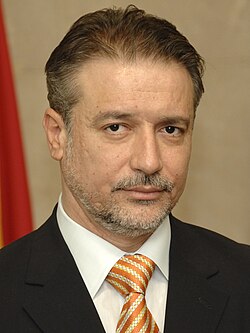 Branko CrvenkovskiBranko Crvenkovski (born 12 October 1962) is a Macedonian…Affiliated
 Boris TrajkovskiBoris Trajkovski (25 June 1956Affiliated
 Ali AhmetiAli AhmetiAffiliated
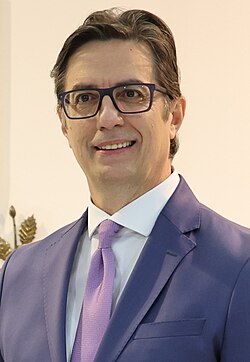 Stevo PendarovskiStevo Pendarovski is a Macedonian politician who served as…Affiliated
 Ljubčo GeorgievskiLjubčo Georgievski (born 17 January 1966) is a Macedonian…Affiliated
 Gjorge IvanovGjorge Ivanov (Macedonian: Ѓорге ИвановAffiliated
 Nikola GruevskiNikola Gruevski is a former Macedonian politician who…Affiliated
How the record is sourced and how the score is derived.
The score is formula-derived (Factrail formula v1, version 1.0.0), not an editorial verdict. Read the methodology.
By the Factrail desk · Method: how we source and score · Last reviewed
Dispute a fact on this pageNamed here, or represent someone who is? Request a right of reply.
People and organizations as listed in the Related section of this page; facts, drivers and the pages that name it as listed in the blocks here. Counts, not a rating.