
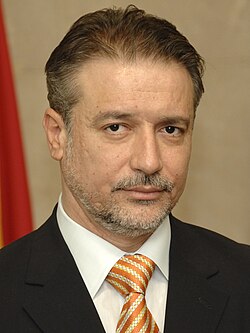
Trajko Veljanovski
Trajko Veljanovski (Macedonian: Трајко Вељаноски; also spelled Veljanoski) is a lawyer and politician from North Macedonia and a long-time member…
- Facts0
- Drivers0
- Indicators0
Trajko Veljanovski (Macedonian: Трајко Вељаноски; also spelled Veljanoski) is a lawyer and politician from North Macedonia and a long-time member…
Trajko Veljanovski (Macedonian: Трајко Вељаноски; also spelled Veljanoski) is a lawyer and politician from North Macedonia and a long-time member of VMRO-DPMNE. He was President of the Assembly of the Republic of Macedonia, the name the state used during his tenure, from 21 June 2008 until 27 April 2017, when a new majority elected Talat Xhaferi in his place. He was re-elected to the chair after the parliamentary elections of 2011 and 2014. In 2021 a Skopje court sentenced him at first instance as an organizer of the violent entry into parliament on the day Xhaferi was elected; in January 2025 that court stopped the case under a 2018 amnesty, and within days the government named him an adviser to Prime Minister Hristijan Mickoski.
Veljanovski was born on 2 November 1962 in Skopje. He graduated in law at Ss. Cyril and Methodius University of Skopje, passed the bar examination in 1988, and practised from his own office until the beginning of 1999. He joined VMRO-DPMNE in 1993. For a number of years he headed the party’s legal-affairs committee and its forum on legal and political questions and the judicial system, and he was a member of its political-system committee. In 1999 he was appointed under-secretary in the Ministry of Justice and soon afterwards deputy minister, working on draft legislation and on bilateral and multilateral agreements. In the same period he sat on the president of the republic’s committee of appeals, on the managing board of the Centre for European Integration, and on the State Election Commission in presidential, parliamentary and local elections. The Assembly biography states that he is married and has two children.
He entered the Assembly at the 2006 parliamentary election and, until April 2008, chaired the Committee on Election and Appointment Issues. Early elections followed the Assembly’s dissolution in April 2008; on 21 June the new chamber elected him speaker. He was elected a member for a third time in June 2011 and for a fourth time in April 2014, and the constitutive sessions of those parliaments returned him as president of the Assembly. In those terms he chaired the Committee on Constitutional Issues and headed the Assembly’s delegation to the Inter-Parliamentary Union. In July 2010 the Social Democratic Union of Macedonia and the New Social Democratic Party tabled a motion to dismiss him over a 1 July confrontation between police and opposition deputies inside the parliament building; after a debate lasting about twelve hours, 14 members voted for dismissal and 68 against.
On 27 April 2017, after months of deadlock following the December 2016 election, the new majority chose Xhaferi as speaker. Supporters of VMRO-DPMNE then entered the building. About 100 people were injured, among them Zoran Zaev, then leader of the Social Democrats and later prime minister. On 18 December 2018 parliament adopted an amnesty for some people caught up in the attack, while excluding organizers, people who used physical violence, masked attackers, people carrying weapons, and officials who exceeded their authority; opposition votes for the law were tied to the procedure for the Prespa Agreement with Greece. On 26 July 2021 the Criminal Court in Skopje, in a judgment that was not yet final, sentenced Veljanovski to six years and six months’ imprisonment for terrorist endangerment of the constitutional order, together with former ministers Mile Janakieski and Spiro Ristovski (six years and three months each) and former secret-police chief Vladimir Atanasovski (six years). The court found that they had prepared a plan to stop a peaceful transfer of power; the defendants expressed remorse for the violence and denied organizing it. An appellate court quashed that judgment and ordered a retrial. On 23 January 2025 the trial court granted the defendants’ request for amnesty and halted the proceedings, although presiding judge Ilija Trpkov said he still believed the 2018 law had not been intended to cover organizers. On 29 January 2025 the government published the names of Mickoski’s advisers and listed Veljanovski as adviser on the parliamentary, political and judicial system.
Trajko Veljanovski was born on 2 November 1962 in Skopje. The Assembly of North Macedonia spells the surname Veljanoski (Macedonian: Трајко Вељаноски), as does much of the press. Parliamentary biographies published while he was president of the Assembly do not name his parents or describe any schooling before university.
He graduated from the Faculty of Law at Ss. Cyril and Methodius University of Skopje. The faculty states that it is the oldest higher-education institution in North Macedonia in the legal, political and communication sciences. A government decree of 3 November 1951 established it as a department of the Faculty of Law and Economics of the University of Skopje, and from 1 July 1956 it operated as an independent faculty of legal sciences. In 2001, on the fiftieth anniversary, the faculty council renamed it the Iustinianus Primus Faculty of Law, so that name post-dates Veljanovski's studies. The Assembly biography does not give the year in which he graduated.
In 1988 he passed the bar examination (Macedonian: адвокатски испит) and opened an independent law office in the same year. He practised as a lawyer until the beginning of 1999. Published biographical notices do not identify his clients or the cases he handled.
Lawyers were organised in a single professional chamber. On 16 June 1945, on a proposal from the minister of justice Pavel Shatev, the Ministerial Council created the Skopje Bar Chamber, with jurisdiction over Federal Macedonia; the decision was also signed by Lazar Koliševski, president of the Macedonian federal government. The chamber held its founding assembly on 28 January 1951. Veljanovski's practice therefore began inside an organisation founded decades earlier and continued after independence. The Assembly adopted the Constitution of the Republic of Macedonia on 17 November 1991, following the referendum of 8 September 1991. Article 53 provides that attorneyship "shall be an autonomous and independent public service, providing legal assistance and carrying out public mandates in accordance with the law." The Bar Association records that on 16 December 1992 the Assembly passed the first law on advocacy of the independent state. In 1999 he left private practice when he was appointed under-secretary in the Ministry of Justice.
Biographies issued by the Assembly while he was its president describe him as married and the father of two children. His wife, Suzana Veljanoska (Сузана Вељаноска), died on 13 October 2017 after a short and severe illness and was survived by her husband and two adult children. The funeral was to be held in the following days at the cemetery in Gjorče Petrov.
Veljanovski joined VMRO-DPMNE in 1993, while still in private practice. Biographies issued by the Assembly of North Macedonia while he was its president state that for a number of years he headed the party's Commission for Legal Affairs and its Forum on Legal and Political Affairs and the Judicial System, and that he was a member of its Commission for the Political System, without dating those posts.
At the parliamentary elections of 18 October and 1 November 1998, the OSCE Office for Democratic Institutions and Human Rights described VMRO-DPMNE as a major opposition party in a long-term coalition with the Democratic Alternative, and as the principal opponent of the governing Social Democratic Union of Macedonia. On 30 November 1998 the prime minister-designate, Ljubčo Georgievski, told the Assembly that the VMRO-DPMNE–Democratic Alternative electoral coalition had 62 deputies, enough to form a government alone, and that the Democratic Party of Albanians had then been included, producing a three-party cabinet. The same sitting elected that government, with Georgievski as prime minister, by 76 votes to 31 with one abstention, and named Prof. Dr. Vlado Kambovski to head the Ministry of Justice.
The Assembly biography states that in 1999, on leaving legal practice, he was elected under-secretary in the Ministry of Justice and soon afterwards became deputy minister. An Assembly decision of 14 September 1999, published the next day, already listed him — under the spelling Трајко Велиноски — as a graduate lawyer and under-secretary, so that post was in place while Kambovski was still minister. On 27 December 1999 the Assembly elected a reconstructed cabinet, still under Georgievski, by 72 votes to 17 with two abstentions, and Xhevdet Nasufi (м-р Џевдет Насуфи) succeeded Kambovski at Justice; the biography dates the deputy ministership only as "soon afterwards" and does not record when either post ended.
In both posts, the biography says, he worked on drafting laws and on their adoption in the Assembly and its working bodies, on bilateral and multilateral agreements, and at international meetings. It also records membership, in the same period, of the President of the Republic's Commission for Petitions and Proposals (Комисија за претставки и предлози; rendered in the English biography as the Committee of Appeals) and of the managing board of the Centre for European Integration (Центар за европски интеграции).
The presidential election of 31 October and 14 November 1999 was run by a State Election Commission appointed by parliament under the Law on the Election of Members of the Assembly. OSCE/ODIHR reported a president, eight members and a non-voting secretary, each with a deputy: the president and two members were Supreme Court judges; three members and deputies were proposed by the governing parties VMRO-DPMNE, the Democratic Alternative and the Democratic Party of Albanians; and three by the largest opposition parties at the previous election, the Social Democratic Union, the Socialist Party of Macedonia and the Party of Democratic Prosperity. During signature collection, the Assembly's Committee on Appointments dismissed president Ms. Inglizova for an "invalid interpretation" of party quotas on election bodies, despite a law the previous month extending her term to 2002. The decision of 14 September 1999, taken under Article 12(3) of the parliamentary election law and amending Official Gazette no. 36/98, named Supreme Court judge Josif Lukovski as president and placed Veljanovski, as under-secretary, among the deputy members rather than the full members. Under Article 27 the commission enforced the election law, appointed district commissions, printed ballots, decided complaints and announced results. The biography adds service in several presidential, parliamentary and local cycles, but the September 1999 entry is what documents him, as a deputy member, for that election.
Parliamentary elections in the then former Yugoslav Republic of Macedonia, now North Macedonia, were held on 5 July 2006 for all 120 seats in the Assembly (Sobranie), about two months early. On 18 April Speaker Ljupco Jordanovski called the poll after the governing Social Democratic Union of Macedonia (SDSM) accepted an earlier date sought by opposition VMRO-DPMNE leader Nikola Gruevski. Seats were filled by regional proportional representation, with no threshold and 20 members in each of six districts. Since European Union candidate status in December 2005, a vote in line with OSCE standards had been treated as a condition for moving toward membership, and the election was also viewed as important for NATO.
VMRO-DPMNE headed a 14-party coalition and campaigned on reform and the economy, while the Democratic Union for Integration (DUI) allied with the Party for Democratic Prosperity and the Democratic Party of Albanians (DPA) stood alone. The Organization for Security and Co-operation in Europe Office for Democratic Institutions and Human Rights found that the elections largely met OSCE commitments and were competitive and generally well administered, but that campaign violence, mostly between ethnic Albanian parties in the north-west, and irregularities such as ballot-box stuffing and group voting overshadowed the process. Turnout was 55.98 per cent of 1,741,449 registered voters.
Final State Election Commission figures, including 19 July re-runs in 29 polling stations ordered by the Supreme Court on 14 July, gave the VMRO-DPMNE coalition 45 seats (32.50 per cent), the SDSM-led “For Macedonia Together” coalition 32, DUI–PDP 17 and the DPA 11. VMRO–People’s Party took seven seats and the New Social Democratic Party (NSDP), formed in November 2005 by Tito Petkovski after he left the SDSM, six; Democratic Reconstruction of Macedonia and the Party for European Future took one each. The Inter-Parliamentary Union’s narrative reversed those two close results.
Trajko Veljanovski—spelled Veljanoski (Трајко Вељаноски) in Assembly records—a VMRO-DPMNE member, was elected to the Assembly. On 28 July President Branko Crvenkovski gave Gruevski the mandate to form a government. The Assembly met on 1 August and elected Ljubisa Georgievski of VMRO-DPMNE as its president with 69 votes; DUI–PDP deputies boycotted over their exclusion. On 15 August Gruevski announced a cabinet of VMRO-DPMNE, the DPA, the NSDP and non-partisan members, which was sworn in on 26 August.
Until April 2008 Veljanovski chaired the Committee on Election and Appointment Issues, composed of a chair, twelve members and deputies; the same working-body list names him vice-chairman of the Committee on Constitutional Issues under Stojan Andov. It opined on appointments within the Assembly’s competence, proposed board members the Assembly elected, and proposed the composition of working bodies, international delegations and cooperation groups.
The mandate ended when the Assembly voted on 11 April 2008 to dissolve itself, with the dissolution dated 12 April, nearly two years early. A motion by DUI leader Ali Ahmeti, tabled after Greece blocked a NATO invitation over the country’s name, passed with 70 votes from DUI, VMRO-DPMNE and the DPA; the SDSM and the NSDP boycotted. Speaker Georgievski then called elections for 1 June 2008.
Trajko Veljanovski — the Assembly and much of the press used Veljanoski (Трајко Вељаноски) — was elected President of the Assembly of the Republic of Macedonia on 21 June 2008, succeeding Ljubiša Georgievski. The state kept that name through his speakership and became the Republic of North Macedonia in February 2019. In the early election of 1 June 2008, with reruns through 29 June, the VMRO-DPMNE-led coalition of Prime Minister Nikola Gruevski won 63 of 120 seats, the Social Democratic “Sun – Coalition for Europe” 27, the Democratic Union for Integration (DUI) 18, the Democratic Party of Albanians (DPA) 11 and the Party for European Future one. The constitutive session verified 114 mandates, the DPA boycotted, and Veljanovski received 79 votes in favour and 19 abstentions, with none against. The OSCE Office for Democratic Institutions and Human Rights found the poll well administered in most of the country, but short of key OSCE commitments because of violence and intimidation, especially in predominantly ethnic Albanian areas.
On 15 April 2011, the day after the Assembly dissolved itself, Veljanovski called an election for 5 June, the first to include three diaspora seats in a chamber of 123. VMRO-DPMNE’s coalition won 56 seats, the Social Democratic Union of Macedonia (SDSM) coalition 42, DUI 15, the DPA 8 and National Democratic Revival 2. At the constitutive session in Skopje on 25 June, all 123 mandates were verified and he was re-elected by 70 votes to 47, with 2 abstentions. SDSM and New Social Democratic Party deputies opposed him over the 1 July 2010 incident in the parliament building and over laws passed without the opposition, while protesters outside demanded accountability for Martin Neskovski, beaten by police on election day. OSCE observers called the election competitive, transparent and well administered, but noted the preceding boycott and the mistrust between government and opposition.
He won a third term on 10 May 2014, after the 27 April early election, held with the presidential runoff. VMRO-DPMNE’s coalition took 61 seats, the SDSM coalition 34, DUI 19, the DPA 7, and one each for National Democratic Revival and Citizen Option for Macedonia (GROM). The only candidate, he received 87 votes in favour, none against and none abstaining, after the chamber verified all 123 mandates by 86 votes. SDSM and National Democratic Revival refused their mandates and stayed away, leaving about 88 deputies at work, seven from the DPA. VMRO-DPMNE and DUI had already agreed to renew the coalition. OSCE/ODIHR reported efficient administration, including on election day, and unobstructed campaigning, but an inadequate separation of party and state and persistent allegations of intimidation.
Assembly biographies for both the 2011 and 2014 compositions list Veljanovski as chair of the Committee on Constitutional Issues and as head of the delegation to the Inter-Parliamentary Union. In the 2014–2016 working bodies the committee had a chair, 16 members and their deputies, and dealt with constitutional implementation, amendment proposals, and constitutional questions in legislation. On 19–21 October 2009 he led that delegation to the 121st IPU Assembly in Geneva, with vice-presidents Jani Makraduli and Rafis Aliti and members Silvana Boneva, Goran Misoski and Flora Kadri.
On 15 October 2012 he opened a Skopje conference as the Assembly began a one-year chairmanship of the parliamentary dimension of the South-East European Cooperation Process, tracing it to a Greek initiative in Athens and to the 2008 Sofia memorandum on regional cooperation. In February 2013, after meeting United Nations Secretary-General Ban Ki-moon, he described the talks as a continuation of Ban’s July 2012 visit with mediator Matthew Nimetz, urged a settlement of the name dispute with Greece as an obstacle to the European Union and NATO, and said he expected the two speakers to meet.
The chair rested on VMRO-DPMNE-led majorities whose ethnic Albanian partner was DUI. After 2008 those parties held 81 of 120 seats, and Gruevski formed the government with DUI rather than the DPA. In 2011 their 71 seats re-elected Veljanovski against 47 opposition votes. In 2014 the SDSM boycott left that majority, with the seven DPA deputies who did sit, to choose the speaker alone, and blocked commissions the law required the opposition to chair, including secret-police and intelligence oversight and human rights.
The DPA had boycotted from August 2009 until the April 2011 dissolution, urging DUI out of government over the status of Albanian. SDSM stopped sitting on 28 January 2011 after a police raid on A1 television and the arrest of its owner; smaller parties joined, and the standoff ended in the early election. On 10 July 2010, after about twelve hours, a no-confidence motion failed by 14 votes for dismissal to 68 against from the ruling majority. SDSM and the New Social Democrats said that on 1 July police had eavesdropped on them in their offices and posted armed officers outside, and that Veljanovski had blocked an inquiry; they called him a puppet of Gruevski and Interior Minister Gordana Jankulovska. The majority said the opposition had staged the incident. Security video showed a clash and shoving, and Jankulovska confirmed officers had been there while repeating that charge. Veljanovski said he had wanted an inquiry, but talks ended once the dismissal motion was filed. The 24 December 2012 budget sitting and the 2015–2017 crises lie outside this period.
On 24 December 2012 the Assembly of the Republic of Macedonia (now North Macedonia) met to adopt the 2013 budget after the Social Democratic Union of Macedonia (SDSM) had stalled the financing commission with more than 1,200 amendments. SDSM opposed two World Bank loans, together €250–300 million, which the VMRO-DPMNE government wanted early in 2013. Finance Minister Zoran Stavreski said the blockade would add €84 million by forcing dearer borrowing; the draft set spending near €2.7 billion against revenue near €2.4 billion. On 23 December the cabinet of Prime Minister Nikola Gruevski sent a revised draft to the plenary. SDSM called that illegal, and Gruevski asked the opposition not to "take the citizens of Macedonia hostage."
In Skopje, SDSM deputies blocked the chamber doors. Balkan Insight reported that the ruling coalition entered by a back door, security was called, and opposition deputies surrounded Speaker Trajko Veljanovski; after a scuffle he was evacuated, and reports said three deputies were hurt. The European Court of Human Rights later recorded that opposition members slapped his table and that parliamentary security removed him and then opposition deputies, while other officers cleared the gallery. Al Jazeera reported Radmila Shekerinska among the injured, and SDSM's Mile Andonov told Radio Free Europe/Radio Liberty that plainclothes interior-ministry officers carried deputies out, and that Mitre Veljanovski was seriously hurt. The majority then passed the budget by 64 votes to four. Veljanovski said, "Everything we did today, we did for the good of the people and the state."
Outside, several thousand supporters of each side threw stones, eggs, apples and bottles across a police cordon until riot police pushed back a breakthrough by SDSM leader Branko Crvenkovski. Balkan Insight reported two civilians hospitalised and at least 18 injured overall; Al Jazeera reported six people briefly treated. Crvenkovski called the day "Gruevski's October 5," after the October 2000 protests in Serbia, and said SDSM would boycott sittings and use civil disobedience.
Reporters were in the gallery above the chamber. The government told the Court that security ordered it cleared; some left, and six who refused, including Association of Journalists president Naser Selmani, were forced out. They said no reason was given. On 26 December Veljanovski wrote that, under section 43 of the Parliament Act, he had asked security to let the session proceed, that the service itself decided to empty the gallery, and that he regretted "such a measure regarding the journalists." He told a news agency he had given no explicit order to remove the press.
Selmani's Association of Journalists asked the Interior Ministry to identify who ordered the removal. On 6 January 2013 its standards department said the gallery was cleared because other people were there and protests might break the cordons, that resisters injured an officer's leg, and that the force was not excessive. The journalists denied causing injury; the government alleged, without the record it cited, that Selmani had injured an officer. On 28 December reporters booed Veljanovski and walked out, SDSM put questions outside, and the association called for a boycott of government briefings. Selmani said the government had "reached the bottom of its irresponsible behaviour."
An EU-brokered end to the boycott provided for an inquiry. A commission appointed on 14 June 2013, with two EU observers, reported on 26 August that the removal violated freedom of public information; chair Borce Davitkovski said it would not assign blame, while SDSM insisted Veljanovski testify in person. On 16 April 2014 the Constitutional Court, without the hearing the journalists had requested, held the removal lawful and necessary for safety, finding that objects had been thrown toward the gallery. Selmani called that scandalous and asked why ruling-party deputies had not been removed as well.
In Selmani and Others v. the former Yugoslav Republic of Macedonia (no. 67259/14), on 9 February 2017 (final on 9 May), the Court in Strasbourg found violations of Articles 6 § 1 and 10 of the European Convention on Human Rights. Refusal of an oral hearing breached Article 6, because the Constitutional Court alone decided the merits, disputed facts mattered, and it gave no reasons for skipping a hearing. The removal breached Article 10: it interfered with freedom of expression, was prescribed by law and aimed at safety and order, but was not necessary: they were passive observers in a separate gallery, and a broadcast did not replace firsthand reporting. The inquiry was not redress. Each applicant received €5,000 for non-pecuniary damage, and nothing for costs.
In February 2015, while Trajko Veljanovski presided over the Assembly of the Republic of Macedonia (now North Macedonia), Zoran Zaev of the opposition Social Democratic Union of Macedonia (SDSM) began releasing recordings he said showed that Prime Minister Nikola Gruevski and secret-police chief Saso Mijalkov had ordered surveillance of more than 20,000 people. Zaev said the material came from inside the security service; the government said a foreign service had supplied it, and prosecutors charged him with espionage and with threatening officials. SDSM had already been absent since the disputed April 2014 election. The European Commission later recorded that its deputies returned only on 1 September 2015, after 16 months, and that the boycott “seriously affected” oversight of the executive, especially of the intelligence services.
On 29 April SDSM aired conversations it attributed to Interior Minister Gordana Jankuloska, Mijalkov and Veljanovski, dated to September 2012, in which they discuss limiting unannounced visits by the opposition-chaired commission overseeing the secret police. The government called the tapes fabricated. On 12 May Jankuloska, Transport Minister Mile Janakieski and Mijalkov resigned, during the same days as fighting in Kumanovo in which eight police officers were killed. On 13 May Veljanovski said the Assembly would open an opposition-chaired inquiry into the wiretaps only if SDSM ended the boycott; Zaev still demanded Gruevski’s resignation. No such committee existed when the Commission reported in November. A commission chaired by SDSM’s Petre Shilegov began hearing witnesses, including Gruevski, only in December, to assign political rather than criminal responsibility.
On 2 June and 15 July 2015 the four largest parties — VMRO-DPMNE, SDSM, the Democratic Union for Integration and the Democratic Party of Albanians — accepted an agreement in Skopje facilitated by Enlargement Commissioner Johannes Hahn, Members of the European Parliament Ivo Vajgl, Richard Howitt and Eduard Kukan, and the EU and United States ambassadors. The 15 July protocol set SDSM’s return for 1 September, a special prosecutor by 15 September, and elections for 24 April 2016 under a technical government installed 100 days earlier. On 15 April 2016 Veljanovski signed the decision calling elections for 5 June.
SDSM deputies returned on 1 September 2015. On 15 September the parties agreed to name Katica Janeva, a prosecutor from Gevgelija, as an autonomous special prosecutor. The OSCE Office for Democratic Institutions and Human Rights later noted missed deadlines: the new State Election Commission was appointed on 15 December, and SDSM’s ministers and deputies on 11 November.
On 14 January 2016 Gruevski said he would hand his resignation to the speaker the next morning, 100 days before 24 April. SDSM refused to run unless the voter register was cleaned, media rules changed and party and state separated, and on 23 February parliament postponed dissolution. Veljanovski dissolved the Assembly on 6 April, opening the 60-day count to 5 June. The 15 April signature followed protests against pardons that President Gjorge Ivanov issued on 12 April for 56 people implicated in the wiretap case, including both party leaders.
Only VMRO-DPMNE, of the four signatories, filed candidate lists. On 18 May the Constitutional Court restrained the dissolution and the speaker’s call for 5 June; the same day the reconvened Assembly, with 96 members present, deleted that date from the Electoral Code and replaced the resigning SDSM ministers with VMRO-DPMNE nominees. On 25 May the court held the dissolution unconstitutional and nullified the speaker’s decree, and the government reverted to its pre-agreement composition. After further EU-sponsored talks the Assembly dissolved itself again on 17 October, by 110 votes of 123, for a poll on 11 December. Those elections, and the deadlock over a new speaker, closed this phase without resolving it.
The Commission’s report of 10 November 2015 called the interceptions the country’s worst political crisis since 2001 and made its recommendation to open accession talks conditional on the June/July agreement and on “Urgent Reform Priorities” covering interceptions, the judiciary, oversight, elections and the media.
Ambassador Jan Petersen, heading the OSCE/ODIHR mission for the cancelled 5 June vote, told Veljanovski the mission would still report; the speaker said its findings could be corrected in time. The mission, opened on 31 March, stopped observing on 1 June.
On 15 September 2016 Veljanovski was listed to speak in Strasbourg, at the Council of Europe conference of parliamentary presidents, on the migration and refugee crisis and the role of parliaments. From 30 September to 2 October the Assembly hosted the OSCE Parliamentary Assembly autumn meeting in Skopje. Veljanovski said the migrant crisis raised economic and security questions for transit and destination countries; delegation head Renata Deskoska said the meeting should not hide an “ongoing political, legal and institutional crisis.”
The Republic of Macedonia (now North Macedonia) held early parliamentary elections on 11 December 2016. An observation mission led by the Organization for Security and Co-operation in Europe called them competitive and an essential step out of a two-year crisis, while recording verified intimidation and a voter-register review that left some citizens unable to vote. Of 1,784,416 registered voters, 1,191,852 cast ballots (66.79 percent). The coalition led by VMRO-DPMNE won 454,577 votes, 38.14 percent of ballots cast, and 51 of 120 seats; the coalition led by the Social Democratic Union of Macedonia won 436,981 votes, 36.66 percent, and 49. The Democratic Union for Integration took 10 seats, the Besa Movement five, the Alliance for Albanians three and the Democratic Party of Albanians two. No out-of-country member was elected, and a re-run on 25 December in Tearce did not change the seat totals. A government needed 61 votes, so the ethnic Albanian parties’ 20 seats decided the arithmetic. Trajko Veljanovski, president of the outgoing Assembly, was returned on the VMRO-DPMNE list in electoral district 2, covering northern Skopje and Kumanovo.
On 7 January 2017, DUI, Besa and the Alliance for Albanians, holding 18 seats, signed a joint declaration after talks that included Albania’s prime minister, Edi Rama. The text, known as the Tirana platform, made entry into any government conditional on points that included official use of Albanian throughout the country, a debate on the flag, anthem and coat of arms, and a resolution on what the parties called genocide against Albanians from 1912 to 1956. VMRO-DPMNE treated the document as a platform drawn up with a foreign government and as a threat to the unitary state and the 2001 Ohrid Framework Agreement; the Albanian signatories presented it as a common position on equality.
Article 90 of the constitution requires the president, within ten days of the Assembly being constituted, to entrust the mandate to a candidate of the party or parties with a majority; that candidate has 20 days to propose a cabinet, which the Assembly elects by a majority of all members. Article 63 requires a constitutive meeting within 20 days of the election, called by the president of the previous Assembly. Veljanovski opened it on 30 December 2016; 118 of 120 members attended, the two from the DPA being absent. SDSM’s Oliver Spasovski said the oldest member should preside, as in 2011 and 2014; Veljanovski answered that the rules of procedure prevailed. Mandates were verified and the sitting then stopped, because no side could yet elect a speaker, so Veljanovski stayed on as provisional chair.
On 9 January, President Gjorge Ivanov entrusted the mandate to VMRO-DPMNE leader Nikola Gruevski. At midnight on 29 January, DUI said it had not chosen a partner, Gruevski’s 20 days ended without 61 votes, and VMRO-DPMNE called for another election; whether the next mandate had to go to SDSM was disputed. On 27 February, SDSM leader Zoran Zaev submitted 67 signatures. On 1 March Ivanov refused, saying the constitution and his conscience barred a mandate for anyone who would destroy the country’s sovereignty and integrity, and that Zaev must publicly reject a “platform coming from a foreign country.” Zaev called that an attempted coup against a parliamentary majority. EU high representative Federica Mogherini asked Ivanov to reverse the decision and quoted the duty to entrust the mandate to a candidate of the majority party; US ambassador Jess Baily said the refusal conflicted with democratic principles and the rule of law.
The constitutive session resumed on 27 March, with the speaker’s election on the agenda. DUI proposed its member Talat Xhaferi, and SDSM was expected to back him inside a bloc of 67. All 51 VMRO-DPMNE members registered to speak, and Veljanovski let members of the same party reply to one another, which the rules otherwise barred, because he said parliamentary groups were not yet formed. The party would accept a speaker only if the Assembly were then dissolved for a new election; the majority said a speaker would remove Ivanov’s procedural reason to withhold the mandate. Sittings continued into late April with no president of the Assembly elected, and Veljanovski still presided as the outgoing president.
On 27 April 2017 the Assembly of the Republic of Macedonia (now North Macedonia) was still in constitutive session in Skopje, more than four months after the December 2016 election. VMRO-DPMNE had filibustered the sitting for about a month. President Gjorge Ivanov had withheld a mandate from Zoran Zaev of the Social Democratic Union of Macedonia (SDSM), whose majority included ethnic Albanian parties, among them the Democratic Union for Integration. Ivanov said wider use of Albanian threatened national unity; the coalition's supporters said he was shielding VMRO-DPMNE leaders after the wiretapping scandal.
Incumbent speaker Trajko Veljanovski, of VMRO-DPMNE, chaired the sitting and then adjourned it. Two days later he called the ballot a "planned scenario," done "in half a minute" and "in a corner of the hall," and said the sitting he had adjourned was unfinished. In later testimony he put the adjournment at 18:01, said he had followed the rules, and regretted the violence.
Deputies of the new majority stayed in the hall. With the oldest member absent, Ferid Muhić presided and named deputies; Goran Misovski chaired the vote. Talat Xhaferi, a DUI deputy and former defence minister, received 61 votes. The Besa Movement and the Democratic Party of Albanians did not vote for him; Balkan Insight described the electors as a majority of 67 in the 120-seat house. He took the oath, then repeated it in Albanian, while VMRO-DPMNE deputies shouted "this is a coup" and sang the anthem. The party called the result a "coup attempt and the installation of parallel institutions"; Xhaferi said a legitimate majority "cannot be a coup." Zaev had suggested that morning that a speaker might be chosen outside ordinary procedure, which the conservatives called an attempted coup. The U.S. Embassy later called the ballot "a regular, continued session of parliament witnessed by members of the public and the press."
Demonstrators who had rallied for about two months as "For a United Macedonia," many of them supporters of former prime minister Nikola Gruevski, then forced their way in. About 200 people, some masked or hooded, broke a police cordon, used side doors, and reached the press hall and the chamber. They threw chairs, overturned camera tripods and punched people, shouting "traitors" and carrying the national flag, while outnumbered police offered little resistance at first. Officers later fired stun grenades outside to clear an exit.
Zaev, at a press conference inside the building, was left bleeding from the forehead; the wound was not thought serious, and three other SDSM deputies were also hurt. Police told RFE/RL that Ziadin Sela, identified as leader of the Albanian Alliance, was the most seriously injured and was taken to a Skopje clinic. Balkan Insight, calling him head of a Democratic Party of Albanians reform group, also reported serious injuries. Authorities' figures differed: police put the toll at 77, including 22 officers; the BBC the next day reported more than 80, including 25 officers; CPJ, citing press reports, about 100, including at least seven lawmakers.
Reporters were attacked as well: RFE/RL said demonstrators damaged doors, seized phones and cameras, and struck its correspondents. Dimitar Tanurov of Meta told CPJ that protesters who saw his press card called him a traitor, took his phone and beat him; he was hurt in the face and head but not hospitalised. Makfax cameraman Nikola Ordevski was treated for a concussion, and at least four other journalists said they were pushed, threatened or stripped of equipment.
SDSM accused VMRO-DPMNE of inciting the violence. Gruevski wrote that "violence is not the solution," while also, the BBC reported, calling the crowd provoked by Xhaferi's election. Interior Minister Agim Nuhiu said "certain police structures" had not done their job, that part of the security forces was under "political influence," and that he would resign. Ivanov called for calm, said the constitution had been violated, and summoned party leaders for the next day. Veljanovski wrote that there had been "no handover of office to the illegitimate and unconstitutional" speaker.
European Union foreign-policy chief Federica Mogherini and Enlargement Commissioner Johannes Hahn called the attacks "wholly unacceptable," told the police to secure the Assembly, and took "positive note" of Xhaferi's election. NATO Secretary General Jens Stoltenberg said he was shocked and urged "dialogue, not violence." The U.S. Embassy said the assault was "not consistent with democracy" and that it would work with the new speaker. The next day the EU delegation, the U.S. Embassy, the OSCE Mission and the NATO office in Skopje called it an "organised attack" on democracy and faulted the authorities for not protecting deputies and journalists. Russia's foreign ministry instead called the election an attempt "to seize power... in violation of established procedures" and accused the EU and the United States of "blatant interference."
On 20 February 2019 police in Skopje detained former Assembly speaker Trajko Veljanovski and former ministers Spiro Ristovski and Mile Janakieski on an order of the Public Prosecution. The office said five people were suspected of organizing the 27 April 2017 violence and of "endangerment of the constitutional order and security," by using party structures, reducing the police presence, arranging a mass entry into parliament and hiring people to commit violent acts. On 31 May 2019 the organized-crime prosecution indicted Veljanovski, Janakieski, a former transport minister, Ristovski, a former education minister, and former secret-police chief Vladimir Atanasovski. The Skopje Criminal Court accepted the indictment on 31 January 2020, and the trial opened on 21 February 2020. The charge was terrorist endangerment of the constitutional order and security under Article 313 of the Criminal Code, which prosecutor Vilma Ruskoska had distinguished, in the wider April 27 cases, from terrorism under Article 394-b.
Former prime minister Nikola Gruevski, the first accused, and former intelligence officer Nikola Boskoski — also spelled Boshkovski — were left out of that trial. Gruevski had asylum in Hungary after fleeing a corruption sentence; Boskoski had gone to Greece in July 2017 and was reported to have received asylum there, and both cases stayed stopped until they appeared or were extradited. The four in court pleaded not guilty. Veljanovski called it "classic political persecution," and Ruskoska said the proof would include calls to VMRO-DPMNE headquarters, contact with Gruevski and help given to violent entrants inside the chamber.
On 26 July 2021 Judge Ilija Trpkov convicted them at first instance: Veljanovski to six years and six months, Janakieski and Ristovski to six years and three months each, and Atanasovski to six years. The court found they had "prepared and implemented a plan with acts of violence to prevent the peaceful transfer of power," engaged the party structure, worked to remove police from the building and coordinated groups including so-called patriotic associations, in an attack that injured about 100 people. The defendants expressed remorse for the violence but denied organizing it and, with the party, said it had been spontaneous. Trpkov said the sentences were lower than the guilty findings suggested, citing their conduct and the 2018 amnesty law, and that one does not defend one's country by beating members of parliament. The court ordered house arrest for Veljanovski, Ristovski and Atanasovski until the judgment was final; Janakieski remained under house arrest already imposed. In a separate trial of people who entered the building, rather than of alleged organizers, 17 defendants received combined sentences of about 200 years.
On 18 December 2018 all 95 deputies present in the 120-seat Assembly voted for an Amnesty Law confined to the 27 April events. Published on 20 December as Official Gazette No. 233/2018, it bars prosecution, stops proceedings and waives sentences for those who qualify. Deputy speaker Frosina Remenski said it excluded organizers and those who prepared the events, people who used physical violence, masked people who used violence, people carrying weapons, and officials who exceeded their authority. Transparency International's account of Articles 1(3) and (4) adds association for hostile activity and unauthorized explosives. Applicants had to ask; the prosecution opined and the court decided.
Twenty-one deputies drafted it after talks in which VMRO-DPMNE sought an amnesty and the Social Democratic Union of Macedonia government of Zoran Zaev had first called a broad amnesty interference in the courts. Eight opposition deputies who in October 2018 opened the constitutional changes required by the Prespa Agreement with Greece then conditioned further support on "reconciliation," including this law; three of the opposition drafters were themselves on trial, and an amendment to cover every participant failed the same day. Zaev said he would "pay a political price" to carry out the name agreement and advance NATO and EU talks. Critics called that a trade of the rule of law for votes, and law professors opposed impunity for the attack. The Criminal Court later amnestied more than 20 people and rejected 13 applications as excluded; on 4 December 2019 the Constitutional Court declined to review Articles 1 and 2.
On 3 April 2023 the Skopje Appellate Court quashed the convictions and ordered a retrial. It found Criminal Procedure Code violations that blocked a correct application of the Criminal Code: the facts of the offence were not fully established, and the failure to deal with the amnesty provisions breached the rights of defence and a fair trial. In the retrial the defence asked for the 2018 law. On 24 December 2024 prosecutors told the court that the request "cannot be challenged" for Veljanovski, Janakieski and Ristovski, who should be treated like others already amnestied, but that the exceptions still excluded Atanasovski, and the hearing was adjourned to 23 January 2025.
That day the Criminal Court, Trpkov presiding, granted the amnesty motion and terminated the proceedings on the 2019 indictment, an end to the case under the statute rather than a new finding on the evidence. The agency's report named all four defendants, and JURIST said the four were released under the 2018 law. Trpkov said the events had been real, that an attack on parliament was an attack on the state, and that he and the council still believed the legislature had not meant to amnesty organizers. He added that the prosecution and the appellate court had nevertheless found three defendants had not acted contrary to their powers, called it implausible that the others had organized themselves — a cordon, he said, is not broken even at a sports match — and said he had hoped they would prove they were uninvolved, while accepting their choice.
After Talat Xhaferi was elected president of the Assembly of the Republic of Macedonia on 27 April 2017, Veljanovski remained a VMRO-DPMNE member. On 2 May he did not hand Xhaferi the speaker’s keys or seal. In June 2017 he was proposed as chair of the committee supervising the Administration for Security and Counterintelligence (UBK) and the Intelligence Agency, and as a member of the Committee on Rules of Procedure and Mandate-Immunity Issues. The Assembly’s page for that composition lists him as chair of the Committee for Supervising the Work of the National Security Agency and the Intelligence Agency, a member of the Committee on Constitutional Issues and of the rules and immunity committee, a deputy member of the Committee on Political System and Inter-Ethnic Relations, and a member of the delegation to the Parliamentary Assembly of the South-East European Cooperation Process.
From 12 to 14 June 2018 he led an oversight visit to UBK. SDK.mk reported that eight members under his lead were told about 200 people were then under court-ordered communications surveillance, and were shown records, interception equipment and the use of special investigative measures. When the director said the service needed more money, Veljanovski said the committee would fully support that. The outlet said that, under the previous interior ministry and former UBK director Sašo Mijalkov, such committees had in ten years been allowed inside only once, and only as far as the courtyard.
He was not on the VMRO-DPMNE lists published on 10 March 2020 for the parliamentary election of 15 July 2020. All six constituency lists include an Aleksandar Veljanovski, not Trajko Veljanovski, and he is absent from the party’s members of the Assembly returned that year.
On 29 January 2025 the government of Prime Minister Hristijan Mickoski published 17 advisers, a list Deutsche Welle said was posted that day on the government website. Veljanovski was named external adviser for the parliamentary, political and judicial system. Also named were former finance minister Zoran Stavreski, for finance and banking, and former deputy prime minister Vladimir Peshevski, for strategic economic issues, both from the governments of Nikola Gruevski.
External advisers are engaged for a defined time, under the decision creating the prime minister’s office, from professors, scientists, businesspeople and specialists. Mickoski said on 28 January that monthly fees ran from 60,000 to 90,000 denars; Telma, citing the government, put three or four advisers at up to 90,000 and the rest at 60,000.
The list came six days after the Skopje Criminal Court, on 23 January 2025, halted the “April 27 organizers” case against Veljanovski and three co-defendants under the 2018 amnesty law. Telma noted other Gruevski-era names, including Peshevski, whose “Trajectory” prosecution it said had ended through criminal-code amendments, and security advisers Ljupčo Andonovski and Goran Nikolovski, whom it linked to Mijalkov. A government text it quoted said the advisers would bring policy experience and that the cabinet was guided by analysis and impartial advice, “strengthening transparency.”
Ranked by shared high-impact facts, then explicit ties, then shared drivers.
 Zoran ZaevZoran Zaev took power on 31 May 2017Affiliated
 Federica MogheriniFederica Mogherini is an Italian politician who served as…Affiliated
 Hristijan MickoskiPrime minister of North Macedonia since 23 June 2024 after…Affiliated
 Branko CrvenkovskiBranko Crvenkovski (born 12 October 1962) is a Macedonian…Affiliated
 Ali AhmetiAli AhmetiAffiliated
 Ljubčo GeorgievskiLjubčo Georgievski (born 17 January 1966) is a Macedonian…Affiliated
 Gjorge IvanovGjorge Ivanov (Macedonian: Ѓорге ИвановAffiliated
How the record is sourced and how the score is derived.
The score is formula-derived (Factrail formula v1, version 1.0.0), not an editorial verdict. Read the methodology.
By the Factrail desk · Method: how we source and score · Last reviewed
Dispute a fact on this pageNamed here, or represent someone who is? Request a right of reply.