
Mirze Edis
Mirze Edis (born 1 January 1972 in Kars, Turkey) is a politician of Die Linke and a member of the German Bundestag from Duisburg.
- Facts0
- Drivers0
- Indicators0
Mirze Edis (born 1 January 1972 in Kars, Turkey) is a politician of Die Linke and a member of the German Bundestag from Duisburg.
Mirze Edis (born 1 January 1972 in Kars, Turkey) is a politician of Die Linke and a member of the German Bundestag from Duisburg. The Bundestag lists his occupation as a steel-construction locksmith (Stahlbauschlosser) and records that he is married with three children; the same page states that biographical details rest on the member’s own account. He sits in the 21st Bundestag via the North Rhine-Westphalia state list of Die Linke, where he was placed sixth, after standing as the party’s direct candidate in constituency 114, Duisburg I. That Bundestag held its constitutive sitting on 25 March 2025.
His family came to the Ruhr as guest workers, and he grew up in Duisburg-Hochfeld. He attended the Hochfelder Markt primary school from 1978 to 1982, then the Hauptschule in Duisburg-Duissern from 1982 to 1986 and the Gutenberg Hauptschule in Duisburg from 1986 to 1988. From 1988 to 1990 he trained as a fitter and assembler at Hüttenwerke Krupp Mannesmann (HKM) in Duisburg, and he worked there as a steel-construction locksmith until 1994. He has said that his father worked at the same firm and that he joined the works council at the age of 22. He has remained a works-council member at HKM, disclosed to the Bundestag as a paid activity of €1,189.95 gross a month, and he is a member of the supervisory board of Duisburger Verkehrsgesellschaft AG.
In 2011, while he was a district representative of Die Linke in southern Duisburg, he was seriously injured in a dispute in a tea house; colleagues were later tried for dangerous bodily harm. At the 2021 federal election Die Linke took 4.7 percent of the first votes in Duisburg I. On 23 February 2025 Edis received 10,805 first votes (8.6 percent), behind Bärbel Bas of the Social Democratic Party on 39.0 percent, the CDU candidate on 22.0 percent and the Alternative for Germany candidate on 17.7 percent. Die Linke’s second-vote share in the constituency was 10.4 percent (13,149 votes).
In the 21st Bundestag he is a full member of the Committee on Economic Affairs and Energy and a deputy member of the Committee on European Union Affairs and the Committee on Economic Cooperation and Development, and he is one of the Bundestag’s secretaries (Schriftführer). He chairs the German–South Caucasus parliamentary group and is deputy chair of the German–Turkish parliamentary group. He is the Left group’s spokesperson on industrial policy and, with other members, organised a steel conference in Duisburg as a counterpart to the federal government’s steel summit. In May 2025 he said he was the member who, during a government statement by Chancellor Friedrich Merz, shouted that events in Gaza were not a war but a genocide, an interjection for which Bundestag President Julia Klöckner had reprimanded an unidentified member of Die Linke.
Mirze Edis was born on 1 January 1972 in Kars, Turkey. The Bundestag biography gives that date and place and notes that such biographies rest on the members' own information. The Rheinische Post has reported that he was born in Turkey and grew up in Hochfeld, a district of Duisburg. The Westdeutsche Allgemeine Zeitung described him as having come to Hochfeld as a Gastarbeiter child and later working casual jobs on the market there. The parliamentary biography and a 2021 Rheinische Post profile do not state the year of the move. He was enrolled at a Hochfeld primary school in 1978, so the family was in Duisburg by the time he was six.
In a 2021 profile he told the Rheinische Post that he had five siblings and that only his father went out to work. He remembered the Hochfeld of the early 1980s as a place where people still walked out on Sundays in tie and hat, and where families ate together at midday after morning Mass. His father, he said, admired the Social Democratic chancellors Willy Brandt and Helmut Schmidt; Brandt in particular was popular among Turks in the city.
The household was tied to the Ruhr steel industry. Edis later said that, growing up in Duisburg, young people wanted a job in steel — as a metalworker, turner, welder or electrician — and that an uncle and his older brothers already worked in steelworks. His father, he said, worked in industry at the same company he himself later joined, and in that generation the works employed about 15,000 people. Hochfeld, an Ortsteil in the borough of Duisburg-Mitte, has remained one of the city's most migrant districts. The municipal social report for 2024, drawing on city statistics for 2021, put the share of Hochfeld residents with a migration history at 80.3 percent, second in Duisburg only to Bruckhausen (84.2 percent) and ahead of Marxloh (78.7 percent).
From 1978 to 1982 Edis attended the Grundschule Hochfelder Markt in Duisburg, again according to the Bundestag biography.
He then entered a Hauptschule, the lower secondary track in North Rhine-Westphalia. The state education ministry describes that school form as covering classes 5 to 10 and combining a basic general education with vocational orientation, including work placements. His biography lists four years at the Hauptschule Duisburg/Duissern, from 1982 to 1986, and two further years, from 1986 to 1988, at the Hauptschule Gutenberg in Duisburg. It does not say why he changed schools. The six years match the length of the Hauptschule course, and they end in 1988, the year he turned sixteen.
During those years he was already earning money in the neighborhood. The Rheinische Post reported that at twelve he sold fruit and vegetables at the stall of a family friend on the Hochfelder Markt, which the profile presented as early practice in persuasion. On the dates in the Bundestag biography, age twelve fell during his time at the Duissern Hauptschule. The Westdeutsche Allgemeine Zeitung later summed up the same stretch of childhood as jobs on the market. General schooling, on the record he gave the Bundestag, stopped at the Hauptschule in 1988, at the edge of the steel trades his relatives were already in.
Mirze Edis’s working life has been spent at Hüttenwerke Krupp Mannesmann GmbH (HKM), the integrated steelworks in Duisburg-Huckingen. The company dates a steelworks on the site to 1909 and the present firm to 1990, when Krupp and Mannesmann founded it; the 2024 management report says a cooperation and supply contract with the shareholders has framed the business since operations began that year. Edis’s Bundestag biography, which the parliament says rests on members’ own statements, records training at HKM from 1988 to 1990 as a Richter und Montierer and work there as a Stahlbauschlosser, a steel-construction locksmith, until 1994.
HKM does not sell on the open market: it makes feedstock, chiefly slabs and tube rounds, for its owners and invoices them at cost. In 2024 the works had a coke plant, a sinter plant, two blast furnaces and a steel shop with slab and round casters. Crude steel before finishing was 4.116 million tonnes, of which 3.952 million tonnes were slabs, and revenue was about €2.98 billion. Average headcount was 3,056, including 96 apprentices; the year-end active workforce, apprentices excluded, was 2,902 people.
A Salzgitter presentation of August 2025 still gave the shares as thyssenkrupp Steel Europe 50 percent, Salzgitter Mannesmann, part of Salzgitter AG, 30 percent, and Vallourec 20 percent. In a December 2025 interview Edis said a steelworks trade had been the ordinary ambition for teenagers in Duisburg, that his father had worked at the same company, and that an uncle and older brothers had also worked in steel plants. He put employment in his father’s time at about 15,000, against roughly 3,000 later.
Edis has been a member of the HKM works council since 1994. He has said he joined at 22, after colleagues urged him to stand. The Bundestag biography adds further training as a speaker and specialist in labour law, works-constitution law and the General Equal Treatment Act (Allgemeines Gleichbehandlungsgesetz). Duisburger Verkehrsgesellschaft’s accounts for 2024 still described him as a released works-council member. He was not the council’s chair: HKM’s 2024 report names Marco Gasse as chair and Philipp Dengel as second deputy chair, both of them on the company’s supervisory board.
On 4 October 2013 IG Metall reported that Edis had driven an equality project at the works and that it had been nominated for the German Works Council Prize (Deutscher Betriebsräte-Preis). The bronze prize, presented on 17 October 2013 in the former Bundestag chamber in Bonn, went to the works council as a body for “Förderung der Gleichstellungspolitik im Betrieb” (promoting equality policy in the plant). The publisher’s record lists the applicant as that council—a steel plant with 3,100 employees, organised by IG Metall—and does not name Edis as the winner.
The entry described a predominantly male plant, average age 46, and said equality often drew little practical interest beyond general assent. With a research institute—IG Metall names INFIS—the council surveyed pay grades, hierarchies and differences by sex and between Germans and migrants, using birthplace and names so that migration background was not reduced to foreign citizenship. IG Metall reported that the migrant share came out nearly twice the figure previously assumed, that women were scarce in technical jobs, and that both shares fell as rank rose.
A works agreement in force from 2010 set up a parity committee on migration, integration and equality, meeting quarterly on equal opportunity for migrants and non-migrants, women and men, younger and older employees, and severely disabled employees. Recorded steps included school cooperation, training offers for women with craft skills up to the end of their twenties, and a further equality report planned for 2014. IG Metall added a higher share of women in the works fire service and on cranes, one severely disabled trainee in each apprentice intake, and more migrants in management beyond production foremen. The chair then, Ulrich Kimpel, was quoted as saying a change of culture had been reached in many areas. Edis has said the works remained under Montan co-determination, with 23 council members at about 3,000 employees, against 39 or 40 when the workforce was much larger, and that he regarded that status as doubtful below 2,500 employees.
After Edis took his seat in 2025, the Bundestag register still listed him as a works-council member at HKM, a paid activity disclosed at €1,189.95 gross a month; the pre-mandate occupation is given as works-council member, with protection against dismissal. In December 2025 he described himself as still on that council while industrial-policy spokesperson of the Die Linke group. The same biography page still showed the HKM entry, at the same monthly amount, on 31 October 2026.
By then the ownership had changed. On 9 July 2026 Salzgitter said it had agreed with thyssenkrupp Steel Europe and Vallourec to take 100 percent of HKM, after those shareholders had said they would leave the joint venture; the contracts were signed on 8 July, with closing intended for 9 July. Handelsblatt reported a planned cut from about 3,000 employees to about 1,000 by the end of 2028 and crude steel of 2 million tonnes a year, and the company’s statement that closure would otherwise have followed. Deliveries to thyssenkrupp Steel were to end in 2028 rather than 2032, and the financial terms were not disclosed.
The register also lists membership of the supervisory board of Duisburger Verkehrsgesellschaft AG (DVG), Duisburg’s municipal transport company, without a figure for pay. Its supervisory board mixes city-council shareholder representatives with employee representatives. In the 2024 accounts Edis appears as “released works-council member, city councillor of the city of Duisburg,” with fixed pay of €6,500 for the year, against €13,000 for the chair, Dieter Lieske, and €111,583.32 for the board in total. A later company list of the board included him without the asterisk used there for employee representatives.
Published accounts do not agree on when Mirze Edis joined the Party of Democratic Socialism (PDS) or its successor, Die Linke. A curriculum vitae with his January 2025 application for the party’s North Rhine-Westphalia list states that he entered the PDS in 2000. A conflicting chronology, cited from a Westdeutsche Allgemeine Zeitung profile of 23 February 2025, dates his entry into Die Linke to 2010 and links it to Agenda 2010. The city’s mandate register is earlier than that later date: from 13 December 2004 to 15 April 2005 he sat as a non-voting expert resident (sachkundiger Einwohner) on the school committee under the heading PDS Offene Liste.
On 22 April 2006 Edis took a voting seat on the Bezirksvertretung Duisburg-Süd for Die Linke, succeeding Thorsten Spelten, whose membership had ended on 4 April. He held it through 20 October 2009. In that term Arno Müller of the CDU was district mayor and Horst Wegner of the FDP was second deputy, not Edis. The Westdeutsche Allgemeine Zeitung identified him in 2008, and again in July 2013, as the Left’s Bezirksvertreter in the south of the city.
The register then gives him a membership from 21 October 2009 to 31 May 2014 and the function of second deputy district mayor (2. stellvertretender Bezirksbürgermeister), filed among the Fraktionslose Bezirksvertreter. Dietmar Eliaß of the SPD was Bezirksbürgermeister and Hermann Diether Kunze of the CDU first deputy. A Rheinische Post report on the outgoing assembly said Eliaß held the office, although the CDU was larger, because the SPD, the Greens and the Left had a cooperation agreement in a 17-member body.
The voting seat ended on 31 July 2014. From 1 August 2014 to 31 October 2020, and again from 1 November 2020 to 19 March 2025, he sat on Bezirksvertretung Süd only as a beratendes Mitglied, the advisory status councillors commonly hold, and in the later span he was also an advisory member of Bezirksvertretung Mitte.
On 25 May 2014 Die Linke won 6.6 percent and six seats on the Rat der Stadt Duisburg, with turnout at 40.5 percent. Edis was one of the six, in a faction chaired by Martina Ammann; the Rheinische Post also named Erkan Kocalar, Carmen Hornung-Jahn, Binali Demir and Dilay Ilhan. From 1 June 2014 he sat on the economy, urban-development and transport committee and the integration council, and from 30 June 2014 on the supervisory board of Duisburger Verkehrsgesellschaft (DVG).
On 13 September 2020 the Left fell to 5.5 percent (7,714 votes) but again took six seats; turnout was 39.1 percent, and Die PARTEI won one seat with 1.1 percent. Edis stayed in the Die Linke faction from 1 November 2020 to 31 January 2024, on the public-order and economy committees and as a deputy on finance and audit.
In January 2024, after numerous resignations, the Westdeutsche Allgemeine Zeitung reported that the remaining Left councillors were forming a faction with Die PARTEI. Part of the old faction had moved to the Bündnis Sahra Wagenknecht, leaving two Left members, who took in Matthias-Maria Eidens of Die PARTEI. Three was then the minimum for faction status; below it a grouping could ask questions but not move motions. By 20 February 2024 Martina Ammann-Hilberath had gone to the BSW group. The register names Edis chair (Fraktionsvorsitzender) of Fraktion Die Linke./Die PARTEI from 1 February 2024 to 19 March 2025.
The joint faction used that right on council business. The February meeting rejected a Junges Duisburg motion to replace cash benefits for asylum seekers with a payment card. Edis called the card a means “to make Germany unattractive for refugees,” said that was unconstitutional, and argued that holders could not shop at a flea market or at the Hochfeld market. On 25 November 2024 its budget amendments included an anti-discrimination office, replacement of missing state social funds, free all-day-school lunches and a teaching pool in Marxloh. The 2025/2026 double budget passed with the SPD, CDU, FDP and SGU, cutting the trade tax by ten points and drawing 43 million euro from reserves against a nominal surplus of 100,000 euro. Edis said federation, state and city were becoming “ever more unsocial,” which he linked to support for antidemocrats and populists.
The council seat, the chairmanship and the advisory district seats end on 19 March 2025, after his election to the Bundestag. On 7 April Barbara Laakmann chaired the joint faction, with Eidens as deputy and Herbert Fürmann as the third member; Erkan Kocalar chaired the BSW faction, with Ammann-Hilberath as deputy. Edis was not in the council elected on 14 September 2025, when Die Linke again won six seats with 6.0 percent (10,099 votes) and turnout was 48.3 percent. The 2025–2030 register still lists him on the DVG board.
In the night of 24–25 September 2011, Mirze Edis was seriously injured during a fight in a tea house (Teestube) in Duisburg-Hüttenheim. He was then a district representative (Bezirksvertreter) of Die Linke for Duisburg-Süd and a works council member at the Hüttenwerke Krupp Mannesmann steelworks. The Westdeutsche Allgemeine Zeitung (WAZ) reported a skull fracture and severe rib injuries; he was operated on several times and, within days, transferred to a specialist clinic for further treatment. An initial report said two acquaintances had beaten him. Police identified three suspects, aged 22, 32 and 33, who, like Edis, worked at the plant and who at that point had not spoken to investigators.
Edis told the WAZ that the men belonged to the Grey Wolves and were members of the Turkish Nationalist Movement Party, which the paper described as right-wing extremist. Duisburg police then called in the state-protection branch (Staatsschutz). Rolf Haferkamp, spokesman for the Duisburg public prosecutor’s office, confirmed that the case was being examined, but police said they had no further sign that the bodily harm had been politically motivated, and the men Edis named refused to make statements. A WAZ report the following day said the suspects denied belonging to the nationalist party. The left-wing paper Rote Fahne likewise presented Grey Wolves membership as Edis’s own account, not as an established fact.
Hermann Dierkes, chair of the Left group on the Duisburg council, publicly called the episode a “brutal attack” on the district representative. He said the Turkish-origin suspects had not previously come to notice at the steelworks, and that Edis could not explain the violence—particularly because, as a works-council member, he had supported the career of one of them, a former youth representative. Dierkes appealed for the incident not to endanger relations among Duisburg’s population groups or within its migrant communities.
On 10 April 2012 prosecutors charged the three young men with dangerous bodily harm (gefährliche Körperverletzung). A trial before a mixed lay-and-professional panel (Schöffengericht) at the Duisburg Amtsgericht opened at the end of June 2012 and then waited on an expert report. Coverage at that stage still described a brawl in which, according to police, Edis had clashed with three young men in the tea house; the precise circumstances were left to the court. When the case was heard in July 2013, the WAZ identified Edis as the Left’s district representative for Duisburg-Süd and the charge as dangerous bodily harm arising from the 2011 tea-house dispute. On 26 July 2013 the Amtsgericht sentenced the three men to 24 and 26 months in prison. The paper reported that the motive for the quarrel remained unclear.
The first-instance judgment was set aside. In March 2014 an appeal chamber found that the attack on the then 42-year-old district representative and works-council member might also have been attempted homicide, quashed the Amtsgericht verdict, and referred the case to the Schwurgericht chamber of the Duisburg Landgericht. The defendants were described as three Turkish-origin men, by then aged 25 to 35, who at first instance had been convicted of dangerous bodily harm. On 2 October 2015, four years after the assault, the Landgericht imposed the sentences the WAZ headlined as mild penalties for the beating: two men received suspended sentences, and the third was imprisoned for two and a half years.
The injuries also interrupted Edis’s local mandate. In March 2013 the WAZ reported that he had sat through only two of the previous seven meetings of the Duisburg-Süd district council, putting at risk the one-seat majority of the alliance of the Social Democratic Party of Germany, Alliance 90/The Greens and Die Linke, and drawing criticism because as second deputy district mayor he continued to draw an allowance while absent. Edis said he had been ill, that the head injuries had been followed by a serious relapse, and that he had also been unable to do his full-time works-council job. He said he had recovered, that quitting politics was out of the question—“Ich mache das mit Leib und Seele”—and that he would be back for the district-council meeting on 11 April 2013. A 2025 Rheinische Post profile, published after he had entered the Bundestag, recalled that work colleagues had beaten him into hospital in 2011.
Mirze Edis's first candidacy for the Bundestag was at the federal election of 26 September 2021, when Die Linke nominated him in constituency 115, Duisburg I. The Federal Returning Officer's register of constituency nominations listed him as a steel-construction fitter born in 1972 and gave him no place on the North Rhine-Westphalia state list, so only a plurality of first votes could have sent him to Berlin. In a Rheinische Post profile published two days before the vote, he said he no longer trusted the Social Democratic Party (SPD) to deal with workers' problems, and he argued that steel in Duisburg had to be made "green" quickly while the jobs remained in the city.
He finished sixth. Of 163,394 people eligible to vote, 118,600 cast ballots, a turnout of 72.6 percent. Edis received 5,500 first votes, 4.7 percent of the 117,280 valid first votes and 2.2 percentage points below Die Linke's 2017 share in the constituency. Bärbel Bas of the SPD held the direct seat with 47,314 votes (40.3 percent). Thomas Mahlberg of the Christian Democratic Union (CDU) took 24,299 (20.7 percent), Lamya Kaddor of Alliance 90/The Greens 16,777 (14.3 percent), Sascha Lensing of the Alternative for Germany (AfD) 11,101 (9.5 percent) and Charline Kappes of the Free Democratic Party (FDP) 8,203 (7.0 percent). Die Linke's second-vote total in the constituency was 5,580, also 4.7 percent, and Edis was not elected.
At the federal election of 23 February 2025 Edis was again Die Linke's direct candidate in Duisburg I, renumbered constituency 114: the boroughs of Rheinhausen and Süd and, within Mitte, Altstadt, Neuenkamp, Kaßlerfeld, Neudorf-Nord, Neudorf-Süd, Dellviertel, Hochfeld and Wanheimerort, but not Duissern. He was also sixth on the party's closed state list for North Rhine-Westphalia. In the Duisburg town hall, the Rheinische Post reported that the 18:00 projection left most party representatives with little to celebrate and that Edis was the exception, because Die Linke was clearly clearing the threshold for entry and sixth place on the state list made a seat likely. He told the paper, "Damit hab ich bis vor drei Wochen noch nicht gerechnet," attributed the party's rise above all to younger voters, and said, "Wir werden eine starke Opposition im Bundestag sein." The same evening the Westdeutsche Allgemeine Zeitung reported that, at the local Die Linke election party, he spoke about having been insulted during the campaign.
The final count in constituency 114 recorded 159,961 eligible voters and 127,170 ballots, a turnout of 79.5 percent, 6.9 percentage points higher than in 2021. Of 125,873 valid first votes, Bas won the direct mandate again, with 49,116 (39.0 percent, down 1.3 points). Dennis Benjamin Schleß (CDU) received 27,748 (22.0 percent), Alan Daniel Imamura (AfD) 22,224 (17.7 percent), Edis 10,805 (8.6 percent, up 3.9 points), Kaddor 9,830 (7.8 percent) and Sven Benentreu (FDP) 3,081 (2.4 percent). On the second vote the SPD led with 32,468 (25.7 percent), ahead of the CDU on 28,994 (23.0 percent), the AfD on 21,867 (17.3 percent), the Greens on 13,470 (10.7 percent) and Die Linke on 13,149 (10.4 percent, up 5.7 points). The Sahra Wagenknecht Alliance took 6,412 second votes (5.1 percent) and the FDP 4,228 (3.3 percent).
Nationally, Die Linke won 8.8 percent of second votes (4,356,532) and 64 seats, clearing the five-percent hurdle that decides which parties share seats. In North Rhine-Westphalia it took 8.3 percent (877,123 votes, up 4.6 points). The Federal Returning Officer's list of members returned from the state gives the party 13 seats and no constituency winner there; Bas, not Edis, is recorded as elected in constituency 114, with 39.0 percent. Under the system used in 2025, seats are apportioned by second votes, first among qualifying parties and then among each party's state lists; a constituency plurality is seated only if the party's seats in that state cover it, and seats that remain are filled in the order of the closed list. With no Die Linke constituency seat in North Rhine-Westphalia, places 1 to 13 on the list were filled, so place 6 was enough for Edis. Three days after the election, calling from a train between Berlin and Duisburg, he told the Rheinische Post, "Ich kann gar nicht beschrieben, wie phänomenal sich das gerade alles für mich anfühlt." The 21st Bundestag convened on 25 March 2025, and Edis took his seat as one of the members returned on the North Rhine-Westphalia list.
In the 21st Bundestag, Mirze Edis sits for Die Linke as a member returned on the state list of North Rhine-Westphalia, after standing in constituency 114, Duisburg I. His Bundestag office is at Platz der Republik 1, 11011 Berlin, and the constituency office is at Wallstraße 19, 47051 Duisburg.
He is a full member of the Committee on Economic Affairs and Energy. The committee was constituted on 21 May 2025 in a sitting chaired by Bundestag President Julia Klöckner. It has 42 members: 14 from the CDU/CSU, ten from the Alternative for Germany, eight from the Social Democratic Party of Germany, six from Alliance 90/The Greens and four from Die Linke—Jörg Cezanne, Agnes Conrad, Edis and Janine Wissler. Christian Freiherr von Stetten (CDU/CSU) was elected chair with 41 votes in favour and one against. Edis is a deputy member of the Committee on European Union Affairs and of the Committee on Economic Cooperation and Development.
On 22 May 2025 the Bundestag elected its plenary secretaries (Schriftführerinnen und Schriftführer) without debate, adopting the groups’ joint proposal in printed paper 21/215 (neu). They named 64 secretaries: 21 from the CDU/CSU, 15 from the AfD, 12 from the SPD, nine from the Greens and seven from Die Linke, Edis among them. Two secretaries sit with the member in the chair as the board of the sitting, one customarily drawn from the governing groups and one from the opposition. They take requests to speak and motions, keep the speakers’ list and establish how votes have gone. His biography still listed the office at the end of October 2026.
He chairs the German–South Caucasus parliamentary group, the Bundestag’s friendship group for Armenia, Azerbaijan and Georgia, and he is deputy chair of the German–Turkish parliamentary group, for relations with Turkey.
From 25 to 30 April 2026 he led the group’s delegation to Azerbaijan, with Daniel Kölbl (CDU/CSU), Macit Karaahmetoğlu (SPD), Harald Ebner (Alliance 90/The Greens) and Sergej Minich (AfD). The programme was talks in Baku with parliamentarians, government and civil society on foreign and domestic policy and economic relations, and a visit to Karabakh concerned with reconstruction. Edis said the group sought dialogue with all three states, that Armenia and Georgia would be visited the next year without that order implying a ranking, and that the delegation would not take sides on the name Karabakh or Bergkarabach.
The speech index on his Bundestag biography lists 14 plenary video clips, from the 14th sitting on 26 June 2025 to the 96th sitting on 24 September 2026. The agenda items were a constitutional amendment on climate-damage adjustment (26 June 2025); energy-industry law and the EU renewables directive (11 September 2025); interim economic-partnership agreements, including with Côte d’Ivoire, and a current-affairs hour on social and ecological industrial policy (10 October 2025, two speeches); steel sites and the automobile industry (16 October 2025); a current-affairs hour on internal security (6 November 2025); relocation of German industry (13 November 2025); the 2026 annual economic report (30 January 2026); small modular reactors (16 April 2026); one year of Chancellor Friedrich Merz’s government and Germany as an industrial country (6 May 2026); abolition of EU emissions trading and the carbon border-adjustment mechanism (21 May 2026); Germany as a place of business (10 July 2026); and a bill on politically motivated boycotts by non-governmental organisations (24 September 2026).
By 31 October 2026 the Bundestag’s documentation system DIP associated him with 330 activities in the 21st electoral period, including 195 minor interpellations (Kleine Anfragen), 74 motions and 32 questions. Minor interpellations go out in the name of the group and a list of members.
His roll-call record lists 85 votes through 15 October 2026: 30 yes, 45 no, four abstentions and six not cast. He voted no on every Bundeswehr deployment in that list: the 2025 mandates and their 2026 renewals for UNMISS, EUNAVFOR Aspides, UNIFIL, KFOR and EUFOR Althea, plus Sea Guardian and EUNAVFOR Med Irini (13 November 2025) and the mission against the Islamic State (29 January 2026). He also voted no on additional military and humanitarian support for Ukraine (8 July 2026), on the bill to modernise military service (5 December 2025), and on the budget laws for 2025 (18 September 2025) and 2026 (28 November 2025).
On economic and social bills in the same record, he abstained on 15 October 2026 on the amendment of the Fuel Emissions Trading Act. On 10 July 2026 he voted no on the amendment of the Building Energy Act and no on the government’s reform of statutory health-insurance finance, and yes on four motions from Die Linke attached to that reform. On 24 April 2026 he voted yes on a Green bill to change the electricity tax and no on a temporary cut in the energy tax on fuels.
Mirze Edis sat in the Bundestag as industrial-policy spokesperson of the Die Linke group while remaining a works councillor at Hüttenwerke Krupp Mannesmann (HKM) in southern Duisburg. The works had been a joint venture of Salzgitter AG, thyssenkrupp Steel Europe and Vallourec. Vallourec ended its supply contract in December 2022 and thyssenkrupp Steel Europe ended its own in April 2025; both then moved to leave. On 8 July 2026 the shareholders signed a final agreement and Salzgitter took the shares that day. Employment was to fall from about 3,000 to about 1,000 by the end of 2028, crude steel to two million tonnes a year, and deliveries to thyssenkrupp Steel were to stop at the end of 2028 rather than 2032. Salzgitter said the alternative to that cut was closure.
Salzgitter linked the cut to an electric-arc furnace meant to cut the site's carbon-dioxide emissions by about 90 percent; Gunnar Groebler presented it as the way to keep the works. Marie Jaroni of thyssenkrupp Steel Europe called the split a milestone that would concentrate production on northern Duisburg. It followed a larger contraction. In July 2025 IG Metall and thyssenkrupp Steel outlined a pact through 2030: capacity from 11.5 million tonnes a year to between 8.7 and 9.0 million, and about 11,000 jobs cut or outsourced, with no compulsory redundancies. Knut Giesler called it a painful compromise that still guaranteed sites and investment.
In a Jacobin interview of 11 December 2025 he said thyssenkrupp still meant to cut 5,000 to 6,000 jobs and that about half the HKM workforce would go. Federal talk of saving steel was, he said, lip service without a plan, and he rejected what he called a Thatcher-style shift into services. Public money, he argued, had to be tied to keeping the site and either the jobs or replacement work. He accepted that coke plants, blast furnaces and related harbour posts would have to disappear in a move to lower-carbon steel. If a buyer such as the Jindal group took control, he wanted the Land to take about 25 percent, a supervisory-board seat and a veto on dividends. He cited Article 15 of the Basic Law, which allows socialisation. Salzgitter and Saarstahl, he argued, were under less strain because they were not run chiefly for shareholders.
On 19 November 2025 the Left group held a steel conference at the Alte Feuerwache in Duisburg, organised by Edis against the federal dialogue of 6 November. He said that summit was not enough: subsidies had to secure sites and jobs, and partial public stakes had to be discussed. HKM works-council chair Marco Gasse asked for stronger co-determination, and economist Tom Krebs of the University of Mannheim proposed a hydrogen price modelled on an industrial electricity price. WDR reported that the ideas were to become a position paper. The 6 November record did not offer equity. Chancellor Friedrich Merz wanted competitive firms, not mere preservation. Finance minister Lars Klingbeil expected employment and location agreements and a preference for European steel in public contracts; the conclusions stressed trade defence against global overcapacity. After the July 2026 closing, IG Metall in North Rhine-Westphalia and the works council took a third line. Karsten Kaus said the point was not the losses but avoided closure, with about 1,100 industrial jobs left, while the council said it would still press for fair exits and training.
On 10 October 2025, in a topical hour requested by the Left, Edis told the Bundestag that more than 300,000 industrial jobs had gone in three years, most of them well paid, above all in steel, cars and chemicals. He said corporate aid in the billions lacked employment conditions, called deindustrialisation "à la Thatcher" a political choice, and asked whether ministers had seen the deindustrialised Ruhr. He asked for a public investment programme for climate-neutral production and a state transformation fund of at least 20 billion euros, and invited economics minister Katherina Reiche to defend her plans before the workforces at thyssenkrupp Steel and HKM. CDU member Vanessa Zobel replied that the coalition was cutting the electricity tax and grid fees, and that the Left would rather debate expropriation. Edis interjected that he preferred expropriation to closure.
The 6 November dialogue made cheaper energy the government's main instrument: an end to the gas-storage levy, the electricity tax at the European minimum, transmission charges cut by 6.5 billion euros in 2026 alone, wider compensation for carbon costs in the power price, an industrial electricity price, and a harder EU steel safeguard after 30 June 2026. Edis said in December that a three-year power-price rule, as he reported employers and unions describing it in private, would not carry a ten-year investment, and that hydrogen still lacked both pipelines and a settled owner. On co-determination he said HKM was still under the Montan parity regime, with about 3,000 employees and 23 works councillors, and that a fall below 2,500 could put that status in doubt. The plan to keep about 1,000 to 1,100 jobs sat under the line he had drawn.
Against calls he attributed to Merz for 13-hour days and working until 70, he said he wanted to see how long the chancellor, just turned 70, would last where heat forced workers to change sweat-soaked shirts several times a shift. On 22 June 2026 he wrote on abgeordnetenwatch that he and his group wanted a minimum wage of at least 15 euros, tax relief for low and middle incomes, and a solidarity minimum pension against old-age poverty. On 13 August 2026 he rejected linking the pension age to life expectancy, calling it a pension cut through the back door.
During Chancellor Friedrich Merz's government statement on 14 May 2025, the stenographic record of the Bundestag notes a shout from the benches of Die Linke: "Es gibt keinen Krieg! Es gibt einen Genozid!" It interrupted his stated hope that ceasefire talks would succeed, in a passage on the 7 October 2023 attack on Israel, relatives of Holocaust survivors taken hostage by Hamas, and Germany's support for Israel. A further shout from the same benches, "Ach, heute?", is recorded when he spoke of news that day of a possible acute famine in the Gaza Strip. Before opening the debate, President Julia Klöckner said she would not leave unanswered an interjection from the Left on the Middle East, which she rendered as "Das ist kein Krieg, das ist Genozid." Referring to that day's commemoration of Margot Friedländer, whose family she said had died in a genocide, she added: "Jede Relativierung verbietet sich hier!" Members of the CDU/CSU and the SPD, and some members of the AfD, applauded. The protocol names no member and records no formal call to order. In an interview published on 20 May, nd-aktuell described the intervention as a reprimand of an unidentified person and as Klöckner's treatment of the wording as a relativisation of the Holocaust.
Edis told the paper that he had been the caller, while Merz was speaking of Israel's war against Hamas. He said events in Gaza were not simply a war but an expulsion, with deliberate starvation and denial of medicine, care and water, and that "genocide" should not be reserved for the Holocaust. He said the International Criminal Court had used the term and that the United Nations had recently criticised Israel's conduct as "ethnic cleansing". The Court's summary of the arrest warrants of 21 November 2024 for Benjamin Netanyahu and Yoav Gallant lists crimes against humanity and war crimes, including starvation as a method of warfare, and does not charge genocide. On 16 May 2025 the UN human rights chief, Volker Türk, said bombing and the denial of aid suggested a push for a permanent demographic shift in Gaza that was "in defiance of international law and is tantamount to ethnic cleansing".
Edis said the reprimand had missed him because the Bundestag did not know who had spoken, and he asked that any complaint be taken up with him rather than with the party as a whole. Some colleagues, including two Social Democrats, had thanked him; others in the group had not. He said the second shout had also been his. He said he would have no difficulty entering the chamber with an Israeli flag to show support for a two-state solution and for Israel's right to exist, and that this did not rule out saying that Netanyahu's government was committing genocide.
In the same interview the paper said a blog in North Rhine-Westphalia had accused him of doubting Israel's right to exist. On 14 October 2023, a week after the Hamas attacks, the Ruhr blog Ruhrbarone wrote that Edis, then a Duisburg councillor, had shared a Facebook story calling the "Zionist 'state of Israel'" contrary to Judaism and demanding an end to the "occupation of Palestine". The blog identified the text with the anti-Zionist group Neturei Karta, argued that sharing it denied Israel's right to exist, and called the post antisemitic.
Edis said that, because of that article, the mayor of Duisburg — a fellow councillor, with whom he said he had friends in common — had reported him to the police as allegedly antisemitic, and that the public prosecutor's office had dropped the case. On 11 August 2026 the same blog criticised an Instagram post it attributed to him, placed over photographs of Itamar Ben-Gvir, Netanyahu and Bezalel Smotrich, quoting: "Sie hassen dich und mich genauso, wie sie die Palästinenser hassen. Jeden, der sich gegen den Genozid in Gaza stellt. Wir sind nur noch nicht an der Reihe." It treated the lines as a claim that those ministers hate anyone opposing what the blog called an unproven genocide.
On 18 September 2025, during debate on the interior ministry budget, the record attributes to Edis two shouts at AfD member Sascha Lensing: "Sie sind doch selber ein Straftäter!" Later in the sitting Klöckner said that during Lensing's speech Edis had called out, in her wording, "Sie sind ein Straftäter!", and she issued a call to order for the remark. Some AfD members applauded. On 23 September 2025 the Bundestag rejected his objection without debate; every group except Die Linke voted to reject it. The Bundestag's account says he had called Lensing a criminal and had based the objection partly on a disciplinary proceeding against Lensing, a police officer.
On 3 December 2025, during debate on a new AfD youth organisation in Gießen, Vice-President Andrea Lindholz told Edis she did not want to hear "Schämen Sie sich!" directed at CDU speaker Tijen Ataoğlu. When he replied "Warum nicht?", she issued a call to order for those words and later had the record state that it was addressed to him.
On 16 April 2026, on an AfD motion about small modular reactors, Edis refused a question from the AfD with "Meine Mutter hat mir verboten, mit Faschisten zu reden." Vice-President Josephine Ortleb called him to order for describing the AfD group as "Faschisten". He then called both small reactors and the AfD a security risk, the latter for the climate, democracy and people he said were threatened by fantasies of remigration, racism and division.
Ranked by shared high-impact facts, then explicit ties, then shared drivers.
 Jörg CezanneJörg Cezanne (born 8 June 1958 in Frankfurt am Main) is a…Affiliated
 Bärbel BasBärbel Bas (born 3 May 1968) is a German politician of the…Affiliated
 Lars KlingbeilLars Klingbeil is a German politician who has been serving…Affiliated
 Andrea LindholzAndrea Lindholz (born 25 September 1970 in Bonn) is a…Affiliated
 Friedrich MerzFriedrich Merz has been Chancellor of Germany since May…Affiliated
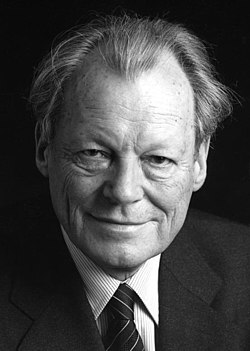 Willy BrandtWilly Brandt (born Herbert Ernst Karl FrahmAffiliated
How the record is sourced and how the score is derived.
The score is formula-derived (Factrail formula v1, version 1.0.0), not an editorial verdict. Read the methodology.
By the Factrail desk · Method: how we source and score · Last reviewed
Dispute a fact on this pageNamed here, or represent someone who is? Request a right of reply.
People and organizations as listed in the Related section of this page; facts, drivers and the pages that name it as listed in the blocks here. Counts, not a rating.