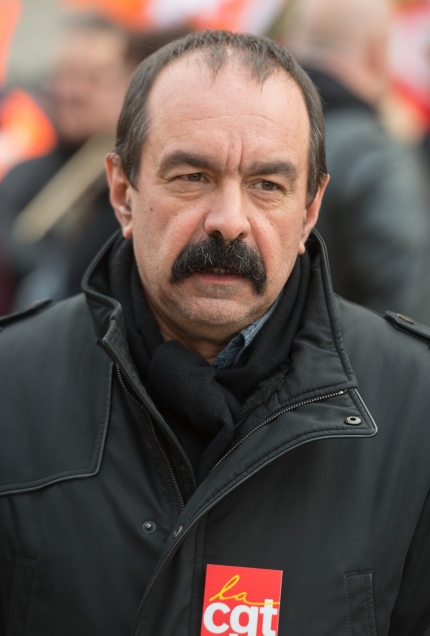
Philippe Martinez
Philippe Martínez is a French film producer, director, screenwriter, actor, and former President of the Odéon Theater in Marseille.
- Facts3
- Drivers0
- Indicators0
Philippe Martínez is a French film producer, director, screenwriter, actor, and former President of the Odéon Theater in Marseille.
Claims against the record, the type of responsibility, and what is disputed.
Responsibility
What could change this assessment
The most relevant dated facts, newest first.
3 February 2015
Philippe Martinez elected secretary-general of the CGTHow the record is sourced and how the score is derived.
3 of 3 linked facts verified, drawing on 3 distinct sources (2015–2023).
Sources include checked 2026-10-15 GET 200 no redirect, claim: martinez+binet+cgt+2023, checked 2026-10-15 GET 200 no redirect, claim: martinez+19 janvier+retraites, checked 2026-10-15 GET 200 no redirect, claim: martinez+cgt+2015.
Sources
The score is formula-derived (Factrail formula v1, version 1.0.0), not an editorial verdict. Read the methodology.
By the Factrail desk · Method: how we source and score · Last reviewed · Sources: 3
An excerpt; the full analysis opens on request.
Martinez led the CGT through years of conflict over labor-market reform, pensions, public services and the distribution of economic adjustment. His leadership style placed strikes and mass demonstrations at the center of bargaining power, while also requiring coordination with unions that often differed from the CGT on tactics and compromise. This institutional background is documented by Reuters via Boursorama (opens in a new tab), which provides the most direct baseline for the office or public role described here. The record is most useful when read as a map of authority: what the person could formally influence, which decisions belonged to other institutions, and where later praise or criticism should be tested against concrete acts rather than reputation alone.
During the 2023 pension conflict, Martinez joined other union leaders in repeated demonstrations against the government’s plan and criticized both the government’s accelerated procedure and tactical choices by parts of the parliamentary left. That stance is important because it shows the CGT leader acting not only as an opponent of the reform but also as a critic of strategies he thought weakened the labor movement’s case. The core events are documented by Reuters Connect (opens in a new tab) and should be read with the distinction between established action, allegation, political interpretation and final legal finding kept explicit. That distinction matters because public figures often become shorthand for a larger conflict; a reliable record instead attributes only the decisions, statements or proceedings that the source actually supports.
Trade-union leadership influences policy indirectly through disruption, bargaining, public opinion and electoral pressure. The costs are also distributed: strikes can impose immediate burdens on commuters and businesses while giving workers leverage they would not have individually. Martinez’s record therefore has to be assessed by whether mobilization changed policy, bargaining conditions or public debate, not simply by counting demonstrations. Reuters Connect (opens in a new tab) provides additional evidence for the surrounding institutional or political context. The important analytical question is not whether the person was simply influential, but what changed for institutions, rights, public resources, security or democratic accountability because of the decisions and events tied to the role.
Dispute a fact on this pageNamed here, or represent someone who is? Request a right of reply.