
Ruppert Stüwe
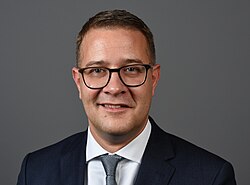
Ruppert Fritz Johannes Stüwe (born 21 May 1978 in Berlin) is a German economist and a politician of the Social Democratic Party of Germany (SPD).
- Facts0
- Drivers0
- Indicators0
Ruppert Fritz Johannes Stüwe (born 21 May 1978 in Berlin) is a German economist and a politician of the Social Democratic Party of Germany (SPD).
Ruppert Fritz Johannes Stüwe (born 21 May 1978 in Berlin) is a German economist and a politician of the Social Democratic Party of Germany (SPD). He has been a member of the Bundestag since 2021, sitting through the Berlin state list, and is the party's candidate in constituency 78, Berlin-Steglitz-Zehlendorf. The federal returning officer's roll for that constituency at the 2025 election prints his name as Ruppert Fritz Johannes Stüwe. The Bundestag lists his occupation as Diplom-Volkswirt.
The official biography, drawn from the member's own statements, records an Abitur in 1998 at the Rudolf Steiner School in Berlin, civilian service at Krankenhaus Waldfriede, and economics studies in Passau, in Brno and at the Free University of Berlin, completed in 2006. From 2007 to 2011 he worked in the Berlin Senate Chancellery, and from 2011 until he entered the Bundestag in 2021 at the Berliner Verkehrsbetriebe, on corporate strategy; the disclosure of outside interests lists him as a BVG employee with a right to return to that post. The same biography describes him as Roman Catholic, with two children, active in the SPD since 1999 and district chair of the SPD in Steglitz-Zehlendorf since 2014. He was born in Berlin and grew up in Steglitz-Zehlendorf. Press accounts of the Berlin party place him on its left wing.
On 18 December 2024 a state delegate assembly of the Berlin SPD elected him, then aged 46, to first place on the state list for the 2025 Bundestag election. He received 133 votes, 50.8 percent, against 128 for Ana-Maria Trăsnea, with one abstention. Welt noted that he had been in the Bundestag since 2021, after ten years at the BVG in corporate strategy, and had chaired the Steglitz-Zehlendorf SPD since 2014. In the 2025 election he stood again in Steglitz-Zehlendorf. Adrian Grasse of the Christian Democratic Union of Germany won the direct seat with 55,398 first votes (30.7 percent); Stüwe took 40,355 (22.4 percent), ahead of Nina Stahr of Alliance 90/The Greens with 39,843 (22.1 percent), and Stüwe returned via the state list.
In the 21st Bundestag he is a full member of the petitions committee and the audit committee (Rechnungsprüfungsausschuss) and one of the parliamentary secretaries (Schriftführer). He is a deputy member of the budget committee, the committee for research, technology, space and technology assessment, and the committee for housing, urban development, building and municipalities, and deputy chair of the German–Czech parliamentary group. At the federal election of 2021, in the predecessor constituency 79, Thomas Heilmann of the CDU won the direct seat with 48,959 first votes (28.0 percent), while the SPD received 43,465 (24.9 percent). After the partial repeat held in parts of Berlin on 11 February 2024, the returning officer's figures for that constituency stood at 28.6 percent for the CDU and 24.4 percent for the SPD.
Ruppert Fritz Johannes Stüwe was born on 21 May 1978 in Berlin. The Federal Returning Officer’s result for the 2025 Bundestag election in Berlin-Steglitz-Zehlendorf lists him under that full name as the candidate of the Social Democratic Party of Germany; the nomination published in the Amtsblatt für Berlin uses the shorter form Ruppert Stüwe and records a birth in 1978 in Berlin and the occupation Diplom-Volkswirt. The Bundestag biography, which the parliament states is drawn from members’ own information, gives the day and month, describes him as Roman Catholic, and records two children. He writes that he lives in Steglitz-Zehlendorf with his wife and their two sons.
Berlin was still divided in the year of his birth. After 1945 the Allied powers split the city into four sectors along the borough boundaries of the time, and West Berlin comprised twelve boroughs. The American sector consisted of Kreuzberg, Tempelhof, Neukölln, Schöneberg, Steglitz and Zehlendorf. Stüwe states that he grew up and went to school in Steglitz-Zehlendorf. That borough name dates from a later reform: after reunification in 1990 the city had 23 boroughs, and in 2001 a reorganization adopted by the Berlin Abgeordnetenhaus reduced the number to twelve, merging Steglitz and Zehlendorf, in the southwest, into Steglitz-Zehlendorf. The Allied Museum, on Clayallee in Zehlendorf, describes its site as lying in the former American sector, then the centre of the American garrison.
The published accounts do not name a primary school. They do record the 1998 Abitur at the Rudolf Steiner Schule in Berlin. In the Berlin school directory that school is the Rudolf-Steiner-Schule Berlin, a private Freie Waldorfschule and state-recognized Ersatzschule (substitute school) at Auf dem Grat 3, 14195 Berlin, in Dahlem, with a gymnasiale Oberstufe. Dahlem is a locality of Steglitz-Zehlendorf. The directory classifies the school as a Waldorf (Freie Waldorfschule) institution and as a state-recognized substitute school, the setting in which the 1998 Abitur is recorded.
After the Abitur he performed Zivildienst at Krankenhaus Waldfriede. Zivildienst was the compulsory civilian alternative for men recognized as conscientious objectors to military service. From 1 January 1996 the statutory length for recognized objectors was 13 months, set against ten months of basic military service. The Bundestag suspended compulsory military service with effect from 1 July 2011. Waldfriede is a hospital of the Seventh-day Adventist Church; the hospital states that it opened on 15 April 1920 with 39 beds, after the church had acquired a building in what is now Zehlendorf. The accounts of Stüwe’s service do not describe the work he did there.
The Bundestag biography and his own account state that, after the Abitur and civilian service, he studied in Passau, in Brno in the Czech Republic, and at the Free University of Berlin, and that he qualified in 2006 as a Diplom-Volkswirt. The places are listed in that order. Neither account names a faculty in Passau or an institution in Brno, and neither gives dates for each stage, so the 2006 degree cannot be assigned from these sources to a single university’s register. The published sequence runs from the 1998 Abitur through civilian service and study in those three places to the degree eight years later. The Bundestag lists Diplom-Volkswirt, a university degree in economics (Volkswirtschaftslehre), as his occupation.
Passau, one of the places he names, is the seat of the University of Passau, a public university opened on 9 October 1978. Brno appears only as a city of study in the Czech Republic. The Free University, the one institution named in the Berlin portion of the same course of study, was founded in December 1948 in response to political repression at the university on Unter den Linden, then in the Soviet sector of the divided city. No thesis title, specialization, or formal exchange arrangement is given in the biographies. The 2006 Diplom-Volkswirt is the qualification recorded at the end of his university education.
From 2007 until 2011, Ruppert Stüwe was employed in the Senate Chancellery (Senatskanzlei) of Berlin. The chancellery is the administrative staff of the Governing Mayor and supports that office through a central department and specialist departments, separate from the Land's press and information office. The whole of his employment there fell under Klaus Wowereit of the Social Democratic Party of Germany, who was Governing Mayor from 16 June 2001 to 11 December 2014.
The Bundestag biography, which rests on members' own information, states only that he was employed in the chancellery from 2007 to 2011. His XING profile gives the post as political planning and matters of principle (Politische Planungs- und Grundsatzangelegenheiten) in the office of the Governing Mayor, dated May 2007 to October 2011. The allocation of business of the Senate of Berlin, as published in 2024, places in the Governing Mayor's portfolio the guidelines of government policy and "strategy, planning and conception in fundamental political, cross-departmental and city-wide matters," together with coordination among departments. That text describes the office as currently organized. It is not a contemporary account of Stüwe's desk, and no grade, file list or project assignment from 2007–2011 has been published. The notice of occupation before membership printed with the biography does not mention the chancellery; it records only the later employer.
In October 2011 he moved to the Berliner Verkehrsbetriebe (BVG), where he remained until he entered the Bundestag in 2021. The BVG is an Anstalt des öffentlichen Rechts whose guarantor (Gewährträger) is the Land Berlin. The Senate department responsible for such bodies describes them as public-law undertakings entrusted with a statutory task, often within Daseinsvorsorge, the provision of essential services. Until 1994 the BVG, like the city's sanitation and water utilities, was run as an Eigenbetrieb of the Land; the change of legal form was intended to allow more independent management. The BVG operates Berlin's U-Bahn, trams, buses and ferries, and the Land's ownership rights are exercised through a guarantors' assembly and a supervisory board drawn in part from the Senate.
The parliamentary biography says that from 2011 until his entry into the Bundestag in 2021 he worked at the BVG with corporate strategy as his focus (mit dem Schwerpunkt Unternehmensstrategie). Reporting his nomination in December 2024 as the Berlin SPD's lead candidate for the Bundestag, Die Welt and the Berliner Zeitung described a ten-year employment at the BVG whose emphasis was corporate strategy, and identified him as a graduate economist (Diplom-Volkswirt).
A finer internal sequence appears only on the XING profile, which lists a post in the staff department for business development (Stabsabteilung Geschäftsentwicklung) from October 2011 to October 2016; from October 2016 to July 2018, head of that staff department, described as attached to the chair of the executive board and covering strategy development, a project-management office and a pool of project leaders; and from July 2018, team leader for corporate strategy (Teamleiter Unternehmensstrategie), an entry the profile still shows as current ("until today"). Those titles are not repeated in the Bundestag biography or in the newspaper accounts, and the open-ended dating does not match the parliamentary record that the employment ended on entry into the Bundestag.
On his 2021 candidate profile he wrote that, as a Diplom-Volkswirt, he was responsible at the BVG for corporate strategy and that his work dealt with the future of local public transport (Öffentlicher Personennahverkehr). The 20th Bundestag met for its constituent sitting on 26 October 2021. The biography ends the BVG employment at his entry into parliament that year. Under the heading for professional activity before membership, the Bundestag lists "Berliner Verkehrsbetriebe (BVG), Berlin" and "Angestellter, Rückkehrrecht" — an employee, with a right of return. Abgeordnetenwatch carries the same item and marks it as activity before membership, not as current outside income.
Ruppert Stüwe’s Bundestag biography, drawn from his own disclosure, states that he has been active on an honorary basis in the Social Democratic Party of Germany (SPD) since 1999 and district chair (Kreisvorsitzender) of the SPD in Steglitz-Zehlendorf since 2014. The district delegates’ assembly elected him chair on 22 March 2014 for the 2014–2016 term. Delegates confirmed him on 8 May 2022 with 91 percent of the vote, and again on 14 April 2024, when an assembly of 130 delegates returned him with 90.8 percent. Reporting on the Berlin SPD’s later list ballot likewise identified him as district chair in the southwestern Berlin borough since 2014.
A gender-equality report to the Berlin party congress counted 2,142 members in Steglitz-Zehlendorf on 31 December 2022, of whom 772 were women (36.04 percent), and 2,030 on 31 December 2023, of whom 739 were women (36.40 percent), against 18,824 and 17,957 members in the Berlin SPD as a whole. On those two dates the district ranked fourth of the twelve geographical Kreisverbände. The same report listed nine local branches (Abteilungen) for 2024–2026, four with a single chair and five with a dual chair, and six women among the branch chairs (42.86 percent). For both the 2022–2024 and 2024–2026 terms it recorded one man and no woman as district chair. The executive published for 2026–2028 included representatives of nine numbered branches and of the working groups, among them the Young Socialists in the SPD (Jusos), SPD Frauen, the employees’ group AfA, AG 60plus, a migration-and-diversity group and SPD Queer.
On 14 March 2026 the delegates ended the period of a sole chair and elected a dual leadership for 2026–2028: Mirjam Golm, a member of the Abgeordnetenhaus of Berlin, and Stüwe as co-chairs, with Franziska Grün, Rodrigo Bustos Barros, Martin Matz and Sarah Maurer as deputy chairs and Anette Hennerkes as treasurer. The assembly also chose delegates to the state party congress.
On 16 December 2024, rbb24 reported that Stüwe and Annika Klose had announced a joint candidacy for the first two places on the Berlin SPD’s state list for the February 2025 Bundestag election, with party sources expecting Stüwe to seek first place and Klose second, despite calls at the previous state party congress for a woman to head the list. The same report said the Landesvertreterversammlung would meet the following Wednesday evening at the Willy-Brandt-Haus. At that assembly, on 18 December 2024, Stüwe received 133 votes to 128 for Ana-Maria Trăsnea, with one abstention (50.8 percent). rbb24 described him as a representative of the party’s left wing and reported that Klose, without an opponent, was placed second, and that state co-chair Nicola Böcker-Giannini had argued at the start of the ballot for a woman at the top, so that the left wing’s two nominees prevailed against the party leadership’s preference.
Ruppert Stüwe speaks at an SPD lectern at the Berlin state delegates’ assembly on 18 December 2024.
Die Welt reported that Klose received 178 votes for second place and that the first three places went to politicians it associated with the left wing. After Stüwe and Klose, Hakan Demir defeated former governing mayor Michael Müller for third place, 135 votes to 122. Müller, who had not stood for first place and had favoured a woman at the head of the list, did not take a later place and was left off the state list. The Berliner Zeitung, in the same news cycle, also described Stüwe as assigned to the SPD’s left wing.
The organized state-level left current inside the Berlin SPD is the Berliner Linke, which its own site distinguishes from other formations by describing it as the SPD Landeslinke and as present in every district. That site records that the group’s plenum on 16 July 2016 elected a nine-member speakers’ council of eight speakers and one business manager, and lists Stüwe among the speakers, with Franziska Becker, Aziz Bozkurt, Klose, Barbara Loth, Mechthild Rawert and Julian Zado. Susanne Kitschun is listed as having resigned on 22 August 2019, and Rolf Henning as business manager. The grouping is the SPD’s state left, not the separate party Die Linke. A capture of the Berliner Linke site in May 2026 still showed the 2016 roster, while the news items on the page ended in 2017, so the site does not record a later election of speakers.
In the Bundestag group, the Parlamentarische Linke describes itself as the organized wing of left-wing SPD members of parliament. A membership overview it published after the federal election of 26 September 2021, and which was archived in April 2022, included Stüwe. He was not among the officers named on the group’s later public “about” page. That page identified Wiebke Esdar, Dagmar Schmidt and Carmen Wegge as speakers and Demir as treasurer, and a steering circle that included Klose but not Stüwe; it no longer published a full list of members.
At the federal election of 26 September 2021, Ruppert Stüwe was the Social Democratic Party of Germany (SPD) candidate for the direct mandate in constituency 79, Berlin-Steglitz-Zehlendorf, covering the whole borough, and stood in fifth place on the Berlin SPD state list. Of 217,814 eligible voters, 177,241 voted, a turnout of 81.4 percent. Thomas Heilmann of the Christian Democratic Union (CDU) held the direct seat with 48,959 first votes (28.0 percent), 5,494 votes and 3.1 percentage points ahead of the SPD. Stüwe received 43,465 first votes (24.9 percent). Nina Stahr of Alliance 90/The Greens was third with 38,873 (22.2 percent), ahead of Hanns-Henning Krumrey of the Free Democratic Party (FDP) on 15,967 (9.1 percent), the Alternative for Germany (AfD) on 9,221 (5.3 percent) and Marcus Otto of Die Linke on 7,455 (4.3 percent), out of 174,820 valid first votes.
Second votes in the constituency put the SPD first on 42,910 (24.5 percent), then the CDU on 39,943 (22.8 percent) and the Greens on 39,550 (22.6 percent). Stüwe therefore entered the 20th Bundestag from the list. The Berlin state returning officer’s final report of those elected names him as Ruppert Stüwe, born 1978, list place 5, mandate type “list.” The same table lists Cansel Kiziltepe (place 2) and Annika Klose (place 4) as the other SPD members elected from the Berlin list, while Michael Müller and Kevin Kühnert won direct seats in other Berlin constituencies. The archived biography for the 20th legislative period records the mandate as obtained via the Berlin state list, with a candidacy in constituency 079.
The September election in Berlin coincided with elections to the Abgeordnetenhaus and the borough assemblies, a referendum, and the Berlin Marathon. In a judgment of 19 December 2023 (2 BvC 4/23) the Federal Constitutional Court found unlawful preparation and conduct in a series of polling districts: too few booths and ballot papers, ballots for the wrong constituency, closures and interruptions, and waits of about an hour or more as evidence of inadequate equipment. The Bundestag had on 10 November 2022 already invalidated the election in 431 districts. The court held that inquiry incomplete, invalidated further districts, restored validity in seven, and required the repeat to be a two-vote election.
The repeat was held on 11 February 2024 in 455 of Berlin’s 2,256 polling districts, on the same nominations as in 2021. Unaffected 2021 votes were combined with the new ballots. The constituency page the federal returning officer now publishes for the old constituency 79 is that combined result, not the September count: 217,506 eligible voters, turnout 79.0 percent (171,803), and 169,542 valid first votes. The CDU took 48,530 (28.6 percent), the SPD 41,371 (24.4 percent) and the Greens 37,751 (22.3 percent); the FDP had 14,929 (8.8 percent), the AfD 9,277 (5.5 percent) and Die Linke 7,196 (4.2 percent). Heilmann kept the seat, and his lead over Stüwe grew from 5,494 votes to 7,159. Stahr, Krumrey and Otto stood again. Roughly 20,000 people in the borough were recalled to the polls. Second votes still placed the SPD first, on 40,677 (24.0 percent), ahead of the CDU on 39,905 (23.5 percent) and the Greens on 38,460 (22.7 percent).
The recalculation cut the Bundestag from 736 to 735 seats. Every Berlin direct mandate from 2021 was held, but the Berlin SPD lost one seat, offset by a gain in Lower Saxony. The Bundestag named Ana-Maria Trăsnea as the SPD member who lost her seat. She had succeeded Kiziltepe, who left Parliament at the end of 15 May 2023. The archived biography states that Stüwe “was not elected on 11 February 2024 in the repeat election in Berlin, but retains his mandate as a list successor.” He was outside the seats the new result assigned in his own right and remained only by succession to a list seat still attributed to a candidate who was no longer sitting.
The 27th Act amending the Federal Elections Act, of 7 March 2024 and in force from 14 March 2024, moved one constituency from Saxony-Anhalt to Bavaria because of population change and renumbered former constituencies 72 through 255. Berlin’s twelve constituencies became numbers 74 to 85. Steglitz-Zehlendorf, previously 79, became constituency 78; the federal returning officer’s description remains the borough of Steglitz-Zehlendorf.
The election was held on 23 February 2025. On 18 December 2024 a Berlin SPD delegate assembly elected Stüwe to list place 1 with 133 votes (50.8 percent) against Trăsnea’s 128 and one abstention. Klose took second place unopposed with 178 votes. For third place Hakan Demir defeated Müller, the former governing mayor and the SPD’s 2021 lead candidate, by 135 votes to 122. Fourth place, reserved for a woman under the party’s alternating list, went to Trăsnea against Sinem Taşan-Funke. Müller declined to contest fifth place, was left off the list, and had to win Charlottenburg-Wilmersdorf directly; under the amended electoral law a constituency win no longer by itself secures a seat. rbb24 reported that state co-chair Nicola Böcker-Giannini had argued for a woman at the head of the list.
Of 214,757 eligible voters, 181,883 voted (84.7 percent). Of 180,189 valid first votes, Adrian Grasse (CDU) won the direct mandate with 55,398 (30.7 percent). Stüwe, on the ballot as Ruppert Fritz Johannes Stüwe, was second with 40,355 (22.4 percent), 512 votes ahead of Stahr, again the Green candidate, on 39,843 (22.1 percent). Peer Döhnert (AfD) received 18,539 (10.3 percent), Marcus Otto (Die Linke) 15,823 (8.8 percent) and Hanns-Henning Krumrey (FDP) 7,382 (4.1 percent). Heilmann had not sought the CDU nomination again; Grasse, the CDU group’s science-policy spokesman in the Berlin House of Representatives, succeeded him.
Second votes put the CDU first on 48,500 (26.8 percent), the Greens on 35,848 (19.8 percent) and the SPD on 32,989 (18.2 percent), then Die Linke on 20,722 (11.4 percent), the AfD on 18,678 (10.3 percent), the FDP on 10,750 (5.9 percent) and the Sahra Wagenknecht Alliance on 7,070 (3.9 percent). The official comparison with “2021” uses the post-repeat baseline: CDU first votes up 2.1 points from 28.6 percent, SPD down 2.0 from 24.4, Greens down 0.2 from 22.3, turnout up 5.7 points from 79.0 percent. The alphabetical list of those elected records “Stüwe, Ruppert Fritz Johannes,” born 1978, SPD, Land Berlin (place 1), constituency 078. The current Bundestag biography lists the mandate as obtained through the Berlin state list, with a constituency candidacy in 078.
Ruppert Stüwe of the Social Democratic Party of Germany (SPD) sat from the opening of the 20th Bundestag. That legislative period began with the constitutive sitting on 26 October 2021. He held a mandate from the Berlin state list, on which he had fifth place, and had stood as the SPD candidate in constituency 079, Berlin-Steglitz-Zehlendorf. The archived biography gives his parliamentary office as Platz der Republik 1, 11011 Berlin.
From 13 December 2021 the SPD parliamentary group lists him as a full member of the Committee on Education, Research and Technology Assessment and as a deputy member of the Budget Committee. On the Petitions Committee he was a deputy from that date until 21 June 2022 and a full member afterwards; the same day he became a deputy on the Transport Committee, and from 5 April 2022 a full member of the Subcommittee on Global Health. The Petitions Committee handles requests and complaints from the public, in a person's own case or on a matter of general concern. The archived biography records the same full seats — education and research, petitions, and global health — and the same two deputyships.
On a visit to its Digital Labs on 29 September 2022, the Berlin Institute of Health at Charité described him as the SPD group's spokesperson for health research. The group's own list of his 20th-term functions does not record that title.
The partial repeat of the 2021 election, held on 11 February 2024 in 455 Berlin polling districts, led to a new determination of the result. In the Bundestag's table of list mandates Stüwe is not marked as having won a seat again; he is entered as a potential list successor to the member Cansel Kiziltepe. The archived biography states that he was not elected in the repeat vote but kept his mandate as a list successor. The Federal Electoral Committee fixed the overall result on 1 March 2024, after which the 20th Bundestag had 735 members, one fewer than before the repeat. His membership continued until that term ended with the assembly of the next Bundestag on 25 March 2025.
Stüwe took his seat for the 21st term at the constitutive sitting of 25 March 2025. The Bundestag biography records the mandate as one won on the Berlin state list, with a candidacy in constituency 078, Berlin-Steglitz-Zehlendorf; on the 2025 list he stood in first place. The SPD group additionally names him as the member looking after the constituencies Berlin-Tempelhof-Schöneberg (080) and Berlin-Lichtenberg (085).
On the biography page as consulted on 30 October 2026 he is a full member of the Petitions Committee and of the Audit Committee (Rechnungsprüfungsausschuss), and a parliamentary secretary (Schriftführer). He is a deputy member of the Committee on Research, Technology, Space and Technology Assessment, the Committee on Housing, Urban Development, Building and Municipalities, and the Budget Committee. The SPD group gives the start of the petitions seat and the budget deputyship as 21 May 2025, of the research deputyship as 25 June 2025, of the housing deputyship as 9 July 2025, and of the audit seat as 6 June 2025.
The Audit Committee works like a standing committee. Its members also sit on the Budget Committee, as full or deputy members, and every full member of the Budget Committee is a deputy on the Audit Committee. Where the Budget Committee appropriates funds, the Audit Committee follows the spending, examines federal budgetary and economic management, and, using the remarks of the Bundesrechnungshof, prepares the plenary's discharge of the federal government.
In the SPD group he has been deputy spokesperson of the petitions working group since 24 June 2025, with deputy places in the working groups that mirror his committee deputyships. The group also lists him, from 4 June 2025, as a deputy member of the Council of Elders' commission for internal affairs (Ältestenratskommission für Innere Angelegenheiten), which the Bundestag biography does not show.
Parliamentary secretaries are members the Bundestag elects on faction proposals. In the 21st term there are 64, rotating through sittings. Two of them, with the presiding officer, form the sitting's presidium and sit to either side of the President of the Bundestag, usually one from the government side and one from the opposition. They take requests to speak and motions, keep the speakers' list and establish vote results. The first slate was elected on 22 May 2025, twelve of them named by the SPD. On 7 May 2026 the plenary elected Stüwe, without dissent and on an SPD proposal, as secretary in succession to Jasmina Hostert.
His parliamentary office is Platz der Republik 1, 11011 Berlin, and his constituency office is Moltkestraße 52, 12203 Berlin. A seat on the administrative board of the Institute for Federal Real Estate (Bundesanstalt für Immobilienaufgaben), recorded as honorary from 1 September 2025, lies outside the Bundestag's committees.
The Bundestag biography lists Stüwe as a deputy member of the German-French Parliamentary Assembly and as deputy chair of the German-Czech Parliamentary Group. The SPD group dates the assembly deputyship from 23 March 2026 and the deputy chairmanship from 22 September 2025. Stephan Mayer of the Christian Social Union in Bavaria is chair of the German-Czech group. The SPD list also records him, from 22 September 2026, as a deputy member of the Interparliamentary Conference on Stability, Economic Coordination and Governance in the European Union, a role not shown on the biography page.
Parliamentary groups (Parlamentariergruppen) are cross-party associations of members, without rules of procedure of their own, for a continuing dialogue with parliamentarians in partner countries. The Bundestag's account describes 47 bi- and multilateral groups, including the Berlin-Taipei circle. The Council of Elders sets their number and structure at the start of each term, chairs follow the strength of the factions, and a member may join at most three. The German-Czech group is one of those bodies; the German-French Parliamentary Assembly is listed separately on the biography, under other memberships.
At the Berlin SPD delegate meeting on 18 December 2024, rbb24 reported, Stüwe used his application speech for the top of the state list to argue for expanding public transport and against building new motorways.
In the 20 September 2026 election to the Abgeordnetenhaus of Berlin, Die Linke led with 25.7 percent, ahead of the CDU (18.8), the AfD (16.3), the Greens (14.3) and the SPD (12.1, the party’s worst result in the city). The CDU–SPD majority was lost. Linke, Greens and SPD then closed exploratory talks. The Tagesspiegel called the most disputed part of their paper the socialization (Vergesellschaftung), under Article 15 of the Basic Law, of about 160,000 dwellings held by five companies with more than 10,000 flats in Berlin, with compensation capped at 16 billion euro. On 19 October the SPD state executive voted 26 to 3 to open coalition negotiations, and a Greens assembly agreed with only 2 of 45 delegates opposed. Die Linke had still to decide at a congress set for 31 October, so no coalition had been formed.
That day the Süddeutsche Zeitung reported a letter from the four Berlin SPD members of the Bundestag, Annika Klose, Hakan Demir, Helmut Kleebank and Stüwe, supporting talks with the Greens and the Left and calling the exploratory results “a viable basis” for a more socially just, ecological and livable Berlin. They rejected a letter from 20 SPD Bundestag members who opposed talks with the Berlin Left “under the present conditions” over its reliability, antisemitism and the glorification of terrorist violence. The four wrote that social responsibility and opposition to antisemitism belonged together, that Israel’s right to exist was not negotiable, and that Jewish people had to be able to feel safe in Berlin.
On 29 October Welt reported that Demir and Stüwe objected on constitutional grounds to interior minister Alexander Dobrindt’s (CSU) draft investment-protection law, meant to make socialization of large housing companies harder. Stüwe said: “The Basic Law expressly provides for the possibility of socialization. A statutory rule by the federation is, in my view, not sensible.” He added that important constitutional questions were open and that, unlike Demir, he would decide his vote only once a bill reached the Bundestag.
In the 20th term Stüwe was a rapporteur for the Committee on Education, Research and Technology Assessment on the CDU/CSU motion to strengthen research into Long COVID, ME/CFS and post-vac syndrome (Drucksache 20/5983). The committee’s report of 14 June 2023, Drucksache 20/7477, names him as Berichterstatter and recommends rejecting the motion. On 6 July 2023 he told the plenary that ME/CFS meant severe exhaustion, pain and disorders of sleep and concentration, and that the pandemic had left more than a million people with post-viral illness. He cited 30 million euro in the EU research programme and 22.5 million euro from the education ministry, plus a national clinical study group on drug development that firms found too uncertain, and said he could reject the motion because it asked for more money without saying how much or from where.
He was a full member of the health committee’s subcommittee on global health; the minutes of its ninth sitting, on 23 January 2023, list him among the SPD’s ordinary members. Ärzte Zeitung reported in February 2025 that he had helped draft his group’s paper on globally solidary pandemic prevention, preparedness and response, and that he wanted a global-health committee continued. After the United States left the World Health Organization and major aid programmes, the portrait quoted him as saying joint European action mattered more.
On 3 June 2022 the Bundestag voted by roll call on a 100-billion-euro special fund for the Bundeswehr and on a constitutional amendment to keep its borrowing outside the debt brake. The final result on the bill amending Article 87a, in the protocol of the 42nd sitting and on the official roll-call sheet, was 568 yes, 96 no and 20 abstentions, from 684 votes cast. In the SPD, 191 members voted yes and eight voted no; Stüwe was one of the eight. The bill creating the fund, the Bundeswehrsondervermögensgesetz, passed the same day by 590 to 80, with seven abstentions, from 677 votes cast. The SPD divided 187 yes, nine no and one abstention, and Stüwe was one of the nine.
In one explanation under § 31 of the rules of procedure, covering both votes, he wrote that the Basic Law should set fundamental rules, not a time-limited special case. Article 115 already allowed exceptions and should be revised, preferably by abolishing the debt brake; he would not accept a special rule for the Bundeswehr, though he favoured continuing the regular funding increases the SPD had secured in the previous term. On 30 January 2025 he told Abgeordnetenwatch he would vote the same way again: higher spending had been right for readiness, but privileging the armed forces over every other field was not, and once the fund was spent the debt brake would again block larger investment.
Dissent on deployments was selective. On 18 March 2022 he cast the only SPD vote against extending the NATO operation Sea Guardian; the final result was 504 yes, 100 no and one abstention, from 605 votes cast. On 20 May 2022 the continuation and enlargement of the German contribution to the United Nations mission MINUSMA in Mali passed by 540 to 102, with four abstentions, from 646 votes cast. Stüwe was one of four SPD no votes; Joe Weingarten abstained. The same day Stüwe voted with the SPD majority for the EU training mission EUTM Mali, adopted by 551 to 105 with one abstention. On 29 March 2023 he was one of two SPD members to vote no on Sea Guardian, which passed by 550 to 106 with two abstentions, from 658 votes cast.
On 26 May 2023 he voted yes on what the debate treated as a last MINUSMA continuation and a withdrawal mandate. The final result was 374 yes, 265 no and one abstention, from 640 votes cast; the SPD cast 188 yes votes and two no votes. On 23 February 2024 he was one of two SPD members to vote against the EU operation EUNAVFOR Aspides around the Red Sea, adopted by 538 to 31 with four abstentions, from 573 votes cast. On 25 April 2024 he was one of four SPD no votes on extending EUNAVFOR Med Irini, the EU operation enforcing the United Nations arms embargo on Libya, which passed by 554 to 100 with two abstentions, from 656 votes cast.
Offices held alongside a seat in the Bundestag are published under the code of conduct in sections 45 and following of the Members of the Bundestag Act (Abgeordnetengesetz). A member must notify the President within three months of taking the seat and within three months of any later change; notifiable particulars are published on the Bundestag website after processing and a check that publication is required. On the biography page as of 30 October 2026, Ruppert Stüwe’s entries are one company-body seat, membership of one federal public-law institution, and three roles in associations or foundations. The page marks the last four as honorary (ehrenamtlich) and publishes no level of outside income for any of them. His earlier post at the Berliner Verkehrsbetriebe, recorded with a right of return, is listed only as employment before he entered parliament, not as a current side office.
The Wissenschaftszentrum Berlin für Sozialforschung (WZB) is a non-university institute in Berlin and a member of the Leibniz Association. Organized as a non-profit company and funded 75 percent by the federal government and 25 percent by the state of Berlin, it studies structural questions of modern societies, chiefly in sociology, political science and economics. Its Kuratorium sets the broad lines of research policy and joins in the main research-policy and financial decisions; the WZB states that its thirteen voting members serve in an honorary capacity. The Bundestag lists Stüwe as a member of that Kuratorium, under functions in companies, without the honorary label used for his other published offices and without a start date. The institute’s list names him, identified with the SPD parliamentary group, among the current trustees.
The Wissenschaftszentrum Berlin für Sozialforschung building on the Reichpietschufer in Berlin.
The Deutsches Netzwerk gegen vernachlässigte Tropenkrankheiten (DNTDs) is a charitable association formed after the 2012 London Declaration on Neglected tropical diseases. It comments on development-policy questions with a health dimension. Its parliamentary advisory board consists of Bundestag members. The network reported that the board was reconstituted on 28 January 2026 and named Stüwe among the members. The biography page discloses the seat as honorary membership of that board, without a start date.
The Institut Solidarische Moderne e.V., based in Berlin, describes itself as a think tank and platform for dialogue among parties, social movements, trade unions, civil society and research. A members’ meeting on 3 June 2026 elected a new board that includes Stüwe, and the Bundestag discloses honorary membership of the board from that date.
The Wissenschaftsstiftung Ernst Reuter is a charitable foundation charged, under its statute, with supporting the Wissenschaftskolleg zu Berlin, an institute for advanced study, by supplying the Kolleg with premises and operating funds. The Stiftungsrat decides on the foundation’s guidelines and annual economic plan. Members serve in an honorary capacity, and up to eight public figures may be co-opted for four years. The Kolleg’s list names Stüwe, as a Bundestag member, among the co-opted members. The biography page discloses honorary membership of the Stiftungsrat and gives no start date.
The Bundesanstalt für Immobilienaufgaben (BImA), seated in Bonn, is a legally capable federal institution under public law, under the legal supervision of the Federal Ministry of Finance. It manages federal real estate, including service properties let to federal departments. The Verwaltungsrat decides on construction projects, the economic and investment plan and the balance-sheet profit, and supports the executive board. The Bundestag discloses Stüwe as an honorary member of that board from 1 September 2025. A BImA notice of 22 September 2025 named him among the Bundestag members of the newly appointed board, whose first meeting was set for 13 October 2025. The seat is a disclosed supervisory office, not employment by the agency.
The Bundestag lists a constituency office for Stüwe in Steglitz-Zehlendorf at Moltkestraße 52, 12203 Berlin. On Abgeordnetenwatch he writes that he grew up and went to school in the borough and that, in his free time, he is as often as possible in the supporters’ block of Alba Berlin.
Abgeordnetenwatch.de is a donation-funded, non-partisan platform run by the nonprofit Parlamentwatch e.V. Its core offer is a public exchange in which citizens question members and candidates; moderators review questions and answers, and the site also publishes recorded votes, committee memberships and outside posts. Counting only questions put during current candidacies and mandates, Stüwe’s profile showed 30 of 32 answered, a rate of 94 percent, with two still open. Questions visible on the page concerned an application to examine a ban on the Alternative for Germany, digital investigative powers, cooperation with Die Linke rather than the AfD, the pension after 45 contribution years, and a closed cycle path along the Teltow Canal.
Coverage of the Berlin SPD state delegate assembly on 18 December 2024 treated Stüwe’s nomination to first place on the Bundestag list as narrow and unexpected for a district chair from the party’s left.
On 20 December 2024 Der Tagesspiegel published Daniel Böldt’s profile under the headline “Ruppert wer?: Dieser Politiker soll die Berliner SPD im Bundestagswahlkampf anführen.” The standfirst called the choice of the Steglitz-Zehlendorf district chair surprising and asked who “the man from the second row” was. The text available outside the paywall described him the next day in the Reichstag restaurant, ordering a small cola, as reserved and quietly spoken, and as having set off a small shock in the Berlin SPD.
Rundfunk Berlin-Brandenburg reported that he received 133 votes (50.8 percent) to 128 for Ana-Maria Trăsnea, with one abstention, after state co-chair Nicola Böcker-Giannini had argued for a woman at the head of the list. Annika Klose was elected to second place without an opponent. Welt’s account, dated 20 December, said former governing mayor Michael Müller, the 2021 lead candidate, lost third place to Hakan Demir by 122 votes to 135, then declined a later place and was left off the state list—an outcome the paper headlined as a humiliation of the ex-mayor. rbb set the contest against an Infratest dimap survey for the broadcaster in November 2024 that put the Berlin SPD at 13 percent for a Bundestag election, against 22.2 percent of second votes in the city in 2021, behind the CDU (24 percent), Alliance 90/The Greens (22) and the AfD (17).
On 19 October 2026 the Süddeutsche Zeitung carried a Deutsche Presse-Agentur report that Stüwe, Klose, Demir and Helmut Kleebank supported opening coalition negotiations among the SPD, the Greens and Die Linke. They called the exploratory results a workable basis and a red-green-red government “a serious political chance,” while rejecting a letter from 20 other SPD members of the Bundestag who opposed talks with the Berlin Left; they also wrote that a clear line against antisemitism, and Israel’s right to exist, were not negotiable.
Ranked by shared high-impact facts, then explicit ties, then shared drivers.
 Jasmina HostertJasmina Hostert (born 3 December 1982 in Sarajevo) is a…Affiliated
 Adrian GrasseAdrian Grasse (born 20 January 1975 in Berlin) is a German…Affiliated
 Alexander DobrindtAlexander Dobrindt is a German politician of the Christian…Affiliated
 Klaus WowereitKlaus Wowereit (born 1 October 1953) is a German…Affiliated
 Kevin KühnertKevin Kühnert (born 1 July 1989) is a German politician of…Affiliated
 Helmut KleebankHelmut Heinrich Kleebank (born 18 November 1964 in Berlin)…Affiliated
How the record is sourced and how the score is derived.
The score is formula-derived (Factrail formula v1, version 1.0.0), not an editorial verdict. Read the methodology.
By the Factrail desk · Method: how we source and score · Last reviewed
Dispute a fact on this pageNamed here, or represent someone who is? Request a right of reply.
Linked because the text names them, not because anything was measured.
People and organizations as listed in the Related section of this page; facts, drivers and the pages that name it as listed in the blocks here. Counts, not a rating.