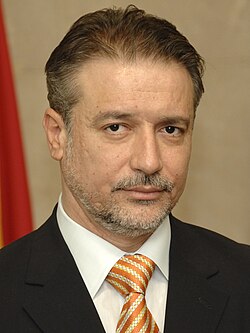
Savo Klimovski
Savo Klimovski (Macedonian: Саво Климовски) is a Macedonian lawyer, law professor and politician. He was born in Skopje in 1947.
- Facts0
- Drivers0
- Indicators0
Savo Klimovski (Macedonian: Саво Климовски) is a Macedonian lawyer, law professor and politician. He was born in Skopje in 1947.
Savo Klimovski (Macedonian: Саво Климовски) is a Macedonian lawyer, law professor and politician. He was born in Skopje in 1947. He graduated from the Faculty of Law in Skopje in 1970, completed a master’s degree in 1975, and received a doctorate in legal science in Ljubljana. The Assembly of the Republic of North Macedonia dates that doctorate to 1978 in its Macedonian biography and to 1979 in its English biography.
In 1971 he was elected an assistant at the Faculty of Law in Skopje, and he later became a docent, an associate professor and a full professor. He was dean of the faculty for two terms, from 1992 to 1996, and president of the senate of Ss. Cyril and Methodius University of Skopje. From 1986 to 1990 he was a member of the Executive Council of the Assembly of the Socialist Republic of Macedonia — the Assembly’s English biography calls the same body the Executive Board — and president of the Republican Committee for Education, Culture and Physical Culture.
The Assembly lists him as its president from 19 November 1998 to 30 November 2000, after Tito Petkovski and before Stojan Andov. Its biography describes him as a founder of the Democratic Alternative and a member of that party’s leadership, and as a member of the Democratic Centre, and it records that from 14 December 2001 he sat as an independent member of parliament. From 19 November to 15 December 1999 he carried out the office of President of the Republic. Article 82 of the Constitution provides that, when the presidential mandate ends, the President of the Assembly performs that office until a new president is elected, and that while doing so he takes part in the Assembly without the right to vote.
That interval fell during the closing stages of the 1999 presidential election, whose second round was held on 14 November and whose partial reruns the OSCE observation report dates, in its detailed account, to 5 December. The Organization for Security and Co-operation in Europe Office for Democratic Institutions and Human Rights found that the election was held mostly in accordance with OSCE commitments, and that violations in parts of the country led the State Election Commission and the Supreme Court to invalidate the results in about 230 precincts and to order those reruns. The report’s final totals were 582,208 votes for Boris Trajkovski of VMRO-DPMNE and 513,614 for Tito Petkovski of the Social Democratic Union of Macedonia, and it recorded that the losing candidate accepted the outcome.
The Assembly biography credits him with ten books, among them Constitutional Law, Political System and Parliamentary Law, and with more than one hundred scholarly works in legal science. On 12 September 2022 the Assembly’s Committee on Election and Appointment Issues withheld support for his nomination, advanced by the opposition, to a seat on the Constitutional Court.
Savo Klimovski was born in Skopje on 13 June 1947, according to the Macedonian Encyclopedia, which gives as its source the Assembly publication Presidents of the Assembly of the Republic of Macedonia, 1944–2004 (Претседатели на Собранието на Република Македонија, 1944–2004, Skopje, 2004). Biographies of former presidents on the website of the Assembly of the Republic of North Macedonia record the same city and year but not the day: the Macedonian and English texts both say only that he was born in Skopje in 1947. None of these accounts names his parents or any other relative. He completed primary and secondary education in Skopje; the schools are not identified.
He graduated from the Faculty of Law in Skopje in 1970. The faculty belonged to the University of Skopje, now the Ss. Cyril and Methodius University of Skopje, which the university describes as the republic's first state university, formed in 1949. The faculty's own account dates its creation to a decree of the government of the People's Republic of Macedonia of 3 November 1951, when it was a department of the Faculty of Law and Economics, and states that from 1 July 1956 it worked as a separate faculty of legal science. The name Iustinianus Primus was conferred only in 2001, so the degree Klimovski took in 1970 was awarded by the faculty under its earlier name.
A master's degree followed. The Assembly biographies date it to 1975 and do not name the faculty, the field, or a thesis. The encyclopedia dates the master's degree to 1974 and places it at the Skopje law faculty, again without a title.
The doctorate was defended at a law faculty in another republic of Yugoslavia. The encyclopedia states that in 1978, at the Faculty of Law in Ljubljana, he defended the thesis Самоуправните интересни заедници (Self-managing communities of interest). The Macedonian Assembly biography likewise places a doctorate in legal science in Ljubljana in 1978, without recording the title. The English text of that biography gives 1979. On the year, the Macedonian Assembly page and the encyclopedia agree, against the English page.
The Ljubljana faculty was a founding member of the University of Ljubljana in 1919. The thesis topic was an institution of the 1974 Constitution of the Socialist Federal Republic of Yugoslavia. That constitution placed self-managing communities of interest within the socio-economic order of socialist self-management.) Speaking to the Chamber of Nationalities on 22 January 1974, Mijalko Todorović, president of the Federal Assembly, presented them, in his report on the final draft, as a means of removing social activities from dependence on the state budget and the state administration, and of associating the people who performed those activities with the people who used their services.)
Klimovski’s university appointments were at the Faculty of Law in Skopje, a faculty of Ss. The faculty dates its foundation to a decree of 3 November 1951 by the government of the People’s Republic of Macedonia, which established it as a department of the Faculty of Law and Economics of the University of Skopje. From 1 July 1956 it worked as a separate institution, described by the faculty as the first independent higher-education institution in the legal sciences in the republic. On 9 September 2001, for the fiftieth anniversary, the teaching-scientific council renamed it the Faculty of Law “Iustinianus Primus,” with the Latin style Facultas Iuridica Iustinianus Primus. During his deanship the school was still the Faculty of Law in Skopje; the new name came only in 2001. From the 1980/81 academic year the faculty also housed interdisciplinary and inter-faculty studies in journalism.
The biography published by the Assembly states that in 1971, after graduation, he was elected an assistant at the Faculty of Law in Skopje, and that he was later elected docent, associate professor and full professor. It does not date the elections after the assistantship. The entry in the Macedonian Encyclopedia is more precise about the first post and the full professorship: from 1971 he was an assistant in the subject of the communal system and communal policy, and from 1989 a full professor of constitutional law and the political system. The Assembly’s intermediate ranks, docent and associate professor, are not given separate years in that entry.
The same Assembly biography, which notes that from 14 December 2001 he was an independent member of parliament, still describes him as a full professor at the faculty. He remained on the staff after the renaming. An English-language page of the Faculty of Law “Iustinianus Primus,” archived on 12 September 2008, lists “Savo Klimovski, PhD” among the academic staff. The faculty’s website now includes him on its list of retired professors and does not state a retirement date.
The Assembly biography records that he was elected dean of the Faculty of Law in Skopje for two mandates, from 1992 to 1996. The Macedonian Encyclopedia gives the same years. In the 1993/94 academic year, during that deanship, the faculty adopted a curriculum introducing political studies. The faculty’s chronology records the curriculum and the year; it does not name the dean.
The encyclopedia states that from 1996 to 1998 he was president of the Senate of the University “Ss. Cyril and Methodius” in Skopje. Its source note cites a 2004 volume on the presidents of the Assembly of the Republic of Macedonia from 1944 to 2004. The Assembly biography also records the presidency of the Senate of the University “St. Cyril and Methodius” in Skopje, but it gives no dates, so the years 1996–1998 rest on the encyclopedia rather than on the parliamentary text. The university’s list of rectors places Radmila Kiprijanova in the rectorship for 1994/96–1997/98, a span overlapping the Senate presidency as the encyclopedia dates it.
On 28 April 1986, at a joint sitting of all its chambers in Skopje, the Assembly of the Socialist Republic of Macedonia elected Gligorie Gogovski president of the Executive Council and elected Savo Klimovski as one of its members. Decisions of that sitting, published in the Official Gazette of the Socialist Republic of Macedonia, No. 18 of 30 April 1986, named Klimovski president of the Republican Committee for Education and Physical Culture and named Borislav Naumovski president of a separate Republican Committee for Culture.
Under the republic's 1974 constitution, the Executive Council was the executive organ of the Assembly of this constituent republic of Yugoslavia. Within the republic's rights and duties it answered to the Assembly for conditions in social life, for carrying out policy and laws, and for coordinating the republican organs of administration. A council was elected for four years after each new Assembly: the Assembly chose the president on a proposal of the Presidency of the Republic and the members on a proposal of that candidate, then appointed from among the members the republican secretaries and other officials who would head administrative organs specified by law.
The Law on State Administration, in the Official Gazette, No. 45 of 31 December 1980, provided for republican secretariats, committees, councils, commissions, directorates and inspectorates. Committees were collegial organs for administrative and professional work in fields where republican bodies and self-managing organizations had to decide questions together and keep policy and the execution of laws uniform. Unless a statute said otherwise, the Assembly named and dismissed the president and members; sitting as a body, a committee considered questions of principle, proposed measures, and could initiate republican legislation.
The president of a committee represented it, prepared, convened and chaired its sittings, signed its acts, decided matters in administrative procedure, and saw that its conclusions were carried out. The constitution made such officials personally responsible to the Assembly and the Executive Council for their work, for the organ they led, and for conditions in its field. Those organs applied Assembly policy, prepared draft laws, and exercised administrative supervision, executing laws when expressly authorized.
On 26 May 1986 the Assembly, under Article 162 of the 1980 law, named the members of both committees. By 8 July 1988 the Executive Council, with Gogovski still presiding, was appointing undersecretaries and assistants in a single Republican Committee for Education, Culture and Physical Culture, using officials from both earlier committees. The Assembly's biography describes Klimovski as a member of the Executive Council and president of that combined committee from 1986 to 1990, although the April 1986 appointment used only the education and physical-culture title.
On 20 September 1990 the Assembly adopted 25 amendments to the 1974 constitution. They introduced political and property pluralism, abolished the delegate system, made the Assembly unicameral and directly elected, replaced the collective Presidency with a president of the republic, and turned the Executive Council into a Government; about a month later the Assembly passed a law on electing and recalling deputies and councillors. The first multiparty parliamentary elections followed on 11 November 1990, on a two-round majority system in 120 single-member constituencies, with 18 parties and 43 independent candidates. The new Assembly met on 8 January 1991 and elected Stojan Andov its president; on 27 January it elected Kiro Gligorov president of the republic, and on 20 March 1991 it elected an expert government under Nikola Kljusev. The Assembly biography ends Klimovski's presidency of the education, culture and physical-culture committee in 1990, within the last period of the Executive Council, rather than in the government formed after those elections.
The Democratic Alternative (Demokratska alternativa) was formed in May 1998 and led by Vasil Tupurkovski, a former member of the collective presidency of the Socialist Federal Republic of Yugoslavia. It campaigned as a centrist option for voters dissatisfied with both the nationalist reputation of the VMRO-DPMNE and the governing Social Democratic Union of Macedonia (SDSM). The biography published by the Assembly of North Macedonia describes Savo Klimovski as a founder of the party and a member of its leadership.
Elections for all 120 seats were held on 18 October and 1 November 1998. VMRO-DPMNE, led by Ljubčo Georgievski, formed a long-term coalition with the Democratic Alternative and was the main opponent of Prime Minister Branko Crvenkovski and the SDSM. The ballot combined 85 single-member districts, with runoffs where needed, and 35 national-list seats. The Organization for Security and Co-operation in Europe judged the elections a clear improvement on earlier polls, despite unclear legal provisions, some news bias and isolated violence.
In the Inter-Parliamentary Union compilation, the Democratic Alternative took 10.1 percent of the proportional vote and 13 seats, and VMRO-DPMNE 49, so that the opposition bloc held 62 seats to 27 for the SDSM. The same table gave the Party for Democratic Prosperity 14 seats, the Democratic Party of Albanians 10, the Liberal Party 4, the Socialist Party 1 and one seat to others. On 1 December 1998 the Assembly approved a cabinet of VMRO-DPMNE, the Democratic Alternative and the Democratic Party of Albanians, with Georgievski as prime minister. Klimovski sat in that Assembly as a Democratic Alternative deputy.
After the 2000 local elections Tupurkovski withdrew the party in November and joined the SDSM in a failed bid to bring the government down. The break followed coalition disputes and the 1999 recognition of Taiwan, associated with Tupurkovski: Beijing blocked renewal of the UNPREDEP mission, and relations with Beijing were restored only in June 2001. Six Democratic Alternative deputies then left the party to preserve a majority, three as independents and three by joining VMRO-DPMNE, while the Liberal Party's three deputies also backed that majority. Stojan Andov of the Liberal Party replaced Klimovski as speaker.
The 2001 conflict fragmented parliament further: the OSCE later noted that eight parties in 1998 had become 16 by early 2002, and that a "unity government" of the four signatories of the Ohrid Framework Agreement sat from May to November 2001. In April 2001, Democratic Alternative members who had wanted to stay in office formed New Democracy, which held four seats and remained in government. On 22 November the SDSM, the Liberal Democratic Party and the Socialist Party withdrew their ministers, arguing that the Ohrid ratification and a calmer security situation had fulfilled that cabinet's purpose; Georgievski called the resignations irresponsible. A reshuffle confirmed on 30 November made New Democracy's Slobodan Čašule foreign minister. Tupurkovski told the deputies still with the Democratic Alternative to oppose that government; they declared themselves independents, voted for it, and left the party with no deputies. The Assembly records Klimovski as an independent member from 14 December 2001.
The Assembly's list for the composition places him in the Democratic Centre (Demokratski centar) with Radomir Karangelovski and Stojan Popov, while stating that from 14 December 2001 he sat as an independent.
The International Republican Institute described the Democratic Centre as a party formed in May 2002 by four deputies who had left the Democratic Alternative, with a rotating presidency then held by Karangelovski and a claim to be a centrist third option. It was briefly aligned with the Democratic Alliance of Pavle Trajanov, formed after he left the Interior Ministry at the end of 1999, before the two ran separately.
In the Assembly's notes on the group, Karangelovski is named president of the Democratic Centre and head of the delegation to the OSCE Parliamentary Assembly, and Popov president of the Committee on Culture, a member of the Committee on Education and Science, and a member of the friendship groups with Slovenia and Italy. Klimovski's entry records his academic posts, his acting presidency of the Republic from 19 November to 15 December 1999, his role in the Democratic Alternative and his independent status; it does not name a standing-committee post.
The 15 September 2002 election was the first conducted under proportional representation. It used a new multi-district system — six districts and closed lists, with no formal threshold — and the OSCE treated the vote as an integral part of the Ohrid agreement. Turnout was 73.47 percent. The OSCE reported 60 seats for "Together for Macedonia", the SDSM-led coalition with the Liberal Democratic Party and smaller parties; 33 for the VMRO-DPMNE coalition; 16 for the Democratic Union for Integration, 7 for the Democratic Party of Albanians, 2 for the Party for Democratic Prosperity and 1 for the National Democratic Party; and 1 for the Socialist Party. The Democratic Alternative, the Democratic Centre and New Democracy won no seats. The new Assembly's first sitting, on 3 October 2002, elected Nikola Popovski of the SDSM as speaker and ended the 1998–2002 mandates; on 1 November it invested a government again led by Crvenkovski.
The Assembly of the Republic of Macedonia lists Dr. Savo Klimovski as its president from 19 November 1998 to 30 November 2000, after Tito Petkovski (6 March 1996 – 19 November 1998) and before Stojan Andov (30 November 2000 – 3 October 2002). The deputies had been elected on 18 October and 1 November 1998. Observers from the Organization for Security and Co-operation in Europe recorded that VMRO-DPMNE had formed a coalition with the Democratic Alternative against the incumbent Social Democratic Union of Macedonia, and identified the Democratic Party of Albanians with the PDPA–NDP list.
On 19 November the oldest deputy, Nikola Kljusev, opened the constitutive sitting in Skopje. The Commission for Elections and Appointments, chaired by Čedomir Kraljevski, nominated Klimovski, a founder and member of the Democratic Alternative's leadership. By public vote he received 69 in favour and 24 against, with no abstentions—the majority of the full membership required by Article 67 of the Constitution—and took the oath that day. He said the majority had won on the slogan "For changes," the name later given to the VMRO-DPMNE–Democratic Alternative coalition. The government formed under Prime Minister Ljubčo Georgievski also included the Democratic Party of Albanians: a United Nations report of February 1999 noted a PDPA/NDP coalition in the new cabinet. During the same speakership he was acting president of the Republic from 19 November to 15 December 1999.
On 27 January 1999 in Taipei, Foreign Minister Aleksandar Dimitrov and Taiwanese Foreign Minister Jason Hu signed a communiqué establishing diplomatic relations with Taiwan. On 3 February Radio Free Europe/Radio Liberty reported Dimitrov's description of Taiwan as a model for development and talk of help in trade, agriculture and technical cooperation. It noted press claims that the step was the source of the investment of about one billion dollars which Democratic Alternative leader Vasil Tupurkovski had promised in the 1998 campaign; Hu denied that Taiwan practised "dollar diplomacy." President Kiro Gligorov, speaking on television, said Macedonia should not "sell its honor" for aid, and objected that Georgievski and Tupurkovski had pursued the contacts for about a year without informing him, Beijing or the previous government.
The government confirmed the decision on 8 February. The next day the People's Republic of China suspended relations. Xinhua reported that Vice Foreign Minister Zhang Deguang and Ambassador Xu Yuehe protested, and that Beijing suspended diplomatic relations and intergovernmental agreements that day because Skopje had broken its pledge to recognize Beijing as China's sole legal government and Taiwan as part of China. On 12 February, with Klimovski presiding, Dimitrov told the Assembly that a separate statement by Tupurkovski, as director of the Agency for Reconstruction and Development, envisaged investment of several hundred million dollars, and that Article 91 placed such relations with the government. Klimovski put a conclusion accepting the government's information; 76 deputies were counted present, and it passed by 65 votes to 7, with 2 abstentions.
On 23 February Gligorov addressed the Assembly, again under Klimovski. He said he had asked on 28 January to speak the next day, and that the sitting came only after the confirmation of 8 February. He called the recognition illegal and illegitimate: Taiwan, he argued, was not "another state" under Article 91 but territory under Beijing's sovereignty, citing General Assembly Resolution 2758 (1971) and the communiqué of 12 October 1993, in which Macedonia had recognized the People's Republic, accepted Taiwan as part of China, and undertaken not to open official relations with Taiwan.
On 25 February the United Nations Security Council failed to extend the United Nations Preventive Deployment Force past 28 February. A draft continuing it to 31 August, for a force of 1,050, received 13 votes in favour, China's vote against and a Russian abstention. China said Macedonia had stabilized and the mission's aims had been met; Macedonia's representative, Naste Calovski, said the negative vote rested on bilateral considerations. The Los Angeles Times reported criticism that Beijing was risking Balkan stability in order to punish Macedonia over Taiwan, while Beijing said the conflict in Kosovo was not a real threat to Macedonia.
In May 2000 Klimovski led a parliamentary delegation to Taiwan for the inauguration of President Chen Shui-bian and Vice President Annette Lu. On 26 May Lu received the group. The Presidential Office recorded that he restated support for Taiwan in the United Nations, invited Taiwanese investment, and gave Lu his book Politics and Institutions. On 18 June 2001 Taiwan broke off the relationship and its aid, and China and Macedonia signed a joint communiqué in Beijing the same day restoring relations; Taipei said Skopje wanted a permanent member of the Security Council behind it in the conflict that had begun that spring.
On 30 November 2000 Klimovski opened the 61st session, summoned at Georgievski's request to consider dismissing members of the government. With 118 deputies present, and with President Boris Trajkovski attending, he resigned as president of the Assembly and signed the resignation there. He said the Assembly's presidency had the previous day authorized Vice-President Iljaz Halimi to preside until a successor was chosen.
Vreme traced the end of the "Coalition for Changes" to Georgievski's dismissal of Ante Marković, the last prime minister of Yugoslavia, from a post as government adviser, which the Democratic Alternative's ministers had opposed. Halimi reported that Georgievski had accepted the resignations of Tupurkovski (minister without portfolio), Dimitrov (foreign affairs), Gale Galev (education and science), Borko Andreev (economy) and Toni Popovski (environment), so the motion to dismiss them fell. Vreme reported that Tupurkovski and Branko Crvenkovski could not gather another majority of 61, while four Alternative deputies, including Amdi Bajram, crossed to Georgievski's majority. The Liberal Party took the speakership, a deputy prime ministership and the foreign ministry.
The same afternoon Abdurahman Aliti was not elected speaker: of 119 voting, 55 were for, 37 against and 17 abstained. Andov was then elected with 65 in favour, 4 abstentions and 40 against, out of 109 voting, took the oath, and was congratulated by Georgievski.
The election to succeed Kiro Gligorov was held as the second term that began with his re-election on 19 November 1994 reached its end on 19 November 1999. Article 81 of the 1991 Constitution requires a majority of all voters in the first round. If none is obtained, the two leading candidates meet within 14 days, and the one with a majority of the votes cast is elected, provided more than half the registered voters take part. The presidential election law applied that first-round test to an electorate of 1,610,340.
Six candidates stood on 31 October 1999. In the shares of the valid vote compiled by the IFES Election Guide, Tito Petkovski of the Social Democratic Union of Macedonia (SDSM) took 33.20 percent, Boris Trajkovski of VMRO-DPMNE 20.60 percent, Vasil Tupurkovski of the Democratic Alternative 16.00 percent, Muharem Nexhipi 14.80 percent, Stojan Andov of the Liberal Democratic Party 11.20 percent, and Muhamet Halili 4.20 percent. There were 1,103,286 valid ballots and 16,801 invalid ballots. The OSCE Office for Democratic Institutions and Human Rights identified Nexhipi as the candidate of the Democratic Party of Albanians and Halili as the candidate of the Party for Democratic Prosperity. No one approached a majority of the registered electorate, so Petkovski and Trajkovski contested a runoff on 14 November.
An OSCE/ODIHR mission under Mark Stevens, joined for the first round by a delegation of the Parliamentary Assembly of the Council of Europe, found the elections mostly in accordance with OSCE commitments, with violations in parts of the second round and the reruns. The campaign centred on the economy, unemployment, education, neighbouring states, and NATO and European Union accession; the Albanian candidates also raised Tetovo University, the Albanian language, the administration, and Kosovo. It was largely peaceful, though sharper before the runoff, and public-service television gave Trajkovski higher-quality first-round coverage.
The first round was generally conducted according to the law, with proxy and family voting among the irregularities. On 14 November that was also true in most of the country, but observers reported serious violations in many stations in the west and around Skopje, and turnout figures that were extremely high where few voters had been seen. Reported turnout exceeded 96 percent in Lipkovo, Kamenjane, Tetovo and Xhepciste, and one Lipkovo station reported 102 percent.
The State Election Commission, appointed by the Assembly from Supreme Court judges and from the largest governing and opposition parties, received about 300 SDSM complaints. Inside a 48-hour deadline the mission later called inadequate, it ordered a fresh vote in 31 stations and dismissed the rest. The Supreme Court, in 23 decisions, added 199. The 5 December rerun therefore covered 230 stations, about 7 percent, in 24 of 85 districts. The mission reported some of the worst irregularities seen in the country since 1998, including ballot stuffing at Labunista in Struga, multiple ballots filled in at Studenicani, and extra voter cards at Aracinovo. From about 14:00, SDSM board members withdrew. The party complained of 224 of the 230 stations and withdrew the complaints the next day. The commission then declared the results final: 582,208 votes for Trajkovski and 513,614 for Petkovski. The report states that the losing candidate eventually accepted the outcome.
Gligorov’s mandate ended on 19 November 1999, with the complaints and the partial rerun still open. That afternoon Klimovski chaired the Assembly’s 29th sitting and invited Gligorov, whom he welcomed as President, to give a farewell covering the years since he had taken office at the start of 1991.
Article 82 states: “In case of death, resignation, permanent inability to perform his/her duties, or in case of termination of the mandate in accordance with the provisions of the Constitution, the office of the President of the Republic is carried out by the President of the Assembly until the election of the new President.” While doing so, the President of the Assembly “takes part in the work of the Assembly without the right to vote.” The Assembly’s biography of Klimovski applies that rule in one line: “Од 19.11.1999 до 15.12.1999: Вршител на функција Претседател на Република Македонија” — from 19 November to 15 December 1999 he carried out the office of President. Nothing in the published record of those weeks attributes to him a separate set of presidential acts.
On 15 December Klimovski opened the 31st sitting at 11:25. Citing Article 81, paragraph 9, he asked the chamber to stand and led Trajkovski through the solemn declaration: to perform the office conscientiously and responsibly, to respect the Constitution and the laws, and to protect the sovereignty, territorial integrity and independence of the Republic. Trajkovski repeated it and signed. Klimovski congratulated him; the choir of Macedonian Radio-Television sang the anthem; and Trajkovski addressed the Assembly, thanking Gligorov and saying that democracy had prevailed despite unpleasant episodes in the election. The sitting ended at 11:50, the day to which the Assembly dates the close of the acting interval.
The Assembly of North Macedonia publishes two biographies that disagree on the year of Klimovski’s doctorate and do not name its subject. The Macedonian text says he received the degree in Ljubljana in 1978 in legal science; the English text dates it to 1979. The Macedonian Encyclopedia states that he defended a thesis at the Faculty of Law in Ljubljana in 1978 on “Самоуправните интересни заедници” (self-managing interest communities) and lists a Skopje book of that title for 1981. No university or union-catalog record of the dissertation was found. A Library of Congress and Harvard record instead catalogs Samoupravni interesni zaednici (Skopje: “Studentski zbor”, 1982; 368 pages, bibliography on pp. 339–368; OCLC 16616507), classed under management and employee participation, the headings used for Yugoslav workers’ self-management. The gap between the encyclopedia’s 1981 imprint and the 1982 catalog date is unresolved.
Two further sole-authored monographs come from the same house. Osnovi na opštestvenoto ureduvanje na Socijalističke Federativna Republika Jugoslavija (NIO “Studentski zbor”, 1982; 380 pages; OCLC 25296810) is classed under constitutional history, constitutional law and the government of the Socialist Federal Republic of Yugoslavia. Opštestveno ureduvanje na SFRJ (Studentski zbor, 1987; 415 pages; OCLC 25296801) has references and an errata slip. Without itemizing those titles, the Assembly biography says he published ten textbooks—naming Constitutional Law, Political System and Parliamentary Law among the more important—and more than one hundred scholarly works in legal science. The Macedonian page calls the ten books “учебници”.
Later textbooks were written with colleagues in the Department of Constitutional Law and Political System at the Iustinianus Primus Faculty of Law of Ss. A Library of Congress record describes Politički partii i interesni grupi (University “Sv. Kiril i Metodij”, Skopje, 2006; 367 pages; ISBN 9989759693), by Klimovski and Tanja Karakamisheva, as treating political parties, elections, pressure groups, representative government and democracy. In January 2016 the faculty sent a second, revised edition, now also signed by Aleksandar Spasenovski, to review. The bulletin of 15 February 2016 describes party organization and party systems in the United States, the United Kingdom, France and Germany; elections; Macedonian pluralism; European parties and European Parliament groups; and interest groups and lobbying in national systems and in the European Union. Google Books records an English edition, Political Parties and Interest Groups (Konrad Adenauer Foundation office in Macedonia, 2017; 634 pages; ISBN 978-608-4648-27-7), with the same three authors.
In 2017 the three submitted Sovremeni politički sistemi (Contemporary Political Systems), about 750 B5 pages in 52 chapters. Reviews by Marika Ristovska and Slaviša Kovačević, printed on 15 September 2017, divide it into theory—politics, democracy, classifications, political power, and parliamentary, presidential, mixed and directorial systems—and country studies of the United Kingdom, the United States, France, Germany, Switzerland and the European Union, called there sui generis. It was proposed for political studies, public relations and the constitutional-law master’s programme.
A separate first edition, Politički sistem (Political System), about 605 pages in six parts with 14 tables and two charts, was reviewed on 15 December 2021. Its authors are Klimovski, Gordana Siljanovska-Davkova, Karakamisheva-Jovanovska and Spasenovski. Ciril Ribičič’s review says they cover concepts and classifications; democracy, liberalism, the rule of law, and nationalism; the organization of state power and the limits of a parliamentary–presidential–mixed split; civil society, parties, elections, political culture and public opinion; European Union institutions after Lisbon; and religion and the political system. It was assigned to law, political studies, journalism and public relations.
The faculty’s first-cycle syllabus lists as required reading Klimovski, Karakamisheva-Jovanovska and Renata Deskoska, Ustavno pravo i politički sistem (Prosvetno delo, 2012). It describes the course, not the book’s contents: sources and types of constitutions, and the order of North Macedonia—fundamental values, human rights, separation of powers, the Assembly, president, government, courts, prosecution, Constitutional Court, ombudsman, local self-government, and citizenship.
Parliamentary Law, named in the Assembly biography, has no separately catalogued monograph in the records consulted. Reviewing, on 1 November 2019, the first textbook of that title—by Siljanovska-Davkova, Karakamisheva-Jovanovska and Spasenovski—Klimovski wrote that students had used his lecture script (“скрипта предавања”) and that the new manuscript was the first textbook for the course.
The co-authors are scholars in the same field. Siljanovska-Davkova’s faculty curriculum vitae describes her as full professor of constitutional law, political system, contemporary political systems and local self-government from 2004, with a 1993 doctorate from the University of Ljubljana, a Venice Commission member from 2008 to 2016, and a minister from 1992 to 1994. The faculty lists her as retired; she was sworn in as President of North Macedonia on 12 May 2024. Karakamisheva-Jovanovska, Deskoska and Spasenovski are full professors on the faculty roster; Spasenovski was still a docent in the 2016 and 2017 reviews. In December 2023 the Macedonian Information Agency reported Deskoska’s election as vice-chair of the Venice Commission’s Sub-Commission on the Judiciary.
Klimovski continued to comment on the constitutional order of North Macedonia. A year after the amendments that followed the 2001 Ohrid Framework Agreement, he told Radio Free Europe that the constitution had been reduced to a bilateral agreement between two subjects and had not been carried into effect. A literal reading, he said, showed a binational component in the making of the state rather than of society. He argued instead for a civic order in which the citizen held power within a Macedonian political nation.
In October 2003 he said a new text was due. Because of Ohrid, unfinished passages and what he called palliative amendments, the country "practically" had no constitution, only several constitutional documents, to be redrawn — with the Ohrid settlement and European Union experience — as one civic document. In November 2008 he again called the text a source of crisis, inconsistent on the relations of president and government. Vlado Popovski, who worked on the 1991 text, said that no defined need for a new constitution existed and that opening one was pointless.
In the crisis around the 2015 Pržino agreement, he criticized the Special Public Prosecutor's Office set up to investigate the wiretapping scandal. In a March 2016 Sitel interview reported by Netpress, he said the office had no constitutional anchor, that it "sailed" on the wind of the opposition which had demanded it, and that it had exceeded its statutory powers.
When VMRO-DPMNE later nominated him to the Constitutional Court, critical outlets revived those views. Lokalno quoted him, without a date, as saying that Ohrid had been imposed from outside "just like" Pržino, that the country was in "chaos and general anarchy" because of that settlement, and that a new constitution was needed. It described him as a speaker at VMRO-DPMNE protests and set his view of Ohrid against the United States' treatment of the agreement as a basis of peace. A Frontline commentary called the positions "anti-state," wrote that predicted harm from Ohrid and his warnings over Pržino had not come true, and asked how members who had backed Ohrid, Pržino and the Prespa Agreement could elect him. Without a dated quotation, it said he had called those who changed the state's name high traitors — reading that as opposition to Prespa — and linked him to praise of Nikola Gruevski.
In March 2023, interviewed by Sloboden Pečat and relayed by Infomax, he said amendments were needed, but not to name Bulgarians. Repeated changes had left the constitution inconsistent and non-functional — he cited the Constitutional Court — and had produced what he called a unique "multiethnic constitution." He opposed naming Bulgarians in the preamble, calling the obligation a product of "dictate and blackmail" from Sofia, which he said did not recognize Macedonian history and language and had not been asked to list its own minorities. As an option he proposed inserting only the Bulgarians and delaying application by a second amendment, with any change made by consensus at a referendum or early elections, not by force.
By May 2022 the court had five of the nine judges the constitution requires, after the terms of Sali Murati, Elena Gosheva, Nikola Ivanovski and Jovan Josifovski had expired. It told Radio Free Europe that nothing passed on 13 April for want of five votes, with ready files including the Prespa decrees and the law on the use of languages, and warned that failure to elect judges by December would lock the court. Opposition members blamed part of the delay on disagreement between the Social Democratic Union of Macedonia and the Democratic Union for Integration over names.
On 13 May 2022 the Assembly's Committee on Election and Appointment Issues took nine names for three of the four vacancies. The majority proposed the public prosecutor Ljubomir Joveski, Fatmir Skender, a civil judge in Skopje, and Tatjana Vasiḱ Bozadzieva, a state adviser on civil legislation. VMRO-DPMNE proposed Klimovski, then 75; civil-law professor Rodna Zhivkovska; Branko Sekulovski, a retired judge from Gostivar; Štip prosecutor Todor Vitlarov; Administrative Court judge Vesna Jovanovska; and Ohrid prosecutor Vojislav Dimovski.
On 12 September the committee did not support Klimovski. Speaking without the majority present, Eli Panova said the majority wanted corruptible judges rather than biographies. Debate then moved to Joveski; Ane Lashkoska called that nomination a continuation of what she termed the judicial practice of Zoran Zaev's government, and the proposers did not defend him. The committee advanced only Vasiḱ Bozadzieva and Skender, whom the Assembly elected on 28 October. The Media Information Agency reported that all six VMRO-DPMNE nominees had failed in committee and that Joveski was still to be discussed.
On the Macedonian pages of his personal website, copyrighted 2000 and still carrying that wording in an Internet Archive capture of June 2008, Klimovski is described in the present tense as founder and president of “LIONS CLUB - Скопје,” the Lions club in Skopje. The English biography on the same site, archived in April 2001, does not mention a Lions office. International membership reports and the Macedonian district’s history identify the club, but they do not name him as founder or president.
Lions Clubs International, formed on 7 June 1917 in Chicago by the businessman Melvin Jones, is the association to which the clubs belong; the Macedonian district gives its headquarters as Oak Brook, Illinois. In what is now North Macedonia, the district history says local people met the organization during the 1996 Summer Olympics in Atlanta, and that the first club was chartered on 10 April 1997 through friendship with Slovenian Lions, with later clubs helped by ties to Lions in Turkey and Italy. A Lions Clubs International report through December 2019 lists that club as number 59382, SKOPJE, chartered on 10 April 1997, then active with 15 members, and a second Skopje club, Gazi Baba (59920), chartered on 4 August 1997.
An archived site of Lions Club Skopje dates entry instead to 20 June 1997, when it says an Austrian member, Lion Rainhard, delivered the membership record before members of Lions Club Tivoli from Slovenia, named there as Marter, Bregr and Belic. It says the club was established by 24 members and worked, under the Lions constitution and code, for children, older people and the ill, and on science, education and ecology. It names no officers. The district history says about thirty intellectuals founded the first club, and names among the founders of the first clubs Vlado Kambovski, Stole Popov, Esma Redžepova Teodosievska and others, including Ratko Chadikovski, Marija Sholjakova and Trajche Nikolovski. Klimovski is not among the names given. The phrase “and others” means that omission does not by itself show he was absent.
In a 2 May 2014 interview, Nebojša Davidovski, introduced by the reporter as founder of the first club in Macedonia, said he had seen the Lions emblem at the Atlanta Games, joined in Slovenia, began around 1995 to gather Macedonian intellectuals, and that the club opened in 1997 with Slovenian sponsorship. The interview does not mention Klimovski. The district says clubs remained in the capital until 2007, when they were chartered in Ohrid and Bitola. The Skopje club site says the first Leo club was organized in 1998 with 28 members; the district dates that initiative to November 1999 and names other founders, not Klimovski.
On 1 July 2008 the clubs were grouped in what the district site calls the National Association of Lions Clubs of the Republic of North Macedonia — Lions District 132 Macedonia — described there as non-governmental, non-partisan, non-profit and humanitarian, and governed by a district governor, vice-governors and a cabinet. The page lists Lions Club Skopje (059382) as the first member club and does not name Klimovski among its officers.
Biographical notes of the Assembly of North Macedonia, in Macedonian and in English, record his party affiliation, university posts, the Republic Committee for education, culture and physical culture, and his legal textbooks. They do not mention a Lions office, a foundation, a professional chamber or any other non-party association.
Ranked by shared high-impact facts, then explicit ties, then shared drivers.
 Zoran ZaevZoran Zaev was Prime Minister of North Macedonia from 31…Affiliated
 Nikola KljusevNikola Kljusev was a Macedonian economistAffiliated
 Branko CrvenkovskiBranko Crvenkovski (born 12 October 1962) is a Macedonian…Affiliated
 Boris TrajkovskiBoris Trajkovski (25 June 1956Affiliated
 Ljubčo GeorgievskiLjubčo Georgievski (born 17 January 1966) is a Macedonian…Affiliated
 Kiro GligorovKiro Gligorov was a Macedonian statesman who served as the…Affiliated
How the record is sourced and how the score is derived.
The score is formula-derived (Factrail formula v1, version 1.0.0), not an editorial verdict. Read the methodology.
By the Factrail desk · Method: how we source and score · Last reviewed
Dispute a fact on this pageNamed here, or represent someone who is? Request a right of reply.
People and organizations as listed in the Related section of this page; facts, drivers and the pages that name it as listed in the blocks here. Counts, not a rating.