
Swantje Michaelsen
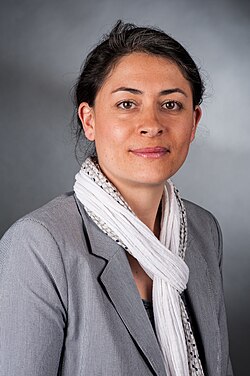
Swantje Henrike Michaelsen (born 4 October 1979 in Mainz) is a German politician of Alliance 90/The Greens and a member of the Bundestag for Lower Saxony.
- Facts0
- Drivers0
- Indicators0
Swantje Henrike Michaelsen (born 4 October 1979 in Mainz) is a German politician of Alliance 90/The Greens and a member of the Bundestag for Lower Saxony.
Swantje Henrike Michaelsen (born 4 October 1979 in Mainz) is a German politician of Alliance 90/The Greens and a member of the Bundestag for Lower Saxony. She sat in the 20th Bundestag (2021–2025), returned on the Lower Saxony state list for constituency 41, Stadt Hannover I, and has sat in the 21st Bundestag since 25 March 2025. The Green parliamentary group lists her as its spokesperson for transport policy. In the 21st Bundestag she is a full member of the transport committee and a deputy member of the committee on the environment, climate action, nature conservation and nuclear safety and of the petitions committee.
Michaelsen spent a school year in Bristol in 1995–96 and passed the Abitur in 1999 at the Gymnasium Oedeme in Lüneburg. After working as an au pair in Florence in 2000, she studied history and art history in Mainz from 2000 to 2004, including a year in Stockholm in 2002–03, and in Cologne from 2004 to 2007, graduating as Magistra Artium in 2007. She was a student assistant at the Haus der Geschichte in Bonn in 2005–06 and, from 2008 to 2012, worked at Experiment e.V. in Bonn on international youth exchange and the association's development. Since 2013 she has managed the Hanover city office of the Allgemeiner Deutscher Fahrrad-Club, a post the Bundestag's disclosure register records with a right of return.
She joined the Greens in 2015. From 2016 to 2017 she was a councillor in Hanover's Vahrenwald-List district, and from 2017 to 2021 she sat in the Hanover regional assembly as transport spokesperson of its Green group. She served on the supervisory board of Üstra Hannoversche Verkehrsbetriebe AG from 2019 to 2022 and has been a member of the supervisory board of Toll Collect GmbH since 2022.
In constituency 41 at the 2021 federal election, the Green first-vote share was 21.8 percent and the Social Democratic Party of Germany led with 34.9 percent; Michaelsen entered the Bundestag on the state list. At the 2025 election she stood in constituency 42, Stadt Hannover II, took 19.1 percent of the first votes and finished second to Boris Pistorius of the SPD (36.2 percent). She was re-elected in fourth place on the Lower Saxony Green list. The Greens received 576,845 second votes in Lower Saxony (11.5 percent), which the federal returning officer allocated as eight list seats. In the 20th term she was a full member of both the petitions committee and the transport committee. On 12 June 2024 the mediation committee of the Bundestag and the Bundesrat adopted a compromise on the Tenth Act amending the Road Traffic Act, after the Bundesrat had withheld consent on 24 November 2023. The compromise was designed to let municipalities, by ordinance, gain more scope over bus lanes, 30 km/h zones and resident parking, taking account of environmental protection, health and urban development as well as the ease and safety of traffic, and it required that traffic safety not be impaired. The Bundestag's biography, based on her own statement, records that she is married and has three children. Her constituency office is at Odeonstraße 4 in Hanover.
Swantje Henrike Michaelsen was born on 4 October 1979 in Mainz. Abgeordnetenwatch, which publishes short profiles supplied by members of parliament, gives 1979 as her year of birth. The chronology of her schooling is set out in the biography on the website of the Bundestag, which states that biographical details rest on the member's own information; the same sequence is printed by the Bundestag group of Alliance 90/The Greens.
She grew up in Lüneburg, in Lower Saxony. A profile by Christian Bohnenkamp in the Hannoversche Allgemeine Zeitung, published on 20 December 2024, describes her as having grown up there and as a trained historian. From 1995 to 1996 she spent a school year abroad in Bristol, England. In 1999 she passed the Abitur at the Gymnasium Oedeme in Lüneburg. That examination, normally taken in the upper secondary stage of a Gymnasium, confers the Allgemeine Hochschulreife. In the glossary maintained for the Kultusministerkonferenz, this is the school-leaving qualification that admits the holder to every subject at German higher-education institutions. Published accounts do not name the Bristol school or the subjects she offered in the Abitur.
In 2000, the year after the Abitur, Michaelsen worked as an au pair in Florence, Italy. The parliamentary chronology dates the start of her university studies to the same year. She read history and art history: from 2000 to 2004 in Mainz, including a year of study in Stockholm, Sweden, in 2002–2003, and from 2004 to 2007 in Cologne. In 2007 she graduated as Magistra Artium. The Bundestag lists her occupation as Historikerin M.A. Neither that biography nor the newspaper profile names a thesis topic or states which subject was the major.
Magistra Artium, abbreviated M.A., is the title the 1995 national framework for Magister examinations assigns to women; the same text assigns Magister Artium to men. Those Allgemeine Bestimmungen für Magisterprüfungsordnungen were adopted by the conference of university rectors and presidents on 3 July 1995 and by the Kultusministerkonferenz on 3 November 1995. They defined the Magister as a combined course of either one major subject and two minor subjects or two major subjects, with the thesis written in a major drawn from the humanities or social sciences. The standard period was nine semesters: four of basic study, closed by an intermediate examination, and five of advanced study, closed by the Magister examination, with the thesis and the subject examinations concentrated toward the end. Michaelsen's biography names only history and art history, so it does not show whether a third subject was included.
The Qualifications Framework for German Higher Education Qualifications, prepared with the German Rectors' Conference and the Federal Ministry of Education and Research and adopted by the Kultusministerkonferenz on 16 February 2017, places the Magister with the university Diplom and the Staatsexamen on the master's level. It assigns those long first degrees a length of four, four and a half, or five years, including the thesis (240, 270 or 300 ECTS credits), and treats them as opening the way to a doctorate. Her own enrolment, from 2000 to the degree in 2007, covered the Mainz period, the year in Stockholm and the move to Cologne, a longer calendar span than the nine-semester standard period.
In the 2024 profile she described the work she had expected that training to lead to: "Ich hatte ein klares Zielbild: Ich wollte ins Museum, Ausstellungen machen oder Museumspädagogik" ("I had a clear picture of where I was heading: I wanted to work in a museum, making exhibitions or doing museum education").
From 2005 to 2006, during her studies in history and art history, Michaelsen worked as a student employee at the Haus der Geschichte der Bundesrepublik Deutschland in Bonn. Opened in 1994, it is the largest site of the Stiftung Haus der Geschichte der Bundesrepublik Deutschland, a foundation established in 1990 to present German history since 1945; the Bonn building is also its headquarters.
From 2008 to 2012 she worked for Experiment e.V. in Bonn, on programmes and the development of the association. Experiment e.V. was registered in Bonn on 24 July 1952 as the German organisation of The Experiment in International Living, begun in the United States in 1932 by Donald B. Watt around homestays; it describes itself as a non-profit organiser of school exchanges, volunteer service and holiday programmes, and states that its office moved to Bonn in 1990. That post ended in 2012, the year before she took paid cycling-advocacy work in Hanover, Lower Saxony.
In October 2013 the ADFC Stadt Hannover hired Michaelsen as its first Geschäftsstellenleiterin, or office manager. The group had been founded on 25 October 2010 under the ADFC Region Hannover, a branch of the Allgemeiner Deutscher Fahrrad-Club, the national association set up in 1979 to improve conditions for cycling. From 2013 the city paid an annual grant for a “Koordinationsstelle Radverkehrsentwicklung und -sicherheit” and an office in the Umweltzentrum on Hausmannstraße. With Michaelsen the group used a cargo-bike information stand, the Infomobil, and a campaign, “Fair im Verkehr”, on sharing road space. The Bundestag register of interests lists that post at Allgemeiner Deutscher Fahrrad-Club Hannover e.V. as her job before parliament, with a right to return.
Cargo bikes of the Hannah sharing scheme, including a white bike marked hannah-lastenrad.de.
In 2015 the local ADFC and the Hanover shop Velogold put the first free-to-borrow Hannah cargo bikes on the street, using a small municipal environmental-education grant and following lending already tried in cities such as Cologne. The project site says Velogold designed the bicycles and the booking system while the ADFC spread them through the region, and states that the scheme became Germany’s largest initiative for free cargo bikes. District funding later added bikes at shops and cultural venues, bookable for at most three days and at first without electric assist; in 2019 the city branch transferred its Hannah fleet to the regional association. In a December 2021 interview Michaelsen called herself an initiator of “Hannah – Lastenräder für Hannover” and said lending reached people who could not pay most of the price of an electric cargo bike. In 2017 the offices added a separate advice service, financed for two years by the federal climate-protection initiative; the ADFC later continued it as WiLas, with a city-funded round in 2022–2023.
Since 2018 the archived Bundestag biography lists her as head of the Fachgruppe “Mehr Frauen” in the ADFC; the register of interests names her Leiterin of the Arbeitsgruppe “Mehr Frauen im ADFC” at the national association in Berlin. The ADFC says the group proposed in spring 2020 how to attract women as members and office-holders and how to bring gender into transport policy; by 2024 it reported mixed-gender federal leadership and quota rules in some statutes.
The same archived biography, based on her own statement, lists her as a co-founder in 2017 of HannovAIR Connection, called there Hanover’s network for clean air. In March 2018 the youth network JANUN described HannovAIR as an initiative of the ADFC, the Verkehrsclub Deutschland, Greenpeace and PlatzDa!, aimed at replacing car trips with bicycles and other modes and at publishing air-quality information; it reported sensor-building and a road blockade at the Klagesmarkt.
That biography also lists her as a co-initiator in 2020 of the Bündnis gegen den Ausbau des Südschnellwegs. A December 2020 local report said twelve groups—among them the city and regional ADFC, BUND, the Verkehrsclub Deutschland, the Naturschutzbund Deutschland and Fridays for Future—had petitioned against widening the road through the Leinemasch from 14.50 metres to 25.60 metres. The WeAct text asked that the floodplain stretch be rebuilt no wider than before, that speeds not be raised, that a flood-safe cycle crossing be included, and that a tunnel be planned separately from the Leinemasch section. Michaelsen, identified as an ADFC mobility expert and a candidate of Alliance 90/The Greens, said a transport shift required a sharp cut in car traffic and that such widening could not proceed if the Paris Agreement were taken seriously. A later donations page administered by the ADFC described the alliance as nearly 20 local initiatives opposing the expansion for reasons of climate protection, cycling routes and the Leinemasch protected landscape. The ADFC’s anniversary account says that after the 2021 federal election she left the Hanover office for the Bundestag.
Michaelsen joined Alliance 90/The Greens in 2015, according to the biography published by the Bundestag, whose biographical notes rest on members' own statements. Her first elected office came at the municipal elections of 11 September 2016, when she won a seat on the district council (Bezirksrat) of Vahrenwald-List, a city district of Hanover. The Hannoversche Allgemeine Zeitung named her among the five Green members on the 21-seat council, with Gisela Witte, Monica Plate, Klaus Geschwinder and Michael Joos. The Social Democratic Party took seven seats, the Greens five, the Christian Democratic Union four, Alternative for Germany two, and Die Linke, the Free Democratic Party and the Pirate Party one each, so that Social Democrats and Greens kept a majority of twelve. The same report called the Greens the clearest losers in the district: they lost one seat and 7.3 percentage points, while the AfD entered the council with 7.9 percent, and 10.9 percent in Vahrenwald itself.
She remained a district councillor into 2018, past the "2016 to 2017" dates in the Bundestag biography. On 9 January 2018 she wrote that she was resigning the Vahrenwald-List mandate with effect from 31 January. Under section 52 of the Lower Saxony municipal constitution act (Niedersächsisches Kommunalverfassungsgesetz), resignation ends membership and the district council must record the loss of the seat; the Vahrenwald-List council did so unanimously on 5 February 2018. The paper records the resignation without stating a reason.
In the regional party organisation, the Hannoversche Allgemeine reported that a 2018 members' meeting elected her an assessor (Beisitzerin) on the executive of the Greens in the Hanover region, confirmed Frauke Patzke and Henning Krause as co-chairs, and chose Simone Meyer as treasurer. The paper noted that these board elections were held every two years. The Bundestag biography lists the assessor's post as running from 2018 to 2021 and also records her as a co-founder, in 2018, of the regional Greens' women's network.
The Regionsversammlung is the elected assembly of the Hanover Region, a municipal association in Lower Saxony. At the election of 11 September 2016, confirmed by the regional election committee on 23 September, the Social Democrats won 26 of the 84 seats, the CDU 24, the Greens 12, the AfD nine, the FDP five, Die Linke four, the local list Die Hannoveraner two, and the Pirate Party and Die PARTEI one each. Regionspräsident Hauke Jagau sat as an eighty-fifth member with a vote, and the new assembly held its constitutive meeting on 15 November 2016.
The Bundestag biography dates Michaelsen's own membership from 2017 to 2021, after that election, and describes her as transport spokesperson of the Green group. Contemporary reporting used the same title. In October 2020 the Antikriegshaus in Sievershausen, in Lehrte, invited her in that capacity to speak on "VERKEHR(T) – bitte wenden!", about how street space is divided among cars, trams, bicycles and walking, and about resistance to reducing the room given to cars.
The Region is the authority for public transport in its territory under the Lower Saxony local-transport act (Niedersächsisches Nahverkehrsgesetz). It plans, finances and organises services, sets their extent and quality in a local-transport plan (Nahverkehrsplan), fixes frequencies and standards such as punctuality and cleanliness, and finances and steers the transport association. The Region is majority shareholder and financier of Großraum-Verkehr Hannover GmbH, which since 1970 has coordinated bus and rail operators so that one ticket covers the network; the municipal companies ÜSTRA and regiobus are shareholders.
From 2019 to 2022 she sat on the supervisory board of ÜSTRA Hannoversche Verkehrsbetriebe AG. The city's 2019 holdings report describes the company's object as local public passenger transport and business that supports it. Of the share capital, Versorgungs- und Verkehrsgesellschaft Hannover mbH held 98.38 percent, the Hanover Region 1.09 percent, free shareholders 0.52 percent and enercity AG 0.01 percent. The supervisory board has twenty members, ten chosen by the shareholders and ten by the employees under the Co-determination Act. As of August 2019 the shareholder side was chaired by Ulf-Birger Franz, the Region's first councillor (Erster Regionsrat), in the chair since 17 July 2015, and consisted largely of members of the regional assembly; Michaelsen was listed among them as a Regionsabgeordnete. ÜSTRA's financial statements for 2022 record that the terms of those shareholder-elected members, including Michaelsen, ended with the ordinary general meeting on 25 August 2022, and that she was not among those elected that day. The statements give her occupation as office manager of the Allgemeiner Deutscher Fahrrad-Club and note a further supervisory-board seat at Toll Collect GmbH.
Swantje Michaelsen has been a candidate of Alliance 90/The Greens at three elections to the Bundestag, each time both in a Hanover constituency and on the party’s state list in Lower Saxony. In the personalized proportional system used in 2017 and 2021, second votes fixed how many seats a party received in a Land. Constituency winners were seated first, and any seats still due to the party were taken in the order of its state list. Overhang and leveling seats could increase the size of the Bundestag. Where the Greens won no constituency in Lower Saxony, list place alone decided who was elected.
A state delegate conference on 19 February 2017 put Julia Verlinden and Jürgen Trittin at the head of the Lower Saxony list. Michaelsen, from the Hanover district association, was elected to place 13. She was also the Green direct candidate in constituency 41, Stadt Hannover I.
At the 2017 German federal election on 24 September she received 12,102 first votes, 9.1 percent of the valid first votes. Kerstin Tack of the Social Democratic Party of Germany won the constituency with 47,549 votes (35.6 percent). The CDU was second, with 39,487 votes (29.6 percent), so Michaelsen was not the runner-up. Turnout was 74.9 percent. Green second votes in the constituency were 16,292, or 12.2 percent.
Across Lower Saxony the Greens polled 404,825 second votes, 8.7 percent, 0.1 points below 2013, on a turnout of 76.4 percent. The final seat calculation gave that list six seats and no constituency seat: five from the state’s initial seat quota and one added when the Bundestag was enlarged. With no Green constituency winner to seat ahead of the list, the six mandates were places 1 to 6. Place 13 was not reached, and Michaelsen did not become a member.
On 30 May 2021 about 270 delegates, meeting in Oldenburg and online, elected a list of 40 candidates. A postal ballot confirmed it by 15 June. Filiz Polat and Kindler led the list; Michaelsen was placed 11th, between Stefan Wenzel and Julian Pahlke. She again stood in Stadt Hannover I. The archived biography for the 20th Bundestag associates her with constituency 41, and Abgeordnetenwatch records the same constituency for that candidacy.
On 26 September, in the 2021 German federal election, she took 27,851 first votes (21.8 percent) and finished second. Adis Ahmetović (SPD) won the direct mandate with 44,538 votes (34.9 percent). The CDU candidate had 27,303 votes (21.4 percent), 548 fewer than Michaelsen. Green second votes in the constituency were 30,360 (23.8 percent), up 11.6 points on 2017. Turnout was 72.9 percent.
In the state the Greens received 726,613 second votes, 16.1 percent, 7.4 points above 2017, with turnout at 74.7 percent. The final distribution assigned the Lower Saxony Greens 13 seats and no constituency seat — three more than the ten in the initial Land quota — and all 13 were list seats. With no Green constituency winner in the state, those seats were list places 1 to 13, including Michaelsen at place 11. She entered the Bundestag when it was constituted on 26 October 2021.
The 2025 German federal election, held on 23 February 2025, produced a Bundestag of 630 members. NDR reported that the electoral reform, including the end of overhang and leveling seats, did not cost any successful constituency candidate in Lower Saxony a seat, because each winner’s party had enough second votes. The state was divided into 30 constituencies.
On 14 December 2024, 228 delegates at a conference in Hanover nominated 31 candidates for the state list. Michaelsen, again from the Hanover district association, was placed fourth, after Polat, Helge Limburg and Verlinden, and ahead of Lena Gumnior. Her direct candidacy this time was in constituency 42, Stadt Hannover II.
Boris Pistorius (SPD) won that constituency with 57,217 first votes (36.2 percent). The official result names Michaelsen as the runner-up, with 30,166 votes (19.1 percent). The CDU followed with 28,168 votes (17.8 percent). Green second votes in the constituency were 33,650 (21.3 percent), down 8.2 points on 2021. Turnout was 83.8 percent.
Across Lower Saxony the Greens took 576,845 second votes, 11.5 percent, 4.6 points below 2021, on a turnout of 83.4 percent. The Federal Returning Officer’s roll of members elected from Land lists in Lower Saxony gives the Greens eight seats, in list order: Polat (place 1), Limburg (2), Verlinden (3), Michaelsen (4), Lena Gumnior (5), Timon Dzienus (6), Karoline Otte (7) and Alaa Alhamwi (8). No Green won a Lower Saxony constituency, so the whole allocation was filled from the list, and place 4 was inside it. The 21st Bundestag was constituted on 25 March 2025. Michaelsen’s current Bundestag biography records the seat as a Lower Saxony list mandate and associates her with constituency 42, Stadt Hannover II.
Swantje Michaelsen has sat in the Bundestag for Alliance 90/The Greens in both the 20th legislative period (2021–2025) and the 21st. The Bundestag records her seat in the 21st period as a place on the Lower Saxony state list. In the 20th Bundestag the Greens governed in the traffic-light coalition with the Social Democratic Party and the Free Democratic Party. In the 21st they are in opposition. On 6 May 2025 the house elected Friedrich Merz chancellor in a second ballot, on a joint nomination of the CDU/CSU and the SPD; the coalition groups then had a notional 328 votes, 208 from the CDU/CSU and 120 from the SPD.
Her main committee seat in both periods has been on the Committee on Transport. In the 20th Bundestag she was an ordinary member. The committee was chaired by Udo Schiefner (SPD), with Nyke Slawik of the Greens as deputy chair. The Green ordinary members were Matthias Gastel, Stefan Gelbhaar, Susanne Menge, Michaelsen and Slawik. The archived roll names Menge as the group's Obfrau and gives Michaelsen no coordinating title. She was also an ordinary member of the Petitions Committee. As a substitute she sat on the Committee on Climate Action and Energy, the Committee on Housing, Urban Development, Building and Local Government, and the Parliamentary Advisory Council on Sustainable Development. The environment committee of that term, then separate from the climate committee, did not list her.
The transport committee of the 21st Bundestag has 30 members and was constituted on 21 May 2025. The Greens, who held the right to nominate the chair, placed four ordinary members on it: Tarek Al-Wazir, Victoria Broßart, Gastel and Michaelsen. In a sitting opened by Bundestag vice-president Omid Nouripour, the committee elected Al-Wazir chair by secret ballot, with 23 votes in favour, one against and six abstentions. On the committee's later roll Broßart is the Green Obfrau and Michaelsen is marked Sprecherin; Gastel is an ordinary member without either designation. Michaelsen's other seats in this period are both substitutes: the Committee on the Environment, Climate Action, Nature Conservation and Nuclear Safety, and the Petitions Committee. The full petitions seat, and the substitute seats on climate and energy, housing and the sustainability council, are not part of that 21st-term list.
Apart from committee office, the Bundestag's register of members' interests states that she belonged to the supervisory board of Toll Collect GmbH until 31 December 2025 and that the gross remuneration published for 2025 was 4,000 euros. The biographical note on the same page, based on the member's own information, dates the board membership from 2022.
Each Bundestag group names an Obmann or Obfrau to coordinate its members inside a committee. That post is not the same as the group's policy spokesperson. In the Green parliamentary group, the heads of the working groups are the policy spokespersons for their fields. The groups prepare committee sittings and draft bills and motions.
In the 20th term both of the transport offices were held by other Green members. As the committees were being filled in December 2021, Taxi Times reported that Gelbhaar would remain the group's transport-policy spokesperson and that Menge would be its Obfrau on the transport committee, with Michaelsen among the ordinary members. Deutschlandfunk still described Gelbhaar as the Green group's transport-policy spokesperson on 26 July 2024. Michaelsen's assignment inside the governing group was the subject file. A Green group event on 28 November 2024 introduced her as the group's rapporteur for road-traffic law (Berichterstatterin für Straßenverkehrsrecht) on the transport committee. That factional rapporteurship is a different office from the Berichterstatter who signs a committee report for the whole house. On the transport committee's report of 18 October 2023 on the tenth amendment of the Road Traffic Act, the reporting member was Florian Müller.
After the 2025 change of government the Green group gave Michaelsen the spokespersonship. Its site lists her function in the group as spokesperson for transport policy (Sprecherin für Verkehrspolitik), and her function in the Bundestag as an ordinary member of the transport committee, with the two deputy seats already noted. She chairs the group's working group on mobility and transport. Broßart is deputy chair, and Al-Wazir and Gastel are the other members. The committee roll follows the same division: Michaelsen is entered as Sprecherin, and Broßart, not Michaelsen, as Obfrau. In the 21st term the committee chair, the group's Obfrau and the group's transport spokesperson are three different Green members. Relative to the governing period, Michaelsen moved from subject rapporteur and ordinary member to opposition spokesperson and working-group chair, and did not take the Obfrau post.
In the 20th Bundestag, under the traffic-light coalition of the Social Democratic Party (SPD), Alliance 90/The Greens and the Free Democratic Party (FDP), Michaelsen was one of the Greens' cycling-policy rapporteurs. In June 2024 she described herself as the group's rapporteur for road-traffic law. By 2026 the Tagesspiegel identified her as the Greens' transport spokesperson in opposition.
The statute that added climate, environment, health and urban development to federal road-traffic purposes was the Tenth Act amending the Road Traffic Act, passed by the Bundestag on 20 October 2023. On 24 November 2023 the Bundesrat withheld consent: the bill missed the absolute majority of 35 state votes, and the linked amendment of the Road Traffic Regulations (Straßenverkehrs-Ordnung, StVO) was dropped from the agenda. Der Spiegel reported that the reversal appeared to come from CDU/CSU-led governments such as Bavaria, which argued that safety must not be diluted by goals such as climate protection. The states had wanted Vision Zero—no road deaths—written into the law, and a basis for social criteria in parking charges. Baden-Württemberg's Green transport minister Winfried Hermann called the safety argument an incomprehensible pretext; FDP state secretary Daniela Kluckert argued for the bill without success. Agora Verkehrswende director Christian Hochfeld called the vote a heavy blow for municipalities.
The government called the mediation committee on 6 June 2024; its proposal of 12 June was accepted by both chambers on 14 June. The act, signed for the government by transport minister Volker Wissing, was promulgated on 16 July 2024 and took effect the next day. New section 6(4a) allows specified ordinances to improve environmental protection, including climate protection, to protect health, or to support urban development. Those ordinances and the orders based on them must still consider the ease of traffic and may not impair its safety—stricter than a duty merely to "consider" safety. Michaelsen said the deal opened the "paradigm shift in road-traffic law" municipalities had demanded, giving them a basis to order cycle tracks, 30 km/h limits and zebra crossings more easily, or to speed up buses.
The Fifty-seventh Ordinance amending road-traffic rules, made on 2 October 2024 and in force on 11 October, carried the new purposes into the StVO. Authorities may assign space to bicycles and walking, and install bus lanes, on environmental, health or urban-development grounds, if ease of traffic is considered and safety is not impaired. For those orders the qualified-danger test in section 45(9) does not apply, and a municipality may ask the competent authority to act. There is no general urban 30 km/h limit; 50 km/h remains the default. Without a qualified danger, 30 km/h may be ordered on priority roads, including federal, state and district roads, beside zebra crossings, kindergartens, playgrounds, heavily used school routes, schools, care homes, facilities for disabled people and hospitals. The closable gap between two 30 km/h stretches rose from 300 to 500 metres. Bus lanes and zebra crossings joined the eased cases; resident parking may be ordered when a shortage is only threatened.
Section 45(9) was not repealed: outside those exceptions, restricting flowing traffic still requires a qualified danger, and Vision Zero was not made binding. The Allgemeiner Deutscher Fahrrad-Club welcomed easier protected cycle lanes and bicycle parking, and the priority of safety over ease of traffic, but managing director Caroline Lodemann said 30 km/h remained a "confusing patchwork," that a clear commitment to Vision Zero was missing, and that a genuine mobility-transition reform had been missed.
On 11 April 2022 velobiz reported that the cycling rapporteurs of the SPD, Greens, FDP and CDU/CSU—Mathias Stein, Michaelsen, Valentin Abel and Gero Storjohann—had reconstituted the cross-party Parliamentary Bicycle Circle (Parlamentskreis Fahrrad), founded in 2018. ADFC director Ann-Kathrin Schneider said its priority should be the promised modernisation of the Road Traffic Act. The 2024 code was the result for walking and cycling: space for both, and bus lanes, can be ordered for the new purposes without an accident blackspot, and heavily used school routes were added to the places where 30 km/h needs no qualified danger. The German Environment Agency has recommended 30 km/h as the urban rule, with higher speeds only as exceptions on suitable main roads. That was not enacted. The ADFC's remaining objection was that the code still prefers car traffic, so extra safety for people walking, using wheelchairs or cycling would be only local.
In Hanover, Lower Saxony's Greens opposed widening the Südschnellweg, a 3.8-kilometre stretch of federal road B 3. In October 2022 lead candidate Julia Willie Hamburg told taz that "such a mammoth road will generate more traffic and thus release still more climate-damaging CO2," and that the party wanted for now only to replace the bridge due for repair with a tunnel. The state road authority said a January 2022 tender had priced the tunnel and a temporary bridge at 250 million euros, and that diesel and steel then rose by about 30 and 80 percent. When the temporary bridge opened in October 2024, the state economy ministry put the federal-budget figure at about 580 million euros, aimed at completion in 2031; the temporary bridge cost 53.5 million euros, and a 480-metre bridge over Hildesheimer Straße is to become an 800-metre tunnel.
Deutsche Bahn said on 5 March 2026 that preliminary planning to expand Hannover Hauptbahnhof was finished: tracks 15 and 16 and a new platform, mainly for S-Bahn trains toward Lehrte, plus a second passenger underpass. A quality review, and a passenger-flow study running to about 2029, still stood before a decision to build. On 19 June 2026 Michaelsen, citing the government's answer to a Green written question, said the next stage was unfunded. "That this project is not financed is a scandal," she said; the tracks were needed for a more punctual S-Bahn, and the station was a bottleneck for northern Germany. Figures reported alongside were more than 260,000 passengers and about 750 trains a day. Allianz pro Schiene called the brake on rail building illogical; the ministry pointed to open budget talks. Her Bundestag biography records that since 2022 she has sat on the supervisory board of Toll Collect GmbH, the federal company that operates the truck toll.
Michaelsen was the first signatory of a Green bill of 14 April 2026 for a general 130 km/h ceiling: cars and other vehicles up to 3.5 tonnes would be limited to 130 km/h on Autobahnen and similar roads and to 100 km/h elsewhere, and within five months the government would report on fuel, prices, emissions and casualties as a basis for keeping or dropping the limit. The memorandum cited an Environment Agency study for an annual cut of 3.5 million tonnes of CO2. The agency's own page puts the saving from speed limits at 2.2 to 8.1 percent of road-transport greenhouse gases, with 130 km/h on motorways and expressways at the bottom of that range, and notes a 2025 Federal Highway Research Institute finding of about 1.3 to 2.0 million tonnes of CO2 a year from a motorway-only limit, counting speed effects alone.
In May 2026 the Tagesspiegel reported that the CDU/CSU and SPD had blocked a public hearing. A hearing needs a quarter of the committee's votes; the Greens and The Left fell short and would not rely on the Alternative for Germany. Michaelsen said the blockade suggested that the Union and the SPD feared the debate. Deputy leader Julia Verlinden spoke of "fear of uncomfortable truths." SPD spokesperson Isabel Cademartori said the arguments were already known and that a hearing was pointless because the partners had no common line. CDU/CSU spokesperson Steffen Bilger asked what new insight remained after years of debate. Michaelsen said the Greens would hold their own discussion on 22 June and invite the other democratic parties. On 9 July 2026 the Bundestag rejected the bill, 137 to 467, with no abstentions and 26 members not voting. Every CDU/CSU, AfD and SPD vote cast was against; every Green and Left vote cast was in favour.
In the 20th Bundestag, Michaelsen, of Alliance 90/The Greens, was a full member of the Petitions Committee and a deputy member of the Committee on Climate Action and Energy and of the Parliamentary Advisory Council on Sustainable Development. In the 21st Bundestag she is a deputy member of the Committee on the Environment, Climate Action, Nature Conservation and Nuclear Safety and of the Petitions Committee, while her full seat and the group’s transport spokesperson role are on the Transport Committee.
On 8 July 2025 she was the first-named author of a Green motion to keep the European Union end, from 2035, of new vehicles with combustion engines, as planning certainty and part of climate neutrality by 2045. The motion rejected plug-in hybrids, synthetic fuels and food- or feed-based agrofuels as substitutes. On 24 March 2026 she was the second-named sponsor of “Klimaschutzprogramm als Entlastungsprogramm”, citing the Federal Environment Agency’s 2025 balance and asking the government not to slow renewables, the heating law or solar.
The group’s biography, based on members’ own information, lists her as a co-organiser since 2020 of the congresses Frauen machen Mobil(ität). The series’ site frames mobility in feminist terms, tied to social life and climate protection, and lists conferences from 31 October 2020; one set for 21 November 2026 was moved to 10 April 2027.
On 27 June 2024, then a full member of the Petitions Committee, she said 11,410 petitions had been filed in 2023 and that the committee had the previous morning cut the public-hearing threshold from 50,000 signatures to 30,000.
The Sixth Act amending the Road Traffic Act and further road-traffic rules set a statutory limit of 3.5 nanograms of tetrahydrocannabinol (THC) per millilitre of blood serum, replacing the 1 ng/ml value used by the courts. It followed the March 2024 advice of an expert group the transport ministry had to appoint under the Cannabis Consumption Act, in force from 1 April 2024. The Bundestag passed the act on 6 June 2024 and the Bundesrat approved it on 5 July 2024; promulgation was on 21 August 2024 and it took effect the next day. The ministry called 3.5 ng/ml a level at which a safety-relevant effect was not remote, yet clearly below a general rise in accident risk, and the act also barred cannabis at the wheel for probationary drivers and drivers under 21, and alcohol for anyone at or above the THC limit. Coverage of the vote put the usual first penalty at a €500 fine and a one-month driving ban.
In the 25 April 2024 debate on a CDU/CSU motion, Michaelsen said 1 ng/ml detected residual THC long after any effect, and that 3.5 ng/ml was strict, comparable for fitness to drive to about 0.2 per mille alcohol. At first reading on 16 May 2024 she said the bill followed the experts, would allow saliva tests, and included a review after three years, while the Greens still thought the novice and under-21 ban unnecessary. On 6 June, Kirsten Kappert-Gonther thanked her for the transport negotiations. Der Spiegel reported her line that nobody should drive intoxicated, and that the rule was meant for people who separate use from driving, not to punish consumption through traffic law. In the April debate, CDU/CSU and AfD speakers called the higher limit a risk to road safety, and Martina Englhardt-Kopf described a tripling of the old value as wholly irresponsible.
On 8 April 2022 the Human Rights Center Viasna reported that Michaelsen had taken a godparenthood, under Libereco’s #WeStandBYyou campaign, for Siarhei Satsuk, editor-in-chief of Ejednevnik (Yezhednevnik) in Belarus. Libereco, which began the campaign in July 2020, says parliamentarians symbolically “adopt” political prisoners to show solidarity and seek their release, not to act as lawyers. She was quoted demanding the immediate release of Satsuk, arrested on 8 December 2021 and held again in pre-trial detention on a bribery allegation, and of other political prisoners. The Committee to Protect Journalists later recorded an eight-year sentence imposed in Minsk in October 2022 for taking a bribe, inciting hatred and abuse of power or authority, upheld on 10 February 2023, with Satsuk held at Prison No. 15 in Mahilou.
Regional and national reporting has followed Swantje Michaelsen mainly as a transport politician of Alliance 90/The Greens. In December 2024 the Hannoversche Allgemeine Zeitung portrayed her move from the Hanover office of the Allgemeiner Deutscher Fahrrad-Club into the Bundestag and treated the road-traffic reform she negotiated for the Greens as a personal success. She said the Straßenverkehrsgesetz had for decades aimed only at keeping cars flowing, and that climate protection, health and urban development had been added.
The taz reported the June 2024 compromise between the Bundestag and the Bundesrat the same way, quoting her that towns would finally have a legal basis for cycle tracks, 30 km/h limits, zebra crossings and faster buses. In November 2023 it quoted Thomas Dienberg, of an alliance of more than 1,000 municipalities, calling the Bundesrat’s rejection bitter and the draft itself only a limited gain. A news-agency report on the final vote noted both the ADFC’s welcome, from federal director Caroline Lodemann, and rejection by the CDU/CSU and the Alternative for Germany.
In May 2026 Der Tagesspiegel reported that the CDU/CSU and the SPD blocked a hearing on a Green bill, introduced while she was transport spokesperson, for a temporary 130 km/h Autobahn limit during a fuel-price spike. She said the coalition feared the debate; Isabel Cademartori said the arguments were known and the partners disagreed; Steffen Bilger asked what a further hearing would add. The taz reported a Greenpeace action covering advisory-speed signs, her comment that a limit could be introduced quickly, and Transport Minister Patrick Schnieder’s rejection of the idea.
Critics aimed at the measures. Thorsten Frei, then CDU parliamentary secretary, called the mediated act a bad law the committee had not improved; AfD secretary Stephan Brandner called it a “climate-mania law”; FDP politician Thorsten Herbst said it would not allow city-wide 30 km/h zones and that safety stayed central. Union-governed Länder had objected that safety was underplayed, so the compromise stated that safety must not be impaired.
From the other side, Environmental Action Germany called the accompanying road-code draft inadequate and still biased toward motor traffic. Verkehrsclub Deutschland spokesperson Michael Müller-Görnert said the change “by no means goes far enough,” because ease of car traffic remained a principle and towns still lacked a general power to set 30 km/h. Michaelsen later told VELOPLAN that parts of the mobility movement were frustrated the government had not spent more on cycling.
The ADAC does not recommend a general motorway limit, citing disputed effects on safety, emissions and journey times, and prefers variable signs; in a 2026 member survey 56 percent favoured a limit and 39 percent opposed one.
On Hanover’s Südschnellweg, Michaelsen said in 2020, as the ADFC’s local specialist and a Green candidate, that the Paris agreement ruled out widening and that car traffic had to fall. The alliance around her—the ADFC, BUND, the VCD, NABU and local Fridays for Future—called a jump from about 14.5 to 25.6 metres backward policy and wanted repair at the existing width. The taz quoted campaigner Ralf Strobach on 1950s planning and researcher Andreas Knie on induced traffic; the road authority said a wider road would cut jams and diversion onto city streets. The Hanover chamber of commerce later called the road unsafe—narrow lanes, no hard shoulders, failing bridges—and criticised reopening a 2021 approval, after courts had rejected emergency challenges, as undermining a finished procedure.
Ranked by shared high-impact facts, then explicit ties, then shared drivers.
 Tarek Al-WazirTarek Mohammed Al-Wazir (born 3 January 1971) is a German…Affiliated
 Isabel CademartoriIsabel Andrea Cademartori Dujisin (born 9 January 1988 in…Affiliated
 Omid NouripourOmid Nouripour (born 18 June 1975) is a German politician…Affiliated
 Friedrich MerzFriedrich Merz has been Chancellor of Germany since May…Affiliated
 Filiz PolatFiliz Polat (born 11 July 1978 in Bramsche) is a…Affiliated
 Matthias GastelMatthias Gastel (born 26 December 1970 in Stuttgart) is a…Affiliated
How the record is sourced and how the score is derived.
The score is formula-derived (Factrail formula v1, version 1.0.0), not an editorial verdict. Read the methodology.
By the Factrail desk · Method: how we source and score · Last reviewed
Dispute a fact on this pageNamed here, or represent someone who is? Request a right of reply.
People and organizations as listed in the Related section of this page; facts, drivers and the pages that name it as listed in the blocks here. Counts, not a rating.