
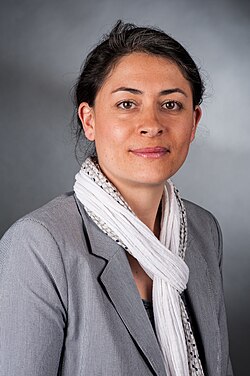
Lena Gumnior
Lena Maria Gumnior (born 10 December 1992 in Rheine) is a German lawyer and a member of the Bundestag for Alliance 90/The Greens.
- Facts0
- Drivers0
- Indicators0
Lena Maria Gumnior (born 10 December 1992 in Rheine) is a German lawyer and a member of the Bundestag for Alliance 90/The Greens.
Lena Maria Gumnior (born 10 December 1992 in Rheine) is a German lawyer and a member of the Bundestag for Alliance 90/The Greens. The 21st Bundestag constituted itself on 25 March 2025, after the snap 2025 German federal election of 23 February. She holds a Lower Saxony seat on the Green state list; the Federal Returning Officer lists her fifth among the Greens elected from that list (list place 5).
In the biography she supplied to the Bundestag she describes herself as Roman Catholic and single. She studied law at the University of Münster and passed the first state examination in law in 2017. She then worked as a research assistant at a chair of criminal law and criminal procedure, first in Hannover and later in Frankfurt (Oder), and in 2022 received a doctorate in the constitutional law of the criminal justice system (Strafverfassungsrecht). The thesis was published in 2023 by Duncker & Humblot as Der Einsatz von Öffnungsklauseln im Strafrecht. Eine verfassungsrechtliche Analyse, volume 413 of the series Schriften zum Strafrecht. She passed the second state examination in 2024, has been admitted as a lawyer (Rechtsanwältin) since that year, and until the end of 2024 practised in a commercial law firm. The Bundestag's register of members' interests names that firm as Gleiss Lutz in Berlin and records a further paid practice as a lawyer in Osnabrück alongside the mandate. From 2023 to 2025 she was an assessor on the state executive of the Lower Saxony Greens and that board's spokesperson on women's and gender policy.
At the 2025 election she was the Green direct candidate in constituency 34, Osterholz–Verden. Andreas Mattfeldt of the Christian Democratic Union won the constituency with 59,337 first votes (35.9 percent). Gumnior received 18,452 first votes (11.2 percent), 3.5 percentage points below the 2021 Green first-vote share there; the party's second votes in the constituency were 20,452 (12.4 percent). Turnout was 84.7 percent of 196,082 eligible voters.
In the 21st Bundestag she is a full member, and the Green group's Obfrau, of the Committee on Legal Affairs and Consumer Protection. She also sits as a full member on the inquiry commission on the COVID-19 pandemic in Germany (Enquete-Kommission „Corona“), on the subcommittee on European law, and on the body constituted under Article 13(6) of the Basic Law. She is a deputy member of the Committee on Labour and Social Affairs, the Interior Committee and the Wahlausschuss, a deputy member of the German delegation to the Inter-Parliamentary Union, and deputy chair of the Bundestag's parliamentary friendship group for West Africa. In a March 2026 interview with the Bundestag weekly Das Parlament she argued for a policy of zero tolerance toward gender-based violence and said that, for as long as the making of pornographic deepfakes was not itself a criminal offence, Germany was in that respect a “perpetrator's paradise” (Täterparadies) by European comparison. She said the Green group had drafted its own bill so that the gap could be closed together with other democratic parliamentary groups.
Lena Gumnior was born on 10 December 1992 in Rheine. The biography published by the Bundestag gives that date and place and, as the member's own disclosure, records her as Roman Catholic and unmarried; the parliament states that its biographical entries rest on information supplied by the members themselves.
Rheine's official gazette, issued under the municipal code of North Rhine-Westphalia, records an agreement between the city and the Steinfurt district and describes the western limit of one planning area as the boundary with the municipality of Salzbergen, in the Emsland district of Lower Saxony. The birthplace in the Bundestag biography is therefore a city in North Rhine-Westphalia, on the state line, and not a place in Lower Saxony. Newspapers reporting her later candidacies have nevertheless placed her upbringing on the Lower Saxon side of that line. In March 2021 the Kreiszeitung called the then 28-year-old lawyer a native of the Emsland ("gebürtige Emsländerin") and wrote that she had grown up in the Emsland. In December 2024 the same paper again described her as having grown up in the Emsland, and that November the Weser-Kurier referred to her as a lawyer from the Emsland ("aus dem Emsland"). None of those reports names a town or village in the district.
The Bundestag biography and that coverage do not name a school, a school-leaving examination, or her parents. In the preface to her dissertation, accepted in the summer semester of 2022, she thanked her parents for their support and for their continuing confidence in her path, credited her mother with giving her the courage to take on the project and with pressing it toward completion, and dedicated the book to her grandfather, who had died before it was finished. The preface is dated Berlin, winter 2022, and does not name them or describe her childhood.
Gumnior studied law at the Westfälische Wilhelms-Universität Münster. The author note published by Duncker & Humblot, which gives her name as Lena Maria Gumnior, states that she studied law at that university and in Palma ("Studium der Rechtswissenschaft an der Westfälischen Wilhelms-Universität Münster und in Palma"). The note does not date the Palma period, name a host institution, or describe the stay as an exchange programme, and the Bundestag biography mentions only the studies in Münster.
The parliamentary biography records that she passed the first state examination in law (erstes juristisches Staatsexamen) in 2017. The Münster faculty of law describes German legal training as two stages: a university course, which it presents as lasting about eight semesters and which ends with the first examination, and a later two-year practical preparatory service (Referendariat) ending in a second state examination. That description is the faculty's account of the course, not a published record of Gumnior's own semesters or results. Neither the Bundestag entry nor the publisher's vita gives an examination grade, a field of specialization, the year she began the degree, or which judicial examination office in North Rhine-Westphalia conducted the state portion of the examination.
The Bundestag biography, which rests on the member's own statements, records that Gumnior passed the first state examination in law in 2017 and then worked as a research assistant (wissenschaftliche Mitarbeiterin) at a chair of criminal law and criminal procedure, first in Hanover and later in Frankfurt (Oder). The author note issued with her monograph names the post more fully: an assistantship at the chair of criminal law, criminal procedure and legal philosophy, first at Leibniz University Hannover and later at the European University Viadrina.
That note corresponds to the appointments of Christian Becker, whom the published preface identifies as doctoral supervisor. The University of Bremen, where Becker has been professor of criminal law, criminal procedure, economic criminal law and legal theory since the summer semester of 2025, states that he was appointed professor at Leibniz University Hannover in 2017 and in 2019 took the Viadrina chair of criminal law, criminal procedure and legal philosophy. In the preface, signed in Berlin in the winter of 2022, Gumnior writes that she worked at his chair while preparing the dissertation. The same author note adds a further assistantship at Viadrina's writing centre (Schreibzentrum). The Bundestag biography does not mention that post; it describes the 2022 doctorate only as a promotion in criminal constitutional law (Strafverfassungsrecht).
In 2023 Duncker & Humblot published the dissertation as *Der Einsatz von Öffnungsklauseln im Strafrecht. The title page in the publisher's reading sample gives the series ISSN as 0558-9126, the imprint year as 2023, print ISBN 978-3-428-18847-5 and e-book ISBN 978-3-428-58847-3. The German National Library records 286 pages and catalogues the book as a 2022 dissertation of the Europa-Universität Frankfurt (Oder). The publisher's e-library gives the same page span, a publication date of 12 July 2023, and the DOI 10.3790/978-3-428-58847-3 for the e-book.
The verso states that Viadrina's law faculty accepted the work as a dissertation in 2022; the preface dates acceptance by the university's department of law to the summer semester of 2022. Gumnior thanks Becker as Doktorvater and thanks Kilian Wegner for preparing the second report (Zweitgutachten). Wegner had taken up a junior professorship of criminal law, criminal procedure and economic criminal law at Viadrina on 1 April 2021, after appointment on 23 March 2021.
The publisher's description defines opening clauses (Öffnungsklauseln) as devices used to enlarge the courts' room for decision: they allow conduct that an offence does not specify more closely to be subsumed under it. The introduction in the reading sample describes the drafting pattern. A provision first lists concrete modes of commission and then, with phrases such as "other comparable acts" (andere vergleichbare Handlungen) or "equally dangerous interferences" (ebenso gefährliche Eingriffe), authorizes courts to bring further, unnamed conduct within the offence by a similarity inference. The examples given there are § 238(1) no. 8 of the Strafgesetzbuch, the stalking offence—the clause had stood at no. 5 before the text in force from 1 October 2021—and § 315(1) no. 4 and § 315b(1) no. 3, on dangerous interference with rail and road traffic. The same passage distinguishes opening clauses from general clauses (Generalklauseln) by that ordered similarity judgment, and it recalls that under § 1 of the Courts Constitution Act and Article 97(1) of the Basic Law judges are subject only to statute.
The book asks whether the reasons given for such clauses are legitimate, and how far the decision that particular conduct is criminal may pass from the legislature to the judiciary. The introduction presents the objection as one of unfinished legislative choice: making abstract general rules is treated as the legislature's task and applying them to the individual case as the courts', so that ordering a similarity inference instead of a concluded decision on punishable conduct raises the question of who makes the criminal norm, and whether that conflicts with the separation of powers and the binding force of statutes (Gesetzesbindung). The table of contents places the constitutional analysis in a chapter from page 63. It runs from the history and present function of the principle of legality (nulla poena sine lege), including the origins of Article 103(2) of the Basic Law, through separate tests of compatibility with the requirement of definiteness (Bestimmtheitsgrundsatz), the prohibition of analogy (Analogieverbot), the prohibition of retroactivity, the fragmentary character of criminal law, and Gesetzesbindung together with separation of powers. A heading inside the analogy chapter is "opening clauses as intra-offence analogies and evasion statutes". Later chapters set out consequences for criminal legislation, from page 236, and practical consequences of not applying existing opening clauses, from page 239, with subsections on § 238(1) no. 8 and § 315b(1) no. 3; an overall result begins at page 243.
The publisher states the result in two sentences. The justificatory approaches used by the legislature already meet constitutional concerns, and opening clauses, because they confer a statutory power of analogy inside the offence (innertatbestandliche Analogiebildung), are incompatible with the separation of powers and with the principle that the courts are bound by statute.
Qualification for judicial office in Germany requires a university degree in law completed by the first state examination and a subsequent preparatory service, the Referendariat, completed by the second state examination. Under the German Judiciary Act the preparatory service lasts two years. It is served in mandatory placements at an ordinary court in civil matters, at a public prosecutor’s office or a court in criminal matters, at an administrative authority, and with a lawyer, together with one or more elective placements in which proper training is assured.
The Bundestag biography of Lena Gumnior, which the parliament states rests on members’ own information, records that she passed the second state examination in 2024. The author note issued by Duncker & Humblot with her 2023 monograph, and still phrased in the present tense in a capture of the publisher’s site on 18 March 2025, describes her as a Rechtsreferendarin at the Kammergericht in Berlin, with stations at the Federal Ministry of the Interior and Community and the Federal Foreign Office. The note does not say which parts of the statutory programme those postings filled, and it gives no start or end date for the traineeship.
Under the Federal Lawyers’ Act, admission to practise as a Rechtsanwältin or Rechtsanwalt requires the qualification for judicial office under the German Judiciary Act, or one of the Act’s routes for certain lawyers qualified elsewhere in Europe. Gumnior’s Bundestag biography states that she has been an admitted lawyer since 2024 and that, until the end of 2024, she worked in a commercial law firm.
In the particulars members must publish, her occupation before entering the Bundestag is given as lawyer at Gleiss Lutz in Berlin, and her paid activity alongside the mandate as a lawyer in Osnabrück, with no firm named for the Osnabrück work. Abgeordnetenwatch records both items, entered on 2 September 2025, for the 2025–2029 term: the earlier post at Gleiss Lutz in Berlin, and a side activity as a lawyer. The published entries do not state which area of the firm’s work she handled. Gleiss Lutz, formally Gleiss Lutz Hootz Hirsch, is a German business-law firm that developed from a competition-law office opened in Stuttgart in the early 1950s by Alfred Gleiss and Arved Deringer; from 1962 it used the longer name, which in ordinary usage is shortened to the first two partners.
The parliamentary biography also lists membership of the Deutscher Juristinnenbund, RechtGrün and Junges Strafrecht. The Juristinnenbund is an association of women trained in law or economics; it describes itself as independent of party and denomination and draws up legal-policy demands in volunteer commissions, including a criminal-law commission. The Duncker & Humblot author note named Gumnior as a member of that commission. RechtGrün – Verein grüner und grünnaher Jurist*innen e.V., seated in Berlin, states as its purposes the promotion of a democratic polity, of the rule of law in Germany and Europe, and of legal education; its statute says that the association does not give legal advice and does not pursue professional or status interests. Junges Strafrecht e.V. is a non-profit association whose purpose is to advance criminal-law scholarship, in particular by offering early-career researchers in the German-speaking countries a forum for presenting work and making professional contacts.
No published account gives a calendar day for Lena Gumnior's entry into Alliance 90/The Greens. In a February 2021 self-introduction carried by the Osterholz district association, she wrote that, alongside work as a research assistant and doctoral candidate, she had been involved with the Greens for more than four years, "especially in anti-discrimination and the protection of women and girls from violence." The Weser-Kurier, reporting her selection as a Bundestag candidate the next month, described her as a party member of four years, which points to joining around 2017; neither report states where she joined.
That article said she was then active in the state and federal working groups on flight and migration, and quoted priorities she named rather than measures she had carried through: a Lower Saxony anti-discrimination statute, reform of the General Equal Treatment Act, lasting finance for shelters and counselling centres, and racism- and gender-sensitivity training for courts, prosecutors and police. In the Osterholz text she also called for a federal anti-discrimination law and wrote that "climate justice begins with the transport transition," linking that phrase to an end to natural-gas extraction and to more public transport and cycling in the rural constituency.
Her documented local tie is to the two district associations that nominate the constituency candidate. In March 2021 members of the Verden and Osterholz associations chose her in a postal ballot, 137 votes to 86 for Erkan Kahraman of Achim, with three ballots invalid. By her renomination she called Verden her political home. The Kreiszeitung reported in December 2024 that she belonged to the extended board of the Greens in Verden, took part in the party's regional conference, and attended events of both district associations, while also sitting on the state executive. At a joint assembly in Verden-Dauelsen on 30 November 2024, 47 of 48 delegates from the two associations backed her. She told them that "the question of justice in feminist legal policy and also the climate crisis" had moved her to stand again, and argued for legalising abortion and for doing more against femicides, saying that almost every day a woman was killed by a man.
On 18 March 2023, delegates at a state conference of the Lower Saxony Greens in Celle elected a new executive. Greta Garlichs received 190 of 215 votes (88 percent) as co-chair; Alaa Alhamwi of Oldenburg received 170 of 220 (77 percent), against 45 votes (20 percent) for Tobias Redlin of Burgwedel. Anne Kura and Hans-Joachim Janßen, chairs since 2018, did not stand again. The Nordwest-Zeitung reported that, on figures given at the conference, state membership had risen during their tenure from about 6,800 at the end of 2017 to about 12,600.
The Lower Saxony Green state executive elected at the March 2023 conference in Celle: Heiko Sachtleben, Greta Garlichs, Alaa Alhamwi, Lena Gumnior, Maximilian Strautmann and Nicole Henkel.
The same conference filled the rest of the six-person board. A Nordwest-Zeitung report on Nicole Henkel of Friedeburg said she was chosen together with the new chairs and with Gumnior of Verden; Maximilian Strautmann of Osnabrück won the remaining open place, and Heiko Sachtleben was confirmed as treasurer for another two years. The state association announced that Gumnior, then 30, was one of the three assessors (Beisitzerinnen and Beisitzer) and the new spokesperson for women's and gender policy, while a statute change created a diversity-policy spokesperson's role, which Garlichs took. Her Bundestag biography, drawn from members' own disclosures, lists those two offices for 2023 to 2025.
The Kreiszeitung still described her, at the November 2024 nomination, as active on that executive for two years. The term ended at the next state conference, again in Celle, on 22 March 2025. NDR reported that Garlichs was confirmed with just under 78 percent and that Strautmann, previously an assessor, became co-chair with just under 55 percent. A dpa dispatch carried by the Süddeutsche Zeitung said he succeeded Alhamwi, who was entering the Bundestag. Those reports do not describe a mid-term resignation by Gumnior. They record a scheduled re-election of the executive after the February 2025 federal election; her parliamentary biography closes the state offices in 2025, the year she took her own Bundestag seat.
Lena Gumnior was the constituency candidate of Alliance 90/The Greens for the Bundestag in constituency 34, Osterholz – Verden, in both 2021 and 2025. The seat covers the districts of Osterholz and Verden in Lower Saxony. She was not first in either contest. She entered parliament only in 2025, and then from the Green state list, not with a constituency seat.
Before the 2021 German federal election, Green members in Osterholz and Verden nominated her by postal ballot, 137 votes to 86, over Erkan Kahraman of Achim. A two-day state delegates' conference in Oldenburg, reported by the party on 30 May 2021, placed her 17th on the closed Lower Saxony list. The order, headed by Filiz Polat and Sven-Christian Kindler, remained subject to postal confirmation until 15 June.
The vote was on Sunday, 26 September 2021. Until that election, the constituency candidate with the most first votes received the seat, then called a direct mandate. In Osterholz – Verden, 151,308 of 197,490 eligible voters took part (76.6 percent, down 1.4 points on 2017), and 149,381 first votes were valid. The Christian Democratic Union polled 50,274 (33.7 percent, down 5.6 points) and the Social Democratic Party 48,574 (32.5 percent, up 0.6). The Federal Returning Officer recorded the CDU as elected in the constituency and the SPD as runner-up. The Kreiszeitung named the candidates as Andreas Mattfeldt and Michael Harjes; the Weser-Kurier called the margin narrow and the result Mattfeldt's fourth constituency win.
Gumnior's first-vote total was 21,933, or 14.7 percent, up 8.0 points on the Green share in 2017 and third place. The Free Democratic Party took 13,764 first votes (9.2 percent) and Die Linke 6,375 (4.3 percent). Alternative for Germany had no constituency candidate, so no AfD first-vote figure was published. Green second votes were 24,183 (16.1 percent, up 6.8 points), behind the SPD on 32.9 percent and ahead of the CDU on 24.1 percent.
The final seat calculation gave the Lower Saxony Greens 13 seats and no constituency seats in the state, so every seat came from the list. Place 17 was not reached. The Kreiszeitung, on the provisional result the next morning, wrote that she had missed the Bundestag despite the party's local gains.
The 2025 German federal election followed the dissolution of the 20th Bundestag. On 27 December 2024 Frank-Walter Steinmeier, at the chancellor's request, dissolved the chamber and set the election for Sunday, 23 February 2025. A 2023 amendment, used for the first time, ended the direct mandate. A party candidate now wins a constituency seat only with the most first votes and if that seat is covered by the party's second-vote entitlement in the Land (Zweitstimmendeckung). Second votes fix how many seats a party receives, and state lists stay closed.
On 14 December 2024 a Green conference in Hanover adopted a list of 31 and put Gumnior fifth, after Filiz Polat, Helge Limburg, Julia Verlinden and Swantje Henrike Michaelsen. The Kreiszeitung called it her second run in the constituency and named the other main candidates as Mattfeldt (CDU), Özge Kadah (SPD), Susanne Rosilius (AfD), Herbert Behrens (Die Linke), Gero Hocker (FDP) and Hergen Ramme (Volt).
The final result showed 196,082 eligible voters and 166,168 ballots cast, a turnout of 84.7 percent (up 8.1 points), with 165,089 valid first votes. Mattfeldt received 59,337 (35.9 percent, up 2.3 points) and was recorded as elected in the constituency. Kadah was the official runner-up on 40,965 (24.8 percent, down 7.7). Rosilius's AfD total was 28,057 (17.0 percent); no comparison with 2021 was given, because the party had not then fielded a constituency candidate. Gumnior received 18,452 (11.2 percent, down 3.5). Die Linke, the FDP and Volt followed with 11,072 (6.7 percent, up 2.4), 4,952 (3.0 percent, down 6.2) and 2,254 (1.4 percent).
Green second votes in the constituency were 20,452 (12.4 percent, down 3.7 points). Statewide the party took 576,845 second votes, 11.5 percent, down 4.6 points. The Lower Saxony returning officer lists eight Green members, all elected from the state list in list order, with Dr. Lena Maria Gumnior fifth.
The Kreiszeitung's election-night report, from Mattfeldt's gathering at the Waldschlösschen in Daverden, treated Gumnior as also heading for the Bundestag. He said he would have preferred a result beginning with a three; she said the Greens could accept the outcome given their part in an unpopular coalition. Weser-Kurier coverage the same evening quoted her, at a Green event of about 60 people in the Mühle von Rönn in Osterholz-Scharmbeck, as saying she would pack her bags. Figures cited there still pointed to about nine Lower Saxony Green seats, not the eight finally allocated.
The 21st Bundestag opened on 25 March 2025 in the Reichstag building, the 30th day after the election and the latest date Article 39 of the Basic Law allows. A candidate who has been declared elected acquires membership when that sitting opens, unless the seat was declined in writing beforehand.
In the 21st Bundestag, Lena Gumnior of Alliance 90/The Greens is a full member of the Committee on Legal Affairs and Consumer Protection (Ausschuss für Recht und Verbraucherschutz) and Obfrau of the Green parliamentary group on that committee. The committee has 38 members and is one of the standing committees that prepare decisions for the plenary. It was constituted on 21 May 2025; the Greens hold five seats, filled at that sitting by Lukas Benner, Gumnior, Helge Limburg, Till Steffen and Awet Tesfaiesus. Its work covers legal-policy legislation, including family, copyright and criminal law, and consumer-protection questions such as passenger rights, banking and contracts made online. The Bundestag describes that work as increasingly shaped by European Union law, because neither online trade nor crime stops at the German border, and the committee also considers whether the Bundestag should take part in proceedings before the Federal Constitutional Court.
The chair and the Obfrau are separate offices. The chair prepares, convenes and conducts meetings, while each group names, for each committee, one Obmann or Obfrau as the main contact for its leadership. That member helps set the group’s line and formulate its interests, agrees agendas and plans the business, and reports the state of the detailed work back to the group. Bundestag accounts of committee practice also describe the Obleute as a point at which conflicts in negotiations can be mediated.
On 8 October 2025 the legal-affairs committee set up its Subcommittee on European Law (Unterausschuss Europarecht), with nine members and one seat for the Greens. Gumnior’s biography lists her as a full member.
She is a full member of the study commission listed as the Enquete-Kommission „Corona“, formally the commission on reviewing the corona pandemic and lessons for future pandemic events. Bundestag President Julia Klöckner constituted it on 8 September 2025. It has 14 members of the Bundestag and 14 outside experts; the Green parliamentary members were Gumnior and Paula Piechotta, and Franziska Hoppermann was elected chair. The mandate is to review the COVID-19 pandemic, including causes, course, consequences and state measures, and to submit a final report by 30 June 2027.
She is also a full member of the body under Article 13(6) of the Basic Law. Article 13 protects the inviolability of the home, while paragraphs 3 and 4 allow interception or recording of private conversations in a dwelling in cases of serious crime or to prevent such crime, which the Bundestag calls a particularly serious interference with fundamental rights. The federal government must report annually on these technical means, and the Bundestag has set up a nine-member body to oversee that report. A Bundestag account of the remit says the body examines whether acoustic surveillance of homes remains effective for investigating crime and averting danger and whether the law sufficiently protects those affected; it does not rule on whether an individual measure was lawful, which is a matter for the courts.
As a deputy she is listed for the Committee on Labour and Social Affairs, the Committee on Internal Affairs (Innenausschuss) and the Wahlausschuss. A substitute may attend but votes only when replacing an absent full member of the same group. The labour committee’s field includes pensions, labour-market policy, support for the unemployed and inclusion of people with disabilities. The interior committee’s field runs from immigration and asylum policy to civil protection and disaster relief, and includes oversight of the interior ministry.
The Wahlausschuss and the Richterwahlausschuss are different bodies, and only the first appears on her membership list. The Wahlausschuss has twelve members of the Bundestag, elected at the start of each term in proportion to the groups, and proposes the Federal Constitutional Court judges whom the Bundestag elects. The eight judges of each senate are chosen half by the Bundestag and half by the Bundesrat; a Bundestag election requires a two-thirds majority. The Richterwahlausschuss, together with the responsible federal minister, appoints judges to the Federal Court of Justice and the federal administrative, finance, social and labour courts, and consists of the 16 competent Land ministers plus 16 members elected by the Bundestag.
She is a deputy member of the delegation to the Inter-Parliamentary Union and deputy chair of the Parliamentary Group on West Africa (Parlamentariergruppe Westafrika). The Bundestag describes the IPU, founded in 1889, as a forum of parliamentarians from 181 countries, concentrated on human rights, peace, democracy, the rule of law and sustainable development. Parliamentary groups are cross-party associations, without their own statutes, that maintain contacts with parliaments abroad; the Council of Elders sets their number and structure each term, and a group that does not hold the chair may name another board member. The West Africa group covers 16 countries. Its chair in this term was Josef Oster (CDU/CSU), and Gumnior joined the group’s delegation to Senegal and Cabo Verde from 1 to 7 February 2026. Her Bundestag office is listed at Platz der Republik 1, 11011 Berlin.
Since 10 November 2016, section 177 of the Strafgesetzbuch has punished a sexual act against another person's recognisable opposing will, the rule known as "Nein heißt Nein". On 21 April 2026 Lena Gumnior, the Alliance 90/The Greens' Obfrau on the Bundestag Committee on Legal Affairs and Consumer Protection, and other Green members tabled printed paper 21/5480. Proposed section 177(1) would impose six months to five years where a sexual act is performed or tolerated "without that person having consented"; the special cases in section 177(2) would be repealed as covered by that rule. A new section 179 would apply where the perpetrator at least recklessly (leichtfertig) misses the lack of consent, with a maximum of three years or a fine.
The memorandum says the 2016 test fails where shock, passivity, fear or a power imbalance means an opposing will is not "recognisable". It invokes Article 36 of the Council of Europe's Istanbul Convention, the GREVIO report of 7 October 2022 and M.C. v. Bulgaria in the European Court of Human Rights, and treats sexual self-determination as part of the personality right under the Basic Law. It states that 14 European countries already use a consent standard, and that Germany, with France and Hungary, blocked one in Directive (EU) 2024/1385.
At the first reading on 23 April 2026 Gumnior said nearly 70 per cent of the women affected freeze and are still expected to refuse unmistakably; that share was her claim in the debate. Consent, she said, could be given "with words, with a nod, with one's whole body language", but not by silence or passivity. Susanne Hierl (CDU/CSU) said section 177 already went "well beyond the shorthand 'no means no'", including shock, and that the draft risked new uncertainty. Knuth Meyer-Soltau (Alternative for Germany) called it a "frontal assault" on criminal-law principles and an unconstitutional reversal of the burden of proof "through the back door". Johannes Fechner (SPD) was open but cited doubts about proof; Kathrin Gebel (Die Linke) supported the bill, which went to the legal-affairs committee.
At the justice ministers' conference in Hamburg on 11 and 12 June 2026 a motion from Hamburg and North Rhine-Westphalia was rejected by a narrow majority. Bavaria's Georg Eisenreich said there were "no relevant protection deficits" and that proof was difficult either way. Stefanie Hubig, the federal justice minister, said Germany would back an EU rule requiring consent at least for sex with minors. The conference unanimously sought 20 years' limitation for every form of rape, against five years in some 2016 cases, and Hubig promised a repairing bill. On 10 July 2026 the Bundesrat asked the government, by resolution 357/26, for a consent-based bill, stating that present law "in fact presupposes active rejecting behaviour by the victim"; the resolution is not itself a change to the code.
On 24 September 2026 the Bundestag gave a first reading to a government bill that would class knockout drops as a weapon or dangerous tool, so that using them in a rape or a robbery would mean at least five years' imprisonment. State secretary Schwabe (SPD), Hierl and Meyer-Soltau each welcomed the higher penalty; Gumnior said investigation and the securing of traces had to improve as well. Nina Fuchs, of "KO – Kein Opfer", told Deutschlandfunk that such acts are often not reported and that only a fraction end in a conviction.
On 24 March 2026 the Green group, Gumnior the first signatory, tabled printed paper 21/4949 to rewrite section 184k, now largely confined to intimate images such as "upskirting". The draft would punish, by up to two years or a fine — three months to three years if office, care or a subordinate relationship is abused — the unauthorised making, transmission, use or sharing of a sexualised image, and a technical alteration that sexualises someone if the result is then passed on. On 26 March Gumnior called it a "bill against virtual rape" and accused the government of "political procrastination". Axel Müller (CDU/CSU) said the harm was no less grave than physical rape but that the draft was not technically clean, and he criticised Green opposition to storing IP addresses. Meyer-Soltau called it a "political project" of "minimal legal substance"; Hakan Demir (SPD) said perpetrators "feel too safe", citing Collien Monica Fernandes.
In an interview with Das Parlament, released on 26 March 2026, Gumnior said that while making pornographic deepfakes was not an offence, "perpetrators need fear nothing" and Germany was, "including by European comparison, clearly a perpetrators' paradise" (Täterparadies). Hubig had spoken of up to two years for making and spreading such images, but no government bill was yet before the Bundestag. The interviewer cited Federal Criminal Police Office figures, as the question stated them, of 308 women and girls killed in 2024, 191 by a partner, former partner or relative. Gumnior said the state had looked away too long, that only a fraction of violence is reported, and that training, psychosocial support in proceedings and claims against platforms for deletion were needed. She rejected a real-name duty, raised by Chancellor Friedrich Merz, and suspicionless storage of IP addresses, because most perpetrators were people known to the victim and anonymity mattered to those seeking help.
A government bill on electronic monitoring and perpetrator programmes under the Protection against Violence Act (printed paper 21/4082) had its first reading on 27 February 2026: family courts could order an ankle monitor, on a Spanish model, and a social training course. Gumnior called it not a "milestone" but "only a beginning", and no cure-all.
On 10 July 2025, in its 18th sitting, the Bundestag established the study commission (Enquete-Kommission) “Aufarbeitung der Corona-Pandemie und Lehren für zukünftige pandemische Ereignisse” (“Review of the coronavirus pandemic and lessons for future pandemic events”). It adopted the amended text of a motion by the CDU/CSU and SPD (printed papers 21/562 and 21/805). The CDU/CSU, the SPD, Alliance 90/The Greens and Die Linke voted in favour; part of the Alternative for Germany (AfD) voted against and another part abstained. A roll-call the same day rejected, by 450 votes to 146 with one abstention, an AfD motion (21/573) for a committee of inquiry into federal measures since August 2019, including what the government knew and any influence on the Robert Koch Institute.
The resolution seats 14 members of the Bundestag and 14 experts: five for the CDU/CSU, three each for the AfD and the SPD, two for the Greens and one for Die Linke. Experts are named by agreement or, failing that, on the same key. A report is due by 30 June 2027, and dissenting opinions may be attached. The brief is the pandemic of 2019–2023, state measures and their effects, with decisions judged only against the knowledge then available.
It constituted itself on 8 September 2025 under Bundestag President Julia Klöckner. Members elected Franziska Hoppermann (CDU) chair with all 25 votes cast; the AfD nominee for deputy chair, Claudia Weiss, received seven and was not elected. The parliamentary news service named Lena Gumnior and Paula Piechotta as the Green members. Piechotta was the Greens’ Obfrau, the group’s spokesperson; Gumnior sat as an ordinary member. Hoppermann left in September 2026 after becoming CDU general secretary. On 21 September 2026 the commission elected Michael Hose (CDU), previously an ordinary member, as her successor.
After early hearings, Gumnior told the Weser-Kurier (Markus Peters, 21 November 2025) that a unanimous report already looked unlikely. “The AfD set the tone,” she said, and “the democratic parties have closed ranks.” She said the AfD was not interested in a genuine review and that its members and experts used the commission to spread their view on social media; the paper summarised that account as the body becoming a “social-media show.”
At an early-November sitting on the rule of law under pandemic conditions, Alena Buyx, former chair of the German Ethics Council, was questioned by Tom Lausen, an AfD-nominated data analyst on video from St. Pölten. He asked about an interview in which she had advised Joshua Kimmich to seek further counsel over refusing vaccination; Buyx said she had spoken as a scientist, not as Ethics Council chair. At an AfD symposium in mid-November, the paper reported, Lausen accused her of lying to the commission and demanded that her federal Order of Merit be withdrawn. Kay-Uwe Ziegler, the AfD Obmann, disagreed and called such decorations—including those of Lothar H. Wieler and Christian Drosten—a “marking” of people to remember “if times change.” The paper also reported that a Dessau court had fined Ziegler in January 2024 for subsidy fraud linked to coronavirus aid.
Stefan Homburg, an AfD-nominated expert and former professor of public finance, tried to question Buyx on a talk-show remark about mRNA-vaccine shelf life. Hoppermann ruled it out of order; the paper reported that Homburg then alleged censorship.
On 10 November 2025, on vulnerable groups and long-term effects, Gumnior said attempts were made to link long COVID with vaccination. Carmen Scheibenbogen of Charité replied, the paper reported, that her data showed no such link—long COVID having been diagnosed before vaccines existed. Michael Nehls, an AfD-nominated molecular geneticist, cited studies claiming a medium dose of lithium would address long COVID; the paper noted the lack of large trials and risks to kidney and thyroid.
Gumnior sits in the 21st Bundestag for Alliance 90/The Greens through the Lower Saxony state list, not as the directly elected member for constituency 34, Osterholz–Verden, where she was the Green candidate. At the federal election of 23 February 2025, Andreas Mattfeldt of the Christian Democratic Union won the seat with 35.9 percent of the first votes (59,337); the Greens’ first-vote share was 11.2 percent (18,452). The Weser-Kurier wrote that fifth place on the state list, not a win over Mattfeldt, who had held the seat since 2009, had been the expected route in. The Bundestag biography lists a constituency office at Grüne Straße 29, 27283 Verden; the district of Verden lists her with Mattfeldt among members from the constituency. The Lower Saxony Greens also assign her regional responsibility for Verden, Osterholz, Cuxhaven, Diepholz and Rotenburg (Wümme). On 22 November 2025 the Cuxhavener Nachrichten reported that she met the local Green executive and council group, joined a weekly-market stall and took part in a vigil against deepening of the Elbe; the paper described her as Stefan Wenzel’s successor for the district of Cuxhaven.
In a Weser-Kurier interview of 13 June 2025 she said she kept a flat in Verden and that local contacts after a sitting week, including a meeting with the association Wabe and a bicycle tour with the Ottersberg Greens, put the Berlin timetable back into proportion. In September 2026 the Kreiszeitung reported a panel in Achim on violence against women, where she argued for a consent standard in sexual-offences law (“Nur Ja heißt Ja”) and for funded women’s shelters and advice services.
A Kreiszeitung profile in September 2021 recorded a café conversation in Verden in which she described a juvenile fare-evasion case, said punishment alone did not address violence against women, and argued for a constitutional right of every child to support for their development.
On 27 March 2026 Stern published an interview after her question to Chancellor Friedrich Merz during government questioning on 25 March. She had asked why he had not spoken about digital sexualised violence against women. He replied that he did not know how long she had been a member of the Bundestag; she answered that work to protect women from violence did not depend on length of service in parliament. She told Stern that she was shocked at how the chancellor dealt with young women, and that he had questioned her expertise because she was a young member.
Under sections 45 and following of the Members of the Bundestag Act, members notify the President, within three months of taking their seats and of later changes, of paid work alongside the mandate and of the occupation they held before it. Income must be stated when it exceeds 1,000 euro in a month or 3,000 euro in a calendar year, and is published after a check of whether publication is required. Gumnior’s entry lists paid work as a lawyer in Osnabrück and, as the occupation before membership, lawyer at Gleiss Lutz in Berlin; the biography says she worked in a commercial law firm until the end of 2024. Abgeordnetenwatch records both activities, entered on 2 September 2025, without a displayed income amount or bracket.
Ranked by shared high-impact facts, then explicit ties, then shared drivers.
 Helge LimburgHelge Limburg (born 25 October 1982 in Hanover) is a…Affiliated
 Paula PiechottaPaula Piechotta (born 19 September 1986 in GeraAffiliated
 Friedrich MerzFriedrich Merz has been Chancellor of Germany since May…Affiliated
 Filiz PolatFiliz Polat (born 11 July 1978 in Bramsche) is a…Affiliated
 Julia KlöcknerJulia Klöckner (born 16 December 1972 in Bad Kreuznach) is…Affiliated
 Julia VerlindenJulia Verlinden (born 18 January 1979 in Bergisch…Affiliated
How the record is sourced and how the score is derived.
The score is formula-derived (Factrail formula v1, version 1.0.0), not an editorial verdict. Read the methodology.
By the Factrail desk · Method: how we source and score · Last reviewed
Dispute a fact on this pageNamed here, or represent someone who is? Request a right of reply.
People and organizations as listed in the Related section of this page; facts, drivers and the pages that name it as listed in the blocks here. Counts, not a rating.