
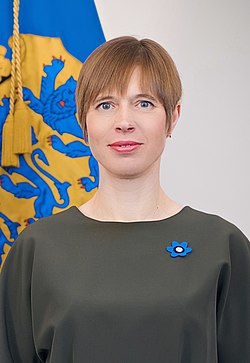
Ülle Madise
Ülle Madise (born Ülle Anton on 11 December 1974 in Tartu) is an Estonian lawyer and scholar of public law who has been President of Estonia…
- Facts0
- Drivers0
- Indicators0
Ülle Madise (born Ülle Anton on 11 December 1974 in Tartu) is an Estonian lawyer and scholar of public law who has been President of Estonia…
Ülle Madise (born Ülle Anton on 11 December 1974 in Tartu) is an Estonian lawyer and scholar of public law who has been President of Estonia since 12 October 2026. She took office as Chancellor of Justice on 31 March 2015. The Riigikogu appointed her to a second seven-year term on 15 December 2021, and that term began on 4 April 2022. On 2 September 2026 parliament elected her president: she received 71 votes in a secret ballot, more than the 68 required, which is two-thirds of the 101-member house; 78 members took part and seven ballots were unmarked. She took the oath on 12 October 2026 as the seventh president and the second woman to hold the office, after Kersti Kaljulaid, succeeding Alar Karis, who had declined to seek another term.
Madise earned a law degree cum laude from the University of Tartu in 1998 and a magister iuris, also cum laude, in 2001, then a doctorate at Tallinn University of Technology in 2007. From 1997 she worked at the Ministry of Justice, heading its public-law department from 1998 to 2002. In the early 2000s she took part in introducing internet voting, and as head of the secretariat of the Riigikogu constitutional committee from 2002 to 2005 she worked on transposing European Union legislation into Estonian law. She was a director of audit at the National Audit Office from 2005 to 2008 and a member of the National Electoral Committee from 2006 to 2010. From 2009 to 2015 she was legal adviser to President Toomas Hendrik Ilves. She taught at Tartu and at Tallinn University of Technology, and was professor of constitutional law at Tartu from 2011 to 2016 and a visiting professor there from 2016 to 2021.
The chancellor's office is an independent constitutional institution, outside the legislative, executive and judicial branches, and is appointed by the Riigikogu on the proposal of the president. It reviews whether laws and regulations conform to the Constitution, hears complaints about public authorities, acts as ombudsman for children and as Estonia's national human rights institution, and reports once a year to the Riigikogu. Madise was the first woman named to the post. In the job she criticised what she has called excessive bureaucracy and official reach into private data, including police licence-plate cameras and agencies' interest in individuals' banking records, and during the COVID-19 pandemic she disputed rules that left intensive restrictions of fundamental rights to the executive rather than to parliament. She is chief editor of the commented edition of the Constitution.
She stood in 2026 without a party and was the only candidate the National Electoral Committee registered. On 24 August 2026, 75 members of the Riigikogu nominated her, from the Reform Party, Eesti 200, the Social Democratic Party and Isamaa, together with unaffiliated members; deputies of the Estonian Conservative People's Party and the Centre Party did not sign. A presidential candidate must be an Estonian citizen by birth and at least forty years old; at least one-fifth of the Riigikogu must nominate, and the term is five years, renewable once in succession. An Emor survey of 1,114 residents aged sixteen and older, taken from 17 to 24 September 2026, found that 31 percent fully supported her election and 32 percent somewhat supported it, while 21 percent were opposed and 17 percent were undecided. She is married to Lauri Madise, a judge at the General Court of the European Union.
Ülle Madise was born Ülle Anton on 11 December 1974 in Tartu and grew up in the Annelinn district. Her father is the lawyer Tõnu Anton, born in Pärnu in 1953. He sat in the Supreme Council, chaired the Constitutional Assembly that prepared the 1992 Constitution of Estonia, and was a justice of the Supreme Court from 1993 to 2016, including as chairman of its administrative law chamber. A Postimees account traces both the paternal Anton line and her mother's family to Viljandi County. Recalling 20 August 1991, Madise said the family sent her father to Tallinn together with Ants Veetõusme and Kalju Koha, and that she went to the sauna with her mother so as not to upset a younger brother further.
She was not taken into school at six, although she could already read, and was placed in a sports class at the neighbourhood school, Tartu 15th Secondary School (Tartu 15. Keskkool). She started there in 1985, in the fourth grade, and stayed through the twelfth, graduating in 1993 with a gold medal and top marks in every subject; the school is now Tartu Descartes' School (Tartu Descartes'i Kool). Director Jaan Reinson, who had led the school since its founding, and former teachers remembered her as quick to grasp what was asked, attentive, conscientious and unusually correct. In a 2018 interview she said she had wanted to be a rhythmic gymnast and then a heptathlete, trained in athletics and met the standard for a women's category in the 800 metres, but was told she would not reach the top; she also described courtyard games, including dodgeball, and skating on ice near home.
Madise entered the faculty of law at the University of Tartu in 1993. She took a bachelor's degree in law cum laude in 1998 and the degree of magister iuris, also cum laude, in 2001. Both final theses carried the title Kohaliku omavalitsuse garantii Eesti Vabariigi 1992. aasta põhiseaduses ("The guarantee of local government in the 1992 Constitution of the Republic of Estonia"). A classmate, Urmas Reinsalu, later described her as a sharp student with a sense of humour and said that near the end of their studies they also worked together in the Ministry of Justice.
She was a doctoral candidate at Tartu from 2001 to 2006 and received the doctorate at Tallinn University of Technology in 2007. The thesis was accepted for defence on 5 July 2007 and defended on 30 August 2007 for the degree of Doctor of Philosophy in public administration. Its title was Elections, Political Parties, and Legislative Performance in Estonia: Institutional Choices from the Return to Independence to the Rise of E-Democracy. The supervisor was Professor Wolfgang Drechsler; the opponents were Markku Temmes of the University of Tampere and Rainer Kattel. Published by TUT Press (ISBN 978-9985-59-721-7), it is a compilation on party democracy, the effect of constitutional institutions on how parliament legislates, and remote internet voting. In the introduction she wrote that a central aim was to examine institutional choices in Estonia since independence and the legitimacy of remote internet voting, including the 2005 local elections, which the thesis describes as the first country-wide legally binding use of that method, and that the six-year research programme had been used in establishing a legal basis for the project.
Madise joined the Ministry of Justice in 1997 as a specialist in its Public Law Department, while a law student at the University of Tartu, and headed the department from 1998 to 2002; for part of 2002 she was also parliamentary adviser to the minister of justice. Her theses were on the constitutional guarantee of local self-government. In 2002 she joined the editorial board of the commented edition of the Constitution of Estonia and, with Märt Rask, Julia Laffranque, Kalle Merusk and Jüri Põld, published an account of the draft Constitution Amendment Act, the short separate act meant to authorise membership of the European Union without rewriting the 1992 text.
Remote internet voting was written into election law in the same years. In 2002 the Riigikogu passed election laws that allowed it but postponed use until 2005. She later wrote that the ministry, led by Rask of the Estonian Reform Party, had grounded the rules in a liberal premise: the state should trust the voter and interfere as little as possible. ERR has said that, as head of this legislative work, she helped introduce online voting. A 2026 Delfi fact-check, citing the State Electoral Service and Mihkel Solvak of the University of Tartu, put her documented project role later and narrower: in 2003 she sat on a National Electoral Committee steering group chaired by Tarvi Martens, as a parliamentary lawyer, while the technical concept came from the electoral administration, Cybernetica and cryptographers.
The statutes made internet voting an extra channel. A holder of an Estonian identity card could vote online in advance polling; a later electronic vote replaced an earlier one, and an advance paper ballot replaced the electronic vote. In 2004 Madise defended reading secrecy by its purpose — the booth protects a free choice, and revoting was meant to blunt coercion off camera — while noting the objections: a card and codes were easier to misuse than a passport at a station, closing stations would breach generality and equality, and the Penal Code still criminalised voting twice. The political theorist Hubertus Buchstein argued, as her dissertation notes, that secrecy is a duty the state owes the citizen, not a safeguard the voter may waive.
From 2002 to 2005 Madise was adviser and head of the secretariat of the Riigikogu Constitutional Committee. ERR has tied that post to the transposition of European Union law into the legislation of Estonia before accession. In 2004 she wrote that the acts were not yet clear enough to count a replaced electronic vote, and that the Chancellor of Justice, replying to Toomas Alatalu on 22 March 2004, had made that right a condition of constitutionality. President Arnold Rüütel refused to promulgate the 2005 amendments because voters who could recast an electronic ballot were treated unequally. On 1 September 2005 the Supreme Court dismissed the petition in case 3-4-1-13-05. In the passages Madise later quoted, it held that revoting was needed to keep the ballot free and secret away from a polling station, and that any inequality was not serious enough to outweigh that aim; it did not review internet voting as a whole.
From 2005 to 2008 she was director of audit of Audit Department II at the National Audit Office of Estonia, covering the justice, defence and interior ministries and the agencies under them. The office's 2006 report, which she signed, said more than 1,000 forensic examinations were waiting without a clear purpose; an inventory then cancelled 2,129 unnecessary DNA orders and shortened DNA queues by about 30 per cent. It also found that hire-purchase debts on privatised land were poorly tracked.
From 2006 to 2010 she was a member of the National Electoral Committee. The Riigikogu Election Act makes that committee a body of seven judges and officials, named by the Chief Justice, the Chancellor of Justice, the Auditor General, the Prosecutor General, the Riigikogu Chancellery and the State Secretary, with one seat reserved for the Audit Office. The term included the 4 March 2007 parliamentary election, the first in an Organization for Security and Co-operation in Europe state to offer internet voting to every voter. Observers found the administration generally trusted, but the People's Union and the Estonian Centre Party still opposed the method because secrecy could not be ensured and the count could not be watched. About 5.4 per cent of votes were electronic. The mission reported no full end-to-end test and security resting on a small team, and said that unless those weaknesses were fixed the authorities should reconsider offering internet voting widely, or at all.
In December 2009 she argued on Kuku Radio against giving the committee supervision of party financing: the powers on offer would not uncover concealed money, and precepts against parties could give them a reason to attack the committee and, with it, the elections. Elsewhere, she said, a parliamentary committee usually did that job.
Madise lectured at the University of Tartu from 2001 to 2005. From 2005 to 2009 she lectured in constitutional and administrative law at Tallinn University of Technology. The thesis, supervised by Wolfgang Drechsler, was accepted for the degree of Doctor of Philosophy in public administration on 5 July 2007 and defended on 30 August 2007. In 2009 the technical university elected her professor of public law, a chair she held until 2011.
/nginx/o/2012/02/27/985530t1h969f.jpg) Ülle Madise in 2012, when the University of Tartu announced her inaugural lecture as professor of constitutional law.
In 2011 Tartu elected her professor of constitutional law. On 5 April 2012 her inaugural lecture, "Kas Eesti põhiseadusel on veel väärtust?" ("Does the Estonian Constitution still have value?"), argued, in the university's summary, that an efficient government with fewer levers for parliament and the people can look expedient, but that the Constitution and independent review show their worth then, and that a text which troubles nobody, or is only a lawyers' monopoly, has no fair value. She held the chair through 2016 and was a visiting professor of constitutional law there from 2016 to 2021; the faculty e-course "Foundations of Law" lists her video lecture on law-making. In 2012 Tartu described her interests as constitutionalism, parliamentarism, the constitution's development and the limits of legal reception, and noted work for the Council of Europe's Group of States against Corruption on party financing (2010–2015 on her office curriculum) and as an OSCE expert on electronic voting.
The 2007 dissertation, Elections, Political Parties, and Legislative Performance in Estonia: Institutional Choices from the Return to Independence to the Rise of E-Democracy, is a set of articles with a unifying introduction. The core pieces are a survey of Estonian parties with Allan Sikk; a comparison, with Vello Pettai, of Baltic legislative performance from independence to European Union accession; and essays on internet voting, including work with Drechsler and, with Tarvi Martens, an account of the October 2005 local elections, the first country-wide binding use of the method. Madise wrote that Estonia's small size and thin traditions made both useful and harmful experiments easier, and that scholars and politicians had not agreed whether remote internet voting would strengthen democracy or undermine it. On secrecy she favoured a purpose-based reading: the rule serves free choice, and because the state cannot police a remote voter's physical privacy, unlimited replacement of an electronic vote during advance voting, or its override by paper, was meant to deter coercion. She cited Supreme Court case 3-4-1-13-05 for the view that equality does not require identical voting days or methods, and, using Fabian Breuer and Alexander H. Trechsel's Council of Europe report, reported that 2005 internet voting looked largely neutral by gender, income, education and settlement type, while its effect on turnout could not be measured directly. She described government-dominated initiation, a comparatively strong Riigikogu among the Baltic parliaments, and a party system shaped by a 1,000-member threshold, state financing and a ban on electoral coalitions.
With Priit Vinkel, in Juridica International in 2011, she split the constitutional question in two after five elections and a new round of criticism and court complaints: abstract norms, which they answered "yes" because of widespread electronic identity, equal conditions among advance voters, a "virtual voting booth" and a "virtual double envelope"; and the technical conduct of a given election, which they said still depended on certification, auditing and observation. They left material equality and the digital divide open. A 2014 study by Drew Springall, J. Alex Halderman and co-authors, based on observation of the 2013 elections, code review and laboratory attacks, found gaps that could let an insider, a criminal or a state-level attacker alter results or cast doubt on them, and recommended that Estonia stop internet voting.
From 2012 she was chief editor of the commented Constitution, a series begun under Eerik-Juhan Truuväli in 2002: the third edition in 2012, the first on the web; the fourth in 2017; and the fifth, revised edition in 2020 (ISBN 978-9985-870-51-8), with Hent Kalmo, Oliver Kask and Peep Pruks. The preface says it uses wording, history, purpose and systematic place, and sets out competing views where none dominates. The fifth edition, presented on 21 December 2020, has 77 authors, 1,280 pages and 3,725 comments, and is free online. Her office curriculum also lists the Kuku radio programmes Vanamehed kolmandalt (2009–2015) and Õigus ja Õiglus (2016–2018).
The Constitution of Estonia provides that the Riigikogu appoints the Chancellor of Justice for seven years on a proposal of the President of the Republic, and that only a court judgment can remove the chancellor. In early December 2014 President Toomas Hendrik Ilves proposed Ülle Madise, then professor of constitutional law at the University of Tartu. Ilves described her as a lawyer with a strong academic background and long experience in public administration who had taken part in every annotated edition of the Constitution and headed the editorial board of the 2012 edition. On 20 January 2015 the Riigikogu appointed her in a secret ballot by 72 votes to nine, with two abstentions, for a seven-year term following Indrek Teder, whose term ended on 9 March 2015. She took the oath before the Riigikogu on 31 March 2015 and entered office that day. The January 2015 appointment made her Estonia's first female chancellor of justice.
She was the fourth chancellor since the institution was restored. The Riigikogu appointed Eerik-Juhan Truuväli on 28 January 1993, then Allar Jõks for 2001–2008 and Teder for 2008–2015. On 16 November 2021 President Alar Karis proposed a second term, citing her academic and public-administration background, her constitutional-review and fundamental-rights work, and her insistence on proportionality when rights are restricted. On 15 December 2021 the Riigikogu approved the appointment by secret ballot, 63 votes to 18 with one abstention. ERR reported that the second term would begin on 30 March 2022; she took the oath for it before the Riigikogu on 4 April 2022. On 2 September 2026 the Riigikogu elected her President of the Republic with 71 votes; she remained chancellor until she took the presidential oath on 12 October 2026, after which Deputy Chancellor of Justice and office director Olari Koppel was to act until a successor was appointed.
The Constitution makes the chancellor independent in discharging the office. The institution describes itself as outside the legislative, executive and judicial powers, and as neither a political body nor a law-enforcement agency; its seat is Kohtu 8 in Tallinn.
The chancellor scrutinises legislative instruments of the Riigikogu, the executive and local authorities for conformity with the Constitution and the laws, considers proposals on amending laws, passing new laws and the work of government agencies, and reports to the Riigikogu where necessary. If an instrument conflicts with the Constitution or a law, the chancellor proposes that the body which passed it bring the instrument into conformity within twenty days and, if it does not, refers the matter to the Supreme Court, which may declare the instrument invalid. In heading the office the chancellor has the authority the law gives a minister over a ministry, and may attend sittings of the Riigikogu and meetings of the Government of the Republic with the right to speak. Criminal charges against the chancellor require a proposal by the president and the consent of a majority of the Riigikogu. In specified cases the chancellor proposes that parliament allow charges against a member of the Riigikogu, the president, a member of the government, the auditor general, or the chief justice or a justice of the Supreme Court.
Later statutes widened that design. Since 1 June 1999 the chancellor has also been the ombudsman for public authorities; since 18 February 2007, Estonia's national preventive mechanism under the Optional Protocol to the Convention against Torture; since 19 March 2011, ombudsman for children; since 1 January 2015, supervisor of covert collection and processing of personal data by executive agencies; and since 1 January 2019, the national human rights institution, granted A-status under the Paris Principles in December 2020, and the promoter, protector and monitor of the Convention on the Rights of Persons with Disabilities. The children's mandate, added in 2011, includes protection and promotion of the rights of the child under the Chancellor of Justice Act and the Convention on the Rights of the Child.
Her office biography lists her as a member of the European Commission against Racism and Intolerance from 2013 to 2022, as an independent expert of the Council of Europe's Group of States against Corruption from 2010 to 2015, and on the European regional board of the International Ombudsman Institute from 2015 to 2021, its world board from October 2017, and again its European board in 2023–2024.
The Constitution requires an annual report to the Riigikogu on whether legislation of the legislature, the executive and local authorities conforms to the Constitution and the laws. The overviews that accompany that report use a year from 1 September to 31 August: writing in ERR, Madise treated 1 September 2024 to 31 August 2025 as the reporting year then under review.
As Chancellor of Justice, Ülle Madise tested laws and official conduct against the Constitution of Estonia. From 2022 to 2026 the public cases clustered around data collection, powers used in the COVID-19 pandemic in Estonia, and the treatment of children and disabled people. In the year to 31 August 2025 the office received just over 5,500 letters. The Supreme Court later rejected her main argument on pandemic powers.
In 2024 Madise told the minister of justice that public-camera rules were too thin. The Law Enforcement Act allows equipment to meet a specific threat or end a disturbance, not to guard against a danger that has not arisen, yet Data Protection Inspectorate guidance already described small municipalities under near-constant cover. She asked the Riigikogu to set locations, retention, and access, and said people should still have somewhere they are not recorded.
In June 2024, as tax officials sought bank-turnover data, she warned that a "surveillance society" arrives gradually, until movements, purchases, and business ideas are an open book. She would not judge a plan whose text was not yet fixed.
Number-plate recognition was the sharpest dispute. Eesti Ekspress reported that the Police and Border Guard Board had run more than 200 cameras, storing over 20 million images a month, with no dedicated statute. Interior Minister Igor Taro first refused to stop them. After Madise's office and the inspectorate said the basis was lacking, collection halted in May 2025; police said the pause would hinder catching offenders. Madise said filming every vehicle "just in case," occupants included, needed a parliamentary decision, and that European Court of Human Rights case law forbids treating the innocent as suspects in advance. On 8 October 2025 parliament allowed the images for criminal proceedings, elevated threats, and searches for wanted people, to be deleted after 45 days, with access also for the Tax and Customs Board. President Alar Karis signed, but required a written threat assessment for each site and removal once the threat passed.
Banking secrecy followed. In July 2025 her office found that the tax board, the Estonian Internal Security Service, the police, and the Financial Intelligence Unit had taken account statements through the enforcement register without a foundational statute. Tens of thousands of inquiries ran from January 2024 to February 2025, under only formal oversight. A statement can map habits and movements, she wrote, so wider access had to be set in law. A Finance Ministry bill that September was still unconstitutional in her view. Until the statute changed, the unit and the tax board could not use the register for banking data.
She objected on the same ground to a money-laundering "super-database" parliament had passed and Karis had not promulgated. Pseudonymised pooling for machine profiling would not stop re-identification, she said, and a machine flag could force someone to prove their innocence. Karis refused promulgation in July 2025, and on 17 September the unamended text drew no votes in favour and 70 against.
In May 2026 she said covert surveillance must stay a last resort. Most checks had been sound, but a few in her term were not. Coercion, she said, must not stockpile data or use artificial intelligence to search for signs that someone "might have thought something wrong."
On electronic voting in Estonia she was less sceptical. After the March 2023 election, Martin Helme of the Conservative People's Party of Estonia blamed online ballots for his party's result. Madise said audits showed no reason for doubt: several commission members must decrypt together, and the obligatory recount matched.
In May 2022 the Tallinn Administrative Court upheld complaints by 52 people and three companies against 2021 orders on quarantine and COVID certificates, and sent provisions of the Communicable Diseases Prevention and Control Act (NETS) to the Supreme Court. Madise said the amendments then in parliament were still too open, including for seasonal viral disease, and that the act should be rewritten.
On 31 August 2022 she told Chief Justice Villu Kõve that NETS gave the executive "overly broad, unspecified and unchecked" power over which restrictions to impose, and why. General duties on unspecified people belonged in published regulations, not orders for single cases. Quarantine of close contacts might be deprivation of liberty, and linking other rights to vaccination touched life and health. The label "novel and dangerous" could, she added, cover illnesses that barely affect hospitals.
On 31 October 2022 the Supreme Court dismissed the application. The orders did limit movement, business, education, and equality, and worked as an indirect vaccination requirement, but the chamber held the norms justified while hospital overload was still a real risk in autumn 2021. Parliament should still tighten NETS later. Proportionality of the orders was left to the administrative courts.
In February 2023, answering the Supreme Court, she found a 2021 business-aid rule unconstitutional. Firms registered for value-added tax throughout 2019 but trading only late that year were excluded, even where their losses could be shown. There was, she wrote, "no reasonable and relevant reason" for the split.
On 16 September 2025 she told the Riigikogu that legality was "in poor and possibly worsening shape" and supervision increasingly toothless: a valid law must be followed or changed, not skirted. She objected to buying rights-restricting technology before parliament had fixed its purpose and retention, and said a machine may only assist an official.
As children's ombudsman, in October 2024 she called a parental scuffle during a custody handover, with child-protection workers and police present, "entirely unacceptable," and said publishing the child's distress caused further harm. In April 2024 she asked for inconsistent ages to be reviewed: local elections at 16 but party membership at 18, and child benefit to 19 while disability benefit then stopped at 16.
In September 2025 she found that Aruküla põhikool's classes, split by grade average, were not authorised by law and sat poorly with inclusive education. Director Avo Möls kept the streams, noting parental support. The opinion is advisory; the education ministry said it would study the case.
Replies on disability were partial. In 2023 she asked Finance Minister Mart Võrklaev to ease the new annual vehicle tax for a car used by a disabled person. He said disabilities differ and that officials would review extra help instead. In December 2024 she wrote that disabled ensembles, including a sign-language choir, should audition for the 2025 Estonian Song Festival, citing Article 30 of the Convention on the Rights of Persons with Disabilities. The Chamber of Disabled People opposed separate events; foundation director Margus Toomla said the letter still needed internal discussion. In January 2025 she found two agencies had, without legal basis, limited an online queue for renovation grants in Lääne-Viru County before the money ran out.
Alar Karis announced on 23 June 2026, in his Victory Day speech in Rapla, that he would not seek a second term. He told Estonian Public Broadcasting that the decision was personal, including a promise to his family on taking office that he would serve only once, and that he had withheld it so as not to disrupt day-to-day work. The Riigikogu was to elect a successor on 2 September.
The president of Estonia is not chosen by popular vote. The Riigikogu elects the head of state by secret ballot, with two-thirds of its membership—68 of 101—required. At least one-fifth of the members nominate a candidate, who must be a citizen by birth and at least 40. Failure in the Riigikogu leads, after further rounds, to an electoral college of members of parliament and local-council representatives. The term is five years, and no more than two may be consecutive.
On 24 August 2026, members of the Estonian Reform Party, Estonia 200, the Social Democratic Party and Isamaa, with unaffiliated members, nominated Chancellor of Justice Ülle Madise. The signature count reached 75 after Isamaa member Andres Metsoja joined an initial 74. The Conservative People's Party of Estonia (EKRE) and the Estonian Centre Party did not back her. Nominations closed at 6 p.m. that day, Madise was the only candidate submitted, and the National Electoral Committee registered her the next day.
On 27 August nine EKRE members asked the Supreme Court to annul the registration, arguing that she should have resigned first. In a judgment published on 1 September, the court held that members could challenge the registration even though the election act does not expressly allow an appeal, but that the law does not require a chancellor to resign in order to run. Other offices end when a president is sworn in, and any further bar would have to be written into statute. Madise had to avoid statements that would compromise the chancellor's independence; the court found no indication that she had.
At an extraordinary sitting on 2 September, 78 members took ballots and all 78 voted. The secret ballot gave Madise 71 votes, with seven unmarked papers and none invalid, clearing the requirement of 68 and ending the election in one round. After the count she told the chamber: "I will do my best to be worthy of this trust. I hope that through mutual understanding, debating vigorously when necessary while still supporting one another, we can accomplish a great deal together for Estonia, so that life in Estonia is happy, good and safe." Karis congratulated her and said he would hand over the office.
She took the oath before the Riigikogu on 12 October 2026, becoming the seventh president and the second woman in the office, after Kersti Kaljulaid. The title has been held by Konstantin Päts from 1938 to 1940 and, since 1992, by Lennart Meri, Arnold Rüütel, Toomas Hendrik Ilves, Kaljulaid and Karis. A president's authority ends when a successor takes office, and the successor's other posts end only then; her office as chancellor of justice ended on the oath.
The office is the headship of state in a parliamentary republic: executive power lies with the Government of the Republic, which conducts domestic and foreign policy, while the president serves a five-year term and no more than two in a row. Office begins with an oath before the Riigikogu. On taking it, every other elected or appointed post ends and party membership is suspended for the term.
The president promulgates laws, but may within 14 days return one, with reasons, for a new debate. If the Riigikogu passes the same text again, the president must promulgate it or ask the Supreme Court to declare it unconstitutional, and must promulgate a law the court upholds. There is no general power to initiate legislation except constitutional amendment. If parliament cannot meet, the president may in urgent matters issue decrees with the force of law, countersigned by the Speaker and the prime minister; they cannot amend the Constitution or laws requiring a special majority, and the Riigikogu must confirm or repeal them.
The president nominates a prime-minister candidate and appoints or releases ministers on the prime minister's proposal; appoints judges on the Supreme Court's proposal and the president of the Bank of Estonia on the bank board's proposal; and recommends to the Riigikogu the chief justice, the chair of that board, the auditor general and the chancellor of justice. The office also confers decorations and military and diplomatic ranks, and may grant clemency at a convicted person's request.
The president represents Estonia abroad, appoints and recalls diplomats on the government's proposal, receives foreign credentials and signs ratification instruments, coordinating that role with the government, which organises foreign relations. As supreme commander of national defence, advised by the National Defence Council, the president proposes war, mobilisation or demobilisation, and a state of emergency to the Riigikogu, and in the case of aggression may declare war and order mobilisation without waiting for parliament.
An Emor survey reported by Eesti Rahvusringhääling on 30 September 2026 found nearly two-thirds of residents supporting Ülle Madise as president. Of 1,114 people aged 16 and older polled online from 17 to 24 September, 31 percent fully supported her election and 32 percent somewhat supported it; 21 percent were opposed and 17 percent were undecided. By party preference, support was 86 percent among Social Democratic Party voters, 83 percent among both Estonian Reform Party and Estonia 200 voters, 80 percent among Parempoolsed voters and 68 percent among Isamaa voters. Estonian Centre Party supporters were more hesitant (34 percent supportive, 23 percent undecided), and 67 percent of Conservative People's Party of Estonia (EKRE) supporters were opposed. Aivar Voog of Emor tied the result to her visibility as chancellor of justice and to broad support in the Riigikogu.
On 2 September the Riigikogu elected her with 71 votes as the only candidate. EKRE members did not enter the chamber. EKRE picketed outside parliament to demand a direct popular vote. Opposition politicians called it a back-room appointment on Toompea, not an election. Chair Martin Helme said she was seeking members' votes while still overseeing parliament, a conflict he said could go to court, and that she would enter through "the back door of Kadriorg," which he called "flagrantly at odds with the basic principles of democracy." Nine EKRE members challenged her registration. The Supreme Court rejected the case: a chancellor need not resign in order to stand, and the court found no breach of the office's independence. Centre chair Mihhail Kõlvart said the process was not democratic, and EKRE's nominee, Mart Helme, had not reached the ballot.
Her name was floated in autumn 2016, when parliament and the electoral college failed to choose a president. Former president Toomas Hendrik Ilves later said he thought she would make a good president but was still too young; she said she was not considering the office then.
During the COVID-19 pandemic, her defence of rights left many thinking she opposed vaccines. A spring 2021 photograph sharpened that view: President Kersti Kaljulaid wore a mask and Madise did not. Madise said she would not be a hypocrite: they had spent an hour and a half unmasked and symptom-free. A surgical mask does not stop the coronavirus, she said, so wearing one only for the camera could mislead. She had seen people skip vaccination or go out ill because they wore a mask, and said anyone with symptoms must stay home.
In December 2021 critics faulted her, given her children's-rights duties, for attending a book event by Peeter Helme, convicted of sexually enticing a minor. A private note later published, and read as softening the offence, said he had been punished for vile drunken posts on an adults' site and had never endangered a child. She then called the visit a mistake. Such conduct must be severely punished, she said, but shunning someone after sentence conflicts with the rule of law, and the chancellor must protect both children's rights and those of people the law readmits. The office acts as ombudsman for children.
In 2025 Eesti Ekspress, citing documents it said it had obtained, described a Kremlin-linked effort to have her United Nations accreditation downgraded. It wrote that the Swiss group Justice pour Tous Internationale asked a UN committee in February 2025 to cut the office from the "A" status of 2020 to "B," alleging minority discrimination, arbitrary detention, media curbs and religious-freedom violations. The paper tied the complaint to a €55,000 contract, financed through the compatriots' fund Pravfond, with Oleg Ivanov, an influence agent it said had left for Russia. Office director Olari Koppel told the paper the claims were rebutted and the A rating was kept.
Madise is married to Lauri Madise. The Court of Justice of the European Union lists him among the members of the General Court, not of the Court of Justice. Its biography states that he was born in Tartu in 1974, was a judge of the Tallinn Court of Appeal from 2002, and was appointed to the General Court on 23 October 2013. Estonian Public Broadcasting has described him as based in Luxembourg.
After her election in September 2026, ERR reported that, given his reserved manner and his work in Europe, he might accompany her on state visits and to the Independence Day reception but otherwise stay largely out of public view, much as Georgi-Rene Maksimovski did during the presidency of Kersti Kaljulaid. Madise said the couple support each other's careers: "Nowadays, both people in a marriage can choose their own careers and of course that means making compromises. We've made those compromises, so I hope it will work out, yes." She said she relieves stress by exercising, walking or joking with her husband, and mentioned discussing their godson's training. She also set aside suggestions that she should be "prettier and more polished," saying she was "exactly who I am" and did not think she could, or needed to, change very much.
The church newspaper Eesti Kirik recorded that she is a member of the Toompea Kaarli congregation of the Estonian Evangelical Lutheran Church in Tallinn. In mid-August 2026, while signatures were being collected for her candidacy, she received ERR's Pealtnägija at a country home on the shore of Lake Saadjärv in Tartu County and rowed its reporter on the lake. In a February 2024 interview she said that, apart from family, people close to her and work, happiness for her usually came from nature, including being at Saadjärv and watching fish from a boat in water clear to the bottom.
On 7 February 2024 President Alar Karis, by decision no. 362, conferred the Order of the National Coat of Arms, 3rd class, serial number 511, citing her as chancellor of justice and a promoter of statehood. The presidential register records that the decoration was presented on 23 February 2024. She told ERR it had come very unexpectedly and that it was an honour to be named with the other recipients. She took it as recognition for work to uphold the rule of law — respecting rights even in a crisis, and resisting hasty decisions driven by fear or anger — and said it belonged to her colleagues as well. Family members, she added, had learned of it from the media and were very pleased. In February 2016 the Estonian Association of Small and Medium-Sized Enterprises named her its Friend of Enterprise, citing a 2015 submission to the Riigikogu to restore social guarantees for members of management boards and what it called the sharpness of her public statements.
Ranked by shared high-impact facts, then explicit ties, then shared drivers.
 Lennart MeriLennart Georg Meri (29 March 1929Affiliated
 Martin HelmeMartin Helme is an Estonian politician and current leader…Affiliated
 Alar KarisAlar KarisAffiliated
 Arnold RüütelArnold Rüütel (10 May 1928Affiliated
 Toomas Hendrik IlvesToomas Hendrik Ilves won Estonia's presidency in September…Affiliated
 Kersti KaljulaidKersti Kaljulaid is an Estonian politician who served as…Affiliated
How the record is sourced and how the score is derived.
The score is formula-derived (Factrail formula v1, version 1.0.0), not an editorial verdict. Read the methodology.
By the Factrail desk · Method: how we source and score · Last reviewed
Dispute a fact on this pageNamed here, or represent someone who is? Request a right of reply.