AUKUS Submarines: The Three-Nation Shipyard Capacity Bill
By the Factrail desk · Method: how we source and score · Last reviewed
TL;DR
The political question for AUKUS is no longer whether Canberra, London and Washington endorse it.
Key graph impact
The article explains graph entities; the causal edges belong to the facts and drivers it links to.
- ArticleAUKUS Submarines: The Three-Nation Shipyard Capacity Bill
- mentionsDriverCost-of-Living Pressure
- weakensIndicators (4)Unemployment, total (% of total labor force) (modeled ILO estimate)
- ArticleAUKUS Submarines: The Three-Nation Shipyard Capacity Bill
- mentionsDriverNATO Deterrence Capacity
- ArticleAUKUS Submarines: The Three-Nation Shipyard Capacity Bill
- mentionsDriverFiscal-Policy Sustainability
- Better
Weakens · 38% impact strength
Observed
4.79% of total labor force · 1.3 above the normal line (2025)
Worse than normal8 readings, 2018–2025: fell from 5.76% of total labor force to 4.79% of total labor force.
Above normal = worse
- Better
Weakens · 31% impact strength
Observed
39.7% · 9.35 above the normal line (2024)
Worse than normal7 readings, 2018–2024: rose from 35.8% to 39.7%.
Above normal = worse
Strengthens · 30% impact strength
Observed
11% of primary-school-age children · 11 above the normal line (2023)
Worse than normalAbove normal = worse · Lag ~12 mo
Strengthens · 30% impact strength
Observed
37.4 deaths per 1,000 live births · 12.4 above the normal line (Dec 2024)
Worse than normal7 readings, 2018–2024: fell from 40 deaths per 1,000 live births to 37.4 deaths per 1,000 live births.
Above normal = worse · Lag ~12 mo
Article
The political question for AUKUS is no longer whether Canberra, London and Washington endorse it. The decisive question is whether enough submarines, propulsion components, nuclear-qualified workers and maintenance capacity can be produced at the same time without hollowing out the US and UK fleets. Australia has committed a historic multi-decade sum, yet capacity rather than appropriations alone governs the timeline. The countries can all claim industrial jobs from the programme, while the Australian public bears the sharpest risk if submarine deliveries lag behind the retirement of the Collins fleet.
The contract is a chain of three production systems
AUKUS Pillar I is routinely discussed as one submarine deal. It is better understood as three interlocking industrial projects with a common strategic goal. The United States must build and maintain enough Virginia-class nuclear-powered attack submarines to meet its own fleet requirements and release boats to Australia. The United Kingdom must complete the next-generation SSN-AUKUS design and expand the production and nuclear-propulsion supply chain in Barrow and Derby. Australia must construct the Osborne yard in South Australia, operate nuclear-powered submarines safely, develop crews, and maintain its current fleet until the transition is complete.
This distinction matters because a successful announcement in one nation can conceal a bottleneck in another. An enlarged Australian construction yard cannot accelerate delivery of a US boat if the American production rate remains constrained. Likewise, a British design programme cannot produce Australian hulls without a trained Australian workforce and components from its international suppliers. Political support is necessary, but only measured manufacturing and sustainment output can demonstrate that all parts are converging.
The three governments reaffirmed Pillar I on 30 May 2026. Their joint statement said Australia could purchase three in-service Virginia-class boats instead of a mixture of new and in-service vessels, a proposed simplification intended to reduce supply-chain and operational complexity. That was an important adjustment, not proof that three surplus boats will be available on the required dates. The same statement confirmed arrangements for Submarine Rotational Force-West to begin in 2027, an operational bridge as well as a training mechanism.
The strategic logic is familiar: nuclear propulsion permits long-range deployments with endurance beyond conventional submarines. But the relevant taxpayer question is how many deployable boats the three allied navies obtain, and when, rather than simply how many contracts they sign.
What Australia is paying, and what the number does not mean
The Australian government's long-range estimate of A$268 billion to A$368 billion over roughly three decades is striking because it spans acquisition, infrastructure, workforce development, operations-related preparation and the industrial transition. Independent economic analysis published in 2026 cites Australian Defence estimates of about A$71 billion to A$96 billion in the decade ahead. Those totals are planning estimates across different years and categories; they should not be presented as cash already paid, a fixed purchase price for three boats, or a guaranteed maximum cost.
A separate contribution has a clearer destination. Australia's submarine agency states that Canberra committed US$3 billion to improving US submarine production and sustainment capacity. In October 2026 it reported the start of construction of a propulsor manufacturing facility in Pascagoula, Mississippi, with combined Australian and US support. The facility is meant to manufacture critical components for Virginia-class propulsion. This is real industrial expenditure, yet breaking ground is only the start of a path through plant completion, equipment, qualified employees, production and inspection.
The Australian government also has to fund infrastructure at Osborne and in Western Australia, where visiting American and British submarines will rotate, while continuing work on the Collins fleet. These are not interchangeable costs. A contribution to a Mississippi supplier does not purchase a completed boat. A dry dock in Perth does not make an Australian crew operationally certified. Every category must be tracked against its own acceptance milestone.
A credible annual public accounts table would separate authorised programme envelopes, awarded contracts, payments made, physical capacity delivered, and contingent future commitments. It would also identify cost escalation in nominal and real terms. The headline total alone cannot reveal whether spending has purchased additional naval readiness or merely moved a problem from one budget year to the next.
The American constraint: production is not procurement
The clearest quantitative warning comes from US congressional research. A January 2026 Congressional Research Service report summarised by USNI News states that the Virginia programme, while usually procured at two boats annually for much of the previous decade, had not actually reached two completed boats a year. Since 2022, the production rate had been around 1.1 to 1.2 boats per year. Congressional authority to buy a submarine and the shipbuilding sector's ability to finish it are separate realities.
For the US Navy, the risk is straightforward. Selling an attack submarine to Australia changes the distribution of an already scarce asset unless additional production compensates. A new workforce, suppliers and facilities can make the long-term partnership a net strategic gain, but only after the resulting productivity is demonstrated. Until then, the US must balance Australian deliveries against its own operational fleet and maintenance requirements.
The supplier base spans Electric Boat, Newport News and many smaller firms, and critical bottlenecks may be inside welding, casting, propulsion or quality assurance rather than final assembly. American construction announcements in 2026 included a proposed major Maryland shipbuilding investment associated with the Navy and Anduril, as described by Australia's submarine agency. Its relevance to AUKUS depends on the exact items it manufactures and whether its output removes actual constraints in submarine new construction and repair.
There is an important distinction between adding a building and adding productive throughput. A new facility requires approved designs, machines, experienced supervisors, controlled processes, supplier certification and stable demand. The same workers may be sought by surface shipbuilding, energy infrastructure and other defence projects. Any forecast that relies on a newly announced plant should include the ramp-up risk.
American taxpayers have a legitimate claim on this bargain. If Australian support produces more US fleet readiness, training capacity and exportable industrial scale, Washington gains. If the programme competes for scarce existing boats and fails to expand output, the resulting security risk is shared by all three partners. That is why shipyard output per year and time in maintenance matter more than the size of a headline investment.
Barrow and Raynesway: the British production promise
The UK has an equally difficult balancing act. The 2025 Strategic Defence Review endorsed continuous submarine production, investment at BAE Systems in Barrow-in-Furness and Rolls-Royce's Raynesway site, and an ambition to achieve one submarine every 18 months. London also signalled a future fleet of up to 12 nuclear-powered attack submarines. The words up to matter: a fleet aspiration is not the same as a funded order for 12 completed boats.
The Defence Nuclear Enterprise's October 2026 update offered a more useful progress test. It described SSN-AUKUS as in detailed design and long-lead procurement, with contracts worth approximately £4 billion already placed and decisions on total boat numbers expected before the phase ends in 2028. It projected cutting steel on the first UK boat in 2027 and entering service in the late 2030s. Those are plans, not observed delivery dates.
The same update described approximately £6 billion of modernisation spending over the relevant spending-review period to expand capacity at Barrow, Raynesway and the supporting supply chain. Australia, it said, had invested £2.4 billion over ten years toward Rolls-Royce infrastructure and shared design costs. These figures describe different programmes and periods, so simply adding them to the headline £15 billion UK sovereign warhead commitment would double-count or confuse attack-submarine spending with nuclear deterrent spending.
Barrow is already a complex naval-industrial site with competing obligations, including nuclear-powered ballistic submarine production. Raynesway supplies reactors for both British and future Australian SSN-AUKUS boats. The British industrial benefit is visible in long-term demand for specialist engineers, apprentices, manufacturing sites and local suppliers, but the challenge is synchronising these tasks with existing commitments.
For Keir Starmer (opens in a new tab), the political value is a defence-industry employment story as well as the security rationale. Yet promised job creation must be assessed against labour availability, wage pressure, training years and output rather than treated as a substitute for completed submarines. A faster cadence only counts when boats are delivered and sustained to operational standard.
Adelaide, Perth and Australia's transition gap
Australia's plan is to begin constructing SSN-AUKUS boats at Osborne, near Adelaide, before the end of the 2020s and receive its first domestically built boat in the early 2040s. The initial nuclear-powered capability is expected through Virginia-class acquisitions from the US in the early 2030s. The dates leave a long period during which a conventional fleet, visiting allied submarines and an immature domestic nuclear industry must operate in parallel.
In September 2026, Australian Defence Minister Richard Marles said work at Osborne was advancing and pointed to the UK's expected first steel cut in 2027. His public comments also noted more than a thousand people in Australia already working on AUKUS. These statements establish current activity, not the completion of a nuclear-qualified workforce. The government still needs to demonstrate how many experienced technicians, safety specialists and submariners can operate and maintain real boats without borrowing indefinitely from other national programmes.
The Australian Submarine Agency says more than 290 Australians were in US training pipelines, with roughly 150 gaining operational experience at sea. It also projects around 1,800 days of cumulative Australian maintenance contribution from the planned 2027 start of rotational operations until the first Virginia transfer. That is a meaningful capacity objective, but actual maintenance days delivered should be published with scope and quality measures.
Australia's Collins-class submarines are therefore more than an old fleet awaiting replacement. They are a critical insurance policy against delay. The Australian National Audit Office's May 2026 review explained why life-of-type extensions are necessary to prevent a capability gap. That work carries its own engineering and fiscal risks. A delayed nuclear programme can magnify those risks by requiring older vessels to operate longer and increasing demands on specialised crews.
For Anthony Albanese (opens in a new tab), a credible account must distinguish industrial construction and defence readiness. Announcing ground works at Osborne is evidence of progress. It is not evidence that the first Australian-built SSN will leave the yard on time. A measurable progress report would pair yard infrastructure stages with workforce certification, reactor supply, launch dates, operational testing and sustained fleet availability.
The hidden cost of a schedule slip
Delays do not affect every participant equally. In the immediate term, firms building yards, propulsion equipment or maintenance infrastructure may still receive payments under valid contracts when the delivery schedule lengthens. Engineering companies can also see more years of design and support work. These payments may be legitimate compensation for extra work, but they must not be confused with society receiving the intended submarine capability.
The larger burden often shifts to taxpayers, naval crews and governments managing the interim period. Australia may need more Collins life-extension spending, more specialised maintenance and more investment in allied rotational operations. The United States can face continued competition for scarce attack submarines, and the UK may face pressure to keep current boats running while new ones remain in production. None of these outcomes is certain, but each is a plausible consequence that should be tested against programme milestones.
Workers in Barrow, Adelaide, Derby and American shipbuilding communities can benefit from a sustained order book and paid training. Higher skilled-labour demand can raise wages, which helps workers but increases costs for employers and may crowd out other local projects. Homeowners may benefit if industrial expansion increases housing demand, while renters in constrained markets can pay more. The distributional effects depend on local housing supply, infrastructure and migration policy.
Not every delay benefits industry. A company with fixed-price obligations may lose money as labour and equipment costs rise. Suppliers can suffer cancellations or idle capacity if the procurement path changes. The right question is who bears each contractual risk, who receives payments, and what output was delivered for that expenditure.
The primary strategic beneficiary of a slip could be any rival seeking to exploit an interval of lower allied submarine availability, particularly if allied deterrence is weaker during the transition. That is not a claim that a rival caused the delay. Conversely, improvements in US fleet availability and rotational maintenance could yield deterrence value before Australia receives its first boat. The interim operational contribution therefore deserves separate measurement.
What it moves
Security: the most direct indicator is deployable allied nuclear-powered attack-submarine days in the Indo-Pacific, supplemented by maintenance turnaround time and the number of qualified Australian crews. A faster ramp-up should lift availability and allied operational flexibility; a prolonged manufacturing bottleneck would put downward pressure on the expected capability path. NATO audiences also have a stake in British submarine availability, because deterrence capacity (opens in a new tab) is limited by deployable assets, not by nominal fleet targets.
Jobs: qualified nuclear and shipbuilding employment should rise in Osborne, Barrow, Raynesway and participating US yards if planned investment reaches production. The useful series is filled skilled positions, apprentices completing certification, retention rates and completed boats per labour hour. Vacancy counts alone can exaggerate employment benefits if training lags behind demand.
Prices: local housing rents and construction wages may face upward pressure around expanding yards when labour and accommodation supply cannot adjust. National consumer price inflation is unlikely to be moved decisively by AUKUS alone. For that reason the appropriate test is regional wages, construction costs and cost-of-living pressure (opens in a new tab), not a claim that one naval programme will determine an entire country's CPI.
Rates: fiscal financing needs can rise if governments absorb cost overruns or increase defence appropriations, but AUKUS by itself cannot reliably predict central-bank rate decisions. The effect on bond yields and borrowing costs is conditional on macroeconomic conditions, revenue choices and other government spending. Evaluating the fiscal sustainability (opens in a new tab) of the programme requires comparing spending commitments with budgets and realistic delivery schedules.
Migration: recruitment from abroad can help address specialised shortages, particularly for engineers and skilled trades, but nuclear-security eligibility and qualification requirements constrain the pool. Net migration is not mechanically determined by the programme. Monitor specialised visas, apprenticeship throughput and local workforce participation as separate indicators.
Energy and industrial supply: nuclear propulsion and defence manufacturing increase demand for specialised electrical equipment and long-term industrial infrastructure. However, claims of broad changes to household energy prices need evidence beyond the existence of a new shipyard. Energy-sector effects may be local and gradual rather than a national price shock.
What the reviews settled, and what they did not
The Pentagon's late-2025 review concluded that AUKUS could proceed while seeking improvements to its implementation. The public summary did not promise an unlimited supply of US boats. In 2026, the three defence ministers renewed their commitment and the UK published more detailed production and contracting intentions. These developments lowered political uncertainty, but the binding limits remain engineering output, people and time.
A fair counterargument is that decades-long strategic investments cannot be judged by immediate boat delivery. New industrial capacity has long lead times, training effects compound and cooperative operations may deliver benefits before the first sale. The 2026 Mississippi propulsor facility and Australian maintenance training are exactly the sort of intermediate achievements one would expect. Dismissing them because they do not yet equal an operational SSN would be unfair.
That defence, however, only strengthens the need for a transparent intermediate scorecard. Governments can show whether a plant has progressed from breaking ground to certified serial production, how many workers completed training, whether submarine production rates increased, whether backlogs shrank and whether maintenance availability improved. They can also disclose which deadlines remain conditional on legislative or operational decisions.
The UK 2026 update says boat-number decisions are still expected by 2028. The US has its own fleet and procurement requirements. Australia must manage the operational and budget risk of the transition. None of these independent choices is settled by the broad phrase that the programme remains on track. A partnership can be politically durable while its production timetable remains fragile.
What readers should watch next
The first checkpoint is 2027, when Submarine Rotational Force-West is scheduled to begin and the UK expects to cut steel for its first SSN-AUKUS. Confirmed vessel visits, maintenance performed, trained crews and construction progress are stronger indicators than ceremonies alone.
The second checkpoint is US production. Independent reporting of completed Virginia-class boats and maintenance-cycle performance should be compared with the long-standing target of roughly two boats per year and the additional capacity needed to allow Australian transfers. Count delivered submarines, not annual procurement authorisations.
The third is the UK's detailed design and procurement stage through 2028. Any final decision on boat numbers should be checked against industrial capacity, propulsion supply and the ability to sustain existing fleet programmes. The difference between an aspirational twelve-boat fleet and a funded build schedule needs to remain visible.
The fourth is Australia's own budget and Collins extension programme. The public should be able to see whether interim maintenance expenses are escalating as new construction advances, not after schedules slip. Because the AUKUS estimate spans decades, every revision should show both cash-flow changes and expected operational outcomes.
These are the questions that make AUKUS auditable. The partnership may still deliver a stronger allied undersea force. But taxpayers should judge its success by measurable capability that arrives on schedule and at an explicable cost, not merely by the durability of the political promise.
Sources
- AUKUS Defence Ministers' Joint Statement, 30 May 2026 (opens in a new tab)
- Australia Propelling Virginia-class Production in the United States, 2026 (opens in a new tab)
- Defence Nuclear Enterprise 2026 Annual Update to Parliament (opens in a new tab)
- Navy Virginia-Class Submarine Program and AUKUS Pillar I: CRS Report, 2026 (opens in a new tab)
- The Economics of AUKUS, Australian Foreign Affairs, June 2026 (opens in a new tab)
- Australian National Audit Office: Collins Class Life-of-Type Extension, May 2026 (opens in a new tab)
- UK to Expand Submarine Programme, Ministry of Defence, June 2025 (opens in a new tab)
- AUKUS Turns Five: Real Progress, Hard Challenges Ahead, CSIS, September 2026 (opens in a new tab)
- AUKUS on Track but Faces Big Challenges, ABC, September 2026 (opens in a new tab)
- Doorstop in Adelaide, Australian Defence Minister, September 2026 (opens in a new tab)
- Five Years into AUKUS: Three Metrics, United States Studies Centre, 2026 (opens in a new tab)
- Pentagon AUKUS Review, ABC News, December 2025 (opens in a new tab)
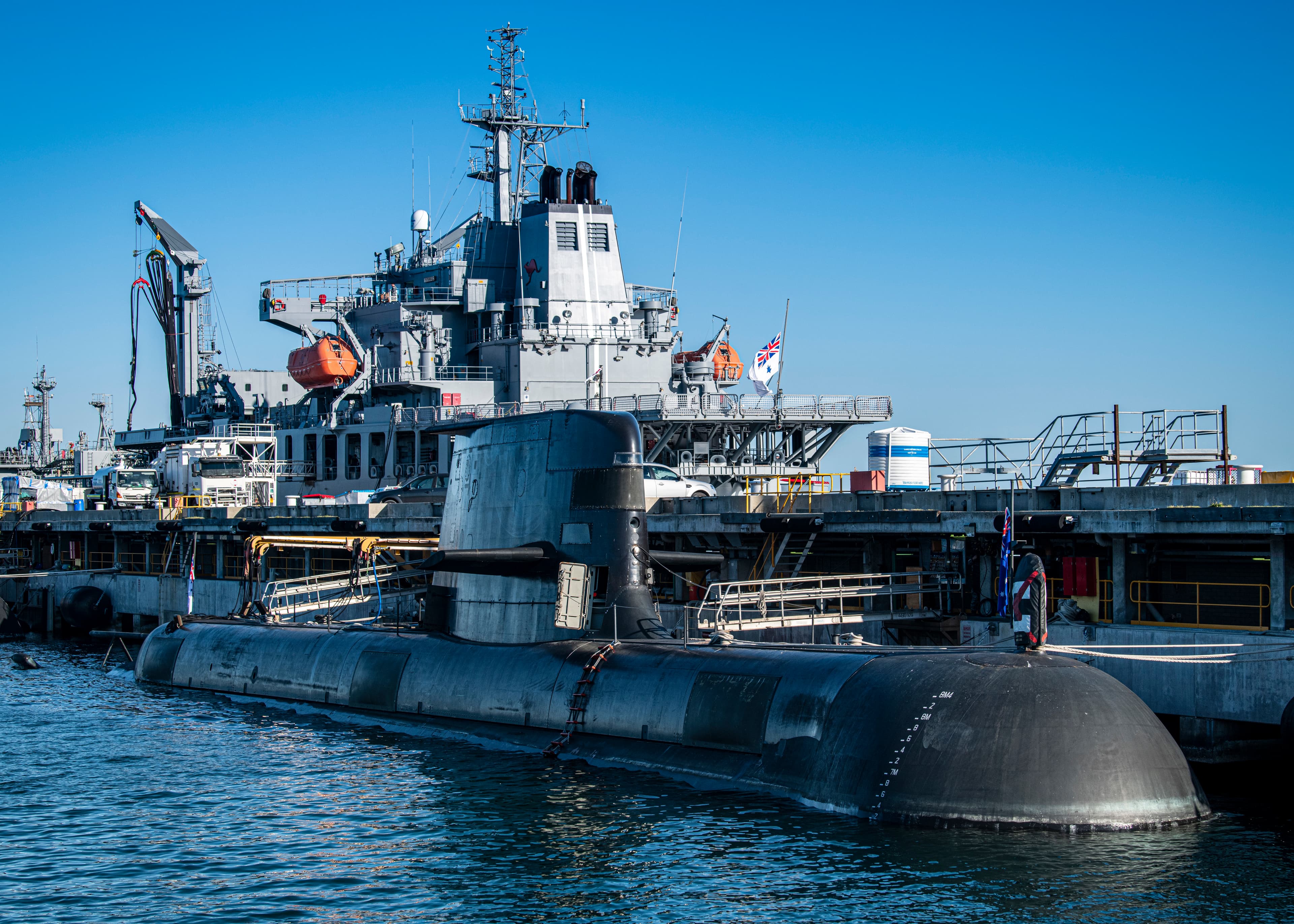
Image: Collins-class submarine at HMAS Stirling, Wikimedia Commons (opens in a new tab), US Navy public-domain image.
Evidence
The sources this article cites, claim-bearing material first.
More analysis
Ranked by shared facts, drivers and people — never by publication date alone.
Articles12
- Britain Promised In-House Civil-Service Training. It Set £380m in No-Tender Ceilings for KPMG and EY.Shares the driver: Cost-of-Living Pressure · 1 November 2026
- Rearmament's Hidden Bill: Capital, Tax and DebtShares the driver: NATO Deterrence Capacity · 31 October 2026
- The Immigration Enforcement Bill Comes DueShares the driver: Cost-of-Living Pressure · 31 October 2026
- Housing Caps Without Homes: Canada and AustraliaShares the driver: Cost-of-Living Pressure · 31 October 2026