Europe's Diesel Winter: Who Pays for the Reserve Release?
By the Factrail desk · Method: how we source and score · Last reviewed
TL;DR
The economic meaning of Europe's diesel decision is sharper than the headline volume. Twelve countries pledged 42.6 million barrels of emergency oil and refined products for release by the end of January 2027, including 20.5 million barrels of diesel.
Key graph impact
The article explains graph entities; the causal edges belong to the facts and drivers it links to.
- ArticleEurope's Diesel Winter: Who Pays for the Reserve Release?
- mentionsDriverEnergy-Price Volatility
- strengthensIndicators (2)Difficulty making ends meet
- ArticleEurope's Diesel Winter: Who Pays for the Reserve Release?
- mentionsDriverEnergy Security
- strengthensIndicators (4)Poverty headcount ratio at $3.00 a day (2021 PPP) (% of population)
- ArticleEurope's Diesel Winter: Who Pays for the Reserve Release?
- mentionsDriverCost-of-Living Pressure
- weakensIndicators (4)Unemployment, total (% of total labor force) (modeled ILO estimate)
Strengthens · 77% impact strength
Observed
18.4% of population aged 16 years or over · 8.35 above the normal line (2025)
Worse than normal8 readings, 2018–2025: fell from 21.5% of population aged 16 years or over to 18.4% of population aged 16 years or over.
Above normal = worse
Strengthens · 62% impact strength
Observed
10.4% · 10.2 above the normal line (2024)
Worse than normal7 readings, 2018–2024: fell from 11.1% to 10.4%.
Above normal = worse
Weakens · 60% impact strength
Observed
7.97% of population aged 16 years or over · 5.2 above the normal line (2025)
Worse than normal8 readings, 2018–2025: rose from 7.77% of population aged 16 years or over to 7.97% of population aged 16 years or over.
Above normal = worse · Lag ~3 mo
Strengthens · 52% impact strength
Observed
0.74 hours · 0.74 above the normal line (2025)
Worse than normal8 readings, 2018–2025: fell from 1.25 hours to 0.74 hours.
Above normal = worse
Article
The intervention buys time, not cheap fuel
The economic meaning of Europe's diesel decision is sharper than the headline volume. Twelve countries pledged 42.6 million barrels of emergency oil and refined products for release by the end of January 2027, including 20.5 million barrels of diesel. The October 29 declaration, reported by Agence Europe, follows the International Energy Agency's earlier collective action and the Group of Seven call to accelerate deliveries. It is an intervention against a shortage of immediately usable products, not proof that Europe has found a durable replacement for Middle Eastern supplies.
Diesel is the politically difficult part of the oil shock because it is woven into costs that households cannot easily avoid. Road freight moves groceries and medicines. Construction machines and agricultural vehicles need fuel. Some buildings use heating oil, whose market follows related middle-distillate conditions. Diesel commuters may reduce discretionary trips but cannot simply stop traveling to work. Governments therefore face a distributional choice: use strategic inventories to reduce the urgency of the shock now, while accepting less inventory headroom later.
One distinction matters: 42.6 million barrels is not the volume of diesel alone. The diesel component is 20.5 million barrels. Nor is the announcement evidence that all barrels have already arrived at refiners, terminals or filling stations. Delivery calendars, product specifications and transport routes determine when a pledge becomes supply. The Agence Europe account (opens in a new tab) names France, Belgium, Denmark, Germany, Greece, Italy, Latvia, Lithuania, Luxembourg, the Netherlands, Portugal and Sweden. The United Kingdom is not listed as a participant in this declaration, although British consumers remain exposed to the same market.
The most important test is not whether ministers can announce a large number. It is whether delivered diesel becomes available at a sufficiently lower cost to interrupt the passage from wholesale supply stress to supermarket invoices, commuting bills and inflation expectations.
Why Hormuz is a diesel story, not only a crude-oil story
The Strait of Hormuz is often described through crude tankers. For European households this misses the refining bottleneck. Oil must reach a refinery, be processed into the correct product and arrive on a commercially viable tanker before it can lower a pump price. The International Energy Agency's October Oil Market Report (opens in a new tab) describes a recovery in Gulf crude volumes but a much weaker return of refined products. Its assessment puts Middle Eastern refined product shipments in September at 1.9 million barrels per day against a pre-war level of 4.7 million.
The same report says global diesel and gasoil export availability in September was roughly 700,000 barrels per day below a year earlier. Lost Middle Eastern and Russian shipments were only partly replaced by higher exports elsewhere. Scarce cargoes are competing for buyers at the very moment northern hemisphere storage should be preparing for greater winter use. Even if crude availability improves, diesel output need not recover at the same pace. Refinery outages, unsuitable crude blends, maintenance and tanker costs can interrupt the transmission from crude supply to usable diesel.
This is why crude-only commentary can give false comfort. A decline in a Brent benchmark does not necessarily mean the margin between crude and diesel has normalized. The relevant number for road haulage is the delivered product cost after refining, shipping, terminal handling, taxation and retail pricing. A state release can support that market directly if the right barrels can be delivered where needed, but its effects will differ by country and region.
In its September report (opens in a new tab), the IEA traced the earlier squeeze to lost Gulf exports as well as interruptions in Russian refining. Those are distinct supply channels, with distinct political causes. Treating them as one undifferentiated crisis risks obscuring whether government action is repairing a market failure or merely compensating for geopolitical danger.
What the reserve releases can and cannot achieve
The IEA's October 15 statement (opens in a new tab) reported about 330 million barrels already released in the broader collective action and around 100 million barrels still to come. It also said participating governments had plans for more than 20 million barrels of diesel to enter the market as soon as possible. The European declaration should be understood within that wider intervention, not mechanically added to every earlier figure as though each announcement described an independent set of barrels.
Releases can do three useful things. First, they can provide physical fuel during a temporary mismatch of supply and demand. Second, the prospect of delivery can limit the premium traders demand for imminent cargoes. Third, they offer governments a visible instrument for addressing fuel scarcity without immediately imposing sweeping demand restrictions. These are tangible benefits, especially if arrivals coincide with the period when heating distributors and road transport businesses are making purchasing decisions.
Yet an emergency stock is an inventory asset, not new production capacity. Once transferred to commercial channels, it must eventually be replaced or the emergency buffer will remain smaller. Replenishment at high future prices could shift some of today's relief into a later public or industry bill. If the Gulf disruption remains unresolved, stock releases are a bridge without a guaranteed destination. This exposes governments to a second decision after the headlines fade: whether to refill rapidly, delay refill or continue drawing down reserves.
There is an institutional accountability issue as well. Citizens need country-by-country reports of barrels actually made available, dates, purchasers, prices and replacement obligations. Without those disclosures, the public cannot distinguish a delivered relief measure from a promise that helped market sentiment but supplied little fuel to the places most in need.
Germany: freight costs reach the factory and supermarket
Germany faces a concentrated version of the shock because diesel supports logistics, industrial inputs, distribution and a substantial road vehicle fleet. Higher delivery costs need not appear as a separate consumer charge. A manufacturer pays more to receive components, a wholesaler pays more to distribute goods and a retailer tries to recover some of that expense in shelf prices. The effect can therefore show up later than the pump spike, and remain after the pump price starts to fall.
Industrial exposure is not uniform. Businesses with large and flexible contracts may negotiate fuel surcharges, shift schedules or delay nonessential transport. A small regional haulier has less room to hedge and may operate with limited cash reserves. Its customer may refuse a full surcharge. At that point the cost becomes lower margins, reduced investment or pressure on staff hours rather than a visible rise in retail prices.
The Kpler analysis dated October 26 (opens in a new tab) found that economics for prompt imports into Europe remained unattractive across key routes, despite some improvement. It highlighted how Atlantic freight costs constrained imports and how much of the additional supply associated with stock releases might arrive only later in November. That timing matters. A market cannot consume a future cargo this morning, and each extra week of high costs can alter contracts or household budgets.
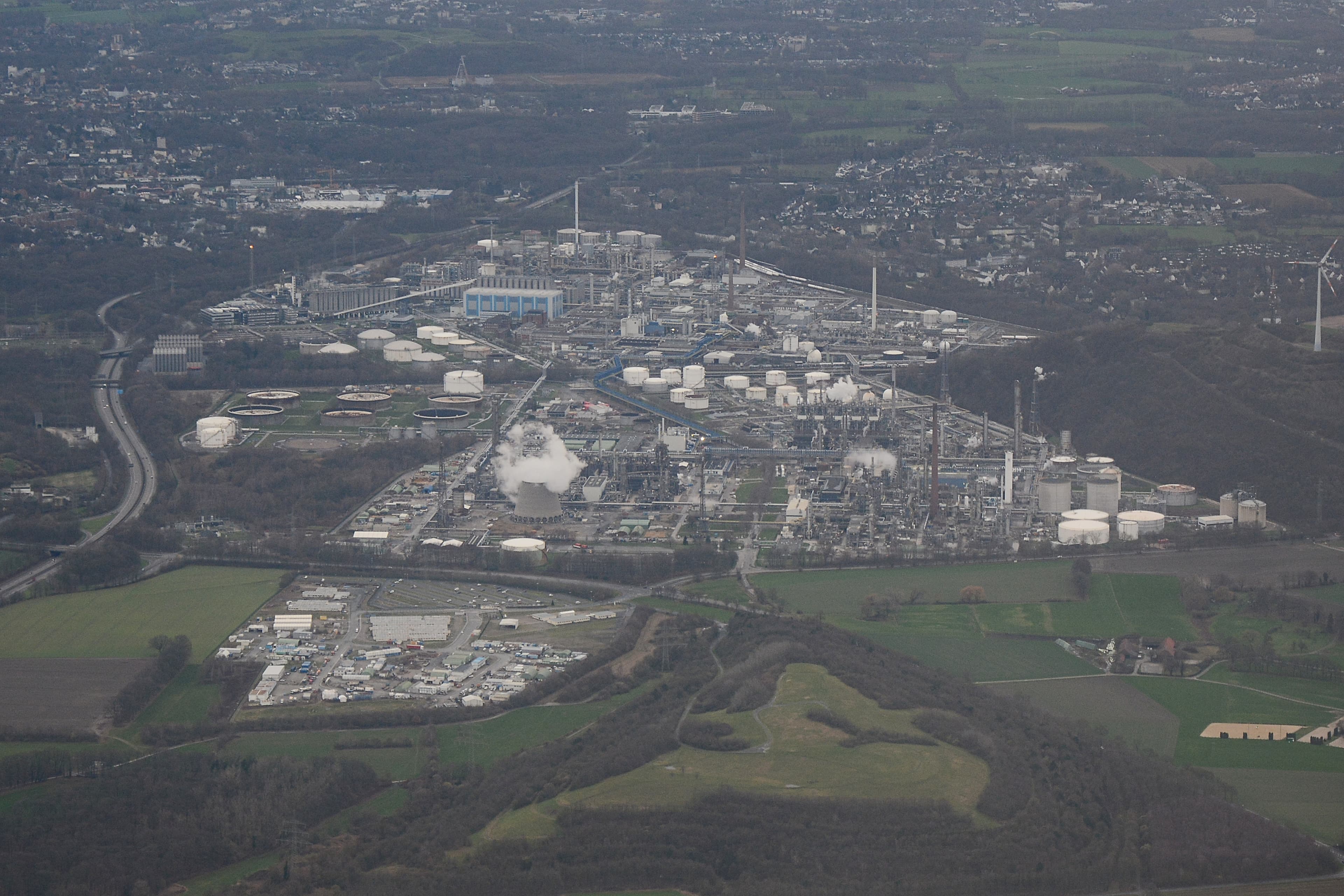
A photograph of the Scholven refinery complex in Gelsenkirchen is an appropriate illustration of the real industrial system at stake: the tanks, processing equipment and physical connections that turn energy policy into usable fuel. Refinery capacity and configuration are as consequential as the number of barrels on a diplomatic declaration.
Germany's policy challenge is consequently larger than the pump price. A government that claims success should show lower wholesale diesel premiums, improved inland availability and evidence that small transport operators can obtain fuel without ruinous premiums. Lower unemployment or stronger production cannot be inferred immediately from a release announcement. The causal chain needs measurable confirmation.
France: strategic oil is being used to influence retail costs
France illustrates the political and fiscal dimensions particularly clearly. A Reuters report of October 27 (opens in a new tab) described a plan to exempt fuel retailers from replacing diesel obtained under a new release mechanism. According to that account, ten million barrels were expected to begin entering the market from November 1, with fuel supplied below market prices under a revised arrangement.
That design matters more than a generic claim that reserves were released. A temporary loan requiring later replacement exposes retailers to the risk of repurchasing at a different price. Removing that obligation can improve the immediate incentive to take the fuel and sell it more cheaply. But the public also needs to know the financing and replenishment consequences. Someone ultimately bears the economic difference between an emergency stock sold at a discount and the cost of replacing it.
France has legitimate reasons to prioritize pump-price relief. Fuel costs can be especially difficult for households outside major cities, where alternatives to driving are limited. Deliveries to pharmacies, food stores and construction sites also depend on road transport. At the same time, a blanket reduction at the pump generally distributes gains according to litres purchased; high-mileage households and businesses can benefit more in cash terms than low-income households using little fuel. More targeted support may deliver different distributional outcomes, although eligibility and administration can slow help.
France's energy minister presented the multinational initiative at the October 29 meeting, according to Euronews (opens in a new tab). This is a test of whether European coordination can translate into national results while preserving public scrutiny of who receives fuel, who sets the resale price and who will pay for stock replacement.
Britain: not on the list, still exposed to the price
Britain's absence from the twelve-country declaration does not isolate it from European diesel costs. Cargoes, refinery margins and shipping rates are internationally connected. When buyers in mainland Europe urgently seek the same product, wholesale conditions can affect prices offered to British distributors. The mechanism is indirect but real: the price faced by one market is shaped by the other buyers competing for scarce supply.
The UK's weekly official fuel data (opens in a new tab) provide an unusually transparent way to follow the pressure. The government series and its downloadable data (opens in a new tab) put average diesel at about 199.2 pence per litre in the week of October 26, compared with around 164.5 pence in mid-July. Those are national weekly averages, not prices at every forecourt. They show how quickly higher fuel costs had become a direct cash-flow issue before the European reserve decision.
A worker with a fixed commute cannot easily respond by driving less during a single pay period. For a household purchasing 50 litres a week, an increase of roughly 35 pence per litre means about £17.50 more each week than at the July reference price, or about £70 over four weeks. That is an illustrative calculation using rounded weekly averages, not a projection of what any household will spend or an estimate of the policy's effect.
The inflation channel is broader than motorists. Haulage contracts transmit fuel surcharges into distribution costs. Bus operators, local service providers and food suppliers can face higher bills. The Bank of England (opens in a new tab) then confronts the familiar problem of distinguishing an imported energy shock from demand pressure that tighter interest rates might address. Rate changes cannot reopen a shipping lane or rebuild a refinery, but sustained fuel inflation can complicate the timing of monetary easing.
Who benefits, and who pays
The first potential beneficiaries of well-timed diesel releases are transport operators and consumers who would otherwise face immediate shortages or still higher prices. Farmers, road contractors and businesses with essential deliveries may also benefit. Refineries and distributors with access to the right product can maintain operations, although benefits depend on commercial terms. Governments can gain political breathing space when households see an intervention rather than silence.
The costs are spread less visibly. The public sector or obligated stockholders give up stored insurance against a future emergency. Future replacement can require cash when market prices remain elevated. Fuel retailers may receive preferential supply terms that need public oversight. Taxpayers or customers may absorb those costs later. Import-dependent economies pay more through freight and currency channels when global competition intensifies.
Not every seller of fuel gains from rising prices. A refinery can earn a wider product margin yet still suffer from much higher crude-delivery costs and operational constraints. The IEA's October report (opens in a new tab) describes the damage that expensive freight and feedstock costs can inflict on refiners. Similarly, a haulier that passes on a surcharge may still lose volumes if its customers reduce orders.
The most vulnerable groups tend to have the least ability to adjust. Rural employees cannot quickly change their commute. Elderly residents using heating oil cannot simply postpone heating indefinitely. A small producer cannot renegotiate every contract weekly. This makes diesel a welfare issue, not merely a trading story. Factrail's cost-of-living pressure driver (opens in a new tab) is the relevant lens for tracking who ultimately carries the burden.
What it moves
Diesel wholesale prices are the first indicator. Additional physical supply should create downward pressure on immediate European diesel premiums, all else equal. A fresh Gulf attack, refinery closure or jump in freight rates would push in the opposite direction. Watch the diesel-versus-crude margin rather than Brent alone.
Retail transport prices should eventually move lower if wholesale relief passes through and taxes or distribution costs do not offset it. The time lag can be significant. For Britain the official weekly pump series is the reference point; for Germany and France, consistent national fuel data and contract terms should be compared rather than isolated station photographs.
Heating expenses face a similar directional test. Middle-distillate scarcity places upward pressure on delivered heating-oil costs, especially when distributors compete for stocks before cold weather. A release that reaches the correct regional terminals can ease that pressure, but it need not reduce every household's bill at once.
Goods prices and measured inflation can move upward through higher transport and production expenses. A durable decline in diesel costs would reduce that input pressure over time; it would not automatically reverse prices already increased. Central banks, including the European Central Bank (opens in a new tab), must assess whether the shock is temporary and whether firms and workers begin building it into longer-run price and wage decisions. The direction of interest rates is therefore uncertain: fuel inflation creates resistance to cuts, while weaker demand and jobs can create pressure to ease.
Jobs and output face downside risks if small transport businesses lose margins or if manufacturers curtail activity. A supply improvement should reduce those risks, not instantly create employment. Security indicators move in the other direction as inventories decline: using emergency stocks reduces the cushion against another disruption until replenishment occurs. The energy-security driver (opens in a new tab) captures that trade-off, while energy price volatility (opens in a new tab) describes the market instability it seeks to limit.
Migration is the least direct channel. Persistent inflation, lost employment or financial strain can influence mobility over a longer period, but no specific migration change can be attributed responsibly to this diesel intervention today. Claims that the stock release will raise or lower migration would outrun the evidence.
A realistic counterargument
The strongest case for the intervention is that emergency inventories exist for precisely this kind of disruption. Refusing to draw them down while essential fuel costs surge would protect the stockpile's headline size at the expense of real economic hardship. Governments cannot create new refining capacity quickly, so a controlled release is a rational short-term response.
That argument is persuasive as far as it goes. The objection is not to using reserves. It is to treating the reserve announcement as evidence that the underlying physical system has recovered. The IEA's October assessment warns that diesel tightness could continue well into 2027, even if refinery throughput improves. That outlook means European policymakers need a replenishment strategy, functioning refineries, transparent allocations and credible contingency plans for a second shock.
A second counterargument holds that high prices will eventually lower demand and balance supply. They can. But demand destruction means households drive less, producers cut activity and some purchases are deferred because they are unaffordable. That is not a costless market cure. The distribution of hardship matters, particularly when policymakers claim to protect vulnerable consumers.
The next decisions that matter
The December Energy Council review should establish how many pledged barrels actually entered the market, the breakdown by product and destination, and the price terms under which traders or retailers received them. France should publish the effects of its revised replacement mechanism. Germany should monitor whether freight and inland product availability improve. The UK should continue reporting national pump averages and explain whether any policy response is justified by the data.
Shipping and refining indicators deserve equal attention. Kpler's import economics (opens in a new tab) show why a theoretically available overseas cargo may not reach Europe when freight remains too expensive. Sparta Commodities' late-October assessment (opens in a new tab) likewise points to persistent distillate tightness despite fluctuations in shipping costs. The simple question is whether commercial supply is returning alongside strategic releases, or whether emergency inventories are carrying an otherwise unrepaired market.
The IEA also has a material role in reporting stock releases, remaining inventory and any further collective action. Its October 7 statement (opens in a new tab) made diesel prioritization explicit. More precise disclosure of actual arrivals would allow observers to distinguish the promised cushion from its measurable effect.
Europe can make this winter less expensive than it would have been without intervention. It cannot guarantee cheap diesel by declaration. The real standard of success is a measurable improvement in delivered supply and consumer costs, paired with a credible plan for the next emergency. Until those tests are met, 42.6 million barrels represent valuable time purchased, not a fuel crisis finished.
Sources
- Agence Europe, 30 October 2026 — 42.6 million barrels from twelve European countries (opens in a new tab)
- Euronews, 30 October 2026 — EU countries pledge 20.5 million diesel barrels (opens in a new tab)
- IEA, 15 October 2026 — Governing Board statement on energy markets and security (opens in a new tab)
- IEA, 7 October 2026 — Executive Director statement on oil stock releases (opens in a new tab)
- IEA, 14 October 2026 — Oil Market Report October 2026 (opens in a new tab)
- IEA, September 2026 — Oil Market Report September 2026 (opens in a new tab)
- Kpler, 26 October 2026 — Economics improve but diesel arbitrage remains closed into Europe (opens in a new tab)
- Sparta Commodities, 28 October 2026 — Westbound freight eases but winter distillate tightness persists (opens in a new tab)
- UK Department for Energy Security and Net Zero, 27 October 2026 — Road fuel price statistics (opens in a new tab)
- UK government, 2026 — Weekly road fuel prices CSV (opens in a new tab)
- US Energy Information Administration, October 2026 — Global energy security data (opens in a new tab)
- Wikimedia Commons — Gelsenkirchen Scholven refinery aerial photograph (opens in a new tab)
Evidence
The sources this article cites, claim-bearing material first.
- reuters.com · reuters.com/business/energy/france-exempt-retailers-replacing-diesel-released-reserves-2026-10-27
- gov.uk · gov.uk/government/collections/road-fuel-and-other-petroleum-product-prices
- gov.uk · gov.uk/csv-preview/6ac3b5951ef3e896de979385/CSV__2018_-__.csv
- eia.gov · US EIA — Energy transit chokepoints (2026-08)
More analysis
Ranked by shared facts, drivers and people — never by publication date alone.
Articles12
- Ukraine's Blackouts Could Become Europe's Housing TestShares the driver: Cost-of-Living Pressure · 2 November 2026
- The Boiler Upgrade Rule Opens a Door, Not a SubsidyShares the driver: Cost-of-Living Pressure · 28 October 2026
- Brussels Picked 77 Climate Projects for €3.4bn. Its Auditors Had Found a €332m Payment Record—and Unproven Emissions Gains.Shares the driver: Energy Security · 1 November 2026
- Germany Entered Winter With Gas Storage at 61%. Reiche Ordered a Late Refill—Who Bears the Risk?Shares the driver: Energy Security · 1 November 2026