Pentagon's $1.7bn Allied Defense Agreement Backlog
By the Factrail desk · Method: how we source and score · Last reviewed
TL;DR
Pentagon auditors flagged $1.7bn in allied defense deals awaiting review as Hegseth seeks more cost sharing. Allies and taxpayers face uncertainty.
Key graph impact
The article explains graph entities; the causal edges belong to the facts and drivers it links to.
- ArticlePentagon's $1.7bn Allied Defense Agreement Backlog
- mentionsDriverNATO Deterrence Capacity
Article
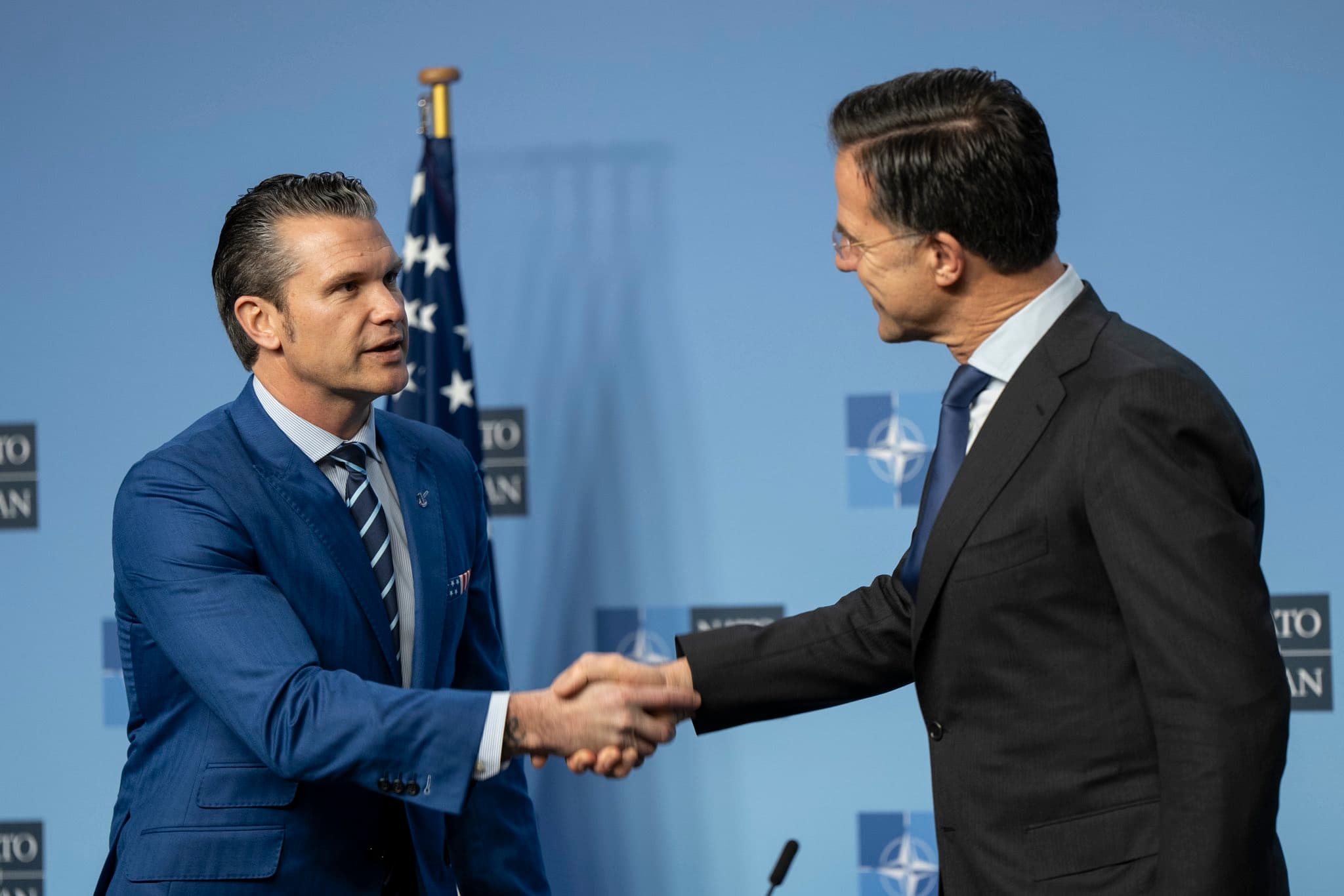
 Credit: US Department of Defense / Wikimedia Commons, public domain. Wikimedia Commons file (opens in a new tab).
The accountability trail connects Pete Hegseth and the US Department of Defense to the cost-sharing commitments of NATO. These connections frame responsibility for the review delays without implying that an ally's payment was already secured.
Hegseth Wants Allies to Share Defense Costs. Pentagon Auditors Found $1.7bn in Agreements Waiting for Review.
Factrail investigative analysis | United States and allied defense procurement | 2 November 2026 |
Dek: The Pentagon wants foreign governments to shoulder more defense costs. Its own audit trail shows how legal interpretation, senior approvals and poor communication can instead make joint projects harder to conclude.
The Pentagon's 2026 strategy asks allies to share more defense costs. An August GAO audit found at least 24 acquisition-related international arrangements worth over $1.7 billion awaiting senior review at one military department, some since 2023. Legal guidance on equal versus equitable contributions was communicated case by case, causing renegotiations and some partners to withdraw. These are potential project values, not missing cash or proven losses. The issue began before Pete Hegseth became secretary; his responsibility is now to fix the system. A new U.S.–U.K. ten-year framework shows one alternative, but neither that success nor the audit identifies private companies that profited from stalled deals.
The central finding is a conflict between a stated political objective and the machinery that must deliver it. In its 2026 National Defense Strategy (opens in a new tab), the Trump administration called for greater allied burden-sharing and a stronger defense industrial base. Yet the Government Accountability Office's August 6 audit (opens in a new tab) found that the Defense Department had no systematic approach to recurring obstacles in acquisition-related international arrangements. The report documented costly rework, delayed approvals, a policy-communication gap and instances in which foreign partners abandoned planned arrangements. It did not establish a quantified taxpayer loss, a bribe, an unlawful contract or a financial benefit to any named defense company.
What this investigation adds
This analysis puts four different records into one decision chain: the statutory rule on cooperative project cost-sharing; the Pentagon's own delegation and approval instructions; the GAO's five-year arrangement dataset and interviews; and an August 2026 U.S.–U.K. agreement designed to shorten approvals. The resulting accountability question is more precise than whether the Pentagon is simply bureaucratic. When an allied partner offers a useful but unequal contribution, who can approve it, who communicates the legal rule, and who bears the cost if the arrangement stalls? The answer points to a decision process with a lawful exception that officials told auditors had not been requested, even while potential projects remained stuck.
This is documentary reconstruction and independent analysis, not a claim to have obtained unpublished contract files. The GAO report does not identify the foreign partners behind the delayed agreements, their proposed contractors or their full negotiated terms. Those omissions prevent a responsible allocation of the $1.7 billion figure to particular companies or countries.
The documentary timeline: a rule, a review queue and a new strategy
2021: A change enacted in the fiscal 2021 defense authorization framework allowed an exception to ordinary cost-sharing rules when a properly authorized senior official made a written strategic-value determination. The current text of 10 U.S.C. §2350a(c) (opens in a new tab) describes equitable sharing as the default, not an automatic requirement that every participating government supply identical cash amounts. It also recognizes cash and noncash contributions. That distinction is important for partners offering test facilities, specialist expertise or technology rather than a matching check.
Fiscal 2021–2025: Across the Air Force, Army and Navy, the Pentagon established or amended 303 acquisition-related international arrangements with a combined associated value of $64 billion, according to GAO. That value includes monetary and nonmonetary contributions from the United States and foreign partners. It is not a five-year U.S. spending total. The annual number of arrangements reached 73 in fiscal 2022 and fell to 58 in fiscal 2025, a reduction of roughly 21%. Their aggregate annual associated value also declined, although the figures are not a controlled measure of unmet defense demand.
Fiscal 2023: Pentagon Office of General Counsel officials began advising that projects governed by the relevant provision required equal cost shares unless the secretary or an authorized delegate approved unequal shares. According to the GAO interviews, military departments had previously worked with equitable shares that could be different. This interpretation required some negotiated arrangements to be reopened. Crucially, GAO reported that the legal office did not treat the adjustment as a change requiring department-wide notice. Guidance was not updated until 2026. The audit describes officials' legal advice and its administrative consequences; it is not a judicial ruling that the advice was unlawful.
January 2025: The published DOD Instruction 5530.03 (opens in a new tab), with Change 1 effective January 17, set out the delegations and review framework for international agreements. This predates the incoming administration's current defense strategy and demonstrates why responsibility cannot be collapsed into a single presidential speech.
January 23, 2026: The National Defense Strategy (opens in a new tab) endorsed allied cost-sharing and industrial capacity. The administration's stated policy is not evidence that every inherited review bottleneck had been corrected. Associated Press's contemporary account (opens in a new tab) independently described the strategy's expectation that allies take greater responsibility for their own defense.
Spring and August 2026: U.S. and British defense officials finalized a ten-year chemical, biological, radiological and nuclear defense project arrangement, publicly described on August 17. Instead of negotiating a separate overarching agreement for every capability, they created a joint steering mechanism for projects nested within a wider framework. The U.S. military's account (opens in a new tab) said this could reduce project initiation to weeks. That is a stated administrative benefit, not independent proof of delivered savings or completed weapons.
August 6, 2026: GAO issued its audit, addressed to congressional defense committees. It recorded two unresolved recommendations: a timely communication mechanism for key changes and a systematic approach to managing the obstacles. DOD concurred with both. As of the report's recommendation entries, implementation had not yet been verified. This investigation found no later authenticated departmental closure record proving those two actions complete.
What the $64 billion and $1.7 billion actually mean
Three numbers invite misuse. The $64 billion is the associated value of the 303 established or amended arrangements during five fiscal years. The GAO methodology and figure notes (opens in a new tab) explicitly include contributions by both the United States and partners, including noncash contributions. An agreement value is not the same as federal obligations, invoices paid or revenue received by a contractor.
The more than $1.7 billion concerns at least 24 arrangements awaiting senior-level review at one military department, with some pending since fiscal 2023. It is not the whole Pentagon's current November backlog, and the report does not say the $1.7 billion has been appropriated, transferred, canceled or stolen. The pending queue was a reported audit-era condition. Its composition and present disposition need a new case-by-case response from the department.
The third number is 90 days: the general target for combined senior review and approval under the acquisition office's guidance. GAO found that actual reviews often took three to fifteen months and highlighted two supposedly urgent memoranda that exceeded the target substantially. Those two cases are illustrative, not a statistically representative median. Their names and partners are not disclosed. A responsible report cannot multiply the number of late days by an imagined contractor rate and call it a loss.
There is a further accounting trap. GAO said the Air Force's annual arrangement value fell from $18.4 billion in fiscal 2021 to $223 million in fiscal 2025, a decline of about 99%. The Air Force represented over 70% of the five-year associated value. But arrangements differ widely in size and type; one major project agreement can change the annual value dramatically. The audit itself identifies changes in project mix, the pandemic, personnel constraints, legal review and partner decisions. It does not isolate a single politician's decision as the cause of that fall.
Who has the decision and veto power?
The military departments are the deal originators. They identify potential foreign partners, negotiate arrangements and propose technical work. The Office of the Under Secretary of Defense for Acquisition and Sustainment coordinates acquisition oversight and senior approval; the Pentagon's Office of General Counsel advises on legal compliance; and the policy office considers foreign relationships and broader priorities. The secretary of defense holds ultimate departmental authority and can delegate defined decisions under the 2019 instruction as amended in 2025 (opens in a new tab).
For cooperative research and development covered by 10 U.S.C. §2350a (opens in a new tab), Congress provided a specific escape valve. Unequal cost-sharing can be authorized through a written determination that it provides strategic value to the United States or another participant, by the secretary or a specified delegate. The relevant statutory language matters more than the shorthand that allies must always pay exactly half.
The most revealing GAO footnote says the legal office believed military departments could use other authorities or request senior approval for an exception, but no military department had made such a request in the cases discussed. That is a sharper administrative finding than simply blaming lawyers for saying no. A lawful pathway existed on paper; the negotiating services either did not use it or did not find it practical. The report does not establish why each service chose not to apply, nor whether any particular request would have passed a strategic-value test.
Pete Hegseth, the incumbent defense secretary identified by the Pentagon's official leadership page (opens in a new tab), is the politically accountable official for corrective action now. He did not personally create the 2023 legal interpretation merely by being secretary in 2026. The 2023 advice arose under the preceding administration; the backlog spans both. Conversely, an inherited defect does not absolve the current leadership of acting on GAO's August recommendations.
Congress has a different role. It wrote the enabling statutes, authorizes programs, funds appropriations and can question senior officials. GAO's report was prepared pursuant to a Senate report provision, and its cover names Senate Armed Services Chairman Roger Wicker and Ranking Member Jack Reed and House Armed Services Chairman Mike Rogers and Ranking Member Adam Smith. Their presence on the transmittal is evidence of oversight jurisdiction, not proof that any one of them blocked a foreign agreement.
The money mechanism: who can benefit, and who cannot yet be named
A successful cooperative defense project can let governments divide research, testing, development or production costs and obtain components or expertise that neither would buy as efficiently alone. Under 10 U.S.C. §2350i (opens in a new tab), foreign contributions to qualifying cooperative projects can be credited to the appropriate U.S. appropriation and used for allocated project expenses, including payments to contractors and suppliers. This is a lawful route from partner contribution to industrial work, not evidence that any particular vendor has already been paid.
The named institutional beneficiaries of a functioning system are the U.S. military services and their allied counterparts, which gain access to shared capabilities. In the publicly documented 2026 example, the U.S. Capability Program Executive for CBRN Defense, the Defense Threat Reduction Agency and the U.K. Ministry of Defence administer or participate in the ten-year arrangement. Their benefit is faster potential cooperation, not an audited cash windfall. Military personnel needing protection from chemical, biological, radiological or nuclear threats are intended downstream beneficiaries; no operational outcome is yet quantified in the public announcement.
Potential commercial beneficiaries would be suppliers selected in actual follow-on contracts. The public GAO dataset does not name vendors for the 24 pending arrangements, disclose their beneficial owners or trace their lobbying and political donations. It would be misleading to attach familiar defense-industry names to this particular queue merely because such companies routinely sell to the Pentagon. Nor is there evidence in the inspected documents that Hegseth, Donald Trump or the officials handling reviews personally received a payment from the delayed projects.
The potential cost bearers are U.S. taxpayers if useful foreign cost contributions disappear and a capability is subsequently funded domestically; foreign taxpayers if their governments must finance independent alternatives; and service members if equipment arrives later. GAO warns about these mechanisms, but its report does not calculate the dollar loss attributable to withdrawn partners. An arrangement that never reaches signature may also simply reflect an unsuitable project, unacceptable risk or a partner's changing priorities. Those possibilities cannot be excluded without the underlying negotiation files.
The communication failure was not only about money
The equal-versus-equitable interpretation illustrates a second failure: information moved vertically through individual negotiations rather than through a clear department-wide notice. Military departments told GAO they negotiated on assumptions that had already changed at headquarters. The resulting rework included revised contribution plans and renewed talks with partners. Some partners left. This is a documented sequence of reported administrative effects, not proof that every canceled project would otherwise have succeeded.
GAO found another example: the advance notice expected for certain substantive amendments changed from 60 days to six months, yet a service learned of it only when it submitted a proposed amendment under the earlier timeline. Officials then split work into multiple arrangements. That may preserve short-term momentum, but it increases drafting and approval burdens. This case shows how an opaque rule can create additional paperwork without a single formal veto.
The data architecture compounds the problem. Headquarters had review-process data, including the share of draft memoranda and project agreements returned for major revision; the services held counts, durations and values. GAO reported that approximately half of the relevant drafts from fiscal 2023 through 2025 required significant revisions, yet headquarters had not systematically assessed why. Nor had the two levels combined their data to identify patterns. An organization cannot credibly promise faster joint production without measuring which reviews are legally necessary and which revisions repeat avoidable mistakes.
This is a measurable oversight failure. It is not proof that legal review should be abolished. Technology release, intellectual-property rights, foreign disclosure, appropriations restrictions and operational security all create legitimate reasons to stop or amend a deal. The missing control is an evidence-based distinction between a justified stop and a delay caused by inconsistent guidance.
The U.S.–U.K. counterexample—and its limits
The August 17 military announcement (opens in a new tab) describes a ten-year U.S.–U.K. arrangement completed in spring 2026 after work began in 2024. It covers research, development, testing, evaluation, integration and potential acquisition across CBRN defense. Individual projects are intended to sit under the larger framework and receive steering-committee decisions, reducing the need for a fresh top-level agreement every time.
That example challenges a simplistic claim that the Pentagon cannot negotiate cooperative deals. It can. It also supplies a practical design hypothesis: pre-agreed governance, scope and reporting might reduce repeated legal staffing while preserving oversight. The participating U.S. offices and British ministry are identifiable, unlike the anonymized delayed cases. The announcement includes the perspective of Kimberly LeButt, a U.S. CBRN international-program official, and describes the joint steering committee's approval and reporting role.
But the example is not a controlled test. The military's own announcement promotes expected benefits; it does not supply a before-and-after cost ledger, completed project delivery dates or a list of private contract winners. A ten-year umbrella can move some review decisions downstream rather than remove them. The Pentagon acquisition office told GAO it had concerns that consolidating agreements could weaken central oversight. That concern must be tested rather than dismissed: a quicker process that permits unsafe technology transfers or unauthorized financial commitments would be a poor reform.
The strongest counter-case for senior scrutiny
The strongest defense of the existing process is that an international arrangement can commit sensitive capabilities, intellectual property, technical data, personnel and future resources. Legal review protects national security and prevents the executive branch from promising money or access without authority. Equal contributions can be a simple bargaining baseline, and a written exception can make deviations transparent. For a government trying to stop U.S. taxpayers subsidizing wealthier allies, this is not an irrational objective.
The statutory scheme also has reporting boundaries. 1 U.S.C. §112b (opens in a new tab) and 22 C.F.R. Part 181 (opens in a new tab) establish reporting and consultation requirements for covered international agreements and qualifying instruments, while providing exemptions and special treatment for categories of defense activity. Failure to find a publicly posted negotiation document is not, by itself, evidence of unlawful secrecy or noncompliance. Some details legitimately remain classified or excluded from automatic public publication.
The counter-case nevertheless does not answer the audit's operational criticism. A valid legal rule should be communicated before teams negotiate under a superseded assumption. An exception procedure should be usable when Congress authorizes one. Reviews should be tracked against risk, not merely counted. And a department that claims the strategic benefit of burden-sharing should know when its own process makes burden-sharing less likely.
DOD's recorded response is also material. The department concurred with both GAO recommendations and identified actions to improve communication and management. The audit does not portray an agency denying the problem outright. It is therefore inaccurate to describe the recommendations as rejected. The unresolved question is whether promised remedies were implemented and shown to work after the audit.
Who must answer, and what would settle the story
Secretary Hegseth can direct the acquisition leadership and general counsel to establish a single dated change-notice mechanism, with an accountable recipient list across the services. The acquisition office can measure median and upper-tail review times, the proportion of returned drafts, reasons for legal revision, and whether cost-sharing exceptions are sought, granted or rejected. Service secretaries can identify how many projects were withdrawn because of cost-share requirements versus other causes. Congress can demand an appropriately classified reconciliation of the 24 pending cases and compare them with subsequent signatures, withdrawals and expenditures.
The decisive missing evidence is agreement-level: project identity, partner country, negotiated contribution schedule, review start and finish, legal objections, written exception requests, final disposition and actual payments. With that record, an investigator could calculate avoidable delay and any foregone contribution. Without it, neither the full $1.7 billion queue nor the five-year $64 billion total can be called a financial loss or a gift to contractors.
A second test is the U.S.–U.K. framework. Its steering committee should eventually be able to show how many subsidiary projects were launched, whether oversight remained effective, what costs each country contributed and whether delivery accelerated compared with similar projects negotiated separately. A press release forecasting weeks is not a performance audit proving weeks.
A third test concerns the political pledge. The administration's burden-sharing strategy can be evaluated against the percentage of cooperative projects that actually mobilize partner cash, facilities or technology—not the number of speeches about allies paying more. If headquarters' legal checks prevent unsafe or unfair commitments, the record should demonstrate those avoided risks. If they merely send negotiators back to start again, that should be visible too.
Verdict and uncertainty
The defensible finding is not that Pete Hegseth caused a $1.7 billion loss or that defense contractors secretly profited. It is that the Pentagon, across administrations, operated an international acquisition review process whose legal advice, communication and management were not sufficiently coordinated with its strategic goal of shared defense costs. GAO documented a large historical pipeline, repeated revision burdens, abandoned arrangements and an unverified corrective-action plan. A successful U.S.–U.K. umbrella arrangement offers a possible remedy, not proof that all scrutiny is wasteful.
Political accountability now belongs to the leaders who can fix the system and to legislators who can require the missing evidence. The original negotiation files, exception decisions and payment ledgers would determine whether this is primarily bureaucratic inefficiency, a defensible legal safeguard, or an identifiable economic loss. The present record supports the first concern; it does not settle the other two.
Factrail context: US Senate (opens in a new tab), NATO deterrence capacity (opens in a new tab), and Donald Trump.
Sources and evidence boundaries
- GAO-26-108249: DOD Has Opportunities to Improve Internal Communication and Oversight (opens in a new tab) — primary audit, August 6, 2026; numbers, interviews, limitations, recommendations and agency response.
- 10 U.S.C. §2350a: Cooperative research and development agreements (opens in a new tab) — primary statutory cost-sharing and written-exception authority.
- DOD Instruction 5530.03: International Agreements (opens in a new tab) — official delegation and review framework, January 2025 change.
- 2026 National Defense Strategy (opens in a new tab) — official policy statement, January 23, 2026.
- U.S.–U.K. Ten-Year CBRN Project Arrangement (opens in a new tab) — U.S. military account, August 17, 2026; institutional response and claimed efficiency, not audited savings.
- 1 U.S.C. §112b: International agreements transparency (opens in a new tab) and 22 C.F.R. §181.1 (opens in a new tab) — primary legal framework and reporting limits.
- 10 U.S.C. §2350i: Foreign contributions for cooperative projects (opens in a new tab) — lawful contribution-to-project-payment mechanism.
- Associated Press: Trump administration's defense strategy tells allies to handle their own security (opens in a new tab) — independent contemporary strategy coverage.
- Legis1: DOD's International Partnerships Decline as Communication Gaps Widen (opens in a new tab) — secondary account of GAO findings, not a separate primary confirmation of its statistics.
Editorial limitations: No right-of-reply outreach was conducted; no current November 2026 disposition list for the 24 cases was obtained; no private contractor ownership or payment claims are established; no Factrail internal URLs or media licenses were asserted. Independent source, legal, editorial, identity and importer QA remain pending.
Sources retained from the live page
Evidence
The sources this article cites, claim-bearing material first.
- files.gao.gov · files.gao.gov/reports/GAO-26-108249/index.html
- uscode.house.gov · uscode.house.gov/us/usc/119-118/t1/s112b
More analysis
Ranked by shared facts, drivers and people — never by publication date alone.
Articles12
- If Trump Pulls US Troops, Who Pays to Defend Europe?Shares the driver: NATO Deterrence Capacity · 2 November 2026
- Washington's Quiet Russia Bargain Puts NATO's Flank on the BillShares the driver: NATO Deterrence Capacity · 31 October 2026
- Europe's Ukraine Force Without America: Who Pays?Shares the driver: NATO Deterrence Capacity · 3 November 2026
- Ukraine Ceasefire: Europe's Bill After Abu Dhabi TalksShares the driver: NATO Deterrence Capacity · 3 November 2026