
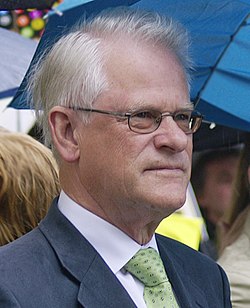
Anders Björck
Anders Per-Arne Björck (born 19 September 1944 in Nässjö, Jönköping County) is a Swedish Moderate Party politician and former county governor.
- Facts0
- Drivers0
- Indicators0
Anders Per-Arne Björck (born 19 September 1944 in Nässjö, Jönköping County) is a Swedish Moderate Party politician and former county governor.
Anders Per-Arne Björck (born 19 September 1944 in Nässjö, Jönköping County) is a Swedish Moderate Party politician and former county governor. He was a member of the Riksdag from 1969 until 31 December 2002 and Minister for Defence from 4 October 1991 to 3 October 1994. On 3 October 1994 the chamber elected him first deputy speaker, and from 2003 he was governor of Uppsala County, leaving the post in 2009 after seven years at Uppsala Castle.
The Riksdag biography supplied for Fakta om folkvalda names his parents as the warehouse manager Arne Ture Axel Björck and Anna Maria Linnéa Svensson, and records a realexamen in 1962, a studentexamen in 1966 and studies at Stockholm University. The same account lists him as national chairman of the Rightist Youth League, later the Moderate Youth League, from 1966 to 1971, and as an employee of Svenska Tändsticks AB (Swedish Match) from 1971 to 1989. In parliament he sat on the Committee on the Constitution from 1974, as its vice chairman from the 1982/83 session until 1990/91, and he was a member of the War Delegation for most of the period from 1979 to 1991.
Björck was a vice-president of the Parliamentary Assembly of the Council of Europe in 1980–81, 1984–85 and 1988–89, and president of the Assembly from 1989 to 1991. After the 1991 election he became minister and head of the Ministry of Defence in the cabinet of Carl Bildt. On 13 February 1992 the government, with Bildt and Björck as signatories, sent the Riksdag a bill on the development of total defence through the 1996/97 fiscal year and a planning line for the next five years. The bill stated that the main task of the Swedish Armed Forces was to be able to meet an armed attack, including one begun at short notice.
When the new Riksdag opened on 3 October 1994 it elected Birgitta Dahl speaker and, on a proposal from the Moderate parliamentary group, elected Björck first deputy speaker, both by acclamation. As governor he lived at Uppsala Castle despite public disputes with the National Property Board over the rent, and he said he was glad the county had resisted a proposal, associated with Ansvarskommittén, to fold it into a larger region. Sveriges Television reported that a large part of the job had been ceremonial — cutting ribbons, crowning Lucia processions and pressing buttons — and quoted him urging the county to be more assertive about its strengths.
Anders Björck, entered in the biographical handbook Vem är det as Anders P-A Björck, was born on 19 September 1944 in Nässjö, in Jönköping County, Sweden. A 2009 SVT profile that gives the same date and place describes him as a politician of the Moderate Party. He was the son of Arne Ture Axel Björck, a warehouse manager (lagerchef), and Anna Maria Linnéa Svensson. SVT and Vem är det shorten the mother's name to Ann-Marie, née Svensson, and the handbook describes the father as a tjänsteman, a salaried employee, rather than by the warehouse title. The fuller parental names in the Riksdag's published biography are information Björck himself supplied to the handbook Fakta om folkvalda. That biography gives his place of residence as Nässjö and, later, Bashult; the 1993 edition of Vem är det places him at Bashult in Jönköping County.
Nässjö is in the historical province of Småland. Before the railway it was a small rural parish; after a dispute over the route, the Southern Main Line was built through Nässjö in 1864, further lines followed, and the place received town rights in 1914. Nässjö Järnvägsmuseum describes the town as Sweden's principal railway junction, the only station in the country at which six railways meet. Looking back in 2019, Björck said that an interest in enterprise had come with growing up in Nässjö, and that it had seemed natural to sympathize with the business-friendly Högerpartiet, the Right Party of his youth. He traced a habit of plain speech to the same years: the value of telling the truth, he said, had been impressed on him as a child, in the formulation "The truth is always unpleasant, and the truer it is, the more unpleasant."
Björck attended school in Nässjö and took his studentexamen there. The Riksdag biography records a realexamen in 1962, the studentexamen in 1966, and subsequent studies at Stockholm University. Vem är det also gives 1966 as the year of the studentexamen and does not record a university degree or a field of study; the Riksdag entry likewise names neither the school nor the subject of the university courses.
In the school system of his childhood, the realexamen was the leaving examination of the realskola. Statistics Sweden describes it as an examination introduced in the early twentieth century for pupils who were not aiming at the studentexamen of the period, and as a qualification aimed at lower clerical posts or employment in trade and business. The same account notes that the largest number passed in 1963, the year after Björck's own realexamen, and that the examination was awarded for the last time in 1973. A profile in Svensk Tidskrift at the end of 1967, when he was 21, treated the Nässjö schooling and the studentexamen as already completed. In a later interview he described himself as punctual and orderly, and said that at school he had been the class ordningsman, a pupil monitor.
In 1960 Björck helped start a branch of Konservativ Skolungdom in Nässjö, in Jönköping County, and after association and district work was elected its national chairman at the congress in Örebro in 1963. He was re-elected in Östersund in 1964 and left the chair at the congress in Gothenburg in 1965. His Riksdag biography, taken from information he gave Fakta om folkvalda, dates the chairmanship to 1963–65.
At the 1965 elevriksdag of Sveriges elevers centralorganisation (SECO) in Ronneby he was speaker for more than 400 delegates and was elected to the presidium; the biography lists him as second vice chairman for 1965–66. A 1967 Svensk Tidskrift profile wrote that he called the post a youthful indiscretion, that the author knew of no other young conservative in that presidium, and that his criticism of SECO’s student-welfare line was welcomed when he left the board.
At the Gothenburg congress in 1965 he also joined the board and working committee of Högerns ungdomsförbund (HUF), youth league of Högerpartiet. The Ronneby congress of 1966 elected him chairman, at 21, the year of his studentexamen. The profile called him the league’s youngest chairman — Sven Johansson, previously the youngest, had been 27 — and the youngest chairman of any party youth organization in Sweden. He held the post until 1971, a span the biography records under both Högerns ungdomsförbund and Moderata ungdomsförbundet, remained on the working committee from 1965 to 1971, and sat on the party board from 1966 to 1971. On 9 January 1969 the parent party took the name Moderata samlingspartiet after a six-hour debate.
The 1967 profile summarized his inaugural speech as an attack on the new left and on liberals he called “extremliberaler,” and as a case for pragmatic, combative conservatism. In 1977 he wrote that school-youth recruitment had made the league younger, that the question of Swedish membership of the EEC had been pursued on ideological rather than mainly commercial grounds, and that he would not stage a public break with the party during the conflict between Yngve Holmberg and Gösta Bohman. On 24 August 1966 he represented HUF in an election debate with the Social Democratic Youth League at Folkets hus in Uppsala.
From 1966 to 1967 he was first vice chairman of Sveriges Ungdomsorganisationers landsråd. In 1968–70 he was president of Nordiska ungkonservativa unionen, which he called Nordiska Ungdomskonservativa Unionen (NUU), an active Nordic body of long standing then finishing, he wrote in 1969, a common young-conservative programme across all policy fields — in his view the first such programme from any Nordic political tendency. He was vice president in 1970–72 of the Conservative and Christian Democratic Youth Community of Europe (COCDYC), which he dated to 1964 and described as a contact forum for moderate and Christian Democratic youth leagues in northern Europe.
The Second Chamber election of 15 September 1968 was the last to the bicameral Riksdag. Högerpartiet won 621,031 votes, 12.9 percent, and 32 seats; the Social Democrats won 2,420,277 votes, 50.1 percent, and 125 of 233 seats.
Björck stood in Jönköping County on the party’s local youth list. In an interview for Torbjörn Nilsson and Josefin Hägglund’s study of the two-chamber parliament, he said the nominating committee hoped the HUF chairman would draw young votes but did not expect a seat, and that he answered with a campaign of posters, “modern methods” and open-air meetings. The votes were enough. He was 23 on polling day, then the age of eligibility and distinct from the voting age, and the return made him the youngest Riksdag member to that date; the armed forces told him that election took him off the military rolls.
The 1968 intake sat from 1969, the year his biography gives for the start of his membership, after new members had been able to attend party-group meetings while the old Riksdag was still sitting. The bicameral parliament ended in 1970/71, and the First Chamber closed in December 1970. After the August 1968 invasion ended the Prague Spring, he turned his first campaign meeting, on Rådhustorget in Jönköping, into a solidarity meeting for Alexander Dubček. He later said that Edmund Burke’s Reflections on the Revolution in France (1790) had persuaded him that institutional inertia could be a safeguard, which was why he stood aside from that year’s calls for rapid upheaval.
The biography Björck supplied for the Riksdag publication Fakta om folkvalda records his first committee posts as a substitute on Allmänna beredningsutskottet in 1969–70 and on the Banking Committee in 1970, then as a member of the Social Insurance Committee in 1971–73 and a substitute on the Committee on Defence in 1971–73. The Riksdag's assignment register shows him again as a defence substitute in 1994–98, 1998–2002 and for the last months of 2002.
For most of the years before the defence ministry his main committee was the Committee on the Constitution. The supplied biography dates membership from 1974; the assignment register lists him as vice chairman from 3 October 1982 to 29 September 1991, as a member again from 10 October 1994 to 4 October 1998, and as a substitute from 20 October 1998 to 30 September 2002 and from 15 October to 31 December 2002. The committee prepares business on the fundamental laws and examines whether the government and its ministers follow the rules for government business; members may report ministers to it, and it also handles radio and television and support for the daily press.
He sat on the committee's delegation for the Parliamentary Ombudsmen in 1974–1975/76 and from 1979/80 to 1990/91, as vice chairman from 1982/83. The delegation consulted the ombudsmen on organization and prepared their election; in 1990/91:KU8 the committee proposed abolishing it from the next electoral period and letting the whole committee take over.
During the examination of the Ebbe Carlsson affair, Svenska Dagbladet later wrote that at the 1989 hearings Carl Lidbom repeatedly refused to answer Björck because he called the questions "trams". The paper quoted the reply: "Jag tycker icke det ankommer på Carl Lidbom att fälla sådana yttranden här. Du ska veta hut när du är här. Punkt. Nu går jag vidare med mina frågor."
He was a member of the War Delegation from 30 September 1979 to 29 September 1991 and from 6 October 1993 until the end of 2002, including 1993–94 while a minister on leave from his seat. The Speaker and 50 members, elected each electoral period, can replace the Riksdag in war or danger of war, and ministers on leave may sit. He was on the nominating committee from 3 October 1982 to 2 October 1991, a substitute on the Speaker's conference in 1982/83–1990/91 and on the Advisory Council on Foreign Affairs in 1984/85 and from 1994/95, and, according to the biography, member and vice chairman of Riksdagens särskilda nämnd in 1986–90 and a member of the Riksdag's data-processing committee in 1983–86.
He served on the 1974 radio and television inquiry (SOU 1977:19) and, from February 1980, on a committee on certain constitutional questions (SOU 1981:15). With Bert Levin and Sven-Erik Nordin he attached reservations and special statements to the mass-media committee's Via satellit och kabel (SOU 1984:65). He was a member of folkstyrelsekommittén (SOU 1987:6) and of the 1985 committee on state support to the daily press (SOU 1988:48). From 22 January 1998 to 31 March 1999 he sat on the media-concentration committee (SOU 1999:30), and from 12 November 1999 to 31 May 2002 on the 1999 constitutional inquiry. The biography also lists the traffic-noise inquiry (1969–76), the national committee for the United Nations' 25th anniversary (1969–70), and inquiries on rights protection, videograms and information technology between 1977 and 1981.
From 1971 to 1989 he was employed by Svenska Tändsticks AB/Swedish Match while sitting in the Riksdag. The same biography records seats on the boards of the Swedish Defence Materiel Administration (1978–85), Sveriges Television (1978–91) and Sveriges Radio (1979–91), on the press-support board (presstödsnämnden, 1979–91) and, as vice chairman, on offentliga sektorns särskilda nämnd (1986–91), plus Gotabanken's eastern Sweden region (1976–91) and the chair of the International Foundation of Airline Passengers Associations (1986–89).
He sat on the national board of the Moderate Party in 1966–71 and again from 1981, through Carl Bildt's chairmanship of 1986–99. In Jönköping County he was on the county party's board from 1969, first vice chairman from 1979 to 1990 and chairman from 1990. In the parliamentary group he was on the executive council (förtroenderådet) in 1979/80–1990/91 and from 1994/95, and its third vice chairman in 1985/86–1990/91 and from 1994/95, the gap matching his leave from his seat as a minister from 4 October 1991 to 2 October 1994.
After the 2002 election, when Aftonbladet put the loss at 400,000 voters since 1998, the paper called Björck, still a party-board member, one of the "bunkergänget" at the Mynttorget headquarters, a circle it said Bo Lundgren had largely inherited from Bildt and in which it named Per Unckel. Björck said the party could not go on as if nothing had happened and that the board must act if Lundgren did not, while rejecting a resignation of the whole leadership.
Sweden's delegation to the Parliamentary Assembly of the Council of Europe, the parliamentary organ of the Council of Europe, is drawn from the Riksdag. Anders Björck, of the Moderate Party, recorded in the note he supplied for Fakta om folkvalda that he was a substitute on the delegation in 1976/77–1979/80 and a member from 1977/78 through 1991/92, and a vice-president of the Assembly in 1980–81, 1984–85 and 1988–89. The Riksdag's assignment register lists him as the delegation's chair from 3 October 1982 to 3 October 1983 and as vice-chair from 3 October 1983 to 12 February 1991, and again as vice-chair from 19 October 1994 to 31 December 2002.
On 8 May 1989, at the Assembly's session in Strasbourg, Björck was elected president by an absolute majority, succeeding the French senator Louis Jung. Three days earlier Finland had become the twenty-third member state, and Jung had presided at the Assembly's fortieth-anniversary sitting. Thanking his opponent, Björn Elmquist, Björck said the Assembly, whose members also sat in national parliaments and which then covered 23 countries rather than the European Parliament's twelve, should not duplicate that parliament. Reform in non-member Central and Eastern Europe, he said, would shape the Council's role. On 6 July he was in the chair for Mikhail Gorbachev's address.
On 11 May 1989 the Assembly created a special-guest status, on a report by Peter Sager of Switzerland, for parliaments of European non-member states applying the Helsinki Final Act, later CSCE instruments and the two 1966 United Nations covenants. About a month later it went to the legislatures of Hungary, Poland, the Soviet Union and Yugoslavia, which could take part but not vote. The same May session gave the Assembly's European Human Rights Prize to Lech Wałęsa. In Russian, Björck told Gorbachev: "You are European. I am also European. Today, we are talking together of our common home." Gorbachev called different social systems a reality to be recognised, alongside sovereign choice, and on 9 November the Berlin Wall was opened.
On 1 June 1990 Björck told El País in Madrid that special guests already included the Soviet Union, Yugoslavia, Poland and Hungary from 1989, and the German Democratic Republic and Czechoslovakia from 1990. Full membership, he said, required a democratic constitution, human rights, free elections and a multi-party system, tests he thought Hungary was the first eastern country to meet. The Soviet Union was, he said, a separate case, but Europe would have neither peace nor stability without close ties to it, and a united Germany should sit fully inside NATO and the European institutions.
Hungary acceded on 6 November 1990 as the twenty-fourth member and the first former Eastern-bloc state to join. Géza Jeszenszky signed the European Convention on Human Rights at the Barberini Palace, and the Hungarian flag was raised in Strasbourg. Czechoslovakia became the twenty-fifth member on 21 February 1991, in Madrid, after the Assembly's January debate. In the debate on German reunification, Björck recalled that Federal German delegates had, on 7 August 1950, called themselves representatives of Germany as a whole. In February 1991, after a visit to the Baltic states, he told the ministers that cooperation with Moscow should depend on human-rights standards. On 18 September he welcomed Estonian, Latvian and Lithuanian delegates, recently made special guests, as they applied to join.
On 26 November 1991, still president, he spoke at Poland's accession as the twenty-sixth member. The elections of 27 October had, he said, met the conditions; he called Poland the first Central and Eastern European special guest, from the summer of 1989, and recalled speeches by Tadeusz Mazowiecki in January 1990 and Leszek Balcerowicz in January 1991. The Council, he said, now covered all of Central Europe and about 500 million people. Björck had been Sweden's minister for defence since 4 October 1991, and on 26 November he resigned the presidency; Sir Geoffrey Finsberg succeeded him for an interim period of several months.
On 4 October 1991 Carl Bildt told the Riksdag that Anders Björck would be minister and head of the Ministry of Defence. The cabinet was the centre-right minority government formed after the 1991 election by the Moderate Party, the Liberals, the Centre Party and the Christian Democrats. Björck’s Riksdag biography gives the appointment as 4 October 1991 to 3 October 1994; he was on leave from his seat from 4 October 1991 until 2 October 1994. On 8 January 1992 he wrote in Dagens Nyheter, under the heading “Obehagliga försvarsbeslut väntar”, that protecting the defence industry mattered more than individual peacetime units.
Bill 1991/92:102, signed by Bildt and Björck on 13 February 1992, set total defence for 1992–1997 and the appropriations for 1992/93. It treated the immediate threat to Sweden as reduced after the Cold War, while restating the Swedish Armed Forces’ main task as meeting an armed attack, including one opened at short notice against national command and other vital functions. The wartime organisation was to comprise 16 army brigades and, once JAS was in service, 16 air divisions in the longer term. Infantry brigades would fall from ten to six and Norrland brigades from five to four; because fewer than a full cohort of conscripts would need basic training, three regiments and one air wing would close. The country was to be divided into three military areas, by merging the Southern and Western areas and the Lower and Upper Norrland areas, by 1 July 1993, with the peacetime reorganisation done by 1 July 1994. The annual military spending frame would rise by 900 million kronor, plus 1.5 per cent of procurement costs, which the bill described as paying for quality while limiting the structural cuts. The closures named in the bill were Hälsinge Regiment (I 14) in Gävle, North Scanian Regiment (P 6) in Kristianstad and Svea Engineer Regiment (Ing 1) in Södertälje, each by 30 June 1994, and Västgöta Wing (F 6) at Karlsborg.
The Riksdag decided the defence committee’s report 1991/92:FöU12 on 3 June 1992, adopting the committee’s proposals except for one change, made in the debate, to the terms for winding up units. Björck told the chamber that the committee supported what he called 95 per cent of the bill, that a real increase was then unique in Europe, and that quality was being preferred to quantity. He added that alterations which did not fit, or which cost more, would leave a less effective defence. The chamber kept F 6 by 285 votes to 9 and instead closed Bråvalla Wing (F 13) at Norrköping by 251 to 32. Closure of Ing 1 passed by 265 to 25, against a reservation from New Democracy, and the brigade figure and the spending frame passed by margins of 169 to 113 and 161 to 114 against Social Democratic reservations.
Sture Ericson, for the Social Democrats, said the bill largely followed a Social Democratic course and that Björck had led the Moderates away from defending a large organisation, but that the cut in units should have gone further in order to fund quality, and that money was already short. Jan Jennehag of the Left Party asked why Sweden was raising spending when neighbouring countries were cutting, and called the forces oversized. New Democracy’s Robert Jousma said his party accepted the bill’s turn toward newer equipment but opposed closing Ing 1 and F 13, argued that the preparation had been too fast, and said the choice of F 13 should not be laid on New Democracy: Björck, he said, had wanted both wings kept.
In September 1992 the government and the Social Democrats agreed a crisis package to cut the structural deficit; bill 1992/93:50 of 20 October applied it to defence. Björck’s annex proposed closing F 6 after all, from 1 July 1993 and completely by the end of 1994/95, a step the bill priced at about 250 million kronor a year, and said another wing would go. The civil planning frame was cut by 100 million kronor and conscripts’ cash and travel benefits by about 150 million. The agreement set the full defence saving at 1.2 billion kronor a year; the bill said the listed steps might fall short and that Björck would look for more inside the 1992 decision’s period. The Riksdag approved the finance committee’s report on 16 December 1992.
The June decision authorised a second batch of the Saab JAS 39 Gripen: 110 aircraft, development of the two-seat JAS 39B and related support, after the Defence Materiel Administration’s November 1991 valuation of an offer from Industrigruppen JAS. The order passed by 164 votes to 116, with 16 abstentions, against a Social Democratic reservation; the project’s continued direction passed by 270 to 23 against the Left Party. Starting procurement of new tanks passed by 160 to 119. The bill sent those tanks toward the mechanised brigade in Upper Norrland and aimed at one Combat Vehicle 90 battalion in each brigade. The three surface flotillas were to be built more slowly: four Göteborg-class corvettes would be finished, missile and patrol boats modernised, and the submarine force held at twelve boats, with auxiliary machinery on the Gotland type.
The same bill put Swedish defence production at about 15 billion kronor a year and said the export share, about 40 per cent in recent years, had fallen sharply. It warned that too little work could leave the industry unable to supply several important Swedish needs, and that security and industrial policy both argued for keeping domestic competence in selected technologies. Björck told the Riksdag that a small country had to choose between that competence and the peacetime order of battle, and that the committee had chosen as the government had.
At the 1994 election on 18 September the governing parties lost support, New Democracy left parliament, and the non-socialist government resigned. Björck’s term as defence minister ended on 3 October 1994. On 7 October Ingvar Carlsson named Thage G. Peterson minister and head of the Ministry of Defence. What remained in force was the June organisation and equipment line, already altered by the autumn agreement’s closure of F 6 and its 1.2 billion kronor savings target.
On 3 October 1994, at the Riksdag's first sitting, senior member Ingvar Carlsson presided while the chamber elected its presidium by acclamation, one office at a time and on a single nomination for each. Sven Hulterström nominated Birgitta Dahl of the Swedish Social Democratic Party as Speaker, and Lars Tobisson nominated Anders Björck of the Moderate Party as first deputy speaker. Görel Thurdin (c) and Christer Eirefelt (fp) were elected second and third deputy speakers. On 5 October 1998 Jan Bergqvist presided as acting senior member, and the chamber again elected Dahl, and Björck on Tobisson's nomination, by acclamation, with Eva Zetterberg (v) and Rose-Marie Frebran (kd) as the other deputies.
Björck opened the sitting of 30 September 2002 as senior member. The chamber elected Björn von Sydow Speaker and, on Bo Lundgren's proposal of re-election, returned Björck as first deputy speaker by acclamation; Kerstin Heinemann (fp) and Helena Höij (kd) were elected second and third deputy speakers. As the Riksdag Committee restated the Riksdag Act in 1999, a deputy speaker's only regulated task was to replace a prevented Speaker in leading the Riksdag's work and in the chamber, and the deputies had no collective duties. The Speaker was to consult them on the opening sitting and, under chapter 5, section 2 of the Instrument of Government, before proposing a prime minister.
The structured assignment list records "Förste vice talman" only from 5 October 1998 to 30 September 2002, with no row for the 1994 election and none after the re-election on 30 September 2002. The curriculum vitae in the same register instead reads "1:e vice talman 94/95–", without an end date, and lists him from 1994/95 as a member and vice chairman of the Speaker's Conference. On 20 December 2002 the Speaker, bidding farewell, described him as first deputy speaker since 1994. Until it was replaced, the Act seated the deputy speakers on the Speaker's Conference with the Speaker, party-group representatives, committee chairs and the administrative board's vice chairman; the register records no vice-chairmanship.
Björck was an ordinary member of the Committee on the Constitution from 11 October 1994 to 4 October 1998, and a substitute from 20 October 1998 to 30 September 2002 and from 15 October to 31 December 2002. From 12 November 1999 to 31 May 2002 he was a member of the government's 1999 constitutional inquiry, Ju 1999:13, chaired by Ulf Lönnqvist and appointed under an authorisation of 2 September 1999. Its reports included SOU 2001:19, Vissa grundlagsfrågor, and three further reports on elections.
On 13 October 1999 the Speaker's Conference, with Björck participating as first deputy speaker, endorsed replacing itself and the administrative board with a Riksdag Board charged with planning parliamentary work, directing the administration and deciding weightier international business. The Committee on the Constitution's report carried the amending legislation, drawn to take effect on 1 July 2000. The chamber elected Björck one of ten board members on 14 June 2000, from 1 July for the rest of that electoral period, and again on 8 October 2002 for the new period. The assignment register carries that seat to 31 December 2002.
He left the Riksdag at the end of 2002 to become governor of Uppsala County. On 25 October 2002 he said that he had accepted the government's offer and would stay until the new year to induct the new speakers. On 20 December the Speaker thanked him, still as first deputy speaker and senior member, and the register records his membership through 31 December 2002.
On 24 October 2002 Dagens Nyheter reported that Anders Björck, the Riksdag's first deputy speaker, was leaving national politics to become county governor (landshövding) of Uppsala County. He took office on 1 January 2003 on a six-year appointment due to end on 31 December 2008. A Moderate Party member of parliament since 1969, he said he would give up his party posts and that a governor should be non-political. Svenska Dagbladet called it a way for the Government of Sweden to disarm a critic of what he had termed Social Democratic favouritism in state appointments.
The county then had only an acting governor, Ulf Henricsson, in place since August 2002 after Ann-Cathrine Haglund. A later SVT list dates Haglund to 1997–2002, Henricsson's acting term to 1 August–31 December 2002, and Björck to 2003–2009. On 3 July 2008 the appointment was extended until 1 October 2009. SVT reported on 8 September 2009 that, after seven years at the castle, he was moving to an apartment in Stockholm. County director (länsråd) Leif Byman was to deputize as governor. On 17 December 2009 the government named Peter Egardt, head of the Stockholm Chamber of Commerce, to succeed him from 12 April 2010 until 31 August 2014.
In Sweden each county has a county administrative board (länsstyrelse) for state business not given to another authority. The instruction then in force made the governor the board's chief and chair, charged with giving national objectives effect while regarding regional conditions, coordinating public interests, promoting development and informing the government; outside Stockholm, Skåne and Västra Götaland, the county director is the deputy.
The governor lived at Uppsala Castle in Uppsala. The county board rented the dwelling from Statens fastighetsverk, the National Property Board; a taxable benefit of 13,000 kronor a month was added to Björck's income. He said a governor had to live there, could not simply move, and had not sought an exemption, which he thought would take years.
In October 2005 the tenancy became a public quarrel. Björck told TT that badly planned works, latest a pipe replacement in his private flat, had caused needless disruption, and that the board used the residency rule because the premises had to be rented; he called the lack of arbitration reminiscent of the nineteenth century. In Dagens Nyheter he urged that the board be abolished, writing that it harmed cultural buildings through unsuitable commercial use and unsightly signs and levied unreasonable rents on state tenants who could not leave. He said the county board, not he as a private resident, was demanding a rent negotiation because broken floors and a cut-off water supply left rooms unusable and disrupted official events. The board told the government his conduct was "unacceptable", including what it called excessive compensation claims, and Svenska Dagbladet reported that it had been denied access; Björck said he had refused no one entry. The property board's communications chief said tenants were generally satisfied, and the Ministry of Finance said it would try to help the parties settle the dispute.
In August 2008 the dispute returned over a higher rent for the flat and the representational floor. The county board called the rise unreasonable, terminated the contract and asked the rent tribunal (hyresnämnden) to mediate. Jörgen Hammarstedt of the property board said the rent had lagged comparable premises and was not unreasonable; Björck would not comment. Leaving, he told SVT he had still liked the castle, despite the rent quarrel and a row over a bust of Dag Hammarskjöld.
On 7 February 2006 Björck attacked Ansvarskommittén, a government commission chaired by county governor Mats Svegfors, in Dagens Nyheter. He wrote that it wanted nine regions instead of 21 counties and was moving to present the Riksdag and the public with a fait accompli; if it kept drawing maps and avoided harder questions, such as the county councils' future, it should be closed. Its final report, SOU 2007:10, Hållbar samhällsorganisation med utvecklingskraft, appeared on 27 February 2007 in Statens offentliga utredningar and asked whether tasks and structures in public administration had to change. Leaving office, he said he was proud and sure it had been right to oppose the commission and the proposal to "kill this fine county".
Måns Månsson's cinéma-vérité documentary H:r Landshövding followed Björck in the post. Martin Persson produced it at Anagram Produktion with support from the Swedish Film Institute. It was nominated for best documentary at the Guldbagge Awards, announced on 30 December 2008, with the ceremony on 12 January 2009 at Cirkus in Stockholm. Reviews split, from a top mark in Svenska Dagbladet, which praised the black-and-white photography, to low marks in Aftonbladet, Expressen and TT Spektra. When the Tempo documentary festival in Stockholm closed on 8 March 2009, the film won best feature documentary and 75,000 kronor. The jury cited its form, its pauses in silence and uneventful moments, and ceremonies around an institution that "appears as an absurdity in the Swedish political system".
While still governor of Uppsala County, Björck left the chair of Försvarets underrättelsenämnd in February 2009 in protest against the law allowing the National Defence Radio Establishment (FRA) to collect signals intelligence from cable traffic. The commission oversees intelligence work by the Swedish Armed Forces and by FRA; he had chaired it for twelve years, and the term then running was due to end in June. He told Svenska Dagbladet that the laws and the oversight being designed promoted neither privacy nor effectiveness. Defence Minister Sten Tolgfors played the resignation down and said a judge would be added to strengthen legal safeguards, which Björck called the wrong road.
On Sveriges Television in January 2013 he attacked Prime Minister Fredrik Reinfeldt and Defence Minister Karin Enström over reports that the new operational defence could hold only one area for about a week. He called that “very serious,” said Gösta Bohman would have turned in his grave, described a “systematic weakening” for which Reinfeldt was ultimately responsible, and warned that defence could become a fate question for the Moderate Party. At the Folk och Försvar conference in Sälen in January 2014 he told Expressen that talk of a good defence was “laughable,” that disarmament was being sold as rearmament, and that he shared Mikael Odenberg’s criticism.
In an Aftonbladet interview reported by Expressen in January 2018 he called the Alliance cuts “a betrayal without equal,” blamed Reinfeldt and Finance Minister Anders Borg for billions taken from the defence, and attributed to the Moderate leadership the line that “eternal peace is on the way” and that defence won no votes. During the COVID-19 pandemic in Sweden, in April 2020, he told Expressen that Sweden had been far better prepared before total defence was dismantled, that “we were naive and historically ignorant,” and that those responsible should “veta hut.” He claimed that until 1994 the country “would have handled this corona outbreak without any major problems.”
In March 2022, after the Russian government warned Sweden against moving closer to NATO, he told Jönköpings-Posten that it was “astonishing that Putin should try to steer Sweden” and that Sweden “should have joined NATO long ago,” in which case “we would not have been exposed to these threats now.”
The biography he supplied to the Riksdag publication Fakta om folkvalda lists him, from 1996, as a member of the Export Control Council and as chair of Försvarets underrättelsenämnd, and from 2000 as a board member of the state company Vin & Sprit AB; that entry gives no end dates. He was not among the council members the government appointed on 1 February 2007.
Svenska Pistolskytteförbundet’s papers record him as förbundsordförande in the mid-2000s: the board report for 2006 lists the office with a mandate through the 2007 congress, and on 10 June 2007 the ordinary congress re-elected him for one year. The federation’s annual report for 2023 still names him among its honorary members.
After the governorship he joined the communications firm JKL as a part-time industrial consultant from 1 January 2010, telling Sveriges Radio that there was “no occupational ban for pensioners”; former prime minister Göran Persson was already on the firm’s payroll. Dagens Media reported that SVT would keep him on its Friday news panel if he disclosed conflicts, and that he must not have any other loyalties. In February 2013 a signed article in Gotlands Allehanda opposing state-owned ferries to Gotland was described by Resumé and Gotlands Tidningar as a JKL text for Rederi AB Gotland; Björck and JKL’s Mats Bergstrand denied that anyone else had written it. Expressen still described him in 2020 as an industrial consultant for JKL.
Kungl. Patriotiska Sällskapet’s roll lists him, with the year 2002, as a former county governor, minister and deputy speaker. In remarks Svensk Dam attributed to an Expressen interview in 2017, he defended the men-only club Sällskapet, of which the magazine described him as a member, citing freedom of association and saying nothing stopped women from starting clubs of their own.
In 1975 Björck married Py-Lotte von Zweigbergk (born 1948), daughter of the director Sverker von Zweigbergk and Astrid, née Sigström, according to the biographical handbook Vem är det. A profile published for his 60th birthday in 2004 listed the household as his wife Py-Lotte and their daughter Anne, then 22, and gave their home as Uppsala Castle. While he was county governor, Py-Lotte Björck told Upsala Nya Tidning that she had made clear from the outset that, because she was in paid work, she would meet the expectations placed on her only so far as she could. At his 75th birthday in September 2019, Göteborgs-Posten described the family as his wife Py-Lotte von Zweigbergk, their daughter Anne and a four-year-old grandchild, Desiré, and reported that they lived in Vasastan in Stockholm.
The Riksdag biography, drawn from information he supplied to Fakta om folkvalda, lists three early books: the conservative quotation collection Oövervinneliga tankar i urval (1968, with A. Arfwedson), Moderat samhällssyn. Analys och perspektiv (1969, with Arfwedson and H. Sandebring) and Ett balanserat försvar (1974). Vem är det also records the 1969 and 1974 titles and notes contributions to political anthologies, the daily press and periodicals. In 2002 Mats Bergstrand, then head of DN Debatt, published the interview book Framför lyckta dörrar – en bok om Anders Björck (Jure, 198 pages), covering the Moderate Party, Carl Bildt and earlier leaders, and work in the Riksdag and its constitutional committee.
During the constitutional committee's televised hearings in the Ebbe Carlsson affair in 1989, he told the ambassador Carl Lidbom, "Du ska veta hut när du är här. Punkt." He later said that he had reacted to Lidbom's nonchalance when nobody else on the committee did, and that people still thanked him for the words. In 2019 he said that speaking plainly had been impressed on him as a child: "Sanningen är ju alltid obehaglig och ju sannare desto obehagligare." A 2009 Sveriges Television article attributes to him a line from the comedy programme Snacka om nyheter on 15 November 1998: "För det första har jag aldrig sagt det, för det andra är jag felciterad och för det tredje skulle det aldrig ha kommit ut." The same article stated that he is a member of the Swedish Order of Freemasons. In 2019 he appeared in the documentary Hasse & Tage – en kärlekshistoria, about the duo Hasse & Tage, and described humour as "ett farligt vapen", worse than losing a debate, while declining the part of a comic from the political right. He was then sorting a private archive for the library of Uppsala University, to stay sealed until 25 years after his death.
On 28 January 2003 Carl XVI Gustaf conferred His Majesty the King's Medal of the 12th size in the ribbon of the Order of the Seraphim. The Royal Court listed the recipient as the former First Deputy Speaker of the Riksdag and as county governor, with the citation "För mångåriga och betydelsefulla samhällspolitiska insatser.".pdf)
In 1988 he was the first person named Årets smålänning, an award instituted that year by P4 Jönköping of Sveriges Radio. Listeners nominate candidates and a jury chooses the recipient; a later recap by the station listed the 1988 winner as Anders Björck, member of the Riksdag.
On 23 May 2007 Uppsala University awarded him its Linnaeus Medal in gold, as county governor and chairman of the National Linnaeus Delegation, for his "engagerade och energiska insatser" in the national and local commemoration of Carl Linnaeus. The university lists him among the gold recipients at that year's Linnaeus festival, the first time the medal was conferred.
Ranked by shared high-impact facts, then explicit ties, then shared drivers.
 Lech WałęsaLech Wałęsa (born 29 September 1943) is a Polish trade…Affiliated
 Per UnckelPer Carl Gustav Unckel (24 February 1948Affiliated
 Ingvar CarlssonGösta Ingvar Carlsson (born 9 November 1934) is a retired…Affiliated
 Sten TolgforsSten Sture Tolgfors (born 1966) is a Swedish government…Affiliated
 Carl BildtNils Daniel Carl Bildt (born 15 July 1949) is a Swedish…Affiliated
 Mikael OdenbergMikael Ingemarsson Odenberg (born 14 December 1953 in…Affiliated
 Fredrik ReinfeldtJohn Fredrik Reinfeldt is a Swedish economist and former…Affiliated
 Göran PerssonHans Göran Persson (born 1949) is a Swedish politician who…Affiliated
How the record is sourced and how the score is derived.
The score is formula-derived (Factrail formula v1, version 1.0.0), not an editorial verdict. Read the methodology.
By the Factrail desk · Method: how we source and score · Last reviewed
Dispute a fact on this pageNamed here, or represent someone who is? Request a right of reply.