
Jaw Shaw-kong
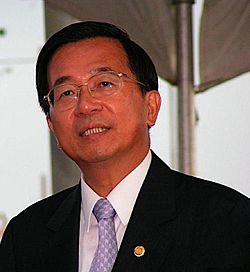
Jaw Shaw-kong (Chinese: 趙少康; born 16 November 1950) is a Taiwanese media executive, political commentator…
- Facts0
- Drivers0
- Indicators0
Jaw Shaw-kong (Chinese: 趙少康; born 16 November 1950) is a Taiwanese media executive, political commentator…
Jaw Shaw-kong (Chinese: 趙少康; born 16 November 1950) is a Taiwanese media executive, political commentator, and Kuomintang politician known for his influential role in conservative media and efforts to revitalize the party's electoral prospects. Educated in agricultural engineering at National Taiwan University and mechanical engineering at Clemson University, he entered politics in the 1980s, serving as a Taipei City Councilor (1981–1987), a member of the Legislative Yuan (1987–1991 and 1993–1994), and administrator of the Environmental Protection Administration (June 1991 – November 1992). He co-founded the New Party in 1993 and was its candidate in the 1994 Taipei mayoral election, finishing second with 424,905 votes (30.17%). After leaving politics in the 1990s to focus on media ventures, including chairmanship of the Broadcasting Corporation of China, Jaw rejoined the KMT in 2021, formed the "Fighting Blue" alliance to consolidate deep-blue support, and ran as vice-presidential candidate alongside Hou Yu-ih in the 2024 election, where the ticket received 4,671,021 votes (33.49%) and finished second. His career has been marked by sharp critiques of the Democratic Progressive Party and advocacy for cross-strait engagement, though his media outlets have faced accusations of undue influence from Beijing, which he has denied while emphasizing Taiwanese sovereignty under the Republic of China framework.
Jaw Shaw-kong was born on November 16, 1950, in Keelung, Taiwan, into a family of mainland Chinese origins that had relocated following the retreat of Kuomintang forces in 1949. His ancestral roots trace to Shexian County in Henan Province, though the area later fell under Hebei's Handan jurisdiction after 1949; Jaw has consistently identified as Henanese rather than Taiwanese by birth. His paternal grandfather practiced traditional Chinese medicine in Handan, serving urban patients amid wartime disruptions.
Jaw's father, Zhao Zhenrong (also recorded as Zhao Yanmin), enlisted in the Republic of China military at age 16 during the Japanese invasion of China, graduating from the Central Army Officer School's 16th class (equivalent to Whampoa's later sessions) and rising to lieutenant colonel as a staff officer before the 1949 exodus to Taiwan. His mother worked as a schoolteacher, contributing to a household marked by military discipline and frequent relocations tied to his father's postings. The family resided in military dependents' villages (眷村), emblematic of waishengren communities, where Jaw experienced a rigorous, militaristic environment that fostered his competitive personality but also led to frequent conflicts with his authoritarian father.
Primary upbringing occurred in Tainan amid his father's assignments, with the family adapting to multiple transfers that honed Jaw's resilience and academic adaptability, though details of early socioeconomic status remain tied to modest military pensions rather than elite privilege. This nomadic yet structured childhood, within a staunchly anti-communist household loyal to the Republic of China, shaped his lifelong identification with mainland heritage and KMT values over native Taiwanese identity.
Jaw Shaw-kong obtained a bachelor's degree in agricultural engineering from National Taiwan University in 1973. He subsequently earned a master's degree in mechanical engineering from Clemson University in South Carolina, United States. These qualifications in engineering fields equipped him with technical expertise that informed his early professional roles in research and industry.
After completing his graduate studies, Jaw served as an adjunct associate professor in National Taiwan University's Department of Agricultural Engineering. He also held a visiting scholar position at Academia Sinica, contributing to research in related technical areas. Additionally, he completed the senior management research program offered by the American Management Association in New York.
Jaw's academic training in mechanical and agricultural engineering, particularly with emphases on practical applications such as pollution control aspects within mechanical systems, influenced his later advocacy for environmental protection during his tenure as administrator of Taiwan's Environmental Protection Administration from June 1, 1991 to November 15, 1992, when the agency introduced the Green Mark eco-label scheme, the Public Nuisance Dispute Mediation Act, and a NT$2 deposit-refund system for PET bottles. This background fostered a pragmatic, data-driven approach evident in his transition to business and policy-making.
Jaw Shaw-kong established UFO Radio Broadcasting Network in 1996 following his announcement to step back from politics. The network launched operations on October 16, 1996, initially focusing on talk shows and news commentary that reflected his pro-unification views, with Jaw serving as chairman. This venture marked his entry into the media sector, leveraging his public profile to build a platform emphasizing conservative and cross-strait perspectives.
Under Jaw's leadership, UFO Radio expanded its reach through provincial syndication by 1997, covering regions including Taipei, Taichung, Tainan, and beyond via FM frequencies such as 89.9 MHz in central Taiwan. The station's growth capitalized on Taiwan's deregulated broadcasting environment post-martial law, attracting listeners with programs like evening talk shows that critiqued government policies.
In December 2006, Jaw, who said he had already stepped down as UFO Radio chairman and was negotiating in a personal capacity, agreed to take over the Broadcasting Corporation of China (BCC), a former Kuomintang party asset that had been sold to the China Times group a year earlier. Jaw and associates acquired it through four companies: Good Listen (好聽), Joy Joy (悅悅), Radio People (廣播人) and Broadcaster (播音員). The DPP alleged a private deal between the KMT and Jaw, and Premier Su Tseng-chang called on the NCC to reclaim BCC's frequencies. Jaw pledged to run BCC as a non-partisan public outlet. The government questioned how companies capitalized at roughly NT$100 million could take control of a broadcaster with assets worth billions, and declined to approve the change of the company's responsible person. On October 24, 2007, Jaw announced he was resigning and withdrawing from BCC's management, accusing the government of suppression; Government Information Office head Shieh Jhy-wey denied the charge. Jaw later returned as chairman and remained in the role until resigning on January 1, 2024. This expansion faced scrutiny over the purchase price, with critics alleging undervaluation of assets tied to party holdings, though Jaw maintained the transaction was transparent and market-based.
By 2007, Jaw had also taken ownership of News 98 radio, further consolidating his influence in Taiwan's talk radio landscape and positioning his enterprises as key outlets for pan-blue commentary. These moves transformed his initial radio startup into a diversified media group, though Jaw transitioned to a background role at UFO by late 2006 amid ongoing political re-engagement.
Jaw Shaw-kong entered the media industry after retiring from the Legislative Yuan in 1996, assuming leadership roles in several broadcasting entities. He served as chairman of Feidie Broadcasting Company (飛碟廣播公司), where he oversaw operations in radio programming targeted at diverse audiences, including talk shows and news segments that emphasized political commentary. Subsequently, he became chairman and general manager of the Broadcasting Corporation of China (BCC, 中廣), a major radio network founded in 1928 and historically linked to the Kuomintang. Under his tenure, which began around 2005, Jaw managed the company's transition amid financial challenges, including a controversial acquisition scrutinized by prosecutors for potential breaches of fiduciary duty in the "Three China Cases" involving state assets.
At BCC, Jaw expanded the network's reach through digital platforms like the BCC Pop Network (中廣流行網), integrating radio with online streaming to attract younger listeners while maintaining traditional AM/FM broadcasts. His leadership emphasized content that critiqued Democratic Progressive Party (DPP) policies and advocated for cross-strait engagement, aligning with pan-blue perspectives. During the vice-presidential debate on January 1, 2024, Jaw announced and signed his resignation as BCC chairman, general manager and director. The DPP campaign responded that he retained a stake of about 27.6% and called the resignation 'mere talk'. On February 21, 2024, the NCC approved Chen Sheng-yi as BCC's new chairman and general manager, on condition that BCC comply with the Radio and Television Act's ban on party, government and military involvement.
Jaw's public influence stems primarily from his hosting of high-profile political talk shows across platforms, including BCC's Zhao Shao-kang Time (趙少康時間), TVBS's Shao Kang's War Situation Room (少康戰情室), and Yahoo TV segments. These programs, launched in the early 2000s, drew substantial audiences—Shao Kang's War Situation Room often topping ratings among political commentary shows—with Jaw delivering sharp analyses of current events, such as DPP governance failures and national security threats from China. His rhetorical style, blending legal expertise with populist appeals, positioned him as a de facto opinion leader for conservative voters, mobilizing "fighting blue" (戰鬥藍) factions within the KMT base and amplifying critiques of pro-independence narratives.
Through these outlets, Jaw shaped public discourse on issues like economic policy and Taiwan's international relations, often attributing media bias to "green media" dominance (80% of outlets, per his estimates) while defending BCC's editorial independence despite its historical KMT ties. His commentary has been credited with swaying voter sentiment during elections, as seen in his 2021 KMT return announcement, which leveraged media visibility to challenge party insiders. Critics, including DPP lawmakers, have accused his platforms of fostering division, yet audience metrics and political endorsements underscore his enduring sway over non-DPP demographics.
Jaw Shaw-kong was first elected a Taipei City Councilor in 1981 as a Kuomintang candidate, finishing second in his district behind Chen Shui-bian, and was re-elected in 1985 with the most votes in the district. In the December 1986 supplementary legislative election he won a seat in the Legislative Yuan representing Taipei City, serving from 1987 to 1991. This election introduced additional seats to the legislature to accommodate Taiwan's growing population and democratization demands, with Jaw securing one of the positions amid the KMT's dominance, which captured most contested seats. At age 36, his entry marked a shift toward younger politicians in the party.
During his initial term from 1987 to 1991, Jaw emerged as part of the KMT's younger faction, focusing on internal party reforms and anti-corruption efforts. In 1989 he co-founded the New KMT Alliance with Wang Chien-shien, Yok Mu-ming and others, an intra-party faction that called for democratization and party reform. His legislative activities included environmental protection, leading to his appointment as head of the Environmental Protection Administration in June 1991, after which he resigned his seat. Denied KMT nomination for the 1992 legislative election, he ran as an independent in Taipei County and won about 235,000 votes, the highest total in that election, which earned him the nickname "political golden boy" in the Taiwanese press.
Jaw Shaw-kong served as a legislator in the Republic of China Legislative Yuan from 1987 to 1991 (Taipei City) and 1993 to 1994 (Taipei County), initially under the Kuomintang (KMT) banner, then as an independent, and from August 1993 as a co-founder of the New Party. During this period, he focused on legislative reforms addressing cross-strait relations amid Taiwan's democratization and the lifting of martial law in 1987.
A primary contribution was his 1988 proposal for the draft of the Act Governing Relations between the People of the Taiwan Area and the Mainland Area (兩岸人民關係條例), which established a legal framework for regulating civilian exchanges, including family visits, marriages, and settlements between Taiwan and mainland China. The bill passed third reading in the Legislative Yuan on February 27, 1992, enabling policies such as allowing mainland spouses to relocate to Taiwan and obtain resident identification cards starting in 1993, addressing humanitarian concerns for separated families and overseas Chinese soldiers. Jaw personally lobbied President Chiang Ching-kuo to permit such cross-strait personal contacts, highlighting the plight of elderly veterans unable to reunite with relatives.
As part of the KMT's younger reformist faction, Jaw advocated for anti-corruption measures and political modernization, criticizing entrenched party interests and pushing for greater transparency in governance. His positions emphasized maintaining the Republic of China's sovereignty while pragmatically managing cross-strait ties to prevent instability, opposing premature independence pushes that could provoke conflict. After forming the New Party, he continued to prioritize clean politics and economic policies favoring business deregulation, though specific bills tied to these stances during his tenure remain less documented beyond cross-strait initiatives.
Jaw Shaw-kong's decision to rejoin the Kuomintang (KMT) in February 2021, after nearly three decades away from active party politics, was driven by an invitation from former Kaohsiung Mayor Han Kuo-yu and a perceived need to revitalize the party amid its post-2020 electoral setbacks. He cited the KMT's internal weaknesses and Taiwan's broader challenges, including escalating cross-strait tensions under the Democratic Progressive Party (DPP) administration, as key factors prompting his return. Jaw emphasized the necessity of strong leadership to safeguard Taiwan's security and economy, positioning his re-entry as a response to what he viewed as ineffective governance that risked conflict with mainland China.
A central motivation articulated by Jaw was to foster cross-strait peace and domestic political reconciliation between the KMT ("blue") and DPP ("green") camps, which he argued had deepened divisions and hindered pragmatic policymaking. In announcing his intent to seek the KMT's presidential nomination for 2024, he framed the effort as an opportunity to "make Taiwan great again," echoing concerns over economic stagnation, youth unemployment, and over-reliance on U.S. support without balanced engagement across the Taiwan Strait. Jaw critiqued the DPP's independence-leaning stance as provocative, asserting that sustained dialogue with Beijing was essential to avert war, a view reinforced by his public warnings that Taiwan stood on the "brink of war" without policy shifts.
By November 2023, when selected as vice presidential running mate to Hou Yu-ih, Jaw's motivations extended to bolstering the KMT's electoral coalition and countering DPP dominance, which he linked to policy failures in housing affordability and energy security. He described the candidacy as a strategic partnership to unify anti-DPP voters, prioritizing national stability over personal ambition and underscoring that his media platform had amplified these issues for years, compelling direct political action. Jaw maintained that re-entry was not merely opportunistic but rooted in a long-held belief that KMT-led governance offered the realism needed for Taiwan's survival amid geopolitical pressures.
On November 24, 2023, the Kuomintang (KMT) selected Jaw Shaw-kong, chairman of the Broadcasting Corporation of China, as its vice presidential candidate to pair with presidential nominee Hou Yu-ih, New Taipei City mayor. The decision followed internal party polling and aimed to harness Jaw's media prominence and appeal to conservative voters skeptical of the ruling Democratic Progressive Party (DPP). Jaw's selection was ratified by a party vote where he outperformed rivals, including former Vice President Lien Chan’s son, positioning him to energize the campaign through his public speaking and broadcasting experience.
During the campaign leading to the January 13, 2024, election, Jaw actively engaged in debates and media appearances, emphasizing national security, economic revitalization, and criticism of DPP policies as provocative toward China. He accused international media of bias against the KMT and framed the DPP as risking war, drawing on his talk show persona to rally support. Jaw's charisma was credited with boosting turnout among KMT bases, though his past controversies, including business dealings, faced scrutiny from opponents.
The Hou-Jaw ticket secured 4,671,021 votes, or 33.49% of the total, finishing second behind DPP candidates Lai Ching-te and Hsiao Bi-khim, who won with 5,586,019 votes (40.05%). The third-place Taiwan People's Party ticket of Ko Wen-je and Wu Hsin-ying received 3,690,466 votes (26.46%). Following the defeat, Jaw publicly attributed the loss to Hou's rigidity in negotiations and campaign strategy, urging party reforms while maintaining his influence within KMT circles. Despite the electoral setback, the candidacy elevated Jaw's profile, positioning him as a key voice in opposition critiques of the incoming administration.
Jaw Shaw-kong's positions on cross-strait relations emphasize preserving the status quo, economic engagement with mainland China, and rejection of formal unification under current Beijing-led terms. Despite co-founding the pro-unification New Party in 1993 to oppose nativist shifts in Taiwanese identity, he has since advocated a pragmatic approach focused on de-escalation through dialogue and mutual non-provocation, without conceding sovereignty. In December 2023, during his vice presidential campaign, Jaw explicitly stated there would be "no unification talks with China if elected," framing such discussions as premature amid Beijing's aggressive posture. He has critiqued China's "unification bullying" tactics, expressing doubt that unification could realistically occur given the vast disparities in political systems and freedoms.
Jaw rejects the "one country, two systems" model, citing Hong Kong's experience as a cautionary failure where promised autonomies eroded into crackdowns on dissent and low electoral participation, such as the 27.5% turnout in the 2023 district council elections. He has affirmed that Taiwan would not accept this framework, while calling for support of Hong Kong dissidents like Jimmy Lai and opening opportunities for Hong Kong talent in Taiwan. Regarding the 1992 Consensus—a cornerstone of KMT cross-strait policy—Jaw has challenged narratives portraying it as foundational to early negotiations, noting it was not referenced in initial talks between Taiwan's Mainland Affairs Council and China's Association for Relations Across the Taiwan Straits. His broader vision integrates economic interdependence with China to foster peace, paired with a China-centric cultural identity for Taiwan, rooted partly in his family's flight from communist persecution—his father a Nationalist veteran who escaped capture, and Jaw himself born mid-crossing the Taiwan Strait in 1950.
On national security, Jaw prioritizes bolstering Taiwan's asymmetric defenses and deepening reliance on the United States as a deterrent against invasion, while decrying Democratic Progressive Party policies as provocative escalations risking war. He has warned of Taiwan teetering "on the brink of war" due to heightened tensions, advocating strength through alliances rather than isolation. In October 2025, amid the KMT chair election, Jaw accused Beijing of orchestrating interference via disinformation and influence operations, asserting that successful meddling would "finish" both Taiwan and the KMT, underscoring his view of Chinese subversion as an existential threat to democratic processes. This stance aligns with his push for KMT reforms to excise overly pro-Beijing elements, ensuring party policies balance engagement with vigilance against coercion.
Jaw Shaw-kong has advocated for Taiwan to prioritize economic cooperation with China while maintaining reliance on the United States for national security, framing this as a pragmatic approach to cross-strait relations that leverages economic interdependence for stability. This stance reflects his background as a media entrepreneur who built enterprises like TVBS and Broadcasting Corporation of China through market-oriented strategies, emphasizing business pragmatism over ideological constraints.
On energy policy, Jaw supports extending the operational lifespan of existing nuclear power plants to address Taiwan's energy needs and reduce reliance on imported fuels, criticizing the Democratic Progressive Party's phase-out as shortsighted. In July 2022, he specifically called for prolonging the use of the Guosheng Nuclear Power Plant beyond its scheduled decommissioning. During the 2024 vice presidential debate, he endorsed a goal of 25 percent nuclear power in Taiwan's energy mix by 2050, achievable by maximizing capacity at current facilities such as Maanshan without building new ones, and proposed deep underground burial of nuclear waste following the U.S. model. He cited local support in areas like Hengchun Township, where 70 percent of residents favor continued operations due to economic subsidies and perceived safety records.
Jaw's broader domestic policy positions align with Kuomintang emphases on fiscal responsibility and infrastructure development, though he has not detailed specific proposals on housing affordability or social welfare expansions in public statements. His critiques often target perceived inefficiencies in ruling party governance, such as energy cost increases under green transition policies, positioning pro-nuclear and pro-trade approaches as essential for economic competitiveness.
Jaw Shaw-kong has repeatedly critiqued the Democratic Progressive Party (DPP) for its cross-strait stance, contending that the party's rejection of the 1992 Consensus has intensified military pressures from China and undermined prospects for peaceful dialogue. In a January 2, 2024, statement, he directly challenged President Tsai Ing-wen's positioning on the "One China" principle, arguing that her administration's approach mischaracterizes Beijing's overtures and escalates tensions by prioritizing independence rhetoric over pragmatic engagement. This criticism aligns with his broader campaign narrative portraying DPP policies under Tsai and successor Lai Ching-te as provocative, potentially leading to conflict rather than stability through economic and cultural ties with the mainland.
Domestically, Jaw has faulted the DPP for governance failures, asserting that President Lai's administration, since its May 20, 2024, inauguration, has delivered no substantive benefits to citizens while fostering internal divisions and external hostilities. He described Lai's most effective role as DPP chairman, accusing the party of weaponizing "citizen groups"—often aligned side-wing entities—to target political rivals rather than addressing core issues like economic stagnation and public welfare. Jaw has linked these shortcomings to broader DPP mismanagement, including persistent youth unemployment rates hovering around 12% in 2024 and housing affordability crises exacerbated by policy inertia under Tsai's eight-year tenure.
In response to the DPP's legislative edge post-2024 elections—despite losing its majority—Jaw has championed recall initiatives against DPP officials as a democratic counterbalance, decrying the party's alleged abuse of power and evasion of accountability. On March 4, 2025, he voiced support for escalating such campaigns amid KMT frustrations over procedural hurdles in initial reviews, framing them as essential to curbing what he views as the DPP's monopolization of influence at the expense of cross-party consensus. These efforts underscore his portrayal of the DPP as ideologically rigid, prioritizing partisan consolidation over national unity.
Jaw Shaw-kong was involved in reciprocal defamation litigation with President Chen Shui-bian over allegations about Chen's 2004 visit to Panama. Jaw, then chairman of UFO Radio, said on a television program, citing a report he had found on a website, that Taiwan had given US$1 million to Panamanian President Mireya Moscoso. People First Party legislators Liu Wen-hsiung and former legislator Tsai Chung-han went further at a news conference, alleging what they called "hush money" and sexual impropriety. Reporters later traced the online report to the website of China's People's Daily. Chen sued all three. On January 6, 2006, the Taipei District Court ruled that Jaw's remarks concerned the financing of diplomatic allies, a matter of public interest "open to discussion," and he was not held liable. Liu and Tsai were ordered to publish half-page apologies in major newspapers. Jaw countersued Chen and Su Tseng-chang, who as Presidential Office secretary-general in 2004 had called him a "disgrace" and an "unscrupulous media man"; Chen had quoted a classical line about evil spirits clamoring. Jaw sought NT$1.6 million in damages and public apologies. The Taipei District Court dismissed his suit on April 18, 2006, finding that their remarks were responses to his allegations and not defamatory. Jaw said he would appeal to the Taiwan High Court.
As chairman of the Broadcasting Corporation of China (BCC) until January 2024, Jaw has been accused of conflicts of interest by blending media influence with political ambitions, particularly during his 2023-2024 vice presidential candidacy. Critics, including Taiwan People's Party figures, argued that media executives like Jaw exploit ownership for partisan advantage, contravening principles of "party-politics-army exit from media" established in broadcasting laws post-2000s reforms. In September 2021, legislator Huang Kuo-chang publicly urged Jaw to resign his media role, citing KMT historical dominance over outlets like BCC as enabling biased coverage favoring conservative viewpoints. Jaw defended his position, emphasizing independent editorial control, but the overlap drew regulatory scrutiny from the National Communications Commission amid election bids.
Jaw's media commentary has prompted allegations of pro-China bias, with analyses showing his statements frequently aligning with Beijing's narratives on cross-strait issues. A December 2023 study by a Taiwanese research center ranked him eighth among pundits most quoted by CCP state media on platforms like Douyin, suggesting his rhetoric aids in shaping favorable perceptions of unification-friendly policies. Outlets under his influence, such as BCC, have been criticized for downplaying Taiwan independence movements while amplifying KMT positions, though Jaw attributes this to journalistic balance rather than external pressure. Such claims, often from pro-independence sources, underscore debates over media neutrality in Taiwan's polarized landscape.
Jaw Shaw-kong, as chairman of the Broadcasting Corporation of China (BCC) and host of political talk shows on TVBS, has faced accusations of leveraging his media platforms to advance Kuomintang (KMT) political objectives, blurring the lines between journalistic impartiality and partisan advocacy. Critics, including Taiwan People's Party legislator Chen Jiao-hua, argued that his public endorsements during elections violate the spirit of the National Communications Commission's (NCC) regulations on separating media from party activities, potentially undermining electoral fairness by providing undue advantages to KMT candidates.
In the March 2023 Nantou County legislative by-election, Jaw actively supported KMT candidate Lin Ming-jin through on-air commentary, social media posts, and personal visits to the district, which detractors claimed skewed media coverage and neglected scrutiny of Lin's past resource allocation controversies in local governance. Similar interventions occurred during the 2022 local elections, where Jaw hosted post-election events for victorious "Fighting Blue" (anti-DPP) candidates and promoted their campaigns via his programs, prompting concerns over TVBS's adherence to neutrality standards.
During the January 1, 2024, vice presidential debate, Jaw asserted that approximately 80% of Taiwan's media outlets are pro-Democratic Progressive Party (DPP), citing government funding of favorable channels with billions in budgets and the closure of dissenting ones like CTiTV as evidence of DPP suppression of alternative voices. He pledged that a KMT administration would avoid using media to target opponents, emphasizing transparent allocations and respect for the press as democracy's "fourth estate." This stance countered widespread perceptions of polarized Taiwanese media, where pro-DPP dominance in traditional outlets is documented, though Jaw's own platforms are frequently labeled pro-KMT by opponents.
Further disputes arose on January 2, 2024, when Jaw accused the DPP of fabricating a CNN-reported incident involving pressure on the band Mayday for not endorsing the KMT, likening it to prior alleged hoaxes like the 2016 Chou Tzu-yu flag controversy; he threatened legal action against perpetrators if the KMT prevailed, a move critics interpreted as intimidating international reporting and echoing Chinese state denials of the story. Publications like New Bloom Magazine, which advocate Taiwan independence and scrutinize KMT ties to Beijing, framed this as Jaw prioritizing confrontation over policy substance, potentially amplifying narratives favorable to China.
Following the Kuomintang's defeat in the January 13, 2024, Taiwanese presidential election, where the Hou Yu-ih/Jaw ticket secured 33.49% of the vote, Jaw Shaw-kong did not assume any formal governmental or legislative position. Instead, he promptly resumed his role as a prominent media executive and political commentator, continuing to host the TVBS talk show Shao Kang's War Situation Room and the BCC radio program Jaw Shaw-kong Time on opposition priorities.
On January 15, 2024, Jaw announced his return to hosting Shao Kang's War Situation Room, a high-rated political talk show on TVBS, with recordings resuming in the studio on January 17. The program, known for its critical stance toward Democratic Progressive Party policies, provided a platform for Jaw to dissect the election loss—attributing it partly to voter concerns over cross-strait stability and economic issues—and to rally support for KMT reforms ahead of future contests. In a January 16, 2024, interview, he reflected on the 50-day campaign as a "miraculous journey," emphasizing challenges in unifying the opposition and the need for the KMT to prioritize national security narratives over internal divisions.
Jaw's post-election influence extended beyond broadcasting, as he emerged as an informal KMT strategist, advocating for party introspection without pursuing leadership roles immediately. His commentary often highlighted perceived DPP overreach in media regulation and defense spending, positioning him as a vocal counterweight to the ruling administration while maintaining ties to conservative business networks. This media-centric role amplified his reach, with the show drawing significant viewership amid ongoing legislative gridlock between the KMT-led opposition and the minority DPP government.
In October 2025, Jaw Shaw-kong actively intervened in the Kuomintang (KMT) chairmanship election, scheduled for October 18, by publicly accusing China of orchestrating interference to influence the outcome. As a prominent KMT figure and media commentator, he warned that successful Beijing meddling would jeopardize both Taiwan's sovereignty and the party's viability, stating on October 11 that external forces must refrain from disrupting the internal contest.
At an October 11, 2025 news conference, Jaw said the KMT chair race faced "an overwhelming wave of Chinese intervention" aimed particularly at Hau Lung-bin. He pointed to YouTube accounts created in August and September that used simplified Chinese and mainland phrasing, and said Beijing wanted a chair "it can control." Frontrunner Cheng Li-wun called for restraint and an end to infighting, and KMT chairman Eric Chu urged members to show restraint. On October 15, National Security Bureau director-general Tsai Ming-yen said a preliminary investigation had found more than 1,000 related videos, including over 200 posted by the same 23 YouTube accounts, more than half of them based outside Taiwan; he declined to say which candidate the videos favored. Cheng won the October 18 election.
Following Cheng Li-wun's victory in the election, Jaw's criticisms continued to resonate in post-election analyses, underscoring divisions between "deep blue" hardliners like himself—who prioritize anti-interference stances—and those perceived as more conciliatory toward China. His role highlighted ongoing tensions in KMT leadership transitions, where external allegations intersect with factional rivalries.
After the chair election, some deep-blue supporters labeled Jaw "綠少康" ("green Shao-kang"). CommonWealth Magazine reported that the label also followed his support, during a dispute over a special defense budget, for a version of about NT$800 billion rather than the KMT caucus's "NT$380 billion plus N" proposal. In October 2026 he interviewed DPP Taipei mayoral candidate Puma Shen twice within eight days, first on TVBS's Shao Kang's War Situation Room and then on his BCC radio program (the second interview was on October 14). Some pan-blue figures, including former legislator Chiu Yi, criticized the interviews, and former KMT chairman Eric Chu said media of all leanings should be respected. Jaw said he supported incumbent mayor Chiang Wan-an and had invited all major candidates.
Jaw Shaw-kong was born on November 16, 1950, in Keelung, Taiwan, to parents who fled mainland China amid the Chinese Civil War; his mother was pregnant with him during the family's escape to Taiwan via motorsailer. His father, a Kuomintang officer, had fought in major conflicts including the Sino-Japanese War and the Chinese Civil War before relocating to Taiwan with minimal possessions. Jaw has publicly cited familial tragedies under Communist rule, stating during a January 1, 2024, vice-presidential debate that his paternal grandfather was driven to suicide in a Communist prison and his maternal grandfather was killed by the regime, framing these as personal motivations against pro-Communist narratives.
Jaw's first marriage ended in divorce via agreement on November 10, 1984; he married his second wife, Liang Lei—a former China Television (華視) reporter and news producer—in 1988 after a three-year courtship. Liang withdrew from journalism post-marriage to support Jaw's ventures, including co-founding UFO Radio (飛碟電台) in partnership with figures like Peng Kuo-hua and Chang Hsiao-yen, which expanded into a major talk radio network. The couple has one son and one daughter; Jaw has three children overall, including one from his prior marriage.
Jaw's private interests include media entrepreneurship beyond his public broadcasting roles, with holdings in radio and financial investments yielding substantial wealth; his 2023 vice-presidential candidacy declaration listed deposits of NT$79,739,572, stocks valued at NT$33,424,200, and properties in Taipei's Da'an District (acquired October 2018) and New Taipei's Jinshan District (acquired October 2011), offset by a NT$47,100,000 mortgage, for a net worth exceeding NT$100 million. He has shared anecdotes of imparting financial lessons to his son, such as through stock investments in companies like Apple, emphasizing disciplined wealth management. No public details emerge on recreational hobbies, reflecting a profile centered on professional and familial priorities.
Jaw Shaw-kong has cultivated a public persona as a charismatic and articulate media figure, often leveraging his platforms to deliver pointed critiques of the Democratic Progressive Party (DPP) and advocate for Kuomintang (KMT) positions on cross-strait relations and domestic policy. His reputation as an intellectual commentator stems from decades in broadcasting, where he hosts programs emphasizing conservative viewpoints and has been described as possessing a "dash of charisma" that appeals to KMT supporters seeking a revival of traditional values. This image, however, remains divisive, with critics portraying him as polarizing due to his media influence and past associations, though supporters value his straightforward style in public debates.
In philanthropic endeavors, Jaw has participated in charity initiatives tied to his role as chairman of the Broadcasting Corporation of China (BCC). On November 30, 2023, he attended BCC's "Embrace Hope, Spread Love" charity event, which focused on supporting vulnerable communities through fundraising and awareness efforts. Additionally, on January 9, 2024, during his KMT vice presidential campaign, he visited the Andrew Food Bank charity association, expressing support for its work in food distribution and poverty alleviation. During a 2024 presidential debate, Jaw pledged to forgo his vice presidential salary if elected and to repurpose the official residence for public benefit, signaling a commitment to forgoing personal gains in favor of broader societal use, though these remain unfulfilled proposals following the election outcome. His involvement appears primarily event-based rather than through large-scale personal foundations, aligning with his media executive role in promoting corporate social responsibility.
Ranked by shared high-impact facts, then explicit ties, then shared drivers.
 Hou Yu-ihHou Yu-ih is a Taiwanese politicianAffiliated
 Chen Shui-bianChen Shui-bian (Chinese: 陳水扁Affiliated
 Chiang Ching-kuoChiang Ching-kuo (27 April 1910Affiliated
 Eric ChuEric Li-luan Chu is a Taiwanese politicianAffiliated
 Ko Wen-jeKo Wen-jeAffiliated
How the record is sourced and how the score is derived.
The score is formula-derived (Factrail formula v1, version 1.0.0), not an editorial verdict. Read the methodology.
By the Factrail desk · Method: how we source and score · Last reviewed
Dispute a fact on this pageNamed here, or represent someone who is? Request a right of reply.
People and organizations as listed in the Related section of this page; facts, drivers and the pages that name it as listed in the blocks here. Counts, not a rating.