
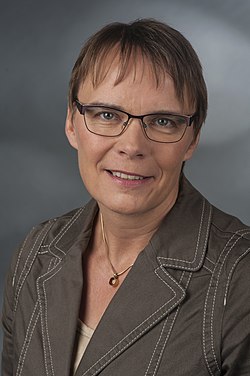
Katharina Fegebank
Katharina Fegebank (born 27 February 1977 in Bad Oldesloe) is a German politician of Alliance 90/The Greens and, since 2015…
- Facts0
- Drivers0
- Indicators0
Katharina Fegebank (born 27 February 1977 in Bad Oldesloe) is a German politician of Alliance 90/The Greens and, since 2015…
Katharina Fegebank (born 27 February 1977 in Bad Oldesloe) is a German politician of Alliance 90/The Greens and, since 2015, Second Mayor (Zweite Bürgermeisterin) of the Free and Hanseatic City of Hamburg. Since 7 May 2025 she has headed the Authority for the Environment, Climate, Energy and Agriculture. From 2015 to 2020 she was senator for science, research and equality, and from 2020 until May 2025 that department also covered the city's boroughs. She has sat in the German Bundesrat for Hamburg since 28 April 2015.
She passed the Abitur in 1996 and studied political science, English and public law at the University of Freiburg, taking a magister artium. In 2000 she was a youth consultant at the United Nations in New York, and in 2002–03 she completed a Master of European Studies in Berlin. She joined the Greens in 2004, worked until 2007 as an adviser on migration and integration for the party's group in the Hamburg Parliament, and from 2007 to 2013 was a staff member in the presidential office of Leuphana University of Lüneburg. She chaired the Hamburg Greens from 2008 to 2015 and was a member of the Bürgerschaft from 2011 to 2015.
At the state election of 15 February 2015 the Social Democratic Party of Germany, led by Olaf Scholz, remained the largest party with 45.6 percent of the vote but lost its majority in the 121-seat Bürgerschaft; the Greens won 12.3 percent and 15 seats. Fegebank, then the Hamburg Green chair, asked a members' assembly to accept a coalition agreement that dropped demands such as a city tram, a congestion charge and a political solution for Lampedusa refugees, and that accepted the deepening of the Elbe. She called the text a solid working basis rather than a trophy, and the party agreed to enter government, with three Senate seats at stake. She took office that year as Second Mayor and science senator.
When Scholz left the city government in March 2018 to become federal finance minister, she conducted the Senate's business only in an acting capacity. On 28 March 2018 the Bürgerschaft elected Peter Tschentscher, until then finance senator, as First Mayor with 71 of 121 votes. At the election of 23 February 2020 the Greens rose by 11.9 points to 24.2 percent and 33 of 123 seats, second behind the SPD on 39.2 percent, and the red-green coalition continued. On 2 March 2025 both parties lost 5.7 points: the SPD fell to 33.5 percent and 45 seats, the Greens to 18.5 percent and 25 seats, and the CDU, with 19.8 percent and 26 seats, moved into second place. Turnout was 67.6 percent. Fegebank, the Greens' lead candidate, said she would hold Tschentscher to continuing the coalition, which she described as a successful model for the city; together the two parties still held 70 of 121 seats. In the Senate constituted on 7 May 2025 she remained Second Mayor and moved from the science authority to the environment portfolio.
Katharina Fegebank was born on 27 February 1977 in Bad Oldesloe, the seat of the Stormarn district in Schleswig-Holstein, and grew up in Bargteheide, in the same district. The Bundesrat lists her as Evangelical Lutheran. She is the daughter of the teachers Fritz and Jutta Fegebank and has two younger brothers.
Until his retirement Fritz taught Latin, history and philosophy at the Gymnasium Buckhorn in Hamburg, where he had also coordinated the upper school. Jutta, also a Latin teacher, left the classroom while the three children were young and later returned; none of the children became teachers. Fegebank has described a politically marked, sheltered home in which she and her brothers were raised with Christian values—mercy, love of one's neighbour, justice and a readiness to forgive—although belief itself was not a dominant subject. She has recalled children's church, confirmation classes and Christmas services in Bargteheide's old brick church, and in 2021 said that her parents still lived in the town. In 1996 she took the Abitur at the Kreisgymnasium Bargteheide; the Hamburger Abendblatt later described the result as an Einser-Abitur, in the top grade band.
In 1996–97 she worked as a teacher and care assistant at Rickmansworth School, which the Senate biography places in London. A 2014 profile reported that the year convinced her she wanted work with a social effect, but not a career inside the school system.
From 1997 to 2002 she studied political science, English and public law at the University of Freiburg and graduated as a Magistra Artium. She volunteered with AIESEC, arranging exchanges for students from abroad, and in 2000 spent about half a year as a Youth Consultant at the United Nations Secretariat's Department for Economic and Social Affairs in New York City. That year, aged 23, she also interned in the planning staff of Schleswig-Holstein's minister-president Heide Simonis of the Social Democratic Party, and soon afterwards with Alliance 90/The Greens in the Bundestag. Profiles record a further internship at the German embassy in Ankara and a placement on the Stormarn edition of the Hamburger Abendblatt. From 2002 to 2003 she completed a postgraduate Master of European Studies at the Zentrum für Staatswissenschaften und Staatspraxis in Berlin.
An internship at the Institute for European Politics in Berlin became her first permanent post. From 2003 to 2004 she was a project manager and research assistant there, responsible for Slovakia and Bosnia and Herzegovina; she has said she carried 13 projects and workshops in six months. She has described standing with local representatives in bombed-out Sarajevo, and being told that people in peaceful Germany did not know how well off they were, as the experience that led her into politics. She returned to Hamburg and joined the Greens in 2004.
From 2004 to 2007, before she held elective office, she was a research officer on migration and integration policy for the GAL group in the Hamburg Parliament; the GAL (Grün-Alternative Liste) was then the Hamburg organisation of the Greens. In 2006–07 she was also deputy managing director of the integration centre Interkulturelle Begegnungsstätte St. Pauli. From 2007 to 2013 she was a member of the academic staff in the executive (Präsidium) of Leuphana University of Lüneburg, a post she later said she kept in order to remain financially independent and then resigned so that she could campaign without a second income.
Katharina Fegebank joined Alliance 90/The Greens in 2004, when the Hamburg association still used the additional name Grün-Alternative Liste (GAL). From 2005 to 2008 she was an assessor (Beisitzerin) on the state executive.
On 22 June 2008 a state members' assembly elected her chair and Anjes Tjarks deputy, replacing Anja Hajduk and Jens Kerstan. Hajduk had become senator for urban development and the environment on 7 May in the coalition of the GAL and the Christian Democratic Union, and Kerstan had taken the leadership of the group in the Hamburg Parliament. Die Welt and the taz called the pair, then 31 and 27, the youngest leadership in the association's history. She said the coalition had been right and spoke of a "green stamp" on the city, but insisted the executive must not become an appendage of the Senate. Of three challengers, former Bürgerschaft member Peter Zamori received 13 of 123 valid votes. The taz reported that she and Tjarks each took more than 100 of about 130 votes.
On 29 October 2011, with the GAL back in opposition, members re-elected her without a serious opponent, but with only 145 of 213 valid votes, about 68 percent—a result the Hamburger Abendblatt called a rebuke after the coalition the party itself had ended. Manuel Sarrazin became deputy with the same share, 129 of 189 valid votes.
On 22 April 2012, 120 of 161 members voted to drop the GAL suffix, with 37 against and four abstentions, clearing the required two-thirds majority. Hamburg was the last state association still using a divergent name; the formal name was already Bündnis 90/Die Grünen, and the short name became "Grüne". Fegebank said the organisation was a party, not a list assembled for elections. Antje Möller, the group's parliamentary business manager, argued for a debate about profile rather than the name.
At the beginning of November 2013 she was confirmed, again unopposed, with 89.2 percent, which Die Welt called her best result in five years as chair; Sarrazin was re-elected deputy with 88.3 percent. She said the absolute majority of Olaf Scholz and the Social Democratic Party had to be broken in 2015. In April 2015, as members backed a coalition with the SPD, she declined to stand again. The incompatibility rule had been abolished, but she called holding both offices poor style: in government, she said, the executive had to watch the Senate.
At the election of 20 February 2011 the GAL won 11.2 percent of the state vote and 14 of 121 seats, 12 of them in the constituencies. Fegebank was elected in constituency 10, Fuhlsbüttel – Alsterdorf – Langenhorn; the official final result records 8,137 votes for her, and in that district the GAL took 12.1 percent of the constituency votes and one seat. The Bürgerschaft of the 20th legislative period met on 7 March 2011.
Until 2015 she was the Green group's spokesperson for social affairs, international affairs and Europe, and chaired the committee on social affairs, labour and integration. In November 2012 a party congress backed her call for an "enabling social policy"—against child poverty, and for childcare, a state minimum wage, housing and integration—to be financed partly by a higher real-estate transfer tax, inside the debt brake.
Her exercise of the seat ended when she entered the Senate in April 2015. Article 39 of the Hamburg constitution provides that senators may not exercise a Bürgerschaft mandate and that the mandate rests while they hold office.
For the Bundestag election of 27 September 2009 the state list ran Krista Sager, Sarrazin and then Fegebank, a place Die Welt treated as hopeless unless Sager won a constituency. She was also the direct candidate in Hamburg-Altona (constituency 20), where the GAL received 17,799 first votes, 13.8 percent. Scholz won the seat for the SPD with 46,522 votes (36.0 percent), ahead of the CDU on 38,969 (30.2 percent). Hamburg's 138,454 Green second votes produced two list seats, so third place did not enter.
For 2013 the Hamburg-Mitte assembly chose her unanimously as direct candidate, and she was again third on the state list. On 22 September, in constituency 18, the Greens received 19,943 first votes (12.0 percent), 4.2 points below the comparable 2009 share. Johannes Kahrs won the seat for the SPD with 64,997 votes (39.2 percent); the CDU received 46,753 (28.2 percent). Hajduk and Sarrazin took the two Hamburg Green list seats, and Fegebank was not elected.
The Hamburg state election on 15 February 2015 used the city's open-list system: each voter has five votes for a state list and five for candidates in a multi-member constituency, and state-list votes set the proportional totals for parties above five percent. Turnout was 56.5 percent. Of 121 seats in the Hamburg Parliament (Bürgerschaft), the Social Democratic Party of Germany (SPD) won 45.6 percent and 58 seats, the Christian Democratic Union of Germany (CDU) 15.9 percent and 20, Alliance 90/The Greens 12.3 percent and 15, Die Linke 8.5 percent and 11, the Free Democratic Party (FDP) 7.4 percent and 9, and the Alternative for Germany (AfD) 6.1 percent and 8. The SPD, whose First Mayor was Olaf Scholz, no longer had a majority on its own.
Fegebank, then the Greens' state chair, and Jens Kerstan, leader of their parliamentary group, were the party's joint lead candidates. In the four-member constituency Fuhlsbüttel–Alsterdorf–Langenhorn (Wahlkreis 10) she was returned on the constituency list with 16,843 personal votes.
The Monday after the vote, Scholz offered the two lead candidates coalition talks without a prior exploratory round. In April the parties agreed a Senate in which the SPD would name eight senators and the Greens three: Fegebank as Second Mayor and head of science, research and equality; Kerstan for environment and energy; and Till Steffen returning to justice. The Greens accepted that deepening of the Elbe would proceed if the courts allowed it. A Green members' assembly approved the contract by a two-thirds majority. On 15 April 2015 the Bürgerschaft re-elected Scholz with 75 of 120 votes cast, 44 against and one abstention, and then confirmed the Senate.
Fegebank was the Greens' sole lead candidate on 23 February 2020. A members' meeting in Wandsbek on 9 November 2019 put her at the head of the list with 96.96 percent, and she said again that she wanted to become First Mayor. Through the deputy Joachim Seeler, the SPD had indicated that it would not serve as junior partner: its line was to be the largest party, with Peter Tschentscher as mayor, or to go into opposition.
Turnout was 63.0 percent. On the state list the SPD won 39.2 percent and 54 seats, the Greens 24.2 percent and 33, the CDU 11.2 percent and 15 — its worst Hamburg result to that point — Die Linke 9.1 percent and 13, and the AfD 5.3 percent and 7. The FDP, at 4.97 percent, missed the five-percent threshold but still won one constituency seat, so the Bürgerschaft had 123 members rather than the statutory 121. SPD and Greens together held 87 seats, a two-thirds majority. Fegebank was again elected in Wahlkreis 10, with 45,300 personal votes.
She called the outcome "Weiter Rot-Grün mit deutlich stärkeren Grünen" and told Der Spiegel that it was a pity not to have become the first Green First Mayor, while arguing that a direct contest with the SPD had produced the gain. The Greens had roughly doubled their 2015 share and remained the junior partner. On 10 June 2020, after the pandemic had delayed talks, the Bürgerschaft re-elected Tschentscher with all 87 red-green votes, against 34 and with two abstentions. The Senate comprised the First Mayor, seven SPD senators and four Green senators. Fegebank stayed Second Mayor, again responsible for science and equality.
She was sole lead candidate again for 2 March 2025. On 9 November 2024 a members' assembly elected her to first place with 306 votes in favour, 11 against and five abstentions, about 95 percent, and with no opponent. She said, "Ich bin bereit, Erste Bürgermeisterin dieser Stadt zu werden." The Greens again aimed to overtake the SPD. Environment senator Jens Kerstan did not seek a list place and said he would leave after the election. The CDU's lead candidate was Dennis Thering.
Turnout was 67.6 percent. State-list shares were SPD 33.5 percent (45 seats), CDU 19.8 percent (26), Greens 18.5 percent (25), Die Linke 11.2 percent (15) and AfD 7.5 percent (10), in a house of 121. The FDP fell to 2.3 percent and won no seat; Volt (3.2 percent) and the Bündnis Sahra Wagenknecht (1.8 percent) also stayed out. SPD and Greens each lost 5.7 points on 2020, while the CDU gained 8.6 and moved into second place. The red-green total was 70 seats, against 61 for a majority; SPD and CDU together would have had 71. Fegebank again won a seat in Wahlkreis 10, with 45,193 personal votes.
Tschentscher said he preferred to continue with the Greens but would also talk to the CDU. On 24 April 2025 the two parties presented a 148-page agreement, "Hamburg vereint – mit Herz und Verstand". Fegebank was to remain Second Mayor but move to the environment authority, succeeding Kerstan; Maryam Blumenthal was to take science. On 7 May the Bürgerschaft re-elected Tschentscher with 71 of 119 votes cast, 47 against and one abstention, so at least one vote came from outside the coalition. The Senate was confirmed with 68 votes. Besides the mayoralty the SPD held seven Senate posts and the Greens four. Fegebank's bid to lead the city had again ended in the second office.
The Second Mayor (Zweite Bürgermeisterin or Zweiter Bürgermeister) of the Free and Hanseatic City of Hamburg is the deputy of the First Mayor in the Senate, the city-state's government. Under the state constitution the First Mayor, as president of the Senate, and the senators form that body, which directs and supervises the administration. The Bürgerschaft elects the First Mayor by a majority of its statutory membership. The First Mayor appoints and dismisses the deputy and the other senators and asks the Bürgerschaft to confirm them, jointly or separately, by secret ballot. The Senate meets in the Ratsstube of Hamburg City Hall.
The First Mayor conducts Senate business, sets the guidelines of policy and answers for them to the Bürgerschaft; senators answer for individual authorities under a distribution of business the Senate adopts, which decides by majority and represents Hamburg toward the federation, the other Länder and abroad.
Katharina Fegebank, of Alliance 90/The Greens, has held it since the Social Democratic–Green senate under Olaf Scholz. On 15 April 2015 the Bürgerschaft re-elected Scholz with 75 of 120 votes and confirmed the senate, including Fegebank as Second Mayor and senator for science, research and equality, by 73 votes to 46, with one abstention. On 10 June 2020 Peter Tschentscher was elected First Mayor and the Bürgerschaft confirmed a senate in which she remained Second Mayor, with the boroughs added to science, research and equality. On 7 May 2025 Tschentscher was re-elected with 71 votes to 47, and one abstention, among 119 ballots; the slate that kept her as Second Mayor and made her head of the authority for the environment, climate, energy and agriculture received 68 votes.
The deputy stands in when the First Mayor is absent. Fegebank described that as routine, including in November 2015, when former chancellor Helmut Schmidt died during Scholz's visit to China. In the Bürgerschaft the First Mayor's place on the senate bench stays empty during such representation, because the Second Mayor keeps a seat of her own.
Scholz resigned to become federal finance minister. His last Senate meeting was on 13 March 2018; he was sworn into the federal cabinet the next day. A senator's term ends when the First Mayor's office ends, and the constitution then requires the Senate to carry on business until a successor is elected. From 14 to 28 March Fegebank, still Second Mayor and science senator, headed that caretaker senate. She cancelled a holiday in Singapore so the Senate would not be leaderless, and said the Senate would spend the fortnight as "a strong team" arranging the handover to Tschentscher. She would chair meetings and take the First Mayor's appointments, she said, but she had no power to set policy guidelines, to appoint or dismiss senators, or to put a question of confidence. The attention, she added, came "because I am now the first woman at the head of the Senate", and it encouraged the idea of a woman leading the city; the Hamburger Abendblatt reported the same first, while stressing that she did not become First Mayor. She called the succession an ordinary coalition procedure, not a break to be "handled like a stroll".
On 28 March 2018 the Bürgerschaft elected Tschentscher with 71 of 121 votes, against 45 and with two abstentions. He has been First Mayor since that day; Fegebank's tenure as Second Mayor and science senator ran without a break from 2015 to 2020.
From 2015 until 7 May 2025, Katharina Fegebank of Alliance 90/The Greens was second mayor of Hamburg and head of the authority for science, research and equality; from 2020 the boroughs were added. On 7 May 2025 she moved to the environment authority, and Maryam Blumenthal became senator for science, research, equality and the boroughs.
In June 2016 Hamburg threatened to block the Excellence Strategy, successor to the Excellence Initiative. Fegebank told the Tagesspiegel that equal chances were still missing and a two-class system could result. Unanimity was required. On the morning of the 16 June meeting with Chancellor Angela Merkel, Der Spiegel reported that a Hamburg no—backed, she said, by First Mayor Olaf Scholz of the Social Democratic Party of Germany—would stop a programme costed at 533 million euros a year, about three quarters federal. She argued that an excellence university would lose the title only if it was weaker after seven years of extra money, so newcomers could barely enter. The council of the University of Hamburg distanced itself from the veto; she said the university already had a strong chance and that she would not drop the demand. Student groups and the Education and Science Union wanted the elite programme abandoned.
The heads of government adopted the agreement the same day. It reserved about 148 million euros a year for eleven excellence-university awards and allowed four further cases from 2026, with extra money if fewer than four incumbents dropped out. On 19 July 2019 the Excellence Commission, after a cluster competition run by the German Research Foundation and an institutional review by the German Science and Humanities Council, chose the University of Hamburg among ten universities and the Berlin consortium. All four of its cluster proposals had been accepted in autumn 2018, the minimum for applying.
Guest chairs produced two further disputes. In winter 2016/17 Farid Esack, chair of the South African Boycott, Divestment and Sanctions campaign, taught at the Academy of World Religions. Fegebank told Die Welt she would not accept antisemitism or boycotts of Israel, and that she had asked how the faculty—not her authority—had made the appointment. In 2022 the art school gave DAAD guest professorships to Reza Afisina and Iswanto Hartono of ruangrupa, directors of documenta fifteen, overshadowed by works with antisemitic imagery. The school had applied in January 2022 and refused to withdraw them. Fegebank said the allegations had to be cleared up before they taught in Hamburg.
The largest site was Science City Hamburg Bahrenfeld, joining laboratories, teaching and housing around DESY in Bahrenfeld, where parts of the University of Hamburg, the Max Planck Society and other institutes already sat. At the first open day, on 1 June 2024, Fegebank called it a main future project for research and urban development. NDR cited plans for 2,500 homes and open space by 2040.
Exterior of the PETRA III Max von Laue experimental hall at DESY in Hamburg.
The quarter was planned at about 125 hectares. Presenting the university's HAFUN physics building, Fegebank said she wanted a landmark open to residents as well as researchers. The planned S-Bahn line 31 was rerouted because vibration would have disturbed sensitive instruments.
The proposed centrepiece was PETRA IV, a rebuild of the PETRA III X-ray source. A September 2023 motion by the SPD and Green groups put the cost, at 2022 prices, at about 1.5 billion euros, of which 1.37 billion would be a grant, and asked the Senate to lock in Hamburg's 10 percent and to press Berlin so main construction could start by 2026. On 27 September the parliament unanimously backed that share. DESY put the total at 1.54 billion euros, including 170 million of its own funds; the federal share was still open. Fegebank called the source a step for the district and for technological sovereignty.
On 22 October 2024 the Senate adopted amendments to the Hamburg Higher Education Act. The science authority said women were 53 percent of students at the city's universities but 31.6 percent of professors, above the national figure, and that the share fell at each career step. Nationally, women were 29 percent of about 51,900 full-time professors at the end of 2023, against 52 percent of new students in winter 2023/24 and 53 percent of 2023 graduates, excluding doctorates.
The Bürgerschaft passed the law on 19 February 2025; it was promulgated on 28 February. Women must be at least 40 percent of appointment committees, including among the professors, unless the presidency and the equality officer allow an exception, and at least 40 percent of voting members of presidential search committees. Equally qualified women are to be preferred where they are under-represented among professors. Universities must keep equality plans while women are a minority of academic and artistic staff, and must set rules against discrimination and sexualised violence. Equality officers, elected for three years, receive staff scaled to the institution and speaking rights on search committees.
There was no new constitutional reform of the seven boroughs while they were in her portfolio. The visible argument was about citizen offices. On 6 December 2024 NDR reported that a Hamburg Service appointment for residents' business took eleven days, inside a two-week target that Anja Quast (SPD) called a success, but that some outer sites, including Rahlstedt, had been cut from two shifts to one. André Trepoll (CDU) said outer-borough services should be strengthened, not reduced while large central offices opened in the inner city.
On 7 May 2025 the Hamburg Parliament re-elected Peter Tschentscher of the Social Democratic Party of Germany and confirmed the Third Tschentscher senate. Katharina Fegebank of Alliance 90/The Greens remained Second Mayor but left science, which she had held since 2015, to head the Authority for the Environment, Climate, Energy and Agriculture. Maryam Blumenthal became senator for science, research and equality, and the districts moved to the SPD-led finance department.
She succeeded Jens Kerstan, environment senator since 2015. In October 2024 he said he would not stand again and would leave after the election. NDR reported that, after cancer, he saw further aims as private; he had been treated for early-stage cancer in 2022. Fegebank said she wanted to give Hamburg “wieder Lust auf Klimaschutz”.
The April 2025 coalition agreement kept a 70 percent CO2 cut by 2030 against 1990 and full neutrality in 2045, and said the partners wanted neutrality sooner if possible. A 2040 date, it stated, still required unmet federal conditions: CO2-storage sites and rules, an electricity mix of 80 percent renewables, a hydrogen ramp-up and a higher renovation rate.
On 12 October 2025 the “Hamburger Zukunftsentscheid”, a popular referendum, asked voters to adopt the draft Gesetz für besseren Klimaschutz. It moved net neutrality from 2045 to 2040, set annual CO2 ceilings and required catch-up programmes if they were missed. The final result, issued on 4 November 2025, was 304,063 valid yes votes to 267,299 no votes, about 53 percent, above the quorum of 262,609 yes votes. Turnout across the day’s two referendums was 43.7 percent; a basic-income pilot failed.
A city study had judged 2040 possible only if gas and oil boilers were replaced, the gas grid closed, renovation sped up, car traffic cut and industry switched to hydrogen. Fegebank said there was no case for activism because the path to 2030 was unchanged, “aber wir müssen schneller und präziser werden.” Tschentscher said implementation was legally required, including affordability, but still depended on the federal government. Christian Democratic Union leader Dennis Thering warned of higher rents, and industry chairman Andreas Pfannenberg said plants and jobs could leave. Luisa Neubauer welcomed the vote. Die Linke alone in parliament had backed the bill; Fridays for Future and the Naturschutzbund Deutschland supported the campaign.
In July 2026 Fegebank visited a rewetted fen of about 34 hectares at Neuland, €1.5 million of compensation for land taken for the Mercedes plant at Moorburg. A plastic sheet-pile wall about 700 metres long and a pump replaced failed rewetting from 2005–06. Lapwing, redshank and moor frog were reported back; BUND and NABU said the work had come much too late.
The coalition agreement treats further rewetting of peatland as a CO2 sink. For new homes it replaced the EH 40 standard with EH 55 and ruled out stricter renovation rules, aiming instead to cut the stock’s final energy use 37 percent between 2020 and 2045.
On 16 June 2026 the Senate adopted a non-binding heat plan. By 2040, 57 percent of demand would come from central networks, chiefly district heating, and 43 percent — 78 percent of buildings — from decentralised supply, with heat pumps as what Fegebank called the means of choice. Fossil heat was still 83 percent, and about eight in ten households used oil or gas; the plan aims at 57 percent by 2030 and 30 percent by 2035. The coalition agreement sets an end to coal in heat by 2030.
On 1 December 2025 work began on an electrolyser at the former coal plant in Moorburg. About 10,000 tonnes a year are due from 2027; no buyers were signed, and Pfannenberg said green hydrogen was not yet competitive. The coalition agreement treats that plant as the basis of a hydrogen economy for industry. In August 2025 Fegebank said cuts alone would miss the targets and that CO2 should be stored under the North Sea by carbon capture and storage, not instead of reductions. BUND said that made emissions look harmless; Stephan Jersch of Die Linke called it a declaration of bankruptcy; CDU spokesman Sandro Kappe said 2040 was then unrealistic. A housing association called the line pragmatic.
In August 2016, as Hamburg's equal-opportunities senator, Katharina Fegebank of Alliance 90/The Greens called a CDU/CSU debate on restricting the burqa "Sommerloch-Populismus". Full-face veiling, she said, "raubt Frauen ihre öffentliche Identität", and anyone serious about women's rights could not approve of it; but wearers were vanishingly few, the debate had nothing to do with counter-terrorism, and she would not let that critique be harnessed to right-wing populism. Ties Rabe of the Social Democratic Party of Germany said schools already applied a ban. In March 2017 the SPD and Greens in the Hamburg Parliament rejected a Christian Democratic Union bill for a statutory ban as unnecessary.
That practice failed in court. On 29 January 2020 the Higher Administrative Court (1 Bs 6/20) held that the School Act gave no basis for ordering a 16-year-old vocational student to remove a niqab. Fegebank, then Second Mayor, said "Burka und Nikab sind für mich Unterdrückungssymbole" and that teaching required seeing the other person's face, so the law should change quickly. The Hamburg Greens backed that change. The CDU, the Free Democratic Party and Alternative for Germany had already demanded a classroom ban, and the CDU noted that red-green had blocked one in 2017. Die Linke's Sabine Boeddinghaus said a ban would cut off dialogue; a critic told Fegebank oppression was not fought "auf dem Rücken von Frauen"; and Greens in Schleswig-Holstein opposed a university ban.
On 14 May 2024 the SPD and Green groups tabled Drucksache 22/15162, adding to section 28(2) a face-covering ban at school, with narrow exceptions, and citing the 2020 ruling and Article 7 of the Basic Law. On 15 May it passed with SPD, Green, CDU and AfD votes; Die Linke voted no. Insa Tietjen warned of "gravierende Folgen". An AfD bid to ban the hijab too failed, and the CDU recalled 2017. The Schura told NDR that freedom of religion protected the practice and that the very small number of pupils made a statute disproportionate. The ban took effect in early June; a hijab leaving the face free stayed allowed.
Fegebank has called high rents Hamburg's main social question while rejecting a Berlin-style cap. In February 2020 she said, "Von einem Mietendeckel wie in Berlin halten wir hier überhaupt nichts": a cap would build no flats, whereas limits on rises after renovation or reletting, and more social housing, were the right tools. In 2025 she said building had not cheapened rents, and proposed a reporting office for excessive rents, a tighter Mietpreisbremse and more social housing than the one-third mix.
On integration she has paired belonging with constitutional limits. In May 2018, answering former Green Kurt Edler, she said a liberal society needed "Spielregeln": invoking Cem Özdemir, no Quran stood above the Basic Law; some young migrants brought a view of women that could not be accepted; and antisemitism, from the right or from people of Arab origin, was unacceptable. Language, schooling and work, she said, were how people joined. After the Hamas attack of 7 October 2023 she said right-wing, Islamic and left-wing antisemitism all had to be named. In 2022 she called any further role for the Islamic Centre Hamburg, treated by domestic intelligence as an outpost of Iran, in the city's contracts with Muslim communities "nicht mehr denkbar".
As Second Mayor she both backed and criticised the 2017 G20 Hamburg summit. In August 2016 she said elected leaders had to meet and the summit had to stay "so stadtverträglich wie möglich". During the July 2017 riots she and fellow Green senators wrote that the summit no longer fitted the city and that the lesson was "Speckt G20 ab", condemning those who came "um zu verletzen und zu zerstören". Die Tageszeitung reported that leading Greens then avoided questions: under Olaf Scholz they had carried the summit while backing protest camps.
Katharina Fegebank has been a member of the German Bundesrat for the Free and Hanseatic City of Hamburg since 28 April 2015. She sits for Alliance 90/The Greens and is one of the state's three voting members, with First Mayor Peter Tschentscher and Finance Senator Andreas Dressel, both of the Social Democratic Party of Germany; Hamburg casts three votes. The Bundesrat lists her as a member of the Committee on Agricultural Policy and Consumer Protection and of the Committee on the Environment, Nature Conservation and Nuclear Safety, and as a deputy member of the Mediation Committee and of the Joint Committee of the Bundestag and the Bundesrat. Those entries stand beside her office, held since 7 May 2025, as Second Mayor and senator for the environment, climate, energy and agriculture. From 2015 to 2020 she was senator for science, research and equality, and from 2020 to 2025 that portfolio also covered the boroughs.
The Bundestag's roll of the 16th Federal Convention, which met on 12 February 2017, lists her as a Hamburg delegate of the Greens rather than as a member of the Bundestag. The roll of the 17th Federal Convention of 13 February 2022 does the same, and a Bundestag list of nominees sent by state parliaments who were not themselves members of a Land parliament names her among Hamburg's delegates as a Green senator. The 16th convention elected Frank-Walter Steinmeier federal president, and the 17th re-elected him.
Before formal coalition talks, the Hamburger Abendblatt reported on 5 October 2021 that Fegebank and Anja Hajduk were in the Greens' exploratory team for a possible Jamaica or traffic-light coalition. Once negotiations among the SPD, the Greens and the Free Democratic Party were under way, tagesschau.de and the Dresdner Neueste Nachrichten named her, then Hamburg's science senator, as one of three leaders of the working group on innovation, science, higher education and research, with Thomas Losse-Müller for the SPD and Lydia Hüskens for the FDP. The 22 specialist groups were to finish by 18:00 on 10 November 2021 and submit position papers; a main negotiating group was then to settle open points, with a coalition agreement expected by the end of November.
As science senator she chaired the board of trustees (Kuratorium) of the University Medical Center Hamburg-Eppendorf. A Senate press release of 25 May 2018 identifies her as chair, and the city's 2024 participation report lists that chairmanship as running until 3 June 2025, when Maryam Blumenthal, the succeeding science senator, took it over.
The Aby Warburg Foundation states that the chair of its board is the presiding senator of Hamburg's authority for science and research, the portfolio Fegebank held from 2015 until 7 May 2025. An archived membership list of the Helmholtz Association, captured on 14 January 2018, names her as an ex officio member of the association's senate in her capacity as Hamburg's senator for science, research and equality. The senate list current as of September 2026 names Blumenthal, holder of the same Hamburg science office, among the ex officio members.
Fegebank grew up in Bargteheide, in Schleswig-Holstein, where both of her parents were teachers and, as of 2021, still lived; she has two younger brothers. The Bundesrat biography lists her affiliation as Evangelical Lutheran. She was confirmed in the church at Bargteheide and has said that faith was not a dominant subject at home, although she and her brothers were raised with Christian values.
Since 2015 she has been the partner of the entrepreneur Mathias Wolff. Their twin daughters were born on the morning of 16 November 2018, ahead of a due date in early December. In 2019 and 2023 the couple and the twins were reported living in a townhouse in Eilbek, a quarter of Hamburg.
On the night of 2–3 July 2017, a few days before the 2017 G20 Hamburg summit, neighbors of Fegebank's house in Eilbek called the police around 3 a.m. after hearing bangs. Officers found that several jam jars filled with yellow paint had been thrown against the facade. A search with several patrol cars did not find the attackers, and that morning police said they could not yet say whether the attack was linked to the summit. Later that day a text posted under the name "allez" on an online forum claimed responsibility. It alleged that she had been involved in summit planning since 2015, had expressed confidence in the interior senator and, like her party, Alliance 90/The Greens, supported bans on protest camps, and it announced further actions.
During the night of 7–8 July 2019, the second anniversary of the summit, unknown people threw jam jars of black and white paint at the Eilbek townhouse where Fegebank lived with Wolff and their infant daughters; a neighboring house was also hit. About 20 patrol cars were sent around 2:30 a.m. Several people near the scene were checked, and no one was arrested. No claim of responsibility had been received. Investigators told the Hamburger Abendblatt that they assumed left-wing extremists were responsible because the method matched earlier attacks that had usually been followed by claims, and the state-protection branch took the case.
On the night of 29–30 January 2023, police said, unknown persons threw glasses of red paint at the townhouse. At least four red marks from shattered glass were on the facade and a window, and a neighboring building was affected. The damage was reported shortly before 8 a.m. Police classed the attack as politically motivated. The state-protection department of the State Criminal Police Office (LKA 7) investigated a complaint against unknown persons and asked witnesses to come forward. The Abendblatt noted the resemblance to July 2019, when investigators had assumed a left-wing extremist background; the 2023 police statements did not name a suspect milieu.
The main external judgment of Fegebank's years as science senator of Hamburg is a member survey by the Deutscher Hochschulverband (DHV), not a state award: members grade only their own Land's science minister, from 1 ("the ideal appointment") to 6 ("the worst conceivable"), ministers need at least 50 ratings and 100 days in office, and the University of Bonn's Centre for Evaluation and Methods runs the poll.
Votes in late 2019 put her first for 2020, on 2.50 from 114 Hamburg ratings, 0.01 ahead of Armin Willingmann (SPD, Saxony-Anhalt), against a Land average of 3.24; comments credited the universities' finances, while others said she "acts opportunistically" and lacked assertiveness. For 2023, after voting from 7 November to 9 December 2022, she led on 2.72 from 75 ratings, ahead of Willingmann on 2.82: nearly half called her "very good" or "ideal", but some wrote that she had no university experience and little visibility.
On 17 February 2025 the DHV named her Wissenschaftsministerin des Jahres for a third time, on 2.31, just ahead of Willingmann (2.32) and Manja Schüle of Brandenburg (3.03). Of more than 33,500 members, 2,335 voted from 11 November to 13 December 2024, and the average mark was 3.28.
In June 2016 her authority blocked a draft federal-state deal on the successor to the German Universities Excellence Initiative, which needed unanimity; the office rejected a permanent "closed shop". On 2 June the council of the University of Hamburg noted "with great concern" the "considerable irritation" nationwide and said neither the council nor the university leadership had initiated the stance. FDP spokesman Wieland Schinnenburg called her "a burden on the science location Hamburg" and said the city stood "isolated"; CDU spokesman Carsten Ovens called the threatened collapse a disgrace and her record "catastrophic". On 16 June the minister-presidents agreed a seven-year review and a later entry route; she called it "a good solution".
At the 23 February 2020 election to the Bürgerschaft, Alliance 90/The Greens, led by Fegebank, took 24.2 percent of state-list votes and second place, behind the SPD on 39.2 percent. Der Spiegel wrote that she had wanted to be First Mayor and was left in the "junior role". After a court found no basis to bar a niqab in school, she backed a ban and called the burqa and niqab "symbols of oppression". Die Linke's Sabine Boeddinghaus said full veiling was "not pretty, but no reason for excitement", doubted that a ban would be lawful, and warned that a heated debate would feed the right. A critic wrote that oppression is not fought "on the backs of women"; Greens in Schleswig-Holstein opposed a full-veil ban at universities.
On 9 November 2024 she was nominated again, with about 95 percent and no opponent, and said she was "ready to become First Mayor of this city". On 2 March 2025 the Greens fell to 18.5 percent, down 5.7 points, from second to third, behind the SPD (33.5) and the CDU (19.8). She did not become First Mayor; Peter Tschentscher stayed and the coalition continued. She moved from science to environment, climate, energy and agriculture after Jens Kerstan left on health grounds, a switch reported as unexpected. The coalition text kept neutrality in 2045 and also named 2040; Annika Rittmann of Fridays for Future called that start "a retreat". A referendum on 12 October 2025 made 2040 binding, with 53.2 percent of votes cast, and CDU floor leader Dennis Thering said the course would harm the city "in many respects" and called the hope of a failed quorum a "costly fallacy".
Ranked by shared high-impact facts, then explicit ties, then shared drivers.
 Heide SimonisHeide Simonis (née SteinhardtAffiliated
 Luisa NeubauerLuisa-Marie Neubauer is a German climate activistAffiliated
 Olaf ScholzOlaf Scholz was Chancellor of Germany from December 2021…Affiliated
 Anja HajdukAnja Hajduk (born 8 June 1963 in Duisburg) is a German…Affiliated
 Angela MerkelAngela Merkel is a German physicist and CDU politician who…Affiliated
How the record is sourced and how the score is derived.
The score is formula-derived (Factrail formula v1, version 1.0.0), not an editorial verdict. Read the methodology.
By the Factrail desk · Method: how we source and score · Last reviewed
Dispute a fact on this pageNamed here, or represent someone who is? Request a right of reply.
People and organizations as listed in the Related section of this page; facts, drivers and the pages that name it as listed in the blocks here. Counts, not a rating.