
Matthias Helferich
Matthias Helferich (born 14 October 1988 in Dortmund) is a German lawyer and politician of the Alternative for Germany (AfD).
- Facts0
- Drivers0
- Indicators0
Matthias Helferich (born 14 October 1988 in Dortmund) is a German lawyer and politician of the Alternative for Germany (AfD).
Matthias Helferich (born 14 October 1988 in Dortmund) is a German lawyer and politician of the Alternative for Germany (AfD). He has sat in the Bundestag since the 2021 federal election, when he entered as a new member from North Rhine-Westphalia, and was returned in 2025 on the state list, on which the state returning officer recorded him in sixth place, while standing in the Dortmund II constituency (Wahlkreis 142). Alongside the mandate he practises as a lawyer in Dortmund and is a member of the city council and of the Scharnhorst district council (Bezirksvertretung).
The biography he filed with the Bundestag states that he is Protestant and unmarried. After his Abitur he performed military service with the Wachbataillon in Siegburg, studied law in Bonn, and in 2015 passed the first state law examination at the Higher Regional Court in Hamm. He then worked as a research assistant on a commercial-law chair in Bochum and as a lecturer in constitutional and European law, began his legal traineeship at the Dortmund regional court in 2018, with placements in Düsseldorf and Klagenfurt, and was admitted to the bar in 2020.
In the 20th Bundestag he sat without a parliamentary group. At the AfD group's constitutive meeting on 29 September 2021 he left the room; outgoing group chairman Alexander Gauland said Helferich had decided, after a long argument, not to belong to the group. Helferich did not dispute that in older chats he had called himself the "friendly face of the NS" (National Socialism) and a "democratic Freisler", referring to Roland Freisler, president of the Nazi People's Court; he later described the remarks as parody. The federal executive had already imposed a ban on his holding party office during that campaign.
On 25 February 2025 the new AfD Bundestag group admitted him, together with Maximilian Krah, without any member asking for a debate on the two names. Tagesschau reported that an expulsion case was still open and that he was accused of threatening party colleagues and of demanding the deportation of German citizens with a migration background. In the 21st Bundestag he is an ordinary member of the Committee on Culture and Media.
On 5 July 2025 the AfD's North Rhine-Westphalia arbitration court excluded him at first instance. Tagesschau, citing WDR, reported that the court treated several past statements as evidence of völkisch tendencies; Helferich denied having written emails that Der Spiegel had described in May 2025 and had not sued the magazine. The same report said his statements also figured prominently in the Federal Office for the Protection of the Constitution's assessment of the AfD. On 26 June 2026 the party's federal arbitration court set the expulsion aside. Welt, which said it had the judgment, reported that the court instead barred him from party offices for six months and held expulsion disproportionate. Helferich told Welt that the state ruling had been arbitrary and that the state executive had used the case to try to remove an internal rival.
Matthias Helferich was born on 14 October 1988 in Dortmund, in North Rhine-Westphalia. The Bundestag biography, which the parliament notes is drawn from members’ own statements, records him as Protestant and unmarried. On his personal website he places the birth more narrowly in the Dortmund district of Hombruch. Those accounts do not name his parents or his school. They state only that he completed the Abitur, the general qualification for university, before military service.
After the Abitur he performed Wehrdienst with the Wachbataillon of the Bundeswehr in Siegburg. A professional profile he later maintained dates the start of his law studies to April 2009, so the service fell before that month. Conscription was still in force: on 24 March 2011 the Bundestag voted to suspend compulsory military service from 1 July 2011 and to open a voluntary term of six to 23 months to men and women, while leaving Article 12a of the Basic Law, the constitutional basis for conscription in a state of tension or defense, unchanged. The Wachbataillon is a Bundeswehr infantry unit under the Feldjäger command, charged both with ceremonial protocol—such as receiving foreign state guests—and with protecting seats of the federal government and the federal president if that constitutional situation arises. The unit is now a Berlin capital formation of about 1,100 soldiers at the Julius-Leber-Kaserne; the parliamentary biography places Helferich’s service with it in Siegburg.
According to that profile, he studied law at the University of Bonn from April 2009 to October 2011 and at Ruhr University Bochum from October 2011 to September 2015, with the listed focus “Unternehmen und Wettbewerb” (enterprise and competition). His website gives the same sequence, legal studies in Bonn and then Bochum, without the month-by-month dates. In 2015 he passed the first state examination in law, the erste juristische Staatsprüfung, before the Oberlandesgericht Hamm.
During the Bonn studies he joined the Bonner Burschenschaft Frankonia, which the Kölner Stadt-Anzeiger described as a fencing student corporation, a schlagende Burschenschaft. The fraternity says it has existed since 1845 as an association of active and former students of the universities in Bonn and Cologne, continuing after graduation, and that its house stands on Lennéstraße between the Hofgarten and the law faculty’s Juridicum. Its own recruitment text states that racism, sexism, and extremism have no place in the corps. Reporting in 2025, drawing on material examined by Der Spiegel, places Helferich in the fraternity in 2014–2016, years after he had moved his degree to Bochum.
The Kölner Stadt-Anzeiger wrote in March 2024 that closeness to the Alternative for Germany had apparently not been treated as a problem for his membership, and that Frankonia excluded him only after a remark of his, which the paper called a National Socialist statement, drew intense criticism in the summer of 2021. Neither Helferich nor the fraternity would discuss the exclusion procedure with the newspaper. Asked separately, Frankonia said it viewed the growing polarization of society and the strengthening of extremist voices on the political margins with concern.
Helferich studied law at the University of Bonn from April 2009 to October 2011 and at Ruhr University Bochum from October 2011 to September 2015; a XING profile in his name gives those dates and lists the Bochum emphasis as “Unternehmen und Wettbewerb” (business and competition). The Bundestag biography, which the parliament notes is supplied by members themselves, records legal study in Bonn and, in 2015, the first state examination in law (Erste juristische Staatsprüfung) at the Higher Regional Court of Hamm (Oberlandesgericht Hamm); it does not mention the move to Bochum. Study in both Bonn and Bochum is what he states on his own site, in a text online since at least March 2022, and on Abgeordnetenwatch.
The same profile lists him as a student assistant, from November 2013 to September 2015, to Johann-Christian Pielow; as a research assistant from January 2016 at Pielow’s chair, “Recht der Wirtschaft”; and, from November 2016, as a lecturer in constitutional and European law (Staats- und Europarecht) at the Studieninstitut Ruhr für kommunale Verwaltung, without an end date for the research post or the lectureship. Pielow had been appointed professor for Recht der Wirtschaft at Bochum’s faculty of economics in October 2003. The Studieninstitut is a training body for public employees, owned by the cities of Bochum, Dortmund, Hattingen, Herne, Lünen, Selm and Witten. The Bundestag text is shorter and does not name the chair or the institute: it records work as a research assistant at a commercial-law chair in Bochum and as a lecturer in constitutional and European law at an administrative academy, and it places that work before the clerkship begun in 2018. In the later self-description he uses the past tense for both jobs.
In 2018 he entered the juristischer Vorbereitungsdienst, the practical legal clerkship (Referendariat), with the Regional Court (Landgericht) in Dortmund as his training court and further stages in Düsseldorf and in Klagenfurt, Austria. He passed the second state examination in law; the published biography does not date that examination or name the examining office. On 24 September 2020 he was admitted as a Rechtsanwalt: the federal official register of lawyers records that day as both the date of admission and the date of first admission, assigns him to the Rechtsanwaltskammer Hamm, and lists a practice in Dortmund with no firm name.
In the register of members’ disclosable interests the parliament lists “Rechtsanwalt, Dortmund” as a paid activity carried on alongside the mandate and publishes no income figure for it. Abgeordnetenwatch carries the same freelance practice, first entered on 25 October 2022, for both the 2021–2025 term and the 2025–2029 term, again without an amount.
By November 2006 Matthias Helferich, from Dortmund, was state chairman of the Schüler Union in North Rhine-Westphalia, the school-students’ organization close to the Christian Democratic Union (CDU), and was active in the party and its youth wing, the Junge Union. That month the taz reported anonymous letters claiming he had told a Swedish girl she was not “reinrassig arisch” and had called outgoing Junge Union state chairman and CDU state general secretary Hendrik Wüst a “Judenschwein” at a birthday party. Helferich called this “totaler Müll,” denied that it was his worldview, cited a stay with a Jewish host family in the United States, and said witnesses could swear he had not spoken antisemitically. Junge Union state manager Dirk Kappenhagen said Helferich had not stood out in that way and blamed the Schüler Union’s inactivity; the state CDU would not comment. Helferich said he would limit himself to his Dortmund branch.
In February 2025 the Ruhr Nachrichten, citing CDU documents and witnesses, reported further allegations from about 2005 to 2007, all of which Helferich denied. The files were said to record that he called Wüst a “Judensau” in 2006; described gay men as “aidskranke Stricher” who, if they “verrecken,” were themselves to blame; shouted at the Swede Jessika Nilsson, at a Düsseldorf Schüler Union event, “Raus, raus, Ausländer raus. Du bist nicht arisch!”; called “Sieg Heil” and asked for uniforms “wie damals” at a federal meeting; and said in 2005 that, as a lifeguard, he would not save a “türkischer Junge” but would tell the parents the boy had drowned. Witnesses told the paper the accounts still held. Of the Nilsson remark, Helferich said it could at best have been irony, because she was blond and blue-eyed, and that he did not think in terms of who was “Aryan.”
One claim reached court. From the indictment at the Amtsgericht Dortmund, as the paper reported it, he was accused of demanding at the Düsseldorf meeting that the “Endlösung” be applied to Turks. The youth court acquitted him of Volksverhetzung because the alleged offense could not be established in fact. The Junge Union opened an expulsion case against the then 18-year-old in 2007 and dropped it. The same investigation reported that he left the Union in mid-July 2015, shortly before, that September, Chancellor Angela Merkel did not close the borders to people arriving mainly from Syria and Afghanistan, and that he joined the Alternative for Germany (AfD) a few months later.
Nordstadtblogger places his visible activity in the Dortmund AfD from autumn 2016 at the latest. In 2017, it reports, he spoke for the local party on panels and was named with Heiner Garbe as a direct candidate for Dortmund’s Bundestag constituencies. On 9–10 December 2017 a state congress in Kalkar elected a new North Rhine-Westphalia executive that, on the state association’s account, included him. The Dortmund AfD reported that at a further Kalkar congress in October 2019 he was elected first deputy state speaker (erster stellvertretender Sprecher) beside state speaker Rüdiger Lucassen. Nordstadtblogger still described him in 2020 as deputy state chairman, and in July 2021 the Westdeutsche Allgemeine Zeitung identified him as stellvertretender Landesvorsitzender.
That Dortmund reporting also describes contacts with the Junge Alternative (JA), then the AfD youth organization: he was photographed at a JA lecture in Arnsberg, and in early 2021 interviewed Zacharias Schalley, a JA North Rhine-Westphalia board member, for the state party. On 31 March 2025 tagesschau reported that the Federal Office for the Protection of the Constitution had classified the JA, about two years earlier, as confirmed right-wing extremist, unlike the party as a whole at that time, and that the AfD was dissolving the JA after a January 2025 congress in Riesa voted to replace the independent youth association.
At the municipal election of 13 September 2020 Helferich was elected to Dortmund city council and to the Scharnhorst district council (Bezirksvertretung). Nordstadtblogger published a photograph of him speaking at the city council’s constitutive session.
Matthias Helferich at the constitutive session of the Dortmund city council in November 2020.
For the city council the AfD took 11,547 votes (5.48 percent) on a turnout of 47.05 percent, and five reserve-list seats on a council enlarged from 80 to 90. Helferich was third, behind Heinrich Theodor Garbe and Peter Bohnhof and ahead of Dirk Horst Thomas and Tino Perlick. In Scharnhorst the AfD won 1,109 votes (8.6 percent) and two of 19 seats, on a turnout of 39.2 percent. Minutes of the constitutive meeting on 17 November 2020 name him and Mike Dennis Barthold as the AfD’s voting members.
He had already sat for the AfD as a voting sachkundiger Bürger on the school committee; the minutes of 11 October 2017 list him. In October 2019 the Dortmund AfD called him an adviser to its council group, especially on schools and social affairs. By 2020 Nordstadtblogger also described him as business manager (Fraktionsgeschäftsführer) of the council group.
At the 2021 German federal election on 26 September 2021, Matthias Helferich was the Alternative for Germany (AfD) candidate in constituency 143, Dortmund II, in North Rhine-Westphalia. He received 11,816 first votes, 8.3 percent, and finished fourth. The direct mandate went to Sabine Poschmann of the Social Democratic Party of Germany, with 55,695 votes (39.1 percent). Michael Depenbrock of the Christian Democratic Union of Germany was second, on 20.3 percent, and Anke Weber of the Greens third, on 14.8 percent. In the same constituency the AfD took 11,290 second votes, 7.9 percent.
Helferich stood seventh on the AfD state list. The party won 717,510 second votes in North Rhine-Westphalia, 7.3 percent, and 12 of the state’s seats. The interior ministry’s provisional roll of members elected from the state lists places him, a lawyer from Dortmund, at list place 7, within the twelve AfD names on that roll. The Bundestag biography for the 20th legislative period records the mandate as won over the North Rhine-Westphalia state list, with Dortmund II given as the constituency.
Before the 2025 German federal election of 23 February 2025 the constituency was renumbered: Dortmund II became constituency 142. Helferich was again the AfD candidate and received 28,240 first votes, 18.5 percent, 10.2 percentage points more than in 2021, for third place. Poschmann won the direct mandate once more, with 49,553 votes (32.4 percent); Depenbrock was second with 37,891 votes (24.8 percent). The AfD’s second-vote share in the constituency was 18.0 percent (27,597 votes).
On the AfD state list he had moved up to sixth place. In North Rhine-Westphalia the party received 1,770,379 second votes, 16.8 percent, and 26 seats. The interior ministry’s provisional roll of those elected from the state lists names Helferich at list place 6; the AfD block on that roll runs from place 1 through place 26, matching the seat total, and he is also entered in the official candidate directory as the AfD nominee in constituency 142 and as list place 6.
He remained an AfD member but sat through the 20th Bundestag as a non-attached member (fraktionslos). At the AfD group’s constitutive meeting on 29 September 2021, before the chairs were chosen, members debated whether he should belong to the group, because of earlier chat messages in which he had described himself as the “friendly face of National Socialism.” Staff were sent out of the room, and Helferich left the sitting. Outgoing group leader Alexander Gauland said that, after a long discussion, Helferich had decided not to join; colleagues said he intended to seek guest status. The Bundestag’s record for the term lists him as non-attached and as a consultative member of the Committee on Internal Affairs.
He later asked to be admitted. At a group meeting on 14 March 2023, described by taz as his fourth attempt, a secret ballot produced 35 votes in favour, 31 against and three abstentions. The group had first decided that entry required a two-thirds majority, which that result did not reach.
After the 2025 election the new AfD group, 152 members, held its constitutive meeting on 25 February 2025 in the Marie-Elisabeth-Lüders-Haus. Alice Weidel and Tino Chrupalla were re-elected as chairs, and no member requested a debate on individual admissions. Helferich was taken in, as was Maximilian Krah, who had been at odds with the leadership over remarks about the Waffen-SS and a staff member suspected of spying for China; Krah said Weidel embraced him on arrival. Tagesschau reported that the North Rhine-Westphalia state group had discussed Helferich the day before, and that some members there said Weidel and Chrupalla had been warned and would bear responsibility for any later scandals.
In July 2021, during the campaign for that year’s Bundestag election, Westdeutscher Rundfunk published screenshots from a non-public Facebook chat between Matthias Helferich and Markus Mohr, then an Alternative for Germany city councillor in Aachen. The messages dated from 2016 and 2017. Helferich, a lawyer from Dortmund, was deputy state chairman of the AfD in North Rhine-Westphalia. Mohr had sent the material to the federal executive. In a letter of 23 July 2021 that Correctiv reported seeing, he wrote that the statements “wurden mir gegenüber in einem Facebookchat getätigt und sind gerichtsfest dokumentiert,” and that they could not be read as satire or humour. Die Tageszeitung reported the same view: Mohr treated the chats as expressions of conviction, not jokes.
Under a photograph of himself with an AfD brochure in front of a church, Helferich wrote, in the chat’s lowercase, “das freundliche gesicht des ns.” Der Spiegel reported the line as “das freundliche Gesicht des ns,” with “ns” standing for Nationalsozialismus. In March 2017, according to Ruhr Nachrichten with Correctiv, he sent film of Roland Freisler, president of the People’s Court, interrogating Ulrich Wilhelm Graf Schwerin von Schwanenfeld, and wrote: “unsere Zeugen sind schwach. ich wollte den „demokratischen Freisler“ beim landeskongreß geben.” Ruhr24 reported the same wish to play “den demokratischen Freisler” at a state congress, and Spiegel and taz both reported the “demokratischer Freisler” formulation.
The same accounts described further messages. He sent a photograph of a cornflower captioned “Die kornblume: geheimes Symbol der nationalsozialisten während des verbots in österreich,” and wrote that he grew it in his garden; taz carried that passage from the Ruhr Nachrichten/Correctiv research. taz and Ruhr Nachrichten, the latter citing WDR, reported that he quoted Adolf Hitler and spoke of contacts in Dortmund-Dorstfeld; the local paper quoted a June 2017 line that if the NPD did not stand in Dortmund, “die jungs aus aus dorstfeld” would probably call for votes for him. In the first weeks he neither confirmed nor denied authorship, citing informational self-determination; he did not deny that the messages existed. Spiegel later stated that he did not dispute having called himself the “freundliche Gesicht des NS.”
Helferich then posted a Facebook video. Ruhr24’s account of it has him speaking of “Erpressung” by the chat partner and of a “Medien- und Rufmordskandal,” and treating the leak as an internal campaign. He called it “Unsinn” that he had named himself the friendly face of National Socialism: he had, he said, taken up and parodied a label used by left-wing bloggers and Twitter users. He did acknowledge having called himself, in 2017, the “freundliche Gesicht des Rechtspopulismus.” An apparent “Führer” quotation, he said, came from British anti-Hitler propaganda rather than from Hitler. The Freisler line, he said, parodied a joke attributed to Konrad Adenauer, who was said to have wanted a “demokratischen Göbbels” in the Federal Press Office, an anecdote Helferich said he had read in the Süddeutsche Zeitung. Neo-Nazi contacts in Dortmund were, on his account, also “Unsinn”; people from the NPD and Die Rechte had instead been pushed out of the local branch.
Spiegel reported that he sought to relativize the remarks as persiflage. Die Welt later summarized his position as parody of opponents’ labels, with the messages “ironisch” and “teils geschmacklos.” Co-leader Tino Chrupalla said he shared the statements “in keinster Weise,” but called them a private chat in an “überspitzten Tenor” and a persiflage, and spoke of a second chance; Alice Weidel called the case “recht unglücklich” and said that a public utterance “hätte … völlig anders gelegen.” Jörg Meuthen told ZDF there was “nicht der geringste Zweifel” that such statements had no place in the party; his push for an expulsion procedure did not obtain a two-thirds majority on the federal executive.
In May 2025 Der Spiegel reported on emails, photographs and documents said to date from 2014 to 2016, when Helferich belonged to the Bonner Burschenschaft Frankonia in Bonn. As Die Welt quoted the magazine, the files came from “antifaschistischen Recherchegruppen” and had been “ausführlich geprüft”; some emails used his actual addresses and carried photographs of him matching the text. n-tv and Die Welt, both following that account, reported several passages attributed to him. One, opening with “Heilchen” and signed “Matthias,” told a fraternity brother: “Du hast noch meine gesamte Rassenkunde-Literatur, du jüdischer Langfinger.” Another recommended a book on mass psychology “welches schon Goebbels anleitete.” A message signed “dein Helferich” used a racist slur and asserted a “genetische Disposition zur kriminellen Lebensweise.” Another preferred the address “Holocaustleugner_In,” a styled term for a Holocaust denier. A November 2015 message ended, on those accounts, “Advent, Advent, ein Asylantenheim brennt. Erst eins, dann zwei, dann drei, dann vier, dann steht der Helferich vor der Reichstagstür. Und wenn das Fünfte brennt, hast du die Revolution verpennt!” WDR noted that authenticity could not be checked from what was then public.
Helferich denied authorship. He told Spiegel the “Mailauszüge, die ich vor zehn Jahren verfasst haben soll” were unknown to him, that he had “nicht verfasst oder versendet” them, and that the style was not his. A former fraternity brother’s account had been hacked, he said, and he did not rule out (“schließe nicht aus”) that the correspondence had been manipulated. In a video he called the report an “Anschlag auf mich” and a “hochdubiosen Sachverhalt,” and said he had not written the “üblen Bekenntnisse.” He told WDR he would file a criminal complaint “gegen Unbekannt”; a letter the broadcaster saw said the mails were not his and hoped the Federal Criminal Police Office would succeed in its investigation. He would not sue Spiegel: “Ich muss meine öffentliche Reputation nicht gegen Medien verteidigen, deren Meinung mir gleichgültig ist. Ich muss aber strafrechtlich-relevante Attacken auf mich abwehren.” To Die Welt he added that he was “weder rechtlich noch moralisch verpflichtet” to spend years and tens of thousands of euros proving that, “vor zehn bis zwölf Jahren vor meiner Zeit in der AfD,” he had not done something. The state executive, already seeking his expulsion on other grounds, demanded a retraction and if necessary an injunction, and said that otherwise the allegations would be added to that case.
After private Facebook chats from 2016 and 2017 became public in the summer of 2021, in which Matthias Helferich had captioned a photograph of himself “das freundliche Gesicht des NS” and spoken of playing the “demokratischer Freisler”—an allusion to the Nazi judge Roland Freisler—the federal executive of the Alternative für Deutschland (AfD) took up party discipline. Co-leader Jörg Meuthen asked the board to open expulsion proceedings. At a meeting reported on 3 August 2021, only six of twelve members present voted to do so and six abstained, including, as reported, Alice Weidel and Tino Chrupalla, short of the required two-thirds. The meeting instead resolved unanimously a two-year ban on party office, covering the deputy chair in North Rhine-Westphalia and the Arnsberg district board but not the Bundestag candidacy; the taz reported that a party court still had to confirm it.
On 9 August a motion by Chrupalla, supported by Beatrix von Storch, against opening expulsion proceedings passed eight to six, and a renewed vote upheld the office ban 11–3. Meuthen, Joachim Kuhs and Sylvia Limmer opposed the ban as the wrong sanction. Chrupalla said he rejected the remarks but treated them as a private parody.
The Landesschiedsgericht in North Rhine-Westphalia did not impose the two-year ban. In a judgment reported on 1 June 2022, the court said it was convinced that Helferich stood firmly on the free democratic basic order and deeply rejected National Socialist ideology, and it classed the chats as badly failed jokes (“Scherzerklärungen”). Helferich apologised, calling the messages careless, ironic and partly tasteless, and said he had repeated labels applied to him by the left.
On 29 May 2024 the state executive under Martin Vincentz applied to the Landesschiedsgericht for expulsion and for the immediate withdrawal of membership rights. The pleading, reviewed by Welt, said Helferich had made the forcible removal of German citizens with a migration background a political aim and had addressed them as “Viecher,” in serious breach of the Basic Law and the party programme. The occasion was a May 2024 Instagram post of an air-freshener printed “Raus mit die Viecher,” marked “Super” and “#Remigration,” which the board called a grave degradation of human dignity and a contamination of the term remigration. It also cited a December 2023 post endorsing calls by two members of the Young Alternative for Germany to deport the Yazidi activist Ronai Chaker, a German citizen, which the board read as an ethnic-biological conception of the people.
Helferich told Welt the step was meant to sideline a rival, and in a June 2024 reply said Germans with a migration background belonged fully to the Staatsvolk. Vincentz said this was not a power struggle: the party was separating itself from “einem unverbesserlichen, destruktiven Querulanten” and needed a boundary with the fringe.
In July 2024 the Landesschiedsgericht suspended his active and passive membership rights until it decided on expulsion, citing extreme degradation of migrants and threats and insults toward members; Helferich said he had threatened no one.
On 5 July 2025, after a hearing in Düsseldorf, the court excluded him at first instance. Reporting on the judgment said it treated the post as calling migrants “Viecher” who had to be deported, a humiliation incompatible with human dignity, and also relied on his self-description as a “Radikalisierungsmotor.” Tagesschau, citing WDR, reported that the court found völkisch tendencies in several statements. Motions to hear witnesses and to recuse the panel were rejected, and Helferich was removed from the room; he said this followed his applications, while observers told WDR he had threatened a judge. He called the tribunal biased and the judgment an arbitrary act in what he termed Vincentz’s system of power, and appealed to the Bundesschiedsgericht; the exclusion was not final.
On 26 June 2026 the Bundesschiedsgericht set the exclusion aside. Welt, which reported having the judgment, wrote that he remained a member and was barred only for six months from exercising party offices; Der Spiegel reported that the higher party court had overturned the state ruling. The federal court held that “Super” and “#Remigration” did not by themselves prove an unconstitutional statement, and that the post did not deny the people depicted their humanity. Further charges, including the “Radikalisierungsmotor” line, which the court said concerned how speeches were drafted rather than radical organisations, did not show a breach serious enough for expulsion, which it called a disproportionate ultima ratio. Helferich said an arbitrary judgment had been lifted and that the state executive had misused expulsion against a rival. Welt had no comment from the Vincentz board.
On 12 July 2026, at the North Rhine-Westphalia meeting in Marl that drew up the list for the 2027 state election, Helferich accused fellow Bundestag member Knuth Meyer-Soltau of shoving his chair and shouting “Halt die Fresse, du dummes Arschloch.” Helferich, a lawyer from Dortmund in the self-described patriotic camp, filed a criminal complaint for insult and assault. Meyer-Soltau, a lawyer from Bochum in Vincentz’s self-described liberal-conservative camp, complained of defamation and obtained an injunction against repeating the claims. On 4 September 2026 the Landgericht Essen, after about seven hours and nine witnesses, lifted the injunction as to the insult, so Helferich could continue to attribute those words to Meyer-Soltau. The pushing allegation was dropped in the hearing. The court rejected Meyer-Soltau’s account that he had been speaking to himself, and ordered him to pay the costs; the criminal complaints remained separate.
Throughout the 20th electoral term (2021–2025), Helferich sat in the Bundestag without a parliamentary group. The chamber’s archived biography lists him as fraktionslos, returned on the state list of the Alternative for Germany (AfD) in North Rhine-Westphalia for the constituency Dortmund II, and as an advisory member (beratendes Mitglied) of the Committee on Internal Affairs and Homeland (Ausschuss für Inneres und Heimat).
The Bundestag’s parliamentary documentation attributes 64 plenary speeches and 98 written questions to him in that term, plus one amendment to the 2024 federal budget bill. Plenary protocols record him speaking as a non-attached member on interior and migration business. On 28 April 2022 he spoke in the debate on a motion for a “national effort” to deport rejected asylum seekers. On 15 November 2023 he spoke on the government bill that became the Self-Determination Act. On 30 November 2023, during debate on the law to improve removals (Rückführungsverbesserungsgesetz), President Bärbel Bas called him to order on the ground that she had been addressed in a manner the presidium would not tolerate. The next day the Bundestag rejected his written objection: the AfD group abstained and the other groups voted it down. Written questions filed in his name included, in December 2021, the removal of non-German offenders linked to clan crime and, in January 2025, online accounts used by the domestic intelligence service.
On 25 February 2025 the AfD Bundestag group admitted Helferich, who had not belonged to the group in the previous term. After that meeting he told Tagesschau that he wanted the culture committee in order to make “patriotische Kulturpolitik,” which he described as a positive reference to nation and people (“positiven Bezug zu Nation und Volk”).
The Committee on Culture and Media was constituted on Wednesday, 21 May 2025, in a sitting chaired by Bundestag President Julia Klöckner. The Bundestag listed Helferich among the committee’s 18 ordinary members and among the four appointed by the AfD; Sven Lehmann of Bündnis 90/Die Grünen, a deputy member, was elected chair. On 22 May 2025 Helferich spoke for the AfD on the first amendment of the Cultural Property Protection Act. He was the lead signatory of an AfD motion of 4 November 2025 to reform the German Publishing Prize (Deutscher Verlagspreis) and to stop public money going to publishers whose programmes, the motion said, included far-left material; the plenary debated that motion on 5 November. A motion of 2 December 2025, which named him among the signatories, called for the dismissal of the minister of state for culture and the media and was debated on 4 December. The same documentation records further speeches by him in the 2025 and 2026 budget debates and, into 2026, AfD motions and questions on cultural subsidies, the publishing prize and federal remembrance policy, including a motion of 18 August 2026 to reorient remembrance culture and one of 13 October 2026 to abolish the publishing prize.
At the municipal election of 13 September 2020 Helferich was returned to the council of Dortmund from third place on the AfD reserve list. Bundestag disclosures also list him as a member of the district council for Scharnhorst (Bezirksvertretung Scharnhorst). For that seat the archived biography of the 20th term published a gross monthly allowance of €754.80 until 31 December 2024 and €769.40 from 1 January 2025. The biography for the following term publishes €769.90 gross a month until December 2025 and €824.00 from January 2026. Membership of the city council is disclosed as a separate public office, without a fixed monthly amount on the later page.
On 26 September 2024 the AfD brought a “remigration” motion before the council. Ruhr24 reported that Helferich asked the city to examine how many of about 13,000 Syrians in Dortmund could be removed to their country of origin, and that he called himself an “Anti-Politiker.” Uwe Wassmann of the CDU called the motion a scandal and likened it to a National Socialist text; Utz Kowalewski of Die Linke+ cited Foreign Office travel warnings for Syria; Michael Kauch of the FDP called collective liability undignified. The council closed the debate. Helferich then sought a personal statement and went on after mayor Thomas Westphal of the SPD had said the subject was finished and the microphone had been cut. Westphal issued a third call to order and, with the council’s consent, excluded him from the chamber; the rest of the AfD group left. Ruhr24 reported that the motion was then rejected unanimously. The Ruhr Nachrichten likewise reported the exclusion and the group’s walkout.
In the Bundestag on 30 November 2023, debating a returns bill, Helferich said multiple citizenship and faster naturalisation would make removal “auf ewig unmöglich” and dissolve Germany as a “Land der Deutschen.” He called proposals to take in Palestinians from Gaza or Afghans from Pakistan the “Vorhut” of the next “migrationspolitischen Großangriff auf das deutsche Volk,” and said: “Wer es gut mit Deutschland meint, fordert Remigration, millionenfache Remigration,” measures that would “friedlich und rechtsstaatlich die Demografie harmonisieren,” keep “die Identität des Staatsvolkes” and stop “die Transformation in einen Vielvölkerstaat.”
On 18 January 2024 he narrowed the claim: “Remigration bedroht keinen Einheimischen mit Migrationshintergrund. Sie sichert gerade das Recht all jener Staatsbürger mit und ohne Migrationshintergrund, die Deutschland als Land der Deutschen erhalten wollen.” The people he named for removal were “Clanchefs, Islamisten, Vergewaltiger, Sozialhilfebetrüger und den ganzen Silvestermob.” After an Islamist killed a police officer in Mannheim, he said on 6 June 2024 that governments had made Germany a “Siedlungsgebiet für Millionen Fremde,” among them “Hunderttausende Kriminelle,” and that “Die beste Extremismusprävention ist Remigration, millionenfach.”
In early May 2024 he posted on Instagram a rear-view-mirror hanger showing the television figure Karin Ritter and the slogan “Raus mit die Viecher,” captioned “Super. #Remigration.” He told the Kölner Stadt-Anzeiger it was a “Meme,” that “Memes sind wohl keine ernsten politischen Meinungskundgaben,” and that his call for a “umfassenden Remigration von kriminellen Ausländern und Ausländern ohne Bleibeperspektive” had always stressed “dass Deutsche mit Migrationshintergrund hiervon nicht betroffen sind.” In a written reply reported by Welt, he called Germans with a migration background “vollwertige Mitglieder des Staatsvolkes” and said the hanger attacked media use of the Ritter figure to discredit “berechtigte und legale Remigrationsforderungen.”
The executive of the Alternative for Germany (AfD) in North Rhine-Westphalia, and the state party court, read parts of the record differently. The court called the slogan-and-hashtag an “extrem die Menschenwürde verletzende Abqualifizierung von Migranten, die augenscheinlich mit ‚Viechern‘ gleichgesetzt werden.” Welt reported that the expulsion motion accused him of making “die Außerlandesbringung von deutschen Staatsbürgern mit Migrationshintergrund unter Anwendung staatlicher Zwangsmittel” a political aim, and that the court found he had made his own an “Ansicht von einer Ungleichwertigkeit von deutschen Staatsbürgern mit Migrationshintergrund, verbunden mit dem Ziel einer Abschiebung,” contrary to the Basic Law and the party programme. The finding cited solidarity with two Young Alternative for Germany members who wanted two German citizens, of Yazidi and Turkish origin, removed. On X he wrote that they were under pressure “weil sie Jesiden abschieben wollen” and that the executive “muss weg.”
After the AfD Bundestag group admitted him on 25 February 2025, Helferich said he wanted the committee for culture and media so as to make “patriotische Kulturpolitik,” tied to a “positiven Bezug zu Nation und Volk.” He told Bild he would “mit rechter Kulturpolitik den linken Kulturkampf beantworten,” and defined that culture as “das Volkstheater,” “schöne Architektur, die anspricht, nicht verhässlicht,” and “ein positiver Bezug zu Natur und Volk.” The remigration speeches use the same frame: preserving the “Identität des Staatsvolkes” and Germany as a “Land der Deutschen.”
Reporting places him in the party’s völkisch-national current, aligned with Björn Höcke. In February 2026 the Süddeutsche Zeitung wrote that an alliance around him was reaching for power in the largest state association, regarded as relatively moderate, and that for Höcke’s camp he was the “Hoffnungsfigur auf schwierigem West-Gebiet.” Bild used the nickname “West-Höcke”—a media label, not a party title—comparing him with the Thuringian co-leader and recalling a 2017 chat in which he had called himself “das freundliche Gesicht des NS.” The Kölner Stadt-Anzeiger described his social-media output as regularly völkisch, and reported that after an entry ban on the Identitarian movement activist Martin Sellner he held up a Bundestag sign reading “Kein Sellner ist illegal.” Vincentz called him an “unverbesserlichen, destruktiven Querulanten” who crossed “nach ganz rechts außen” for attention; Helferich called the conflict a “Machtkampf.”
Tagesschau reported in July 2025 that the state party court treated several statements as völkische tendencies, and that the statements figure prominently in the Federal Office for the Protection of the Constitution assessment used to classify the AfD. The Recklinghäuser Zeitung reported that the assessment mentions him about 50 times and calls him an “erwiesener Rechtsextremist.” Bild reported that he treated admission to the group as confirmation of what the paper called his “scharf rechten Kurs,” and that he would continue his “patriotisch-parlamentarische Arbeit.”
On 2 May 2025 the Federal Office for the Protection of the Constitution announced that it had raised the federal Alternative for Germany from a suspected case (Verdachtsfall) to an "erwiesen rechtsextremistische Bestrebung," which Tagesschau reported as the office's finding that the party was right-wing extremist and directed against the liberal democratic basic order. The basis was a file of more than 1,000 pages, not officially released. Der Spiegel reviewed a 1,108-page text citing "millionenfache Remigration," a "Messer-Dschihad," and "war against the government." The AfD, which calls the surveillance politically motivated, sued on 5 May 2025 in Cologne and sought an injunction (13 K 3895/25 and 13 L 1109/25).
On 8 May the office gave a standstill undertaking: until the injunction was decided it would not publicly call the party a "gesichert rechtsextremistische Bestrebung," deleted its press release, and kept only the suspected-case label, which still allowed intelligence methods at a higher threshold. Tagesschau noted that the pause was not a retreat. Co-chairs Alice Weidel and Tino Chrupalla called it a first step toward answering the charge and said they would contest the upgrade by every legal means.
Cicero then posted the text; author Mathias Brodkorb wrote that it rested almost entirely on public material. A Westdeutscher Rundfunk count with BR24 Data found more than 20 people from North Rhine-Westphalia, and 24 of 40 AfD mandate-holders from the state, while describing that branch as comparatively less conspicuous. Helferich, the Dortmund Bundestag member, appeared just under 40 times, the most of anyone from the state, one functionary among many. In the WDR's reading, his place on lists and in the Bundestag group, despite a pending expulsion case, was taken to show that Weidel "does not oppose unconstitutional positions in the AfD." The file cited remarks treated as demeaning toward immigrants and especially Muslims, ties to Ein Prozent, and grouped him with an eastern official, Leisten, as a case of "openly neo-Nazi or racist conduct." The Recklinghäuser Zeitung headlined that the office called him an "erwiesener Rechtsextremist," counted about 50 mentions, and quoted him that the file set "no standards" for him.
On 26 February 2026 the Cologne court largely granted the injunction: until the main case ends at first instance, the office may not classify, treat, or publicly describe the federal party as a "gesichert rechtsextremistische Bestrebung." The judges found sufficient certainty of anti-constitutional efforts inside the party, but not a dominating tendency of the whole party; in court the office had relied only on public sources. An appeal lay to the higher administrative court in Münster. Interior minister Alexander Dobrindt said the suspected-case status was unchanged. Weidel called the order a victory for the party and the rule of law; Chrupalla called it a first stage won.
From summer 2021, coverage framed Helferich through leaked messages and later the intelligence file. On 1 August 2021 the taz, citing WDR screenshots and Correctiv with the Ruhr Nachrichten, wrote that he had captioned a photo of himself "the friendly face of the NS," which he did not deny and called persiflage. Co-chair Jörg Meuthen told ZDF there was "not the slightest doubt" such remarks had no place in the party. After the 2021 election, Alexander Gauland said Helferich had decided not to join the Bundestag group.
In 2025 Tagesschau, drawing on the WDR, described him as one of the AfD's most far-right members and said his statements figured prominently in the federal report, while adding that Weidel was thought to have no interest in expelling him because of his following on the party's right. Before a 5 July 2025 hearing in Düsseldorf on the state board's expulsion application, about 100 supporters gathered, many from the dissolved Young Alternative for Germany. On 6 April 2025 police counted about 300 protesters in Weilheim against a planned visit. On 1 May, at Dortmund's Zeche Zollern, antifascists blocked about 50 AfD members and supporters around Helferich; after scuffles, police took assault complaints against both sides.
Ranked by shared high-impact facts, then explicit ties, then shared drivers.
 Bärbel BasBärbel Bas (born 3 May 1968) is a German politician of the…Affiliated
 Alexander GaulandDrAffiliated
 Alice WeidelAlice Weidel is a German politician and co-leader of the…Affiliated
 Julia KlöcknerJulia Klöckner (born 16 December 1972 in Bad Kreuznach) is…Affiliated
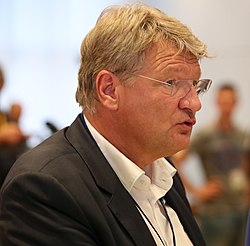 Jörg MeuthenJörg Hubert Meuthen (born 29 June 1961) is a German…Affiliated
 Björn HöckeBjörn Uwe Höcke is a German politician of the far-right…Affiliated
How the record is sourced and how the score is derived.
The score is formula-derived (Factrail formula v1, version 1.0.0), not an editorial verdict. Read the methodology.
By the Factrail desk · Method: how we source and score · Last reviewed
Dispute a fact on this pageNamed here, or represent someone who is? Request a right of reply.
People and organizations as listed in the Related section of this page; facts, drivers and the pages that name it as listed in the blocks here. Counts, not a rating.