
René Wilke
René Wilke (born 30 June 1984 in Frankfurt (Oder)) is a German politician of the Social Democratic Party of Germany (SPD).
- Facts0
- Drivers0
- Indicators0
René Wilke (born 30 June 1984 in Frankfurt (Oder)) is a German politician of the Social Democratic Party of Germany (SPD).
René Wilke (born 30 June 1984 in Frankfurt (Oder)) is a German politician of the Social Democratic Party of Germany (SPD). Since 18 March 2026 he has been Minister for Labour, Social Affairs, Health and Social Cohesion of the state of Brandenburg, appointed that day by Minister-President Dietmar Woidke and sworn in before the Landtag of Brandenburg. He was the state’s Minister of the Interior and for Municipal Affairs from his appointment on 22 May 2025 until the March 2026 change of cabinet. In the German Bundesrat he sat as a full member for Brandenburg from 27 May 2025 to 18 March 2026 and has been a deputy member since then.
From 2018 to 2025 Wilke was Lord Mayor (Oberbürgermeister) of Frankfurt (Oder), a city on the border with Poland. Standing for the alliance “Frankfurt geht besser”, he led the first round on 4 March 2018 with 9,505 votes (43.44 percent). In the runoff on 18 March he defeated the incumbent, Martin Wilke, with 11,337 votes (62.49 percent), on a turnout of 37.71 percent. Before the mayoralty he was a member of the Landtag from 2014 to 2018, serving on his faction’s executive and later as deputy faction chair, as spokesperson first for social, health, care and policy for older people and then for the budget, as deputy chair of the budget and finance committee, and as a member of the interior and municipal-affairs committee.
Wilke had been a member of Die Linke for 24 years and left the party at the end of June 2024, while he was still lord mayor. In a statement that reached the Deutsche Presse-Agentur he wrote that differences with the federal party’s direction on fundamental questions had grown too large, and that the “inner balancing act” was no longer bearable. He remained in office as a non-party mayor and, asked whether another party was in view, said no.
Woidke named him interior minister on 22 May 2025, while Wilke was still outside any party, after Katrin Lange (SPD) had resigned. He joined the SPD in November 2025. The party and its Landtag group announced the step on 18 November; SPD general secretary Kurt Fischer said the entry had taken place the previous Friday, and Landtag group chair Björn Lüttmann said Wilke had told the group he identified with the SPD’s values. The Bundesrat lists him, as an SPD minister, in the labour and social-affairs portfolio he took up on 18 March 2026.
René Wilke was born on 30 June 1984 in Frankfurt (Oder), then part of the German Democratic Republic, the son of a German father and a Russian mother. In 1990 the family moved to Moscow, his mother's home city, because of his parents' work. His mother worked in the mailroom of the embassy of Germany, and his father, a chemist who had been employed at the largest microelectronics manufacturer in the GDR, worked in a Western company's business in Russia. Published accounts date the move to 1990 and the return about five years later; Wilke himself has written that the family stayed roughly five and a half years and spent most holidays in Frankfurt (Oder). He was about eleven or twelve when they came back.
He has said that what remained with him from Russia in those years were the contradictions “zwischen arm und reich, Leid und Unbeschwertheit, Elend und Überfluss” — between poor and rich, suffering and ease, misery and abundance. In a December 2022 interview he said he had seen widespread misery and poverty on Russian streets and had watched members of a mafia cut off a man's hand, an episode he linked to the feeling that arbitrary harm could be done to someone and go unpunished. In 2024 he told the Süddeutsche Zeitung that people died on the street during the upheaval after 1990, and that those experiences were one reason he joined the Party of Democratic Socialism at the age of 16.
After the return he attended the 1. Grundschule am Klingetal and then the Otto-Brenner-Gymnasium. He has described Frankfurt's youth culture in the later 1990s as split, in a largely pseudo-political way, between right-wing and left-wing scenes, with a hard boundary that was partly enforced by violence. He said he belonged to the left-leaning milieu, for whom the city was unsafe: right-wing groups went through the streets attacking people, he and his friends did not go out alone, and his name stood on lists of "main enemies," which he distinguished from death lists. He said he never used violence himself and was not part of the more radical currents in that scene, who sometimes started the fighting; he later learned that his father, once he understood the danger, had on some days waited secretly nearby in a car.
Wilke passed the Abitur at the Otto-Brenner-Gymnasium in 2004. He performed Zivildienst, the civilian alternative to conscription, at the Gronenfelder Werkstätten, a workshop for people with disabilities. From 2005 to 2012 he studied cultural studies, political and administrative science, and psychology at the European University Viadrina in Frankfurt (Oder) and at the FernUniversität in Hagen. On his own account the courses amounted to several semesters at each university, taken for further knowledge rather than as a finished degree, and later official biographies list no academic qualification. From 2005 to 2014 he was a staff member for deputies in the Landtag of Brandenburg, the Bundestag and the European Parliament.
In 2011 he qualified as a mediator, with the emphasis on conflict management, at the mediation office for the border region of Frankfurt (Oder) and Słubice, the neighbouring town in Poland. In 2013 he completed vocational training as a Kaufmann für Bürokommunikation (clerk for office communication) with the Chamber of Industry and Commerce for East Brandenburg.
Wilke joined the Party of Democratic Socialism (PDS) in 2000, while he was still a pupil in Frankfurt (Oder). A text on his own site, still online in a February 2015 capture, says that he was elected to the local PDS executive at 18 and that from the age of 20 he chaired the Frankfurt district association, a post the page still attributed to him; Munzinger dates the chairmanship to 2004. On 16 June 2007 the PDS merged with the Labour and Social Justice – The Electoral Alternative (WASG) to form Die Linke.
The Brandenburg government biography dates his work as a staff member for members of the Landtag of Brandenburg, the Bundestag and the European Parliament to 2005–2014. The 2015 site names the Landtag member Kerstin Meier, the Bundestag members Lothar Bisky and Thomas Nord, and the MEP Helmut Scholz. At the 2012 annual members’ meeting of the Brandenburg branch of the Rosa Luxemburg Foundation, the political foundation close to Die Linke, he was elected to its board.
He was no longer district chair by the congress of 14 October 2017. Sandra Seifert, the outgoing chair, did not stand again, citing other work and a wish to concentrate on the city-council group during the mayoral campaign, and the congress elected Nord in her place while unanimously nominating Wilke for mayor. Nord had taken the post for that campaign and, after Wilke became mayor, gave it up as planned; at the end of May 2018 the association elected his constituency worker Jan Augustyniak as chair.
Between 2011 and 2018, the ministerial biography records, Wilke was a sachkundiger Einwohner—a resident admitted to committees without being a councillor—and, for part of that span, a member of the Stadtverordnetenversammlung and chair of a committee or of the Die Linke group.
The council was elected on 25 May 2014, the same day as the European Parliament election. Of 50,007 eligible voters, 20,239 cast ballots, a turnout of 40.5 percent; each voter could distribute up to three votes. Die Linke took 17,767 of 58,159 valid votes, or 30.5 percent, ahead of the Christian Democratic Union (CDU) on 23.6 percent, the Social Democratic Party (SPD) on 18.7 percent and the Alternative for Germany (AfD) on 11.6 percent. The city election committee allocated 46 seats: 14 to Die Linke, 11 to the CDU, nine to the SPD, five to the AfD, three to a joint list of Alliance 90/The Greens and a local planning group, and one each to the Free Democratic Party, BürgerBündnis, Bürgerinitiative Stadtumbau and the Pirate Party.
Wilke was the first name on the Die Linke list in constituency 5301. He received 2,262 personal votes, more than any other candidate on that list, and was declared elected. In the same biographical note he described himself as chair of the Die Linke group, chair of the committee for urban development, the economy, labour, transport and the environment, and deputy chair of the main, finance and public-order committee, and as a member of the supervisory board of the municipal trade-fair and events company. The ministerial biography ends those council roles in 2018, the year he became mayor.
On 14 September 2014 Wilke stood for Die Linke in Landtag constituency 35, coterminous with the city. Of 48,117 people entitled to vote, 22,245 did so, a turnout of 46.23 percent. He received 6,786 first votes, 31.04 percent, ahead of Michael Möckel of the CDU (19.97 percent), Hartmut Händschke of the AfD (19.31 percent) and Wolfgang Pohl of the SPD (18.78 percent). On the party list in the same constituency Die Linke was narrowly ahead of the SPD, 24.86 percent to 24.72 percent. Across Brandenburg, Die Linke won 17 of 88 seats and only four constituencies. The state election committee recorded Wilke as the winner in constituency 35; the other direct seats went to Christian Görke, Hans-Jürgen Scharfenberg and Kerstin Kaiser.
The sixth Landtag held its constituting session in Potsdam on 8 October 2014. In the parliamentary group of Die Linke in Brandenburg he sat on the executive. After Margitta Mächtig gave up the group chair on health grounds, the group on 2 June 2015 elected the former economics minister Ralf Christoffers to succeed her—11 of 17 members for, one against, five abstentions—and chose the existing board members Kathrin Dannenberg and Wilke as deputies. The ministerial biography lists him as the group’s spokesperson first for social affairs, health, care and policy on older people, and later for the budget and finances; as deputy chair of the budget and finance committee; and as a member of the committee for the interior and local government.
He resigned the mandate with effect at the end of 5 May 2018. On 30 May the Landtag was told that the state returning officer had reported Carsten Preuß as a member since 6 May, sitting with the Die Linke group. The budget committee had elected Preuß as its deputy chair on 17 May, and the group had elected Marco Büchel as a deputy chair on 22 May. nd reported that the rearrangement followed Wilke’s election as mayor of Frankfurt (Oder).
On 4 March 2018 Frankfurt (Oder) chose an Oberbürgermeister from five candidates. Of 48,562 eligible voters, 22,084 voted (45.48 percent). René Wilke, on the list “Frankfurt geht besser”, received 9,505 votes (43.44 percent). Independent incumbent Martin Wilke took 4,433 (20.26 percent), Wilko Möller of the Alternative for Germany 3,726 (17.03 percent), Markus Derling of the Christian Democratic Union 3,116 (14.24 percent) and Jens-Marcel Ullrich of the Social Democratic Party 1,099 (5.02 percent). None reached the absolute majority of 10,940 votes required by Brandenburg municipal election law, so the first two advanced.
On 18 March, 18,317 of 48,572 eligible voters took part (37.71 percent). Wilke won with 11,337 votes (62.49 percent) to Martin Wilke’s 6,804 (37.51 percent). The two were not related. The winner, then 33, sat for Die Linke in the Landtag of Brandenburg. Die Linke and Alliance 90/The Greens had nominated him together, after about 180 residents helped shape the programme. Neues Deutschland called him the party’s first Oberbürgermeister in Brandenburg and the state’s youngest. Martin Wilke, leaving after eight years, said, “Es ist, wie es ist.”
Wilke resigned the Landtag seat on 5 May 2018; Carsten Preuß, an independent, succeeded him. The next afternoon he was installed in the Marienkirche. In that day’s speech he thanked Martin Wilke, Derling and Ullrich and called the ceremony the start of an eight-year term. A greeting from Tomasz Ciszewicz, mayor of the Polish sister town Słubice, had been arranged, and Wilke intended to stress cooperation with Poland.
Frankfurt carried a large stock of Kassenkredite, the short-term loans that kept it solvent. In 2019 the state and the city agreed to reduce them over five years. The last state payment, on 12 July 2023, brought Brandenburg’s contribution since 2019 to €50,353,938; the city’s own consolidation from 2019 to 2022 was €58,669,450. Interior state secretary Markus Grünewald said Frankfurt had cut the credits by its own efforts.
The main building scheme was the town hall, a medieval hall with a 1913 wing, not comprehensively renewed since 1978 and partly closed, including the council chamber, because of a risk of collapse. The state building authority records costs rising from about €25 million in 2019 to about €35.7 million, about €18.9 million of it federal and state Stadtumbau money, with delay from contaminants, defects and the pandemic. It reopened on 22 May 2024. rbb reported about €36 million against an earlier estimate of €27 million. Staff returned in stages from the Oderturm while finishing work continued; the city spokesman said the move back to the market square made the administration visible again.
The consolidation did not last. On 4 May 2025 the Märkische Oderzeitung reported that Wilke, for the first time in the term, could not present a balanced budget and that there was practically no room for manoeuvre. In May 2026 the interior ministry refused the city’s double budget for 2025 and 2026. Acting treasurer Claus Junghanns told the council that Frankfurt would stay under provisional rules, had no approval for new loans, and could carry out only about a quarter of that year’s planned investment. Grants the city was not legally obliged to pay, including for sport and culture, were put under review.
Wilke treated Frankfurt and Słubice as one area of daily life across the Oder. In November 2020 he called recognition of the Oder–Neisse border the precondition of a “großartige Versöhnungsleistung”, and Poland’s entry into the Schengen Area the opening of a bridge people had once avoided. Some Frankfurt shops, he said, drew up to 40 percent of their customers from Poland.
From March to June 2020 the border was almost completely closed in the COVID-19 pandemic. Wilke called that unnecessary, because infection levels were similar on both banks, and said commuters had to choose between a job and family.
Stationary checks returned for migration control. From October 2023 Germany ran spot checks at the busy A12 crossing near Frankfurt, and from July 2025 Poland checked entries at 52 crossings with Germany. In December 2025, after Wilke had left office, the Autobahn GmbH began rebuilding the German post so cars and buses would have an extra lane toward Berlin. Successor Axel Strasser called the new layout only a relief inside controls which the twin city and cross-border business still wanted brought to an end.
Early on 26 August 2018 two asylum seekers ejected from the club “Le Frosch” returned with a larger group. Prosecutors investigated dangerous bodily harm and breach of the peace. Wilke said more than 1,300 refugees lived in the city and that the misconduct of a few harmed both them and residents who were helping them. On 12 September the Frankfurter Allgemeine Zeitung reported that he wanted criminal refugees removed and that Die Linke was distancing itself. On 21 September the city opened expulsion proceedings against seven men from Syria, Pakistan and the Palestinian territories, two linked to the attack. A file was not an expulsion order: the facts still had to be tested, and those affected could sue. Party colleagues and the Greens called the line symbolic politics; the AfD welcomed it. Wilke told the B.Z. he was judging individual cases, not refugees as a group. In 2020 a court sentenced a 42-year-old Syrian who admitted the assault to ten months, aggregated to two years and three months. Four other defendants were tried separately, and it was unclear whether the convicted man would be deported.
On the afternoon of 25 September 2024, with the Oder gauge near 600 centimetres against a usual level of about 210, Wilke — by then without a party — declared flood alarm stage IV, the highest. The city expected the crest overnight into 26 September. Stage IV meant a danger to life: people were told to keep off the river, dikes, cellars and low ground, and to follow the emergency services. Wilke said difficult hours lay ahead, that the preparations should be enough, and that he warned against treating the danger as already over.
During the previous night a sheet-pile wall on the bank cracked and water ran onto the Holzmarkt. Firefighters held it with pumps and sandbags. Residents near the river secured their property, and entry to flood defences and areas at risk was banned.
He left before that term ended. After Interior Minister Katrin Lange resigned, Minister-President Dietmar Woidke appointed him, and the Landtag swore him in on 22 May 2025. He cited his experience, as mayor, of the interior department’s work with municipalities and on migration. Bürgermeister Claus Junghanns of the CDU became acting Oberbürgermeister, with an election due within five months. Wilke had planned, with local CDU and SPD backing, to stand again in 2026. Left councillor Sandra Seifert called the departure a gap the city would not quickly fill. AfD deputy Wilko Möller said he was choosing a career over budget trouble, crime and a weak economy, while hoping a former mayor in the state government might still help Frankfurt.
On 29 June 2024 Wilke told a members’ meeting of the Frankfurt (Oder) district association that he was leaving Die Linke. He had joined its predecessor, the Party of Democratic Socialism, at 16 around 2000. A written statement reached the Deutsche Presse-Agentur the next day, his 40th birthday. He said he had waited until after the municipal election of 9 June so as not to damage the party. In the vote for the Frankfurt (Oder) city council, Die Linke’s share fell by seven percentage points to 15.8 percent. He intended to remain lord mayor with no party, to work with the Left group and other “constructive forces” in the council, and to join no other party. The term then in office ran until 2026.
He wrote that differences with the federal party on fundamental questions had grown too large and that “the inner balancing act” was no longer bearable. He linked that strain to his March 2024 appearance on the ZDF talk show hosted by Markus Lanz, a discussion of attacks on local politicians, and to the reaction inside the party. The gap was older. In a September 2021 taz interview he said he could not recommend that any other party form a coalition with Die Linke. In May 2024 he told the Märkische Oderzeitung that he no longer recognised himself in the federal party’s line.
At the district meeting he said he could not accept the party’s position on the Russian invasion of Ukraine. He called the refusal of military support “supposed pacifism” and said he could not face the nearly 1,000 Ukrainians in the city while defending a line whose result, as he saw it, would be that their country was overrun. In a Tagesspiegel interview published on 25 July he spoke of “naive pacifism,” in which backing arms deliveries was treated as wanting the war and only opposing them as defending peace. Criticism of Russia or Vladimir Putin, he said, was difficult unless the United States and NATO were condemned just as sharply. He described a similar one-sidedness on social policy and migration: benefit recipients treated as needy and blameless, refugees seen only as people fleeing the greatest distress, and failed integration blamed on the majority society. The dispute had a local history. In 2018, after a group of refugees attacked a club with knives and iron bars, he began deportation proceedings and was sharply criticised by his own party. At the 2024 European election, he told the Tagesspiegel, he had even considered voting for another party.
He ruled out the Bündnis Sahra Wagenknecht. Partial agreement on economic, migration and social questions did not extend to the war, and he objected to the way Sahra Wagenknecht denied other politicians good faith. He said he was leaving “without rancour,” grateful for 24 years of joint work, thanked Brandenburg state chair Sebastian Walter, and wished Die Linke success as a voice he still thought necessary.
The resignation came less than three months before the election to the Landtag of Brandenburg, and about a week after another Brandenburg deputy, Marlen Block, had also left. Walter said the step was not a surprise. The Frankfurt association noted it with regret. Chair Anja Kreisel said the joint work had rested on mutual respect and on what was best for the city, compared the estrangement to a plaster now removed, and said the party had existed before Wilke and would exist after him. At the new council’s first sitting in early July he told members that his exit could also be read as an offer. In November 2024 he told rbb that he was at ease with the decision and with the role of a non-party mayor.
On 22 May 2025 Minister-President Dietmar Woidke gave René Wilke his certificate of appointment as Brandenburg’s minister of the interior and for municipal affairs at the state chancellery in Potsdam, and Landtag President Ulrike Liedtke swore him in before the plenary that morning. Wilke, then 40 and without a party, succeeded Katrin Lange of the Social Democratic Party (SPD), who had resigned on 16 May. He had been lord mayor of Frankfurt (Oder) since May 2018 and a Landtag member from 2014 to 2018.
The vacancy followed a dispute over the Verfassungsschutz, the domestic-intelligence department of the interior ministry rather than a separate state office. On 14 April 2025 the department upgraded the Brandenburg branch of Alternative for Germany (AfD) from a suspected case (Verdachtsfall) to a confirmed right-wing extremist endeavour (gesichert rechtsextremistische Bestrebung). Lange said she learned of it only on 5 May, and on 6 May removed the department’s head, Jörg Müller, for loss of trust. The ministry said he was to enter temporary retirement; Müller said he had nothing to reproach himself for. On 7 May Lange made the upgrade public, said it would stand for the time being, and said Müller had not broken standing instructions but had informed her too late. Die Welt reported an email of 2 May in which Müller had already contacted her about the upgrade. She maintained that she had not been informed properly or in time, and that she would not defend secrecy over an unpublished assessment.
She said she was resigning so the argument would not keep overshadowing the SPD–Bündnis Sahra Wagenknecht (BSW) coalition, which Der Spiegel reported held the Landtag by two votes. SPD group leader Björn Lüttmann said the group had expressed confidence after an intensive discussion, but four members said questions remained open and the Jusos criticised her. Lange argued that the AfD should be answered politically rather than mainly by bans and surveillance, and that she would not write off what she put at about 30 percent of Brandenburg’s voters. State-chancellery chief Kathrin Schneider represented the ministry until a successor was named, with State Secretary Frank Stolper running daily business; Lange had held the portfolio since 2024.
On 20 May the Landtag’s parliamentary control commission, which oversees the Verfassungsschutz, sat in special session, and on 21 May found the upgrade comprehensible, legally coherent and justified._sitzung_am_20._mai_2025_den_folgenden_beschluss_gefasst_und_den_vorsitzenden_beauftragt_die_oeffentlichkeit_hierueber_zu_informieren:/43436) It also found that the interior minister had not informed it on 6 May, as section 25(1) of the state Verfassungsschutz law required, and recommended putting classification powers, until then only in internal instructions, into statute._sitzung_am_20._mai_2025_den_folgenden_beschluss_gefasst_und_den_vorsitzenden_beauftragt_die_oeffentlichkeit_hierueber_zu_informieren:/43436)
Woidke named Wilke on 19 May. Wilke had left Die Linke in the summer of 2024 over federal-party disputes, including its line on Russia in the war against Ukraine, and was to be the second non-party minister in the cabinet, beside health minister Britta Müller. Woidke cited his record as mayor of a border city. Christian Democratic Union (CDU) group leader Jan Redmann, Die Linke state chair Sebastian Walter and Greens state chair Clemens Rostock each treated the nomination as workable, while SPD general secretary Kurt Fischer said he expected Wilke to join the SPD. In Frankfurt (Oder), deputy mayor Claus Junghanns (CDU) served until a mayoral election required within five months, and Wilke took city spokesman Uwe Meier to Potsdam as ministry spokesman.
Wilke ruled out reinstating Müller. He told rbb that the service needed a new start because the ground was burned (verbrannte Erde), and that reinstating Müller would prolong the conflict. On 17 June 2025 the cabinet, on his proposal, appointed Wilfried Peters, vice-president of the Berlin administrative court, to lead the department from 14 July. Wilke called a revision of the Verfassungsschutz law part of rebuilding trust in the service.
On 14 August 2025 Wilke, still without a party, and Peters published the assessment, more than 140 pages; it had already leaked. Wilke said the service found breaches of human dignity under the Basic Law and a demand for an ethnically and culturally defined people from which people of non-German origin were excluded as equals, while not classing every member as extremist. Peters said the state party sought to remove elementary constitutional principles, in particular by denying or limiting human dignity for a larger group. AfD group leader Hans-Christoph Berndt called the findings unproven and said the main case would continue at the administrative court in Potsdam; withdrawal of an emergency application had allowed publication. The same classification already applied in Saxony, Saxony-Anhalt and Thuringia. The SPD and the Greens welcomed publication; the BSW criticised unconstitutional AfD statements but warned against a ban.
Wilke also reviewed the Dublin centre in Eisenhüttenstadt, which Lange and federal interior minister Nancy Faeser had agreed in February to set up, because later federal decisions on turning people back and on border controls had changed the conditions. The ministry said 80 people were housed there, three had been transferred to Poland and 30 procedures were open; Wilke told the Landtag that further investment should stop if the centre proved unnecessary within two or three months. At the Conference of Interior Ministers in Bremerhaven, whose results he reported on 13 June 2025, the Länder called for faster EU asylum procedures and more returns.
As a member of the state government, Wilke sat for Brandenburg in the Bundesrat. The Bundesrat records him as a full member from 27 May 2025 until 18 March 2026 and as a deputy member from that day, so full membership covered nearly his whole time as interior minister. On 18 March 2026 he left the interior ministry to become minister for labour, social affairs, health and social cohesion, and the deputy membership dates from the same day.
The coalition of the Social Democratic Party of Germany (SPD) and the Bündnis Sahra Wagenknecht in Brandenburg broke up at the beginning of January 2026. On 4 March in Potsdam, Minister-President Dietmar Woidke and the Christian Democratic Union (CDU) presented a coalition agreement and the posts in what became the fifth Woidke cabinet. The SPD kept six ministries and the state chancellery; the CDU took the interior, economic-affairs and education portfolios, the last of which the SPD was giving up for the first time in 36 years. Woidke assigned the outgoing interior minister, René Wilke, a merged ministry for labour, social affairs, health, family, societal cohesion and integration.
Jan Redmann, CDU state chairman and leader of its Landtag group, became Deputy Minister-President and Minister of the Interior and for Municipal Affairs, and Daniel Keller moved from economic affairs to finance. Robert Crumbach, the previous finance minister and deputy minister-president, was nominated by the SPD for infrastructure and state planning while an independent; by the swearing-in he had left the BSW and rejoined the SPD. Gordon Hoffmann, CDU general secretary, took education, youth and sport, and Martina Klement of the Christian Social Union in Bavaria, formerly a Berlin state secretary for digital administration, took economic affairs, energy, climate protection and Europe. Hanka Mittelstädt, Manja Schüle, Benjamin Grimm and state-chancellery head Kathrin Schneider stayed.
On 17 March Woidke dismissed Britta Müller (independent, formerly BSW) from health, Detlef Tabbert (independent, formerly BSW) from infrastructure, and SPD education minister Steffen Freiberg. The next morning, 18 March 2026, Redmann, Crumbach, Hoffmann, Keller, Klement and Wilke were sworn in at the start of the 30th sitting of the Landtag of Brandenburg. Wilke, Redmann, Hoffmann and Klement used the religious oath; Crumbach and Keller did not. Woidke was not re-elected, because Article 85 of the state constitution ends a minister-president’s term only when a new Landtag meets. The majority was two votes, until the election due in 2029. The police union had warned against another change at the interior ministry; Tagesspiegel reported that Wilke, discussed as a possible successor to Woidke, appeared surprised.
Wilke was sworn in as Minister for Labour, Social Affairs, Health and Societal Cohesion (Minister für Arbeit, Soziales, Gesundheit und gesellschaftlichen Zusammenhalt). Labour came out of Keller’s former ministry for economic affairs, labour, energy and climate protection, and migration and integration came out of the interior ministry. The Deutsches Ärzteblatt noted that integration had moved from social affairs to the interior under Katrin Lange and was now again treated as social policy, enlarging the health brief Wilke took over from Müller. Reporting compared the department with Regine Hildebrandt’s social ministry and recorded concern in Potsdam that it was too large for a minister who then had one state secretary.
Woidke appointed Johannes Wagner state secretary on 18 March and, on 31 March, added Friederike Haase, previously a state secretary for economic affairs, as a second. The same day Jörg Treffke became Redmann’s second state secretary, after the SPD group sought a matching post once Redmann, as deputy minister-president, asked for one. Woidke cited the workload of both ministries and said the number of state secretaries was unchanged from the SPD–BSW government.
Wilke told the Deutsches Ärzteblatt that area-wide care, in town and country and at every age, would concern him from the first day, and that getting to a doctor and affording nursing were questions of cohesion as well as of social security. Every hospital site, he said, should remain a place of regional care, with no inpatient service ending unless outpatient care replaced it—the coalition formula, which also allowed sites to continue as hospitals or as polyclinic-style centres, kept the nursing pact, and proposed a rural-doctor quota at the Medizinische Universität Lausitz – Carl Thiem plus scholarships for dentists.
On 27 March the Bundesrat adjusted the federal hospital reform without Brandenburg calling the mediation committee. Wilke said further talks had been weighed against ending uncertainty, then called the result good for Brandenburg because hospitals could plan. Not every site would stay unchanged, he said, but the state did not have too many hospitals: all were to remain points of care, some as outpatient centres or with office-based doctors, and eastern states noted a need for further correction. Returns of people with no right or prospect of staying, the deportation task force, and easier access to work for those who remain—the coalition’s migration line—now sat in his ministry rather than in Redmann’s.
On Friday, 14 November 2025, René Wilke joined the Social Democratic Party of Germany (SPD), state general secretary Kurt Fischer told Der Spiegel. He was then Brandenburg’s non-party minister of the interior and for municipal affairs, appointed in May 2025 to succeed Katrin Lange, after 24 years in Die Linke and a resignation in 2024 over the federal party’s direction. The Märkische Oderzeitung reported that the membership ran through the Frankfurt (Oder) sub-district and the local branch Frankfurt (Oder) Süd, whose executive still had to approve it. On 18 November he informed the SPD group in the Landtag of Brandenburg. He said the decision had matured over several weeks and now “felt right,” and that he stood by the SPD’s values, the governing alliance, and a duty to contribute to stability, reliability, sovereignty and security. He told the Deutsche Presse-Agentur that, while others in the coalition seemed unsure where they belonged, it was “a good moment for commitments, in order to create clarity and also to contribute a little to stability.” To the Märkische Oderzeitung he added that he would not have taken the ministry earlier in the summer without an affinity for the SPD, and that a faction retreat in September had brought the step about.
Group chair Björn Lüttmann said the faction had greeted the news “very cheerfully and warmly,” and that membership would ease cooperation because some meetings were open only to party members. Matthias Steinfurth, a Landtag member and chair of the Frankfurt (Oder) sub-district, said he had congratulated Wilke and did not see the entry as a manoeuvre to protect a post he did not regard as being at risk. The paper also reported surprise among some Social Democrats, who had expected Wilke to stay non-party longer, and speculation in the Landtag that the move was tied to the crisis in the coalition with the Bündnis Sahra Wagenknecht and to his chances of remaining a minister if the cabinet were rebuilt.
Parts of the press read the announcement as a bid in the discussion of who might succeed Minister-President Dietmar Woidke. Der Spiegel wrote that some observers suspected an application for the succession. In a Tagesspiegel analysis headlined “Wilke, the crown prince,” Thorsten Metzner argued that the entry let Wilke show ambition without stating it, and treated a place as Woidke’s preferred successor, after Lange’s departure, as by then settled. The paper reported that in an INSA survey that September Wilke already had the highest approval of the names discussed, while the SPD stood at 24 per cent and the Alternative for Germany at 34 per cent. rbb24 named the then economy minister Daniel Keller, science minister Manja Schüle and Berlin’s economy senator and former governing mayor Franziska Giffey as others in that field. Lüttmann said no race had opened, with the next Landtag election about four years away. Wilke told the Deutsche Presse-Agentur that the debate was not one to conduct then and that his decision had “nothing at all to do with something like that now.” Woidke had repeatedly said he meant to stay until the end of the term in 2029, though Der Spiegel and rbb24 noted that conflict in the BSW Landtag group had left the coalition unsteady. No candidacy was announced.
Wilke linked his 2024 exit from Die Linke chiefly to its line on Russia's full-scale invasion of Ukraine. In a Tagesspiegel interview reported on 24 July 2024 he said criticism of Russia or Vladimir Putin drew "sideways glances" unless the United States and NATO were condemned especially harshly, and he called it "naive pacifism" to treat arms deliveries as wanting war. At a local meeting he said he could not face nearly 1,000 Ukrainians in Frankfurt (Oder) with a position that would leave their country overrun. He would not join the Bündnis Sahra Wagenknecht, where he saw overlap on the economy, migration and social policy but not on the war.
On 28 November 2024 he told rbb24 Inforadio that nothing beforehand justified the attack, since only one side had invaded, and that strong Alternative for Germany and BSW results in Frankfurt did not alienate him: the wish for peace was shared, the route to it was not.
On 26 February 2026 in the Landtag of Brandenburg, answering BSW and AfD interruptions, he defended sanctions as decency, so that Germany would finance the killing as little as possible, and said ties with Russia should normalise only after Russia stopped fighting and changed course. "Ich bin Halbrusse," he added: his mother came from Russia and his grandmother was Ukrainian. Leaving or shrinking the European Union, he argued, would be naive beside an erratic United States, a strengthening China and Russia.
On 17 December 2025 he told the Landtag that American protection could no longer be assumed, and that the new US National Security Strategy's interest in splitting Europe ran against German interests. He refused the word Kriegstüchtigkeit and spoke of defence capability "in order to preserve the peace", citing Holzdorf as a future major air-force site and Brandenburg's place in any talks on Ukraine. A capable Bundeswehr, he said, needed steady support from the Land and its municipalities.
In that July 2024 interview he also faulted Die Linke for treating people on benefits as always needy and blameless. In May 2025 he called the coalition's municipal budget deal relief rather than a cure: 2025 funds stayed intact, 2026 was eased, and planned net borrowing exceeded €2.2 billion, about €130 million of it extra for the towns. CDU deputy Steeven Bretz said the coalition borrowed more whether taxes rose or fell.
On 12 September 2025 he told Oderwelle that municipalities should get a large, flexible share of the federal infrastructure fund to clear backlogs in roads, schools and sports halls. The finance ministry had assigned about €1.5 billion of an expected €3 billion to them, plus €460 million agreed jointly for hospitals.
On 16 July 2026 he opposed Family Minister Karin Prien's plan to stop the maintenance advance (Unterhaltsvorschuss) at 16 rather than 18, affecting about 80,000 young people by her figure. The cost rise was real, he told dpa, but parents who owed support should be pursued, not single parents, because many households would simply move to other benefits.
In July 2024 he said Die Linke saw refugees almost only as people in extreme need and blamed failed integration on the majority. On 21 August 2026, at an opportunity centre in Frankfurt (Oder), he said protection must be given where it is needed, those who stay must join society quickly, those without a right to remain must leave, and the state must make that reliable. He said the middle of society would reject benefit abuse, avoidable dependence and serious repeat crime, while migration was still necessary for a shrinking workforce. Of 7,749 people obliged to leave on 30 June 2026, he thought about 3,000 could be deported; by 31 July there had been 63 deportations and 604 voluntary departures. He told rbb the welfare state should not "get out of hand".
In January 2026 he had his ministry prepare a rule keeping recognised refugees in their assigned district, citing school violence in Cottbus. On 10 May he said he would keep it so integration stayed manageable. The Refugee Council of Brandenburg called it, on 19 January, a massive interference with basic rights. Der Spiegel cited a 2024 study by the German Institute for Economic Research finding that moving bans tended to hurt integration and burden authorities.
On 5 June 2026 Wilke, then 41, and his long-time partner Kathrin Lindenberg were married in a civil ceremony at the town hall in Frankfurt (Oder). Lindenberg works in the same building, where she heads the office of the city council, and the municipal website later listed her under the married name Kathrin Wilke; Wilke had made the engagement public in December 2025. The couple had been together since 2019. Lindenberg wore white, and Wilke a jacket, waistcoat and bow tie in shades of lilac. Musicians from the Brandenburgisches Staatsorchester Frankfurt played three pieces in the foyer, including the traditional wedding march and a movement from Antonio Vivaldi’s The Four Seasons. His successor as mayor, Axel Strasser, was among those who congratulated them, and several dozen people, including personnel of the German Red Cross, gathered outside.
He has continued to live in Frankfurt (Oder) rather than moving to Potsdam, the seat of the Brandenburg government. In July 2025 he told the Märkische Oderzeitung that staying put let him remain close to eastern Brandenburg, and that he commuted daily, using his official car as a “rolling office” for calls and video conferences; he had then had to spend the night in Potsdam only once.
Wilke’s mother is from Russia. In a July 2025 interview he said she lives in Frankfurt (Oder) and that relatives in Russia had died long before. He described himself as having grown up bilingual and compared Russian with swimming or cycling: it “gathers a little dust, but it is never gone.” In the same conversation he mentioned a spring holiday with his partner in Masuria.
In September 2026 he said that neither he nor his wife belongs to a religious denomination, but that both would describe themselves as believers. Their honeymoon was a walk on the Camino de Santiago in northern Spain, a plan he had mentioned at a citizens’ dialogue in Rathenow on 19 May 2026. They started in Galicia along the Atlantic coast, passed the monastery town of Oia, and continued to Santiago de Compostela and Cape Finisterre, staying in simple pilgrim hostels. Wilke said the walk had been his wife’s idea—she had earlier done part of the route with her mother—and that the couple had crossed the Alps on foot in 2025. He came to hiking from long-distance cycling, including a ride from Frankfurt (Oder) to Venice and back across the Alps.
Ranked by shared high-impact facts, then explicit ties, then shared drivers.
 Sahra WagenknechtSahra Wagenknecht is a German politicianAffiliated
 Vladimir PutinVladimir Putin has been President of Russia since 2012Affiliated
 Nancy FaeserNancy Faeser is a German lawyer and politician of the…Affiliated
 Franziska GiffeyFranziska Giffey (born 3 May 1978) is a German politician…Affiliated
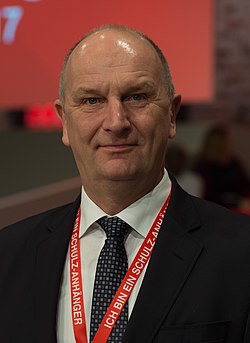 Dietmar WoidkeDietmar Woidke (born 22 October 1961 in NaundorfAffiliated
How the record is sourced and how the score is derived.
The score is formula-derived (Factrail formula v1, version 1.0.0), not an editorial verdict. Read the methodology.
By the Factrail desk · Method: how we source and score · Last reviewed
Dispute a fact on this pageNamed here, or represent someone who is? Request a right of reply.
Linked because the text names them, not because anything was measured.
People and organizations as listed in the Related section of this page; facts, drivers and the pages that name it as listed in the blocks here. Counts, not a rating.