Delhi's voter-roll dispute becomes a test of whether citizens can challenge the referee
TL;DR
The confrontation around Delhi's Jantar Mantar is no longer only about a disputed voter-roll revision. It is also about whether citizens can visibly contest the institution that decides who appears on the democratic register.
By the Factrail desk · Method: how we source and score · Last reviewed
Article
The confrontation around Delhi's Jantar Mantar is no longer only about a disputed voter-roll revision. It is also about whether citizens can visibly contest the institution that decides who appears on the democratic register.
Around 150 protesters were detained as activists again tried to reach Jantar Mantar, according to The Indian Express. The demonstration demanded Chief Election Commissioner Gyanesh Kumar's resignation and challenged the Special Intensive Revision of electoral rolls. Yogendra Yadav and Prashant Bhushan were among those detained, placing prominent civil-society figures inside a dispute that had already produced large-scale detentions on the previous day.
The democratic stakes operate on two levels. The first is the electoral roll itself. A voter register is administrative infrastructure, but it determines access to political participation. Errors, unjustified removals or opaque procedures can therefore have consequences far beyond paperwork.
The second level is protest accountability. If people believe the electoral referee is acting improperly, the legitimacy of the system depends not only on whether those accusations are ultimately proven, but also on whether citizens can challenge the process without disproportionate state restriction.
Concerns reported around officers concealing identification and the use of surveillance technologies intensify that accountability problem. Police authority is legitimate only when its exercise can itself be traced. An officer whose actions cannot easily be attributed to an identifiable state agent weakens the possibility of later review.
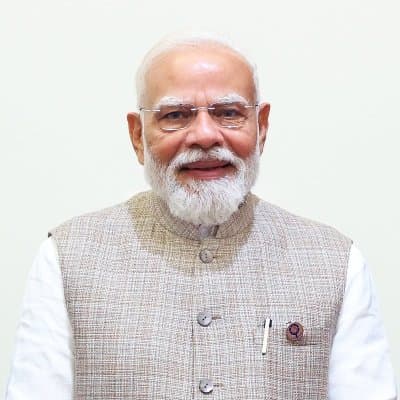
Narendra Modi (opens in a new tab) is not the direct administrator of every Election Commission decision or police detention, and Factrail should not manufacture that causal link. His relevance is at the level of national executive power and the political system in which the dispute is unfolding. Specific responsibility for the voter-roll process belongs to the election authorities; specific responsibility for protest policing belongs to the relevant security command.
That separation matters because criticism-first analysis is strongest when it identifies the actual lever rather than assigning every state action to the most famous politician.
The welfare stake is democratic access: who gets counted, who gets heard, and whether institutions with power over elections remain contestable. If the process governing participation cannot withstand peaceful scrutiny, procedural legitimacy deteriorates even before a single ballot is cast.
Democratic accountability has two layers here: the integrity of the voter register, and the ability of citizens to contest the referee without disproportionate coercion. Narendra Modi is not the day-to-day administrator of every Election Commission or police act — Factrail must not invent that link — but national executive power sets the political climate in which those institutions operate.
The welfare stake is who gets counted and who gets heard. If peaceful scrutiny of electoral procedure is met with opaque policing, procedural legitimacy erodes before any ballot is cast. Criticism-first analysis names the actual levers: election authorities for rolls, security command for detentions, and the governing coalition for the ambient pressure around both.
Evidence
The sources this article cites, claim-bearing material first.
- Press Information Bureau of India · PIB — Government of India notifies Constitution (Application to Jammu and Kashmir) Order, 2019
More analysis
Ranked by shared facts, drivers and people — never by publication date alone.
Articles11
- Narendra Modi’s Russia Hedge Is Becoming Harder to Call Strategic AutonomyAlso covers Narendra Modi · 5 October 2026
- India Voter List 2026: Why 130M Names Were CutAlso covers Narendra Modi · 15 October 2026
- Why India's Supreme Court Put the Election Commission on NoticeAlso covers Narendra Modi · 15 October 2026
- How Europe Replaced Russian Pipeline GasAlso covers Narendra Modi · 3 August 2026