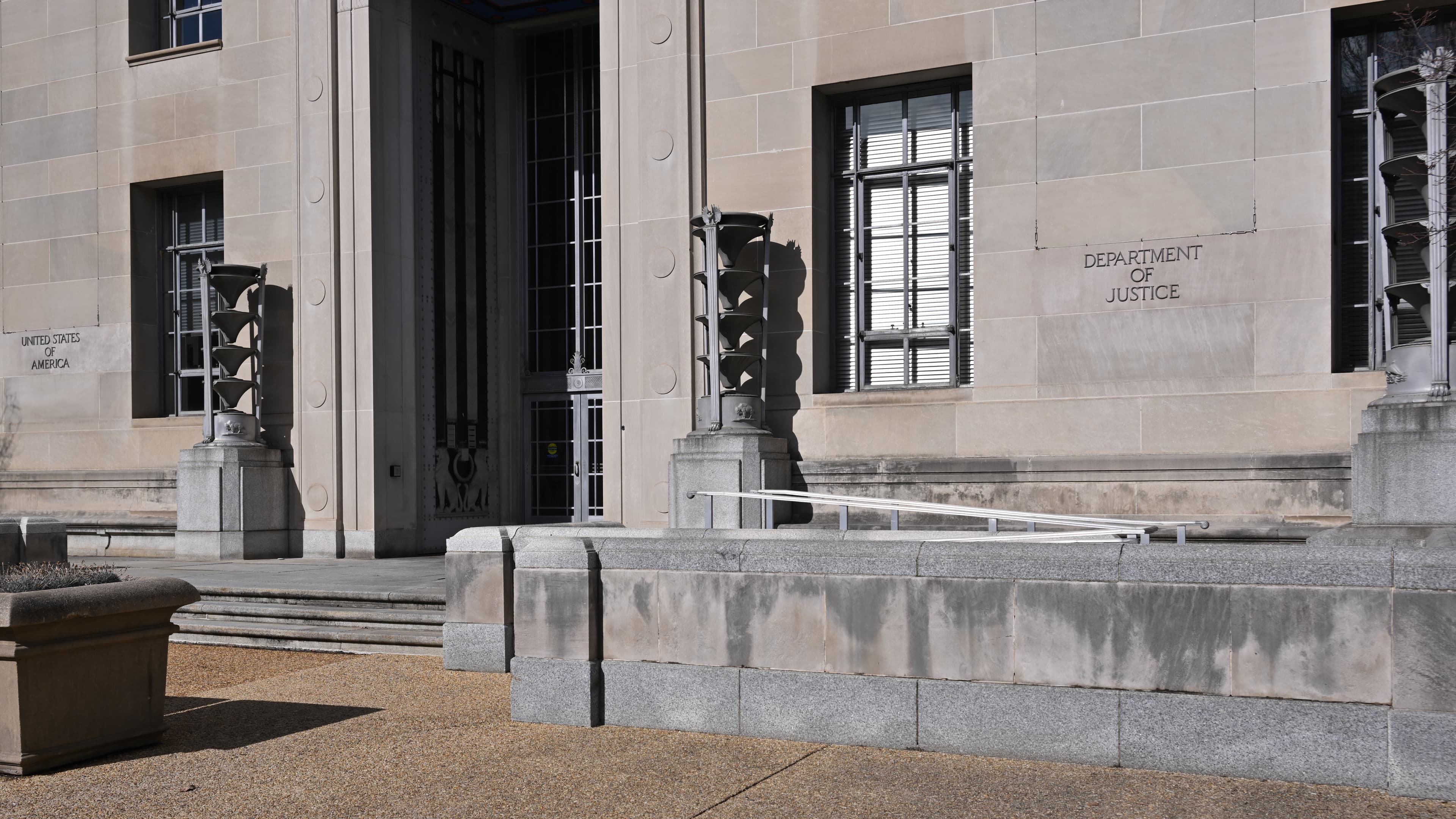
The Justice Department's Pre-Election Restraint Is Being Tested
By the Factrail desk · Method: how we source and score · Last reviewed
TL;DR
NBC News reports an unusual concentration of Justice Department election-related actions in the weeks before the 3 November 2026 midterms. The important question is not whether election law suddenly ceased to apply during campaign season. It did not.
Key graph impact
The article explains graph entities; the causal edges belong to the facts and drivers it links to.
- ArticleThe Justice Department's Pre-Election Restraint Is Being Tested
- mentionsDriverRule of Law
- weakensIndicators (4)Rule of Law Gap from the Highest Governance Score
Weakens · 74% impact strength
Observed
43.9 Score · 43.9 above the normal line (2024)
Worse than normal26 readings, 1996–2024: rose from 43 Score to 43.9 Score.
Normal is zero · any amount = worse
- Better
Strengthens · 68% impact strength
Observed
0.62 score from 0 to 1 · 0.25 below the normal line (2024)
Worse than normal125 readings, 1900–2024: rose from 0.37 score from 0 to 1 to 0.62 score from 0 to 1.
Above normal = better
Strengthens · 58% impact strength
Observed
0.55 index score (0-1) · 0.26 below the normal line (2024)
Worse than normalAbove normal = better
Strengthens · 50% impact strength
Observed
0.57 index score (0-1) · 0.23 below the normal line (2024)
Worse than normal125 readings, 1900–2024: rose from 0.5 index score (0-1) to 0.57 index score (0-1).
Above normal = better
Article
00 Verdict
NBC News reports an unusual concentration of Justice Department election-related actions in the weeks before the 3 November 2026 midterms. The important question is not whether election law suddenly ceased to apply during campaign season. It did not. It is whether federal officials have departed from the department's longstanding preference to avoid overt investigative steps that could unnecessarily affect an imminent vote, and what institutional checks remain when they do. That question requires the current Justice Manual provisions, case dockets and dates—not simply the number of headlines.
The central institutional distinction is between the lawful ability of the Justice Department to enforce election laws and the separate obligation to exercise that power without improperly influencing an election. The United States does not suspend federal law enforcement during campaign season. Instead, federal prosecutors operate under statutes, constitutional constraints and Justice Department policies intended to prevent partisan intervention and protect the integrity of voting. When a department takes conspicuous steps close to polling day, its officials should be able to identify an actual legal necessity and explain why the action could not reasonably wait.
The reported Alaska and California disputes should not be conflated. A lawsuit concerning certification can involve different federal powers, evidence and remedies from a request for access to voter or ballot records. The mere existence of two cases does not demonstrate a coordinated suppression strategy, just as the government's use of the word 'integrity' does not validate its legal claims. Courts, election officials and voters must be able to distinguish allegations, procedural scheduling and final orders. This distinction is especially valuable in a campaign when a public accusation may spread far beyond the eventual legal result.
01 Hidden finding
The central analytical question is not the headline alone but the separation between the public claim and the mechanism that could move real outcomes.
The brief identifies an Alaska certification lawsuit and a California request involving approximately 20,000 ballots. It says a judge expedited the Alaska case and the California request was denied. These are reported procedural developments, not proof that the department won the underlying arguments or that the ballots were unlawful. Court orders should be checked for the precise relief requested, who had standing, the scope of the ruling and whether any appeal followed. An expedited schedule changes when a case is heard; it is not a merits judgment.
The operative framework starts with federal voting statutes, constitutional protections, court jurisdiction and the Justice Manual. Election administration remains primarily a state and local responsibility under applicable federal constraints. Federal officials may investigate or litigate particular violations when Congress has provided a legal basis, but they cannot simply replace an election authority's decisions by announcing a federal preference. A complaint is a request for judicial action; an injunction requires the relevant showing; a final finding needs a court or other legally competent body to decide the merits.
The quiet-period practice concerns discretion over public investigative steps, especially actions that might create the appearance that the department is using its powers to affect election outcomes. It is not equivalent to a blanket rule forbidding enforcement in the final weeks. A credible allegation that time-sensitive evidence will disappear can justify urgency, while the same timing in a weak case may amplify reputational harm unnecessarily. The relevant internal policies should be quoted from their exact current version, since informal statements about a '60-day rule' can obscure the distinction between written guidance and public convention.
The Alaska filing reportedly sought to affect the procedures around Senate-election certification. Its docket, parties, legal authority and requested order are necessary to identify the precise institutional dispute. In California, the reported demand involving roughly 20,000 ballots raises a different issue: what records were requested, whether the request was proportionate, and whether a judge denied the request for jurisdictional, evidentiary, procedural or substantive reasons. Those distinctions cannot be supplied by a headline. The initial draft is therefore a framework for testing the government's conduct, not a finding that the cases violated a specific internal policy.
02 Who holds the levers
The consequential powers sit with the institutions and counterparties identified below; a public statement does not itself establish implementation.
The department's previously reported California voter-data ultimatum (opens in a new tab) and charges involving 16 noncitizens (opens in a new tab) are separate events. Charges are allegations, not convictions, and an individual criminal case cannot establish the prevalence of illegal voting across the electorate. A meaningful pattern analysis should code each action by date, legal basis, remedy sought and judicial result, rather than count press releases as equivalent interventions.
The Attorney General and senior Justice Department leadership direct litigation priorities within the law and may influence which cases are expedited or publicised. Career attorneys evaluate evidence and legal authorities; individual prosecutors are obliged to follow professional responsibilities, including candour to courts. Federal judges can reject unsupported claims, control schedules and issue relief only within their jurisdiction. State election administrators and local officials run registration, ballot processing and certification under the relevant rules, subject to judicial review.
These institutions create important veto points but not perfect protection from political effects. A judge may deny a late application after the public has already heard the government's allegation. A court's procedural order does not erase the administrative work imposed by responding to litigation. Conversely, an injunction may prevent an unlawful practice before ballots are certified. The public-interest measure is not whether a filing was politically controversial; it is whether the executive exercised coercive authority on a sound basis, with appropriate timing and a remedy proportionate to the evidence.
Congress also plays a structural role because it creates voting-rights obligations and oversees the department, though it cannot decide an individual case by political statement. Independent press scrutiny and public-record access help reveal the original filings. Oversight must be even-handed: comparable action against Democratic or Republican administrations should face the same test of timing, legal authority and evidence. A pattern of disparate treatment cannot be established merely by selecting two newsworthy filings from a larger unknown case population.
03 Document trail
The dated sequence and source trail distinguish a reported event from an operative decision or settled measurement.
The temporal sequence should be reconstructed case by case. Earlier October actions, including the reported California voter-data demand and charges announced in a separate noncitizen-voting case, provide possible context but are not interchangeable legal events. The Alaska case reportedly entered an accelerated judicial schedule, which is a scheduling development and not a ruling on the lawfulness of election administration. In California, the reported denial of an application is likewise one procedural endpoint whose legal rationale must be read in the actual order.
The next chronological point is the 3 November 2026 midterm election. As of the 30 October cutoff, the outcome is not known and should not be anticipated. Certification follows jurisdiction-specific timetables and may itself become the subject of new proceedings. For every claimed action a serious timeline records filing date, plaintiff, defendant, authority invoked, requested remedy, emergency hearing, judicial reasoning, appeal and any effect on election operations. It must then distinguish the public release date from the legal date of service, because publicity can precede or follow the formal step.
A separate baseline is the department's own historical practice. An allegation of unprecedented conduct requires a comparable dataset spanning previous cycles, including urgent voting-rights cases that administrations of different parties brought near Election Day. Without that denominator, a 'flurry' can accurately describe a short-term observation while still failing to establish an exceptional trend.
04 How it was done
The transmission pathway matters because the same headline can affect groups differently depending on contracts, procedure and timing.
The so-called quiet-period principle is not a universal statute prohibiting all federal election litigation shortly before polling day. Election-integrity enforcement can be legitimate and time-sensitive; delaying an urgent, supported legal claim can itself harm voters. But discretionary timing is a powerful lever. A public filing can shape political narratives even when the underlying request is rejected. The legal outcome and the public effect of announcing a claim must therefore be assessed separately.
For voters, the immediate welfare interest is an election whose rules are administered consistently and whose results are accepted on evidence rather than rumour. A late federal complaint can have competing effects. It could protect voters if authorities document a genuine violation that must be remedied before certification. It could also undermine trust if sensational allegations are publicised without substantiation and later rejected. The harmful consequence is not always a formally invalidated ballot; people may lose confidence in the procedure or face confusion about whether their vote will count.
Election administrators bear a distinct operational burden. On tight deadlines they must process ballots, verify eligibility, preserve records and comply with court orders. A lawsuit that demands emergency responses can divert attention even without changing the result. But a lawful, narrowly tailored court intervention may also correct an administrative failure, so it would be mistaken to assume every late legal challenge harms electoral integrity.
The indicator connection concerns public confidence, electoral participation, timely certification and rule-of-law performance. Factrail's World Justice Project rule-of-law indicator (opens in a new tab) may provide broad institutional context, but it cannot measure the immediate effect of one Department of Justice filing. More precise outcome measures would include court disposition rates, election litigation volumes normalised against comparable cycles, certification delays and independently collected survey evidence on confidence. Inferring a national collapse in the rule of law from two cases would fail the same evidentiary standard being demanded of the government.
05 Money, access and intermediaries
The distribution of control and financial exposure depends on who can transfer money, set terms or restrict access.
| Institution or group | What it can do | What cannot be inferred |
|---|---|---|
| Justice Department (opens in a new tab) | Bring authorized federal actions | Filing is not judicial validation |
| Federal courts | Grant, deny or schedule relief | An expedited hearing is not victory |
| State election officials | Administer and certify under applicable law | A federal allegation does not automatically void ballots |
| Campaigns and voters | React to public legal claims | Political benefit or voter suppression requires evidence |
The earlier Alaska case analysis (opens in a new tab) and California case analysis (opens in a new tab) address specific disputes. The distinctive issue here is the department-wide practice and the cumulative burden on election administration. The relevant causal framework is rule of law, and the WJP rule-of-law indicator offers long-run context, not an immediate numerical measure of these filings. The strongest disconfirming evidence would be a documented, consistent application of the same urgency and legal standards across parties and prior elections.
This story is not primarily about a monetary payment; it is about public authority, access to election records and the costs of enforcing or defending legal claims. Litigation can require state attorneys, election officials, contracted counsel and technical staff to divert time from preparing or completing vote counts. These costs may be real without being independently measured in the public record. The Justice Department's resource allocation also matters: pursuing one class of cases may mean fewer attorneys available elsewhere, but such an opportunity cost should not be quantified without staffing and budget evidence.
The most sensitive asset is often information. Voter records can contain personally identifying data, while ballot-secrecy law and record-retention rules impose limits on what is disclosed and how it may be used. A court may need to weigh the government's documented need against privacy, security and disruption. The extent of any requested California data must be established from the actual filing, not an assumption that the department sought or acquired every individual ballot.
Political actors may gain attention by invoking alleged election irregularities, even when a subsequent judicial ruling rejects the requested remedy. That possible media advantage is not evidence of illicit coordination between the litigators and a campaign, nor proof that the publicity changed a single vote. The distinction between intended legal remedy, actual decision and public perception is the equivalent of tracing money through a financial investigation: each stage requires a separate evidentiary link. No named candidate should be assigned a realised electoral gain without results and credible causal identification.
06 Narrative vs record
The public narrative needs to be compared with the narrower record and its unresolved evidentiary boundaries.
The principal open question is exactly what the department's current election-season guidance says and which officials approved exceptions or urgent steps. Another is whether the Alaska and California complaints presented sworn evidence or verifiable datasets sufficient for the remedies requested. Readers also need the complete judicial orders: a judge can refuse relief without ruling that every allegation is false, or can reject an action for lack of jurisdiction rather than lack of evidence. Summaries that omit those distinctions create false certainty.
To test the allegation of selective enforcement, compile comparable cases from several election cycles, coding timing relative to polling day, administration, target, statute, remedy and disposition. To test welfare impact, identify whether officials changed ballot procedures, whether certification was delayed and whether voters were wrongly denied or granted ballots. To test public impact, look for credible measured trust or participation effects while controlling for the broader campaign. None of these findings should be invented to complete a strong narrative.
07 Who profits / who pays
The distinctions below separate potential gains from observed transfers, and documented roles from plausible exposure.
| Actor | Gains / loses | Evidence | Label |
|---|---|---|---|
| US Justice Department | Ability to initiate and prioritise federal election litigation | Reported Alaska and California actions; dockets still required | reported |
| State election administrators | Possible additional litigation and compliance costs | Reported actions and procedural obligations; cost amounts absent | inference |
| Voters and candidates | Potential protection from genuine violations but also uncertainty close to voting | Competing enforcement and fairness interests; impacts unquantified | hypothesis |
| Parties that prevail in litigation | Possible legal or electoral advantage, not a demonstrated partisan payoff | Final judicial orders and outcome records still needed | hypothesis |
The welfare consequences described in §04 depend on the legal and market mechanisms above; the table does not establish realised cash transfers or unlawful motives.
08 Strongest countercase
The strongest alternative reading deserves weight before a final attribution or causal claim is made.
The central account remains conditional on the original records, rather than on a headline or a forecast. The strongest alternative explanations and the status of disputed claims require independent documentary review.
The strongest defence of aggressive federal enforcement is simple: people do not lose statutory voting protections because the calendar approaches Election Day. A late-discovered violation may demand urgent relief, and federal prosecutors cannot legitimately ignore it merely to avoid headlines. If the Alaska and California actions rest on credible evidence and appropriate statutory authority, an expedited intervention may protect rather than compromise an election. That argument should be tested against the filings, not dismissed because it is offered by a political administration.
The strongest criticism is that emergency government accusations can shape public perceptions irreversibly, making proportionality and evidentiary care especially important. Judicial rejection after public amplification may correct the legal record but not the political impression. Those effects warrant scrutiny even when no internal rule was formally breached. Yet the criticism remains bounded: a controversial timing decision is not automatically a federal crime, and an unfavourable ruling does not demonstrate bad faith.
A further alternative is selection bias in media coverage. High-profile litigation receives unusually intense attention during campaigns; routine enforcement does not. A credible department-wide claim should include a census of actions under a consistent definition and an historical comparison. The responsible conclusion is that the reported cases merit careful scrutiny, but intent, systemic departure and tangible electoral effects remain to be demonstrated independently.
09 What would change the verdict
The following documentary and implementation checkpoints would materially change this assessment.
The next checkpoint is the relevant official decision, final dataset or court record. No result is inferred before that record is available.
The key pre-election signals are docket orders, emergency appellate applications and any new litigation affecting record access or certification. Court orders should be read in full rather than inferred from legal news headlines. The department may issue explanatory statements, but these are an interested party's interpretation of its actions. State authorities' responses and independent election-law specialists can help identify operational effects.
After 3 November, examine the actual results, certification history and judicial resolutions. A case dismissed as moot after voting may leave a policy question unresolved; a court's merits ruling may establish a more durable precedent. A transparent retrospective should state whether the requested relief was granted, whether an administrative practice changed and what evidence supported any claim of voter harm. If the case produced no operational effect, that negative result deserves equal prominence.
What is established? Only the documentary and numerical claims explicitly qualified above. What is still uncertain? The latest legal status, causal attribution and the size of any realized welfare impact.
Is there a federal law forbidding DOJ action 60 days before an election? Not as a general prohibition on all enforcement. The legal rules and internal guidance must be distinguished.
Does an expedited hearing mean federal officials won? No. Scheduling is not a merits decision.
Do charges against noncitizens establish widespread illegal voting? No. Charges involve specified defendants and remain allegations until adjudicated.
Can states ignore federal election law? No. States administer elections subject to federal law and judicial review, but federal officials still need statutory authority for particular interventions.
What would demonstrate partisan abuse? Documentary evidence of improper motivation or unequal standards, considered alongside comparable cases and actual legal results, not merely a count of headlines.
10 Evidence file
SOURCE_QA_PENDING — external links are preserved as cited, but have not been independently HTTP-verified in this repair.
- NBC News: pre-election Justice Department activity (opens in a new tab) — reports the event or numerical claim discussed; underlying primary documentation remains subject to QA. Label: reported.
- NBC News: Alaska litigation (opens in a new tab) — reports the event or numerical claim discussed; underlying primary documentation remains subject to QA. Label: reported.
- CNBC: Alaska lawsuit (opens in a new tab) — reports the event or numerical claim discussed; underlying primary documentation remains subject to QA. Label: reported.
- Justice Manual (opens in a new tab) — provides the institutional or policy record to check; the exact claim needs source-level verification. Label: record.
- PACER (opens in a new tab) — provides the institutional or policy record to check; the exact claim needs source-level verification. Label: record.
Evidence
The sources this article cites, claim-bearing material first.
- justice.gov · justice.gov/jm/justice-manual
- pacer.uscourts.gov · pacer.uscourts.gov
More analysis
Ranked by shared facts, drivers and people — never by publication date alone.
Articles12
- Poland's court crisis puts EU money and NATO trust at riskShares the driver: Rule of Law · 31 October 2026
- Berkeley Can Clear a Camp—but Not Ignore Disability RightsShares the driver: Rule of Law · 28 October 2026
- A Justice Budget Cannot Buy Reform Without LawyersShares the driver: Rule of Law · 28 October 2026
- Poland's Defence Surge: Who Pays for Europe's Front Line?Shares the driver: Rule of Law · 24 October 2026