Rakhine’s market deaths put the targeting question back at the center
TL;DR
Rights investigators say Myanmar military aircraft struck civilian areas in Kyauktaw, including a crowded market. Their war-crime characterization is an allegation requiring legal adjudication; the reported civilian toll demands scrutiny regardless.
By the Factrail desk · Method: how we source and score · Last reviewed
Article
Fortify Rights said on October 2 that Myanmar military aircraft carried out multiple strikes in Kyauktaw Township on September 28, including an attack on a crowded market and nearby areas that reportedly killed at least 50 civilians and wounded more than 50. The organisation characterised the attack as an apparent war crime.
That legal characterisation is an advocacy organisation’s conclusion, not a court judgment. The reported death toll is also based on information assembled during an active conflict. Both qualifications are important. Neither removes the central accountability question: why were explosive weapons used in or around a densely occupied civilian market, and what information existed about the presence of civilians before the attack?
Fortify Rights says it reviewed casualty lists, photographs and video of the aftermath. It also reported strikes in several other Rakhine townships the same day. Those materials provide a basis for investigation, but independent access to conflict areas in Myanmar remains difficult. The evidentiary standard should therefore remain explicit: documented allegations supported by collected material, awaiting fuller independent or judicial testing.
The mechanism behind the alleged harm is nevertheless clear enough to examine. Air power allows the Myanmar military to strike territory it does not securely control on the ground. Fortify Rights says the Arakan Army controls most townships in Rakhine State and argues that airstrikes have intensified as the military loses territory.
If that relationship holds, territorial weakness can create an incentive to substitute aircraft for ground control. That substitution changes who bears risk. The attacking force can operate at greater distance; civilians in markets, homes, hospitals and transport corridors face the possibility that areas under an opponent’s control will be treated as target environments.
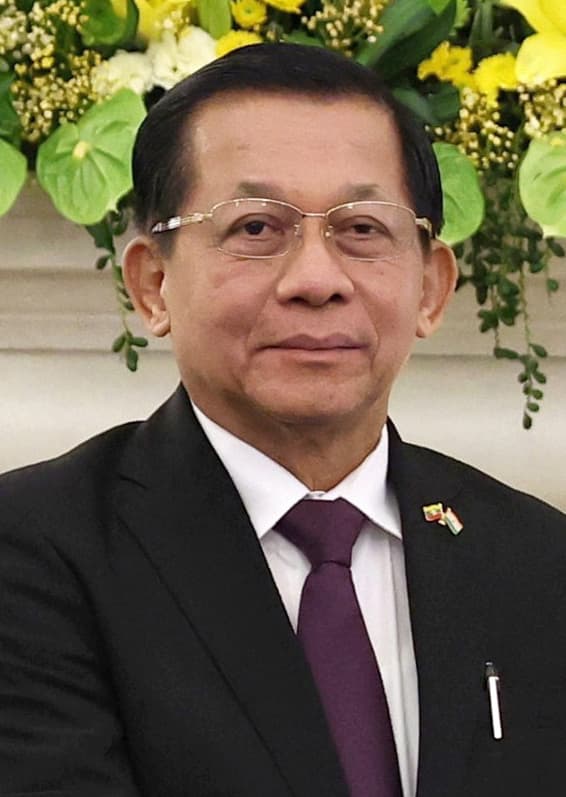
Min Aung Hlaing (opens in a new tab) sits at the top of Myanmar’s military-led political and command structure. That makes his government and armed forces central to questions about doctrine, targeting rules, aircraft operations and military accountability. It does not mean every tactical decision can be personally attributed to him without evidence establishing the relevant chain of command.
Aung San Suu Kyi (opens in a new tab), whose elected government was displaced by the military takeover, is relevant to Myanmar’s broader political breakdown but not to the operational responsibility for these reported airstrikes. Factrail should preserve that distinction rather than using every live person page as an interchangeable conflict link.
The policy lever extends beyond Myanmar as well. Fortify Rights called for states to restrict supplies of weapons and aviation fuel. Such measures seek to intervene upstream: rather than waiting for another strike to produce casualties, they attempt to limit the material capacity used to conduct repeated air operations.
Whether those restrictions would reduce attacks depends on substitutability — alternative suppliers, stockpiles, smuggling networks and domestic capacity. But the causal theory is testable: constrain the inputs required for sustained air operations, and the military’s ability to use aircraft against distant targets may decline.
The most important accountability task now is evidence preservation. Casualty lists, geolocation, weapon fragments, flight data, photographs, witness accounts and command records can transform a reported atrocity into an evidentiary record capable of supporting later legal assessment. A round number such as “50 killed” should not become a substitute for that work.
The market strike matters because the difference between an allegation and a finding should be resolved through evidence, not by lowering the standard for either. The victims’ welfare interest is served by the same discipline: establish what happened, identify who ordered and executed it, determine whether civilian protection rules were followed, and trace the material systems that allowed the operation to occur.
Evidence
The sources this article cites, claim-bearing material first.
- International Criminal Court · ICC Prosecutor — application for an arrest warrant, Bangladesh/Myanmar, 27 November 2024
More analysis
Ranked by shared facts, drivers and people — never by publication date alone.
Articles12
- Malaysia sends 1,476 people back to Myanmar while safety remains unprovenAlso covers Min Aung Hlaing · 4 October 2026
- Myanmar's Military Lost Ground in Rakhine. Civilians in Kyauktaw Paid the Price.Also covers Min Aung Hlaing · 5 October 2026
- Min Aung Hlaing's air force bombed a market. ASEAN answered with concern.Also covers Min Aung Hlaing · 5 October 2026
- Debt, Climate, and Weak Institutions: Why Crises Hit Poor States HarderAlso covers Aung San Suu Kyi · 3 August 2026