AUKUS Submarine Visit Tests Australia's Workforce
Published Factrail
Summary
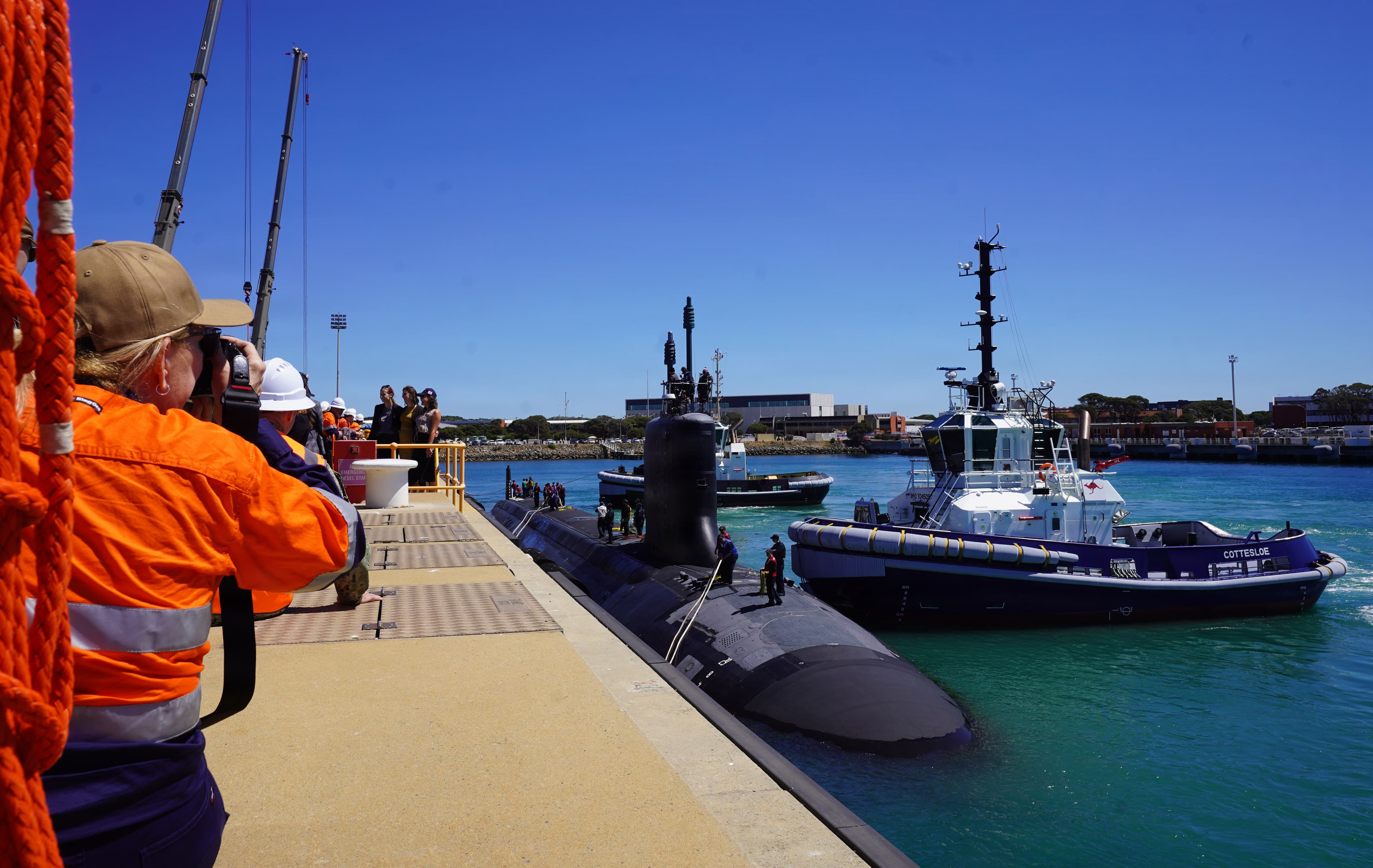
USNI News' October 30 Western Pacific report confirmed that USS Colorado was at HMAS Stirling for its scheduled maintenance period. This October 30 confirmation puts an operational workforce test, rather than the earlier October 27 announcement, at the centre of the latest reporting.
Report
USNI News' October 30 Western Pacific report confirmed that USS Colorado was at HMAS Stirling for its scheduled maintenance period. This October 30 confirmation puts an operational workforce test, rather than the earlier October 27 announcement, at the centre of the latest reporting. Australia's first named US submarine rotation is now a practical test of whether the AUKUS programme can create technical capability on Australian soil before the larger submarine purchases occur. On October 27, officials from Australia, the United States and Britain designated USS Colorado as the first US Virginia-class attack submarine due to enter the Submarine Rotational Force-West in late 2027. On October 30, USNI News reported that the boat was already at HMAS Stirling in Western Australia for a maintenance visit. The distinction is critical: the current visit is a training and maintenance activity, not the beginning of the planned permanent rotational presence and not delivery of an Australian-owned nuclear-powered submarine.
The most valuable evidence of progress is in the work performed. Australia's Defence Department says local personnel are undertaking in-hull maintenance on an operational US submarine, alongside demonstrations using Australian equipment and upgraded shore facilities. Tasks include maintenance on a towed array, ship repairs and the use of Australian-made scaffolding to provide access to the vessel. A Navy photograph accompanying the event says more than 30 certified Australian civilian technicians from ASC are participating. That is a concrete workforce result. It should not be confused with a complete Australian capacity to design, operate or overhaul nuclear submarines independently.
The programme's stated operational plan is substantial. From 2027 the Stirling base is expected to host rotations of as many as four American attack submarines and one British boat. The partnership is designed to give Australia earlier hands-on experience and to supply a regional base for allied deployments. Eventually, Australia intends to acquire its own Virginia-class submarines and later build the next-generation SSN-AUKUS with its partners. These are separate stages carrying different technical, financial and legal obligations. A successful maintenance month supports one stage but does not prove that future ship transfers or construction schedules are secure.
Staffing is one of the biggest constraints. Reporting this week by The Guardian describes the larger crews required for Virginia-class submarines: up to 134 sailors compared with substantially smaller crews aboard Australia's Collins-class boats. It reported around 230 Australian personnel in the American nuclear-submarine training pipeline and roughly 145 who had finished nuclear-power training, with a stated aim of 400 trained by 2030. Those figures measure progress against a future demand that is much larger than one crew. They also depend on keeping trained people in service rather than simply graduating them.
Recruitment is not an abstract human-resources problem. Nuclear-powered boats require specialists in propulsion, reactor safety, mechanical systems, electronics, weapons and engineering, as well as crews able to tolerate long patrols. Local maintenance also calls for technicians, supervisors, inspection teams, emergency responders and regulators. Each activity competes for scarce skilled labour with civilian engineering, construction, mining and energy industries. Pay, training time and retention can determine whether capital investment translates into an operational fleet. Expanding dry docks and piers without sufficiently qualified workers would leave public assets underused.
The Australian Naval Nuclear Power Safety Regulator sets out a phased pathway, beginning with preparation to host allied boats and continuing toward Australian ownership and operation in the early 2030s. This creates an important safety division: a host country must have oversight and emergency response capabilities even before it owns the visiting propulsion system. Defence says drills at Stirling simulate radiological scenarios while no radioactive waste is being brought ashore for this exercise. That is not a claim that nuclear safety rules are unnecessary; it describes the limited scope of the present activity.
International and domestic responsibility should be distinguished. The three governments are responsible for agreements that allow personnel and boats to operate at the base. The Australian Parliament and defence agencies remain responsible for appropriations, project delivery and oversight of Australian infrastructure. The United States owns and controls its vessels; Australian technicians work within authorised maintenance arrangements. A headline about American submarines operating from Australia does not make them Australian assets. Nor does Australia automatically gain the ability to deploy one independently because its people have trained on board.
Who benefits first includes local contractors supplying specialised equipment and qualified labour, Western Australian port and construction businesses, Australian sailors who obtain practical expertise, and US and British naval forces seeking more maintenance options in the Indo-Pacific. Strategic beneficiaries could include allies relying on undersea deterrence and trade routes. Those gains depend on a fleet that is actually available for operations, not just an impressive harbour visit. The 2027 rotation should therefore be assessed against maintenance availability, operational schedules and genuine technical transfer.
Who pays is more complicated. Australian taxpayers finance base upgrades, training, regulation and the wider multi-decade submarine acquisition programme. Defence allocations may crowd out other projects if costs rise faster than planned. Workers and their families pay with long training commitments, deployments and relocations. Communities near the base carry potential land-use, transport and emergency-preparation costs. The existence of local employment benefits does not show that every dollar is well spent. Procurement should disclose contract outcomes and schedule movement without exposing operational secrets.
Two distinct risk types require honest treatment. First is industrial delivery risk: qualified labour shortages, component supply, regulatory preparation, construction delays and dependence on allied shipyard capacity. Second is strategic risk: deterrence may improve, but a more visible allied naval presence can also make Western Australia a more prominent target in regional contingency planning. These possible outcomes cannot be quantified from this month's maintenance work alone. Claims that the activity guarantees peace or inevitably produces conflict would both go beyond the evidence.
What it moves
The immediate measurable indicators are the number of Australian personnel certified for nuclear-submarine maintenance, the scope and duration of actual maintenance tasks completed without rework, and the availability of upgraded berths and support facilities. The next threshold is whether the rotational force starts on schedule in late 2027. Over the longer term, the indicators are Australian qualified crews, sustainment costs per boat, project schedule variance and readiness days. The desired direction is more certified workers and useful maintenance capacity with fewer delays or cost overruns, not simply more announcements.
The relationship with Anthony Albanese (opens in a new tab) is one of government accountability for a long-term national commitment. NATO deterrence capacity (opens in a new tab) is a related but geographically distinct measure: AUKUS is not NATO and the submarines' Indo-Pacific role cannot be added to NATO's European readiness totals. The broader fiscal policy sustainability (opens in a new tab) issue is how Australia pays for procurement, training and sustainment through successive governments. The energy-security (opens in a new tab) mechanism is also distinct from the naval propulsion programme, which does not supply civilian electricity.
What happens next
The next useful public test is a written account of maintenance skills acquired during this visit, followed by independent review of staffing and infrastructure milestones before the 2027 rotation. Officials should distinguish between a worker trained, an apprentice certified, a safety system approved, a berth ready and a submarine operational. They should also publish enough spending information for voters to compare promise, contract, delivery and ongoing cost. AUKUS can be strategically important while remaining open to demanding audits of schedule and value for money.
Sources
USNI News — Western Pacific Pulse, October 30 (opens in a new tab) Australian Defence Department — Australia advances readiness for Submarine Rotational Force-West, October 27 (opens in a new tab) Australian Defence Ministers — Joint statement naming USS Colorado, October 27 (opens in a new tab) Australian Defence Magazine — Australia continues US nuclear submarine maintenance, October 28 (opens in a new tab) AAP — Early arrival for first AUKUS nuclear sub, October 27 (opens in a new tab) The Guardian — Recruitment challenge facing AUKUS submarine programme, October 28 (opens in a new tab) Australian Naval Nuclear Power Safety Regulator — Corporate Plan 2026-27 (opens in a new tab) Defense News — Pentagon announces first US submarine joining SRF-West, October 26 (opens in a new tab)